INTERNSHIP REPORT ON
Investment Activities of Social Islami Bank Limited
Supervised by Nusrat Nargis Assistant Professor
Department of Business Administration Daffodil International University
Submitted by Masum Billah ID: 172-14-2450
Program: MBA, Major: Finance Department of Business Administration Faculty of Business & Entrepreneurship
Daffodil International University
Date of submission: 07 January, 2019
Letter of Transmittal
Date: 07 January, 2019 To
The
Nusrat Nargis Assistant Professor
Department of Business Administration Daffodil International University
Subject: Submission of internship report on “Investment Activities of Social Islami Bank Limited”
Dear Madam,
With due respect, I am Masum Billah, student of MBA, ID:172-14-2450, of Daffodil International University (DIU) have completed the report paper based on the topic
“Investment Activities of Social Islami Bank Limited” as the course requirement of the MBA program.
The preparation of this formal study paper is of a great expectation in our MBA program and I am pleased enough to submit it applying all that I think should have to be included and which should not be included. It was a great experience for me. The report has put on impression in my mind that, all that matters is the efficient management of one’s time, skill, experience, knowledge, and finally reality. If we were not asked to submit such paper we might remain isolated from practical field. During the preparation of the report, we had to face some difficulties that has been erased out with your propound help and assistance. Without your cooperation and guideline, this report would have been an incomplete one insufficient one.
Finally, thank you for your supportive thought and kind consideration for formulating an idea and developing the structure of the paper.
Thanking you,
………
Masum Billah ID: 172-14-2450 Major: Finance
Department of Business Administration Faculty of Business and Entrepreneurship Daffodil International University
Dhanmondi, Dhaka.
Student Declaration
I, the under-mentioned, solemnly declare that this internship report on Social Islami Bank Limited is my original work. I further declare that I have strictly observed reporting ethics and duly discharged copyright obligation and properly referred all outsourcing of materials used in this report and nothing is confidential in this report in respect of the company of my internship. I take the responsibility for all legal and ethical requirements regarding this report.
………
Masum Billah ID: 172-14-2450 Major: Finance
Department of Business Administration Faculty of Business and Entrepreneurship Daffodil International University
Dhanmondi, Dhaka.
Certificate of Supervisor
I am pleased to declare that Masum Billah of MBA program bearing ID No: 172-14-2450, was advised to prepare a report on “Investment Activities of Social Islami Bank Limited” for Internship purpose. This student has reviewed all the relevant materials and has conducted efforts practically Social Islami Bank Limited for three months to achieve practical knowledge regarding banking sector in Bangladesh. I have recommended him to submit this report. I wish him success in his effort.
……….
Nusrat Nargis Assistant Professor
Department of Business Administration Faculty of Business & Entrepreneurship Daffodil International University
Acknowledgement
At first, I express my whole gratitude to almighty Allah for preparing this internship report successfully. Just after Allah, I would like to thanks my parents without them none of my effort is valuable.
I acknowledge from very core of my heart, my greatest indebtedness to my reverend program supervisor Nusrat Nargis, Assistant Professor, Department of Business Administration, Daffodil International University for her brilliant and excellence guidance and assistance to complete this report.
On the other hand, I am really thankfulness from my deepest heart to Executive Vice President & In-charge Social Islami Bank, Charfashion Branch. I also wish to express our gratitude to Vice-President Mr. Md. Rafiqul Islam.
Executive Summary
This report is a pre-requirement for the competition of 1.5 years MBA course, to get knowledge of practical banking activities. This report focuses three months working experiences in Social Islami Bank Bangladesh Limited (SIBL). This report has been developed by the secondary data of banking activities of Social Islami Bank Bangladesh Limited and primary data from day to day activities during my internship period.
Social Islami Bank Bangladesh Ltd is the first and major private sector commercial bank in Bangladesh fully owned by the Bangladeshi Entrepreneurs. The Bank started its operation from 13March 1983. Now, with its 251 branches in all over the country SIBL serving its valued customers through diversified banking activities. The whole banking process of SIBL is divided into 3 sections. These are General Banking, Investment, and Foreign Exchange Division. Here first chapter discuss background of the report, objective and methodology used in preparation of the report and limitation faced in preparation.
Next, I have tried to concentrate on company profile and internship duties.
In the First Chapter: Origin of the report, Objectives of the report, Methodology of the report, Limitations of the report has been discussed in this chapter.
In the Second Chapter: Historical Background, Mission &Vision, Operating Performance, SIBL Department, Organogram of SIBL, Products and Services, Corporate Social Responsibility (CSR), Investment, Investment Management, Theoretical Aspect, Concepts of Social Islami Bank Ltd has been discussed in this chapter.
In the Third Chapter: Different Investment Modes, Investment Policies of SIBL, Investment Approval has been discussed in this chapter.
In the Fourth Chapter: Investment Monitoring / Recovery Cell, Total Deposits, Deposit Mix of SIBL, Investment as a % of Client Deposits, Investments (General), Investment (Shares & Securities), Net Investment Income, Industry Wise Classification of Investment, Portion of Bad/ Loss as of Total Classified Investment, Risk Weighted Capital Adequacy Ratio, Recovery Ratio has been discussed in this chapter.
In the Fifth Chapter: Finding, Recommendation, and Conclusion has been discussed in this chapter.
Acronyms
SIBL Social Islami Bank Ltd.
TIN Tax Identification Number CRG Credit Risk Grading
BDMD Business Development & Marketing Division.
FAD Financial Administration Division
ICTD Information & Communication Technology Division GSD General Service Division
HRD Human Resources Division AVP Assistant Vice President
IRMD Investment Risk Management Division HPSM Hire Purchase under Shirkatul Meelk MTDR Mudaraba Term Deposit Receipt SME Small & Medium Enterprise
RJSCF Registrar of Joint Stock Companies and Firms NEC Non-Encumbrance Certificate
RO Relationship Officer RM Relationship Management
IRM Investment Relationship Management BOD Board of Director
BM Branch Manager
CIB Credit Information Bureau CL Classified Investment
TABLE OF CONTENTS
SL.NO Topic Name Page
Letter of Transmittal i
Student Declaration Ii
Certificate of Supervisor Iii
Acknowledgement Iv
Executive Summary V
1 Chapter One: Introduction 1-3
1.1 Origin of the Report 2
1.2 Objectives of the Report 2
1.3 Methodology 2
1.4 Scope of the Report 3
1.5 Limitations of the Report 3
2 Chapter Two: Company Overview of Social Islami Bank Limited.
4-16
2.1 Historical Background 5
2.2 Mission & Vision 6
2.3 Operating Performance 7
2.4 SIBL Department: 7
2.5 Organogram of SIBL 8
2.6 Organization Structure for Branch 9
2.7 Board of Directors 10
2.8 Products and Services 11
2.9 Corporate Social Responsibility (CSR): 12
2.10 Investment 13
2.11 Investment Management 14
2.12 Concepts of Social Islami Bank Limited 14
2.13 Theoretical Aspect 15
3 Chapter Three: Different Mode of Investment of Social Islami Bank Limited
17-28
3.1 Investment 18
3.2 Investment Management 24
3.3 Different Investment Modes 26
Chapter 4
Investment Analysis and Evaluation of Islami Bank Limited
29-40
4.1 Investment Monitoring / Recovery Cell 30
4.2 Total deposits 30
4.3 Deposit Mix of SIBL 31
4.4 Investment as a % of Client Deposits 32
4.5 Investments (General) 33
4.6 Investment (Shares & Securities) 35
4.7 Net Investment Income: 36
4.8 Industry Wise Classification of Investment: 37 4.9 Portion of Bad/ Loss as of Total Classified Investment 38
4.10 Risk Weighted Capital Adequacy Ratio 39
4.11 Recovery Rate 40
5 Chapter Five: Findings, Recommendations and Conclusions
41-44
5.1 Finding 42
5.2 Recommendation 43
5.3 Conclusion 44
Bibliography 45
List of Tables
Serial Number Particulars Page
Number
Table 1 Operating Performance 7
Table 2 Total Deposits 30
Table 3 Deposit –mix of SIBL 31
Table 4 Investment as a % of Client Deposits 32
Table 5 Investment (General) 33
Table 6 Investment (Shares & Securities) 35
Table 7 Net Investment Income 36
Table 8 Industry Wise Classification of Investment 37 Table 9 Portion of Bad/Loss as of Total Classified Investment 38
Table 10 Risk Weighted Capital Adequacy Ration 39
Table 11 Recovery Rate 40
Table of Figures
Serial Number Particulars Page
Number
Figure 1 Total Deposits 30
Figure 2 Deposit –mix of SIBL 32
Figure 3 Investment as a % of Client Deposits 33
Figure 4 Investment Analysis 34
Figure 5 Investment (Shares & Securities) 35
Figure 6 Net Investment Income 36
Figure 7 Industry Wise Classification of Investment 37 Figure 8 Portion of Bad/ Loss as of Total Classified Investment 38
Figure 09 Risk Weighted Capital Adequacy Ratio 39
Figure 10 Recovery Rate 40
Chapter: 1
Introduction
1.1: Origin of the Report
Financial Intermediary especially Bank play an important role in the economy. From the inception of the civilization the banking sector dominate the economic development of a country by mobilizing the saving from the general people and channeling those saving for investment and thus economic development and growth.
Banking Industry is one of the most promising industries of our country. The importance of this sector revealed through its contribution in the economic growth of the country. This sector increase economic growth through mobilizing funds from surplus unit to the deficit unit. Banking Industry is moving towards rapid changes due to technological innovation and diversified needs of its customers.
I have already completed my internship program from Social Islami Bank Bangladesh Limited (IBBL) and got practical knowledge about Social Islami Banking. On the basis of my practical experience as well as theoretical knowledge, I have completed the report regarding “Investment Activities of Social Islami Bank Bangladesh Limited. It is compulsory requirement for every student to achieve a MBA degree from Daffodil International University.
1.2: Objectives of the Report
To analyze the investment activities of Social Islami Bank Limited.
To analyze the investment procedure of Social Islami Bank Limited.
To evaluate the investment performances of Social Islami Bank Limited from year 2013 to year 2017.
To find out the problems of the bank.
To provide some recommendations about the problems of the bank.
1.3: Methodology
This report is descriptive in nature. To prepare this report I mainly used the secondary sources of data. Besides this, I also collect some primary data. After collecting all the data, they are coded and d processed, analyze the Investment Management, graphically
1.3.1 Primary source of data:
Besides this, I also collect some primary data by taking expert opinion from the officers and direct observation while I doing the internship program at the bank
1.3.2 Secondary source of data:
Bank Annual Report, monthly statement of the bank, SIBL bank website, banker’s training guide has been used. Moreover, various library sources and textbooks also have been used as secondary sources of collecting early mentioned data and information.
1.4: Scope of the Report
The study focuses on the Investment function of Social Islami Bank Limited (SIBL). SIBL is one of the most new generation banks in Bangladesh, which is shaped to develop a balance & sound economic, social & industrial sector of Bangladesh. The scope of that study was to discuss with the client about the business formalities in Investment sector.
The report covers the organization structure, background, functions, and performance of the Bank.
For gathering experience on overall banking system my schedule time was divided in various departments.
1.5: Limitations of the Report
Only 12 weeks were not sufficient to collect and understand all the activities related to Banking.
In the research areas, the authorities could not express to us accurate data easily for the reason of their confidentiality.
The executives of the bank could not give adequate time because of their work.
All the interpretation and conclusion about the result of study is based on the analyst own perspective.
Chapter: 2
Company Profile of Social Islami Bank Limited
2.1: Historical Background
Social Islami Bank Restricted a premium free Shariah bank in Bangladesh fused as a keeping money organization on 5 July 1995 under the Organizations Demonstration 1994.
It started managing an account activities on 22 November 1995 with an approved capital of Tk. 1,000 million partitioned into 1 million normal offers of Tk. 1,000 each. The underlying paid up capital was Tk.118.36 million completely bought in by its 38 supports including 3 Middle Easterner nationals. The paid up capital was upgraded a few times and remained at Tk. 260 million on 31 December 2000. The bank is recorded with the Dhaka Stock Trade. In 2000, add up to liabilities and investor's value of the bank remained at Tk.
5,671.99 million.
The bank gives a wide range of business keeping money administrations and it conducts business on the Social Islamic standards of musharaka, Mudaraba, bai-muazzal and procure buy exchanges. The expansive range operational parts of the bank have been embarked to include three segments - formal, non-formal and willful - in a far reaching modified. In the formal corporate segment, the bank offers keeping money benefits through store and speculation accounts, exchange financing, gathering of bills, cash exchanges, rent of gear and customers' solid, employ buy and portion clearance of capital products, interest in ease lodging and land the executives, and financing ventures in agribusiness, transport, training and wellbeing segments. In the non-formal non-corporate part, it is engaged with opening and presenting different reserve funds and speculation plans for the jobless poor and the informed. In the willful part, it is associated with the advancement and the executives of WAQF and mosque properties, the board of legacy properties, and joint endeavor ventures identifying with religious issues and altruistic exercises. Add up to stores of the bank added up to Tk. 4,863.21 million of every 2000 contrasted with Tk. 124.73 million out of 1995 and included cash and different stores, charges payable, term stores and reserve funds stores. On 31 December 2000, the Speculations and advances in different parts remained at Tk. 3,522.24 million as against Tk. 0.22 million of every 1995. On 31 December 2000, the ordered speculations (Ventures and venture) of the bank added up to Tk. 173.1 million (4.91% of the aggregate). Remote trade business dealt with by the bank in 2000 represented Tk. 4,250 million, which involved fare overhauling, import financing and settlement offices. That year the benefits of the bank were esteemed at Tk. 5,672 million and the wobbly sheet-things Tk. 1,060.04
million. The bank began having net benefits since 1998 and the net benefit in the wake of altering all arrangements for tax assessment and characterized Speculations added up to Tk. 38.1 million. The productivity of the bank is extremely influenced by the way that it needs to keep up a significant measure of arrangement for its grouped Speculations every year. The administration of the bank is vested in a 27-part top managerial staff headed by an executive. There is a 5-part Shariah Board of the bank to guarantee the consistence of Social Islamic standards in its exercises. The bank has likewise a 13-part privileged remote individuals' global warning gathering to guidance it on worldwide business issues, especially in Social Islamic nations.
2.2: Mission & Vision
Mission:
High quality financial services the latest technology.
Fast, Accurate and Satisfactory customer service.
Introducing innovative Social Islamic Banking products.
Attract and retain high quality human resources.
Empowering real poor families and create local income opportunities.
Vision:
Social Islami Bank Limited begun its voyage with the idea of 21st Century Social Islamic participatory three segment saving money display: I) Formal Division Business Keeping money with most recent innovation; ii) Non-Formal Area - Family Strengthening Miniaturized scale Credit and Small scale undertaking system and iii) Willful Segment - Social Capital activation through Money WAQF and others. At last, "Decrease of Neediness Level" is our Vision, which is a prime question as expressed in Notice of Relationship of the Keep money with the dedication "Cooperating for a Minding Society".
2.3: Operating Performance
Add up to Working Pay of the Bank as on 31st December 2017 remained at Tk. 5515.09 million against Tk. 4146.25 million of the first year. The Bank made a working benefit of Tk. 1368.84million in 2017 against Tk. 1513.16 million of 2016.
Particulars 2017 2016 Growth Rate
Income on Investment 11319.01 6922.20 63.52%
Profit paid to the Depositors 7541.68 4541.15 66.08%
Net Investment Income 3777.33 2381 58.64%
Commission, Exchange & Other Income 1737.76 1765.20 -1.55%
Total Operating Income 5515.09 4146.25 33.01%
Operating Expenses 1897.27 1377.45 37.74%
Profit Before Provision 3617.82 2768.80 30.66%
Provision against Investment & Others 869.93 867.52 0.28%
Profit Before Tax 2747.89 1901.28 44.53%
2.4: SIBL Department:
Information & Communication Technology Division
Financial Administration Division
International Division
Managing Director’s Secretariat
Business Development & Marketing Division
Audit & Inspection Division
Chairman's Secretariat
Share Division
Board Secretariat
Human Resources Division
Shariah Board Secretariat
SIBL Training Institute
SME Banking Division
Law & Recovery Division
Board Audit Cell
MIS, Planning & Research Division
Internal Control & Compliance Division
Investment Risk Management Division
Voluntary Banking Division
2.5: Organogram of SIBL
Board of Director
Secretary (SVP/ EVP)
Sariah Board Secretary Executive Committee Audit Committee
Managing Director
Deputy Managing Director (Operation)
Deputy Managing Director (Business)
EVP/
SVP
EVP/
SVP
EVP/
SVP
EVP/
SVP
FAD MI S
HRD IT DBMD GSB ICTD
EVP/SVP AVP
NF&VBD
EVP
VP/AVP ID
VP LD
SVP IRMD
VP CBD
SVP
2.6: Organization Structure for Branch:
Branch Manager
Relationship Management Department(Relation
ship Manager)
Investment Risk Management
Department (In charge of IRMD)
Investment Monitoring/
Recovery Department
Relationship
Officer Approval Unit
(Account Officer)
Investment Administration Unit
(In charge of IAU Unit)
Documentation &
Custodian Cell (Documentation
Officers)
Disbursement Cell (Disbursement
officer)
Compliance Cell (Compliance Officer)
2.7 Board of Directors
Md. Anowar Azim Chairman
Major (Retd.) Dr.
Md. Rezaul Haque Director
Mr. Walid Mahmud Sobhani
Nominated Director &
CEO
Mr. Md. Anisul Hoque Director
Mr. Abul M.M Farhad Nominated
Director
Mr. Abdul Hannan Khan
SEVP & Company Secretary
Sheikh Mohammad Rabban Ali
Director
Mr. Md. Abdur Rahman Nominated
Director
Mr. Tarik Morshed Nominated
Director Md. Kazi Osman Ali
Managing Director &
CEO
2.8: Products and Services:
• Mudaraba Term Deposit
• Mudaraba Savings Deposit
• Al-Wadia Current Account
• Mudaraba Scheme Deposit
• Mudaraba Hajj Savings Deposit
• Mudaraba Monthly Savings Scheme
• Mudaraba Monthly Profit Deposit Scheme
• Mudaraba Education Deposit Scheme
• Mudaraba Home Saving Scheme
• ATM Service
• Locker Service
• Online Banking
Investment Products
• Bai-Muazzal
• HPSM
• HPSM- Ijara
• Murabaha
• Musharaka
• Bill Purchase
• Bai-Salam (PC)
• Quard
Deposit Products
• Mudaraba Scheme Deposits
• Al Wadiah Current Account
• Mudaraba Savings Deposit
• Mudaraba Term Deposit
• Cash Waqf. Deposit
Cards
• SIBL Credit Card
• Visa Islamic Credit Card (Dual)
• Visa Islamic Credit Card (Local)
• SIBL Zameel Debit Card
• Special Offers
• Card User Guideline
• Schedule of Charge
2.9: Corporate Social Responsibility (CSR):
As a Social Islamic Bank, Social Islami Bank Limited is very aware of its social obligation and continually attempting to take an interest in social reason program in the nation. The bank is resolved to serve the general public everywhere through its family strengthening Small scale Speculation, Smaller scale Endeavor and SME programs under non-formal part, social capital preparation through Money WAQF and different projects under intentional division. The bank has officially shaped CSR Work area with the mean to serve humankind through various altruistic exercises giving accentuation on wellbeing and Instruction. The bank trusts that any sorts of social and magnanimous exercises would enhance the nature of the lives of the poor masses of the nation.
The Governing body of the Bank comprises of winning identities in particular territory of Exchange, Trade and Industry of the nation. Under the proactive direction, approach and bearing of the Board, The executives leads its business activities. The Corporate Administration frameworks in SIBL guarantee straightforwardness and responsibility at all dimensions in directing business.
The Shariah Supervisory Board of trustees is comprising a gathering of noticeable Social Islamic Researchers, Financial experts and Legal advisors to exhort the Administration on Shariah matters identifying with the business activities.
The Directorate gives initiative and heading to the Administration to accomplish objectives and targets of the bank.
2.10: Investment:
Investment involves a vast part of a bank's aggregate exercises. Venture task of a Bank is, in that capacity, of crucial significance as the greatest share of total revenue is generated from it. The very existence of a bank mostly depends on prudent management of its investments port-folio. Sound investment practice, therefore, is very important for profitability and success of a bank.
For efficient deployment of mobilized resources in profitable, safe and liquid investments, a sound, well-defined, well-planned and appropriate investment policy framework is a prerequisite for achieving the goal of the bank. It is, therefore, essential to have an unmistakably characterized and adjusted venture strategy endorsing the methods for execution thereof based on which the bank's speculation port-folio will be arranged and spending plan will he arranged for advancement of ventures.
For sound venture it is important to build up a sound approach. Present day venture systems have be to embraced to guarantee that speculations are protected and the cash will return inside the time set for reimbursement. For this reason, legitimate and earlier examination of venture proposition is required to evaluate the hazard. Speculation itself is hazardous and the simple motivation behind examining the hazard is to find/distinguish the hazard for acquiring conceivable cover/precautionary measure.
While deciding an investment proposal we are to judge the degree of risk a given situation. Investment is judgments, which depend upon our ability to assess the shortcomings in the proposal and to identify the risk. Therefore, the ability in taking proper/prior measures to minimize the risk is very important.
Investment risk is an essential factor that needs to be managed. Investment risk is the possibility that the client will fail to meet its obligations in accordance with agreed terms. Investment risk, therefore, arises from the bank’s dealings with the investment clients, the corporate, individuals, and other banks or financial institution.
Investment risk management, in this way, should be a powerful procedure that empowers banks to proactively oversee venture portfolios so as to limit misfortunes and procure an adequate dimension of return for investors. Fundamental to this is a far reaching IT framework, which ought to be able to catch every single key client information, chance
administration and exchange data including exchange and remote trade exchange. Given the quick changing unique worldwide economy and the expanding weight of globalization, progression. Union and disintermediation, Social Islami Bank Ltd has figured a hearty speculation hazard the executive’s strategy and systems that are touchy and receptive to these changes. The manual sets out the basic procedures to be follow throughout SIBL for sanctioning and controlling investment facilities. These procedures are intended to provide bank management with an accurate and detailed information base for investment decision.
2.11: Investment Management:
One of the two essential elements of a business bank is to stretch out Investment to the shortage financial unit that involves borrowers of different kinds. Bank speculation is an impetus of monetary advancement. Without sufficient back, there can be no development in the economy. Bank loaning is imperative for the economy as in it can at the same time fund the majority of the sub-segments of money related field, which includes horticultural, business and mechanical exercises of a country. Consequently, a bank should disperse its venture finance among monetary operator in-deficiency in a way that it will create adequate salary for it and in the meantime advantage the borrower to conquer his/her shortage.
2.12: Concepts of Social Islami Bank Limited.
Social Islami Bank Limited is a money related organization whose status, standards and systems explicitly express its responsibility to the rule of Social Islamic Shariah and to the restricting of the receipt and installment of enthusiasm on any of its activity. For many Muslims, banks were foundation to be dodged. Islam is a religion, which keeps Devotees from the tellers' window. Their Social Islamic convictions keep them from dealings that include usury or intrigue (Riba). However Muslim needs managing an account benefits as much as anybody and for some reasons: to back new business adventures, to purchase a house, to encourage capital Speculation to attempt exchanging exercises and to offer safe place for sparing. Muslims are not unwilling to genuine benefit as Islam urges individuals to utilize cash in Social Islamic partner real endeavors not simply to keep their assets inactive.
The best-known component of Social Islamic Keeping money is the denial on premium.
The Heavenly Quran restricts the charging of 'Riba' on cash loaned. It is imperative to comprehend certain standards of Islam that support Social Islamic back. Muslim researchers acknowledged the word 'Riba' to mean any settled or ensured premium installment on loans or on stores.
The guidelines with respect to Social Islamic fund are very straightforward and can be summed up as pursues. The predetermined payment over and above the actual amount of principal is prohibited.
The bank must partake in the benefits or misfortunes emerging out of the undertaking for which the cash was loaned.
Making money from is not Social Islamic ally acceptable
2.13: Theoretical Aspect:
Primary security:
There are the securities taken by the ownership of the item for which banks provides the facility.
Collateral security:
Collateral security allude to the security stored by the outsider to anchor the development for the obtain in thin sense. In winder sense, it signifies any sort of security on which the bank has an individual right of activity on the indebted person in regard of the advances.
Risk:
The chance that actual outcomes may differ from those expected.
Public offering:
The non-exclusive sale of either bonds or stocks to the general public.
Pay Order:
A Pay Order is a draft issued by each other or on its branch. The buy of a draft imprints to the vender on nearby cash at the household focus while the paying after introduction of the
draft by the recipient pays the recipient. There is likewise danger of loss of the draft in travel.
Cash Disbursement:
Al outlays of cash by the firm during a given financial period.
Portfolio:
A collection or group of assets.
Interest Rate:
The compensation by the borrower of fund to the leader from the borrower’s point of view, the cost of borrower funds.
Quotation:
Information on bonds, stock and other securities or assets including current price data and statistics on recent price behavior.
Premium:
The amount by which a bond sells at a value that is greater than its par value.
Risk Management:
Risk management is the identification, assessment and prioritization of risks.
Chapter: Three
Investment Activities of Social Islami Bank
Limited
3.1: Different Investment Modes
The bank extends Investments under the principals of 01. Mudaraba
02. Musharaka
03. Bai- Mudaraba (Contract Sale)
04. Hire Purchase under Shirkatul Meelk (HPSM) 05. Bai-Muajjal (Sales under deferred payment) 06. Bai- Salam (Advanced Purchase)
07. Bai- Istisna
1) Mudaraba (The Hiring of Capital):
Mudaraba is a standout amongst the most outstanding ventures reasonable under Social Islamic Shariah and generally utilized by all nations where Social Islamic frameworks of keeping money are working. Mudaraba back joins monetary involvement with business encounter. Mudaraba is an agreement in benefit sharing where one gathering gives capital/reserves and the other work/work. Under this framework, banks give the capital and customers give mastery and benefit is shared by concurred proportion. If there should arise an occurrence of misfortune, the bank bears the budgetary hazard and the customer loses just his work/exertion and his normal offer of benefit.
Important Features
Mudaraba is generally limited to self-liquidating transactions.
The benefits of Mudaraba ought to be effortlessly unmistakable and must be acknowledged and exchange with the goal that the returns can be effectively appropriated between the accomplices at the end of activities, finish of arrangement, or the accomplishment of Mudaraba targets.
If the partners want to renew the Mudaraba, a new contract must be negotiated, but only after the old one has been terminated and the rights and liabilities of the parties concerned have been recognized and settled.
Mudaraba is generally limited to trading activities.
The entrepreneur has no right to mix the Mudaraba funds with his own funds, unless he was permitted to do so by the bank.
Before liquidation of distribution of profits, the Mudaraba possesses an uncontested right not only to his share in profits but also to any gains or appreciation in the value of output or assets of the joint venture that might occur during the life of the Mudaraba contract.
The Mudaraba accounts must be recorded properly and the books of accounts should be audited.
2) Musharaka (Partnership Profit Sharing):
Musharaka is another sort of financing component utilized by Social Islamic Banks. This method of back is spoken to by at least two agents in commitments of equivalent or unequal proportions of cash-flow to set up another task or to partake in a built up the whole gang accomplices are qualified for offer the aggregate benefits of the endeavor as per proportion as commonly settled after taking into account administrative aptitudes to be compensated; however the misfortunes are shared precisely in extent to capital extent.
Interest parties have the privilege to take an interest in the administration of the task and at a similar they may likewise defer this privilege for an explicit accomplice.
There are two kinds of Musharaka contracts:
Constant (changeless)
Decreasing (lessening) Interest.
In the primary case, the bank takes an interest in the value and gets offer of benefit on ace rata premise every year and time of end of the agreement isn't referenced/indicated. Thus, the agreement may proceed as long as the gatherings concerned concur it to proceed.
The reducing association of Musharaka is getting increasingly well known in Social Islamic Banks due to its possibilities than changeless Muskaraka. In steady/changeless Musharaka reserves are submitted for a significant lot; however this isn't so on account of reducing Musharaka. Diminishing Musharaka permits value interest in any case and offer benefit on professional rata premise. This framework likewise gives/reaches out for future installments of cash well beyond the bank's offer in the benefit as a reimbursement of the piece of value held by the bank. As such, the value held by the bank is diminished dynamically with the progression of time. After slip by of certain timeframe, the bank will have zero value and will stop to be an accomplice.
Important Features:
The bank is not guaranteed a fixed return on its participation.
Banks benefits in financing fixed assets or working capital or both lie in the profit sharing scheme between the banks and venture.
Benefits are shared professional rata with value and are determined for this reason, in the wake of taking into account the board charges and before devaluation and arrangements, as non-money things.
3) Bai-Mudaraba (Contract Sale):
Mudaraba is a standout amongst the most broadly utilized methods of fund attempted by the Social Islamic Banks. Around 70 to 80 percent of monetary activities of the most Social Islamic Bank have a place with this section. It is reasonable for speculation for financing industry, farming, exchange or some other parts. It empowers the customer/financial specialist to acquire completed merchandise, crude materials, apparatus or hardware from the nearby market or through import by opening letter of credit under Mudaraba business.
Mudaraba is one child of offer exchange. Under this arrangement of venture, a deal exchange is occurred among customer and bank. The customer asks for the bank to buy certain products as recommended by him/them with a cost affirmed by the customer from a provider/dealer in the nation or abroad. The bank, itself or through a specialist (might be
simply the customer) gathers all the data about the nature and detail of the products, its value, terms of conveyance and so forth.
Mudaraba is likewise a twofold deal and bye. Under this method, bank purchases the merchandise upon the demand of the customer and after that pitches the products to him/them. The products are bought by the client from the bank inside a settled timeframe or by portion with an expense incorporate expense of merchandise in addition to increase benefit. The benefit increase as settled before the arrangement can't be expanded regardless of whether the customer does not take the conveyance inside the booked time.
At the point when Mudaraba deal is made of conceded installment premise, this is called Mudaraba – Bai-Muajjal. Under this deal. Bank pitches the ware to the customer based on conceded installment against a concurred value, which incorporates the cost and increase benefit. Mudaraba deal is additionally one sort of total deal, which is partitioned into three sorts in regard of cost. These are given underneath:
Bargain Sale: Selling of commodity at a price already agreed upon irrespective of its purchased price.
Tawlia Sale (respective Sale): Selling the commodity at purchased price without any additional or discount.
Discount Sale: Selling the commodity at a purchased price allowing certain discount.
4) Hire Purchase Under Shirkatul Meelk:
Hire purchase under Shirkatul Meelk is a special type of contract that has been developed through practice. Actually, it is a composition of three contracts:
1) Shirkat: Shirkat means partnership. When two or more persons supply equity, purchase an asset, own the same jointly, and share the benefit as per agreement and bear the loss in proportion to their respective equity, the contract is called Shirkatul Meelk contract.
2) Ijarah (Leasing): The Ijarah financing under Social Islamic Shariah is akin to the western concept of leasing. In Ijarah financing, Social Islamic banks finance capital goods to industrial project against payment of a rent by installment.
In Arabic the Leasing is characterized as contract between a renting organization (called as the lessor) of one section and the client of the gear resource (called the resident) of other gathering whereby the tenant/Investment consents to pay the lessor a concurred measure of cash as rentals over a predetermined/compulsory timeframe in thought for the utilization of capital hardware claimed by the lessor. The lessor holds responsibility for gear and tries to get the capital expense of the hardware in addition to a net revenue out of the rent rentals payable amid the time of the rent.There are two types of leases recognized under this system of investment. These are-
1. Operational Lease: Under this system of finance, Social Islamic Banks hold a number of various assets to respond to the needs of different customers. These assets have usually high degree of marketability. The bank rents these assets to its client who is desirous to utilize the same for a team to be agreed upon on payment of rental. After expiry of the lease period, the assets are returned to the bank. The bank then looks for new lessee.
2. Lease Purchase: The lease purchase or lease out that closes with ownership is another method of venture enhanced By the Social Islamic Banks. Under this framework, bank does not hold the benefits; but rather buys the advantages because of a vehement demand from one of the clients to claim the benefits through rent that closes with ownership. In this way, the benefits won't stay as the property of the bank toward the finish of the rent time frame just like the case in the task rent. When the buy measure of family products alongside rental is satisfied with in the rent time frame, the responsibility for leasehold thing exchanges to the renter naturally according to contract
3. Sale: This is a sale contract between the buyer and a seller under which seller transfers the ownership of certain goods or assets to buyer against agreed upon price paid/ to be paid by the buyer. In this manner, in Hire Purchase under shirkatul
buy the benefit with that value cash, possess the equivalent together, share the advantage according to assertion and bear the misfortune in extent to their individual value. The offer, part or extent of advantage possessed by the bank, is employed out to the customer accomplice for a settled lease for every unit of time for a settled period. In conclusion, the bank moves and exchange the responsibility for offer/part/segment to the customer against installment of cost settled for that part either progressively part by part or in singular amount inside the contract time frame or after the expiry of the contract assertion. Hire Purchase under shirkatul Meelk Agreement has three stages:
Purchase under joint ownership
Hire
Sale and /or Transfer of ownership to the other partner Hirer.
5.Bai- Muajjal:
Bai-Muajjal implies deal for which installment is made at a future settled date or inside a settled period. Bai-Muajjal might be characterized as contract between a purchaser and a merchant under which the vender pitches certain explicit merchandise to the purchaser at a concurred settled value payable at a specific settled future date in singular amount or inside a settled period by settled portions.
In bank, Bai-Muajjal is treated as an agreement between the bank and the customer under which the bank pitches to the customer certain explicit products, bought according to request and particular of the customer at a concurred value payable inside a settled future date singular amount or by portion.
6.Bai-Salam (Advance Sale and Purchase):
Bai-Salam might be characterized as an agreement between a Buyer and a Seller under which the dealer moves ahead of time the specific items/items passable under Social Islamic Shariah to the Buyer at a concurred value payable on execution of the said contract and the wares/items are conveyed according to determination, measure, quality, amount at a future time in a specific place. Under this exchange the expense of product is progressed in real money to the merchant who consents to adherent the item on a distinct due date.
The conveyance of the product sold is conceded however the installment of the cost is quick.
Important Features
Bai-Salam is a mode of investment allows by Social Islamic Shariah in which commodities/ products can be sold without having the said commodities/ products either in existence or physical/ constructive possession of the seller.
Generally, industrial and agricultural products are purchased/ sold in advance under Bai-Salam mode of investment to infuse finance so that production is not hindered due to shortage of fund/ cash.
It is permissible to obtain mortgage and / or personal guarantee from a third party as security before signing of the agreement or at the time of signing the agreement.
7.BaiIstisna:
The majority of the juries consider as one of the division of Bai- Salam. Therefore, it should be treated under the definition of Bai- Salam. But the Hanafi School Fiqh declares Istisna an independent and separate contract. The jurists of the Hanafi School have given various definitions to Istisna, some of which are:
“It is a contract with a manufacturer to make something and it is a contract on a commodity on liability with the stipulation of working.”
Under this agreement the primary party consents to contract/producer a specific item and conveys it to second gathering against a foreordained cost. The cost may not be required to pay ahead of time. It might be paid in portions, or can even be conceded until the point when the ideal item is conveyed.
3.2: Investment Policies of SIBL:
SIBL will follow Shariah principles strictly while making investment decision, as it is a Sharahi based Commercial Bank.
SIBL will go for investment to national priority sectors.
Investment to trade and commerce sector.
Investment to foreign trade (import and export).
Cottage Industry
Agro-based, agro processing and agro supportive industries.
Fish canning, freezing and preservation units
Rice, flour, oil and pulse mills.
Wearing apparel.
Glass and glass products.
Leather and leather products.
Paper, paper products and printing.
Manufacturing units of hydrogenated oil, banaspati ghee and edible oil and fats.
Textile linkage industries.
Ceramic products.
Bricks and tiles.
Small-scale industries.
Computer service oriented training programmed.
Power generation and distribution industries.
Working capital investment to good industrial units.
Road Transport
Water Transport
Telecommunication including:
Mobile Telephone Exchange
Satellite ground station
Investment in housing and construction sector:
Housing societies / companies
Hosing individual
Other than housing
Investment to shortage (warehousing, cold storage).
Investment to hotels and restaurants.
Investment under special investment schemes.
Investment for professional services
Or any other sector as decided by management.
3.3: Investment Approval:
The endorsement procedure must fortify the isolation of Relationship the executives/Marketing from the supporting expert. The duty regarding setting up the speculation Proposal is rest with the RM of the Branch and in addition the Corporate Banking Department (for task/syndicated financing or huge venture) at head office.
Investment proposals should be recommended for approval by the RM team in the Branch and Corporate Banking (for project/ syndicated financing or large investment) department and to be forwarded to the approval team within the IRM at Head Office and to be approved by authority as delegated by the Board of Directors. IRM approval team will take necessary steps to get approval of the proposal from the competent authority. Total approval process is classified into two ways as under:
Proposal for other than Project and Syndicated Finance:
In this case RM (Relationship Management) team at Branch level will recommend and forward the proposal to Head Office IRM (Investment Relationship Management) Division for approval. IRM approval team after proper analysis of the proposal will prepare relevant note/ memo for approval of Managing Director directly or through recommendation of the management Committee. If the proposal is beyond the discretionary power of Managing Director, the Managing Director will place to the Executive Committee (EC) of the Board or to the Board of Director (BOD) the proposal.
EC/ BOD will advise the decision regarding the proposal to IRM. After getting approval from the competent authority IRM approval team will communicate the branch about the decision of the authority. Branch will then take necessary steps according to the communication/ sanction letter of the Head Office.
Proposal for other than Project and Large Finance:
Proposition under task or syndicated back or expansive Investment/venture classifications will be arranged, prescribed and forward by RM at Branch to Corporate Banking at Head Office. Corporate Banking at Head Office additionally may set up the speculation proposition under substantial Investment/venture, venture/syndicated Finance. In both the cases, Corporate Banking will send the proposition to IRMD at Head Office with their suggestion for endorsement. Approval Department of IRMD after proper checking, risk
RO RM BM IRM MD EC BOD
RO RM BM
Corporate Banking
IRM MD EC BOD
analysis will prepare note/ memo for getting approval from concerned authority. If the proposal is beyond the discretionary power of Managing Director the proposal will be placed before the Executive Committee of the Board or before the Board of Director by the Managing Director, EC/ BOD will advise the decision regarding the proposal to IRMD. After getting decision from the authority IRM approval Department will communicate the same to Corporate Banking. Corporate Banking will communicate the same to the respective Branch to take necessary action
Chapter 4
Evaluation of Investment Performance of Islami
Bank Limited (2013-2017)
4.1: Investment Monitoring / Recovery Cell:
Monitoring and recovery cell at Branch will be responsible for monitoring and recovery of past due accounts of the Branch. The functions of monitoring/ Recovery Cell will be as under:
Conditions and Covenant Breach Monitoring
Monitoring of past due, Limit, Expiry and Documents Efficiency.
Determine Action Plan/ Recovery Strategy.
Taking appropriate steps for recovery the overdue
Ensure Adequate and timely investment loss provision, as per CL statement is made based on actual and expected losses.
Regular review of grade 6 or worse accounts.
Compliance of internal Audit/ Bangladesh Bank Inspection Report.
4.2: Total deposits:
Year 2013 2014 2015 2016 2017
Deposit (TK. in millions) 24099.82 31588.16 44850.77 66852.55 93594.29
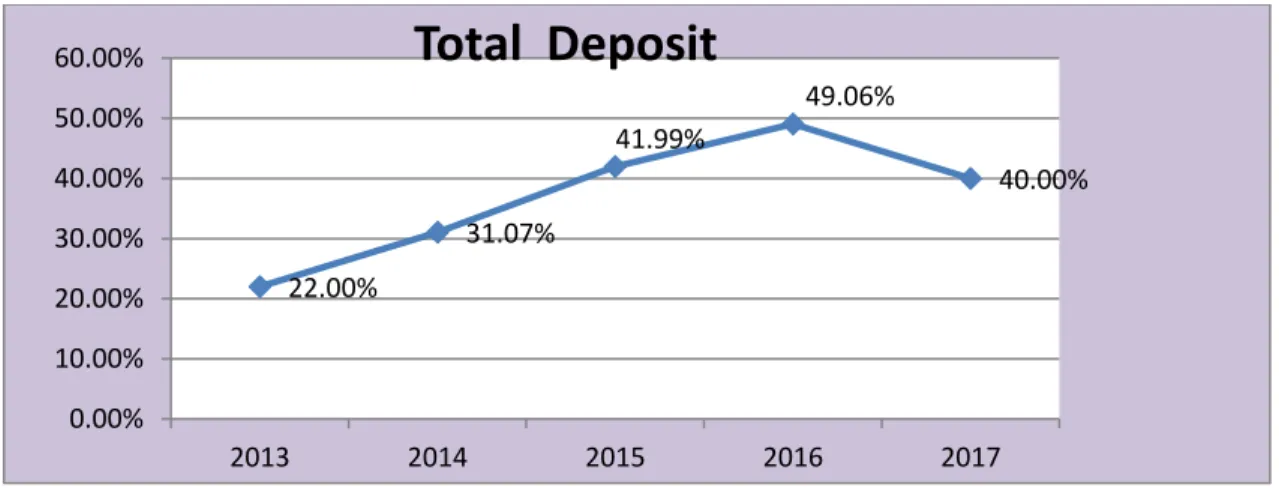
Growth Rate 22.00% 31.07% 41.99% 49.06% 40.00%
Note: In 2007, the Investment & Advance was 19753.94 Graphical Presentation
24099.82 31588.16
44850.77
66852.55
93594.29
20000 40000 60000 80000 100000
Total Deposit
Fig: Total Deposits
Interpretation: The graph demonstrates the growth rate of Total Deposits ratio the growth rate of Total Deposits ratio is consistently increased over the years 2013 to 2017.
In 2017 the ratio was 22.00%, in 2014 it increased 31.07%, in 2015 the ratio is also increased 41.99%, and in 2016 it increased 49.06%. But in 2017 it is decreased compare to 2016.
4.3: Deposit Mix of SIBL
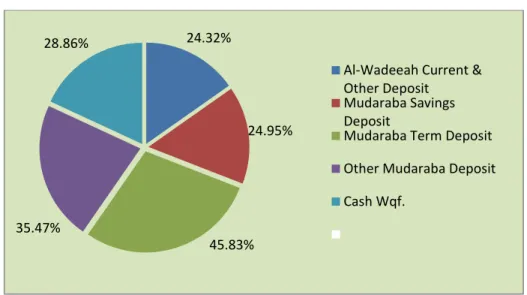
Deposit mix is a most important for that is a any commercial bank to depends on deposit, so the bank to make decision where to invest. So deposit is effective for any commercial banking.
Deposit Mix
Taka in (million)
Growth
2016 2017
Al-Wadeeah Current & Other Deposit 10903.16 8769.99 24.32%
Mudaraba Savings Deposit 4905.32 3925.74 24.95%
Mudaraba Term Deposit 62267.65 42699.28 45.83%
Other Mudaraba Deposit 15449.26 11404.06 35.47%
Cash Wqf. 68.90 53.47 28.86%
Source: SIBL Annual Report of 2017
22.00%
31.07%
41.99%
49.06%
40.00%
0.00%
10.00%
20.00%
30.00%
40.00%
50.00%
60.00%
2013 2014 2015 2016 2017
Total Deposit
Graphical Presentation
Fig: The Deposit Mix Interpretation:
The Mudaraba Term Deposit is the highest (45.83%). This was possible due to superior customer service delivery at the branch level, expansion of branch network to rural areas where foreign remittance flow is significant. But it increases at a slower rate in the forwarding years.
4.4: Investment as a % of Client Deposits:
Year 2013 2014 2015 2016 2017
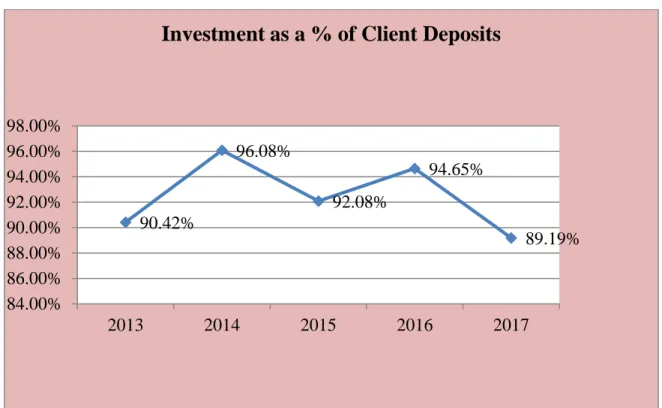
Growth Rate 90.42% 96.08% 92.08% 94.65% 89.19%
Source: annual report 2013-2017
24.32%
24.95%
45.83%
35.47%
28.86%
Al-Wadeeah Current &
Other Deposit Mudaraba Savings Deposit
Mudaraba Term Deposit Other Mudaraba Deposit Cash Wqf.
Graphical Presentation
Fig: Investment as a % of Client Deposits Interpretation:
From the above graph it has been seen that, the Investment as a % of Client Deposits are fluctuating over the years. But it has slowly increased from 2013 to 2014 the percentage rate in Increased 90.42% to 96.08% .Then again decrease from 2014 to 2015.But again the Investment as a % of Client Deposits is moderately increased 2015 to 2016 the percentage rate is decreased 92.08% to 94.65% and in 2017 it has been decreased to 89.19% .
4.5: Investments (General)
Year Investment Growth of Investment
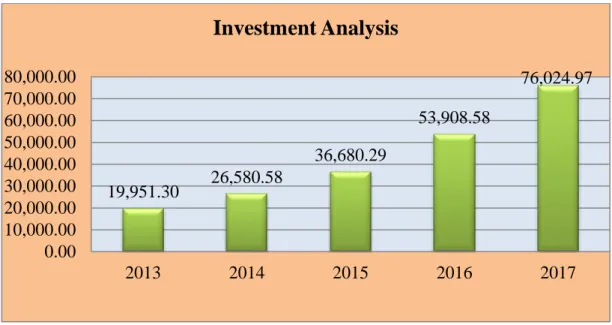
2013 19,951.30 21.36%
2014 26,580.58 33.23%
2015 36,680.29 38.00%
2016 53,908.58 46.97%
2017 76,024.97 41.03%
Note: In 2016, the Investment was 16,440.26 Source: Annual Report of SIBL (2013-2017) 90.42%
96.08%
92.08%
94.65%
89.19%
84.00%
86.00%
88.00%
90.00%
92.00%
94.00%
96.00%
98.00%
2013 2014 2015 2016 2017
Investment as a % of Client Deposits
Graphical Presentation
Fig: Investment Analysis
Interpretation:
Growths of investment are increasing over the years. Growth rate of investment of SIBL in 2017 was 21.36 %, in 2014 it has increased significantly to 33.23%. But after 2014 the growth rate of investment increased up to 2016 consistently. In 2017 it has decreased to 41.03% compare to 2016. This is bad sign for bank.
19,951.30 26,580.58
36,680.29
53,908.58
76,024.97
0.00 10,000.00 20,000.00 30,000.00 40,000.00 50,000.00 60,000.00 70,000.00 80,000.00
2013 2014 2015 2016 2017
Investment Analysis
21.36%
33.23%
38.00%
46.97%
41.03%
0.00%
10.00%
20.00%
30.00%
40.00%
50.00%
2013 2014 2015 2016 2017
Investment Analysis
4.6: Investment (Shares & Securities):
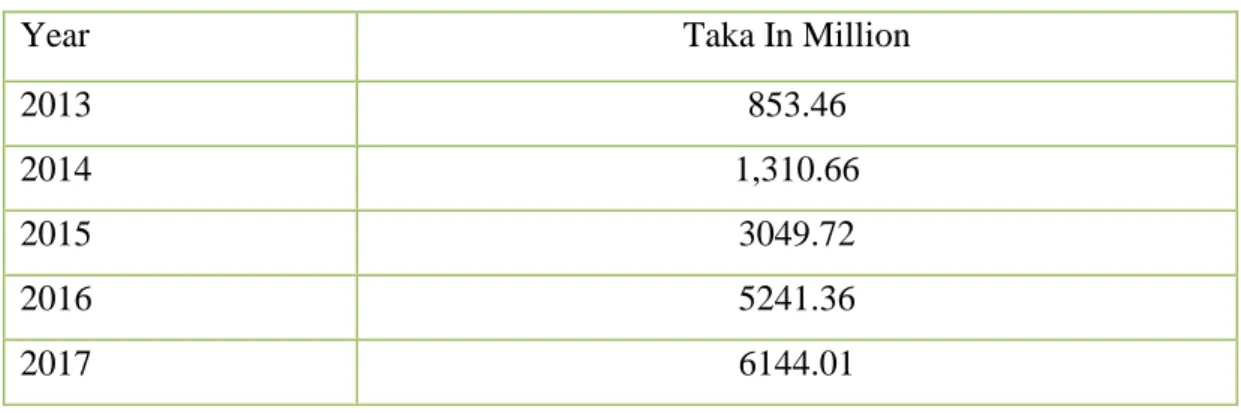
Year Taka In Million
2013 853.46
2014 1,310.66
2015 3049.72
2016 5241.36
2017 6144.01
Source: Annual Report of SIBL (2013-2017) Graphical Presentation
Fig: Investment (Shares & Securities)
Interpretation: Growths of Investment (Shares & Securities) are increasing over the years. Investment of SIBL in 2013 was 853.46 in 2014 it has increased significantly to 1310.66. Investment (Shares &Securities) increased up to 2017 consistently. This is good sign for bank. That means bank significantly increasing their investment and in future the bank should keep this upward trend.
853.46
1,310.66
3049.72
5241.36
6144.01
0 1000 2000 3000 4000 5000 6000 7000
2013 2014 2015 2016 2017
investment (Share and Securities)
4.7: Net Investment Income:
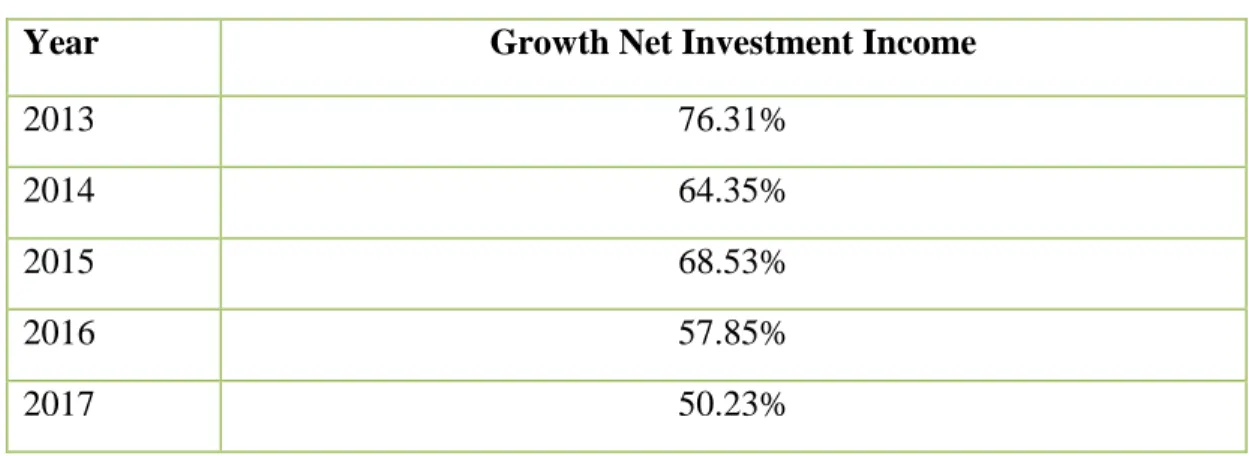
Year Growth Net Investment Income
2013 76.31%
2014 64.35%
2015 68.53%
2016 57.85%
2017 50.23%
Source: Annual Report of SIBL (2013-2017) Graphical Presentation
Fig: Net Investment Income Interpretation:
The above graph show, the Net Investment Income is fluctuating over the years. Growth rate of net investment income of SIBL in 2013 was 76.31 %, in 2014 it has moderately decreased .Growth rate of net investment income is increasing in 2015, compare to 2014.
In last two years net investment income significantly decreased. So the bank need to concern about this. Because of bank’s profitability greatly affected by net investment income.
76.31%
64.35%
68.53%
57.85% 50.23%
0.00%
10.00%
20.00%
30.00%
40.00%
50.00%
60.00%
70.00%
80.00%
90.00%
2013 2014 2015 2016 2017
Net Investment Income
4.8: Industry Wise Classification of Investment:
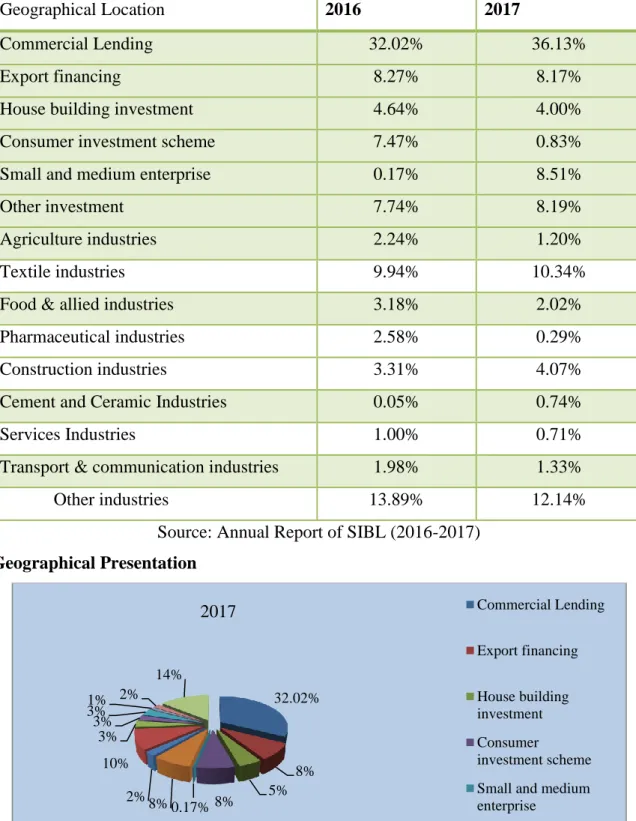
Geographical Location 2016 2017
Commercial Lending 32.02% 36.13%
Export financing 8.27% 8.17%
House building investment 4.64% 4.00%
Consumer investment scheme 7.47% 0.83%
Small and medium enterprise 0.17% 8.51%
Other investment 7.74% 8.19%
Agriculture industries 2.24% 1.20%
Textile industries 9.94% 10.34%
Food & allied industries 3.18% 2.02%
Pharmaceutical industries 2.58% 0.29%
Construction industries 3.31% 4.07%
Cement and Ceramic Industries 0.05% 0.74%
Services Industries 1.00% 0.71%
Transport & communication industries 1.98% 1.33%
Other industries 13.89% 12.14%
Source: Annual Report of SIBL (2016-2017) Geographical Presentation
Fig: Industry Wise Classification of Investment (2016-2017)
32.02%
8%
8% 5%
0.17%
2%8%
10%
3%
3%3%
1% 2%
14%
2017 Commercial Lending
Export financing
House building investment Consumer
investment scheme Small and medium enterprise
Other investment
Agriculture industries
Interpretation:
From the above graph it is seen that, the bank provide highest amount on investment in commercial lending both the years in 2016 & 2017. In 2016, 32.02% of total Investment and in 2017, 36.13% .they provide second one is Textile industries. Then export financing, small and medium Enterprise, House Building financing respectively. They do not concern in Agriculture industries the bank provide only fey amount of investment of total investment both the years in 2016 & 2017, the portion is 1.20% & 2.24%.
4.9: Portion of Bad/ Loss as of Total Classified Investment
Year 2013 2014 2015 2016 2017
Bad/Loss Investment
134365000 339579000 742360000 1111407000 2140079864
Total Classified Investment
143243000 413234220 1173125000 1522507000 2842267138
% of Bad/
Loss Investment
93.80% 82.18% 63.28% 72.10% 75.29%
Source: Annual Report of SIBL (2013-2017) Graphical Presentation
93.80%
82.18%
63.28%
72.10%
75.29%
0.00%
10.00%
20.00%
30.00%
40.00%
50.00%
60.00%
70.00%
80.00%
90.00%
100.00%
2013 2014 2015 2016 2017
Year
% of Bad/ Loss as of Total Classified Investment
Interpretation
The above diagram shows that the Bad/loss investments are fluctuating over the years.
SIBL bad/loss investment as of total classified investment was in 2013 is 93.80%, in 2014 it decreased 82.18% but from 2015 to 2017 the percentage of bad/loss investment consistently increased. The percentage was 63.28% in 2015, 72.10% in 2016 and 75.29%
in 2017. The percentage has overall decreased which is good for the bank. The bank should concentrate to reduce the bad/loss investment to increase the performance in following year.
4.10: Risk Weighted Capital Adequacy Ratio:
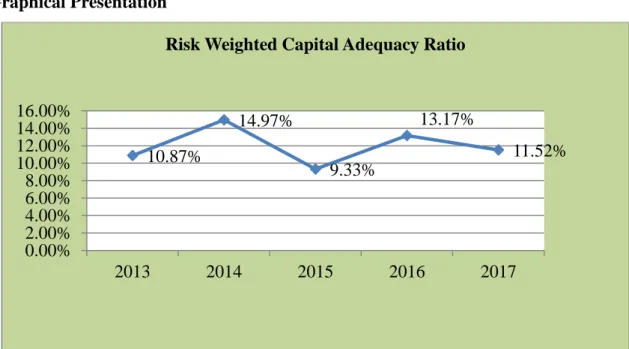
Year 2013 2014 2015 2016 2017
Growth Rate 10.87% 14.97% 9.33% 13.17% 11.52%
Source: annual report 2013-2017 Graphical Presentation
Fig: Risk Weighted Capital Adequacy Ratio Interpretation:
The above figure shows the capital adequacy ratio from 2013 to 2017. Capital adequacy determines the capacity of the bank in terms of meeting and managing their risk such as credit risk, operational risk etc. capital adequacy ratio is 10% for standard management for the bank. In this sense SIBL capital adequacy ratio is more than standard line all over the years. So the Capital Adequacy Ratio of SIBL is in a satisfactory level except in 2015 (9.33%).
10.87%
14.97%
9.33%
13.17%
11.52%
0.00%
2.00%
4.00%
6.00%
8.00%
10.00%
12.00%
14.00%
16.00%
2013 2014 2015 2016 2017
Risk Weighted Capital Adequacy Ratio
4.11: Recovery Rate:
Year 2013 2014 2015 2016 2017
Growth Rate 95.63% 96.81% 95.25% 96.08% 96.63%
Source: Annual Report of SIBL (2013-2017) Graphical Presentation
Fig: Recovery rate Interpretation:
From the above graph it has been seen that recovery rate of investment was fluctuating over the year. From 2013 to 2015 it was fluctuating from 96.81% to 95.25% and in 2017 it has been increased to 96.63%. SIBL is more conscious about their recovery but in last year it was slightly increased. They have to concentrate about their recovery rate.
95.63%
96.81%
95.25%
96.08% 96.63%
94.00%
94.50%
95.00%
95.50%
96.00%
96.50%
97.00%
2013 2014 2015 2016 2017
Recovery Rate
Chapter 5
Findings, Recommendations & Conclusion
5.1:Findings
: Social Islami Bank Limited’s investment operations are increasing gradually.
During 2013 to 2017, investment growth indicates that SIBL is doing good regarding investments. The Investment as a percent of Client Deposits is fluctuating over the years. However, in 2017 the percentage of investment was moderately less than its previous year.
Growth of investment (Shares & Securities) was increasing over the years. Since 2013, investment (Shares &Securities) increased up to 2017 consistently. This is good sign for bank. That means bank is significantly increasing their investments.
In future the bank should keep this upward trend.
The Net Investment Income is fluctuating over the years. From 2013 to 2014, it has moderately decreased. After that net investment income has increased in 2015, compare to 2014. In last two years (2016 and 2017) net investment income significantly decreased. It is not sound for this bank.
In the Industry Wise Investment, SIBL invest much in Textile Industry.
The bank provides low amount of investment in agricultural industry.
SIBL’s bad/loss investment as of total classified investment was in 2013 is 93.80%, in 2014 it decreased to 82.18%. But from 2015 to 2017 the percentage of bad/loss investment consistently increased. The percentage was 63.28% in 2015, 72.10% in 2016 and 75.29% in 2017. The percentage has overall decreased which is good for the bank. The bank should concentrate to reduce the bad/loss investment to increase the performance in following years.
The recovery rate of investment was fluctuating over the year. From 2013 to 2015, it was fluctuating from 96.81% to 95.25% and in 2017; it has been slightly increased to 96.63%.
The Mudaraba Term Deposit is larger compare to other deposit schemes. This was possible due to superior customer service delivery at the branch level, expansion of branch network to rural areas where foreign remittance flow is significant. But it increases at a slower rate in the forwarding years.
From 2013 to 2017, there is only in 2015 the Risk weighted capital adequacy rate