University of Rajshahi Rajshahi-6205 Bangladesh.
RUCL Institutional Repository http://rulrepository.ru.ac.bd
Department of Statistics PhD Thesis
2018
Modeling and Predicting Prevalence of Tobacco Use in Bangladesh
Begum, Munjila
University of Rajshahi
http://rulrepository.ru.ac.bd/handle/123456789/100
Copyright to the University of Rajshahi. All rights reserved. Downloaded from RUCL Institutional Repository.
MODELING AND PREDICTING PREVALENCE OF TOBACCO USE IN BANGLADESH
A Dissertation Submitted to the
University of Rajshahi in Partial Fulfillment of the Requirements for the Degree of Doctor of Philosophy
By
Munjila Begum
DEPARTMENT OF STATISTICS UNIVERSITY OF RAJSHAHI
RAJSHAHI
JUNE, 2018
MODELING AND PREDICTING PREVALENCE OF TOBACCO USE IN
BANGLADESH
Ph.D
Researcher MUNJILA BEGUM
Session: 2013-2014 Department of Statistics
University of Rajshahi, Rajshahi
Superviser
Dr. Mst. Papia Sultana Professor
Department of Statistics University of Rajshahi,
Rajshahi
Department of Statistics University of Rajshahi,
Rajshahi
June, 2018
II
DECLARATION
I do hereby declare that the thesis entitled, “MODELING AND PREDICTING PREVALENCE OF TOBACCO USE IN BANGLADESH”, submitted to the Department of statistics, University of Rajshahi for the of Doctor of Philosophy in Statistics is exclusively my own and original work. This work is carried out by me under the supervision and guidance of Professor Dr. Mst. Papia Sultana, Department of Statistics, University of Rajshahi, Rajshahi, Bangladesh. No part of it any form, has been submitted to any other University or Institution for any degree, diploma or other similar purposes.
Rajshahi Munjila Begum
28/06/2018 Ph.D Research Fellow
Department of Statistics, University of Rajshahi Rajshahi, Bangladesh.
III
ABSTRACT
Tobacco consumption is one of the major preventable causes of death and disability globally. Bangladesh is one of the largest tobacco consuming countries in the world. The use of tobacco is high among male population in Bangladesh. Also the use of tobacco is increasing. Therefore this study aims to explore the prevalence, patterns and determinants of tobacco use among adults.
This study used data from Global Adult Tobacco Survey (GATS), 2010 that covered 9,629 Bangladeshi aged 15 years or above. The survey was based on a three-stage stratified cluster sample of household. Information of a total of 9629 adults has been analyzed in the present study.
Pattern and prevalence of tobacco consumption in Bangladesh are primarily presented in the form of frequency distributions and in prevalence rates. This study uses binary logistic regression model and multilevel logistic regression model for analyzing data to quantify the objectives of the study.
Prevalence of adults tobacco user was 44.05% in Bangladesh with 65.11% in male and 34.89% in female. Common significant predictors include sex, age, educational level and wealth Index. Male and older had a higher tendency to use tobacco products. Current tobacco smoking was significantly higher among male (p-value<0.001 and OR=44.17) than female. Females were more likely to use smokeless tobacco than males (odds ratio, OR=1.72). Adults with no education were more likely to use tobacco products in Bangladesh compared to others with tertiary education. Adults with the poorest wealth status were more likely to consume tobacco products in Bangladesh compared to those from richest wealth index. It applies a multilevel (two level) logistic regression analysis to draw valid conclusions about the effects of the selected determinants on tobacco consumption using GATS-2010 data which is a multistage stratified cluster data. Instead of single level logistic model, multilevel logistic regression model has been utilized since the data follow a hierarchical structure. Also the comparison between single and multilevel
IV
model has been done to investigate the necessity of multilevel effects. The findings suggest that sex, age, level of education and wealth index have significant multilevel effects on tobacco consumption. Manufactured cigarettes and betel quid with zarda are the most usable tobacco products in Bangladesh.
Intervention to reduce or stop tobacco using should be directed towards the poor, older and people with lower education and women should be targeted for prevention of the use of tobacco. All the significant variables should be considered for developing suitable policies to reduce the consequences of tobacco use in Bangladesh.
V All praise goes to almighty Allah who has given me the opportunity to do this research. It is a great pleasure for me to express my sincere appreciation to the Department of Statistics, University of Rajshahi for giving me the opportunity to do this research.
I want to mention the contribution of all those who have inspired, influenced and guided me to complete this research work successfully. First of all, I would like to express my heartiest gratitude to my venerable supervisor Professor, Dr.
Mst. Papia Sultana. Throughout my study, she kindly read my works and provided me with insightful comments substantively and editorial advice. I am grateful to him for hes kind and sincere guidance and personal supervision all through my work.
I am also grateful to Professor, Dr. Md. Ayub Ali, Chairman, Department of Statistics, University of Rajshahi, for giving me the permission to work on this thesis and providing me all sources of facilities of this department.
I wish to acknowledge my gratitude to all my respected teachers of Statistics Department for their suggestions and kind cooperation. Specially, I am very grateful to Dr. Md. Nurul Islam, Professor, Department of Statistics, University of Rajshahi.
Many of my friends deserve thanks for their encouragement and cooperation.
My special thanks go to my youngest brothers Rakib, Rashed and Rana. I want to specially thank Dr. Aziza Sultana Rozy Sarkar, Lecturer, Department of statistics, Rajshahi College, Rajshahi and Eva, M.Sc. thesis student.
I would like to thank the members of the Evaluation Committee for their valuable comments and suggestions in several occasions namely, proposal and candidature defense and final presentation at the faculty. Finally, and most
VI importantly, I would like to thank to my family. None of this would have been possible without their love and support. I owe my deepest gratitude to my parents, sister, husband, Md. Ramjan Ali and son, Muntakim. Their understanding and love were undeniably the most important support for me.
June, 2018
Munjila Begum PhD Research Fellow Department of Statistics, University of Rajshahi, Rajshahi, Bangladesh.
VII
ABSTRACT IΙΙ
ACKNOWLEDGEMENTS V
TABLE OF CONTENTS VII
LIST OF FIGURES IΧ
LIST OF TABLES ΧI
CHAPTER ONE: INTRODUCTION 1-27
1.1 Background of the Study 1
1.2 Literature Review 4
1.3 Objectives of the Study 25
1.4 Organization of the Study 26
CHAPTER TWO: DATA AND METHODOLOGY 28-58
2.1 Introduction 28
2.2 Data source 28
2.3 Sampling design 29
2.4 Questionnaire 31
2.5 Methodology 2.6 Data screening
33 56
CHAPTER THREE: CHARACTERISTICS OF THE STUDY SUBJECTS
59-71
3.1 Introduction 59
3.2 Characteristics of the study subjects 60
3.3 Characteristics of the study subjects to tobacco consumption 66
VIII
3.4 Discussion 71
CHAPTER FOUR: PATTERN AND PREVALENCE OF TOBACCO USE IN BANGLADESH
72-97
4.1 Introduction 72
4.2 Tobacco Smoking
4.2.1 Current pattern of Tobacco Smoking in Bangladesh (GATS, 2010) 4.2.2 Comparison of socio-demographic and economic characteristics of
study subjects to current tobacco smoking
4.2.3 Current pattern of smoking tobacco product used among the users in Bangladesh stratified by area of residence and gender
4.2.4 Age adjusted and unadjusted prevalence of tobacco smoking
73 73 74 79 84
4.3 Smokeless Tobacco Consumption
4.3.1 Current pattern of smokeless tobacco consumption (STC) in Bangladesh (GATS, 2010)
4.3.2 Current STC (daily) by socio-economic and demographic factors 4.3.3 Current pattern of smokeless tobacco product used among the users
in Bangladesh stratified by area of residence and gender
4.3.4 Age adjusted and unadjusted prevalence of smokeless tobacco use
85 85 86 91 96
4.4 Discussion 97
CHAPTER FIVE: BINARY LOGISTIC REGRESSON TO DETERMINATE TOBACCO USE
98-103
5.1 Introduction 98
5.2 Analyze the socio-demographic and economic predictors to current tobacco smoking using binary logistic regression
5.3 Analyze the socio-demographic and economic predictors to current smokeless tobacco using binary logistic regression
99 101
5.4 Discussion 103
IX
6.1 Introduction 104
6.2 Multilevel Modeling 105
6.3 Multilevel Modeling to Tobacco Smoking
6.3.1 Association of various cofactors with tobacco smoking 6.3.2 Intercept Only Logistic Model
6.3.3 Multilevel Logistic Regression Model
106 111 105 105 6.4 Multilevel Modeling to smokeless tobacco use
6.4.1 Association of various cofactors with smokeless tobacco consumption
6.4.2 Intercept Only Logistic Model
6.4.3 Multilevel Logistic Regression Model 6.5 Discussion
109 109 110 110 116
CHAPTER 7: DISCUSSION AND CONCLUSION 117-125
7.1 Discussion 117
7.2 Policy Implication 120
7.3 Contribution of the Study 122
7.4 Strengths and Limitations of the Study 123
7.5 Conclusion 124
BIBLIOGRAPHY 126-138
IX
LIST OF FIGURES
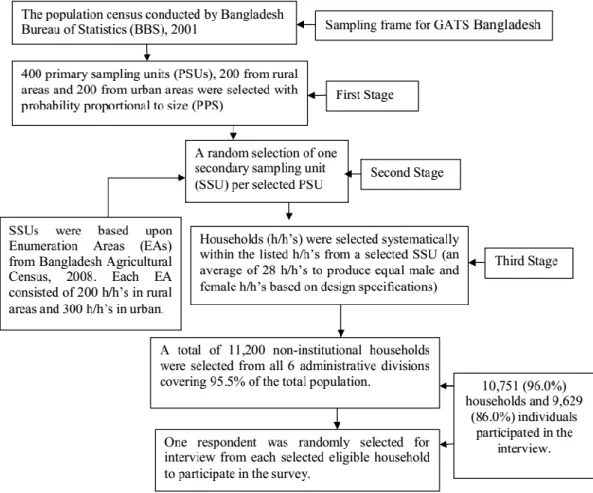
Figure 2.1 Sampling design of GATS in Bangladesh 30
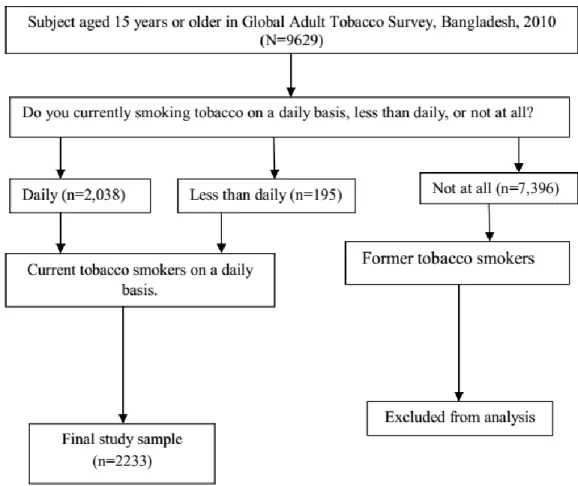
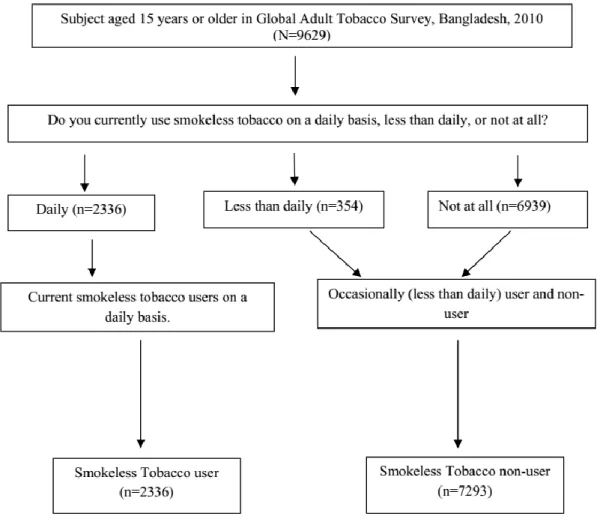
Figure 2a Survey screening process used to select current tobacco smokers 57 Figure 2b Survey screening process used to select current smokeless tobacco
users
58
Figure 3.2.1 Pie-Chart of residence 61
Figure 3.2.2 Pie-Chart of gender 62
Figure 3.2.3 Pie-Chart of Age(yrs) 62
Figure 3.2.4 Bar-diagram of educational level 63
Figure 3.2.5 Bar-diagram of occupation 63
Figure 3.2.6 Bar-Chart of Wealth Index 64
Figure 3.2.7 Pattern of tobacco using 64
Figure 3.3.1 Distribution of tobacco consumption by urban and rural respondents
67 Figure 3.3.2 Distribution of tobacco consumption by male and female 68
Figure 3.3.3 Tobacco Consumption by age group 68
Figure 3.3.4 Tobacco consumption by educational level 69
Figure 3.3.5 Tobacco consumption by occupational status 70
Figure 3.3.6 Tobacco consumption by economical status 70
Figure 4.2.1 Current pattern of tobacco smoking by residence and gender 73
Figure 4.2.2 Current tobacco smoking by Residence 75
Figure 4.2.3 Current tobacco smoking by Gender 76
Figure 4.2.4 Current tobacco smoking by educational level 76
Figure 4.2.5 Current tobacco smoking by age (yrs). 77
Figure 4.2.6 Current tobacco smoking by Wealth Index 77
Figure 4.2.7 Current tobacco smoking by Work status 78
Figure 4.2.8 Pattern of using smoked tobacco products among males and females
81 Figure 4.2.9 Distribution of tobacco products used by urban male and female 82 Figure 4.2.10 Distribution of tobacco products rural male and female 83
Figure 4.3.1 Current pattern of smokeless tobacco use 86
X Figure 4.3.2 Current Smokeless tobacco consumption daily by residence 88 Figure 4.3.3 Current Smokeless tobacco consumption daily by gender 88 Figure 4.3.4 Current Smokeless tobacco consumption daily by age group 89 Figure 4.3.5 Current Smokeless tobacco consumption daily by educational
level
89 Figure 4.3.6 Current Smokeless tobacco consumption daily by work status 90 Figure 4.3.7 Current Smokeless tobacco consumption daily by economical
status
90 Figure 4.3.8 Distribution of smokeless tobacco consumption by male and
female
93 Figure 4.3.9 Pattern of tobacco consumption by urban residents 94 Figure 4.3.10 Pattern of tobacco consumption by rural residents 95 Figure 6.1(a) Area under the receiver operating characteristics (AUC) curve for
tobacco smoking
110 Figure 6.2(b) Area under the receiver operating characteristics (AUC) curve for
using smokeless tobacco
115
XI
LIST OF TABLES
Table No. Title Page
No.
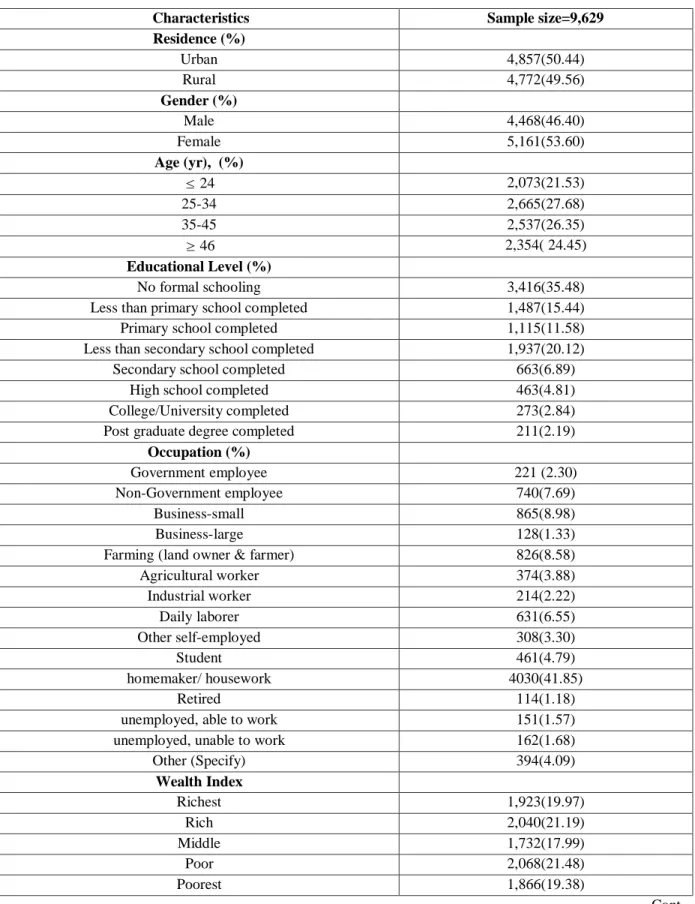
3.2.1 Characteristics of the study subjects 60-61
3.3.1 Characteristics of Study subjects to Tobacco Consumption (GATS, 2010)
66-67
4.2.1 Prevalence of “Current” Tobacco Smoking 73
4.2.2 Tobacco smoking daily by socio-economic and demographic factors (n=9629)
74-75 4.2.3 Pattern of current tobacco smoking (GATS, 2010) in
Bangladesh
79-80 4.2.4 Age adjusted and unadjusted prevalence of tobacco smoking 84 4.3.1 Prevalence of Current Smokeless Tobacco Consumption (STC) 85 4.3.2
4.3.3 4.3.4 5.2.1
5.3.1
6.3.1 6.3.2
Smokeless tobacco consumption daily by demographic factors (n=9629)
Pattern of current smokeless tobacco use (GATS, 2010) in Bangladesh
Age adjusted and unadjusted prevalence of Smokeless Tobacco Consumption
Socio-economic and demographic correlates to current tobacco smoking
Adjusted and unadjusted odds ratios derived from logistic regression to current smokeless tobacco use (daily) in Bangladesh
Test of association: chi-square tests of independence between explanatory and dependent variable
Odds ratio and standard errors of an intercept-only logit model and intercept-only multilevel models predicting the probability
87 91-92 96 100
102
106 107
XII 6.3.3
6.4.1
6.4.2
6.4.3
of tobacco smoking
Identifying correlates of tobacco smoking in Bangladesh using multilevel logistic regression analysis
Test of association: chi-square tests of independence between explanatory and dependent variable
Odds ratio and standard errors of an intercept-only logit model and intercept-only multilevel models predicting the probability of smokeless tobacco use
Identifying correlates of smokeless tobacco use in Bangladesh using multilevel logistic regression analysis
109
111
112
113-114
INTRODUCTON
1.1 Background of the study 1.2 Literature review
1.3 Objectives of the study 1.4 Organization of the study
CHAPTER ONE
CHAPTER ONE
INTRODUCTION
1.1 Background of the study
Tobacco use is one of the leading preventable causes of premature death, disease and disability around the world. An estimated 4.9 million deaths occurring annually can be attributed to tobacco use. This figure is expected to rise to about 10 million by the year 2020 [http://www.who.int/whr/2002/en/], if the current trend continues unchecked, there will be up to one billion tobacco-related deaths during the 21st century, many of which will be from developing countries.
[http://www.who.int/tobacco/mpower/tobacco_facts/en/index.html.]. Tobacco and poverty together form a vicious circle from which it is often difficult to escape. The adverse effects of tobacco use, including loss of income, being a leading causes of death, and contributing to chronic disease, are well documented worldwide (Ezzati M et al., 2003).The prevalence of tobacco use is an important predictor of the future burden of tobacco-related diseases (Flora MS et al., 2009). Despite scientific evidence linking tobacco to adverse health outcomes, a certain proportion of youth and adults are very likely to continue smoking, chewing and snuffing tobacco products unless there is continued public health action to control their use. Misperceptions about the dangers of using tobacco may partly explain why youth and adults use tobacco in developing countries (Elton-Marshall T et al., 2010). In Bangladesh, tobacco use has become not only a major contributor to the country‟s high morbidity but also the biggest drains to the nation‟s economy (Zamman MM et al., 2007). Bangladesh, like many transitional nations in the world is straddling through the demographic and epidemiological transitions. The country is observing large decline in mortality due to acute, infectious, and parasitic diseases and increases in chronic diseases such as heart
Chapter One
Introduction Page 2
disease and diabetes (collectively known as non-communicable diseases or NCDs) over the last 20 years. Consistent with this shifting epidemiological profile, recent data suggests that tobacco consumption is one of the most important modifiable risk factors contribute to these emerging chronic diseases (WHO, 2002) and has also been identified as a major risk factor for mortality. Bangladesh is ranked among the top tobacco consuming countries in the world (http://bdnews24.com/health/2014/12/17/
Bangladesh -among-top-smokeless-tobacco-using-nations). Form of smoked tobacco include manufactured cigarettes, bidis, pipes, cigars, water pipes and smokeless tobacco is usually consumed orally or nasally, without burning or combustion.
The use increases the risk of cancer and leads to nicotine addiction similar to that produced by cigarette smoking or other smoked tobacco products. Different 12 types of smokeless tobacco are: chewing tobacco (most prevalent in Indian subcontinent); snuff (most prevalent in Scandinavian and US but becoming popular worldwide); and dissolvable (most prevalent in high income countries). The chewing tobacco is an oral smokeless tobacco product that is placed in the mouth, cheek, or inner lip and sucked or chewed. They are also referred to as “spit tobacco” because of the tendency by users to spit out the built-up tobacco juices and saliva. Overall, the percentage of Bangladeshi people who use smoked tobacco, smokeless tobacco or both, increased from 36.8% in 2004-05 to 43.2% in 2009 (ITC Bangladesh Summary, Promoting Evidence-Based Strategies to Fight the Global Tobacco Epidemic, 2010).
This alarming rise poses severe impact on the country‟s overall disease burden. A WHO study estimated that in 2004, 57 000 people lost their life prematurely as a result of tobacco use and 382,000 people became disabled in Bangladesh (D.
Efroymson et al., 2001). In Bangladesh, the numbers of tobacco smokers are increasing rapidly because of the availability of cheap tobacco products, lack of strong tobacco control regulations, and weak enforcement of existing regulations. The Global Adult Tobacco Survey conducted by WHO reported that Bangladesh is one of the top ten countries in the world with high tobacco use (both smoking and smokeless forms) with a prevalence of 43.3% among adults (41.3 million) (http://www.who.int/tobacco/surveillance/survey/gats/en/). Smoking tobacco is a risk factor for several diseases and has been increasing in many developing countries. It is
Introduction Page 3
not only a global public health concern, but also an economic problem amongst individuals, societies, and the country as a whole. The risks of cancer, cardiovascular disease, respiratory disease, and a range of other health problems are increased in tobacco smokers and, as a consequence, smokers are more likely than nonsmokers to die prematurely. Smoking is considered a leading cause of morbidity and mortality in virtually every country in the world, and it is the second only to high blood pressure as a risk factor for global disease burden. Tobacco use causes more than 440,000 deaths in the US per year, accounting for one out of every five deaths. In addition, up to two- thirds of deaths in current smokers can be attributed to smoking. The higher prevalence of tobacco use in the developing countries are anticipated to result in large disease burden in the near future. Tobacco and poverty together form a vicious circle from which it is often difficult to escape. The adverse effects of tobacco use, including loss of income, being a leading causes of death, and contributing to chronic disease, are well documented worldwide. The prevalence of tobacco use is an important predictor of the future burden of tobacco-related diseases. It is estimated that each year tobacco smoking accounts for about 9% of deaths globally. Around 71% of lung cancer, 42% of chronic respiratory diseases, and nearly 10% of cardiovascular diseases are caused by smoking. It is reported that 18% of deaths in high-income countries have occurred due to tobacco use, whereas in middle- and low-income countries it is 11% and 4% respectively (Giovino GA et al., 2012). In low- and middle-income countries such deaths are projected to increase from 3.4 to 6.8 million between 2002 and 2030 (Hu T-w et al., 2005). In addition, secondhand smoke exposure poses a serious risk of causing heart disease and various respiratory illness, lung cancer, etc among nonsmokers. Both smoking and chewing tobacco products are commonly used in Bangladesh. The smokeless tobacco use constitutes a major part of overall tobacco use in Bangladesh and India (Palipudi KM et al., 2015). Smoking tobacco products include cigarettes, bidis (a small, thin, hand-rolled cigarette consisting of tobacco leaf, manufactured mostly in India and Bangladesh), hookah (a water pipe which is used to smoke tobacco through cooled water). Chewing or smokeless tobacco products include betel quid with tobacco (also known as pan, which is a mixture of betel leaf, areca nut, slaked lime, and tobacco), zarda (a mixture
Chapter One
Introduction Page 4
of tobacco, lime, spices, and vegetable dyes), zarda with areca nut, and gul (an oral tobacco powder that is rubbed over the gum and teeth). It is found that 28.30% men and 0.20% women in Bangladesh smoke cigarettes. In the Indian subcontinent, poor people use bidis as smoking tobacco. It has also been documented that the main predictors of cigarette smoking are sex, age, and having friends who smoke (Reda AA et al., 2012). Moreover, cigarette smoking is considered as a “gate way” toward illegal drug use, especially among adolescents. Several strategies have been shown to reduce tobacco use. However, more than 50 years after the health dangers of smoking were scientifically proven, and more than 20 years after evidence confirmed the hazards of second-hand smoke, few countries have implemented effective and recognized strategies to control the tobacco epidemic. International efforts led by WHO resulted in rapid entry into force of the WHO Framework Convention on Tobacco Control (WHO FCTC), which has 168 signatories and more than 150 Parties.
Achievement of tobacco control goals will require coordination among many government agencies, academic institutions, professional associations and civil society organizations at the country level, as well as the coordinated support of international cooperation and development agencies. Various socioeconomic factors are found to be associated with different types of tobacco use. Studies regarding tobacco use in developing countries provided mixed results (Bush J et al., 2003).
Thus, it is an important task to identify the determining factors of tobacco use in Bangladesh.
1.2 Literature Review
Some research works already have done in related area. Some of the previous empirical studies as well as of other countries in this area has been conducted. Citable research works are summarized below:
Achia TNO (2015) examined the association between self-reported tobacco use and frequency of mass media utilization by women and men in nine low-to middle-income sub-Saharan African countries. Data for the study came from Demographic and Health
Introduction Page 5
Surveys conducted in Burkina Faso, Ethiopia, Liberia, Lesotho, Malawi, Swaziland, Uganda, Zambia and Zimbabwe over the period 2006–2011. Each survey population was a cross-sectional sample of women aged 15–49 years and men aged 15–59 years, with information on tobacco use and media access being obtained by face-to-face interviews. An index of media utilization was constructed based on responses to questions on the frequency of reading newspapers, frequency of watching television and frequency of listening to the radio. Demographic and socioeconomic variables were considered as potentially confounding covariates. Logistic regression models with country and cluster specific random effects were estimated for the pooled data.
The risk of cigarette smoking increased with greater utilization to mass media. The use of smokeless tobacco and tobacco use in general declined with greater utilization to mass media. The risk of tobacco use was 5% lower in women with high media utilization compared to those with low media utilization [Adjusted Odds Ratio (AOR)
= 0.95, 95% confidence interval (CI):0.82–1.00]. Men with a high media utilization were 21% less likely to use tobacco compared to those with low media utilization [AOR = 0.79, 95%CI = 0.73–0.85]. In the male sample, tobacco use also declined with the increased frequency of reading newspapers (or magazines), listening to radio and watching television.
Aziz S, Choudhury T and Huque N (2015) explored the association of tobacco consumption with socio-demographic factors, self-rated health and non-communicable chronic diseases among the rural population in Bangladesh. A cross sectional data from “IUB Health and Socio Economic Survey” 2013 was used for this study. A sample of 1512 male and 1569 female aged 18 and above were randomly selected from four districts of Bangladesh. Binary logistic regression was used to explore the association of tobacco consumption with socio-demographic characteristics; self reported chronic diseases and general health. The prevalence of current tobacco use in any form (smoking or chewing tobacco) among adults in rural Bangladesh was 47.4%.
Poor self reported general health was found to be a significant predictor of tobacco consumption. Males were 2.13 times more likely to use tobacco than their female counterparts. Tobacco use was significantly associated with older age (OR=3.18, CI=
Chapter One
Introduction Page 6
2.507-4.035), higher education (OR=0.426, CI=0.289-0.628) and Sylhet region (OR=3.707, CI=2.911-4.720).
Bhise MD and Patra S (2018) estimated the current prevalence of hypertension and its correlates in the state of Maharashtra. The variation in the prevalence of hypertension associated with individual-level characteristics is explained at the community and district level. Data was used from the recent round of District Level Household &
Facility Survey (DLHS-4), 2012–13. The DLHS-4 had used the nationally representative sample, collected through multistage stratified sampling procedure. A similar sampling frame, used in NSSO-2007-08, had been followed. The chi-square test was used to show the significance level of the association between the estimated prevalence of hypertension and its correlates. Multilevel regression analysis was carried out to investigate the effects of individual and community level factors on the prevalence of hypertension. The overall prevalence of hypertension is 25% in Maharashtra, and a huge variation in the prevalence of hypertension is found across the districts. Dhule, Gadchiroli (with a low HDI rank), Mumbai and Satara (with higher HDI rank) were the districts with the higher (above 30%) prevalence of high blood pressure. The prevalence also significantly varied according to different correlates. The prevalence of high blood pressure is higher among elderly population (40%), among males (28%), in the urban areas (27%) and in the richest wealth quintile (28%). The prevalence was also higher among cigarette smokers (31%), alcohol consumers (30%) and people with obesity (38%) as compared to their counterparts.
The results of the multilevel analysis showed that the older and obese persons were at four-time higher risk of hypertension. Again, age, sex, marital status, place of residence, wealth status, unhealthy habits (i.e. smoking and alcohol consumption) and BMI were significantly associated with hypertension. The results of VPC statistics show that 14% of hypertension prevalence could be attributed to differences at the community level.
Corsi DJ, Lear SA, Chow CK, Subramanian SV, Boyle MH and Teo kk (2013) described the socioeconomic and geographic distribution of smoking behaviour in Canada among 19,383 individuals (51% women) aged 15–85 years. Current smoking
Introduction Page 7
and quitting were modeled using standard and multilevel logistic regression. Markers of socioeconomic status (SES) were education and occupation. Geography was defined by Canadian Provinces. Results: The adjusted prevalence of current smoking was 20.2% (95% confidence interval [CI]: 18.8–21.7) and 63.7% (95% CI: 61.1–66.3) of ever smokers had quit. Current smoking decreased and quitting increased with increasing SES. The adjusted prevalence of current smoking was 32.8% (95% CI:
28.4–37.5) among the least educated compared to 11.0% (95% CI: 8.9– 13.4) for the highest educated. Among the least educated, 53.0% (95% CI: 46.8–59.2) had quit, rising to 68.7% (95% CI: 62.7– 74.1) for the most educated. There was substantial variation in current smoking and quitting at the provincial level; current smoking varied from 17.9% in British Columbia to 26.1% in Nova Scotia, and quitting varied from 57.4% in Nova Scotia to 67.8% in Prince Edward Island. Nationally, increasing education and occupation level were inversely associated with current smoking (odds ratio [OR] 0.64, 95% CI: 0.60–0.68 for education; OR 0.82, 95% CI: 0.77–0.87 for occupation) and positively associated with quitting (OR 1.27, 95% CI: 1.16–1.40 for education; OR 1.20, 95% CI: 1.12–1.27 for occupation). Those associations were consistent in direction across provinces although with some variability in magnitude.
Dhungana RR, Khanal MK and Baniya A (2013) conducted meta-analysis to estimate the prevalence of current tobacco use among lower secondary to higher secondary students in Nepal. The study searched and identified the studies which were published between 2003 and 2013 using MEDLINE, Google Scholar and NEPJOL. From five selected studies, total 7,832 eligible students were included in analysis.
Considering the high degree of variability (Q = 82.6, I2 = 95%) among selected studies, the study used random effects model to estimate the weighted prevalence of current tobacco use and found as 13.9 % (10.2-17.5). This result showed that current tobacco use among lower secondary to higher secondary students still remains high, which compels an effective implementation of tobacco control programs and policies.
Do YK and Bautista MA (2015) aimed to investigate the associations between tobacco use within households and expenditures on food, education, and healthcare in LMICs.
Using data from the World Health Survey , this cross-sectional study included a
Chapter One
Introduction Page 8
sample of 53,625 adult males aged <60 years from 40 LMICs. Multilevel, mixed-effects linear regression was used to determine the association between current tobacco use status of the main income provider (daily; occasional; no use) and three categories of (logged) household expenditures: food, education, and healthcare;
controlling for age, level of education, household wealth quintile, marital status, urban–rural setting, country-level income group, and region. Results In the preferred random-slope models that controlled for covariates, daily tobacco use was associated with lower household expenditures on education and healthcare by 8.0 % (95 % confidence interval:( −12.8 to –3.2 %) and 5.5 % (−10.7 to –0.3 %), respectively . The association between tobacco use and food expenditure was inconsistent across models.
Conclusions T obacco use in LMICs may have a negative influence on investment in human capital development. Addressing the tobacco use problem in LMICs could benefit not only the health and economic well-being of smokers and their immediate families but also long- run economic development at a societal level.
Evans-Whipp TJ, Bond L, Ukoumunne OC, Toumbourou JW and Catalano RF (2010) measured tobacco polices in statewide representative samples of secondary and mixed schools in Victoria, Australia and Washington, US (N = 3,466 students from 285 schools) and tested their association with student smoking. Results from confounder-adjusted random effects (multi-level) regression models revealed that the odds of student perception of peer smoking on school grounds were decreased in schools that have strict enforcement of policy (odds ratio (OR) = 0.45; 95% CI:
0.25 to 0.82; p = 0.009). There was no clear evidence in this study that a comprehensive smoking ban, harsh penalties, remedial penalties, harm minimization policy or abstinence policy impact on any of the smoking outcomes.
Evans-Whipp TJ, Bond L, Ukoumunne OC, Toumbourou JW and Catalano RF (2010) measured tobacco polices in statewide representative samples of secondary and mixed schools in Victoria, Australia and Washington, US (N = 3,466 students from 285 schools) and tests their association with student smoking. Results from confounder-adjusted random effects (multi-level) regression models revealed that the
Introduction Page 9
odds of student perception of peer smoking on school grounds were decreased in schools that had strict enforcement of policy (odds ratio (OR) = 0.45; 95% CI: 0.25 to 0.82; p = 0.009). There was no clear evidence in this study that a comprehensive smoking ban, harsh penalties, remedial penalties, harm minimization policy or abstinence policy impact on any of the smoking outcomes.
Gaete J, Ortúzar C, Zitko P, Montgomery A and Araya R (2016) examined the inter-school variability in student smoking in a large sample of Chilean schools and identifies the school- and student-level characteristics associated with cigarette smoking This cross-sectional study used self-reported student-level data from 45,273 students from 1462 schools and official data from these schools provided by the Chilean Ministry of Education (2007). Student smoking behavior was used as an outcome, and individual-level and school-level features were used as explanatory variables. Logistic multilevel modeling was used to analyses the data. The mean prevalence of smoking in the 1462 schools was 39.9 %. The null model indicated that 8 % of the variance in smoking behavior was explained by schools; and in the final model, controlled by individual- and school-level variables, the variance explained by schools dropped to 2.4 %. The main school-level variables explaining the school influence were school bonding, school truancy and school achievement.
Gilani SI and Leon DA (2013) conducted a cross-sectional survey of nationally representative sample of men and women living in rural and urban areas of four main provinces of Pakistan from March through April 2012. Face to face in house interviews were undertaken using a pre-tested structured questionnaire that asked about smoking and other forms of tobacco use. Multistage stratified random area probability sampling was used. To determine the national prevalence of tobacco use, the sample was weighted to correspond to rural-urban population proportions in each of the four provinces as in the 1998 census conducted by Pakistan‟s Population Census Organization. Association between socio-demographic variables and tobacco use were investigated using multivariable robust regression. Out of 2,644 respondents (1354 men and 1290 women), 345 men and 4 women reported being current cigarette smokers. The weighted prevalence of current cigarette smoking was 15.2% (95% CI:
Chapter One
Introduction Page 10
11.2, 19.3) overall, 26.6% (95% CI: 19.1, 34.1) among male, and 0.4% (95% CI: - 0.2,1.0) among females. Among females 1.8% (95% CI: 0.4, 3.1) used any smoked tobacco and 4.6% (95% CI: 1.8,7.4) used any smokeless tobacco daily or on some days of the week. Among males, odds of current cigarette smoking decreased with increasing level of education (OR=0.76; 95% CI: 0.68, 0.84) and increased with having a father who used tobacco (OR=2.11; 95% CI: 1.39,3.22) after adjusting for other socio-demographic characteristics. Lower household income was associated with current cigarette smoking among rural males only (odds ratio [OR] =0.67; 95%
CI: 0.48, 0.92 per category increase in monthly household income).
Guo Q, Johnson CA, Unger JB, Lee L, Xie B, Chou CP, Palmer PH, Sun P, Gallaher P and Pentz MA (2007) explored whether the Theory of Reasoned Action (TRA) and Theory of Planned Behavior (TPB) predict adolescent smoking in China. Data were obtained from 14,434 middle and high school students (48.6% boys, 51.4% girls) in seven geographically varied cities in China. TRA and TPB were tested by multilevel mediation modeling, and compared by multilevel analyses and likelihood ratio tests.
Perceived behavioral control was tested as a main effect in TPB and a moderation effect in TRA. The mediation effects of smoking intention were supported in both models (pb0.001). TPB accounted for significantly more variance than TRA (pb0.001). Perceived behavioral control significantly interacted with attitudes and social norms in TRA (pb0.001). Therefore, TRA and TPB were applicable to China to predict adolescent smoking. TPB was superior to TRA for the prediction and TRA could better predict smoking among students with lower than higher perceived behavioral control.
Hossain MS, Kypri K, Rahman B, Arsian I, Akter S and Milton AH (2014) estimated the prevalence and identify correlates of smokeless tobacco consumption among married rural women with a history of at least one pregnancy in Madaripur, Bangladesh. The study conducted a cross-sectional survey using an interviewer administered, pre-tested, semi-structured questionnaire. All women living in the study area, aged 18 years and above with at least one pregnancy in their lifetime, who were on the electoral roll and agreed to participate were included in the study. Information
Introduction Page 11
on socio-demographic characteristics and smokeless tobacco consumption was collected. Smokeless tobacco consumption was categorized as „current‟, „Ever but not current‟ and „Never‟. Associations between smokeless tobacco consumption and the explanatory variables were estimated using simple and multiple binary logistic regression.
Huang H-L, Chen F-L, Hsu C-C, Yen Y-Y, Ted Chen, Huang C-M, Shi H-Y, Hu C-Y and Lee C-H (2010) examined school based tobacco policy status, implementation and students‟ perceived smoking at school in regard to gender-specific differences in smoking behavior. The study conducted a multilevel-based study to assess two-level effects for smoking among 2350 grades three to six students in 26 randomly selected elementary schools in southern Taiwan. A series of multilevel models were analyzed separately for male and female students. The school level variables appear to be related to smoking behavior in male students. Among males, the risk of ever-smoking was significantly associated with those schools without antitobacco health education activities or curricula [adjusted odds ratio (aOR: 56.23, 95% confidence interval (CI):
2.55–15.24), with a high perceived smoking rate (aOR53.08, 95% CI: 1.41–6.72) and located in a mountainous region (aOR: 52.53, 95% CI: 1.15–5.58). The risk of ever- smoking among females was significantly associated with those schools without antitobacco activities or curricula (aOR 53.10, 95% CI: 1.27–7.55). As compared with female counterparts, the specific school that the male students attended had a positive significant effect on the risk of being ever-smokers. The findings suggest that effective tobacco policy implementation should be considered in elementary schools that were currently putting children at the greatest risk for cigarette smoking, especially in regard to male students.
Imtiaz D, Kandpal SD and Juyal R (2015) assessed the quitting behavior among current tobacco users in a rural population of Dehradun. The study was cross sectional in nature carried out among 993 current tobacco users aged 10 years and above in the field practice area and quitting behavior was assessed using a pretested and predesigned questionnaire. Of the 993 Current tobacco users, 38% and 40% of the current smokers and current smokeless tobacco users respectively had attempted to
Chapter One
Introduction Page 12
quit smoking and smokeless tobacco use in the past 12 months. 54.3% of the smokers wanted to quit smoking with majority of male smokers (56.3%) willing to quit smoking compared to only 40.5% of female smokers. 36.0% of the smokeless tobacco users wanted to quit smokeless tobacco use where in contrast more female smokeless tobacco users (39.3%) wanted to quit smokeless tobacco compared to 33.3% of males.
Jafarabadi MA, Allahverdipour H, Bashirian S, and Jannati A (2012) studied underlying factors in predicting the behavior of tobacco smoking among employed youth and students in Iran. In this analytical cross-sectional study, based a random cluster sampling were recruited 850 high school students, employed and unemployed youth age ranged between 14 and 19 yr from Iran. The data of demographic and tobacco smoking related variables were acquired via a self-administered questionnaire. A series of univariate and multivariate logistic regressions were performed respectively for computing un-adjusted and adjusted Odds Ratios utilizing SPSS 17 software.
Khan MH, Khan A, Kraemer A and Mori M (2009) used secondary data which was collected by the 2006 Urban Health Survey. The data were representative for the urban areas in Bangladesh. Both slums and non-slums located in the six City Corporations were considered. Slums in the cities were identified by two steps, first by using the satellite images and secondly by ground truthing. At the next stage, several clusters of households were selected by using proportional sampling. Then from each of the selected clusters, about 25 households were randomly selected.
Information of a total of 12,155 adult men, aged 15–59 years, was analyzed by stratifying them into slum (= 6,488) and non-slum (= 5,667) groups. Simple frequency, bivariable and multivariable logistic regression analyses were performed using SPSS. Overall smoking prevalence for the total sample was 53.6% with significantly higher prevalence among men in slums (59.8%) than non-slums (46.4%).
Respondents living in slums reported a significantly (P < 0.001) higher prevalence of smoking cigarettes (53.3%) as compared to those living in non-slums (44.6%). A similar pattern was found for bidis (slums = 11.4% and non slums = 3.2%, P < 0.001).
Multivariable logistic regression revealed significantly higher odds ratio (OR) of
Introduction Page 13
smoking cigarettes (OR = 1.12, 95% CI = 1.03–1.22), bidis (OR = 1.90, 95% CI = 1.58–2.29) and any of the two (OR = 1.23, 95% CI = 1.13–1.34) among men living in slums as compared to those living in non-slums when controlled for age, division, education, marital status, religion, birth place and types of work. Division, education and types of work were the common significant correlates for both cigarette and bidi smoking in slums and non-slums by multivariable logistic regressions. Other significant correlates of smoking cigarettes were marital status (both areas), birth place (slums), and religion (non-slums). Similarly significant factors for smoking bidis were age (both areas), marital status (slums), religion(non-slums), and birth place (both areas).
Khan MHR and Shaw JE (2011) examines the selected determinants of contraceptive prevalence among 10-49 aged ever-married women in Bangladesh and their true impact on the contraception prevalence rate (CPR). It applied a multilevel logistic regression analysis to draw valid conclusions about the effects of the selected determinants on CPR using the 2004 Bangladesh Demographic and Health Survey (BDHS) contraceptive binary data which wass a multistage stratified cluster data. Instead of standard single level logistic model, multilevel logistic regression model had been utilized since the data followed a hierarchical structure. Also the comparison between single and multilevel model had been done to investigate the necessity of multilevel effects. The findings suggested that age of the women, number of living children, education, religion, media, place of residence and wealth index had significant multilevel effects on CPR. The study had finally suggested integrating a strong awareness program that targets the 10-49 aged currently married women in Bangladesh in those divisions (level-3) and clusters (level-2) where the particular determinant of contraceptive use had been found to be less effective.
Khayyati F, Taymoori P, Mohammadpoorasl A, Allahverdipour H and Asghari Jafarabadi M (2016) studied underlying predictors of tobacco smoking among Iranian Teenagers in a generalized structural equation model. In this cross-sectional study, a Generalized Structural Equation Model based on planned behavioral theory was used to explain the relationship among different factors such as
Chapter One
Introduction Page 14
demographic factors, subjective norms, and the intention to tobacco and, in turn, intention with tobacco use. The sample consisted of 4,422 high school students, based on census, in East Azerbaijan province, Iran. The questioner was designed adapting to the objectives of study. It was used global youth tobacco survey to design the queries of tobacco use. The model had a good fit on data. Adjusting for age and gender, there was a statistically significant relationship between the intention to consumption and the following factors: working while studying (P<0.05), consumption of hookah by family members (P<0.05), history of smoking among close friends (P<0.05), history of leaving school during the day without informing the officials (P<0.05), lack of commitment to academic tasks (P< 0.05), lack of acceptance by peers (P< 0.05), knowledge (P< 0.05), and attitude (P<
0.05). There was a significant relationship between the intentions to consumption to tobacco consumption in the past 30 days (P< 0.05) as well.
Kishore J, Jena PK, Bandyopadhyay C, Swain M, Das S and Banerjee I (2013) assessed the prevalence and associated factors of hardcore smoking in three South- East Asian countries and discussed its implication for smoking cessation intervention in this region. Global Adult Tobacco Survey (GATS) data of India, Bangladesh and Thailand were analyzed to quantify the hardcore smoking prevalence in the region. On the basis of review, an operational definition of hardcore smoking was adopted that includes (1) current daily smoker, (2) no quit attempt in the past 12 months or not interested in quitting, (4) time to first smoke within 30 minutes of waking up, and (5) knowledge of smoking hazards. Logistic regression analysis was carried out using hardcore smoking status as response variable and gender, type of residence, occupation, education, wealth index and age-group as possible predictors. There were 31.3 million hardcore smokers in the three Asian countries. The adult prevalence of hardcore smoking in these countries ranges between 3.1% in India to 6% in Thailand.
These hardcore smokers constitute 18.3-29.7% of daily smokers. The logistic regression model indicated that age, gender, occupation and wealth index were the major predictors of hardcore smoking with varied influence across countries.
Introduction Page 15
Kristjansson AL, Sigfusdottir ID, and Allegrante JP (2013) sought to add to a growing body of literature into peer contexts by testing a model of peer substance use simultaneously on individual and school community levels while taking account of several well established individual level factors. We analyzed population based data from the 2009 Youth in Iceland school survey, with 7,084 participants (response rate of 83.5%) nested within 140 schools across Iceland. Multilevel logistic regression models were used to analyze the data. School level peer smoking and drunkenness were positively related to adolescent daily smoking and lifetime drunkenness after taking account of individual level peer smoking and drunkenness. These relationships held true for all respondents, irrespective of socio-economic status and other background variables, time spent with parents, academic performance, self-assessed peer respect for smoking and alcohol use, or if they had substance-using friends or not. On the other hand, the same relationships were not found with regard to individual and peer cannabis use. The school-level findings in the study represent context effects that were over and above individual-level associations. This holds although accounted for a large number of individual level variables that studies generally had not included. For the purpose of prevention, school communities should be targeted as a whole in substance use prevention programs in addition to reaching to individuals of particular concern.
Leatherdale ST and Manske S (2005) examined how perceptions of student smoking in the school environment and the actual smoking rate among senior students at a school are related to smoking onset. Multilevel logistic regression analysis was used to examine correlates of ever smoking in a sample of 4,286 grade 6 and 7 students from 57 elementary schools in Ontario, Canada. Students are at increased risk for smoking if they (a) often see students smoking near their school, (b) report that students at their school smoke where they are not allowed, and (c) attend a school with a relatively high senior student smoking rate. Each 1% increase in the smoking rate among grade 8 students increased the odds that a student in grades 6 or 7 was an ever smoker versus never smoker (odds ratio, 1.05; 95% confidence interval, 1.02-1.08). A low-risk student (no family or friends who smoke) was over twice as likely to try smoking if he/she attended a high-risk school. Prevention programs should target both
Chapter One
Introduction Page 16
at-risk schools and at-risk students, and strongly enforced policies preventing students from smoking on or near school property should be implemented.
Manimunda SP, Benegal V, Sugunan AP, Jeemon P, Balakrishna N, Thennarusu K, Pandian D and Pesala KS (2012) Conducted a cross-sectional survey among a representative sample of 18,018 individuals in the age group of >=14 years in the Union Territory of Andaman and Nicobar Islands during 2007-09. A structured questionnaire, a modified version of an instrument which was used successfully in several multi-country epidemiological studies of the World Health Organization, was used to survey individual socio-demographic details, known co-morbid conditions, tobacco use and alcohol use. Fagerstrom Test for Nicotine Dependence (FTND) was used to estimate nicotine dependence. The response rate of our survey was 97%
(18,018/18,554). Females (n=8,888) were significantly younger than males (34.3
14.6 Vs 36.2 15.4 years). The prevalence of current tobacco use in any form was 48.9% (95% CI: 48.2-49.6). Tobacco chewing alone was prevalent in 40.9% (95% CI:
40.1-41.6) of the population. While one ten of males (9.7%, 95% CI: 9.1-10.4) were nicotine dependent, it was only 3% (95% CI: 2.7-3.4) in females. Three fourth of the tobacco users initiated use of tobacco before reaching 21 years of age. Age, current use of alcohol, poor, educational status, marital status, social groups, and co- morbidities were the main determinants of tobacco use and nicotine dependence in the population.
Merlo J, Wagner P, Ghith N and Leckie G (2016) proposed an original stepwise analytical approach that distinguishes between “specific” (measures of association) and “general” (measures of variance) contextual effects. Performing two empirical examples they illustrated the methodology, interpreted the results and discussed the implications of this kind of analysis in public health. They analysed 43,291 individuals residing in 218 neighbourhoods in the city of Malmö, Sweden in 2006. We study two individual outcomes (psychotropic drug use and choice of private vs. public general practitioner, GP) for which the relative importance of neighbourhood as a source of individual variation differs substantially. In Step 1 of the analysis, they evaluated the OR and the area under the receiver operating characteristic (AUC) curve
Introduction Page 17
for individual-level covariates (i.e., age, sex and individual low income). In Step 2, they assessed general contextual effects using the AUC. Finally, in Step 3 the OR for a specific neighbourhood characteristic (i.e., neighbourhood income) was interpreted jointly with the proportional change in variance (i.e., PCV) and the proportion of ORs in the opposite direction (POOR) statistics. For both outcomes, information on individual characteristics (Step 1) provide a low discriminatory accuracy (AUC = 0.616 for psychotropic drugs; = 0.600 for choosing a private GP). Accounting for neighbourhood of residence (Step 2) only improved the AUC for choosing a private GP (+0.295 units). High neighbourhood income (Step 3) was strongly associated to choosing a private GP (OR = 3.50) but the PCV was only 11% and the POOR 33%.
Moore L, Roberts C, Tudor-Smith C (2001) examined the association between school smoking policies and smoking prevalence among pupils. Multilevel analysis of crosssectional data from surveys of schools and pupils, 55 secondary schools in Wales, 55 teachers and 1375 pupils in year 11 (aged 15–16) were computed. Main outcome measures was self-reported smoking behavior. The prevalence of daily smoking in schools with a written policy on smoking for pupils, teachers, and other adults, with no pupils or teachers allowed to smoke anywhere on the school premises, was 9.5% (95% confidence interval (CI) 6.1% to 12.9%). In schools with no policy on pupils‟ or teachers‟ smoking, 30.1% (95% CI 23.6% to 36.6%) of pupils reported daily smoking. In schools with an intermediate level of smoking policy, 21.0% (95%
CI 17.8% to 24.2%) smoked every day. School smoking policy was associated with school level variation in daily smoking (p = 0.002). In multilevel analysis, after adjusting for pupils‟ sex, parents‟ and best friends‟ smoking status, parental expectations, and alienation from school, there was less unexplained school level variation, but school smoking policy remained significant (p = 0.041). The association of smoking policy with weekly smoking was weaker than for daily smoking, and not significant after adjustment for pupil level variables. Both daily and weekly smoking prevalence were lower in schools where pupils‟ smoking restrictions were always enforced. Enforcement of teacher smoking restrictions was not significantly associated with pupils‟ smoking.
Chapter One
Introduction Page 18
Palipudi KM, Gupta PC, Sinha DN, Andes LJ, Asma S and McAfee T (2012) examined the role of social determinants on current tobacco use n thirteen low-and- middle income countries. The study used nationally representative data from the Global Adult Tobacco Survey (GATS) conducted during 2008-2010 in 13 low and middle income countries: Bangladesh, China, Egypt, India, Mexico, Philippines, Poland, Russian Federation, Thailand, Turkey, Ukraine, Uruguay, and Viet Nam.
These surveys provided information on 209,027 respondent‟s aged 15 years and above and the country datasets were analyzed individually for estimating current tobacco use across various socio-demographic factors (gender, age, place of residence, education, wealth index, and knowledge on harmful effects of smoking). Multiple logistic regression analysis was used to predict the impact of these determinants on current tobacco use status. Current tobacco use was defined as current smoking or use of smokeless tobacco, either daily or occasionally. Former smokers were excluded from the analysis. Adjusted odds ratios for current tobacco use after controlling other cofactors, was significantly higher for males across all countries and for urban areas in eight of the 13 countries. For educational level, the trend was significant in Bangladesh, Egypt, India, Philippines, Thailand, Turkey, Ukraine, Uruguay and Viet Nam. The trend of decreasing prevalence with increasing levels of knowledge on harmful effects of smoking was significant in China, India, Philippines, Poland, Russian Federation, Thailand, Ukraine and Viet Nam.
Palipudi KM, Sinha DN, Choudhury S, Zaman MM, Asma S, Andes L and Dube S (2015) examined predictors of current tobacco smoking and smokeless tobacco use among the adult population in Bangladesh. The study used data from the 2009 Global Adult Tobacco Survey (GATS) in Bangladesh consisting of 9,629 adults aged≥15 years. Differences in and predictors of prevalence for both smoking and smokeless tobacco use were analyzed using selected socioeconomic and demographic characteristics that included gender, age, place of residence, education, occupation, and an index of wealth. The prevalence of smoking was high among males (44.7%, 95% confidence interval [CI]: 42.5‑47.0) as compared to females (1.5%, 95% CI:
1.1‑2.1), whereas the prevalence of smokeless tobacco was almost similar among both
Introduction Page 19
males (26.4%, 95% CI: 24.2‑28.6) and females (27.9%, 95% CI: 25.9‑30.0).
Correlates of current smoking were male gender (odds ratio [OR] =41.46, CI=23.8‑73.4), and adults in older age (ORs range from 1.99 in 24‑35 years age to 5.49 in 55‑64 years age), less education (ORs range from 1.47 in less than secondary to 3.25 in no formal education), and lower socioeconomic status (ORs range from 1.56 in high wealth index to 2.48 in lowest wealth index. Predictors of smokeless tobacco use were older age (ORs range from 2.54in 24‑35 years age to 12.31 in 55‑64 years age), less education (ORs range from 1.44 in less than secondary to 2.70 in no formal education), and the low (OR=1.34, CI=1.0‑1.7) or lowest (OR=1.43, CI=1.1‑1.9) socioeconomic status.
Park S, Nam B-H, Yang H-R, Lee JA, Lim H, Han JT, Park Su, Shin HR and Lee JS (2013) developed an individualized risk prediction model for lung cancer in Korean men using population-based cohort data. From a population-based cohort study of 1,324,804 Korean men free of cancer at baseline, the individualized absolute risk of developing lung cancer was estimated using the Cox proportional hazards model. We checked the validity of the model using C statistics and the Hosmer–Lemeshow chi- square test on an external validation dataset. The risk prediction model for lung cancer in Korean men included smoking exposure, age at smoking initiation, body mass index, physical activity, and fasting glucose levels. The model showed excellent performance (C statistic = 0.871, 95% CI = 0.867–0.876). Smoking was significantly associated with the risk of lung cancer in Korean men, with a four-fold increased risk in current smokers consuming more than one pack a day relative to non-smokers. Age at smoking initiation was also a significant predictor for developing lung cancer; a younger age at initiation was associated with a higher risk of developing lung cancer.
Pinilla J, González B, Barber P and Santana Y (2002) estimated the effects of individual, family, social, and school related factors. Cross sectional analysis performed by multilevel logistic regression with pupils at the first level and schools at the second level. The data came from a stratified sample of students surveyed on their own, their families‟ and their friends‟ smoking habits, their schools, and their
Chapter One
Introduction Page 20
awareness of cigarette prices and advertising. The study was performed in the Island of Gran Canaria, Spain. Participants:1877 students from 30 secondary schools in spring of 2000 (model‟s effective sample sizes 1697 and 1738) . 14.2% of the young teenagers surveyed use tobacco, almost half of them (6.3% of the total surveyed) on a daily basis. According to the ordered logistic regression model, to have a smoker as the best friend increases significantly the probability of smoking (odds ratio: 6.96, 95% confidence intervals (CI) (4.93 to 9.84), and the same stands for one smoker living at home compared with a smoking free home (odds ratio: 2.03, 95% CI 1.22 to 3.36). Girls smoke more (odds ratio: 1.85, 95% CI 1.33 to 2.59). Experience with alcohol, and lack of interest in studies are also significant factors affecting smoking.
Multilevel models of logistic regression showed that factors related to the school affect the smoking behavior of young teenagers. More specifically, whether a school complies with antismoking rules or not was the main factor to predict smoking prevalence in schools. The remainder of the differences could be attributed to individual and family characteristics, tobacco consumption by parents or other close relatives, and peer group. A great deal of the individual differences in smoking were explained by factors at the school level. The most relevant predictors for smoking in young adolescents included some factors related to the schools they attend. One variable stood out in accounting for the school to school differences: how well they enforced the no smoking rule. Therefore we could prevent or delay tobacco smoking in adolescents not only by publicizing health risks, but also by better enforcing no smoking rules in schools.
Piontek D, Buehler A, Donath C, Floeter S, Metz URK, Gradl S and Kroeger C (2008) applied a multilevel approach to examine the associations between school smoking policy and student smoking. It was tested whether individual characteristics are mediators of school policy effects. On the basis of cross-sectional data from 3,364 students and school principals from 40 schools in Germany, two multilevel nonlinear regression models were computed for current smoking. In the first model, controlling for individual factors not influenced by school, smoking bans for students and evidence-based prevention activities were negatively associated with smoking prevalence. The second model included student characteristics potentially influenced
Introduction Page 21
by school (e.g. school engagement, peer smoking). As school variables remained significant, these characteristics obviously do not mediate school context effects.
Rahman MM, Karim MJ, Ahmad SA, Suhaili MR and Ahmad SNW (2011) determined the prevalence of smoking and to examine the determinants of smoking behavior among the secondary school teachers in Bangladesh. A two-stage cluster sampling was used with a selection of schools on Probability Proportional to Enrolment (PPE) size followed by stratified random sampling of government and private schools and then all the teachers present on the day of the survey were selected for the study. The 66-item questionnaire included smoking behavior, knowledge, attitude, second-hand smoking, tobacco free school policy, cessation, media advertisement and curriculum related topics. Seven additional questions were included to assess the socio-demographic characteristics of the teachers. Data analysis was performed using SPSS 17 software. A total of 60 schools were selected with school response rate of 98.3%. An anonymous self-administered questionnaire was filled in by all teachers present at the day of the survey. The sample consisted of 559 teachers with response rate of 99.5%. The prevalence of smoking was 17% (95% CI:
14%, 20.4). About half of the teachers (48.4%) smoke daily followed by 25.3% smoke 1-2 days in last 30 days. The mean duration smoking of was 13.7 (95% CI: 11.6, 15.9) years. Logistic regression analysis revealed that male teachers smoke 37.46 (95% CI: 5.078, 276.432) times higher than their female counterparts. The graduate teachers were 2.179(95% 1.209, 3.926) times more likely to be smoke than master‟s degree holder teachers. Smoking by friends appeared to be the strongest predictor for teachers smoking behavior (OR 4.789, 95% CI: 1.757, 13.050). However, no statistically significant association was found between type of school, second-hand smoking and curriculum related factors and smoking behavior of the teachers (p>0.05).
Rahman MS, Mondal MNI, Islam MR, Rahman MM, Hoque MN and Alam MS (2015) explored the different types of tobacco use, and to identify the determinant factors associated with the tobacco use among ever-married men in Bangladesh. Data of 3,771 ever-married men, 15–54 years of age were extracted from the Bangladesh