R
ETHINKINGE
NGLISHT
EACHING THROUGHCLT
ING
OVERNMENTP
RIMARYS
CHOOLS OFB
ANGLADESHShampa Iftakhar1
Abstract: In Bangladesh, English is compulsory from class one.
Teaching English in the government primary schools in the rural areas through Communicative Language Teaching (CLT) is a great challenge. The problems are manifold. The schools lack effective English teachers having little idea of CLT and language awareness.
They suffer from low motivation for many reasons. This study first presents an overview of primary education focusing on the state of English teaching in government primary schools along with teachers’
qualification and training. Then the study investigates the definition and principles of CLT and language awareness as the teachers perceive and practice. The present study with 200 participants who are working at different primary schools in rural areas proves that lack of in-depth knowledge and training in CLT make it difficult to ensure quality English teaching.
Keywords: CLT, Teachers’ qualification, Training, Motivation, language awareness, Quality English teaching
1. Introduction
In Bangladesh, the present education system is broadly divided into three levels, viz. primary, secondary and tertiary or higher education. The duration of primary education in Bangladesh is five years: from class I to class V. In 1990, the Government of Bangladesh passed an act declaring primary education compulsory. Children aged 6-10 years are the target population for the primary education. Table 1 shows us the number of government primary school and registered non-government primary schools along with the number of teachers and learners in 2012.
1. Shampa Iftakhar, Senior Lecturer, Department of English, Daffodil International University
Table 1: Number of primary schools, teachers and students, 2012
Serial No. of primary
schools
No. of primary teachers
No. of learners
Government primary schools
37,672 2,14,658 1,07,56,766
Registered non- government primary schools
22,101 86,536 41,03,980
Source: APSC 2012
Bangladesh Government introduced competency-based curriculum at primary level in 1992. National Curriculum and Textbook Board (NCTB) has introduced English For Today for class one to ten. English For Today for class one to five are language-based books that lay emphasis on listening, speaking, reading and writing. NCTB (2012) in the preface of English For Today mentions that these books attach importance to communicative approach (p. 4). These books have been developed to help students attain competence in all four language skills through meaningful and enjoyable activities. Emphasis has been given on listening and speaking skills as the foundation to develop reading and writing skills. These books include pair work, group work and individual work. For example in English For Today for class two, unit 1, titled “Greeting and Introduction” is a pair work; unit 3
“Commands and Instruction” is an individual work; and unit 4 “Days of the Week” is a group work.
1.1 Primary Teachers’ Qualifications and Training
The Government of Bangladesh (2013) declares that the educational qualification for government primary school teachers is Bachelor Degree for a male and HSC for female teacher. The study of Garton, Copland & Burns (2010) acknowledges the importance of training before recruitment (p. 6).
But Mullick and Sheesh (2008) state that no professional training is a must (p. 79). In the survey, APSC (2012) adds that in Bangladesh, there are 37,672 government primary schools where 2,14,658 teachers work (p. 12). But
Nayeem et al (2013) mention the scarcity of English teachers in GPS (p. 34).
Wang (2002) also reports that at the primary level, teachers are required to teach English when this is not their subject specialisation (p. 104).
According to the Bangladesh Economic Review (GoB 2010), government policy is to reserve 60% of posts in government primary schools for the female (p. 176). The PEDP II Programme Completion Report (2007) states that 60% of 45,000 teachers recruited for GPS schools under PEPD II were women (p. 53).
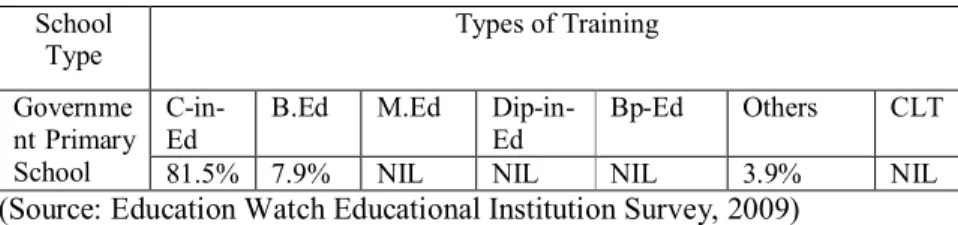
The primary teachers received various types of training, such as, Certificate- in-Education (C-in-Ed), Bachelors of Education (B.Ed), Masters of Education (M.Ed), Diploma in Education (Dip-in-Ed) etc. CAMPE (2009) reveals that some teachers received a number of trainings while others received none. On an average, 38.7% of the teachers had no training; 58.4% received one training; 2.9% received two or three trainings. Half of the teachers received C-in-Ed and 7.9% received B.Ed. (Table 2). C-in-Ed was mandatory for formal schools; 81% of the government and 83% of the non-government school teachers had this training. Primary teachers are also given subject- based training. 22.1% teachers received training in English (p. 40).
Table 2: Percentage of teachers with various types of training School
Type
Types of Training
C-in- Ed
B.Ed M.Ed Dip-in- Ed
Bp-Ed Others CLT Governme
nt Primary
School 81.5% 7.9% NIL NIL NIL 3.9% NIL
(Source: Education Watch Educational Institution Survey, 2009)
APSC (2013) reported that the annual coverage of subject-based training slightly declined in 2012 (p.13). Between 2011 and 2012 there has been a fall in participation rates but they are still above average: 61% for subject and 78% sub-cluster based training (Table 2.1). EIA (2009) also worked from May 2009 to enhance teacher ability to teach communicative English.
Table: 2.1 Percentage of teachers with training
School Type Subject-based Training Sub-cluster Training Government Primary
School
61% 78%
(Source: APSC 2012)
Figure 1 shows the proportion of teachers who received each type of training annually.
Figure 1. Proportion of teachers (GPS and RNGPS) who received different types of in-service training, 2005–2011 (%)
(Source: ASC 2005, 2010 and 2011) 2. Theoretical Perspective of CLT
According to Richards and Rodgers (2001), CLT starts with a theory of language as communication, and its goal is to develop learners’
communicative competence (p. 81). Communicative competence is considered to be the main conception of CLT. Communicative competence means knowing what to say and how to say it appropriately based on the
situation, the participants, and their roles and intentions. Harmer (2001) defines:
The communicative approach or CLT is the name which was given to a set of beliefs which included not only a re-examination of what aspects of language to teach, but also a shift in emphasis is how to teach. The “what to teach” aspect of the communication approach stressed the significance of language functions rather than focusing solely on grammar and vocabulary. (p. 84)
2.1 Key Principles of CLT
Brown (2001), in describing the key principles of CLT, offers the following six characteristics:
1. Classroom goals are focused on all of the components (grammatical, discourse, functional, sociolinguistic, and strategic) of communicative competence. Goals therefore must intertwine the organizational aspects of language with the pragmatic.
2. Language techniques are designed to engage learners in the pragmatic, authentic, functional use of language for meaningful purposes.
Organizational language forms are not the central focus, but rather aspects of language that enable learners to accomplish those purposes.
3. Fluency and accuracy are seen as complementary principles underlying communicative techniques. At times fluency may have to take on more importance than accuracy in order to keep learners meaningfully engaged in language use.
4. Students in a communicative class ultimately have to use language, productively and receptively, in unrehearsed contexts outside the classroom. Classroom tasks must therefore equip students with the skills necessary for communication in those contexts.
5. Students are given opportunities to focus on their own learning process through an understanding of their own styles of learning and through the development of appropriate strategies for autonomous learning.
6. The role of the teacher is that of facilitator and guide, not an all-knowing bestower of knowledge. Students are therefore encouraged to construct meaning through genuine linguistic interaction with others. (p. 43)
Richards (2006) also mentions some basic principles of CLT. These are:
Make real communication the focus of language learning.
Provide opportunities for learners to experiment and try out what they know.
Be tolerant of learners’ errors as they indicate that the learners are building up their communicative competence.
Provide opportunities for learners to develop both accuracy and fluency.
Link the different skills such as speaking, reading and listening together, since they usually occur so in the real world.
Let students induce or discover grammar rules. (p. 13) 2.2 Classroom Activities in CLT
Celce-Murcia (1991) listed the following classroom activities in CLT:
a) Linguistically structured activities: These involve presentation or the practice of certain linguistic structures
b) Performance activities: Here students prepare something beforehand and present in the class. Then they engage in class discussion. Role play and drama are involved in performance activities.
c) Participation activities: These include guided discussion, interview and oral dialogue.
d) Observation activities: Students observe verbal and non-verbal interactions between two native speakers.
Moreover in CLT we get information-gap activities, jigsaw activities, communication games, debates, etc.
2.3. Teachers’ and Students’ Roles in CLT Classroom
In CLT, teachers work as a motivator, co-ordinator, language instructor as well as participant. Breen and Candlin (1980), in defining the role of the teacher in CLT classroom, notes the following central roles:
The first role is to facilitate the communication process between all participants in the classroom, and between these participants and the various activities and texts. The second role is to act as an independent participant within the learning- teaching group. A third role of the teacher is that of a researcher and learner, with much to contribute in terms of appropriate knowledge and abilities, actual and observed
experience of the nature of learning and organizational capacities.
(p. 99)
Hu (2002) proposes that the roles of students in CLT classroom are supposed to be “those of negotiators for meaning, communicators, discoverers, and contributors of knowledge and information” (pp. 95-96).
3. Language awareness
Language awareness helps the student to gain a positive attitude in learning a language. It comprises four features: a) content about language, b) language skill, c) attitudinal education and d) metacognitive opportunities. Bilash and Tulasiewicz (1995) point out that it is a very important issue to create student-centred classroom and it helps the language teacher prepare and develop material accordingly to student readiness (p. 49). Various classroom activities like open discussion on language, vocabulary test, games on language variation and dialect and word origin, using cognates help a lot to increase language awareness. To increase students’ language awareness, a language teacher must have knowledge on that particular language that s/he is teaching. The point is that effective and interesting knowledge about language is centrally concerned with the integration of analysis with practice.
So an English teacher’s knowledge must cover the following areas:
a) Language structures: It includes an introduction to descriptive linguistics.
b) The nature of language variation: It includes variation according to user’s social class and locality, variation according to the use and attitudes to language.
c) Language development and learning.
d) Language on literature.
4. Our Teachers’ Perceptions of CLT and Language Awareness
Abedin, M. (2012) states that our English teachers hardly have a clear idea about CLT (p.10). Littlewood (2007) reports the same view (p. 244).
Ansarey, D. (2012) mentions that some teachers have misleading ideas about CLT but they consider this idea about CLT as a mild challenge (p. 72). Wu (2008) states that the two most common misconceptions of CLT are that it does not teach grammar and that it means teaching only speaking (p. 56) Our primary school English teachers’ knowledge of English is not strong. A major threat to increasing students’ awareness comes from their overall concept about English language. Iftakhar, S. (2012) states that our teachers
never consider English as a language, rather, to them, it is a subject like Maths or Religion (p. 163). This idea is transferred from teacher to student.
So in our context, English teachers want their pupils to get a good grade in English subject and students, along with their parents and class management, want English teachers to ensure desired grades. The studies of Hasan (2004), Sadek (2002), and Manzoor (2013) support this idea.
5. Difficulties to Implement CLT in GPS:
If we consider the context of English teaching in primary schools of Bangladesh, we observe that implementation of CLT is difficult as we lack many of these principles and characteristics. The reasons behind this failure are many.
5.1 Course Materials: Our primary schools in rural areas lack necessary materials and equipment for classroom. CLT approach requires certain supports like logistic support, appropriate classroom, enough time to complete the syllabus etc. which teachers do not get here. Ultimately, there is a mismatch between teachers’ perceptions and practices and learners’ needs and preferences. Savignon and Wang (2003) claim that these two factors cause great difficulty in implementing CLT (p. 224). Rahman et al (2006) view that teachers’ strong belief about the ineffectiveness of CLT in GPS influences teachers’ attitudes and behaviour in classroom (p. 31). Jones and Fong (2007) support this view and mention that teachers’ beliefs are embodied in their thinking inward and recognizing their beliefs about their teaching. These beliefs are drawn from their past experiences. Subsequently, they look outward at institutions, classrooms realities, expectations, and find a match between these two sets of expectations (p. 34). Johnson (1994) states that such beliefs influence teachers’ perception, judgment and behaviour, which in turn, influence what they say and do in the classroom (p. 445). In GPS in rural areas we lack computer classroom, multimedia projector, audio- visual resources etc. which are important for implementing CLT.
5.2 Large Class: Enever, J., Moon, J, and Rahman, U. (2009) say that CLT is a proper method for adults when groups are small and classes are well- equipped (p. 10). In fact, it is not appropriate for the children with over- crowded classroom having few or no resources. Large class size is a big
challenge for CLT. Rao (2002) mentions that this issue was a significant institutional constraint that hindered the effective implementation of CLT in EFL classrooms (p. 89)
5.3 Contact Hour: Our primary school teachers’ get limited contact hours in an academic year. Education Watch (2013) reports that here contact hour is much lower than international norms which is 900-1000 hours per year (p.
11).
5.4 Lack of Proficient English Teachers and Low Motivation: We lack proficient English teacher in GPS. Enever and Moon (2009) state that it is a great problem at primary sector (p. 10). Education Watch (2013) mentions that teaching at GPS is not treated as a high-profile profession (p. 11). So a graduate with profound knowledge of English rarely prefers teaching at GPS.
In our context, teachers in general who are working in the rural areas, lack proper motivation due to poor remuneration, heavy workload, virtually non- existent promotion and career paths and large class size. If we consider their promotion, we see that a primary teacher begins as an assistant teacher and he/she can only be the headmaster after being promoted. There is no other career option for a primary teacher.
5.5 Lack of training in CLT: CLT requires proper training. Sultana, F. and Alim, A. (2013) mentioned that no CLT training has been given to our primary English teachers. Dailey, A. ( 2010) states that English teacher needs continuous training which makes teachers feel more comfortable and confident in implementing CLT in their classrooms (p.16).
5.6 Our teachers’ poor knowledge of English: Our teachers at GPS lack adequate knowledge about English. Both teachers and students are comfortable in using Bangla in English classroom. Salahuddin, Mahubub, and Rahman (2013) mention that our teachers rarely use English to communicate with their students in English classes. Examining CLT implementation in Bangladesh classrooms, Biswas, Ahmed and Sarker (2013) also states that because speaking is not promoted in classrooms, students can “feel out of place” (p. 118) and have difficulty in expressing
themselves when assigned collaborative tasks. This failure to successfully complete activities may later lead to an aversion to the communicative syllabus and the students trying to revert to the traditional teaching style of English. Another point noted by Garton, Copland & Burns (2010) is that primary English teachers lack confidence (p. 6). All these result in teachers’
low English proficiency.
6. Methodology
For this study, data were collected through interviews, observation and document analysis.
6.1 Research Design and Objectives
This study followed “Typical Case Sampling” which is a type of purposive sampling, suggested by Wiersma & Jurs (2005) in their book Research Methods in Education: An Introduction.
The main aim of the study is to explore our teacher-related problems that hamper in implementing CLT in GPS in rural areas. To explore these problems, this study set some specific purposes. These are:
a) Investigating our teachers’ academic background, teaching and training experience.
b) Taking into account the theoretical basis of the CLT and language awareness.
c) Examining our teachers’ perceptions of CLT and their proficiency in English language.
d) Exploring teacher-related constraints that hinder proper implementation of CLT in GPS.
At the end of the study, some recommendations have been put forward to overcome these problems.
6.2 Participants
I collected my data from March 2013 to May 2013. The participants were primary school teachers who conducted English class from one to five. They worked at government funded primary schools and were from Kapasia and Norshindhi thanas of Gazipur district. The interviews were conducted with
two hundred teachers, both male and female in equal proportion. Their educational qualification and training varied a lot.
6.3. Data Collection
In this study, data were collected through interviews, observation and document analysis. The interview followed ‘structural’ format where detailed one to one interview of the teachers was conducted. There were different interview questions (See Appendix A) focusing on different issues. This study intended to explore their qualification, teaching experience, training, motivation, knowledge of CLT, teaching tools and problems in English teaching. Each interview lasted for 20 to 40 minutes.
Observation was the second tool that I used for this study. A total number of 15 classes were observed at different government-funded primary schools at Kapasia and Norshindhi to find out the real and accurate picture of English teaching. I keenly observed teaching materials, use of English in classroom, and students’ response and participation in classroom activities (Appendix 2).
For this study purpose, the pay scale of GPS teachers’ was also examined.
7. Findings
7.1 Educational background, training and experience
At the primary level, 48 teachers are post-graduate, 23 graduate, 112 are BA (pass), 2 are H.S.C. and 6 are S.S.C. Among them, 125 teachers completed B.Ed. and 75 teachers M.Ed. degree. In the primary sector, 78 teachers completed C-in-ED (Certificate in Education), 98 completed B.Ed. (Bachelor in Education) and 14 M.Ed. (Masters in Education). All teachers have gone through various training programs lasting 5 to 15 days, such as Subject-based training, Pedagogy training, Class-management training etc, organized by BIAM, PTI, PEDP, and URC. 99% primary and secondary English teachers agree that trainings are useful to make the class effective. Only 1% mentions that trainings are necessary for promotion.
Table 3: Distribution of Teachers in terms of educational qualification and training
Type of School
Post Gra- duate
Graduate BA pass
HSC SSC Training for recruitment
C- in Ed
B.
Ed M.
Ed Subject Based training
Other Training (BIAM, PTI etc) Primary
48 23 112 9 8 NONE 78 98 14 200 200
In the primary sector, 56 teachers mention that they have been in teaching for about 25 years, 75 of them for about 12 years, 35 teachers for about 8 years, and 8 teachers for about two years and rest for 1 year.
7.2 Perception of CLT, Classroom Activities and English Proficiency In the primary level, 96% teachers state that they do not have any clear idea about CLT. Ultimately, they feel comfortable to teach in Grammar- Translation Method. 100% teachers receive training on CLT and CLT classroom activities, but 95% get it quite difficult to engage the class in those activities and give a proper feedback. Students are simply ignorant of classroom activities such as activities focused on fluency in English, information-gap activities, jigsaw, communication games, discussion and debates, and prepared talks and oral presentation. Our respective teachers are unenthusiastic to apply these activities because of the large class size, teachers’ low deficiency in spoken English and preferences to use GMT, and students’ low English proficiency.
In the primary schools, 99% teachers mention that they are having a large class containing more than 70 students. Large class usually becomes over- crowded. The physical setting of the rural classroom is still very poor. Inside the classroom, within a small space, there are 10-12 movable benches and narrow desks where 70 to 80 students sit together and ultimately classroom becomes chaotic. So class management becomes a serious concern for the teacher. Then engaging large class in group or pair activities is more difficult.
If any teacher ever desires to do so, teacher cannot monitor the students, paying attention to each learner. Moreover, they have to maintain some disciplinary formalities in the classroom that consumes class-time. Another issue to be concerned is the huge syllabus that teachers’ are instructed to cover within a limited time. So at times they are bound to skip activities and just to go through some grammatical rules of English.
All teachers mention their excessive workload is a threat to better performance in the English class and implementing CLT. In a day they generally take 5 to 7 classes. A very common fact is that English teachers take English along with other subjects. In fact, all primary schools lack subject teacher. No matter whether it is maths or science, a single teacher is assigned to take class on different subjects from class one to five. Sometimes they have to attend school-meeting.
Both teachers’ and students’ level of proficiency in English is simply below satisfaction. 99% teachers never conduct the class in English as they have poor vocabulary and no in-depth knowledge about effectiveness of using English in the classroom. They just read the text line by line and explain the text and grammatical rules in Bangla. They hardly go through any English literary text and movie. On the other hand, students who enrol in the government primary schools are from very poor social, economical and cultural background. So no one gets supportive environment to use English in the actual situation. They watch English cartoons as a part of entertainment but are never encouraged to learn English from watching cartoons.
98.5% teachers mention that their main and common teaching materials are the text book and black board. They never use multimedia or OHP.
7.3 Motivation and job satisfaction
English teachers at primary schools lack motivation for various reasons.
Among them, poor salary, increment and large class size are most prominent.
88% primary teachers are strongly dissatisfied with the salary they are getting. Interestingly, female teachers are not that much dissatisfied with the salary. The reason is that most of the cases a female teacher’s salary is the extra income in her family. 100% agree that salary should be increased to give the teachers a proper motivation and to ensure a standard life. This dissatisfaction results in teachers’ involvement with private tuition and coaching centre. 73% are involved in private tuition and 65% teachers are involved in different coaching centres.
8. Recommendations
Effective implementation of CLT is a demand now. It can ensure students’
better performance in English which is directly related to their performance in all sectors of their academic and professional life. Here better performance does not mean achieving good grade in examination. CLT can be implemented properly by qualified, skilled and motivated English teachers.
For this reason we have to consider the following issues:
a) Government should rethink the recruitment policy. The government’s policy (MoE, 2010) prefers women as teachers for primary schools in Bangladesh. So a woman can be a teacher with less educational qualification than men according to the teacher recruitment policy.
Quality education cannot be ensured by less qualified teachers. Hanushek and Woessmann (2010) state how a country’s economic growth depends on quality education system (p. 51). In brief, a good quality education system ensures the quality and availability of teachers, adequate and relevant use of high-quality curricula, learning materials and facilities, systematic assessment and analyses of these assessments feeding back into the policy. Hanushek and Rivkin (2010) mention that among these requirements, the effectiveness of teachers is the single most important determinant of high-quality learning. (p. 269)
b) Bruns et al (2011) mentions that the framework for enhancing teacher performance includes proper motivation, bonus pay, mastery of the subject matter, job stability, opportunities for professional growth, recognition and prestige (p. 144). So at first Government must increase salary in such way that teaching at a primary school, no matter where the school is, in urban or rural area, becomes a lucrative job for a university graduate. Consequently, highly paid teachers can lead a standard life and will feel primary teaching as a prestigious job. Though Bangladesh Government on 9 March 2014 has declared that the pay scale has been revised as 5,200-11235, this amount is not sufficient to meet daily needs.
c) Government as well as school management should address primary teachers’ heavy workload. It is evident that English is the core subject in primary and secondary levels. But materials for CLT are not sufficient.
We should ensure English teachers in all primary schools who will take English classes in different grades. English teachers must be provided
with proper and sufficient classroom materials to carry on exact CLT class.
d) Government should introduce the Continuous Professional Development (CPD) policy in Bangladesh in the primary sector along with other training programs. In the seminar titled ‘Making learning effective through teacher professional development—implications for policy’, EIA (14 May, 2012) lays importance on quality education. World Bank (2014) also suggests introduction of CPD in Bangladesh (p. 113).
Regular CLT training should be introduced.
e) We can introduce monetary and non-monetary incentives in attracting and rewarding effective English teachers in the rural areas. Burns et al.
(2011) mentions that performance-related pay for teachers works best in raising student achievement levels in the countries where the base teacher salary is low (p. 157).
8. Limitations of the study
There are a number of limitations of this study. At first, the sample size is very small where two hundred (200) GPS teachers participated. The analysis of the data was limited because the students were neither questioned nor interviewed.
9. Conclusion
This is a very small scale study where participants do not cover a large proportion of existing English teachers, which is mandatory to draw general conclusion. It reflects the teacher-related problems that hamper the effective implementation of CLT at GPS. No doubt, English needs to be well-learnt and well-spoken everywhere in Bangladesh. It is a great challenge to train our primary English teachers in CLT and give them proper motivation to build up the next generation with high proficiency in English.
References
Abedin, M. M. (2012). “The present mode of teaching in the ELT classroom at the Higher Secondary level in Bangladesh: Is it the practice of CLT or disguised GTM?” Stamford Journal of English. 7: 1-15.
Ansarey, D. ( 2012). “Communicative Language Teaching In EFL Contexts: Teachers Attititudes and Perception in Bangladesh.” Asa University Review. 6(1): 61-78
APSC. (2013). Annual Primary School Census 2012 Dhaka: Directorate of Primary Education.
ASC. (2005). Annual School Census 2005. Dhaka : Directorate of Primary Education.
ASC. (2010). Annual School Census 2005. Dhaka : Directorate of Primary Education.
ASC. (2011). Annual School Census 2005. Dhaka : Directorate of Primary Education.
Bilash, O. & Tulasiewicz, W. (1995). “Language Awareness and Its Place In Canadian Curriculam” Retrieve from https://www.caslt.org/pdf/language_awareness.pdf
Biswas, D., Ahmed, N. U., & Sarker, S. R. (2013). “Doomed to Fail: The Fate of Communicative Language Teaching (CLT) in Bangladesh.”Language in India.13(9):111-123 Breen, M. P. and Cardin, C. (1980). “The essentials of a communicative curriculum in language teaching.” Applied Liguistics. 1(2): 89-112
Brown, H. D. (2001). Teaching by principles: An Interactive approach to language pedagogy. New York: Addison Wesley Longman, Inc.
Burns, B., D. Filmer, and H.A. Patrinos. (2011). Making Schools work (Human Development Perspectives). Washington D.C.: World Bank.
CAMPE. (2009). State of Primary Education in Bangladesh Progress Made, Challenges Remind. Education in Watch :2008. Dhaka: Campaign for Popular Education.
Celce-Murcia, M. (1991). Teaching English as a second language or foreign language (2nd ed). New York: Newbury House.
Dailey, A. (2010). “Difficulities Implementing CLT in South Korea: Mismatch between language policy and what is taking place in the classrroom?” Retrieved from www.birmingham.ac.uk/.../ADaileyDifficultiesImplementingCLTinSouth...
EIA (English in Action). (2009). Baseline Study 1: An Assessment of Spoken English Competence among School Students, Teachers and Adults in Bangladesh. Prepared for the EIA Research, Monitoring and Evaluation Team by Dr John Brown, Trinity College, London.
Enever, J., Moon, J, & Rahman, U. (2009). Young learner English Language policy and Implemention: International Perspective. Garnet Education: Reading. UK.
Garton, S., Copland, F. & Burns, A. (2011) Investigating global practices in Teaching English to Young Learners .British Council ELT Research papers, 11/01.
GoB. (2010). Bangladesh Economic Review. Dhaka: Government of Bangladesh.
GoB. (2013). Bangladesh Gazette. Additional Issue. Dhaka: Government of Bagladesh Retrieved from www.moedu.gov.bd › ... › Secondary Wing
Hamid, M. O., Sussex, R.and Khan, A. (2009) 'Private tutoring in English for Secondary school students in Bangladesh', TESOL Quarterly 43(2): 281-308.
Hanushek, E. and L.Woessmann. (2010). “The Economics of International Differences in Educational Achievement,” Handbook of the Economics of the Education. .3.North Holland.
Hanushek, E. and S. Rivkin (2010). “Generalizations about Using Value-Added Measures of Teacher Quality.” American Economic Review 100(2): 267-71
Harmer, J. (2001). The Practice of English Language(3rd ed). New York: Pearson Longman.
Hasan, M. K. (2004). “A linguisticc study of English Language Curriculum at the Secondary level in Bangladesh- A Communicative approach to Curriculum Development.” Language in India. 4(8): 1-150
Hu, G. (2002). “Potential cultural resistance to pedagogical imports: The case of communicative language teaching in China.” Language, Culture and Curriculum. 15(2):
93-105.
Iftakhar, S. (2012). “Teaching Speaking Through Public Speaking Course.” Stamford University Journal. 7: 183-203.
Johnson, K. (1994). The emerging beliefs and institutional practices of pre-service English as second language teachers. Teaching and Teacher Education, 10(4), 439- 452.
Jones, J. F. and Fong, P. M. (2007). The impact of teachers’ beliefs and educational experiences on EFL classroom practices in secondary schools, Asian Journal of English Language Teaching, 17, 27-47.
Littlewood, W. (2007). “Comunicative and Task-based language teaching in East Asian Classroom.” Language Teaching. 40(3), 243-249.
Mullick, J. I., & Sheesh, S. (2008). Teachers’ Quality and Teacher Education at Primary Education Sub-sector in Bangladesh. BRAC University Journal, V(1), 77-84. Retrieved from http://dspace.bracu.ac.bd/bitstream/10316/670/3/ Teachers%20 quality.
Nayeem, A. S. M., Mahbub, M. R. K., and Arifur, R. (2013) “Challenges of Implementing English Curriculum at Rural Primary Schools of Bangladesh.” The International Journal of Social Sciences. 7(1). 36-51.
NCTB. (2012). National Curriculum Text Book. Dhaka: Bangladesh.
PEDP II. (2007). Program Completion Report: Community Participation In Education (COPE): An Action Research Project. DPE: Dhaka.
Richards, J. C. (2006). Communicative language teaching today. New York: Cambridge University Press.
Rahman, A., Kabir, M. M. and Afroze, R. (2006). 'Effect of BRAC-PACE training on English language teachers of rural non-government Secondary schools', BRAC
Research Report, September. Dhaka,Bangladesh: BRAC Centre. Available online at:
http://www.bracresearch.org/srch_dtls.php?tid=417
Rao, Z. H. (2002). Chinese students’ perceptions of communicative and non- communicative activities in EFL classroom. System, 30(1), 85-105.
Richards, J. C., and Rodgers, T. (2001). Approaches and methods in language teaching (2nd ed.) New York: Cambridge University Press.
Sadek, M. A. (2002). The Problems of English Language Teaching at Primary level In Rural School of Bangladesh. Unpublished Thesis. IER: University of Dhaka.
Salahuddin, A. N. M. Mahbub, R. K. & Rahman. A. (2013). “Challenges of Implementing English Language Curriculum at Rural Primary Schools of Bagladesh.”
The Interantional Journal of Social Sciences. 7(1): 36-51
Savignon, S. J. and Wang, C. (2003) 'Communicative language teaching in EFL contexts:
learner attitudes and perceptions'. IRAL 41(3): 223-49.
Sultana, F. & Alim, A. (2013). “Efficacy of Communicative Language Teaching Primary A School-Bangladesh Context.” Interantional Journal of English LanguageEducation. 2(1): 113-119.
Manzoor, S. (2013). Reasons and necessity of private tutoring in English for Bangla Medium primary school students in Bangladesh. published Thesis. Brac University.
Retrieved fromdspace.bracu.ac.bd/bitstream/handle/10361/2584/final.pdf?sequence=1 Wang, Q. (2002). “Primary school English teaching in China new developments.”English Language Teacher Education and Development. 7,: 99 102.Reteived from www.elted.net/issues/volume-7/qiang-pdf
Wiersma, W., & Jurs. (2005). Research Methods in Education: An Introduction.
Boston: Pearson.
World Bank. (2014). Bangladesh Education Sector Review Seeding Fertile Ground:
Education That Works for Bangladesh. Washinton D.C.: USA.
Wu, W. (2008). “Misunderstanding of Communicative Language Teaching.” English Language Teaching. 1(1): 50-53
Appendix A: Interview questions for teachers:
Part One: Academic background and teaching and training experience 1. What is your academic qualification?
2. Have you completed C-in Ed. and B.Ed?Do you have any training experience in CLT?
3. How long have you been teaching at primary school?
Part Two: Ideas on CLT and English Language
4. Give details of your opinion regarding CLT, your training experiences on CLT( if any), and problems for implementing CLT.
5. What kind of activities do you do in your English classes?
6. Have you ever gone through any English literary text?
7. Have you any idea about language awareness? Do you encourage your students to learn English from watching English Cartoons or from reading literary texts?
Part Three: Word load and motivation
8. Give details of your academic and administrative duties.
9. How many students do you meet each class?
10. How many classes do you conduct per day?
11. Do you conduct English class in English? If not, mention the reasons.
12. Are you satisfied with your salary or annual increment?
13. Are you involved in private tuition or in teaching at coaching centre?
If yes, why?
Appendix B: Observation Checklist School: One
No. of Observed Class: 5
Class: 1 to 5 and Class duration: 45 minutes
Class No. of Students
Subject- teacher
Teaching Technique
CLT activity
Use of English
Other Activity
Physical setting of the class
One 87 Nil Reading aloud
and Oral drill
Nil Nil Taking
attendance
18 benches, no power supply, one blackboard
Two 82 Nil Reading aloud,
explaining line using Bangla
Nil Nil Taking
attendance
20 benches, no power supply, one blackboard
Three 73 Nil Reading aloud, explaining text and
grammatical rules using Bangla,
Nil Taking attendance
20 benches, no power supply,one blackboard
Four 79 Nil Reading aloud,
explaining text and
grammatical rule in Bangla
Nil Nil Taking
attendance
16 benches, no power supply, one blackboard
Five 74 Nil Reading
aloud,explain line and grammatical rules in Bangla, class work done without monitoring and proper feedback
Nil Nil Taking
attendance 20 benches,no pwer supply, one blackboard,
School: Two
No. of Observed Class: 5
Class: 1 to 5 and Class duration: 45 minutes
Class No. of Students
Subject- teacher
Teaching Technique
CLT activity
Use of English
Other Activity
Physical setting of the class
One 82 Nil Reading aloud
and Oral drill
Nil Nil Taking
attendance
20 benches, no power supply, one blackboard
Two 80 Nil Reading
aloud, explaining line using Bangla
Nil Nil Taking
attendance
19 benches, no power supply, one blackboard
Three 77 Nil Reading aloud, explaining text and grammatical rules using Bangla,
Nil Taking attendance
17benches, no power supply,one blackboard
Four 67 Nil Reading
aloud, explaining text and grammatical rule in Bangla
Nil Nil Taking
attendance
16 benches, no power supply, one blackboard
Five 59 Nil Reading
aloud,explain line and grammatical rules in Bangla, class work done without monitoring and proper feedback
Nil Nil Taking
attendance 15 benches,no pwer supply, one blackboard,
School: Three
No. of Observed Class: 5
Class: 1 to 5 and Class duration: 45 minutes
Class No. of Students
Subject- teacher
Teaching Technique
CLT activity
Use of English
Other Activity
Physical setting of the class
One 80 Nil Reading
aloud and Oral drill
Nil Nil Taking
attendance
20 benches, one ceiling fan, one blackboard
Two 82 Nil Reading
aloud, explaining line using Bangla
Nil Nil Taking
attendance
20 benches, one ceiling fan (out of order) , one blackboard
Three 73 Nil Reading aloud, explaining text and grammatical rules using Bangla,
Nil Taking attendance
18 benches, one ceiling fan, one blackboard
Four 65 Nil Reading
aloud, explaining text and grammatical rule in Bangla , Homework given
Nil Nil Taking
attendance
16 benches, one ceiling fan, one blackboard
Five 66 Nil Reading
aloud, explain line and grammatical rules in Bangla, frequent question on vocabulary ,class work done without monitoring and proper feedback
Nil Nil Taking
attendance 20 benches,one ceiling fan, sone blackboard,