DEPARTMENT OF HORTICULTURE ANO POSTHARVEST TECHNOLOGY
SHER-E-BANGLA AGRICULTURAL UNIVERSITY DHAKA-1207
ALBELY AFIFA MIR
EFFECT OF PRUNING AND PLANT GROWTH REGULATORS ON GROWTH, FLOWERING, FRUITING AND YIELD OF CUCUMBER
JUNE-2007 Prof. Md. Ruhul Amin
Chairman
Department of Horticulture and Postharvest Technology Sher-e-Bangla Agricultural University, Dhaka
Prof. Md. Ruhul Amin
Department of Horticulture and
Postharvest Technology SAU. Dhaka.
(Co- supervisor) Prof. Dr. Md. Nazrul Islam
Department of Horticulture and Postharvest Technology
SAU.Dhaka.
(Supervisor)
Approved by:
MASTER OF SCIENCE (M.S.)
INHORTICULTURE
SEMESTER: JANUARY-JUNE 2007 A thesis
Submitted to the Department of Horticulture and Postharvest Technology Sher-e-Bangla Agricultural University, Dhaka
in partial fulfillment of the requirements for the degree of Registration No.
27602/00749EFFECT OF PRUNING AND PLANT GROWm REGULATORS ON
GROWTH, FLOWERING, FRUITING AND YIELD OF CUCUMBER By
ALBELY AFIFA MIR
n
Prof. Dr. Md. Nazrul Islam
Department of Horticulture and
Postharvest Technology.
SAU.Dhaka.
Dhaka, Bangladesh.
Dated:
course of this investigation have been duly acknowledged.
I further certify that any help or source of information has been availed during the This is to certify that the thesis entitled, "P.'F'FEC'I OP
(1!'1/j)!J{I1f<;
.ft!}{tD~£.Mn' ~ ~<;V~fJOtRS
O'J{<;<JlS)'WI!J{; 'F£0'WE.qf]1f(],
~VJ'[J1f<; ~
'YIP.L<D OP ClJC(Y.M.(JY.E~" submitted to theDepartment of Horticulture and Postharvest Technology ,
Sher-e-Bangla Agricultural University, Dhaka, in partial fulfillment of the requirements for the degree of~~ O'F ScPF:J(C'E. IN 1{0tJ/91C'(}£Pf.>ll!A embodies the result of a piece of
bonafide research work carried out by ~l&fy~fifa~v, ~No. 27602/00749 under my supervision and my guidance. No part of the thesis has been submitted for any other degree or diploma.
CERTIFICATE
DEDICATED TO
MY PARENTS
'l'lie
.ft.utli.orfastfy,
tfie autfior wouUf Cif?..! to ac~.,rwwfetfoe fiis heartiest gratituae to fier parents, sisters and brother whose 6fessin9s, inspiration and' encoura9ement ooened the 9ate anti paved tlie way to lier fiilJlier studies.Cordial tfianf<§ are also to :M.tf. nazimuddin, Scientific officer, Oiericulture, (J3angfaaesfi }49ricu{tura{ <R§searcfi Institute, qazipur for his speciall fte{p anti sug9estions aurin9 completion the thesis and :Mr. :Mok,lifesur <Rg.li.man, ;tssistant Scientist, Horticultural Tarm, Sfier-e-<Ban9fa .ft9ricuftura{ University, ©lia/(fl, for his fie{p durinq the researcfi wor~
<Jlze author is 9reatfu{ to a[[ this
friends,
especially :M.tf. }46tiu{ Hannan (J3a6u, Jewe~~tna, Sliafu'd, Nazia, Smriti, :M.unny, Saji6,
Nirmol
dada, 'J(umk,um, sofia9 (}J/iai for their fie{p, encouragement anti moral support towards tfie completion of tlie degree.<Jhe author also express his fieartfeft tfzanf<§ to a{{ tfie teacfiers of department
of
Horticulture anti postharoeest rfecfinow9y, Sfier-e- (}3an9fa .fl9ricuftura{ University, ([)/iak,a, for their fie{p va{ua6fe su99estions anti encouragement tiuring tfie periiod
of
study.
rrhe author express his fieartfeft 9ratitutfe and indebtness to professor :M.tf. <R.µhu{.ftmin, Deartment of Horticulture and <Postliaroest <fecftnowgy, Slier-e-<Ban9fa .ft9ricu{tura{
University, ©liak,a for his 9uUfance and va{ua6fe SU91Jestions anti heartiest cooperation aurin9 preparation of tliis thesis.
rrhe author feefs prowl to his profound. respect, deepest sense of 9ratitutie, lieartfu{
appreciation to (l)r. :M.tf. nazrul Islam, professor, ©epartment of Horticulture anti postharvest technology, slier-e-<Ban9fa ;t9ricuftura{ University, (l)/ia/(fl for his constant
insprition, scholastic 9uUfance and va{ua6fe SUIJIJeStion tiurin9 the conduct of tfie researcli anti for liis constructive criticism anti wfiofe hearted. cooperation tiurin9 preparation of this tliesis.
fl{{ praises are due to tlie JUmilJfity ")l [{afi" 'Wlio Fijtuffy enabled: the autfior to complete tlie researcli work,atuf tlie tliesis featiin9 to :Master of Science.
A field experiment was conducted in the Horticulture Farm of Sher-e Bangla Agricultural University, Dhaka, Bangladesh during the period from April to August 2006 to study the effect of pruning and different plant growth regulators on growth, flowering, sex ratio and fruit setting and yield of cucumber (Baromashi). The experiment was laid out in the two factors Randomized Complete Block Design (RCBD) with three replications. A statistically significant variation was recorded in terms of all the characters related to growth and yield of cucumber. Three different type of growth regulators viz. H 1 (Maleic hydrazide 200 ppm), H2 Ripen-l S ( ethephon 300 ppm), HJ Crops care (NAA 18 ppm) with control (No growth regulator, Ho) and two different shoot pruning practices; Pl (Pruning to 3 primary branches), P2 (pruning to 5 primary branches) with control (No pruning, Po) were applied in the experiment. Maximum stem length (193.17 cm) at 50 DAS was found in Ho treatment and minimum (167.5 cm) was found in H2 treatment.
Maleic hydrazide and NAA showed higher stem length than ethephon 300 ppm.
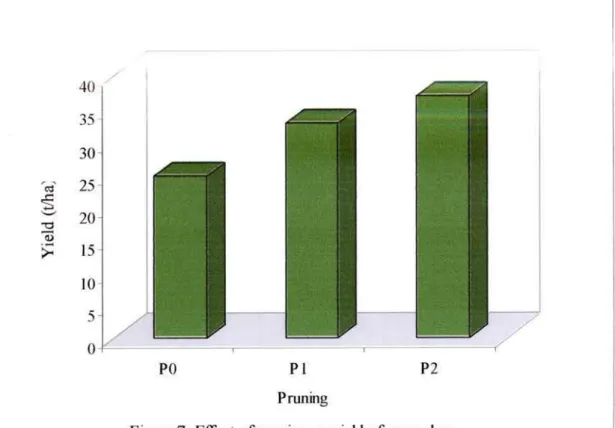
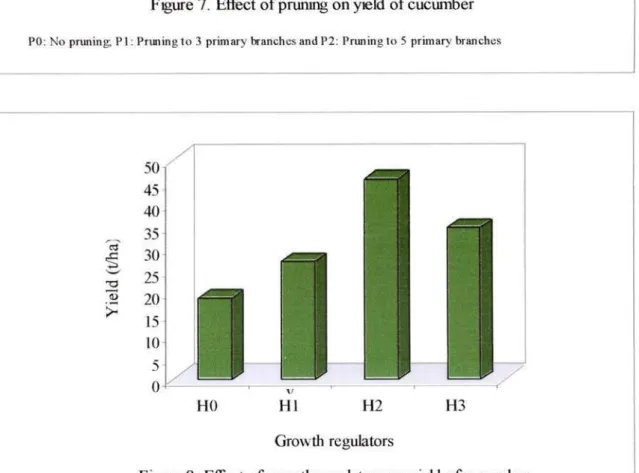
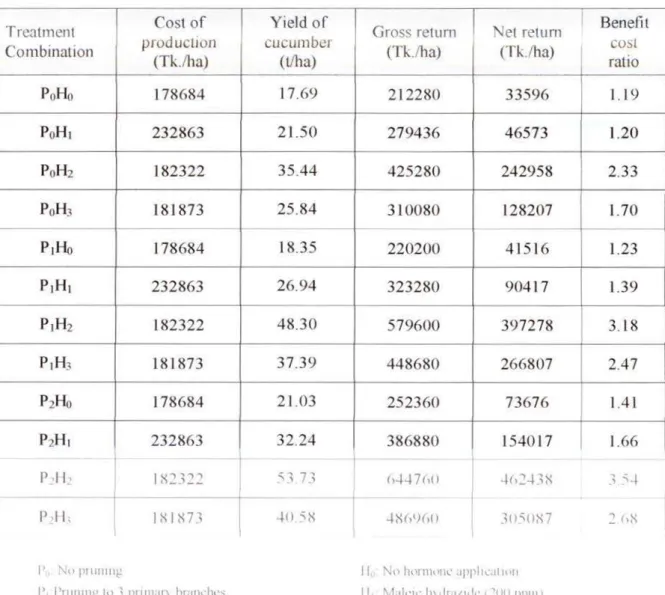
However, the highest number of primary branches ( 12.37), secondary branches (24.31 ), female flower (22.94), fruit per plant (17.07), fruit setting percentage (74.81%), fruit weight (239.78 gm) and yield (45.82 t/ha) were recorded from H2 treatment. The minimum values of the same parameters were observed in Ho treatment or control. Maleic hydrazide and NAA were given lower yield than Ethephon but higher values than the control. Pruning to 5 primary branches showed better results in flowering fruit setting and yield of cucumber than pruning to 3 primary branches. The lowest yield (13.36 kg/plot) was found in Po and highest yield (19.92 kg/plot) was found in P2 treatment. Six days early female flower initiation and four day early fruit maturity was recorded from H2 treatment over control. The lowest male to female flower ratio (2. 75) was found in Ethephon treated plant and highest ratio was found in control. Pruning did not give any significant value in terms of male to female flower ratio. In the interaction of pruning and growth regulators the maximum yield (53.73 t/ha) was found in P2H2 treatment and lowest (17.69 t/ha) was recorded in PoHo treatment. The second highest (48.30 t/ha) yield was obtained from P1H2 treatment which was closely followed by P2H3 treatment (40.58 t/ha). The highest benefit cost ratio (3.54) was attained from the treatment combination of pruming to 3 primary branches and ethephon 300 ppm treated plants.
ABSTRACT
EFFECT OF PRUNING AND PLANT GROWTH REGULATORS ON
GROWTH, FLOWERING, FRUITING AND YIELD OF CUCUMBER BY
ALBELY AFIFA MIR
CHAPTER TITLE PAGE
ACKNOWLEDGEMENT
ABSTRACT II
LIST OF CONTENTS Ill-VI
LIST OF TABLE
VII
LIST OF FIGURE VIII
LIST OF PLATE
VIII
LIST OF APPENDICES
IX
LIST OF ABBREVIATED TERM.S
x
l-3
CHAPTER I INTRODUCTION
CHAPTER 2 REVIEW OF LITERATURE
4-15
2.1
Review results of growth regulators4-13
2.2
Review results of pruning14-15
CHAPTER 3 MATERIALS AND METHODS
16-25
3.1
Experimental site16
3.2
Climate16
3.3
Soil16
3.4
Plant Materials17
3.5
Treatments of the Experiment17
3.6
Experimental design and layout17
3.7
Land preparation 18CONTENTS
CONTENTS (contd.)
CHAPT ER TITL E PAGE
3.8 Pit preparation in the plots 18
3.9 Application of manures and fertilizers 20 3.10 Sowing of seeds and selection of seedlings 21 3.11 Preparation of Plant Growth Regulator (PGR) 21
solution
3.12 Application of Hormone treatments 21 3.13 Application of Pruning treatment 22
3.14 lntercultural Operations 22
3.15 Harvesting 22
3.16 Data collection 23-25
3.16.1 Plant height 23
3.16.2 Number of primary branches per plant 23
3.16.3 Number of secondary branches 23
3.16.4 Node number for 151 female flower 24
3.16.5 Days to 50% flowering per plot 24
3.16.6 Total number of male and female flower per plant 24 3.16.7 Days required to first female flower and male 24
flower
3.16.8 Ratio of male and female flower per treatment 25
3.16.9 Number of fruit per plant 25
3.16.10 Fruit length and girth 25
3.16.11 Yield of fruits 25
3.16.12 Statistical analysis 25
CHAPTER TITLE PAGE CHAPTER 4 RESULTS AND DISCUSSION 26-54
4.1
Stem length (cm)26
4.2
Number of primary branches28
4.3
Number of secondary branches29
4.4
Node for 1 SI male flower30
4.5
Node for I SI female flower31
4.6
Days required for I 51 male flowering34 4.7
Days required for I 51 female flowering35
4.8
Days required for 50% male flowering36
4.9
Days required for 50% female flowering36 4.10
Total number of male flower37 4.11
Total number of female flower37 4.12
Ratio of male and female flower39 4.13
Days required for harvest of green fruit40 4.14
Total number of fruit per plant43
4.15
Fruit setting(%)43
4.16
Average length of individual fruit (cm)47 4.17
Average girth of individual fruit (cm)47
4.18 Individual fruit weight (gm)
48
4.19 Yield (kg/plot)
39
4.20 Yield (t/ha)
50
4.21 Cost analysis
54
CONTENTS (contd.)
CHAPTER TITLE PAGE CHAPTER 4 RESULTS AND DISCUSSION
4.21.1 Gross return 54
4.21.2 Net return 54
4.21.3 Benefit cost ratio 54 CHAPTER 5 SUMMARY AND CONCLUSION 56-59
SUMMARY 56-58
CONCLUSION 59
REFERENCES 60-65
APPENDICES 66-71
CONTENTS (contd.)
I. Main effect of pruning and plant growth regulators on stem length,
32
number of primary and secondary branches and node for 1 SI male and female flower per plant of cucumber
2.
Interaction effect of pruning and plant growth regulators on stemlength, number of primary and secondary branches and node for
33
1 SI male and female flower per plant of cucumber
3. Main effect of pruning and plant growth regulators on days required for 151 and 50% flowering, total number of flower and
41
ratio of male and female flower of cucumber
4. Interaction effect of pruning and plant growth regulators on days
required for 151 and 50% flowering, total number of flower and
42
ratio of male and female flower of cucumber
5.
Main effect of pruning and plant growth regulators on daysrequired for harvest of green fruit, total number of fruit, fruit
52
setting, length, girth and individual fruit weight and yield per plot and hectare of cucumber
6. Interaction effect of pruning and plant growth regulators on days
required for harvest of green fruit, total number of fruit, fruit
53
setting, length, girth and individual fruit weight and yield per plot and hectare of cucumber
7. Cost and return of cucumber cultivation as influenced by pruning
55
and plant growth regulators
PAG E
TITLETABL E
LIST OF TABLES
PLATE TITLE PAGE
I. First female flower in lower node at ethylene treated plant. 31 2. First male Flower in lower node at control treatment. 3 l 3. First mature fruit at lower node in ethylene treated plant. 44 4. Fruit on secondary branches in ethylene treated plant.
44
LIST OF PLATE
FIGUR E TITL E PAGE
l. Layout of the experimental design 19
2.
Effect of pruning on stem length at different days after 27 sowing of cucumber3. Effect of different growth regulator on stem length at 27 different days after sowing of cucumber
4. Effect of pruning on fruit setting of cucumber 45 5. Effect of growth regulators on fruit setting of cucumber 45 6. Interaction effect between pruning and growth regulators 46
on fruit setting of cucumber
7. Effect of pruning on yield of cucumber 51
8.
Effect of growth regulators on yield of cucumber 51LIST OF FIGURE
70-71
68 67
and hectare of cucumber as influenced by pruning and plant growth regulators
Per hectare production cost of cucumber
VI.
of primary and secondary branches and node for l 51 male and female flower/plant of cucumber as influenced by pruning and plant growth regulators
TV. Analysis of variance of the data on days required for I st
and 50% flowering, total number and ratio of male and female flower of cucumber as influenced by pruning and plant growth regulators
V. Analysis of variance of the data on days required for harvest of green fruit, total number of fruit, fruit setting,
length, girth and individual fruit weight and yield per plot 69 I. Monthly recorded of air temperature, rainfall, relative
humidity and sunshine hours during the period from April 66 2006 to August 2006
II. Characteristics of Horticulture Farm soil is analyzed by
Soil Resources Development Institute (SRDI), Khamar 66 Bari, Farmgate, Dhaka
III. Analysis of variance of the data on stem length, number
APP ENDIX
TITLE PAGELIST O F APPENDICES
TSP RCBD
SAU
no.
% MP mo mm m FAO g ha hr kg etc DMRT
DAT cm
oc
AEZ et al.
BBS Agro-Ecological Zone
And others (at elli)
Bangladesh Bureau of Statistics Centimeter
Degree Celsius
Duncan's Multiple Range Test Date After Transplanting
Etcetera
Food and Agricultural Organization Gram
Hectare Hour Kilogram Meter Millimeter Month
Murate of Potash Number
Percent
Randomized Complete Block Design Sher-e-Bangla Agricultural University Square meter
Triple Super Phosphate
ABBREVIATION
FULL
NAMELIST OF ABBREVIATED TERMS
Cucumber is widely consumed both fresh and as a processed food (Jarrick, 1986).
Based on use it may be three types as; salad type, pickling type and cooking type.
In Bangladesh, cucumber is available in all the year round. As ours is a tropical country, it is cultivated both in summer and rainy season. It is mainly cultivated for its young tender fruits which are being used as 'salad' sometimes mature fruits are cooked as vegetable and pickled. The plant starts flowering early and producing marketable fruits within about two of three months depending upon culrivar, region, soil climate, etc.
Flowering in cucurbits is very important phase of development because fruiting and yield depends on this process. Cucumber generally is a monoecius plant. The first flowers to appear near the base of a cucumber plant are male. ln about a weak after male flower initiation the femaJe flowers appear with the small cucumber fruit at the base (Bantoc, 1964). Normally, fruits at the base of the plant are smaller than those borne on laterals or on the upper portion of the plant (Lower et Cucumber (Cucumis sativus) is an annual trailing vine vegetable with a main stem and its branches , belongs to the family cucurbitaceae. It is a warm season crop and has little or no tolerance to frost. Growth and development are favored by temperature above 20°c. The optimum temperature for growing is between 20°c and 30°C. Cucumber is an important vegetable crop of Bangladesh. It is considered as a good source of nutrients for human body as it is mostly taken as fresh. It is a primary source of vitamins and mineral of man (A VRDC, 1999).
Nutrition council of Bangladesh recommended at least 235 g/day/person of vegetables for Bangladeshi adult but the availability is only 65.5 g/day/person.
The Annual production of vegetables in Bangladesh is only 4.31 million tons including potato but we need around 11. 15 million tons vegetable for our population (Anon, 2002).
INTRODUCTION
However in Bangladesh very limited research was conducted to improve femaleness in cucumber. Farmers of ow· country not use growth regulators.
Farmers need to know about growth regulators with proper dose and effective measures to increase the production, quality and yield of cucumber. At present, at a very limited scale the farmers of our country started to use growth regulators to increase the yield of their vegetables as per recommendation of some commercial trader.
"Crops care" is a plant growth regulator in the class of organo-naphthalene, which stimulates cell division and tissue differentiation, promotes enlargement of sexual Exogenous application of growth regulators has shifted the sex expression towards femaleness by increasing the production of female flower and suppressing male flower of cucumber (Singh, 1984 and Arora el al, 1994 ). Moreover, pruning has a significant effect for decreasing the sex ratio in cucumber (Arora and Malik,
1989).
Lower number of female flower compare to male flower is a problem for cucumber production in Bangladesh due to high temperature and humidity. So, it is necessary to increase the number of female flowers as well as fruiting for increasing the yield. High temperature and long photoperiod enhanced the number of male flower. On the other hand, low temperatures of 24°C to 25°C and photoperiod up to 12 h enhanced pistillate flower production. Photoperiod has no influence under gynoecious stability under high temperature, above 30°C.
al. 1986). Cucumber bears unisexuaJ flowers, sex expression rs genetically controlled, but it is emendable to modification by environmental factors and application of growth regulators. There is a wide range in sex ratio of cucumber.
Female and Male flower ratio may vary up to 1: 15 to 1: 13. It can be minimized by some mechanical techniques and chemical practices.
Considering the above facts, the present experiment has been undertaken with the following objectives:
l. To find out the effective Plant Growth Regulators on flowering (Sex ratio) of cucumber.
2. To know the effect of pruning on flowering, fruiting and quality fruit production cucumber.
3. To study the interactions between different hormones and prunmg on flowering, fruiting and yield of cucumber.
However, very few research was conducted to improve the femaJeness and yield of local variety of cucumber by hormone application and pruning practice.
Therefore this experiment will be conducted to determine the effects of pruning and growth regulators on the flowering, fruiting and yield of cucumber.
The growth of plants and other factors can be modified by pruning according to
human desires (Janick, 1986). There are many purposes for vine pruning
treatments in cucumber, such as mechanical harvesting, hybrid seed production, to easily control insect and diseases, to use the higher plant population without significant yield reduction, and to obtain uniform fruits (Humphries and
Vermillion, 1994).Actually, the use of 'Crops care', 'Ripen-IS' and MH had influenced the production of cucumber.
organs, induces fruit and promotes blossoming. "Ripen-l 5" is an organo phosphate compound and a growth regulating agent and the function of "Ripen- 15" is to increase female flower and the ratio female parts, promote blossoming in some plants and accelerate maturation (Hossain, 2004). Maleic hydrazide (MH) is a growth regulator which can stimulate femaJe flowering and give higher fruiting percentage and fruit weight and yield of cucurbits ( Samdyan et al. 1994).
Choudhury et al. ( 1967) carried out an experiment with AA I 00 ppm, IAA I 00 ppm and 200 ppm and MH 50 ppm and 200 ppm. They found that the treatments were equally effective in suppressing the male flowers and increasing the number of female flowers in cucumber over control. There effects subsequently increase the percentage of fruit set and ultimately the yield.
Bukovac and Wittwer ( 1961) reported that cucumber plants treated with gibberellins at a concentration of I 00 ppm to young pickling type cucumber seedling hastened pistillate flowers formation earlier when cucumber plants were grown under short rather than long photoperiod.
2.1 Review results of growth regulators:
Choudhury and Pahatak ( 1959) stated that cucumber plants treated with MH 200
ppm and NAA I 00 ppm and lAA I 00 increased the number of female flowers and MH 600 and 800 ppm, AA JOO ppm and IAA 200 ppm greatly suppressed the number of male flower over control. All treatments increased the female to male flower ratio when compared with the control.
Cucumber is one of the most popular salad vegetable of the world as well as Bangladesh. The crop received much attention to the researcher of different countries including Bangladesh. But a few investigations have been taken on the effect of pruning on cucumber production. There is a little or no combined research work to the effect of plant growth regulators and pruning on growth and yield of cucumber in Bangladesh. The literature and research results related to the present study are reviewed in this chapter.
REVlEW OF LITERATURE
Randhawa and Singh ( 1970) stated that M H 200-300 ppm induced maximum number of hermaphrodite flowers thereby decreasing the sex ratio of cucumber.
They suggested that maximum production of fruits can obtain from the use of MH 200-300 ppm in cucumber.
Freytag el al. (I 970) carried out an experiment on cucumber sex-expression
modified by growth regulators. They found that TlBA IOppm and IOOppm treated plant produced less number of female flowers which treatment with cthrcl at
I OOppm increased femaleness.
Lower el al. ( 1970) reported that cultivar of cucumber Galaxy treated with ethephon at a concentration of 120 ppm at the one-leaf stage of at subsequent leaf stages increased pistillate flower formation.
Sims and Gledhill, (1969) reported that application of ethephon at concentrations
of 50-250 ppm at the fully expanded true leaf stage induced femaleness in the hybrid 'Piccadilly' and reduced the size of the plants by shortening the intemodes.
McMurray and MilJer (1969) stated that cucumber seedJings treated with ethephon at concentrations of 120 ppm, I 80 ppm or 240 ppm increased the number of pistillate flowers. The staminate to pistillate flower ratio was approximately l 0: I.
But in case of ethephon treated plants, the staminate to pistillate flower ratio ranged from I :6 to l: 14, depending on the concentration of ethephon used.
Irving el al. ( 1968) reported that TlBA at 25 ppm was particularly effective in promoting the femaleness in cucumber. The increased Tl BA stimulation of female flowers ranged from 100 to 200 percent. TIBA aJso increased the number of male flowers but lowered the male flowers but lowered the male and female ratio.
Beyer and Quebedeaux (1974) observed that a single application of NAA at concentration ranging from 500 to 5000 ppm increased number of pistillate flowers of cucumber to develop into fruits, while number of fruits were minimum on the controls. Fruits shape was normal but the growth was slightly retarded at 5000 ppm. They reported that application of N-1-naphthylphthalamic acid had positive effect on fruit set and development in cucumber.
Elassar et al. ( 1973) conducted an experiment on the normal and parthenocarpic fruit development. They reported that 8-NOA (napthoxyacetic acid), at rates lower than I 00 ppm and lAA 10 ppm to 100 ppm were effective in normal fruit development and were less effective in producing parthenocapic fruit, GA3 ( J 00- 1000 ppm) and GA4+7 (50 ppm) slowed down the early rate of fruit development as compared with pollinated fruit, but were very effective in accelerating fruit development during later stages.
Augustine et al. (1973) found that MCEB (5-methyl-7 chloro-4- ethoxycarbonylmethoxy-2, 1, 3-benzothiadiazole) had no effect on the androecious phenotype of cucumber while ethephon 500 ppm induced pistillate flowers. The effect of MCEB and ethphon treatment was a marked reduction in the number of staminate flowers. Ethylene induced pistillate flowers except when there was a 48-hour period between application of ethephon and MCEB In gynoecious phenotype, MCEB 75 ppm induced staminate flowers, ethephon had no effect, and the effect of MCEB and ethephon treatment was to induce staminate flowers at relatively high concentrations of MCEB 150 ppm.
Robinson et al. ( 1971) reported that two application of 250 ppm ethephon produced gynoecia in cucumber plant and reduced intemodes length and number of secondary braches.
Gopalkrishnan and Choudhury ( 1978) reported that in contrast with TISA, GA in general produced the largest number of male flowers; GA at the lowest concentration of I 0 ppm produced more number of female flowers in first year.
Treatment with TIBA at 50 ppm, 100 ppm and 200 ppm excelled all the other treatments in producing a favorable female to male flower ratio TlBA from 50 ppm to 200 ppm gave a significant increased in the number of fruits and weight of fruits of cucumber.
Das and Swain (1977) reported that Alar 200 ppm produced the maximum number of fruits followed
by
its lower concentration and ethrel as compared to the control.Alar 200 ppm with 40 kg/ha nitrogen significantly produced more number of fruits followed by Alar I 00 ppm with 40 kg/ha nitrogen and also produced heaviest fruit followed by ethrel I 00 ppm with 40 kg/ha of nitrogen, ethrel 200 ppm with 20 kg/ha of nitrogen.
Bisaria ( 1976) reported that MH 200-300 ppm and chloroflurenol 40-200 ppm induced femaleness in cucumber plant.
Bhandary et al. (1974) observed that the first female flower appeared earlier while male flower appearance was delayed after ethephon treatments 100-300 ppm sprayed at seedling stage in cucumber.
Brokowski (1974) reconunended ethephon 120 ppm for god fruit production of cucumber. He also reported that complete male flower sterility and maximum production of female flowers can occur with 240 ppm ethephon.
Churata Masca and Awad (1974) observed improvement in early and total yield with ethephon 100-400 ppm applied twice to foliage prove beneficial in increasing fruit yield in rnonoecious cucumber.
Hume and Love]) ( 1983) reported that application of ethephon to field-grown plants of both bush and trailing forms of Cucurbita maxima and C. pepo caused leaf epinasty, suppression of male flowers and earlier production and increase in Gosh and Basu ( 1983) found that spraying with LAA at 17.5 or 35 mg/I increased the nwnber of female flowers. Eth rel at 25 mg/I increased female flowers but I 00 mg/l decreased it. GA application at 60 mg/l increased the number of female flowers. All GA application reduced the ratio of male to female flowers.
Sidhu el al. (1982) conducted an experiment to study the effect of prunng and grwth regulators on musk melon. They recommended that the foliar spray of ethephon 500 ppm for obtaining maximum fruit yield in both pruned and un pruned muskmelon cv Hara Madhu.
Mangel et al. (1981) conducted an investigation to study the influence of various chemicals (Ethrel, NM Cycocel, MH, PCPA, Ascobric acid and Boron) on the growth, flowering and yield of bitter gourd. PCP A at I 00 ppm improved plant growth significantly. The treatment of CCC at 250 and 500 ppm produced female flowers about 12 days earlier in comparison to control plant Maximum fruit yield per plant (3 I 23gm) was produced under Cycocel 250 ppm followed by Ascorbic acid 25 ppm and Cycocel 500 ppm.
Choudhury and Phatak ( 1981) studied the effect of concentration of MH, NAA, lAA and 2, 4-D on the sex expression and sex ratio of cucumber. They found that MH 200 ppm and NAA I 00 ppm increased the number of female flower significantly over the control. MH 600 ppm and 800 ppm, NAA 100 and IAA 200 ppm and CAA I 00 ppm suppressed the nwnber of male flowers over the control IAA 100 ppm and 200 ppm and NAA 200 ppm stimulated the growth.
Vadigeri and Madalageri (1989) found that Seedlings of Poinsette and Belgaum Local at the 4-6 leaf stage were sprayed with Ethrel [ethephon] at 200 ppm or 400 ppm and GA3 [gibbereJlic acid] 5 ppm or I 0 ppm and subsequently evaluated for sex ratio (male : female flower) and yield. Ethrel at 400 ppm had the greatest effect on both genotypes, significantly increasing the number of female flowers and fruits/plant compared with the untreated controls.
Sreeramula ( 1987) reported that ethrel I 00 g/1 increased the number of pistillate flowers and also hastened appearance of the female flower compared to the control in sponge gourd. It also delayed the appearance of the first staminate flower and also decreased the total number of male flowers.
Verma et al. (1984) reported that ethrel 100 ppm delayed the appearance of first male flowers of cucumber MH 200 ppm and Born 3 ppm and 4 ppm produced the earliest female flowers but at a higher node, while ethrel l 00 ppm induced the first staminate and pistilJate flower at the lowest nodes at 6.5 and 9.5 respectively.
Boron 4 ppm also proved superior to all the other chemicals in producing the maximum fruits and yield.
numbers of female flowers. This gave rise to an increase in the ratio of female to male flowers per plant and a decrease in the total number of flowers. The sex of the main bud at the first five to six nodes is usually determined at this stage but the secondary buds still have bisexual potential. The change in sex expression was brought about by all male flower buds that had formed by the spraying time aborting, and all buds that developed (both main and secondary) for at least 7 days after spraying became female flowers. Thus, nodes five and six had male flowers in the controls, whereas in ethephon-sprayed plants the presumptive male flowers aborted at the bud stage at these nodes and secondary primordial developed into functional femaJe flowers.
Ying el al. (1994) conducted an experiment on hormonal control of sexual differentiation in bottle gourd. They reported that the sex expression of cucurbit flowers can be modified by plant growth regulators, especially ethylene. The treatment of leaves or shoot tips of bottle gourd with ethephon (3 .5 mm) resulted promoted the production of female flowers. Female flower production and ethylene evolution increased with the earliness of the cultivar. They also reported that ethylene response was inversely correlated with the amount of 1- (molonylamino) clyclopropane -1- carboxylic acid (ACC) in the tissue. Treatment with ACC changed the direction of sexual differentiation in potentially male buds to female buds. At last the scientists concluded that ethylene induces female flowers in bottle gourd by suppressing the differentiation of stamen primordial and thereby promoting that of pistil primordial.
Rudich (1990) reported that the application of Ethrel (2-chloroethance phosphonic acid), an ethylene-releasing compound, to monoecious cultivars of cucumber and squash and an andromonoecious cultivar of muskmelon, caused a shift towards femaleness in aJl three species. The increase in femaleness manifested itself in several symptoms: a decrease in the number of staminate (male) flowers, an increase in the number of pistillate (female) or hermaphrodite (perfect) flowers, and a change in flowering pattern, namely, formation of female flowers at lower nodes in cucumber and squash and formation of hermaphrodite flowers on the main axis in muskmelon where normally only male flowers are formed in this cultivar.
Islam et al. (1990) reported that the bottle gourd plants treated with AA 200 ppm produced fruits of maximum length and girth, whereas fruits to minimum length and girth in control. Numbers of fruits per plant were also found maximum in plants where NAA 200 ppm was applied. Hormone application at the rate of 200 ppm NAA produced maximum yield (48.15 t/ha).
Arora el al. ( 1994) reported that flower application of plant growth regulator had significant effect on growth, flowering and yield of long melon. The experiment was conducted during the summer seasons of J 991 and 1992 to study the effect of ethephon, GA3. maleic hydrazide (MH), and NAA on melon. Growth regulators were applied at the 2-and 4-leaf stages. GA3at 25 mg/litre resulted in the longest vine length (3.97m), whereas vine length in controls (water sprayed) was 2.82 m.
Ethephon at 250 mg/litre resulted in the highest number of braches/plant (10.8).
shortest internode length (8 cm), lowest male : female flower ratio (3.1), fewest days to first female flower (68 days), highest number of female flower/plant (27) Kim el al. ( 1994) reported that application of auxin transport inhibitors, naptalam (N-1-naphthylphthalamic acid) and Tl BA to the ovary or peduncle of cucumber flowers (cultivars Khira and Pandex and their F1 hybrid) significantly increased the IAA content of the ovary. The ratio of IAA:IBA in po11inated or naptalarn-or TIBA-treated ovaries was also higher than that in unpollinated controls. The unpollinated ovaries of genetically parthenocarpic cv. Pandex showed 92% fruit set, whereas the non-parthenocarpic cv. Khira ovaries failed to set fruit and the F1 hybrid had only 8o/o fruit set. Application of auxins, AA and 4-CPA, GA3
cytokinins, BA and CPPU [forchlorfenuron] to the ovary at anthesis, however, induced over 60% parthenocarpic fruit set in Khira and the F 1 hybrid.
Samdyan el al. (1994) carried utan experiment on bitter gourd with different plant growth regulators. They reported that thickness or weight of rind and fruit rind:
flesh ratio were recorded maximum with MH 50 mg/l, while maximum thickness or weight of flesh, dry matter vitamin 'C' and T.S.S. contents were observed with cycocel 250 mg/I GA3 25 mg/I resulted in maximum seeds in fruits. while MH 25 mg/I and ethrel 100 mg/I caused maximum weight loss of fruits 2 DAS or 4 DAS, respectively. N 50 kg/ha
+
ethrel 100 mg/1 or GA3 25 mg/I improved the shape index and seed control of fruits, respectively.Al-Masoum (1999) reported that Cucumber cv. Beit Alpha was grown in a greenhouse in 1996-97 and ethephon applied at 250 ppm, 350 ppm or 450 ppm at the seedling stage (2-4 true leaves). Data were collected on the total yield, early, late yield, number of female flowers; number of male flowers; days to the first female flowers; days to the first male flowers; number of nodes to first female
Baruah and Das (1997) stated that NAA (25 and 100 ppm) and Maleic hydrazide (50 and 100 ppm), applied at the 2-true leaf stage and sowing dates (15 day intervals from l 0 September to 25 October) had significant influence on the growth of lagenaria siceraria ( cv. Kiyari Lao) during rabi 1994 to 1995 in India.
They observed that treated plants with NAA at 25 ppm and MH at 50 ppm produced the best yields (5.48 and 4.86 kg/plant respectively). Yield decreased with later sowing dates from 5.49 to 2.62 kg/plant.
Gedarn et al. (1998) conducted an experiment on bitter gourd plants treated with 15 ppm, 25 ppm or 35 ppm GA3 50 ppm or 150 ppm NAA, 50 ppm, 100 ppm or 1 SO ppm ethephon, l 00 ppm, 200 ppm or 300 ppm maleic hydrazide, 2 ppm, 4 ppm or 6 ppm boron or with water (control). GA3 at 35 ppm produced the earliest male flower and NAA at 50 ppm produced the earliest female flower. Fruit maturity was earliest in plants treated with 50 ppm AA or 4 ppm boron.
Das and Rabhal (1999) reported that in a greenhouse experiment on cucumber cultivars Chinese green, Pusa Sanyog and Poinsette, NAA was applied at 30 ppm or l 00 ppm, kinetin at l 0 ppm or 50 ppm and Ethrel at 250 ppm or 500 ppm at the 4- to 5-leaf stage and at flower bud appearance. NAA application produced the largest fruits with the highest flesh : placenta ratio. TSS and ascorbic acid content were highest when Ethrel was applied.
and fruits /plant (17. 7) and highest plant yield (1.36 kg/plnat). Ethephon at 250 mg/litre also gave the highest fruit yield/ha (29.76 t), while GA3 at 25 mg/1itre gave the lowest (11.08 t).
I
About (45%) more female flower was recorded in cucumber from the plants treated with 2.0 ml of "Ripen-LS" and (56%) more female flower was recorded in bittergoud treated with 2.5 m of "Ripen-l S". About 7 ton more yield was found from 0.4 ml of "Crops care" both in cucumber and bitter gourd. 2.0 ml of "Ripen- 15" gave 7.6 t/ha and 7.85 t/ha more yield in cucumber and bitter gourd respectively over the control.
Hossain (2004) conducted an experiment to study the effect of "Crops care"
(NapthaJene Acetic Acid, NAA 4.5%) and "Ripon-I S" ( 15% Ethephon) on the flower initiation, fruit set and yield of cucumber (Barishal HYV) and bitter gourd (Tia HYV) during April to August, 2003 at the experimental farm of Bangabandhu Sheikh Mujibur Rahman Agricultural University, Gazipur. Four concentrations of
"Crops care" 0.2 ml (9 ppm), 0.3 ml ( 13.5 ppm), 0.4 ml ( 18 ppm) and 0.5 ml (22.5 ppm) and five concentrations of "Ripon-LS" 1.0 ml ( 150 ppm), 1.5 ml (225 ppm), 2.0 (300 ppm), 2.5 ml (375 ppm) and 3.0 ml (450 ppm) were applied in the experiment. "Crops care" and "Ripen-IS" showed positive effects on different yield attributing characters of cucumber and bitter gourd treated plants compared to the control. Early female flowers (6 to 7 days) and early fruit maturation (5 days) were found in both cucumber and bitter gourd plants treated with "Crops care" (0.5 ml) and "Ripen-t S" (3 ml) compared to control. "Crops care" (0.4 ml) gave about (30%) more female flower in cucumber and (32%) more in birrergourd.
flower, number of nodes to the first male flower and plant height. Positive result was found form ethephon treated pants in case of all parameters. Greater fruit yield was given from the ethephon treated plants because ethephon induced femaleness (pistillate flowers) on the main stem. Ethephon induced femaleness (pistillate flowers) on the main stem that led to greater fruit production.
Thang (1995) reported that an experiment was carried out on the effect of six different pruning methods on the yield of cucumber variety Poung and evaluated from December 1995 to February 1996 at A VRDC-ARC experimental field, Kamphaengsaen, Nakhon Pathom, Thailand. The local cucumber variety Poung was chosen for the field experiment. The treatments of the experiment were o pinching (Mo), Pinching branches on main stem at node 10 up to down (M1),
Pinching branches on main stem at node 15 up to down (M2), No pruning (P0) and pruning branches at node 4 (P1). The highest yield (total yield = 19.72 t/ha, marketable yield = 14. 93 t/ha, non-marketable yield = 4. 79 t/ha, early stage yield=
3.28 t/ha) was obtained by the treatment M0P1, with no pinching of branches on main stem but pruning braches at node 4. The method of pruning branches had no significant effect on horticultural character such as fruit size and plant height. The pinching treatments had low yield. This was resulted because of the absence of sufficient branches.
Gobeil and Gosselin ( 1989) conducted an experiment on the influence of pruning season of cucumber. They reported that summer pruning gave a high production of fruits.
Arora and Malik (1989) reported that pruning of ridge gourd plants to six primary branches with a medium spacing level ( 45 cm) produced the longest plants, gave maximum number of secondary branches, resulted in early appearance of pistiUate flowers, lowered sex ratio and gave higher number and weight of fruits from early and total yield. The result of reduced sex ratio for pruning was due to more production of secondary branches on which pistillate flowers appeared in large number.
2.2 Review results of pruning
Nu (1996) stated that the effect of pruning (pinching out the branches on main
stem at node 4 up to the bottom and prune when lateral shoots on main stem set fruit on first on second node of lateral shoot) on yield and fruit quality of four cucumber varieties, namely; Lanna-5 (F1), Nopakao (F1), Lan-Laem (op) and Poung (op) was evaluated using a 4 x 2 factorial experimental design with no pruning treatment. The experiment was canied out at the ARC-A VRDC experimental field, located at Kasetsart University, Nakhon Pathom, Thailand form November 1996 to February 1997. The no prumng treatment produced the highest total yield 22.18 ton/ha as well as highest non- marketable yield 7. 70 tJha while the pruning treatment produce low non marketable yield 5.16 tJha and total yield 17. 11. But, the number of branches, nodes and stem length was higher in the pruning treatment.
Soil series- Tejgaon
General soil - Non -calcareous dark gray.
AEZ No. 28 3.3 Soil
The soil of the experimental area belongs to the Modhupur Tract (UNDP 1988).Soil analysis report of the experimental area was collected from Khamarbari, Dhaka which was determined by SRDI, Soil testing Laboratory. The analytical data have been presented in appendix-Il.
The experimental site was a medium high land and rH of the soil was 5.4 to 5.6.
The morphological characters of the soi I as indicated by F AO ( 1988) are given below-
The experimental site is located in subtropical region where climate is characterized by heavy rainfall during the months from April to September (Kharif season) and scanty rainfall during rest of the month (Rabi season). The maximum and minimum temperature, humidity rainfall and soil temperature during the study period arc collected from the Bangladesh Meteorological Department (Climate division) and have been presented (Appendix- I).
3.2 Climate
This chapter deals with the major information's that were considered to conduct the experiment.
3.1 Experimental site
The experiment was conducted at the Horticulture farm of Sher-e-Bangla Agricultural University, Dhaka. The experiment was carried out during the period from April 2006 to July 2006. The location of the site in 23°74" N latitude and 90°35" E longitude with an elevation of 8.2 meter from sea level (Anon, 1989).
MATERIALS & METHOD
It was a factorial experiment. The experiment was laid out in a Randomized Complete Block Design (RCBD) with three replications. An area of 24 m x 16 m was divided into six equal blocks. Each block was divided into six plots. Firs two blocks were included in first replication (R1) and 3rd and 41h block was in second replication (R2) and last two blocks was in third replication (R3). Every replication had twelve plots where 12 treatments were allotted at random. The size of each 3.6 Experimental design and layout
There were altogether 12 treatments combination such as HoPo, HoP" HoP2, H 1 Po, H1Pi, H1P2, H2Po, H2P1, H2P2, H3Po, H3P1, H3P2_
TII. P2 (Pruning to five primary branches) Factor A: Plant growth regulators (Four type)
I. Ho (Control)
11. H 1 (Maleic Hydrazide 200 ppm)
Ill. H2 (Ehephon 300ppm)
IV. H3(NAA l8ppm) Factor B : Pruning (Three type)
1. Po (No pruning)
II. P1 (Pruning to three primary branches) 3.5 Treatments of the Experiment
The experiment was designed to study the effects of different types of plant growth regulators and shoot pruning practices on growth, flowering and yield of cucumber. The experiment consisted of two factors as follows:
3.4 Plant Materials
Seed of 'Baromashi' local variety of cucumber were obtained from BADC, Sher- e-Bangla Nagar, Dhaka.
There were six pits in every plot The length and breadth of each pit was 30cm and 30cm respectively. There was 20cm depth in pits and 45cm distance from the border of the plots. The pits were prepared with necessary manures and fertilizers in
?1
11 April, 2006.3.8 Pit preparation in the plots
The selected land for the experiment was opened 23 March, 2006 with the help of a power tiller and then it was kept open to sun for 4 days prior to further ploughing. Then the land was prepared well by plonghing and cross ploughing followed by well by laddering. Weeds and stubble were removed and the basal dosed of fertilizers were applied and mixed thoroughly with the soil before final land preparation. The unit plots were prepared by keeping l m spacing in between two plots and 50cm drain was dug around the land. The space between two blocks and two plots were made as drain having a depth of about 30 cm.
3.7 Land preparation
plot was 3m x l .8m. The distance between two blocks and two of plots both were lm. A layout of the experiment has been shown in Fig. 1.
Fig 1. Layout of the experimental design
24 n
I H, P2 I B B B B B n
B B B B B B B B B B B EJ B B B B B B B EJ B B B B B B BB B B
1.8m 16m
A common dose of cow dung@ 1 kg per pit, urea @7 gm per pit, TSP@ 12.5 gm per pit and · iP@ 6 gm per pit was applied during pit preparation in the respective plots a week before seed sowing. The rest 8 gm urea and 4 gm MP per pit was given in two installments. 4 gm urea and 4 gm MP was given in each pit after 3 weeks of seed sowing and the rest 4 gm urea was given in each pit after 5 weeks of seed sowing.
Manures and fertilizers Dose per plot Dose per pit
Cow dung 6k 1 kg
Urea 90 g 15g
TSP 75g 12.5 g
MP 60 g 10 g
Manures and fertilizers applied uniformly in the experimental plots and pits as per following doses in accordance with the recommended dose.
150 kg 125 kg 100 kg TSP
MP
10 ton Cow dung
Urea
Dose per hectare Manures and fertilizers
Following doses of manures and fertilizers were recommended for cucumber production by Rashid (1994 ).
3.9 Application of manures and fertilizers
ln the experiment each f the three plant growth regulator solution were applied in three installments. 1~1 spray was done at 2 to 4 true leaf (fully expanded) stage of seedlings with the help of a hand sprayer on 26th April, 2006. 2°d spray was done 3.12 Application of Hormone treatments
c) NAA 18 ppm (H3): To make AA 18 ppm solution 0.40 ml "Crops Care"
was added with 2 ml surfactant and then the solution was made upto 1000 ml by adding distilled water and shacked well.
b) Ethephon 300 ppm (H2): To make Ethephon 300 ppm solution 0.705ml
"Ripen- 15'' was added with 2 ml surfactant for increasing the additive
value.Then the solution made upto 1000 ml by adding distilled water ad shacked well.
a) Maleic hydrazide 200 ppm (H1): To make maleic hydrazide 200 ppm solution 0.2 gm maleic bydrazide powder mixed with 2ml NH40H solution. Then 2ml surfactant was added with the solution for increasing the additive value. Then the solution was made upto 1 OOOmJ by adding distilled water and shacked well.
The solutions were prepared through following procedures:
Three different plant growth regulators were used in the experiment. "Crops Care" (NAA 4.5o/o), "Ripen-IS" 42.5% ethephon and maleic hydrazide powder were used to prepare AA (18 ppm), ethephon (300 ppm) and maleic hydrazide (200 ppm) solutions respectively.
3.11 Preparation of Plant Growth Regulators (PGR) solution
The seeds were sown directly in the pit on 12th April. 2006. 2 to 3 seeds were sown in each pit at 2 to 3 cm depth when the seedlings attained I 0-15 cm height and hard enough then one healthy seedling was selected to remain in each pit and others were thinned out.
3.10 Sowing of seeds and selection of seedlings
3.
t
4.5 Plant protectionCucumber is a very sensitive plant to various insect pests and diseases. So, various protection measures were taken. Melathion 57 EC and Ripcord was applied 2 ml
r
1 against the insect pests like beetle, fruit fly, fruit borer and other. The insecticide 3.14.3 Vine management
for proper growth and development of the plants the vines were managed upward by hand and with the help of iron rope and nylon net. So, the rainy and stormy weather couJd not damage the growing vines and fruits of the plants.
3.14.4 Irrigation
The experiment was done in summer season. So, irrigation was given when it is necessary. Sometimes rain was supplied sufficient water then irrigation was no need. When irrigation was supplied then it was given through drains of the plots.
3.14.1 Weeding:
Weeding was done when ever necessary to keep the crop free from weeds.
J.14.2 Sta king:
When the seedlings were established, staking was given to each plant. Stick of dhaincha plant was given to support the growing twig.
3.14 lntercultural Operations
Side branches on main stem were pruned according to treatments. When the branches were appeared from the main stem and became 2-3 cm long then that was pruned. Pruning was done from the basal nodes of the plants according to treatments. First pruning was done on 4th may, 2006.
3.13 Application of Pruning treatment
after 7 days of I st spray and 3rd spray was done after I 0 days of 2"d spray to the
leaves and twigs of the plants with a knapsack sprayer.
3.16.3 Number of secondary branches
Total number of secondary branches was counted at final harvest from each plant of the treatment. Mean value was calculated by the following formula
Total number of primary branches N b f · b h from six plants of each treatment
um er o pnmary ranc es= ---·---
6
3.16.2 Number of primary branches per plant
Total number of primary branches was counted at last harvest from each plant of the treatment and mean value was calculated. The pruned branches number was also included in counting. Mean value was calculated by the following formula.
3.16 Data collection 3.16. l Stem length (cm)
Stem length was taken at three times and. measured in centimeter from ground level to tip of the main stem from each plant of each treatment and mean value was calculated.
When the green fruits were in marketable condition then they were harvested.
Total eight times harvesting was done from every plant at three days interval from every plot.
3.15. Harvesting
application was made fortnightly from 10 days after seed sowing to a week before first harvesting. Food trap was also given to prevent fruit fly with a mixture of ripe sweet gourd and Cyperson in earthen pots. During cloudy and hot weather precautionary measures against viral disease like mosaic of cucumber was taken by spraying. Furadan I 0 G was also applied @ 5 gm/pit during pit preparation as soil insecticide.
3.16.7 Days required to first female flower and male flower
Days required to first female and male flower initiation was recorded. Number of days required from sowing to first flower initiation was recorded for every plant and average was calculated.
calculated by the following formula
3.16.6 Total number of male and female flowers per pant
Number of female flower per plant was counted from first female flower appearance and it was take at three days intervals. Total number of female flowers was recorded from six plants of each treatment. It was calculated by the following formula.
Number of male flowers was also conducted from first flowering and at three days intervals. Total number of male flower was recorded from each treatment and was 3.16.5 Days to 50°/o flowering per plot
Different dates of the 50% flowering from sowing data were recorded and then the observations were calculated.
3.16.4 Node number for 151 female and male flower
When first female flower was appeared in any plant of each treatment then the node number of that plant was counted. This data was taken from each plant of each treatment and mean value was calculated. In the same way node for l " male flower was also calculated.
Total number of sec ondarybranches from six plants of each treatment Number of secondary branches per plant= ---
6
3.16.12 Statistical analysis
The recorded data on different parameters were statistically analyzed using MST AT software to find out the significance of variation resulting from the experimental treatments. The mean for the treatments was calculated and analysis of variance for each of the characters was performed by F (valiance ratio) test. The differences between the treatment means were evaluated by LSD test at l % or 5%
probability.
3.16.11 Yield of fruits
To estimate yield, all the six plants in every plot and all the fruits in every harvest were considered. Thus the average yield per plot was measured. The yield per hectare was calculated considering the area covered by the six plants.
3.16.10 Fruit length and girth
Fruit length and girth was taken by measuring tape in centimeter. Girth i.e. breath of fruit was measured at the middle portion of fruits from each plot and their average was taken. Average length of same fruits was also taken.
3.16.9 Number of fruit per plant
Number of fruit was counted from first harvest stage to last harvest. The total number of fruits per plant was counted and average number of fruit was recorded.
It was recorded by the following formula.
Total number of fruits
N b f frui I from six plants of each treatment um ero its perp ant=---'"---
6
3.16. 8 Ratio of male and female flower per treatment
The ratio of male and female flower was calculated from total number of male and female flowers. Ratio of male and female flower was calculated by dividing of male flower by female flower.
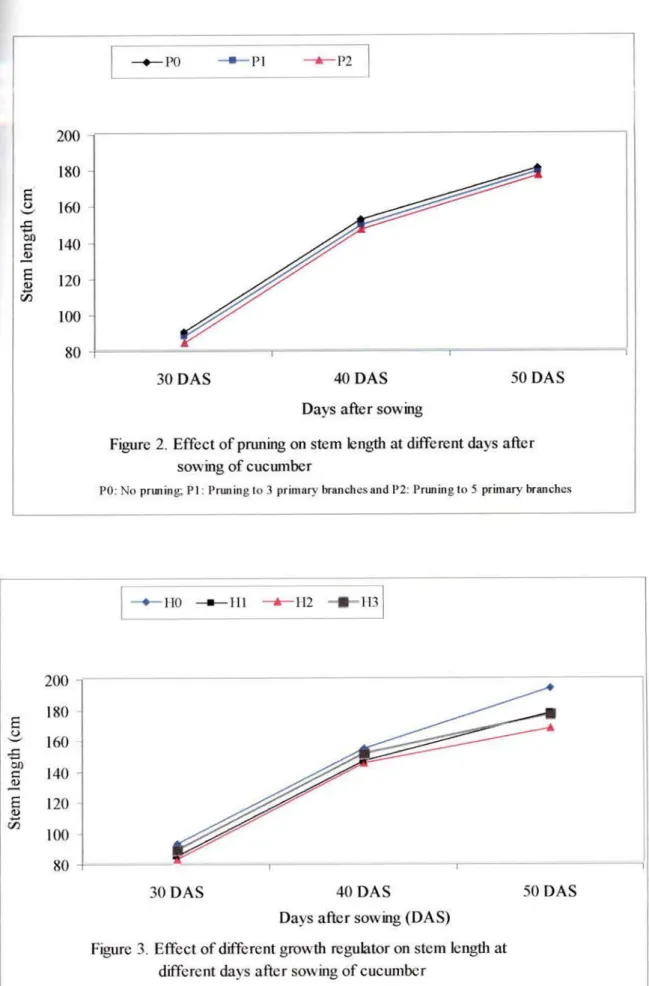
ln terms of stem length in relation with different type of plant growth regulators at 30 DAS, 40 DAS and 50 DAS a statistically significant difference was recorded
4.1 Stem length (cm)
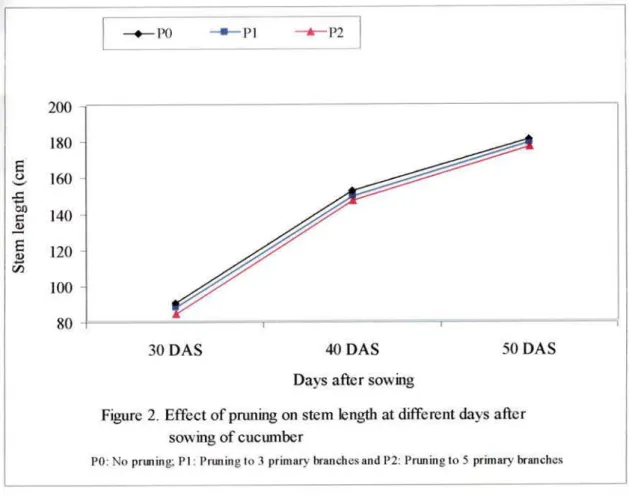
A statistically significant variation was found in stem length due to with different levels of pruning at 30 DAS, 40 DAS and 50 DAS. Length of the main showed a gradual decreasing trend start from no pruning to pruning to 5 primary branches at 30 DAS. The maximum stem length (90.59 cm) at 30 DAS was recorded from Po treatment which was closely followed by P1 treatment (87.30 cm) consisting of pruning to 3 primary branches (Figure 2) and the minimum stem length (83.72 cm) was recorded from P2 treatment comprising of pruning to 5 primary branches. At 40 DAS the maximum stem length (152.86 cm) was recorded in P0 treatment and the minimum (146.71 cm) length was recorded from P2 treatment. At 50 DAS the maximum stem length (181.50 cm) was recorded from Po treatment and the minimum stem length ( J 76.25 cm) was recorded from P2 treatment. The results indicated that maximum stem length was produced the cucumber plant without any pruning. It may be due to the plant suffered some shocking period of pruning which hindered the growth of main shoot and due to producing more lateral shoot over control.
The present experiment was conducted Lo determine the effect of pruning and
growth regulators on the yield contributing characters and yield of cucumber. The analysis of variance (ANOV A) of the data on different yield components and yield of cucumber are given in Appendix lll-V. The results have been presented and discussed, and possible interpretations have been given under the following headings:
RESULTS AND DISCUSSION
l lO: No hormone application; 111: Malcic hydrazidc (200 ppm); H2: Ripcn-15 (Ethcpnn-300 ppm) and 113:
30 DAS 40 DAS 50 DAS
Days after sowing (DAS)
Figure 3. Effect of different growth regulator on stem length at different days after sowing of cucumber
200 E 180
o 160
..__, -£i Oil
140
c Q)
E 120
....
Q) C/)100 80
Figure 2. Effect of pruning on stem length at different days after sowing of cucumber
PO: No pruning; PI: Pruning to 3 primary branches and P2: Pruning to S primary branches Days after sowing
50 DAS
40 DAS 30 DAS
c-.-po
200 180 E o