Productivity of
Kalung
Crickets (
Gryllus bimaculatus
) Cultivation
(Case Study in Central and East Java)
Y.P. Rahmawati, H. C. H. Siregar1), & L. Cyrilla 2)*
1)Department of Production Science and Technology Faculty of Animal Science, Bogor Agricultural University, Bogor 16680 Indonesia
2) Department of Production Science and Technology Faculty of Animal Science, Bogor Agricultural University, Bogor 16680 Indonesia,
*e-mail: [email protected]
Abstract
The research was conducted to analyse technical and economical of Kalung crickets cultivation productivity and to analyse any factors that influence them. The research was conducted in Central Java (Demak, Kudus, and Purwodadi) and East Java (Tulungagung, Kediri, and Porong) from March 3rd until March 12nd, 2010. The research consisted of two stages: (1) determination of research area and the number of samples and (2) data collection. Survey method was used in this research and the samples were selected purposively based on farm scale and farmer’s experience. The farm’s productivity, income and R/C ratio were analysed descriptively. The average of cricket’s production in Central and East Java were 9.78 and 12.69 tons/year respectively. Technical productivity in both provinces was not different, in contrary to economical productivity. The average income in Central Java was IDR 134,714,300.00 or 72.21% from IDR 186,566,666.00 revenue, while in East Java was IDR 149,899,333.00 or 58.56% from IDR 255,960,000.00 revenue. The R/C ratios in both provinces were more than one which meant the enterprises is profitable and feasible economically. The value of R/C ratio in Central Java (3.5) was higher than East Java (2.6). Low R/C ratio value in East Java was caused by high cost in feed, equipment and cage. The farmers should utilize local resources optimally.
Key words: income, kalung crickets (Gryllus bimaculatus), productivity, R/C ration
Introducton
East Java Provnce attempted to cultvate crcket so that the area s renowned as a centre for the cultvaton of crckets. The research objectves were to evaluate the
productvty of the cultvaton of Kalung crckets techncally and economcally as
well as the factors that affect the productvty of Kalung crckets cultvaton.
Materals and Method
The research was conducted n the communty of Kalung crcket’s cultvators
n Central Java (Purwodad, Demak, Kudus) and East Java (Tulungagung, Kedr, Porong). Research was carred out for two weeks, from March 3 to 12, 2010.
The materals used n ths study were statonery, thermometers, cameras, and
questonnares to obtan prmary data cultvaton of Kalung crckets n the farmer’s
communty. Prmary data was collected usng a questonnare through drect ntervew wth respondents. The respondents were purposvely selected n each regon; one person was taken of each regon. Selected farmers are crcket’s cultvators that have greatest and longest cultvated for more experenced and skll of the cultvaton of crckets. Secondary data was obtaned from the lterature and report documents from related government agences.
Ths research was desgned as a survey. Descrptve analyss was used to descrbe the characterstcs of crcket’s cultvaton technques, crcket’s productvty, and ncome analyss.
Results and Dscusson
Kalung Crickets Cultivation Techniques
Kalung crcket’s hatchng eggs are usually derved from ther own cultvaton or some were obtaned from ccada eggs merchants. Egg harvestng s done usng a straner or seve to separate the eggs from the sand and drt. Harvestng s done every day. Eggs that have been harvested then ncubated for hatchng. Meanwhle the meda s returned to the nestng box for brood stock mantenance. Ths must be done to antcpate the possblty f not the entre parents spawnng. Examnaton of spawnng meda s done every 3-4 days. The characterstc of a good qualty crcket’s eggs are cream-colored, translucent, shny, clean, not dngy, and warm
when wrapped (Pamn, 1999; Pamn et al., 1999). Crcket’s cultvators use cloth,
sand, and sawdust for hatchng meda. The relatve humdty requred for hatchng
eggs range between 65-80%, wth ar temperature 26 oC. Temperature and relatve
humdty needs to be mantaned to prevent the hatchng falure caused by poor egg qualty, unsutable mosture and many predators. Nymph’s mantenance s mportant n crcket’s cultvaton.
open and closed or compound and no compound. Selecton of the type s more due to the ease of feedng and drnkng, mantanng, harvestng, cleanng cages and for the preventon from predator. The crckets are placed n an area free from drect sunlght and complemented wth a hdng place, made of dred banana leaf or egg tray. Observaton n the feld showed that the cage cleanlness was mantaned properly. Farmers always change the hdng meda and the cultvator used pedestal n feedng ther crckets. Cages were also prevented from predators such as lzards, ants, mce and other anmals by coverng the cage wth gauze, cloth, ant-ants chalk or puttng mat contanng kerosene or used motor ol on each foot cage. The average sze of the cage for 4000 crckets per cage n Central Java was 250x112x50 cm and 230x112x58 cm n East Java. Cage densty n both provnces was lower than the densty reported by Wdyanngrum (2001) that was 5000 crckets n every cage. Ths
cage densty affected the crcket’s mortalty.Problems that affect crcket’s mortalty
are low hatchablty, cage’s densty, unsutable temperature, dwarfsm, cannbalsm, dsease and death-smellng darrhea.
Crckets feed on Central and East Java conssted of concentrate and forage. Cultvators used layng qual or broler feed for crcket’s concentrate. Forages used by farmers n Central and East Java, were banana stems, squash, cassava leaves, thorns cottonwood leaves, cabbage leaves, grass, mustard greens, fruts and stems of papaya. Varaton of forage feed depended on the forage resources avalable n each area. Vta chck and vtamns were commonly gven when the envronmental condtons of cultvaton was not good.
Cricket’s Productivity
Techncal productvty of the cultvaton of Kalung crckets n Central and East
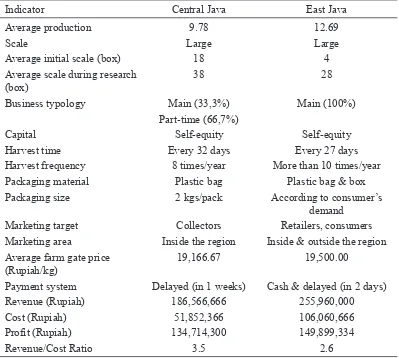
Java vary n each producton perod. Ths s due to many factors that nfluence cul-tvaton such as temperature and humdty envronment, predators, egg qualty, feed qualty, and cultvator’s management sklls (Wdyanngrum, 2001; Pradtya, 2003; Ftryan, 2005). The average producton n Central Java was 9.78 tons/year, whch was lower than n East Java (12.69 tons/year) (Table 1). Average producton n East Java crckets was hgher due to better management of cultvaton.
Income Analysis
labor (25.08%), and equpment (16.87%). The percentage of hatchng eggs cost n Central Java was hgh because 33.3 per cent cultvators bought eggs from ccada
eggs merchants. Producton cost n Kalung crckets was affected by farm scale, and
wage rate n each regon. Fxed costs consst of deprecaton of cage and equp-ments. The average crcket’s prces n Central Java was Rp19,166.67/kg, whle n East Java, the average prce was Rp19,500.00/kg. The farmers stated that they wll get a break-even f the prce of crckets was not less than Rp10,000.00 per kg.
Rev-enue-Cost Rato (R/C) of Kalung crcket’s cultvaton n Central Java and East Java
was 3.5 and 2.6, respectvely. Value of R/C rato s more than one ndcates that the
cultvaton of Kalung crckets that cultvators n Central Java and East Java run ths
busness proftable and vable, despte fluctuatons n the prce of each harvest pe-rod (Hernanto, 1993; Soekartaw, 1995).
Table 1. The characterstcs and productvty of kalung crcket’s cultvaton
Indcator Central Java East Java
Average producton 9.78 12.69
Scale Large Large
Average ntal scale (box) 18 4
Average scale durng research (box)
38 28
Busness typology Man (33,3%) Man (100%)
Part-tme (66,7%)
Captal Self-equty Self-equty
Harvest tme Every 32 days Every 27 days
Harvest frequency 8 tmes/year More than 10 tmes/year Packagng materal Plastc bag Plastc bag & box
Packagng sze 2 kgs/pack Accordng to consumer’s
demand
Marketng target Collectors Retalers, consumers
Marketng area Insde the regon Insde & outsde the regon Average farm gate prce
(Rupah/kg)
19,166.67 19,500.00
Payment system Delayed (n 1 weeks) Cash & delayed (n 2 days)
Revenue (Rupah) 186,566,666 255,960,000
Cost (Rupah) 51,852,366 106,060,666
Proft (Rupah) 134,714,300 149,899,334
Concluson
The productvty of Kalung crcket’s cultvaton n Central Java and East Java
provnces techncally was not dfferent. Farm ncome analyss showed that Kalung
crcket’s cultvators n East Java get hgher ncome than cultvators n Central Java. The R/C rato n both locaton was more than one, means that Kalung crcket’s cultvaton s economcally proftable and feasble to run.
Crcket’s farmers n East Java are necessary to save the cost of feed, through the use of local resources wthout reducng the productvty of crckets. Smlar research can be done by larger number of farmers and areas ncluded so we can get more accurate data to ncrease productvty and ncome of crcket’s cultvators n the future.
References
Ftryan, J. 2005. Performance of Kalung crckets (Gryllus bimaculatus) n cages
wth and wthout smearng mud and nsulaton. Thess. Faculty of Anmal Sc-ences. Bogor Agrcultural Unversty, Bogor.
Hernanto, F. 1993. Farm Management. Penebar Swadaya, Jakarta.
Mukson, E. Prasetyo, B. M. Setawan & H. Setyawan. 2005. Analyss of factors that nfluence the development of farms n Central Java. Journal of Socal Eco-nomcs of Lvestock. Vol 1. 31-37.
Novant, J. 2003. The chemcal composton of Kalung crcket’s (Gryllus
bimacu-latus) flour at varous age and dfferent dryng temperatures. Thess. Faculty of Anmal Scences. Bogor Agrcultural Unversty, Bogor.
Pamn, F. B. 1999. Overcome the Problem of Crckets. 1st Edton. Penebar Swa-daya, Jakarta.
Pamn, F. B., I. E. Pudjastut & Ernawat. 1999. Successful Crcket’s Breedng. 1st Edton. Penebar Swadaya, Jakarta.
Pradtya, A. A. 2003. Optmzaton of Kalung crcket’s management n broodng
perod. Thess. Faculty of Anmal Scences. Bogor Agrcultural Unversty, Bogor.
Soekartaw. 1995. Farm Analyss. UI-Press, Jakarta