Suppl
I
-
1998 Global Epidemiology and country report 17s1-4
Country report:
Tlphoid
fever and other
Salmonellosis
in Mexico
Edmundo Calvax,
Juan
JoséCalva*x
Abstrak
Menurut
liporan
resmi epidemiologi kasusdi
Mexico, penyakit infeksi yang disebabkan kuman Salmonella masih merupakan masalah kesehatan masyarakat yang penting, meskipu-n mortalitas karena penyakit diare (termasuk salmonellosis) terus menurun s4nma 30 tahun terakhir ini. Pada nhun 1994, angka mortalitas untuk penyakit ini dilaporkan sebesarIl3 dan
72per
100.000 pènduduk untukanak Balita dan orang tua. Tbriadi penurunen sebesar 59Vo dari angka kematian karena penyakit infeksi saluran pencernaan, sedangkan
mortalitas knrèna salmonellosis menurun dari dari 0.64 menjadi 0.3 per 100.000 penduduk semua umur Hal ini mungkin terjadi karena
usaha penerangan tentang kesehatan secara intensifyang dilakuknn untuk pencegahan terhad.ap kolera. PrevaLensi tertinggi dari demam
tifuid dan paratifuid ditemukan pada kelompok umur 25-44 tahun. Angka kejadianr demam
ffiid
untuk saat ini adalah sebesar 9,8 per 100.Am, suatu angka yang lebih rendah dibandingkan dengan 17per 100.000
pada tahun 1988. HaI ini berlnwanan 4an sangat berbeda bila dibandingkan dengan angka kejadian untuk demam paratifoid dan salmonellosis yang lain, yang mengalami kenaikan yaitu dari 102 padn tahun 1988 menjadi 163 per 100.000 penduduk. Selain S. typhi, serotipe utama yang menjadi penyebab darij4
kejadian luar biasa yang dilaporkan seiak nhun1982 hingga 1993 adalah: S. typhimurium, S. enteritidis, S. newpoirt dan S.paratyphi A.Abstract
In Mexico, according to
fficial
epidemiological cases report, infections by Salmonella continue to pose an important threat topublic health, although mortality due to diaruheal illness (including salmoneLlosis) has steadily diminished during the last 30 years. In 1994, these mortality rates were lI3 and 72 per 100,000 inhabitants, in chiàren less than 5 years old and in the eLderly, respectively.
Between 1990 and 1994, deaths due to intestinal infections diminished 59Vo, and mortality rates due to ialmoneLlosis decreasedfrom 0.64 to 0.3 per 100,000, at aII ages. This was probabLy due to the intense campaigns promoting health measure, to reduce the incidence
of cholera. Typhoid fever and other salmonellosis , including paratyphoid, are most prevalent in the 25-44 year-old age group, and
hap-pen mainly during the warm and rainy months of March to August. The present inciàence rate
for
typhoid fever is 9.8 per i00,000; onincidence that has been steadily declining since 1988, whenitwas 17 per 100,000. In contrast, the present ratefor paratyphoid and other salmonellosis of 163 per 100,000, represents an increase since 1988, when it was 102
per 100,000.
Aside from S.typhi, the main serotypes isolatedfrom34 outbreaks,between 1982 and 1993, have been: S. typhimurium, S. enteitidis, S. Newport, and.S. paratyphiA.Introduction
The incidence
rates are presentedper
100,000inhabi-tants
of
the
Mexican Republic which,
in
1996,had
areported official
population
of
93,181,633.
The
data are asreported
by
the SistemaNacional
de
Vigilancia
Epidemiolôgica
de
la
Secretar[a de Salud, México
(The National System
for
Epidemiological
Surveil-lance
of 'theMexican
Ministry of Health). Further
in-formation
can beobtained
at:http://www.ssa.gob.mx.
The incidence rates were obtained from the
general
open
population, that
seekedmedical
care at
govern-ment-supported
clinics
andhospitals,
as well as from+
Molecular Microbiology Department, Instituto de Biotecno-logîa UNAM, Av. Universidad 2001, Cuernavaca,MoreLos 622 10, Mexicct,
**
Department of Infectious Diseases, Instituto Nacional de la Nutriciôn "Salvador Zubinin", Mexico DF 14000,Mexico
the
population affiliated to
theInstituto Mexicano del
Seguro Social
(Mexican Institute
for
Social
Secu-rity);
the latter representing about
one-third
of
the
to-tal population.
These
figues
depict
a
lower
estimate
dueto underreporting, since not
all cases
areproperly
diagnosed,
and others are treated without
medical
care
or by private
physicians.
[image:1.595.47.537.67.188.2]Tlphoid
fever
in
Mexico
(19S3-1996)
Figure
1
shows
the incidence
of
typhid
fever in
Mexico, during the last nine
vears.
As can be
seen,there
rs a sharpdecline (almost
two-fold)
between
theyears
of
1989 and 1993 which, interestingly,
coin-cides
with
the advent
of
extensive
nationwide-tele-vised health campaigns to prevent cholera, to
halt
the
spread
of
the Peruvian epidemic. This was a
gener-ally
observed phenomenon:
between I99O
and 1994,L c
18 Typhoid Fever and other Salmonellosis
Figure 1. Typhoidfever incidence in Mexico (1988-1996)
The rate
for
typhoid fever
in
1996,
of 9.8
per
100,000,
meansthat almost
1in 10,000
Mexicans
ac-quired the
diseaseduring
that
year.The
mortality
rate [image:2.595.50.545.78.602.2]is
considered
to be
17oor
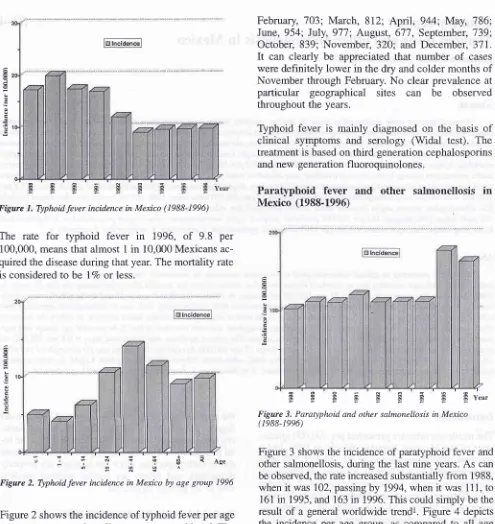
less.Figure 2. Typhoidfever incidence in Mexico by age group 1996
Figure
2 showsthe incidence
of typhoid
fever per
agegroup,
ascompared
to all
agegroups considered. The
25-M
year-old age group was most affected: their
higher
risk is probably
due
to their
increased
likeli-hood
for consuming food
away
from
home.In addition, typhoid fever
happens
mainly during
thewarm
andrainy
months of
March
to
August;
although
during
someyears the highest
rateshave
beenpreva-lent
into
October, as
in
1995, presumably due
to
alonger duration
of
the rainy
season.The number of
casesper month, during
1995, were: Jantary,
764;
Med
J
IndonesFebruary,
703; March, 812;
Apil,944; May,786'
June,
954; July, 977; August, 677,
September,
J39;
October, 839;
November,32O; and December,
3lI.
It
can clearly
be
appreciated
that number
of
caseswere
definitely lower in
the
dry
andcolder
months
of
November through
February.
No clear prevalence
atparticular
geographical
sites
can be
observed
throughout
the
years.Typhoid fever
is
mainly diagnosed on the basis
of
clinical
symptoms
and serology
(V/idal test).
The
treatment is
based onthird
generation cephalosporins
and
new
generation
fluoroquinolones.
Paratyphoid
fever and other
salmonellosis
in
Mexico
(1988-1996)
Ë Ë E E $ Ë È E
HY.u,
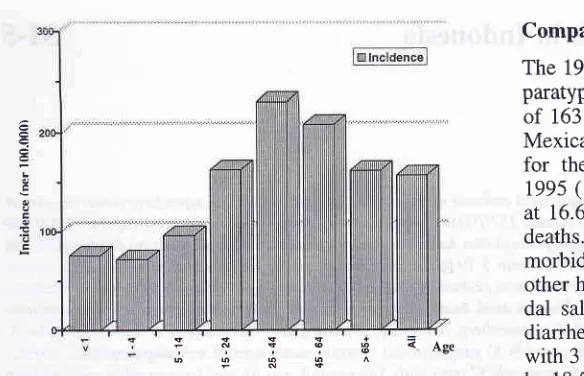
Figure 3. Paratyphoid and other salmonellosis in Mexico
( 1988- 1996)
Figure
3
showsthe incidence
of
paratyphoid
fever
andother salmonellosis,
during
the last nine
years.As
can be observed, the rate increasedsubstantially
from
1988,when
it
was
102, passingby
7994,when
it
was
111,to
16l
tn
1995, and 163in
1996.This could
simply
be theresult
of a
generalworldwide trendl. Figure 4
depictsthe
incidence
per
age
group,
as compared
to all
agegroups
considered.
Again, as
for
typhoid fever,
thehighest
rates
were found
in
the 25-44 year-old
agegoup;
probably
becauseof their
increasedlikelihood
to
consume meals
away
from
home.As for typhoid,
the highest incidences were
found in
the
warm
andrainy
months
of March
to
August;
with
some
years extending
into
October.
For
1995, the
to-tal
casesper
month were: January,74,012;
February,
10,878;
March
10,430;
April,
12,466;
May,
12,639;
June, 14,091;
July,
16,806;
August,
L3,II4;
Septem-çs+=
:iT'?3<Ase
e
L
o
E
o
Ê
Suppl
I -
1998Figure 4. Paratyphoid and other salmonellosis in Mexico in 1996
ber,12,092; October, 13,97I; November, 9,648;
and
December, 7,492.
As for typhoid
fever,
thenumber
of
cases
drop in
the
cooler
months
of
November to
Feb-ruary. Again, there
is
no clear correlation
of
higher
incidence rates
with
particular
geographical
sites,throughout
the
years.Paratyphoid
fever and other salmonellosis
are
diag-nosed
mainly on the
basis
of
clinical
symptoms,
andstool cultures
are sometimes
performed.
Paratyphoid
is
also diagnosed
basedon
serology.
Antibiotic
treat-ment is applied for paratyphoid,
asin the
caseof
ty-phoid
fever.
No antibiotic
treatment
is
recommended
for
other
non-typhoidal
enteritis.
Microbiology
In
acomprehensive
study,
10,703
Salmonella
strains
isolated
in
Mexico
between 1982
and
1993,
were
characterized
(2). Out
of
119different
serotypes,
themost
frequent clinical
isolates, i.e.
from blood,
feces,and bone
cerebral-spinal
fluid,
were:
S.typhimurium
(20Vo),
S.
enteritidis (I5Vo), and
S. typhi
(IÙVo).From 563
hemocultures
alone,
the
most frequent
were:
S.typhi
(637o), S.
enteritidis (l3Vo),
and.S.
4,-phimurium
(l2Va).
Out
of
34
outbreaks studied,
the
greatest
number
were due
to
S.
typhi,
with
12:
followed
by
S.
ry-phimurium, S. enteritidis
and
^S.newport,
with
9,
6,and
2,
respectively. Interestingly, there was an
out-break
due
to
S.paratyphi
type
A. In
general,
a
grad-ual
increase
in
the
frequency
of
S. enteritidis
has
been observed.
Global Epidemiology and country
report
19Comparison
with
world
rates
The
1996reported incidence
oftyphoid
fever,
andof
paratyphoid
fever
andother salmonellosis,
of
9.8
andof
163
per
100,000
inhabitants, respectively,
for
theMexican Republic,
aremuch
lower
than the
estimatesfor
the
general
worldwide
population reported in
1995
(1).
In
this report, typhoid fever was
estimated
at
16.6
million
cases,annually,
with
nearly
600,000
deaths.
Assuming
aworld population of
7billion,
themorbidity
rate
would be
237
per
100,000.
On
the
other hand,
the global incidence of
other
non-typhoi-dal
salmonellosis, causing acute gastroenteritis
anddiarrhea, was estimated
at
1.3billion
casesper
year,with
3million
deaths.Thus, the
morbidity
rate
would
be
18,571per
100,000, or
nearly
one-in every
five
in-dividuals.
It
seemsdiffrcult,
atthis point, to
make a close estimateof how
much
lower
arethe incidence
ratesin Mexico,
as compared
to
the
global
situation.
How
much
is
dueto underreport,
asmentioned previously, or
to
ashift in
the
epidemiological
profile
in
the
country,
towards
chronic-degenerative disorders, should
be a
matter
of
future
andmore
extensive research.Corollary
As
a molecular biologist
or
as
an epidemiologist,
it
would
be
fascinating
to
learn more about the
modesof
transmission
andreservoirs
for
pathogens, thus
al-lowing
us
to
understand better
the host
and
environ-mental factors that determine susceptibility
to
infec-tion,
andtheir relationship with
human
lifestyles
andhabits.
Tô
achieve
this,
improved epidemiological
data
is
paramount;
this
indeed holds
for Mexico,
andprobably
for
many
other parts
of the world.
This
shall
be
accomplished
with
the aid
of
more
rapid,
accurate, and less expensive
diagnostic
meth-ods;
agoal that requires
aconcerted
multidisciplinary
effort from
scientists
throughout
the
world.
Thus,
thefield of
molecular epidemiology
of
enteropathogens,
including,
of
course, the salmonellae, promises many
exciting
happenings
in the
years
to
come.
References
l.
PangI
Bhutta ZA, Finlay BB, AltweggM.
Typhoid fever and other salmonellosis: a continuing challenge. Trends Mi-crobiol 1995; 254: 253-5.2.
Gutiérrez-CogcoL,
Gonzâlez-BonillaC,
Giono-Cerezo S,Beltrân LG. Frequency of Salmonella serotypes identified in 10,703 strains in Mexico from 1982 to 1993. Rev Lat-Amer Microbiol 1994; 36: 221-6.
;
i
Y
?
3
<Ase
[image:3.595.28.320.79.267.2]