23
CHAPTER 3
RESEARCH METHODOLOGY
3.1. Current Research
The research of Information System Success Model Evaluation on Manually
Organized (Cluster 2) Small Scale Medium Enterprises (SMEs) at Yogyakarta is a
testing out research which improve the model of Sinaga et.al (2015) which were
using ISM methodology that resulted four clusters of information system success
model (Manually Unorganized, Manually Organized, Semi Computerized, and
Computerized) without weighted impact of the criteria while this research results
the interplay and weighted impact of the criteria. In addition, the researches of
Putra (2015), Putri (2015), Wulandari (2015), and Kusferyano (2015) were
conducted in several SMEs based on particular basic raw material while Putra
(2015) in wood industry; Putri (2015) in pottery industry; Wulandari (2015) in
leather industry; and Kusferyano (2015) in metal industry. Therefore, this research
selects one cluster which is Cluster 2 (Manually Organized Information System) by
selecting four SMEs of various basic raw material industry to be studied.
3.2. Research Methodology
This research requires several stages to identify information system success
correlations and evaluate information technology needs. There are two general
stages which are preparation stage and exploratory survey. The research
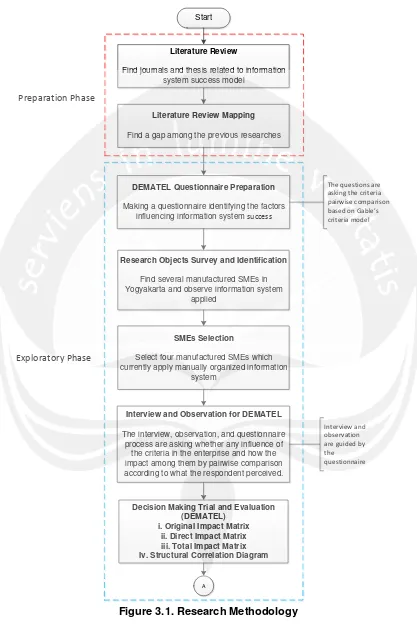
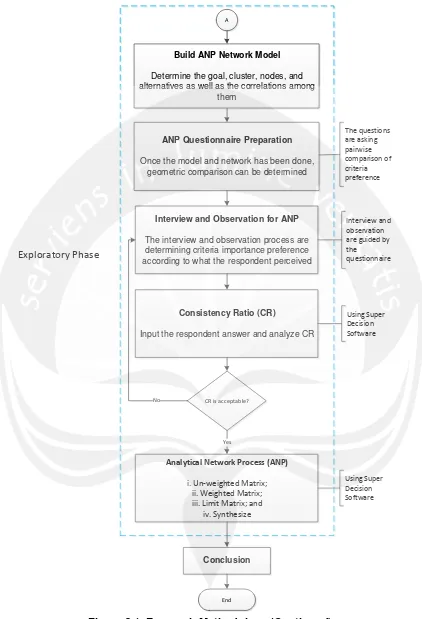
methodology flowchart is shown in Figure 3.1.
3.2.1. Preparation Phase
There are several stages in the preparation phase which are
a. Literature Review
Do a literature review to find the appropriate reference to the theoretical
model of information system success;
b. Literature Review Mapping
This step is done to find a gap in previous researches to check this research
authenticity can be conducted. After mapping, it is known that the
enterprises information system success model by Gable, et al. has been
studied for SMEs by Sinaga et al. (2015), using ISM method which is used
to identify the relationship among criteria and the dominant criteria with a
24
information system success model in SMEs. So that, there is a lack of
systematic evaluation to measure information system technology success
specifically on interrelation among criteria and weighted impact with
dependence factors and feedback.
3.2.2. Exploratory Survey Phase
This Exploratory Survey phase is an important phase to construct a model for
success information systems in SMEs. Here are the stages of exploratory survey:
a. DEMATEL Questionnaire Preparation
Making a questionnaire to identify the existing information system criteria
in SMEs and also identify the impact among the criteria by pairwise
comparison according to what the respondent perceived. Once the
research gaps and methods have been decided, DEMATEL questionnaire
can be developed by describing all of the criteria based on Gable’s
information system model as the first step. Secondly, design questions to
identify whether each criterion has influence or not in the industry. Thirdly,
question for each criterion are paired off to identify correlation between
them with 0-4 scoring range which denotes no impact, low impact, medium
impact, high impact, and extremely high impact respectively. Later on, this
questionnaire will guide the interview process. The results of the
questionnaire can be found in Appendix 1.
a. Research Object Survey and Identification
Find the research objects which are handcraft SMEs in Yogyakarta.
Researcher visit 13 SMEs however 4 of them already use computer, 3 of
them has no business recapitulation, and the remaining 6 SMEs use
manual information system.
b. Research Object Selection
Based on survey identification, two manual information system SMEs are
objected to be interviewed, observed, and answer the questionnaires. So
that, four handcraft SMEs which currently apply manual information system
are selected which are Yoni Arts, Budenx Art Stone, Warung Perak, and
Kartika while their figures are shown in Appendix 2. Moreover, these four
SMEs record the information in form of paper and also logbooks.
c. Interview and Observation for DEMATEL
After obtaining the questionnaire based on information system success
25
observing, and giving questionnaire to four SMEs which manually organize
information system with various basic material used. The interview and
observation processes are asking whether any influence of the criteria in
the enterprise and how the impact among them by pairwise comparison
according to what the respondent perceived. The respondent from each
SME is the owner who responsible and manage the entire information,
because none of the employees manage the information such marketing
and finance. Perform analysis and scoring during the interviews.
Observation covers the documents used in the process of their information
systems by taking some photos as documentation that can be seen in
Appendix 3 as well as interview processes are recorded in Appendix 4.
Moreover, the answers of questionnaire are shown in Appendix 5.
d. Decision Making Trial and Evaluation Laboratory (DEMATEL)
Based on criteria of information system success model evaluation as stated
above, this study further employed the DEMATEL methodology to indicate
the complex relationship and identify the significant information success
model evaluation perspectives and criteria.
i. Original Mean Impact Matrix (A)
Generate an original mean impact matrix based on interview and
observation result which is a score ranged from 0 to 4. Because the
interview and observation are conducted in four different SMEs, so that
the perceived criteria impact may vary depends on each enterprise
experience and situation. The original impact matrix can be obtained by
averaging the summation of the expert answer matrices (original impact
matrix) in Appendix 6.
ii. Direct Impact Matrix (M)
Calculate the direct matrix to find priority ranking of the direct impact
matrix among criteria.
iii. Total Impact Matrix (T)
Total impact matrix is calculated in order to determine and judge the
correlation among the criteria using a threshold value.
iv. Structural Correlation Analysis
Analyze the impact relations of the value of (D-R) and the value (D+R)
26
e. Build Analytical Network Process (ANP) Model
Determine the goal, criteria, and alternatives are the most important step in
this stage. Furthermore, DEMATEL results criteria correlations in which as
reference to construct the relation among ANP network model for
information system dimension.
f. ANP Questionnaire Preparation
After obtaining the correlations of information system success criteria from
DEMATEL and constructing ANP model, the next step is designing
questions to evaluate information technology needs. Firstly, build ANP
model in Super Decisions software. Secondly, connect the correlations
along the nodes, and then ANP questionnaire can be obtained from Super
Decisions. The data is collecting by interviewing and observing one of four
SMEs. The interview and observation processes are asking importance
preferences according to what the respondent perceived. 1-9 scoring range
is based on importance criteria preferences. The interviews are recorded
as shown in Appendix 4 and the questionnaire is shown in Appendix 7.
g. Interview and Observation for ANP Pairwise Comparison
Based on the model constructed, a questionnaire is designed to guide the interview and observation. Interview is done by selecting one SME’s expert to answer the questions.
h. Consistency Ratio (CR)
Input the ANP pairwise comparison to Super Decisions Software, after that
analyze the Consistency ratio (CR).
i. Check Consistency Ratio (CR)
Once a CR results less than 0.1, a confirmation step should be conducted
by re-interviewing and deeply observing the importance preferences with
the respondent regarding the inconsistent cluster.
j. Analytical Network Process (ANP)
A Super Decisions software is used to process ANP methodology by
inputting answers from the experts.
i. Generate Un-weighted Matrix;
ii. Generate Weighted Matrix;
iii. Generate Limit Matrix; and
iv. Synthesized
27
Start
Literature Review
Find journals and thesis related to information system success model
DEMATEL Questionnaire Preparation
Making a questionnaire identifying the factors influencing information system success
Research Objects Survey and Identification
Find several manufactured SMEs in Yogyakarta and observe information system
applied
Interview and Observation for DEMATEL
The interview, observation, and questionnaire process are asking whether any influence of
the criteria in the enterprise and how the impact among them by pairwise comparison according to what the respondent perceived.
Decision Making Trial and Evaluation (DEMATEL)
i. Original Impact Matrix ii. Direct Impact Matrix iii. Total Impact Matrix Iv. Structural Correlation Diagram
Literature Review Mapping
Find a gap among the previous researches
Preparation Phase
Exploratory Phase
SMEs Selection
Select four manufactured SMEs which currently apply manually organized information
system
A
The questions are asking the criteria pairwise comparison
based on Gable’s
criteria model
[image:5.595.90.507.97.730.2]Interview and observation are guided by the questionnaire
28
Build ANP Network Model
Determine the goal, cluster, nodes, and alternatives as well as the correlations among
them
Interview and Observation for ANP
The interview and observation process are determining criteria importance preference according to what the respondent perceived Exploratory Phase
ANP Questionnaire Preparation
Once the model and network has been done, geometric comparison can be determined
A
Consistency Ratio (CR)
Input the respondent answer and analyze CR
End Conclusion
CR is acceptable?
Analytical Network Process (ANP)
i. Un-weighted Matrix; ii. Weighted Matrix; iii. Limit Matrix; and
iv. Synthesize
Yes No
Using Super Decision Software Interview and observation are guided by the questionnaire
[image:6.595.88.510.81.700.2]Using Super Decision Software The questions are asking pairwise comparison of criteria preference