i
TRANSLATION ANALYSIS OF DEIXIS IN PASUNG JIWA NOVEL INTO BOUND BY OKKY MADASARI
PUBLICATION ARTICLE
Submitted as a partial fulfillment of the Requirements for Getting Bachelor Degree of Education
in English Department
Written by: Diana Awalia
A320120042
English Departement
SCHOOL OF TEACHER TRAINING AND EDUCATION MUHAMMADIYAH UNIVERSITY OF
1
TRANSLATION ANALYSIS OF DEIXIS IN PASUNG JIWA NOVEL INTO BOUND BY OKKY MADASARI
Jl. A. Yani Kartosuro Tromol Pos 1 Surakarta 57102 Telp. (0271) 7177417 Fax. (0271) 715448
ABSTRACT
This research focuses on deixis analysis used in the Bound novel into Pasung Jiwa by Okky Madasari and translation accuracy of Bound novel into Pasung Jiwa by Okky Madasari. This research is descriptive qualitative research. The purposes of this research are: (1) to describe the types and function of deixis analysis in Bound novel into Pasung
Jiwa by Okky Madasari, (2) to describe the translation accuracy in Bound novel into Pasung Jiwa by Okky Madasari. The data of this research are utterances containing
deictic word and translation accuracy collected from the data source. The data source is the Bound novel into Pasung Jiwa written by Okky Madasari. The methods of collecting data are documentation, questioner and interview. Based on the analysis of the Indonesian translation, the researcher found that there are 616 deictic word. (1) 503 data belongs to person deixis, (2) 56 data belongs to place deixis, (3) 15 data belongs to time deixis, (4) 4 data belongs to social deixis, (5) 38 data belongs to discourse deixis. There are three aspects for good accuracy that analysis should fulfill: accurate, less accurate,
and inacurate: (1) 200 data or 50 % accurately, (2) 155 data or 38,7 % less accurately,
and (3) 42 data or 11, 3 % inaccurately.
Keywords: novel, accuracy, deixis.
ABSTRAK
Fokus dalam penelitian ini adalah analisis diksi yang dihunakan dalam novel Bound dan Pasung
Jiwa karya Okky Madasari serta keakuratan penerjemahan dalam novel Bound kedalam Pasung Jiwa
karya Okky Madasari. Jenis Penelitian ini merupakan penelitian deskriptive kualitatif. Tujuan dalam penelitian ini adalah: (1) untuk mendeskripsikan jenis dan fungsi diksis yang terdapat dalam novel Bound dan Pasung Jiwa karya Okky Madasari, (2) untuk mendeskripsikan keakuratan penerjemahan dalam novel Bound dan Pasung Jiwa karya Okky Madasari. Data dalam penelitian ini adalah ungkapan yang mengandung kalimat diksis dan ketepatan penerjemahan yang dikumpulkan dari sumber data. Sumber data dalam penelitian ini adalah novel Bound dan Pasung Jiwa karya Okky Madasari. Metode pengumpulan data dalam penelitian ini menggunakan dokumentasi. Berdasarkaan analisis dalam penelitian ini, peneliti menemukan ada 616 diksis. Dengan spesifikasi sebagai berikut: (1) 503 data termasuk dalam diksis orang, (56) data merupakan diksis tempat, (3) 15 data merupakan diksi waktu, (4) 4 data termasuk dalam diksi sosial dan (5) 38 data termasuk dalam diksis wacana. Ada tiga aspek dalam keakuratan penerjemahan diantaranya: akurat, kurang akurat dan tidak akurat. (1) 200 data atau sekitar 50 akurat, (2) 155 data atau 38,7% kurang akurat dan (3) 42 data atau 11,3% tidak akurat.
2 1. Introduction
Translation act have the similar meaning with speech act, that is transfered the
meaning from the first language to the other language. In the translation act the
translator have to face the meaning of word, phrase, clause and sentence. In the other
hand, understanding and comprehending the meaning is very important for translator in
translation act.
In conducting the research, the researcer applies pragmatics approach.
According to Kreidler (1998: 18) “Pragmatics is a branch of linguistics that concerns with meaning”. According to Levinson (1983: 87) “Pragmatics is essentially concerned with the problem that the meaning of an utterence of language used cannot be fully
accounted for by looking at the literary meaning of the sentences or words by which that
iterance is performed”. While Peccei (1999: 5) states that: “ Pragmatics concerntrated on the aspect of meaning that could not be predicted by lingistic knowledge alone and take
into account our knowledge about the physical and social world”. The focus of
pragmatics analysis is on the meaning of words or sentence.
From the definition above, it summarized that the main point of pragmatics is
the meaning of speaker utterance rather than on the meaning of words or sentences. The
study of pragmatics is concerned with many principles to make sense of what somebody
hears and reads.
The principle studied in Pragmatics according to Levinson (1983: 27), are the
study of deixis, entailment, presupposition, speech act, and aspects of discourse
structure.
Deixis means a term which is to indicate or to point out the personal
pronounces, tense, specific time and place adverb. Deixis is generally called deictic
words. A deictic word is one which takes some elements of its meaing from the situation
like the speaker, the addressee, the time and the place. Of the utterance in which it used
This study is focused on translation analysis of deixis in Bound novel into
Pasung Jiwa by Okky Madasari. This study attempts to describe types and function of
3
TL: Saat itu aku sudah menyesal kenapa aku harus dilahirkan. Dunia bukan untukku. Dunia tak membutuhkanku. Aku tak menukai semuanya. Aku seperti berada ditempat yang salah. Dan selalu salah.
In the example above it can be seen that deixis “It” is the personal deixis. It
has the diferent meaning in every sentence. In the first “It” the meaning is “Saat itu” it
show the time of writer want to tell about. Then in the second “It” has the meaning of
“Dunia” it show the noun of writer have told before. And the last “It” means
“semuanya” it conclude that the last it mean everything the writer have, it probably belong to the first and second it.
A text can be referred to as a translation, if the text has a meaning or a
message similar to other text (read: the text of the source language). Therefore, efforts to
reduce or add to the content or message source language in the target language should be
avoided. The accuracy consists of three levels as shown below.
Therefore, efforts to reduce or add to the content or message source language
in the target language should be avoided. Nababan (2012: 50)
In this research the writer focused on types and function of deixis in Bound
novel by Okky Madasari translated into Pasung Jiwa by Nurhayati Indriyatno
Mohammed and Makna Sinatria based on Lavinson theory of deixis analysis.
The object of this research are utterances containing deictic word (person
deixis, place deixis, time deixis, social deixis and discourse deixis) and translation
accuracy which can be found in the Bound novel into Pasung Jiwa by Okky Madasari.
The similarity between the previous research with the present research is in
translation analysis of deixis. While the difference is that the previous, researchers were
takes Bound novel into Pasung Jiwa by Okky Madasari as the object focusing in the
4
The first research entitles A Translation Analysis of Deixis in A Bilingual
Novel Entitled You’re Nicked Ms Wiz by Terence Blacker into Kau Tertangkap Ms Wiz
by Ramayanti by Krisna (Dinus, 2012). This study directs to find the types of deixis and
to explain the equivalences of deixis in the target language. The researcher used a
descriptive qualitative method during the research since the aim of this study is
identifying the types of deixis whether the equivalence of deixis proper in the TL
situation. Based on the analysis that has been done, the researcher found 724 words of
deixis. Five types of deixis are found in the data; person deixis, place deixis, time deixis,
discourse deixis, and social deixis.In the analysis, the researcher also found that there are
no unequivalent Past and Future Time Deixis in this bilingual novel. Moreover, the
researcher concludes that the bilingual novel entitled You're Nicked Ms Wiz into Kau
Tertangkap Ms Wiz has more equivalence words of deixis than the unequivalence ones.
The researcher needs to notify both types of deixis and the criteria of equivalence to find
the correct analysis.
The second research is A Translation of Deixis in Stephenie Meyer’s Novel
The Twilight Saga “Eclipse” into Monica’s “Gerhana” by Poerwalangendaru,
Asmarani (Dian Nuswantara University, 2013). This researchdiscuss on Deixis in
Stephenie Meyer‟s Novel The Twilight Saga “Eclipse” into Monica‟s “Gerhana”. This
study is aimed to find out the types of deixis and the equivalence of deixis words in
target text that is used by main character from chapter 1 to chapter 3. The method
employed in this research is a qualitative descriptive.The steps to analyze the data are
reading the novel, identifying the deictic words, classifying the deictic words based on
the types of deixis, identifying and describing the equivalence of deixis words in target
text and then drawing the table of the result. The result of this analysis shows that all
types of deixis arefound. There are person deixis, time deixis, place deixis, social deixis
and discourse deixis. Based on the data, words of deixis found in this novel from chapter
1 to chapter 3 are 387 words. The type of deixis that is mostly used in the novel Twilight
5
word I translated into “aku”. There are 107 words or 35,31% out of 130 words. Besides “aku” the word I is translated into “ku-“ and “–ku”. The frequency is 17 words (5,61%)
and 6 words (1,98%). The translator mostly used “aku” as the equivalence of the word I
because the situation of the utterances are informal. It can be seen from the main
character which has a close relationship with the other characters such as the relation of
daughter and father.
The notion of translation since the day is defined through many ways with its
theoritical background and its different approach. The following are some definitions
about translation.
According to Suryawinata (in Nababan, 2008: 25) “There are three steps of
translation process. Those steps are 1) analysis, 2) transfering and 3) restructuring. This
translation process then is followed and used by the other of translator or linguist”.
In conducting the research, the research applies pragmatics approach.
According to Kreidler (1998: 18) “Pragmatics is a branch of linguistics that concerns with meaning”. According to Levinson (1983: 87) “Pragmatics is essentially concerned
with the problem that the meaning of an utterence of language used cannot be fully
accounted for by looking at the literary meaning of the sentences or words by which that
uterance is performed”. While Peccei (1999: 5) states that: “ Pragmatics concerntrated
on the aspect of meaning that could not be predicted by lingistics knowledge alone and
take into account our knowledge about the physical and social world”. The focus of
pragmatics analysis is on the meaning of words or sentence.
Pragmatics equivalence is one aspect to reach good translation. This
equivalence emphasized on the meaning mean by speaker. Here, to determine it, a
translator has to investigate the context of utterances. In the utterances, one thing that
should be regarded is deixis.
The term of „deixis‟ is borrowed from the Greek word. It means pointing or
indicating, In Levinson‟s finding (1983:53)
6
pronouns, tense, specifictime and place adverbs like there and here, and variety of other grammatical features tied directly to the circumstance of utterance.
Based on the explanation above we can conclude that property of a small set of
words like I, here, and now,in an utterance I‟m here now,that they refer to an aspect of the context in which they are uttered is called deixis. Furthermore, it is concluded that
the indeterminacy stems from the speaker‟s use of the words I, here, and now can only
be resolved when we look at the context, who the speaker is, and where and when the
sentence is uttered.
In some statements about deixis, we can see very clearly that deixis is indicating or
pointing person, place, time the context of utterances. We will know who the speaker is,
when and where the sentence is uttered.
The categories of deixis based Levinson‟s study (1983:69-94) and Marmaridou (2000:65-74) is divided into five, they are person deixis, place deixis, time deixis,
discourse deixis, and social deixis.
2. Research Method
In this research the writer uses the descriptive qualitative research
because it will describe the Types and Function of Deixis found in Bound novel into
Pasung Jiwa written by Okky Madasari and to describe the translation accuracy of
Bound novel into Pasung Jiwa written by Okky Madasari. The qualitative research
is a research which yields the descriptive data in the form of written or oral words
from observing people and behavior. In the other words, a descriptive qualitative
research is a type of research which does not include any calculation or
enumeration. Therefore, the data concerned appear in words rather than in numbers.
The objects of this research are utterances containing deictic word
(personal deixis, place deixis, time deixis, social deixis and discourse deixis) and
translation accuracy which can be found in the Bound novel into Pasung Jiwa
7
The data of this research are utterances containing deictic word (personal
deixis, place deixis, time deixis, social deixis and discourse deixis) and translation
accuracy collected from the data source. The data source is the Bound novel into
Pasung Jiwa written by Okky Madasari. The informant of accuracy is Mr. Fitri
Kurniawan.
The methods of collecting data used by the writer are documentation,
questioner (if that needs information, than uses interview), and interview.
Documentation is applied by utterances containing deictic word (personal deixis,
place deixis, time deixis, social deixis and discourse deixis) in the Bound novel into
Pasung Jiwa written by Okky Madasari. The steps of collecting data are as follows:
1) Reading Bound novel and Pasung Jiwa as its Indonesian translation by
Okky Madasari.
2) Finding deictic words (personal deixis, place deixis, time deixis, social
deixis and discourse deixis) and translation accuracy in the Bound novel into
Pasung Jiwa written by Okky Madasari.
3) Re-writing deictic words (personal deixis, place deixis, time deixis, social
deixis and discourse deixis) and translation accuracy in the Bound novel into
Pasung Jiwa written by Okky Madasari.
Validation of data is a measure, which shows the levels of validity of an
instrument. Test the validity of which will be used in this research is to test the
validity of the content is a measuring instrument is deemed.
Testing the validity of the content of the instrument is to ensure the
stability and accuracy of data that has been dug up, collected, recorded in the
selected research activities and determined the proper ways to develop the validity
of the data obtained. This study used the technique of triangulation. A triangulation
technique checks the validity of the data by using something else for the purpose of
checking or comparing of the data. There are two types of triangulation used in this
study: data source and technique of collecting data. Data source consists of spoken
8
collecting data consists of documentation with content analysis, questioner (if that
needs information, than uses interview), and interview.
3. Research Finding and Discussion
The research finding will elaborate the types and functions of deixis in the
Bound novel into Pasung Jiwa by Okky Madasari it will be followed by discussion.
a. Types and Function of Deixis Found in Bound Novel Into Pasung Jiwa By Okky Madasari
As discussed in Chapter II, this research is focused on Deixis analysis
found in Bound Novel into Pasung Jiwa by Okky Madasari. Types of deixis
found in Bound Novel into Pasung Jiwa by Okky Madasari such as: Personal
deixis, Place deixis, Time deixis, Social deixis and Discourse deixis.
Personal deixis devide into First Person Deixis, Second Person Deixis
and Third Person Deixis.
First Person Deixis found in Pasung Jiwa Novel by Okky Madasari into
Bound by Makna Sinatria such as: aku, ku, ane, saya, kami, kita, kite, diriku,
milikku and miliknya.
1) Aku as first person deixis is translated into: I, me, my, us, and
myself..
2) Ku as first person deixis is translated into: I, me, my, mine, and
myself.
3) Ane as first person deixis is translated into: I and my.
4) Saya as first person deixis is translated into: Me and my.
5) Kami as first person deixis is translated into: Our, us, and we.
6) Kita as first person deixis is translated into : our, us, and we.
7) Kite as first person deixis is translated into Us.
8) Diriku as first person deixis is translated into: me and myself.
9
10)Miliknya as first person deixis is translated into Mine.
Second Person Deixis found in Bound Novel into Pasung Jiwa by Okky
Madasari such as: You and Your.
1) Kamu as second person deixis is translated into You
2) Kau as second person deixis is translated into You
3) Kon as second person deixis is translated into You
4) Ente as second person deixis is translated into: you and Your
5) Mu as second person deixis is translated into your.
Third Person Deixis found in Bound Novel into Pasung Jiwa by Okky
Madasari such as: They, Their, Theirself, Their own, Them, Themself, She, Her,
Herself, He, His, Him, Himself, It and Its.
1) Mereka as third person deixis is translated into: They, my, their, them,
and he.
2) Dirinya as third person deixis is translated into: Thieir, and Her.
3) Dia as third person deixis is translated into: she, he and him.
4) Ia as third person deixis is translated into: she, her and he.
5) Ibu as third person deixis is translated into she.
6) Elis as third person deixis is translated into: she and her.
7) Perempuan as third person deixis is translated into she.
8) Melati as third person deixis is translated into she.
9) Istrinya as third person deixis is translated into she.
10)Mbak Minah as third person deixis is translated into she.
11)Laki- laki as third person deixis is translated into he.
12)Ayah as third person deixis is translated into: he and him.
13)Jali as third person deixis is translated into he.
10
Place Deixis found in Bound Novel into Pasung Jiwa by Okky Madasari
devided into: Proximal Distance and Distal Distance.
The kinds of Proximal distance in Bound Novel into Pasung Jiwa by
Okky Madasari such as: This, These and Here.
1) This as Proximal distance translated into: untranslated, Ini, Yang, and
Ada.
2) These as proximal distance translated into: ini
3) Here as proximal distance translate into: Kesini, Tempat ini, Pulau
ini, and Disini.
The kinds of Distal Distance found in Bound Novel into Pasung Jiwa by
Okky Madasari such as: those, that and there.
1) Those as distal distance translated into: itu and Kalau.
2) That as distal distance translated into: Yang, Itu, untranslated, Seperti
itu, Ini and Begitu.
3) There as distal distance translated into: Disitu, Tiba, untranslated,
Ada and Bersama.
Time Deixis found in Bound Novel into Pasung Jiwa by Okky Madasari
devided into: Past tense, Present tense and Future tense.
1) The kinds of Past tense of time deixis such as: Then, After, When, In
the afternoon, on the day, twice a week, one night, that night, on the
ride home, in the morning, the night before, that day, that evening and
upon
2) Present tense of time deixis found in Bound Novel into Pasung Jiwa
by Okky Madasari is Now
3) Future tense of time deixis found in Bound Novel into Pasung Jiwa
11
Social Deixis found in Bound Novel into Pasung Jiwa by Okky Madasari
devide into: Absolute deixis and relational deixis.
Absolute deixis found in Bound Novel into Pasung Jiwa by Okky
Madaari such as: He translated into Guru, Her, Maid, He translated into Ayah
and the art teacher.
Discourse deixis found in Bound Novel into Pasung Jiwa by Okky
Madasari devided devided into: That, Those, This and These.
1) That as discourse deixis translated into: Ini, Untranslated, Yang and
Itu.
2) Those as discourse deixis translated into Itu.
3) This as discourse deixis translated into: Begini, Ini and untranslated.
4) These as discourse deixis is not translated.
b. The Translation Accuracy of Bound Novel into Pasung Jiwa by Okky Madasari.
1) Accurate
In this classification, all data taken are accurate. The content of this
source sentence is accurately conveyed to the target sentence. The translated
sentence is clear to the evaluator and no rewriting is needed. It means that the
meaning of words, technical terms, phrases, clauses, sentences or the source
language accurately transferred into the target language absolutely no
distortion of meaning.
001/ B/ PJ/ 001
Source Language : I choose to stay in Malang.
Target Language :Aku tetap tinggal di Malang.
The message in the source language is translated accurately in the
12
more appropriate to be applied in translating result. It can be seen that the
sentence of I choose to stay in Malang is translated into aku tetap tinggal di
Malang. It is used to delete or substract the verb choose and conjunction to in
order to be translated into the target language. It can be deleted without
changing the information to the auience.
2) Less Accurate
The content of the source is accurately conveyed to the target sentence.
The translated sentence can be clearly understood by the evaluator, but some
rewriting and some change in the word order are needed. Most of the meaning
of words, technical terms, phrases, clauses, sentences the source language has
been transferred accurately into the target language. However, there is
meaning eliminated, which interfere with the integrity of the message.
002/ B/ PJ/ 002
SL : In Jakarta I was only a minion to Jali and the Habib.
TL : Di Jakarta selamanya aku hanya akan jadi cecunguk.
The message in the source language is translated less accurately in the
target language by the translator. The translator knows well which word is
more appropriate to be applied in translating result. It can be seen that the
sentence of In Jakarta I was only a minion to Jali and the Habib. Is translated
into Di Jakarta selamanya aku hanya akan jadi cecunguk.The words of Jali
and the Habib are not translated into the target language. The phrase of was
only is translated into selamanya hanya jadi. But in the dictionary, the phrase
of was only means hanya jadi. Therefore, it can be deleted without changing
the information to the audience. It makes easier to understand and readable by
the audience. If there is no previous word, the sentence will be ambiguous.
1) Inaccurate
The source sentence is not translated at all into target sentence. It is
13
phrase, clause, sentence or source language inaccurately transferred into the
target language or omitted (deleted).
056/ B/ PJ/ 056
SL: Allahu Akbar! I shouted as we all piled into the trucks.
TL: Aku menyerukan nama Allah saat kami semua sudah naik ke truk dan pikap.
The message in the source language is inaccurately in the target
language by the translator. The translator uses the wrong words to be applied
in subtitling result. It can be seen that the phrase of Allahu Akbar! I shouted as
we all piled into the truck is translated into Aku menyerukan nama Allah saat
kami semua sudah naik truk dan pikap. If the phrase of Allahu Akbar! I
shouted as we all pilled into the truck is translated into word-to-word the
sentence structure in target language, the meaning is the same as the source
language. It is completely different from the meaning of that word. In this
datum the translator does not translated into the correct one. In the subtitle
above, the translator is not translated all of the words.
4. Discussion
After analyzing the data above, the researcher presents some findings. The
researcher analyze the types and function of deixis and translation accuracy in
Bound novel into Pasung Jiwa by Okky Madasari. The researcher finds the
fifth deixis, they are person deixis, place deixis, time deixis, social deixis, and
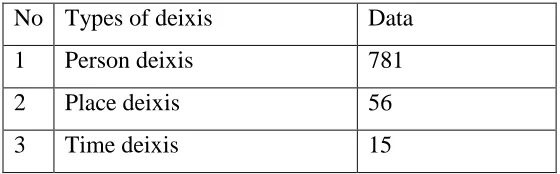
discourse deixis. Here the classification of the finding in this research
Table 1
Types of deixis
No Types of deixis Data
1 Person deixis 781
2 Place deixis 56
14
4 Social deixis 4
5 Discourse deixis 38
Another finding is translation accuracy of the Bound novel into Pasung
jiwa byy Okky Madasari. That there are three aspects for good accuracy that
translation should fulfill: accurately, less accurate and inaccurate. From 400
total counts of data there are 200 data or 50 % belongs to accurate translation,
155 data or 38,7 % belongs to less accurate translation, and 45 data or 11,3 %
belongs to inaccurate translation. The accuracy consists of three levels as
shown below.
Table 2
Accuracy of the translation
Scale Classification Total Percentage
1 Accurate 200 50 %
2 Less Accurate 155 38,7 %
3 Inaccurate 45 11, 3 %
TOTAL 400 100 %
There are some relationship between the translation of deixis analysis
and translation accuracy. Deletion strategy in translation deixis can be
considered as the inaccurate of the message convey between the source
language and target language. The deixis translation which transfered into the
same level in grammatical belongs to accurate of translation. When the source
language and target language transfered in the different level of grammatical it
can be less accurate. Accuracy translation is dominated by transfer strategy.
Less accurately subtitle can be clearly understood by the evaluator, but some
rewriting and some change in the word order are needed. However, there is
15
accurately subtitle is dominated by paraphrase strategy. Inaccurately subtitle is
not translated at all into target sentence. It is omitted or deleted. Inaccurately
is dominated by deletion strategy.
This research uses the theory of deixis from George Yule and
Levinson about explanation and types of deixis. This deixis may involved
person deixis, place deixis, time deixis, social deixis and discourse deixis. The
researcher also uses the theory of Nababan (2012: 44-51). Nababan said that
there are three aspects for good accuracy that translation should fulfill:
accurate, inaccurate and less accurate.
BIBLIOGRAPHY
Kreidler, W.Charles.1998. Introducing english Semantic. New York: Routledge.
Levinson, Stepen.1983.Pragmatic.Cambridge: Cambridge University Pers.
Peccei, Jean Stiwell.1999. Pragmatics. London and New York: Routledge.