DEVELOPMENT OF A MINI AUTOMATIC VACUUM CLEANER
MOHAMMAD ANIS BIN MOHD ANUAR B051110289
UNIVERSITI TEKNIKAL MALAYSIA MELAKA
DEVELOPMENT OF A MINI AUTOMATIC VACUUM
CLEANER
This report submitted in accordance with requirement of the Universiti Teknikal Malaysia Melaka (UTeM) for the Bachelor Degree of Manufacturing Engineering
(Robotics and Automation) (Hons.)
By
MOHAMMAD ANIS BIN MOHD ANUAR B051110289
900515086231
UNIVERSITI TEKNIKAL MALAYSIA MELAKA
BORANG PENGESAHAN STATUS LAPORAN PROJEK SARJANA MUDA
TAJUK: Development of a Mini Automatic Vacuum Cleaner
SESI PENGAJIAN: 2013/14 Semester 2
Saya: MOHAMMAD ANIS B. MOHD ANUAR
mengaku membenarkan Laporan PSM ini disimpan di Perpustakaan Universiti Teknikal Malaysia Melaka (UTeM) dengan syarat-syarat kegunaan seperti berikut: 1. Laporan PSM adalah hak milik Universiti Teknikal Malaysia Melaka dan penulis. 2. Perpustakaan Universiti Teknikal Malaysia Melaka dibenarkan membuat salinan
untuk tujuan pengajian sahaja dengan izin penulis.
3. Perpustakaan dibenarkan membuat salinan laporan PSM ini sebagai bahan pertukaran antara institusi pengajian tinggi. atau kepentingan Malaysia sebagaimana yang termaktub dalam AKTA RAHSIA RASMI 1972)
(Mengandungi maklumat TERHAD yang telah ditentukan oleh organisasi/badan di mana penyelidikan dijalankan)
Alamat Tetap:
DECLARATION
I hereby, declared this report entitled “Development of a Mini Automatic Vacuum
Cleaner” is the results of my own research except as cited in references.
Signature : ……….
Author’s Name : MOHAMMAD ANIS B. MOHD ANUAR
APPROVAL
This report is submitted to the Faculty of Manufacturing Engineering of UTeM as a partial fulfillment of the requirements for the degree of Bachelor of Manufacturing Engineering (Robotics & Automation) (Hons.). The member of the supervisory is as follow:
i
ABSTRAK
Tujuan projek ini adalah untuk membina satu mini pembersih vakum automatik. Mini pembersih vakum automatik direka untuk menjadikan proses pembersihan menjadi lebih mudah dan tanpa menggunakan vakum manual. Idea untuk membuat mini pembersih vakum automatik adalah kerana produk pembersih vakum automatik yang sedia ada seperti Roomba adalah besar. Jadi, untuk menyelesaikan masalah ini, reka bentuk pembersih vakum perlu dibentuk untuk menjadi lebih padat dan bersaiz kecil. Lantas itu, design yang akan dihasilkan akan dapat membantu untuk meningkatkan prestasi pembersih vakum untuk menyedut habuk pada tempat yang pembersih vakum automatik sedia ada tidak dapat dicapai.Pada asasnya mini pembersih vakum automatik mempunyai sensor untuk mengesan apa-apa objek dan menghantar output kepada PIC yang akan mengawal pergerakan mini pembersih vakum automatik. Dengan menggunakan mini pembersih vakum automatik, pengguna hanya boleh menghidupkan pembersih vakum automatik mini untuk beroperasi sendiri tanpa perlu menawalnya. Metodologi dan skop kajian dilakukan dengan melakukan ulasan kesusasteraan dan penyelidikan mengenai pembersih vakum automatik. Pada masa akan datang, projek ini dapat dihasilkan dengan lebih banyak ciri yang akan meningkatkan prestasi dalam tempoh yang cekap, teratur dan mesra pengguna, yang memenuhi keperluan manusia.
ii
ABSTRACT
iii
DEDICATION
To my beloved parents, Mohd Anuar and Nor Pisah
With loving, sacrifices and their unconditionally support in my life.
To my siblings and my friends,
Who always helped me to prepare and completed this report.
and
For those I love very much
also
iv
ACKNOWLEDGEMENT
Very special thanks to my project supervisor, Dr. Fairul Azni Bin Jafar who serve an assist on this project. I would like to express an appreciation for her germinal ideas, professional conduct, detail guidance, continuous encouragement and constant support in ensuring this project possible and run smoothly as per planning schedule. I am truly grateful to gain her commitment and time spent in proofreading and commenting on the project gains. I also sincerely thanks to all my friends and members of the staff of the Manufacturing Engineering Department, UTeM, who helped me in many ways. Many special thanks to them for their excellent co-operation, inspirations and supports during this study. My thanks go to all the lecturers and also administrative and technical staffs in the Faculty of Manufacturing (Robotic and Automation), University Technical Malaysia, whose have helped and gave supported to accomplish this final year project. Special thanks to my family for their good-natured forbearance with the process and for their pride in this accomplishment. It was a team effort to classmates, for sharing materials from their knowledge and research.
v
CHAPTER 1: INTRODUCTION
1
1.1 Introduction 1
2.2.2 Automatic operation in vacuum cleaner 9
2.3 Cleaning robot 11
2.4 Automatic vacuum cleaner 13
2.5 Future automatic vacuum cleaner 17
2.6 Summary 18
CHAPTER 3: METHODOLOGY
19
3.1 Overall method 19
vi
3.3.2 Concept selection 26
3.3.3 Concept development 27
3.3.3.1 General design 28
3.4 Development 29
3.4.1 Material selection 30
3.4.1.1 Material selection for base 31
3.4.1.1.1 Design requirement 31
3.4.1.1.2 Screening 32
3.4.1.1.3 Scoring 32
3.4.1.1.4 Result 32
3.4.1.2 Material selection for body chassis 33
3.4.1.2.1 Design requirement 33
3.4.1.2.2 Screening 34
3.4.1.2.3 Scoring 34
3.4.1.2.4 Result 34
3.4.2 Fabrication process 35
3.4.2.1 Hardware requirement 35
3.4.2.2 Process requirement 38
3.4.2.2.1 Process procedure 39
3.4.3 Control system designing 39
3.4.3.1 Arduino Uno Rev3-Main Board 40
3.4.3.2 Motor driver 40
3.4.3.3 Infra-red sensor 41
3.4.4 Programming 42
3.5 Testing 43
3.5.1 Hardware testing 43
3.5.1.1 Programming testing. 44
vii
4.2.1.2.1 Main Controller Circuit 60
4.2.1.2.2 Sensor Testing 62
4.4.2.1.1 Movement without obstacle and without dust. 67 4.4.2.1.2 Movement with obstacle and without dust. 69 4.4.2.1.3 Movement without obstacle and with dust. 71 4.4.2.1.4 Movement with obstacle and with dust. 74
4.4.2.2 Obstacle avoidance measurement. 77
4.4.2.2.1 Front sensor measurement 77
viii
4.4.2.2.4 Capability of mini automatic vacuum
cleaner to avoid obstacle 81
4.5 Bill of material 84
4.6 Discussion 86
4.7 Summary 86
CHAPTER 5: CONCLUSION & FUTURE WORK
88
5.1 Conclusion 88
5.2 Future work 89
REFERENCE
91
ix
LIST OF TABLES
3.1 Criteria of final design selection 27
3.2 Design requirement for base material 31
3.3 Screening for base material 32
3.4 Scoring for base material 32
3.5 Design requirement for body chassis material 33
3.6 Screening for body chassis material 34
3.7 Scoring for body chassis material 34
3.8 Basic Type of Movement 42
4.6 Avoidance wall testing result 83
4.7 Avoidance wall testing result 83
4.1 Time taken data for vacuum suction 63
4.2 Time taken for movement without obstacle and without dust 67 4.3 Time taken for movement with obstacle and no dust 69 4.4 Time taken for movement without obstacle and with dust 72 4.5 Time taken for movement with obstacle and with dust. 74
4.9 Electrical equipment 85
x
3.6 General design drawing using solidwork software 28
3.7 Flowchart for project development 30
3.8 Flowchart for material selection 31
3.9 Acrylic material. 36
3.10 Motor 36
3.11 Wheel 36
3.12 Castor ball. 37
3.13 Vacuum 37
3.14 Rechargeable battery. 37
3.15 Spacer 38
3.16 Medium range IR sensor 38
3.17 Arduino Uno Rev3-Main Board 40
3.18 L293D pin connection 41
3.19 Infra-Red Sensor 41
3.20 Plan view of the system 46
3.21 Motion concept 47
xi
4.1 3D drawing for mini automatic vacuum cleaner. 52
4.2 2D drawing of mini automatic vacuum cleaner. 52
4.10 Tamiya gearbox and back wheel assembly 57
4.11 Tamiya castor ball and back wheel assembly onto robot base 58 4.12 Soldering process for electronic circuit (motor driver) 58
4.13 Electronic part assembly 59
4.14 Medium range infrared sensor assembly 59
4.15 Vacuum assembly 60
4.23 Experiment working area without obstacle and without dust 68 4.24 Movement result without obstacle and without dust. 69 4.25 Experiment working area with obstacle and without dust 70 4.26 Movement result with obstacle and without dust. 71
4.27 Obstacle avoidance movement result 71
xii
4.33 Measurement setup 77
4.34 Front sensor measurement 78
4.35 Front and left sensor measurement 79
4.36 Front and right sensor measurement 80
4.37 Front and right sensor measurement 81
4.38 Wall obstacle layout 82
xiii
LIST OF ABBREVIATIONS, SYMBOLS AND
NOMENCLATURE
PMMA - Polymethyl Methacrylate
Lb - Pound
Ft-Feet
^ - Power of
MYR - Malaysian Ringgit rates
Kg - Kilogram
Gpa - Gigapascal
Mpa - Megapascal
Al - Aluminium
DC - Direct current
PIC - Peripheral Interface Controller
IR - Infra-red
USB - Universal Serial Bus
PWM - Pulse-width modulation
I/O - Input/output
LDR - light-dependent resistor
1
CHAPTER 1
INTRODUCTION
1.1 Introduction
Nowadays most of the vacuum cleaner machines use human energy to operate as many of the consumers use manual vacuum cleaner at their house. Usually it takes much time to move on the entire area to ensure the room or area can be cleaned sufficiently. This situation may give the user become tired especially if the cleaning process has to be made frequently.
Manual vacuum cleaner usually gives difficulties to the consumer in term of weight, maintenance and limitation in the movement of the vacuum cleaner itself. For persons who are busy, manual vacuum cleaner is not the good choice because it may consume more time and spend more energy to use the manual vacuum.
Every consumer that use manual vacuum cleaner usually does not have enough time to clean their house and it will use more energy when using the manual vacuum cleaner. Furthermore, manual vacuum cleaner also not suitable to be used for older people because the manual vacuum cleaner is heavy hence create trouble to move the vacuum.
2 situation, automatic vacuum cleaner is more practical in order to replace manual vacuum system.
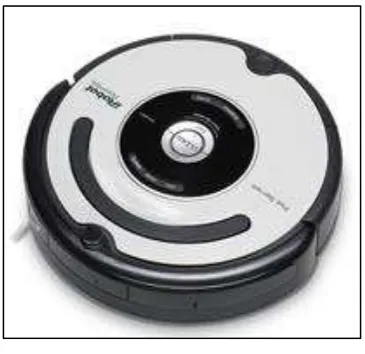
All this kind of uneasiness situations can be solved if there is a type of vacuum cleaner system that can be operated automatically. In the market actually automatic vacuum cleaner has already been introduced like iRobot’s Roomba as Figure 1.1. This automatic vacuum cleaner is the most popular in United State which comes in various ranging.
Figure 1.1: iRobot Roomba 565
(Source :< http://www.conrad.com/ce/en/product/192581/>).
3
1.2 Problem statement
Automatic vacuum cleaner has been introduced in the market, the product is more expensive and current existing design of automatic vacuum cleaner such as Roomba is quite big. Due to current design of the automatic vacuum cleaner, reaching a small or narrow space or wall corner may be a difficult task to be achieved.
Based on that problem, a recommended solution is to come out with a mini automatic vacuum cleaner. Perhaps, through the new innovation, it will be able to help consumer to save their time, money and energy to operate the vacuum cleaner, as the proposed mini automatic vacuum cleaner will operate wirelessly and equipped with rechargeable battery. Through this development, the mini automatic vacuum cleaner is just need to be put in room, switch it ON and the sensor will help to ensure the automatic vacuum cleaner runs with a capability to avoid obstacle in the operation.
The design of the vacuum cleaner needs to be compact and smaller. Mini automatic vacuum cleaner will be designing in smaller scale compared to existing automatic vacuum cleaner. This is because existing automatic vacuum cleaner such as Roomba is in large design and gives some limitations during operation.
This design of mini automatic vacuum cleaner will produce improvement in term of the working operation because it can reach till the small spaces. This design would also help to increase the performance of vacuum cleaner by sucking dust at the area which could not sucked by current existing automatic vacuum cleaner.
4
1.3 Objective
The main objective is to develop a mini automatic vacuum cleaner that is uses to clean up dust automatically. Besides that, other goals that need to be achieved are:
i. To design and develop a small size of automatic vacuum cleaner
ii. To analyse the performance of the small size automatic vacuum cleaner.
1.4 Scope and limitation
To successfully complete this project, there are some limitations of the project:
i. This project will come out as prototype and not as actual product. ii. The operation movement area must be flat and no curve.
iii. Test and experiment will be done where the robot is to run in a certain limited area that had been decided at first.
iv. Navigation and localization of the mini vacuum cleaner is not involved as only locomotion is considered.
v. The performance of the vacuum is not analyse in detail.
1.5 Report structure
5 Chapter two describe about the literature review that consists of the background of the project. It also describes about the similar works that have been done by other person and is a comparison to the similar works, thus discuss the advantages and disadvantages of previous project. Other than that, it also describes about types of the vacuum cleaner that had been existed in the market and the locomotion of the automatic vacuum cleaner.
Chapter three describes about the project planning. The project planning consists of hardware design, software and electrical circuit system. This chapter also discusses about the development method that will be used in the project such as material selection, fabrication process, control system development and programming. Then, the testing method and method to analysis will be discussed.
Chapter four describes about the result and analysis data. The analysis in this chapter is consists of the suction analysis and performance analysis.
6
CHAPTER 2
LITERATURE REVIEW
This chapter is focusing on the related works of automatic vacuum cleaner. The section 2.1 of this report will explain about vacuum cleaner, section 2.2 will explain about the operation inside of the vacuum cleaner, section 2.3 will explain about the cleaning robot, section 2.4 will discuss about the automatic vacuum cleaner, section 2.5 will talk about the future of the automatic vacuum cleaner and followed by section 2.6 which is summary of this chapter.
2.1 Vacuum cleaner