Serum levonorgestrel concentration and cervical mucus viscosity
after six months of monoplant® implantation
Abstrak
Latar belakang: Penggunaan implan levonorgestrel sebagai metode kontrasepsi telah mengalami perubahan dari enam batang pada metode awal hingga dua batang pada metode terbaru dan telah terbukti efektif. Penelitian ini bertujuan untuk mengevaluasi efektiitas pemakaian satu batang implan (Monoplant®) dengan mengukur kadar levonorgestrel serum dan kualitas mukus serviks.
Metode: Sebanyak 30 wanita sehat, usia 20-40 tahun, terbukti fertil, dilakukan pemasangan susuk levonorgestrel satu batang. Pemeriksaan kadar levonorgestrel selanjutnya dilakukan setiap bulan dan pemeriksaan kekentalan lendir serviks dilakukan setiap tiga bulan, hingga bulan keenam.
Hasil: Konsentrasi levonorgestrel serum secara konsisten berada di atas kadar minimal efektif (200 pg/mL), masing-masing pada bulan ketiga, keempat, kelima dan keenam adalah 338,9 pg/mL, 424,8 pg/mL, 320,3 pg/mL, dan 337,5 pg/mL. Hampir seluruh akseptor (96,7%) mengalami kekentalan lendir serviks yang baik sejak bulan ketiga setelah pemasangan susuk.
Kesimpulan: Kadar serum levonorgestrel pemakai susuk satu batang (Monoplant®) hingga bulan keenam masih di atas kadar efektif kontrasepsi. Kekentalan lendir serviks meningkat segera setelah pemasangan susuk. Hal ini menggambarkan bahwa implan levonorgestrel tunggal efektif sebagai suatu metode kontrasepsi.
Abstract
Background: The use of levonorgestrel implants as a contraceptive method have undergone changes in the number of implants used, beginning from six rods in the early methods to two rods in the present method and have been
proven effective. This study aims to evaluate the eficacy
of single rod implant (Monoplant®) by measuring serum levonorgestrel concentration and cervical mucus quality.
Methods: Thirty healthy women, aged 20-40 year old, and have been proven fertile, underwent single rod implant insertion. Levonorgestrel serum levels was measured every month and cervical mucus viscosity was examined every three month, until six months.
Results: Levonorgestrel serum concentration was consistently above minimum effective level (200 pg/mL), from month 3 to 6 respectively 338.9 pg/mL, 424.8 pg/mL, 320.3 pg/mL, and 337.5 pg/mL. Almost all of the acceptors (96.7%) had good cervical mucus viscosity since three months following implant insertion.
Conclusion: Levonorgestrel serum concentration in Monoplant® users was still above minimum contraceptive level until the sixth month. Viscosity of cervical mucus increased immediately following implant insertion. This indicates that single rod levonorgestrel implant is effective as a contraceptive method.
Keywords: cervical mucus viscosity, implant monoplant®, serum levonorgestrel
pISSN: 0853-1773 • eISSN: 2252-8083 • http://dx.doi.org/10.13181/mji.v23i1.685 • Med J Indones. 2014;23:25-9 Correspondence author: Eka R. Gunardi, [email protected]
C l i n i c a l R e s e a r c h
Copyright @ 2014 Authors. This is an open access article distributed under the terms of the Creative Commons Attribution-NonCommercial-ShareAlike 4.0 International License (http://creativecommons.org/licenses/by-nc-sa/4.0/), which permits unrestricted non-commercial use, distribution, and reproduction in any medium, provided the original author and source are properly cited.
Eka R. Gunardi, Biran Affandi
Department of Obstetrics and Gynecology, Faculty of Medicine, Universitas Indonesia, Cipto Mangunkusumo Hospital, Jakarta, Indonesia
which consists of six capsules, has been proven to be effective as long-term contraception method for more than 25 years.2-5 In later development, the number of
rods was reduced to two, which caused the implant to be known as Norplant-2®. That implant was later renewed and renamed as Jadena® (in Indonesia) or Jadelle® (in the USA).6,7
Implant is a contraceptive device placed under the skin which contains steroid hormones and can be used for up to ive years. One of the examples of implant which are widely used is levonorgestrel (LNG).1
As the country with one of the most populous family planning acceptors in the world, Indonesia has developed its own implants, the irst of which contains two LNG rods called Indoplant®,8 and the other one
contains one LNG rod called Monoplant®.9,10
Monoplant® only has one rod which contains the progestine hormone, LNG. This implant uses one lexible rod and contains the same amount of ingredient of LNG with elastomer silicone. The implant rod is covered with thin-walled silicone (similar with the one used on Jadelle® or Jadena®), and each pole is covered with silastic (polydimethyl-siloxane) medical grade adhesives. Every implant rod is 43 - 44 mm long, 2.5 to 2.6 mm wide and contains 160 mg LNG. LNG itself has been used for more than 30 years as the ingredients of contraceptive pills (combination pill and mini-pill) and implants.11
The pharmacokinetics of the LNG serum concentration’ average those of Jadena® and norplant-2®’ simplantations which is above 400 pg/mL. Within one-year after insertion, the average concentrations for both implants are still above 300 pg/mL. It is also known that after two to three years, the LNG concentration is relatively constant or only slightly decreased, but still above minimal effective concentration for prevention of pregnancy (200 pg/ mL). However, this concentration is inluenced by body weight, steroid hormone binding globulin (SHBG) level, and its metabolites clearance.12-15
Beside prevention of ovulation and its effects on endometrial thickness,16 another mechanism
of progestin for contraception, is its effect on cervical mucus viscosity.17 Under the inluence
of endogenous and exogenous progesterone, the cervical mucus undergoes changes to be thick, murky, inelastic and non-transparent or not clear. This situation resembles cervical mucus at the end of menstrual period, in which the external cervical ostium was covered by viscous thick and acidic mucus, so it is impossible for sperms to penetrate into the uterus. Cervical mucus quality is different for every phase of the menstrual period. During ovulation, mucus is thinner and elastic because it contains higher water. It is more transparent or translucent and less acidic.18
The main objective of this study was to determine LNG serum concentration following single LNG rod implantation. The secondary objective was to determine its effects an cervical mucus quality.
METHODS
This study was part of a second phase clinical trial of Monoplant® implant with pre and post design. It was conducted in Raden Saleh Clinic, Jakarta, and was held between 2009 and 2010 for six months involving women aged 20-40 year old who still want to be pregnant.
Number of subjects in this preliminary study was limited to only 10-20 subjects. The protocol of this study has been approved by The Research Ethics committe Faculty of Medicine Universitas Indonesia No.176/PT02.FK/ETIK/2009. After calculation, the required sample size was found to be 30 subjects.
Monoplant® was inserted on menstrual period (day one up to day seven). Afterwards, the follow up were performed in the fourth week of every month, for six months. On those periods, basic physical examinations and side-effect evaluations were performed. In addition, examination of LNG, estrogen (E), and progesterone (P) level were also performed. Other biochemistry indicators were triglyceride, total cholesterol, high density lipoprotein (HDL) and low density lipoprotein (LDL), and random blood glucose. Endometrial thickness and cervical mucus viscosity were also measured.
Measurent of LNG concentration was done in two different laboratories, which are Makmal Terpadu Faculty of Medicine, Universitas Indonesia - Cipto Mangunkusumo Hospital, Jakarta, and The Population Council, New York, USA. All subject’s serum for LNG examination from the irst to the sixth month was examined in Makmal. Only a part of the subject’s serums (from the third to the sixth month) was examined in the USA because the remaining serum amount was not suficient to be transferred (which require at least one mL of serum).
RESULTS
As many as 30 family planning acceptors had been recruited to be subjects and followed this Monoplant® implant study. All subjects inished the study on schedule. No subject requested to have their implants removed before study had been over.
Subject characteristics
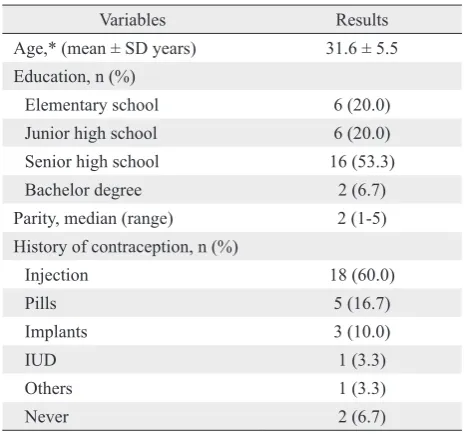
General subjects characteristics can be seen in table 1. All subjects had formal education, mostly senior high school (53.3%). Only 20% elementary school.
All subjects were still married and generally had two children, with the smallest parity of one, and
Variables Results
Age,* (mean ± SD years) 31.6 ± 5.5 Education, n (%)
Elementary school 6 (20.0)
Junior high school 6 (20.0)
Senior high school 16 (53.3)
Bachelor degree 2 (6.7)
Parity, median (range) 2 (1-5)
History of contraception, n (%)
Injection 18 (60.0)
Pills 5 (16.7)
Implants 3 (10.0)
IUD 1 (3.3)
Others 1 (3.3)
Never 2 (6.7)
Table 1. Characteristics of the subjects by age, education, parity, and history of contraceptive use (n = 30)
* Normality test of Shapiro-Wilk (p = 0.164)
the biggest of ive. All subjects still wanted to have another child or were not sure to terminate their fertility. Because of those reasons, they wanted to use monoplant® for three years.
Most of the subjects (93.3%) had previously used contraception, and stopped for six months or more. The chosen contraception was hormonal (86.7%), 10% of them had used six capsuls of implant, Norplant®.
Levonorgestrel concentration
The LNG serum level examined in Makmal were low and inconsistent, but when it was examined in
the United State of America, the serum concentration was higher.
LNG serum examination in Population Council Laboratories, New York, USA showed higher concentration. Even in the sixth month, the average concentration was 337.5 pg/mL. The average LNG concentration every month was relatively stable. There was no data about concentration on the irst and second month, but LNG concentration in the following month was 338.9 pg/mL, 424.8 pg/mL, 320.3 pg/mL, and 337.5 pg/mL.
Table 2. Levonorgestrel concentration after monoplant® insertion
DISCUSSION
The most frequent contraception method used prior to the subjects’ participation in this research was injection (60.0%). The average age of 29 year old and the number of parity of two means that most of the subjects still need effective and reversible contraceptive method to prevent pregnancy. The criteria for contraception method for pregnancy spacing are:19 1) does not suppress lactation; 2)
effective; 3) reversible; 4) last for lifetime (long acting).
Levonorgestrel concentration
Sivin20 in a multi-center research (North and South
America, Europe and Asia) about Jadelle® revealed
LNG (pg/mL) Lab. USA
N Mean Minimum Maximum
Month 1 - - -
-Month 2 - - -
-Month 3 11 338.9 231.2 501.5
Month 4 8 424.8 287.5 608.3
Month 5 15 320.3 115.5 484.3
Month 6 13 337.5 187.5 532.8
Table 3. Changes in cervical mucus viscosity after Monoplant® insertion (n = 30)
Examination Variable
Third month n (%)
Sixth month n (%) Viscosity of cervical discharge
Thick 29 (96.7) 29 (96.7)
that progestin implant contraceptive effect depended on the diffusion ability of LNG from its reservoir to circulation system. Furthermore, LNG was circulating and bound to SHBG, and only free LNG gave effect on target organs.
According to Sivin, a few moments after implant insertion; LNG could be detected in the serum. Maximum concentration is achieved within 24 to 72 hours after insertion and would decline on the irst week,21 reaching its median concentration on the irst
month,20 and continuously decrease in three years of
usage.22 LNG average serum concentration on the
irst month after Jadelle® insertion was 435 pg/mL, and would decrease to 280 pg/mL by the end of third year. Although Jadelle® was only recommended for three years of contraception, this research was continued for seven years. LNG serum concentration in the end of seventh year was 224 pg/mL.23
In this study, the data of LNG serum concentration from the beginning of insertion does not exist, but, LNG concentration at the end of the sixth month was above effective contraceptive level (200 pg/mL), reaching 337.5 pg/mL. This level was not much different from Jadelle® acceptor level of serum LNG in the same month, 357 pg/mL, then subject could still use Monoplant® as a contraception until the 36th months, as recommended.9
Cervical mucus viscosity
Progestin as contraception works to prevent ovulation and endometrial thickness,16,24 also has an effect on
viscosity of cervical mucus.17
Under the inluence of endogenous or exogenous progesterone, the cervical mucus will be thick, cloudy, non elastic and non-transparent or not clear. This condition is similar to cervical mucus after the end of menstrual period; the external cervical os was covered by viscous mucus which is thick and acidic, so it is not possible for sperm to enter the uterus. Cervical mucus quality is different from every phase of the menstrual period. At ovulation period, mucus was thinner and elastic because its content a higher water, more transparent or translucent, and less acidic.18
In this study, 29 subjects had thick cervical mucus after few days of implant insertion (Table 3). According to Baziad the main mechanism of progestin pills is to make cervical mucous become thick.25 These effects occur within few hours after
taking the pill and maximum effect after four hours. Thickening effect of cervical mucus can still be found up until 20 hours after taking the pill, but contraceptive effect would have become less unless users take the next pill.
Lewis assess the cervical mucus of LNG-IUD users using recommendations by the World Health Organization (WHO),26 such as cervical mucus
microscopic assessmen using scores of cervical mucus analysis (CMA). The CMA score ≥ 10 (maximum of 15), indicates a favorable cervical mucus for sperm penetration. This study concludes the quality of cervical mucous-LNG IUD users at mid-cycle is not adequate for transportation of sperm into the endocervical area.
Jonsson compared the indings of cervical mucus on the three types of IUDs (inert IUD, copper IUD and LNG-IUD).27 Compared to other types of IUDs,
the LNG-IUD could prevent ovulation, no change in the levels of estradiol, signiicant decrease in the levels of progesterone, the cervical mucus is thick, no change in the composition of mucin, albumin and immunoglobulin G.
Jian-ping found reducing crystals in the cervical mucus of LNG-IUD acceptors, so that the picture of fern leaves on microscopic preparations was also reduced.28 Similarly, mucus viscosity is much higher
than the copper IUD. This situation demonstrates the high local concentration of LNG in the uterus will change the status of the uterine cavity and cervical mucus.
Croxatto mentioned that eventhough LNG implant give inhibition effect towards ovary including anovulation and luteal insuficiency, also estrogen independent of irregular thickening of endometrial tissue, the main effect of this LNG is to make less and thick cervical mucus due to its strong antiestrogenic effect.29 Resistance effect of sperm penetration is a
result of antifertility effect of Norplant® even during circulating estradiol levels which are seen as much as late follicular phase of normal menstrual cycle or ovulating cycle.17
In conclusion, the serum levels of levonorgestrel after single rod levonorgestrel implant Monoplant® is still above effective levels until the sixth month. The viscosity of cervical mucus will increase immediately after implant insertion.
Conlict of interest
The authors declare that this study is free of conlict of interest.
REFERENCES
1. Affandi B, Santoso SS, Djajadilaga, Hadisaputra W, Moeloek FA, Prihartono J, et al. Five-year experience with
Norplant. Contraception. 1987;36(4):417-28.
2. Curtis KM. Safety of implantable contraceptives for women: data from observational studies. Contraception.
2002;65(1):85-96.
3. Brown A. Long-term contraceptives. Best Pract Res Clin
Obstet Gynaecol. 2010;24(5):617-31.
4. McDonald-Mosley R, Burke AE. Contraceptive implants.
Semin Reprod Med. 2010;28(2):110-7.
5. Davis AR, Westhoff C, O’Connell K, Gallagher N. Oral
contraceptives for dysmenorrhea in adolescent girls: a
randomized trial. Obstet Gynecol. 2005;106(1):97-104.
6. Meckstroth KR, Darney PD. Implantable contraception.
Obstet Gynecol Clin North Am. 2000;27(4):781-815.
7. Brache V, Faundes A, Alvarez F, Garcia AG. Transition from Norplant to Jadelle in a clinic with extensive experience providing contraceptive implants. Contraception.
2006;73(4):364-7.
8. Affandi B, Wijayanegara H, Permadi W, Soedarto, Hasan M, Ngartjono W et.al [Internet]. Multi centers research comparative study of Indoplant® and Norplant® in
Indonesia. 2005 [cited 2013 Oct 7];[5 screen]. Available
from: http://www.triyasa.com/prodadd/csini.pdf
9. Gunardi ER, Affandi B, Juliaan F. Levonorgestrel concentration in a single rod implant users for six months.
Indones J Obstet Gynecol. 2011;35(3):122-7.
10. Gunardi ER, Affandi B, Muchtar A. Monoplant® the Indonesian implant: the overview of implant and its
development. Indones J Obstet Gynecol. 2011;35(1):40-6. 11. Council P. Norplant® LNG implant: a summary of scientiic
data. New York (NY): The Population Council; 1990.
12. Sivin I, Nash H, Waldman S. Jadelle® levonorgestrel rod
implants. A summary of scientiic data and lessons learned
from programmatic experience. New York: Population
Council; 2002.
13. Berek SJ. Berek & Novak’s Gynecology. California:
Lippincott Williams & Wilkin; 2007.
14. Henry M. Williams textbook of endocrinology.
Philadelphia: Saunders Elsevier; 2008.
15. Raudaskoski T, Laatikainen T, Kauppila A. Sex-hormone binding globulin as an indicator of the hepatic impacts of continuous combined hormone replacement regimens.
Maturitas. 1998;29(1):87-92.
16. Shaaban MM, Segal S, Salem HT, Ghaneimah SA, Khalifa EA, Ahmed AG. Sonographic assessment of ovarian and endometrial changes during long-term Norplant use and their correlation with hormonal levels. Fertil Steril.
1993;59(5):998-1002.
17. Croxatto HB, Diaz S, Salvatierra AM, Morales P, Ebensperger C, Brandeis A. Treatment with Norplant subdermal implants inhibits sperm penetration through cervical mucus in vitro.
Contraception. 1987;36(2):193-201.
18. Weschler TID. Taking charge of your fertility, 10th ed.
the deinitive guide to natural birth control, pregnancy
achievement, and reproductive health. Harper Collins:
United States of America; 2002.
19. Affandi B. Clinical, pharmacological and epidemiological studies on a levonorgestrel implant contraceptive. Jakarta:
University of Indonesia; 1987.
20. Sivin I, Lahteenmaki P, Ranta S, Darney P, Klaisle C, Wan L, et al. Levonorgestrel concentrations during use of
levonorgestrel rod (LNG ROD) implants. Contraception. 1997;55(2):81-5.
21. Sivin I, Lahteenmaki P, Mishell DR Jr, Alvarez F, Diaz S, Ranta S, et al. First week drug concentrations in women with levonorgestrel rod or Norplant capsule implants.
Contraception. 1997;56(5):317-21.
22. Sivin I, Viegas O, Campodonico I, Diaz S, Pavez M, Wan L,
et al. Clinical performance of a new two-rod levonorgestrel contraceptive implant: a three-year randomized study with Norplant implants as controls. Contraception.
1997;55(2):73-80.
23. Sivin I, Mishell DR Jr, Diaz S, Biswas A, Alvarez F, Darney P, et al. Prolonged effectiveness of Norplant(R) capsule implants: a 7-year study. Contraception.
2000;61(3):187-94.
24. Barbosa I, Bakos O, Olsson SE, Odlind V, Johansson ED. Ovarian function during use of a levonorgestrel-releasing IUD. Contraception. 1990;42(1):51-66.
25. Baziad A. Endocrinologi ginekologi. Edisi Ke 2. Jakarta:
Media Aesculapius; 2003. Indonesian.
26. Lewis RA, Taylor D, Natavio MF, Melamed A, Sokol R, Mishell DR Jr. Effects of the levonorgestrel intrauterine system (LNG-IUS) on cervical mucus quality and
sperm penetration. Fertility and Sterility. 2009;92(3,
Supplement 1):S27.
27. Jonsson B, Landgren BM, Eneroth P. Effects of various iuds on the composition of cervical mucus. Contraception.
1991;43(5):447-58.
28. Shi JP, Wu XR. Levonorgestrel levels in serum and uterine
lushings in women bearing LNG-Cu-IUD. J Tongji Med Univ. 1993;13(2):126-8.
29. Croxatto HB. Norplant: levonorgestrel-releasing