1.0 INTRODUCTION
1.1 BACKGROUND OF THE STUDY
Parenting styles as listed by Baumrind (1991) have four primary styles which are
authoritative parents, authoritarian parents, permissive parents and uninvolved
parents[ CITATION Kop07 \l 1033 ]. Each of the styles has different degree of warmth and
control towards their children’s development. For this study, it focuses on two parenting styles
which are an authoritative parents and uninvolved or neglectful parents. These two styles will
relate on effect towards children development and educational theories such as Piaget’s
theory, Vygotsky’s theory and Bronfenbrenner’s theory.
1.2 PROBLEM STATEMENT
Some parents are not realizing that their parenting style may affect their children
development. This is because most of them sometimes being neglectful and too controlling
their children. According to Kopko (2007), parents gain benefit from an understanding that
how their parenting style gives a basis for many healthy developmental outcomes during teen
age. It is very important for the parents to know their parenting styles to help their children to
1.3 PURPOSE OF STUDY
This study was carried out to determine the following:
To compare children’s development between authoritative parents and neglectful
parents
To describe on how parenting styles affect their children’s development To clarify the parents that parenting styles affect children’s development
1.4 SIGNIFICANCE OF STUDY
It is particularly obvious that students and teachers nowadays still not realize the positive
effects of music towards their academic achievement. As this study investigate the relation
between music and academic achievement, it is hoped that the outcome of the study will be
beneficial in order to help teachers and students to understand the relation between music
and academic achievement and the positive effects.
1.5 RESEARCH QUESTIONS
Parents have the right to set the rules in house
Parents still can give independent to the child to develop the skills
Parents that give attention can develop children’s negotiation skills
Neglectful parents delay the children’s academic performances Neglectful parents cause the children have high egocentrism Authoritative parents develop children’s language skills
Authoritative parents able to increase children’s sophistication in use of words
Children have greater understanding of complex literary works when parents engage with them
Children delay in language skill caused by neglectful parents Children unable to understand complex words when parents do
Children use inappropriate words when parents avoid to communicate well with them
Children easily adapt to socialize with others when parents give attention
Authoritative parents caused children keep positive relationship with peers
Authoritative parents caused children to broad their links of friends
Neglectful parents caused the children to isolate themselves Neglectful parents caused children’s social skill delay
Children tend to become introvert when parents do not give attention
2.0 LITERATURE REVIEW
2.1 INTRODUCTION
This chapter presents the definition of an authoritative parenting style and a neglectful
authoritative and neglectful parenting style in children cognitive (academic
achievement). This chapter also explains on comparison between an authoritative and a
neglectful parenting style in children social and language skills.
2.2 DEFINITION OF AN AUTHORITATIVE AND NEGLECTFUL PARENTING STYLE
According to Baumrind (2012), authoritative parenting style applies high degree of
warmness, involvement, strictness and supervision. This kind of parents give
independent while set the limits and controls the children actions. The parents also
engage in discussion and listen to the children viewpoint. Meanwhile, a neglectful
parenting style can refer to the parents that uninvolved with children. They are not
warm and less to interact with children [ CITATION Bau12 \l 1033 ]. According to
Kopko (2007) a neglectful parents are difficult to consider their children’s input in
decisions and never care by their children (as cited in Baumrind, 1991).
2.2 DEFINITION OF CHILDREN DEVELOPMENT
As children grow from infants to teens to adult by facing the process of developmental
changes that are important to all aspects of their developmental (Child Development
Institute, n.d.) including physical, social/emotional, language/cognitive[ CITATION
Irw07 \l 1033 ] and grow and mature at different tempo [ CITATION Med13 \l 1033 ]
Children experience impressive physical changes from birth through
teenager[ CITATION Coo05 \l 1033 ].
2.3 COMPARISON BETWEEN AN AUTHORITATIVE AND NEGLECTFUL
The parenting style plays as a main role in the area of educational development
[ CITATION Bab15 \l 1033 ]. The kind of power of Authoritative parent is confrontive
power where they reasoned, negotiable, outcome-oriented and concerned with
regulating their child’s behavior[ CITATION Bau12 \l 1033 ]. According to Baldwin,
McIntyre and Hardaway (2007), college students that live in an authoritative home
revealed more confidence, determine and academic achievement (as cited in Strage and
Brandt, 1999). The children from authoritative parents tend to success academically,
show few internal or external behavioral problems, score higher on measures of
self-reliance and do show more pro-social behaviors [ CITATION Bal07 \l 1033 ].
According to De Oleveira (2015), authoritative parenting values the person, and the
objective is to encourage the child towards independence and autonomy. She also found
that motivation of academic success by parents was positively related with academic
achievement. Differ from neglectful parents as cited in Baumrind (1991) that are not
warm and do not take any demands on their teen [ CITATION Kop07 \l 1033 ].
Children that have being neglected show more evidence of delayed cognitive
development [ CITATION Bra14 \l 1033 ]. According to Action For Children (n.d.),
one of the effects of neglect on children is having poor cognitive such as language
delay, lower intellectual ability and inability to concentrate or express feeling.
These Baumrind Parenting style are much related to Piaget’s theory where the theory
related to constructivist point of view. Children build their own individual
understandings and knowledge [ CITATION Irw07 \l 1033 ] and therefore the children
develop their cognitive skills through experiences. Besides Piaget’s theory, Baumrind
parenting style also much related to Vygotsky’s theory. Vygotsky explored the
relationship between language and though, instruction and development, everydat and
academic concept formation and a host of others[ CITATION Ale03 \l 1033 ]. Children
skilled helper. Vygotsky saw words as briefing children scientific concepts [ CITATION
DeVnd \l 1033 ]. According to Bronfenbrenner (1994), “human development is going
through the process of progressively more complex reciprocal interaction between an
active, evolving biopsychological human organism and the persons, objects, and
symbols in its immediate environment”. This is because; Bronfenbrenner’s theory
focuses on the social contexts where people live and the people who influence their
development. Authoritative parenting styles may affect positively of their children
development in social contexts compared to neglectful parents. This is because,
children that have been neglected appear more signs of delayed cognitive development,
poor language skills, and poor social skills and coping abilities[ CITATION Bra14 \l
1033 ].
3.0 METHODOLOGY SECTION 3.1 Method used
In this study, survey method was used to get the feedback. A questionnaire on comparison of authoritative and neglectful parenting style was administered in order to compile the parent’s perception about the effect on children’s development.
A questionnaire comprising 2 sections was used in this study. In the first section, the respondents are required to answer 3 questions on demographic data. The questions consist of the respondents’ age, gender and number of children. The second section contains 3 subsections that can be categorized as children cognitive, language and social skills. There are 6 questions in each of the subsections. Overall, there are 21 questions in the questionnaire.
There are about 20 parents are given the questionnaire. Our respondents consist of parents and single parents. Our respondents made up of our own neighbors where we already know about the number and ages of their children, which further facilitate our survey.
3.3 Limitation(s)
This study was conducted in two different places which are in Nilai Impian, Negeri Sembilan and Klang, Selangor. It is because we want to see the parent’s perception between these two places. 10 questionnaires were given for each places. Parents and single parents that we do a survey must have at least 7 years old child. The requirement we prescribed may help us get a more accurate perception as compared of young parents.
4.0 ANALYSIS OF DATA (RESULTS) AND DISCUSSION 4.1 Result presentation
All the data and findings gathered are presented in percentages in the form of table.
4.1.1 Demographic data
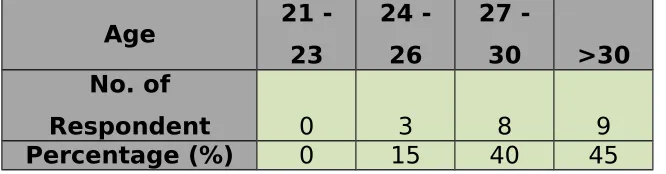
Among 20 of the respondents, 15% of them are in range age of 24 – 26, while 40% of them are in 27 – 30 years old. The higher percentage of the respondents are 30 years and above.
B. Gender
Gender Male Female
No. of
Respondent 8 12
Percentage (%) 40 60
60% of the respondent are female while other 40% are male. This amount are not equal because the study also carried on the single parents too.
C. Number of Children
No. of Children 0 1 - 5 6 - 10 >10 No. of
Respondent 0 16 3 1
Percentage (%) 0 80 15 5
80% of 20 respondents have 1 to 5 children, while 15% of them have 6 to 10 children. Only 5% has more than 10 children. The studied done on parents that have children at least 7 years old. It is because they are more experienced in order to give a feedback on their children development rather than a younger parents.
Table 4.1.2 Respondent’s gender
4.1.2 Respondent’s Feedback
A. Children Cognitive Skill
Question 1 : 60% of
20 parents strongly agree
that they have the right to
set the rules in their house,
while 40% of them were agree too.
Question 2 : Most of the parents agree that parents still can give independent to the child to develop the skills and 10% of them strongly agree with the statement. Only 20% of them feel neutral with the statement.
Question 3 : 60% of the parents agree that negotiation skills among their children can be develop if parents give them attention. 20% of them strongly agree with the statement while another 40% have neutral feeling about that.
Question 4 : More than half which is 55% of the parents agree that attention given by the parents will develop child’s reasoning skills and 20% of them strongly agree with this. 15% of the parents not sure about the statement while 10% of them were disagree.
Question 5 : 40% of parents strongly agree that neglectful parents will delay the children’s academic performance and 35% of them also agree with this. While 15% of them were disagree with the statement, other 10% in neutral feelings about this.
Question 6 : 10% of parents were not agree that high egocentrism among children are cause from neglectful parents. 60% and 5% were agree and strongly agree with the statement. Other 25% of the parents not sure about the statement given.
B. Children Language Skill
Scale 1 2 3 4 5
Q1 3 6 7 4
(%) 15 30 35 20
Q2 1 6 9 3 1
(%) 5 30 45 15 5
Q3 3 8 9
(%) 15 40 45
Q4 1 2 10 7
(%) 5 10 50 35
Q5 3 9 8
(%) 15 45 40
Q6 4 10 4 2
(%) 20 50 20 10
Table 4.1.5 Respondent’s feedback on children language skill
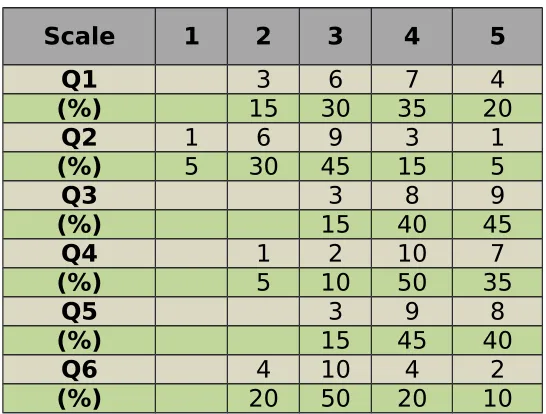
Question 1 : 35% of parents that answer the questionnaire agree that authoritative parents will develop children’s language skill while 20% of them strongly agree with the statement. 30% of the respondents not sure about the statement while another 15% disagree with the statement.
Question 2 : Authoritative parents able to increase children’s sophistication in use of words and this statement was totally agree and agree by 5% and 15% respectively. In other side, 5% and 30% were said they are totally disagree and disagree respectively. Balance of 45% were not sure about the statement,
Question 3 : 45% of parents totally agree that children will have greater understanding of complex literary works when they engage with their child and 40% of them agree with that. 15% of them have a mix feelings about the statement.
Question 4 : Half of the parents agree that neglectful parents cause children delay in their language skill while 35% of them strongly agree with the statement. In the other hand, only 5% of the parents disagree and the balance of 10% said they feel neutral with the statement.
Question 5 : 45% and 40% of parents agree and strongly agree respectively about parents that not give attention will cause their children unable to understand complex words. A balance of 15% had a mix feelings about that.
C. Children Social Skill
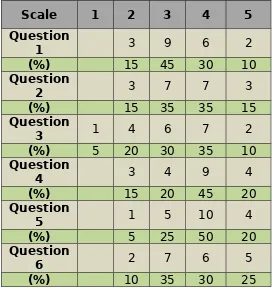
Question 1 : 45% of parents have mix feelings when we said that children easily adapt to socialize with others when parents gives attention. 30% of them agree and 10% strongly agree while another 15% disagree about that.
Question 2 : Authoritative parents will cause children to keep positive relationship with peers and this statement were disagree by 15% of parents. 35% of parents have equally perspective about that in natural feelings and agree with the statement. Another 15% very sure and strongly agree with the statement.
Question 3 : 35% and 10% of parents agree and totally agree respectively when we state that authoritative parents caused children to broad their links of friends. While that, 5% and 20% of parents strongly disagree and
Table 4.1.6 Respondent’s feedback on children social skill
disagree respectively about that. A balance of 30% parents have neutral feelings about that.
Question 4 : 15% of parents disagree that neglectful parents caused the children to isolate themselves while 45% and 20% of parents agree and strongly agree respectively with the statement. A balance of 20% have neutral feelings about this.
Question 5 : Half of the respondents agree when we state that neglectful parents caused children’s social skill delay, while 20% of parents strongly agree with the statement. 25% of them have mix feelings and only 5% of them disagree with the statement.
5.0 CONCLUSION
5.1 INTRODUCTION
This chapter comprises the summary of the findings, and the conclusion of the study.
5.2 SUMMARY OF FINDINGS
The objectives of this study are to compare children’s development between authoritative
parents and neglectful parents, to describe on how parenting styles affect their children’s
development and to clarify the parents that parenting styles affect children’s development.
In this study has shown that the authoritative parents provide high positive effects in
children development because of the warmth and negotiation in discussion. Differ from
the neglectful parents that do not give any demands on the child and reluctant to have
interaction between the children show negative children development. Their kids tend to
be extrovert and delay in cognitive skills, language skills and social skills. Therefore, the
warm and control parents are more beneficial to the adolescent compare to not warm and
uninvolved parents. Baumrind parenting styles are highly related to children development
according to Piaget’s theory, Vygotsky’s theory and Bronfenbrenner’s theory. The
REFERENCES
Stimulative Music. (2003). Retrieved June 21, 2015, from The Free Dictionary: http://medical-dictionary.thefreedictionary.com/stimulative+music
The Ameican Heritage Dictionary of the English Language. (2013). Houghton: Houghton Mifflin Harcourt Publishig Company.
Action For Children. (n.d.). Neglecting the Issue: Impact, causes and responses to Child Neglect in the UK. Watford: University of Stirling.
Alex, K., Gindis, B., Agevey, V. S., & Miller, M. S. (2003). Introduction-Sociocultural Theory and Education: Students, Teachers and Knowledges. In K. Alex, B. Gindis, V. S. Agevey, & M. S. Miller, Vygotsky's Educational Theory in Cultural Context (pp. 1-11). Cambridge: Cambridge University Press.
Anonymous. (2013, September 9). Music For Studying: 10 Tips to Pick the Best Study Music. Retrieved June 21, 2015, from Examtime:
http://www.examtime.com/blog/music-for-studying/
Anonymous. (2013, November 22). Researchers Find Link Between Music and Academic Performance in Nashville. Retrieved June 21, 2015, from MNPS Children First: http://mnpschildrenfirst.com/2013/11/22/researchers-find-link-between-music-and-academic-performance-in-nashville
Babu, S. (2015). Parentign Styles and Academic Success. Sai Om Journal of Arts & Education, 2(1), 12-16.
Baldwin, D. R., McIntyre, A., & Hardaway, E. (2007). Perceived Parenting Styles On College Students' Optimism. College Student Journal, 41(3), 550-557.
Baumrind, D. (2012). Differentiating between Confrontive and Coercive Kinds of Parental Power-Assertive Disciplinary Practices. Human Development, 55, 35-51.
Brandon, M., Glaser, D., Maguire, S., McCrory, E., Lushey, C., & Ward, H. (2014).
Missed Opportunities: Indicators of neglect-what is ignored, why, and what can be done? United Kingdom: Childhood Wellbeing Research centre.
Bronfrenbenner, U. (1994). Ecological Models of Human Development.
International Encyclopedia of Education, 3, 37-43.
Cabanac, A., Perlovsky, L., Cabanac, M. C., & Cabanac, M. (2013). Music and Cademic Performance. Elsevier : Behavioural Brain Research, 257-260.
Child Development Institute. (n.d.). Child Development. Retrieved from Child Development Institute:
Clair, A. A. (2015). Education and Care. Retrieved June 21, 2015, from Alzheimer's Foundation of America (AFA):
http://www.alzfdn.org/EducationandCare/musictherapy.html
Cook, J. L., & Cook, G. (2005). Cognitive Development: Paigetian and
Sociocultural Views. In J. L. Cook, & G. Cook, Child Development: Principles & Perspectives (pp. 3-37). Boston: Pearson.
De Oliveira, T. L. (2015). Are Associations Between Parenting Style and Acdemic Achievement Moderated by Ethnicity and Individualism-Collectivism?
Walden University ScholarWorks, 1-131.
Deke, F., Wehrum, S., Stark, R., & Schwarzer, G. (2014). Music Lessons and Academic Self Concept in 12-to-14 Years Old Children. Musicae Scientiae, 204-215.
DeVries, R. (n.d.). Vygotsky, Piaget, and Education: A Reciprocal Assimilation of Theories and Educational Practices. Iowa: University of Northern Iowa.
Dolegui, A. S. (2013, November 7). The Impact of Listening to Music on Cognitive Performance. Retrieved June 13, 2015, from Student Pulse:
http://222.studentpulse.com/articles/762/the-impact-of-listening-to-music-on-cognitive-performance
Dovey, D. (2014, December 16). Music Education Improves Students' Academic Performance, but Active Participation is Required. Retrieved June 13, 2015, from Under The Hood: http://www.medicaldaily.com/music-education- improves-students-academic-performance-but-active-participation-is-required
Eason, B. J., & Johnson. (2013). Prelude : Music Makes Us BAseline Research Report. Nashville: Metro NAshville Public School.
Horton, R., Bustamante, R. M., Edmonson, S. L., & Slate, J. R. (2013). Music and Student Performance: A Conceptual Analysis of the Literature. The Online Journal of New Horizons in Education, 72-85.
Irwin, L. G., Siddiqi, A., & Hertzman, C. (2007). Early Child Development: A Powerful Equalizer. Vancouver: World Health Organization.
Kopko, K. (2007). Parenting Styles and Adolescents. United States: Cornell Cooperative Extension.
Lipman, J. (2013, October 12). Sunday Review: Opinion. Retrieved June 13, 2015, from The New York Times:
http://www.nytimes.com/2013/10/13/opinion/sunday/is-music-the-key-to-success
Medline Plus. (2013, December 6). Child Development . Retrieved from U.S. National Library of Medicine :
Roden, I., Grube, D., Bongard, S., & Kreutz, G. (2013). Does Music Training Enance Working Memory Performance? : Findings From a Quasi-experimental Longitudinal Study. Psychology of Music, 285-298.
Schellenberg, E. G. (2003). Music Lesson Enhance IQ. Ontario: Psychological Science.
Waller, G. D. (2007). The Impact of Music Education on Academic Achievement, Attendance Rate, and Student Conduct on the 2006 Senior Class in One Southeast Virginia Public School Division. Virginia: Virginia Polythecnic Institute and State University.
APPENDICES
Questionnaire form
EDUCATIONAL PSYCHOLOGY
COMPARISON BETWEEN AN AUTHORITATIVE AND NEGLECTFUL PARENTING STYLES EFFECTS ON CHIDLREN DEVELOPMENT We are from the Faculty of Education in program Physical & Health Education would like you to answer the questions below for our case study on topic Comparison Between An Authoritative and Neglectful Parenting Styles Effects On Children Development for Educational Psychology course.
Definition:
1. Authoritative Parents: Give independent to the child but need to follow the rules. Warm parents
Age : 21-23 Gender : Female ACCORDING TO THE SCALE BELOW. TICK ONE ANSWER ONLY FOR EVERY QUESTION.
1. Parents have the right to set the rules in house
2. Parents still can give independent to the child to develop the skills
3. Parents that give attention can develop children’s negotiation skills
4. Parents that give attention can develop child’s reasoning skills
5. Neglectful parents delay the children’s academic performance
B. Children Language Skill
NO QUESTIONS 1 2 3 4 5
1. Authoritative parents develop children’s language skill
2. Authoritative parents able to increase children’s sophistication in use of words 3. Children have greater understanding of
complex literary works when parents engage with them
4. Children delay in language skill caused by neglectful parents
5. Children Unable to understand complex words when parents do not give attention
6. Children use inappropriate words when
parents avoid to communicate well with them C. Children Social Skill
NO QUESTIONS 1 2 3 4 5
1. Children easily adapt to socialize with others when parents give attention
2. Authoritative parents caused children keep positive relationship with peers
3. Authoritative parents caused children to broad their links of friends
4. Neglectful parents caused the children to isolate themselves
5. Neglectful parents caused children’s social skill delay
6. Children tend to become introvert when parents do not give attention