APPLYING CONTEXTUAL TEACHING AND LEARNING IN MASTERING THE PRESENT CONTINUOUS TENSE
(A Classroom Action Research in the First grade of MTs Khazanah Kebajikan pamulang)
“Skripsi”
Presented to the Faculty of Tarbiyah and Teacher Training In Partial of Fulfillment of the Requirements
For the Degree of S.Pd (Bachelor of Arts) in English Language Education
By:
GUSRIANTI 205014000395
DEPARTMENT OF ENGLISH EDUCATION
FACULTY OF TARBIYAH AND TEACHERS TRAINING
SYARIF HIDAYATULLAH STATE ISLAMIC UNIVERSITY
JAKARTA
DEPARTEMEN AGAMA
UNIVERSITAS ISLAM NEGERI (UIN) SYARIF HIDAYATULLAH JAKARTA FAKULTAS ILMU TARBIYAH DAN KEGURUAN
Jl. Ir. H. Juanda No.95 Telp: (62-21) 7443328, 7401925 Ciputat 15142 Jakarta Email: [email protected]
SURAT PERNYATAAN KARYA SENDIRI
Saya yang bertanda tangan dibawah ini,
Nama : Gusrianti
Tempat/Tanggal lahir : Jakarta, 26 Agustus 1986
NIM : 205014000395
Program Studi : Pendidikan Bahasa Inggris
Judul Skripsi : Applying Contextual teaching and Learning in
Mastering The Present Continuous Tense (A Classroom Action Research in the First Grade of MTs Khazanah Kebajikan Pamulang)
Dosen Pembimbing : Drs. Nasifudin Jalil, M.Ag.
Dengan ini menyatakan bahwa skripsi yang saya buat benar-benar hasil karya saya sendiri dan saya bertanggung jawab secara akademis atas apa yang saya tulis. Pernyataan ini dibuat sebagai salah satu syarat menempuh Ujian Munaqasah.
Jakarta, 28 Juli 2011 Mahasiswa Ybs.
GUSRIANTI
ACKNOWLEDGEMENTS
In the name of Allah, the most Gracious, the Most Merciful
All praise to Allah, lord of the worlds who has bestowed upon the writer in
complement this “skripsi”. Peace and blessing be upon our prophet Muhammad
SAW, his family, his companions, and his followers.
This “skripsi” is presented to the English Department of the faculty of
Tarbiya and Teacher Training, State Islamic University Syarief Hidayatullah Jakarta as partial fulfillment of the requirement for the Degree of strata-1 (S1)
The writer would like to express her great honor and deepest gratitude to her beloved Father (Hadisman), her mother (Yeni), her sisters (Sri wahyuni and Yanti Rahmadhani) and all family who always provide the encouragement and incentive
for the writer to get on and complete this “skripsi”.
The writer also would like to express her great gratitude to her advisor Drs. Nasifudin Jalil, M.Ag., for his valuable advices and guidance during the writing of
this “skripsi”.
Furthermore, her gratitude goes to a head of English education department, Drs. Syauki, Neneng Sunengsih M.P.d as the secretary of English Education Department, all the lecturers of English Education Department who have transferred their knowledge and also for their valuable guidance and encouragement to the writer. And the same respect is also addressed to Prof. Dr. Dede Rosyada, M.A. as the Dean of the Faculty of Tarbiyah and Teachers Training Syarief Hidayatullah State Islamic University Jakarta.
For all my friends in class B extension of the English Education Department academic year 2005 that the writer cannot mention one by one who always help
and give supports to the writer in accomplishing this “skripsi”. The words are not
enough to say thank you for your help and motivation. May Allah, the Almighty bless them all, amen.
Jakarta, July 28, 2011
ABSTRACT
Gusrianti. 2010. Applying Contextual Teaching and learning in Mastering Present Continuous Tense (A Classroom Action Research at First grade in MTs Khazanah Kebajikan Pamulang), skripsi, English
education Department, the faculty of tarbiyah and teachers training, Syarief Hidayatullah State Islamic University Jakarta.
Advisor: Drs. Nasifudin jalil. G. M.Ag
Keywords: Present Continuous Tense, Contextual Teaching Learning.
This study is aimed at knowing whether students ability in using the present Continuous tense could be improved through Contextual Teaching and Learning and describing the implementation of Contextual Teaching and Learning in teaching the presenr continuous tense at first grade of MTs Khazanah Kebajikan Pamulang. This study is related to the result of a preliminary study show that the students were still lack of grammatical pattern understanding; especially on present continuous tense.
This study used classroom action research (CAR) conducted to solve the
students‟ problem in understanding and using the present continuous tense. The
CAR was done based on Kurt Lewin‟s design, in which it was conducted into two
cycles. The subjects of this study were students of class VII-B of MTs Khazanah Kebajukan Pamulang. The techniques used in collecting the data are observations, interview, questionnaires, and test.
The finding of this study indicated that the implementation of Contextual Teaching and learning was successful since the criteria of success were achieved.
ABSTRAK
Gusrianti. 2010. Applying Contextual Teaching and learning in Mastering Present Continuous Tense (A Classroom Action Research at First grade in MTs Khazanah Kebajikan Pamulang), Skripsi, Jurusan
Pendidikan Bahasa Inggris, Fakultas Ilmu Tarbiyah dan Keguruan, Universitas Islam Negri Syarief Hidayatullah Jakarta.
Pembimbing: Drs. Nasifudin jalil. G. M.Ag
Kata Kunci: Present Continuous Tense, Contextual Teaching Learning.
Penelitian in ditujukan untuk mengetahui apakah kemampuan siswa dalam penggunaan kalimat present continuous tense dapat ditingkatkan melalui pembelajaran yng kontekstual dan untuk menjelaskan pelaksanaa pemnbelajaran kontekstual dalam mengajarkan kalimat simple past tense pada siswa kelas tujuh di MTs Khazanah Kenajikan Pamulang. Penelitian ini berdasarkan pada study pendahuluan yang menunjukan bahwa siswa masih memiliki pemahaman yang kurang pada pola tata bahsa; khususnya pada kalimat Present continuous tense.
Penelitian ini menggunakan metode penelitian tindakan kelas yang dilakukan untuk mengatasi masalah siswa dalam pemahamnan dan penggunaan kalimat present continuous tense. Penelitian ini dilakukan mengikuti pola desain kurt lewin, penelitian ini dilaksanakan dalam dua siklus. Suvjek penelitian ini adalah siswa kelas tujuh MTs Khazanah Kebajikan Pamulang. Teknink yang digunaklan dalam mengumpulkan data antara lain observasi, wawancara, angket dan tes.
Hasil dari penelitian ini mengindentifikasi bahwa pelaksanaan
pembelajaran kontekstual dinyatakan berhasil dikarenakan tercapainya criteria sukse. Kriteria sukses pertama adaklah 75% dari siswa dapat mecapai nilai lebih
LIST OF APPENDICES
Appendix 1 Pretest , Posttest score of cycle 1, Posttest score of cycle 2……..57
Appendix 2 The graph Improvement of students score……… 58
Appendix 3 Observational Notes for need analysis before CAR………. 59
Appendix 4 Observational Notes for need analysis in Cycle 1……… 60
Appendix 5 Observational Notes for need analysis in Cycle 2……… 63
Appendix 6 Interview Guidelines for the need analysis ( Before CAR )….… 64 Appendix 7 Interview Guidelines for the need analysis ( After CAR ).…….. 66
Appendix 8 The result of Pre Questionnaire.……… 68
Appendix 9 The result of Post Questionnaire……….……….. 69
Appendix 10 Instrument of Pre Questionnaire for students………... 70
Appendix 11 Instrument of Post Questionnaire for students……….. 71
Appendix 12 The blueprint test of pretest & posttest 1……….. 72
Appendix 13 The blueprint test of Posttest 2………..73
Appendix 14 Instrument of Pre test………... 74
Appendix 15 Instrument of Posttest 1………... 78
Appendix 16 Instrument of Posttest 2……… 82
LIST OF TABLES
Table 1 The Students Score of Pretest, Posttest 1, Posttest 2………..40
Table 2 The result of Pre Questionnaire……….… 46
CHAPTER I INTRODUCTION
A. Background of The Problem
Nowadays, English is an international language that is used by people in the world wide community. It means that English language is not only viewed as knowledge but also as a life skill, that is skill of
communication. As a result the purpose of teaching and learning English is no longer to make students know about the language but to make students able to use the language.
That is the why, today, in Indonesia, students are acquired to have language competences. One of the competences is communicative competence that is, knowing how to use the language rather than just
knowing about the language1. It means that the central aim of teaching and
learning English is to make student able to use all aspects of language. English has four important skills that should be mastered by the student, namely Listening, Speaking, Reading, and Writing. Where the receptive skill are listening and reading and productive skill are speaking and writing. Meanwhile, the English components should not be taught separately but those must be taught integrated to support the mastery of the four language skills.
In conducting teaching and learning process, the teacher should follow the curriculum recommended. It is in line with the decree of the Minister of Education number 22/2006 about the national content standard composed by BNSP. It can be represent in the teaching and learning
text is organized. It would be simply known by analyzing the time, the place, and the participant who taking part in the text. Meanwhile, the vocabulary aspect in the terms of difficult words can not be neglected to be delivered when the teaching learning activity discuss the text. And the last aspect is the term of linguistic features. It focuses on the aspect of grammar, conjunction, linking verb, etc. therefore, those aspects such as schematic structure, vocabulary items and grammar become three in one strongly integrated that the teacher should give full attention related to
understand the genre/ English text type.
Based on the explanation above, Grammar is the one of the most
important parts to be learnt is “tense”. Tense is usually defined as relating
to the time of an action, event or state.2 There are three tense forms
normally called simple present, simple past and simple future.3 By tense,
the students can know what time the actions occur, and understand the correspondence between the form of the verb and their concept of time, for example, the form of present continuous tense (s + V-ing) is easy to remember but the students are lazy to memorize verb-ing. Most of the time the teacher presented the formula and asked the students to memorize it, and then they should do the exercises.
Many factors caused the students comprehension about the present continuous tense low; we divide the factors into two categories. The first category comes from the inside of students themselves that we called internal factor. This factor contains motivation, interest, intelligence, and etc. The second category is called external factor that comes from outside of the students such as school curriculum, physical conditions, the teacher, learning material including the teaching method.
2
Laurie baurer, English word formation. (Cambridge University Press, 1983), p.157
3
Actually, there are many kinds of method of approach can be applied in teaching present continuous tense. Method by which students are taught may have some effects on their motivation. If they have confidence in the method they will find it motivating. By motivation, students are eager to study and it easy to difficult area of all to be certain of
To support teaching and learning process, there are many methods that appear to help the learners in acquiring the language and help teachers
to achieve the learning goals. One of the methods that can be used in teaching learning process is contextual teaching and learning (CTL). To
learn contextually is to learn in a way that naturally draws forth a student‟s
full promise.
Elaine B. Johnson in Contextual teaching and learning said that: The contextual teaching and learning system is an educational process that aims to help students see meaning in the academic material they are studying by connecting academic subject with the context of their personal, social and cultural circumstances. To achieve this aim, the system encompasses the following eight components: making meaningful connections, doing significant work, self regulated learning, collaborating, critical and creative thinking, nurturing the individual, reaching high
standards, using authentic assessment.4
The contextual teaching and learning system consists of eight components: making meaningful connections, doing significant work, self regulated learning, collaborating, critical and creative thinking, nurturing the individual, reaching high standards, using authentic assessment. Taken
together, however, these components invite students to connect school work with daily life in ways that hold personal meaning. When students see meaning in their school work, they learn and remember it.
4
To make present continuous tense easier to learn, the writer tries to apply contextual teaching and learning approach can motivate students in learning to make connections between knowledge and is applications to their daily lives. Contextual teaching and learning approach enables students to consolidate, develop, and apply the knowledge and language skill in various levels both in and outside schools. In addition, students learn to solve problems they encounter by using the language actively, like forming a discussion or doing simulation. That is the reason, why the
writer chooses that title of the “skripsi” that is applying contextual
teaching and learning in mastering present continuous tense.
To respond the problem above the researcher attended to applying the Contextual teaching and learning in mastering present continuous tense and the researcher wanted to find out the effect of applying contextual teaching and learning in the skill of the students, because it is very help the students reading in facing the final exam at the third grade.
B. Identification of The Problem
There are many factors that can cause the problem that can cause the problems in understanding present continuous tense. Those are internal and external factors. The internal factors that can cause the difficulty in understanding the present continuous tense are motivation, intelligence, interest, and etc. while the external factors and school curriculum, physical conditions, the teacher, learning material including the teaching approach.
The researcher limits only on the external factor that is the teaching approach. Then the writer regards contextual teaching learning (CTL) as the approach in teaching present continuous tense.
C. Limitation of The problem
present continuous tense. In this research the researcher will focus on using contextual teaching and learning to make the student more early to understand about the present continuous text. The researcher would focus on how the contextual teaching and learning technique became an effective method in mastering the present continuous text.
D. Formulation of The Problem
From the limitation of the problem above the researcher formulates
the problem as follows how the applying of contextual teaching and learning can help the students in mastering the present continuous tense texts.
E. Objective of The Study
The objective of this research is as follow:
1. To improve students ability in mastering present continuous tense text
at the first grade of MTs Khazanah Kebajikan pamulang
2. To increase students skill in understanding about the present
continuous tense text and its relation with situation and condition.
F. Significances of The Study
Firstly, the result of the research will be helpful for the teacher to improve their technique in teaching especially in teaching present continuous tense text. It is hoped that it can overcome the problem of the students in mastering present continuous tense at MTs Khazanah Kebajikan Pamulang.
CHAPTER II
THEORETICAL FRAMEWORK
A. General Concepts of Present Continuous Tense
1. Definition of Tense
According to A.S. Hornby, tense refers to an action, activity or state that may occur in past, present or future.5 Therefore, there are three tenses in language; present, past, and future. It is in line with Kam Chuan Aik who defined that the tense refers to the indication of time by the form of the verb or verb phrase, whether an action is a present, past or future.6
Meanwhile, Sydney Greenbaum defined that the tense is a
grammatical category that is realized by verb inflection.7 Other definition
from Michael Swan said, “The verb-forms which show differences in time are called tenses. Tenses are formed either by changing the verb (e.g.
know, knew; work-worked), or by adding auxiliary verbs (e.g. will know;
had worked)‟. According to those definitions, the word „tense‟ stands for a verb from or series of verbs used for declare a time relation.
There are many kinds of tense in grammar; one of them is the present continuous tense that will be discussed in this chapter.
2. The Understanding of Present Continuous Tense
5
A.S Hornby, Guide to Pattern and Usage in English, (New York: Low Priced Inc, 1975), p.78
6
Kam Chuan Aik and Kam Kai Hui, Longman Dictionary of Grammar and Usage, (Addison Wesley Longman Singapore Pte Ltd, 1992), p.294
7
The present continuous tense is one of the important elements of English language especially in grammar. Present continuous tense is also
known as present progressive tense.8
present continuous tense, that is by adding –ing to the verb,10 for example:
a. I am learning how to make origami b. My mother is cooking at the kitchen c. Rina is reading a magazine at the corner
Derived from those definitions, it can be concluded that the present continuous tense indicates the activity that is going on or in progress at the moment of speaking.
3. The Form of Present Continuous Tense
According to A.J. Thomson and A.V. Martinet, the present continuous tense is formed with the auxiliary verb be + the present participle:11 The present continuous tense consists of four form, they are:
a. Affirmative
To make affirmative statement by using this formula12:
Subject + TO BE (am, are, is) + PRESENT PARTICIPLE
8
Michael Swan, Practical English Usage, (Oxford; ELBS/ Oxford University Press, 1980), p.500
9
Robert Krohn, English Sentence Structure, (The University of Michigan Press, 1970), p.36
10
Ann Seaton, English Grammar for Students, (Singapore Learners Publishing, 2000), p.107
11
A.J. Thomson and A.V. Martinet, A practical English Grammar: fourth edition, (New York: Oxford University Press, 1986), p.153
12
(ing-form) + Object
For example13 :
Subject To Be Present Participle Object
I am studying English
You are studying English
She/he/It is studying English
We/they are studying English
b. Negative
To make negative statement, put “not” after the auxiliary
“be”:14
Subject + TO BE (am, is, are) Not + PRESENT PARTICIPLE (ing- form) + Object
For example:
Subject To Be Not Present Participle Object
I am not studying English
You are not studying English
She/he/It is not studying English
We/They are not studying English
c. Interrogative
To make interrogative statement, put “be” before the
subject:15
13
A.J. Thomson and A.V. Martinet, A practical English Grammar…..p.153
14
Raymond Murphy, Essential Grammar in Use, (Cambridge: Cambridge University press, 2003), p.14
15
TO BE (am, is, are) + SUBJECT + PRESENT PARTICIPLE (ing-form) + OBJECT +?
For Example:
To Be Subject Present Participle Object
Am I studying English?
Are You studying English?
Is She/he/It studying English?
Are We/They studying English?
d. Negative Interrogative
To make negative interrogative statement put contractive form of “be + not” before the subject16
Contractive form BE (am, are, is) Not + SUBJECT +
PRESENT PARTICIPLE (ing-form) + OBJECT +?
For example:
Aren‟t I studying English
Aren‟t You studying English
Isn‟t She/he/It studying English
Aren‟t We/They studying English
If they are not contracted, the negative interrogative form is like this17
Form of Be (am, is, are) + SUBJECT + Not + PRESENT PARTICIPLE (ing-form) + OBJECT
For example:
To be subject Not Present Participle Object
16
A.J. Thomson and A.V. Martinet, A practical English Grammar…..p.153
17
Am I not studying English
Are You not studying English
Is She/he/It not studying English
Are We/they not studying English
Something must be noticed concerning with form of the present continuous tense that is the process of making the infinitive into ing-form, because each verb has different form, so there are different ways to form it. There are some ways to spell the present participle, Rebecca E and friends stated below:
1) A final e that is not pronounced is dropped
Take Taking
Write Writing
But a final ee is retained.
Free Freeing
Agree Agreeing
2) A final consonant letter (except h,w,x,y), preceded by a single vowel letter, is doubled in words of one syllable.
Beg Begging
Stop Stopping
But fix (ending in x) fixing
Greet (two vowels letter before consonant) greeting
3) A final consonant letter (except h,w,x,y), preceded by single
vowel letter, is doubled in words accented on the last syllable.
Begin Beginning
Permit Permitting
4) A few verbs ending in ie. The ie in some of these verbs changes
to y when the ing ending is added.18
Die Dying
Lie Lying
3.1 The Usage of Present Continuous Tense The present continuous tense is used to:
a. Express an activity that is in progress at the moment of speaking.19 It began in the recent past, is continuing at the present, and will probably end at some point in the future.
For example: - Rina is sleeping right now
b. Express the beginning, progression or end of an action
For example: - My headache is getting worse20
c. Refer a temporary activity that is necessary at the moment of speaking. For example: she is learning Spanish this year
The students are doing a project this term
d. Express annoyance with a frequently repeated action (an adverb like always, constantly, forever or continually used with it)
For example: Mr. Rizal is always coming late to work21
In summary, the time of the action always be mentioned, as otherwise there might be confusing between present and future meanings, go and come; however, can be used in this way without a time expression.22
18
Rebecca E, Dorothy W. and Aurora Quiros, Mastering American English, (New Jersey: Prentice-Hall, inc, 1956), p.63
19
Betty S. Azar, Understanding and Using English, (New Jersey Prentice Hall Regents, 1989), third edition, p.11
20
Marcella Frank, Modern English Part 1, (New Jersey: Prentice Hall, Inc, 1972), p.48
21
Kam Chuan Aik and kam kai Hui, Longman Dictionary…..p.299
22
B. General Concepts of Contextual Teaching and Learning 1. Background of Contextual Teaching and Learning
Contextual teaching and learning is one of the hot topics in education today. John Sounders said that Contextual teaching and learning was a subject of great interest to educations philosopher, John Dewey, around turn of the century. He add that contextual learning supports that
when new knowledge presented in the context of a person at past time
experience, the learning is most effective.23
The philosophy that was going on the basis of contextual approach
was developed 1916 by John Dewey.24 An educational philosophy
emphasized on developing student‟s interest and experience.
Philosophy of contextual teaching and learning is rooted from John Dewey progressivism, the students will be best learning if what they have learned related with what they have already known and teaching learning process will be productive if the students involve actively in the process of learning.
Before long, schools were implementing teaching and learning in context. Academies and career path began to appear in both large and small high schools around the nation. Block scheduling was introduced to give students enough time to learn by doing and to apply lesson to daily life.
Partnership that let students apply academic lesson to the workplace; lesson that connect schoolwork to daily experience; school restricting that permits student to learn by doing-all this activities are
revealed by the power of Contextual Teaching and Learning central message. This central message is that learning by doing causes to make
23
John Sounders, Contextual Based Learning. Fad or Proven Practice in a forum brief:
www.Naid/ca/fulltext/htm.1999.Http//Contextual teaching information.html.
24
connection that yield meaning, and when see meaning, acquire and retain
knowledge and skills.25
Meanwhile, background of contextual teaching and learning in Indonesia had also told in the 55th TEFLIN International conference by
Kasihani. “More than one hundred Junior High School of math, science,
biology, English, and Bahasa Indonesia were sent to the University of They admitted that their learning achievement were relatively better when they implemented this approach. It has empirically been proved that CTL is a fruitful instructional approach which seems appropriate to be adapted by teachers in Indonesia, including EFL teachers.
Furthermore, he mentioned four educational programs are designed to support the CTL development in Indonesia. Indonesia training project 2001-2002:
1) Short fellowship Training (C-STARS: August 2001-April 2002)
2) Developing CTL materials
5 groups of teachers & lectures develop CTL materials for middle schools.
3) Try- out programmed (July 2002)
31 SLTP (Junior High School) in 6 provides implemented the
CTL approach.26
Basically, contextual teaching and learning is a respond to behaviorism approach which emphasizes on the concept of stimulus
25
Elaine B. Johnson, contextual Teaching & Learning what it is and why it’s here to stay, (California: Corwin Press, Inc., 2002), p.11
26Muljanto Sumardi (ed), “Human Resources Development in English Language
respond with mechanical drills. To be able to use the language naturally as in real life and in various situation critical thinking and meaningful learning are needed. When the students can relate the lesson they have got in school to their daily lives, they will be aware of the benefit learning. Besides, they will realize the importance of going to school.
2. Definition of Contextual Teaching and Learning
“Language communication is inseparable from its communicative context. Taken out of context, language communication makes little
sense”.27
It means the use of the context plays in enabling language learners to process and produce a foreign or second language. Simply put the more familiar the context, to the easier to understand it and function with it.28
The word “context” comes from the Latin verb contexere meaning
“to weave together” in which it refers to “whole situation, background, or environment” that exists in relationship to the self that is woven together
with it.29 Various contexts are for example, of neighborhood, family,
friends, school, job, and Earth‟s ecosystem. Similarly all other entities,
living and nonliving exist in context.
Contextual Teaching and Learning (CTL) is “a concept that helps
teacher related subject matter to real world situation (Sears, 2001)”.30
Furthermore Contextual Teaching and Learning is the concept of learning that aim to help teacher to make connection between the teaching materials with the context of students real world and encourages student to make connection between their knowledge with its applications in their daily
27
B. Kumaravadivelu, Beyond Methods Macro strategies for language teaching, (London: Yale University Press, 2003), p.204
28
Judith L Shrum, Contextualized Language Instruction, (Boston: Heinle and Heinle Publishers, 1994), p.24
29Webster’s New World Dictionary
, 2nd ed. (New York: world Publishing, 1968)
30Muljanto Sumardi (ed). “Human Resources Development…..
lives.31 Using contextual teaching strategies, teachers help students make connections with their roles and responsibilities as family members, citizens, students and workers.
Meanwhile, Elaine B. Johnson gave the definition in her book about Contextual Teaching and learning:
The Contextual Teaching and Learning system is an education process that aims to help students see meaning in the academic material they are studying by connecting academic subjects with the context of their daily lives, that is, with context of their personal, social, and cultural circumstance. To achieve this aim, the system encompasses the following eight components: making meaningful connection, doing significant work, self regulated learning, collaborating, critical and creative thinking, nurturing the individual, reaching high standards,
using authentic assessment.32
In line with those statements, the Washington State Consortium members have formulated the following definition of CTL: Contextual Teaching is teaching that enables K-12 students to reinforce, expand and apply their academic knowledge and skills in a variety of school and out of school setting in order to real world problems. Contextual learning occur when students apply and experience what is being taught referencing real problems associated with their roles and responsibilities as family members, citizens, students and workers. Contextual teaching and learning emphasizes higher-level thinking, knowledge transfer across academic discipline, collecting, analyzing synthesizing information data from
multiple source and viewpoints.33
Based on the preceding definitions of Contextual Teaching and Learning, the writer concludes that CTL is a conception of teaching and learning that helps the students to get better understanding about the knowledge as they relate to the context of real life.
31
Departemen Pendidikan Nasional, 2003, Kurikulum Berbasis Kompetensi. (Jakarta: Balitbang Depdikbud)
32
Elaine B. Johnson, contextual Teaching & Learning…..p.25
33
3. The Principles of Contextual Teaching and Learning
To teach contextually, the teacher needs to know the principles of Contextual Teaching and Learning. Here they are:
a. Planning the learning based on the student developmentally appropriate. The relationship between curriculum content and methodology used to teach must be based on the social condition, emotional and student intellectual development. Therefore, age of student and the other individual characteristic and social condition and student culture
environment must be notice in planning the learning.34
b. Making independent learning groups.
Through small groups, students learn from each other and learn to work in teams, quality circles, and other form of collaboration that are required of adults in the workplace and in other context in which students will be expected to believe others. Learning groups, or learning communities, are established in workplace and school in an effort to share knowledge, focus on goals, and allow all to teach to learn each other.
c. Preparing an environment that supports self regulated learning
Environment that support self regulated learning has three general characteristic: awareness in thinking, usage of strategy and continuing motivation. The students are encouraged to know their strong and their weakness to organize the learning goal and develop the strategies to achieve the goal. Therefore the teacher must create an environment where the student can reflect how they learn to help them use their thinking to guide their plans, select their performance, so they can solve the problem in good way.
d. Considering the diversity of students.
In the class, student population is becoming more diverse, and with increased diversity comes differences in values, social mores and
34
perspectives. These differences can be the impetus for learning and can add complexity to the contextual teaching learning experience. Students are required to work with different partners, to form different grouping
for different tasks, to engage in mingling activities, and so on.35
e. Focus on multiple intelligences of students.
In serving students in the class, a teacher must collaborate any strategies of contextual learning approach so that the learning will be more effective for the students with any kinds of either intelligence.
Contextual teaching and learning teachers encourage young people to cultivate their intelligences, releasing that latent potential residing within.
f. Using the questioning techniques.
Questioning techniques enhance students learning and the development of problem solving and other higher-order thinking skills. For contextual teaching and learning to achieve it goals, appropriate types and level of question must be asked. Question must be carefully planned to produce the intended level of thinking response, and actions by students and all participants in the contextual teaching and learning approached.
g. Applying the authentic assessment
The authentic assessment evaluates the applying of knowledge and
the students‟ complex thinking. It is better than just memorizing the
actual information. An assessment is authentic when it involves students in tasks that are worthwhile, significant and meaningful.
4. The Characteristics of Contextual Teaching and Learning
35
According to Elaine B Johnson, the contextual Teaching and
Learning system encompasses to the following eight components:36 They
are as follows:
a. Making Meaningful connections
Connecting learning to one‟s life makes studies come alive. When learners can connect of an academic subject such as English with their own experience, they discover meaning and meaning gives them a reason for learning. Johnson declared that there are many effective
ways to connect teaching and learning with the context of student‟s
daily circumstance. These include six methods.37
1) Traditional stand- alone classroom that connect material with
the students context
2) The infusion into a stand-alone class of material from another field
3) Linked courses that remain separate but cover related topics
4) The integrated course bringing together two or more disciplines
into a single class context in the real life as a business and as a citizen.
c. Self regulated learning
Self regulated learning is a learning process that engages students in independent action involving sometimes one person, usually groups. This independent action is designed to connect academic knowledge
with the context of student‟s daily lives in ways that achieve a
meaningful purpose.
36
Elaine B. Johnson, contextual Teaching & Learning …..p.24
37
d. Collaborating
Students are able to be cooperative. Teacher helps them in order to work effectively in group, helps them understanding how do they influence and communicate each other.
e. Critical and creative thinking
Thinking is an active, purposeful, organized process that we use to make sense of the world. In this sense, John Chaffee assumed that critical thinking is thinking to systematically explore the thinking
process itself.38 It means not only reflecting purposefully, but also examining the use and others make of evidence and logic.
f. Nurturing the individual
Students keep their individuals: understand, give attention, possess the high wishes, motivate and empower their individuals. Students cannot success without the adult people. So the students need to respect their friends and adults.
g. Reaching High Standards
Students know and reach the high standards: it identifiers their purpose and motivates them to reach it. Teacher shows to the students how to reach called excellent.
h. Using authentic assessment
Contextual Teaching and Learning asks students to exhibit their attainment of high standard by doing authentic assessment tasks. These tasks challenge students to apply their knowledge and skills to real world situation for significant purposes.
5. Strategy in Contextual Teaching and Learning
Contextual Teaching and Learning helps us to relate subject matter
content to real world situations and motivate students to make connections between knowledge and its applications to their lives as family members,
38
citizens, and workers and engage in the hard work that learning requires.
There are six strategies in using contextual teaching and learning:39
a. Problem based
Contextual Teaching and Learning begins with a simulated or real
problem. Students use critical thinking skills and a systemic approach to inquiry to address the problem or issue. Students may also draw upon
multiple content areas to solve these problems. Worthwhile problems that
are relevant to students‟ families, school experiences, workplaces, and
communities hold greater personal meaning for students.
b. Using multiple contexts
Theories of situated cognition suggest that knowledge can not be separated from the physical and social context in which it develops. How and where a person acquires and creates knowledge is therefore very important. CTL experiences are enriched when students learn skills in multiple contexts (i.e. school, community, workplace, family).
c. Drawing upon student diversity
As the whole, our student population is becoming more diverse, and with increased diversity comes differences in values, social mores, and perspectives. These differences can be the impetus for learning and can add complexity to the CTL experience. Team collaboration and group
learning activities respect students‟ diverse histories, broaden perspectives,
and build inter-personal skills.
d. Supporting self-regulated learning
Ultimately, students must become lifelong learners. Lifelong learners are able to seek out, analyze, and use information with little to no supervision. To do so, students must become more aware how they process information, employ problem-solving strategies, and use
39
Center on Education and Work at the University of Wisconsin-Madison (TEACHNET)
background knowledge. CTL experiences should allow for trial and error; provide time and structure for reflection; and provide adequate support to assist students to move from dependent to independent learning.
e. Using interdependent learning groups
Students will be influenced by and will contribute to the knowledge and beliefs of others. Learning groups, or learning communities, are established in workplaces and schools in an effort to share knowledge, focus on goals, and allow all to teach and learn from
each other. When learning communities are established in schools, educators act as coaches, facilitators, and mentors.
f. Employing authentic assessment
Contextual Teaching and Learning is intended to build knowledge and skills in meaningful ways by engaging students in real life, or "authentic" contexts. Assessment of learning should align with the methods and purposes of instruction. Authentic assessments show (among other things) that learning has occurred; are blended into the teaching/learning process; and provide students with opportunities and direction for improvement. Authentic assessment is used to monitor student progress and inform teaching practices.
Meanwhile, the Center of Occupational Research and Development
(CORD) gives the five strategies for the teacher for applying contextual teaching and learning. These are famously called REACT, they are:
a. Relating : The learning related with the real world experience
context
b. Experiencing : The learning is focused on the exploring, discovery, and invention
c. Applying : The learning is should be presented into the context of benefit
e. Transferring: The learning through beneficent of knowledge in the new situation or context
6. The strengths and the Weakness of contextual Teaching and Learning
In applying CTL, on the one hand, there are always obstacles or problems that should be faced by a teacher. In this case, it is usually called as weaknesses. On the other hand, there are some things that make teacher
who teach contextually become easier to reach goal of teaching and learning process. Then it is called the strengths of CTL. Here are some weaknesses and strength of CTL.
Weaknesses
- Multiple contexts outside classroom may be limited by time, money,
and resource
- It is not easy to find a problem related to teachers subject area and students life
- An authentic assessment takes more time for teachers to develop and
apply
- Most students have been spoon-fed and told what to learn. It is
teachers task to turn them to be self regulated
- Time consuming preparation; in preparing a lesson plan, teacher
should organize students diversity and then utilize those differences to create a rich learning environment.
Strengths
- Dynamic; there is a number of different people to react it, to share
ideas with, etc; exchange of information is sometimes more „natural‟
in smaller scale interaction.
- Positive atmosphere or „affective climate‟. Motivation is improved if
has relation with their environment), less inhibited, and more able to explore possibility self-expression.
- Improving social development and encouraging students to engage in
society.
- Developing students communication skill
- Increasing student‟s comprehension about current issues which are
related to their lives.
C. Teaching Present Continuous Tense through Contextual Teaching and Learning
Before the writer teaches, she prepares the suitable material. Preparing
suitable material has to do by the teacher in order the teaching learning
process run well successfully. Here, the writer prepares the materials related
to contextual teaching and learning method. When the teacher applies
Contextual Teaching Learning in the classroom, it must include the main
components of Contextual Teaching Learning.
Here are the steps for teaching present perfect tense by using
contextual teaching and learning. These steps are taken from Nurhadi‟s book
which title „pembelajaran kontekstual dan penerapanya dalam KBK‟ with the
adjustment of teaching present perfect tense.40
1. Preliminary activities
Teacher ask the student related their condition
2. Presentation
Teacher Explains about the concept of present continuous tense
40
Teacher Divides students into group, four each group consists of 4 student
Teacher gives each student a verb in the present continuous tense
(„studying‟ or „writing‟ etc) and each group consist of two word of verb
Teacher gives the example of present continuous tense sentence related
with their condition, Starting with a simple sentence, for example:
Starting with verb “Studying” and “writing, and teacher gives the
example of the sentence from the verb. Example is: We are studying English and writing a sentence
Teacher asks the students to write a sentence from the verb they have as
they can about themselves and their life by using present continuous tense with their group of work.
After the students make a sentence, one of the students from each group
has to write down the sentence on the white board and correct together.
3. Closing
After teaching process, teacher asks the students what they have learned today. After that, teacher and students make summarize about present continuous tense.
CHAPTER III
RESEARCH METHOD
A. Research Design
This research is designed as action research; the researcher chose the
classroom action research designs. This kind of research can solve teacher‟s
problems in teaching process. According to Arikunto, classroom action research is an action research which is carried out at the classroom aimed to improve learning
practice quality.41 Geoffrey E. Mills defines that action research is any systematic
inquiry conducted by teacher researchers, principals, school counselors or other stakeholder in the teaching and learning environment to gather information about how their particular school operates, how they teach, and how well their students
learn.42 This information is gathered with the goals of gaining insight, developing
reflective. Effecting positives changes in the school environment (and on the educational practices in general), and improving students outcomes and the lives of those involved. It means that CAR is aimed to overcome problems in teaching learning process in order to improve educational practice
The essential component of action research according to Kember as
Suharsimi Arikunto, Penelitian Tindakan Kelas, (Jakarta: Bumi Aksara, 2009), p.58
42
Geoffrey E. Mills, Action Research: a Guide for the teacher researcher, 2nd ed. (United State: Prentice Hall, 2003), p.5
43
professional practice. Action research is a process of studying a real school or class situation to improve the quality of actions or instructions and tries to take an action and effect positive educational change in the specific school environment that was studied. Action research is also a type of inquiry that is preplanned, organized, and can be shared with others.
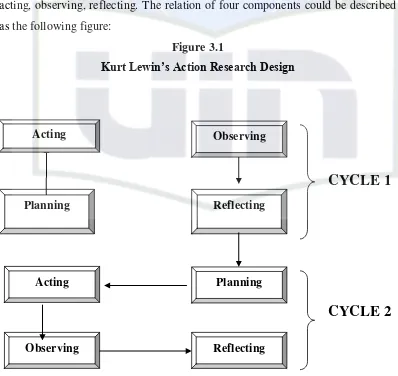
The writer uses Kurt Lewin model as a reference research design in classroom action research. The four main concepts in this model are: planning, acting, observing, reflecting. The relation of four components could be described
as the following figure:
Figure 3.1
Kurt Lewin’s Action Research Design
CYCLE 1
CYCLE 2
(Adapted from Wijaya Kusumah, 2009) The classroom action research design applied in this study is a collaborative classroom action research. It means that the writer collaborates with the English teacher of MTS Khazanah Kebajikan Tangerang as an observer and collaborator. In carrying out the study. the writer is as an observer in the
Planning
Acting
Observing
Reflecting
Planning
Reflecting
classroom. She monitories the students in CAR and creates a lesson plane and the passive when learning English in the classroom. That is why the students need an appropriate strategy to assist them in developing their present continuous tense.
C. Classroom Action Research procedures
As mentioned before, this study followed Kurt Lewins‟ design. Kurt
Lewin suggests four phases for classroom action research. Those are planning, acting, observing and reflecting. Those four phases are called as one cycle. After the writer, the teacher, and the students accomplished cycle 1, there might be found a new problem. Hence, it is essential to continue to the next or second cycle, the writer and the teacher will follow the same phases. These are the following of the explanation in every phase in CAR:
1. Preliminary study
Before entering the cycle of classroom action research, the writer conducts the preliminary study of reconnaissance. According to Mills reconnaissance or preliminary information gathering is taking time to
reflect on researcher‟s beliefs and to understand the nature and context of her general idea.44 It is as preparation for planning the action.
44
Preliminary study is useful for analyzing and indentifying the problems faced by the students in learning writing needed to be solved. In conducting the preliminary study, the writer carried out the
observation to the students‟ activity in teaching learning process in grade VII-E of MTS Khazanah Kebajikan Tangerang. Then, she interviewed the English teachers in terms of the techniques and activities employed in teaching and learning, especially, on grammar of present continuous tense.
2. Planning Phase
In planning phase, after the writer and the teacher had shared the
information, she identified and diagnosed students‟ problem of present
continuous tense occurred in the class observed by observing and interviewing. Then, the researcher prepared all things concerning the implementation of CAR. The preparation consisted of designing lesson plans, preparing the instrument, and setting the criteria of CAR success. The further explanation is as follows:
a. Designing the lesson Plan
Designing lesson plan aims to provide the teacher with the guideline of teaching and learning activities. The lesson plan is including the following items: specific instructional objectives, instructional materials and media, procedure of presentation, and procedure of assessment.
b. Preparing the Instrument
To collect the data during the implementation of CAR, the researcher prepared some instruments such as interview guidelines,
questionnaire, observation note, and test for each cycle including pre-test and post-test.
c. Setting the Criteria of action Success
This criterion is used to decide whether this step is success or not. The step will succeed if the average scores of class is bigger than KKM (Kriteria Kurikulum Minimum) that is made by the teacher about 65. In this study, when 75% of students reach any progress: getting score 65 (sixtyfive) of present continuous tense test started from the pre-test to the next cycle, it means that this research is success. Afterward, the next action would be stopped. But if this condition has not been reached yet, the alternative action
would be done in the next cycle. In addition, the action will
succeed if the development average of students‟ participation
reaches 84%.
3. Acting Phase
The action here means that it is controlled and consciously conducted.45In this phase, both the writer and the teacher discuss together to carry out the planned action. In this phase, the lesson plan that has been discussed would be implemented by the writer and the
teacher to their students. This phase could solve the students‟ problem.
4. Observing Phase
Observation is aimed at collecting the data from the influence of action.46 This phase discusses about this process of recording and gathering all relevant data about any aspect occurred during the implementation of the action. The important aspects in observation are sources of data, instrument used in collecting the data, and technique for data collection. In doing the observation, she observes all the
activities that happen in the class.
45
Kunandar, Langkah Mudah Penelitian Tindakan Kelas (Sebagai Pengembangan Profesi Guru), (Jakarta: Rajagrafindo Persada, 2008), p.72
46
In conducting the observation toward the implementation of the action, the observer uses field notes and observation checklist for gathering the result of observation dealing with the teacher
performance, the students‟ participation and the class condition.
5. Reflecting Phase
The writer and the teacher who role as collaborator and observer analyze and evaluate learning process in cycle 1. However, if there is
found the problems are found, it should move to the next cycle regarding re-planning, re-acting, and re-observing. Consequently, the writer and the teacher should work out uncompleted problems that have not been solved yet.
D. Technique of Data Collecting
Techniques of data collecting in this research are using qualitative and quantitative data. Qualitative is used to describe data which are amenable to being
counted measured in objective way, and are therefore “subjective” while
quantitative is broadly used to describe what can be counted or measured and can
therefore be considered „objective‟.47
1. Observation
Observation is the technique in collecting data about the process of English teaching learning in the physical classroom. It was conducted during the implementation Contextual teaching learning. In this case, the writer acted as an observer who observed the teaching learning process without being involved in the process. She uses unstructured observation to observe anything occurs during learning process. She observes the teachers performance during CAR, class situation while teaching present continuous tense activity, the students participation toward the learning process.
2. Interview
47
The writer interviews the teacher and the students before and after applying classroom action research. It is to know general description
about process of learning present continuous tense, students‟
difficulties in learning present continuous tense, students‟ situation in
present continuous tense activity, and method or any strategies usually implemented by the teacher in teaching present continuous tense. The writer also interviews the teacher and the students to know their reaction toward the suggestion of contextual teaching and learning
technique after classroom action research. 3. Questionnaire
Another way to get the data, the writer also carried out the question in two sessions, before and after the implementation of CAR. The writer used yes/no response as the design of the questionnaire. The writer would know students response and experience about the ideas of Contextual Teaching and Learning. Each questionnaire consists of ten questions which cover 3 categories; they are students feeling toward understanding the present continuous tense, implementation of the method and the effects of Contextual Teaching and Learning to know improvement of grammar skill.
4. Test
The writer uses test to get data about process of learning present continuous tense. The tests are pre-test and post-test. The pre-test is conducted before the implementation of Contextual Teaching and Learning in teaching present continuous tense. Meanwhile, the post-test is conducted after the implementation of each cycle. Because in
this research the CAR consists of two cycles the post-test is delivered in the final action of each cycle. Furthermore, the tests are done in the from of multiple choices and fill in the blank type.
In data analysis, the data derived from observation and interviews were conducted by the researcher to make her easier in reporting the research report. Then those data were used to answer the second research question.
Meanwhile, to answer the first research question the writer analyzed the data from the test and questioner. After knowing the students individual score the writer analyzed the average of students
score per action within one cycle, the writer uses the formula.48
x=
X : Mean
X : Individual Score N : Number of Students
Then, to get the class percentage which passes the KKM 65, the writer
used the formula:49
P= X 100%
P : The class Percentage
F : Total Percentage score
N : Number of student
Next step, the writer identified the improvement score on students‟
descriptive paragraph from the pre-test up to the post-test score in cycle 1
and cycle 2.
The writer used the formula.50
48
Sudjana, Metode Statistika, (Bandung: PT. Tarsito, 2002), p.67
49
y1 - y
P = ─── X 100% y
P: Percentage of students‟ improvement
Y: Pre-test Result Y1: Post test 1
y2 - y
P = ─── X 100% y
P: Percentage of Students Improvement Y: Pre-test Result
Y2: Post-test 2
50
CHAPTER IV
RESEARCH FINDINGS AND DISCUSSION
A. Research Findings
1. The Students Participation in Teaching and Learning Process
In getting the data on the students‟ participation in the teaching learning
process, the researcher utilized the observation. The observation consisted of
three categories; students‟ activity, students‟ involvement and the teacher
response. The observation was held into two sections; in the preliminary study and during the action of each cycle.
In the preliminary study, the result of the researcher observation notes showed some findings such as; only few of the students responded to the teachers question about the use of the present continuous tense, while the teachers explained the present continuous the students just listen and remember the formula of the tenses without making a new sentences in present continuous tense. Moreover, the students were not actively involved in teaching learning activities of present continuous tense. Meanwhile, the teacher seems dominated the teaching learning process at the time without interaction with the students because the students do not understand the explanation from
the teacher about the present continuous, but the students just keep in their mind without asking to the teacher.
that most of the students could answer the teacher questions correctly related the reviewing of the last material.
Based on the observation for those two meetings in the first cycle, it can be
inferred that there was a good improvement on the students‟ involvement in
teaching learning process with applying contextual teaching and learning. However, the teacher and the researcher did not satisfy yet with the result. Therefore, they conducted the third and forth meeting in the second cycle with applied contextual teaching and learning in order to reach the criteria of
successful action.
In the third and forth meeting in the second cycle, the observation notes showed that the students seemed enthusiastic and it easy to write some sentence in the present continuous tense. They were motivated and enjoyed the teaching and learning process with applied contextual teaching and learning, especially when the teacher explained the present continuous with asking the students about the condition of the school based on the situation and condition of their school.
In conclusion, the result of data analysis indicated that the students participation or involvement in teaching learning was successful because it came up the criterion of the success that contextual teaching and learning could create classroom atmosphere that gave students joyful experience and could motivate students to sustain life long self learning.
2. The Students Achievement Score in Learning Present Continuous Tense
The data on students‟ achievement score were obtained from students‟
score of pre-test, post-test 1and post-test 2. The students‟ sore of pre-test,
post-test 1 and post-post-test 2 are illustrated into a table as following:
Table 4.1
The Students
’
Score of Pre-test, Post-test 1, and Post-test 2
1 6.6* 7.3* 8*
The pre-test is held on before the implementing of the action. It functions
to measure students‟ ability in using the present continuous tense. The test was conducted on Saturday, 12 February 2011. There were 20 questions. It started from 15.00 p.m until 16.00 p.m.
Students‟ scores were calculated to get the mean score of the pre test and
X =
X = 165.5 29 X = 5.71
From that computation, the mean score of the class in pre-test is 5.71. It
means that the student‟s achievement score of present continuous tense before
implementing Classroom Action Research (CAR) is 5.71
Then, it is to get the percentage of student who passed the KKM score, the writer computed by using the formula as follow:
P = X 100%
P = 11 X 100% 29
P = 41.38%
From that computation, the students score percentage in the pretest is 41.38%. It means that there are 11 students who pass the KKM and there are 18
students are still below the KKM. It could be seen that the students‟ ability in using the present continuous tense was still low because the score doesn‟t fulfill
yet the target score that is students could pass KKM (65).
Furthermore, in cycle 1, after getting students score in post-test 1, the writer analyzed the data in order to compare the result between pre-test and post-test. First of all, the writer wants to know the mean score of the post-test 1. It is calculated as follow:
X =
X = 194.9 29 X = 6.72
score. It could be seen from the pre-test mean score (5.71) to the mean score of post-test 1 (6.72). It improves 1.01 (6.72-5.71)
Then, to know the percentage of students who passed the KKM, it uses the calculation as following:
P = X 100%
P = 20 X 100% 29
P = 68.96%
From that computation, the class percentage which passes the KKM is 68.96%. It means that in cycle 1 of Classroom Action Research (CAR), there are 20 students who passed the KKM and there are 9 students whose score are below the KKM. The class percentage of post-test 1 shows some students improvement
of the class percentage in the pre-test (41.38%). The students‟ improvement which
passes the KKM is 27.58% (68.96%-41.38%).
Next, the percentage of students improvement score could be explained from the following computation:
y1 - y
P = ─── X 100% y
P = 6.72-5.71 X 100% 5.71
P = 1.01 X 100% 5.71
P = 17.68%
Based on the result above, the percentage of students improvement score
In cycle 2, the same ways are used to know the mean score of post-test 2,
students‟ improvement which has the KKM score and the percentage of students
improvement score from post-test 1 to post-test 2. Here is the calculation to get the mean score of the post-test 2 as following:
X =
X = 207.7 29
X = 7.16
The calculation showed that the means score for the post-test 2 is 7.16. It
shows that there are some student‟s improvement score from the mean score of post-test 1 (6.72).
Then, to know the percentage of students who passed the KKM, it uses the calculation as following: is10.35% (79.31-68.96%). In the post-test 2, there are 23 students who passed the KKM score.
Next, to know the percentage of student‟s improvement score it could be
explained from the following computation:
As the result, the contextual Teaching and Learning improved the
students‟ ability in using the present continuous tense. It was indicated by a
number of students who passed the KKM score more than 75% it means that it has already met the criterion of success.
3. The Students response to The Implementation of Contextual Teaching and Learning
To get the data on the students‟ response to the implementation of the
technique, this researcher utilized questionnaire which consisted of 10 statements. Was utilized the statement covered three categories: they are the students feeling toward understanding the present continuous tense, the implementation of the method and the effects of Contextual Teaching Learning to knowledge improvement and grammar skill.
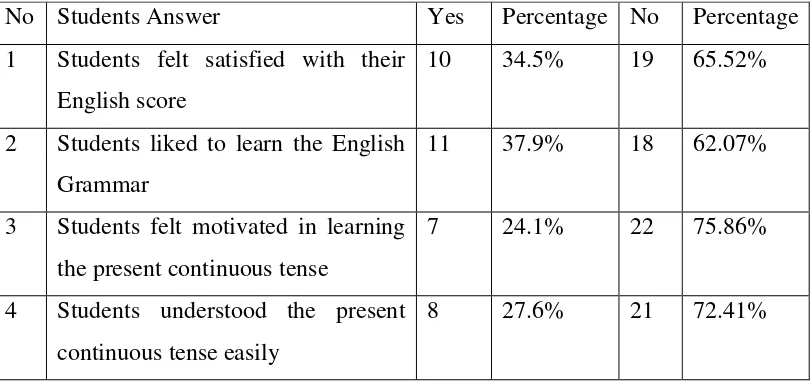
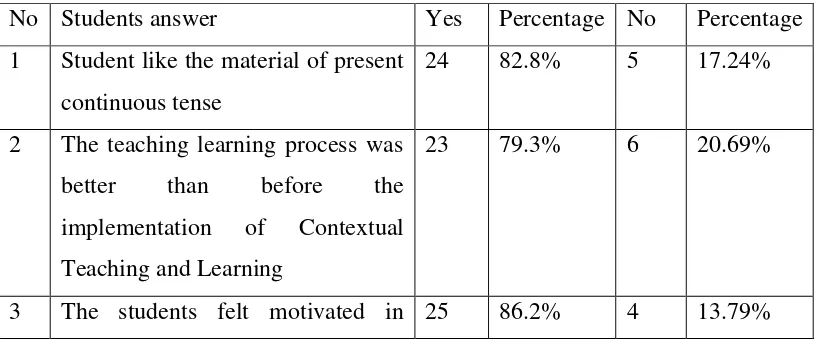
The questionnaire was delivered to the students in two sessions; before the implementation of the action and after the implementation the action. Then, the result was compared to know whether the students felt satisfied or unsatisfied with the approach and whether this study was successful or not. The detailed
percentage of the students‟ response before the implementation of contextual
teaching and learning is presented into a table as following.
Table 4.2
The Result of Pre Questionnaire
No Students Answer Yes Percentage No Percentage
5 Students had the difficulty in using
The pre questionnaire was administered on February 11th, 2011. Referring to the
result of the data, generally it was found that students still had low motivation in learning the present continuous tense and most of them still had difficulties in using the present continuous tense meaningfully.
The result on the questionnaire revealed that from the first statement
65.52% (19 students) did not feel satisfied with their English score and only 34.5 % (10 students) who felt satisfied. To statement number 2, only 37.9% (11 students) liked to learn English grammar and 62.07% (18 students) did not like to learn English. Relating to the statement number three, 75.86% (22 students) said
that they didn‟t feel motivated in learning present continuous tense, it means that