UNIVERSITI TEKNIKAL MALAYSIA MELAKA
Design and Fabrication of Solar
Assisted Drying Machine
Thesis submitted in accordance with the requirements of the Universiti Teknikal Malaysia Melaka for the Degree of
Bachelor of Engineering Manufacturing (Design)
By
Mohd Nashriq Bin Sulaini
UTeM Library (Pind.1/2007)
UNIVERSITI TEKNIKAL MALAYSIA MELAKA
BORANG PENGESAHAN STATUS TESIS*
JUDUL: DESIGN AND FABRICATION OF SOLAR ASSISTED DRYING MACHINE
SESI PENGAJIAN : 2007/2008
SayaMOHD NASHRIQ BIN SULAINI
mengaku membenarkan tesis (PSM/Sarjana/Doktor Falsafah) ini disimpan di Perpustakaan Universiti Teknikal Malaysia Melaka (UTeM) dengan syarat-syarat kegunaan seperti berikut:
1. Tesis adalah hak milik Universiti Teknikal Malaysia Melaka .
2. Perpustakaan Universiti Teknikal Malaysia Melaka dibenarkan membuat salinan untuk tujuan pengajian sahaja.
3. Perpustakaan dibenarkan membuat salinan tesis ini sebagai bahan pertukaran antara institusi pengajian tinggi. atau kepentingan Malaysia yang termaktub di dalam AKTA RAHSIA RASMI 1972)
(Mengandungi maklumat TERHAD yang telah ditentukan oleh organisasi/badan di mana penyelidikan dijalankan)
(TANDATANGAN PENULIS)
DECLARATION
I hereby, declared this thesis entitled “Design & Fabrication of Solar Assisted Drying Machine” is the results of my own research except as cited in references.
Signature : ……….
Author‟s Name : Mohd Nashriq Bin Sulaini
APPROVAL
This PSM submitted to the senate of UTeM and has been as partial fulfillment of the requirements for the Degree of Bachelor of Manufacturing Engineering (Design). The
members of the supervisory committee are as follow:
………
ABSTRACT
ABSTRAK
DEDICATION
Specially dedicated to; My beloved Father, Sulaini Bin Mohamad and My Mother,
Rosini Binti Yahaya who are very concern, understanding, patient and supporting. Thanks for everything. To My Respectful Supervisor; Mr. Raja Izamshah Bin Raja
Abdullah for his constructive guidance, encouragement and patience in fulfilling our aspiration in completing this project. To the Team who design and fabricate Solar Drying
Machine; Mohd Ridhwan Bin Razali and Nor Hazlami Bin Nor Adnan and All My Friends, I also would like to say thanks. The Work and Success will never be achieved
ACKNOWLEDGEMENTS
In The Name of Allah Almighty and The Most Merciful and Blessings
Be Upon His Messenger Prophet Muhammad S.A.W and His Companions.
TABLE OF CONTENTS
2.1.4 Collector construction………6
2.1.5 Thermal Solar Collector……….…9
2.1.6 Solar Collector………...…10
2.2 Solar Energy………….………....12
2.3 The Drying Process……….………..…..12
2.3.1 Heat………...…..13
2.3.2 Heat Transfer………..….14
2.4 Advantages of Solar Dryer……….……… 14
2.5 Solar Drying versus Open Sun Drying………17
2.6 Colour Selection………....…..19
3. METHODOLOGY……….……..………….20
3.1 Introduction………..…...20
3.2 Study some literature reviews………..…24
3.3 Materials selection (study and research) ……….………24
4.7 Design Analysis……….…………...46
4.7.1 Screening Concept……….…………...47
4.7.2 Concept Scoring Matrix……….…….……...48
4.8 Project……….………….…...49
4.9 Testing……….…………...………..…...51
4.9.1 Data Collection……….……...……...54
5. DISCUSSION………..……….……56
6. CONCLUSION……….…………....…57
RECOMMENDATION………...58
REFERENCES...59
APPENDICES
LIST OF FIGURES
2.1 Indirect dryer 6
2.2 Collector frame and three types of absorbers. 9 2.3 A typical bin dryer utilizing natural air/flow temperature drying 16
3.1 Flow Chartof general design step. 21
3.2 Flow Chart for the Overall Project 22
3.3 Flow chart for the scope of project. 23
3.4 Basic Concept for Drying Machine 25
4.1 Design idea of structure for Solar Heat Collector 29 4.2 Design idea of structure for Solar Heat Collector (side and top view) 29
4.3 Dimension of material 30
4.4 Size of material 30
4.5 Size of material for top layer 31
4.6 Name of external part for the Solar Heat Collector 38 4.7 Name of internal part for the Solar Heat Collector 39
4.8 Weld joining mild steel 40
4.9 Rivet joining for aluminium 40
4.10 Product by structure of mild steel and glass for the top layer 41 4.11 Product by structure of mild steel and acrylic for the top layer 42 4.12 Product by structure of aluminium and glass for the top layer 43 4.13 Product by structure of aluminium and acrylic for the top layer 44
4.14 Structure of heat collector 49
4.16 Heat collector before tested 50 4.17 Side view of Solar Heat Collector for the air flow 51 4.18 Side view of Solar Heat Collector for the air flow 52
4.19 Testing Process 52
LIST OF TABLES
2.1 Table of the detailed specifications of the absorbers 8
2.2 Table food drying using solar energy 13
2.3 The comparison between the source and the cost 15
4.1 The Conduction of Heat Thermal for the Conductor and Insulator 32 4.2 The properties of mild steel and aluminium 33
4.3 The properties of glass and acrylic 34
4.4 The concept screening matrix 47
4.5 The concept scoring matrix 48
1
CHAPTER 1
INTRODUCTION
1.1 Introduction
The chapter 1 is introducing about the general information with overall what a meaning this Final Year Project (Projek Sarjana Muda) subject. The objective of this project is to train aboutt working independently to design, fabricate, analyze, collect data and then solve the problem by experiment and investigation using available facilities including library, laboratory equipment, internet and software. Beside, by doing this Final Year Project, can improve our knowledge about engineering field because student need to apply his knowledge in science, mathematics and engineering to solve the problems.
2
1.2 Objectives
The objectives of this project are: a) To design solar heat collector. b) To fabricate solar heat collector.
1.3 Scope Of Project
The scopes of this project are:
a) To design the solar heat collector by using suitable method to choose the best idea and to learn to use CAD tool.
b) To study on material selection and about the processes to use.
1.4 Problem Statements
There are a few methods of producing and manufacturing food drying machine. For instance, there are food drying machine that uses electricity, diesel, conventional fuels and even firewood and coals. All of this method or design of drying machine does the same process; that is to dry the food or herbs. This method is somehow rather better than the previous way of drying foods or herbs where previously, drying is being done on open yards without any good hygienic conditions.
Anyhow, looking at the negative side of this method, there is a lot of wasting in using either electricity, neither diesel nor the others mentioned earlier. For example, put
yourself in the low class farmer‟s shoe; would you be able to pay all the bills for
3
4
CHAPTER 2
LITERATURE REVIEW
2.1 Introduction
This chapter is a literature review for the design and fabrication of energy efficient drying system for the solar drying machine. In this chapter will introduce about the design of drying machine. Introduction of drying machine includes definition and types of drying machine where have in the current market nowadays. Besides, this chapter also describes detail about the solar energy efficient and findings from the journals and articles.
2.1.1 Solar Dryer
5
2.1.2 Solar Dryer Type
Solar dryer fall into two broad categories: active and passive. Passive dryer can be further divided into direct and indirect models .A direct (passive) dryer is one in which the food is directly exposed to the sun's rays. In an indirect dryer, the sun's rays do not strike the food to be dried. A small solar dryer can dry up to 300 pounds of food per month; a large dryer can dry up to 6,000 pounds a month; and a very large system can dry as much as 10,000 or more pounds a month. Passive dryer use only the natural movement of heated air. They can be constructed easily with inexpensive, locally available materials. Direct passive dryers are best used for drying small batches of foodstuffs. Indirect dryers vary in size from small home dryers to large-scale commercial units .Active dryers require an external means, like fans or pumps, for moving the solar energy in the form of heated air from the collector area to the drying beds. These dryers can be built in almost any size, from very small to very large, but the larger systems are the most economical. (VITA Volunteer Roger G. Gregoire, P.E. 1984)
2.1.3 Indirect Dryer
6
perpendicular to the sun's rays. Second, by tilting the collectors, the warmer, less dense air rises naturally into the drying chamber. The drying chamber should be placed on support legs, but it should not be raised so high above the ground that it becomes difficult to work with. (VITA Volunteer Roger G. Gregoire, P.E.)
7
2.1.4 Collector construction
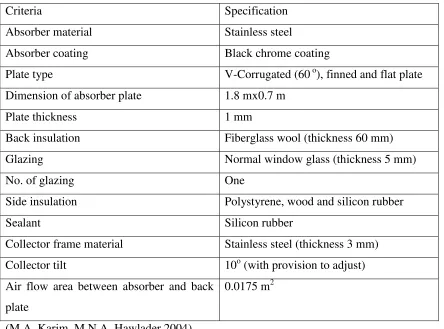
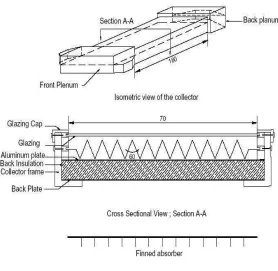
Three collectors, reported in this study, were designed, constructed and tested under the meteorological condition of Singapore. In order to avoid fabrication of several solar air collectors for different absorber plate configurations, a collector frame with interchangeable absorber plate was designed. Another objective of this design was to prevent thermal performance differences, which might occur due to construction differences. The detailed configuration of the collectors under consideration is shown in Figure 2.2. The flat plate and finned collectors had 25 mm flow duct height and the v-corrugated collector had 50 mm v-height, leading to a flow passage area of 0.0175 m2 for all three collectors. The collector frame was so constructed that the back plenum could be opened, and the absorber plate could be inserted by sliding through the c-channel of the collector (Figure 2.2). Window glass was used as the glazing for all the collectors. The bottom of the v-groove and finned absorbers rested on the aluminum plate of the collector, whereas the flat plate collector was suspended from the c-channel. Supports were provided to prevent bending of the flat plate absorber. The flow channels on top of the absorbers were formed between the glazing and absorber plates. The ends of the flow channels were brought together in a metal transition, which turned the air flow 180 o. This was done to conduct tests in the double pass mode.
8
Table 2.1: Table of the detailed specifications of the absorbers.
The detailed specifications of the absorbers are given below:
Criteria Specification
Absorber material Stainless steel
Absorber coating Black chrome coating
Plate type V-Corrugated (60 o), finned and flat plate Dimension of absorber plate 1.8 mx0.7 m
Plate thickness 1 mm
Back insulation Fiberglass wool (thickness 60 mm)
Glazing Normal window glass (thickness 5 mm)
No. of glazing One
Side insulation Polystyrene, wood and silicon rubber
Sealant Silicon rubber
Collector frame material Stainless steel (thickness 3 mm) Collector tilt 10o (with provision to adjust) Air flow area between absorber and back
plate
0.0175 m2
9
Figure 2.2: Collector frame and three types of absorbers. (M.A. Karim, M.N.A. Hawlader,2004)
2.1.5 Thermal Solar Collector
10
2.1.6 Solar Collector
A solar collector is a device for extracting the energy of the sun directly into a more usable or storable form. The energy in sunlight is in the form of electromagnetic radiation from the infrared (long) to the ultraviolet (short) wavelengths. The solar energy striking the earth's surface at any one time depends on weather conditions, as well as location and orientation of the surface, but overall, it averages about 1000 watts per square meter on a clear day with the surface directly perpendicular to the sun's rays.
A solar thermal collector that stores heat energy is called a "batch" type system. Other types of solar thermal collectors do not store energy but instead use fluid circulation (usually water or an antifreeze solution) to transfer the heat for direct use or storage in an insulated reservoir. Water/glycol has a high thermal capacity and is therefore convenient to handle. The direct radiation is captured using a dark colored surface which absorbs the radiation as heat and conducts it to the transfer fluid. Metal makes a good thermal conductor, especially copper and aluminium. In high performance collectors, a "selective surface" is used in which the collector surface is coated with a material having properties of high-absorption and low-emissivity. The selective surface reduces heat-loss caused by infrared radiant emission from the collector to ambient. Another method of reducing radiant heat-loss employs a transparent window such as clear UV stabilized plastic or Low-emissivity glass plate. Again, Low-E materials are the most effective, particularly the type optimized for solar gain. Borosilicate glass or "Pyrex" (tm) has low-emissivity properties, which may be useful, particularly for solar cooking applications.