A Skripsi
Submitted to the Faculty of Language Education In a Partial Fulfillment of the Requirements
For the Degree Sarjana Pendidikan
Eko Kurniawan 20110540106
ENGLISH EDUCATION DEPARTMENT FACULTY OF LANGUAGE EDUCATION
MOTIVATION IN READING ENGLISH JOURNAL ARTICLES AMONG STUDENTS OF ENGLISH EDUCATION DEPARTMENT OF
UNIVERSITAS MUHAMMADIYAH YOGYAKARTA A Skripsi
Submitted to the Faculty of Language Education In a Partial Fulfillment of the Requirements
For the Degree Sarjana Pendidikan
Eko Kurniawan 20110540106
ENGLISH EDUCATION DEPARTMENT FACULTY OF LANGUAGE EDUCATION
Acknowledgement
Praise and great gratitude submitted to almighty God, Allah SWT who always gives her gracious, mercy and great blessing that has helped the researcher has been finishing this thesis entitled; Students’ Motivation in Reading English Journal Articles Among Students of English Education Department Universitas Muhammadiyah Yogyakarta. This thesis is as a requirement in accomplishing the S-1 Degree at the English Education Department in Universitas Muhammadiyah Yogyakarta.
In addition, the researcher would like to thanks to all of those who have given the contribution thus this thesis can be finished. The researcher would like to deliver these thanks to:
1. Ika Wahyuni Lestari, S. Pd., M. Hum as the first advisor who had guided and assisted the researcher in writing and finishing the thesis. Thanks for your advice and valuable input.
2. Indah Puspawati S. Pd., M. A as examiner who had given the valuable input and advice for enhancement of this thesis.
3. All lecturers in EED of Universitas Muhammadiyah Yogyakarta that the researcher cannot mention all of the names. Thanks for your time, knowledge, advice and motivation that you have given to the researcher while study in this great University.
5. The greatest thanks and appreciation dedicated to Kamarudin and Erni, the researchers’ beloved parents. They always give the writer pray, encourage,
love, spirit, motivation and patience to the writer during finishing this thesis and waiting for the researchers’ graduation. Thank you so much for everything.
6. Sincerely thanks to my beloved brother and sister Apridinata, Tya, Dita, Febin for becoming the researcher motivation in finishing this study on time.
7. Students of English Education Department of Universitas Muhammadiyah Yogyakarta that the researcher cannot mention all of the names. Thanks for your support.
8. Students’ English Education especially among students’ batch of 2011 who welcomed the researcher to willingly involve in this thesis. Thanks for your time, help and contribution during finishing this thesis.
9. Ahmad Sahal Mahfudz S.Pd as the researchers’ partner. Thanks so much for your help and support which had been giving to the researcher during accompanying this thesis patiently.
11.My beloved small family of UMY, especially for kontrakan geng
members: Hanjaya Sukma Aji, Wahyu, Aris Rofiq, Muh Kenang, Thank you for your support and motivation.
Table of Contents
Title Page ... i
Approval Page ... ii
Statement of the Authenticity ... iii
Acknowledgement ... iv
Abstract ... vii
Table of Contents ... viii
Chapter One: Introduction ... 1
Background of the study ... 1
Identification and Limitation of the Problem ... 4
Formulation of the Problem ... 5
Purpose of the Study ... 6
The Significance of the Study ... 6
Chapter Two: Literature Review ... 8
Students’ Motivation ... 8
Definition of Motivation ... 8
Types of Motivation ... 9
Definition of Reading ... 14
The Roles of Reading ... 15
The Advantages of Reading ... 19
Academic Reading ... 21
Definition of Journal Articles ... 22
Review of Related Studies ... 23
Conceptual Framework of Reading Motivation ... 25
Chapter Three: Research Methodology ... 27
Research Design ... 27
Research Setting ... 28
Research Participants ... 28
Data Collection Method ... 29
Data Analysis ... 30
Chapter Four: Finding and Discussion ... 32
Students’ motivation in Answering the Reading English Journal Articles ... 32
Intrinsic Motivation ... 32
Students’ Curiosity ... 32
Students’ Involvement ... 33
Students’ Preference for Challenge ... 34
Extrinsic Motivation ... 35
Students’ Competition ... 35
Students’ Compliance ... 36
Students’ Recognition ... 38
Students’ Social Sharing ... 39
The Advantages of students get by reading English journal articles ... 41
Improving Students’ Vocabulary ... 41
Improving Students’ Grammar ... 42
Improving Students’ Critical Thinking ... 43
Improving Students’ Speaking and Writing Skills ... 45
Chapter Five: Conclusion and Recommendation ... 47
Conclusion ... 47
Recommendation ... 48
References ... 50
List of Appendices
Abstract
Reading English journal article is the process to transfer some ideas to students’
brainstorming on the journal articles. In reading English journal articles, it is related with students’ motivation because motivation is the most important factor to drive the individuals to get goal and desire that students want to achieve. Many of students of English Education Department of Universitas Muhammadiyah Yogyakarta felt bored in reading English journal articles. Therefore, this research is to find out the kinds of motivation in reading English journal articles among students of English Education Department (EED) of Universitas Muhammadiyah Yogyakarta (UMY). In addition, this research is to find out the advantages of students of EED of UMY got in reading English journal articles. Furthermore, the methodology in this research is descriptive qualitative. The setting of the research is in EED of UMY, and also there are three respondents from the students of EED of UMY batch 2011 who have been interviewed. The results showed that the students’ motivation of EED of UMY in reading English journal articles is
influenced by two kinds of motivation; intrinsic motivation and extrinsic motivation. In addition, there are some advantages of students of EED of UMY get by reading English journal articles; improving students’ vocabulary, students’ grammar and students’ critical thinking.
Chapter One
Introduction
In this chapter, there are five phases that are explain. Firstly, it is about the background of the study. This part discusses about the reasons why researcher is interested in this research. The second one is about the identification and
limitation of the problem. In the identification, it describes the possible problems of research to the study. Furthermore, the limitation of the research focuses on students only, especially for students of English Education Department of
Universitas Muhammadiyah Yogyakarta. The third is about the formulation of the problem. It describes about the problem of the research. Fourth is about the purposes of the study. It discusses about the aim of the study based on the third point. The last is about the significances of the study. This section describes about the contribution of this research for lecturers, students, and institutions.
Background of Study
Reading is the way of people to communicate with the world indirectly by reading something. Tampubolon (1987) has stated that “Reading is one of the four basic language skills and also it is one of component of written communication” (p.5). Soedarso (2004) has found that “reading is a complex activity by mobilizing a large number of separate actions” (p.4) including: someone should use the
words, connecting to meaning and appealing a conclusion about the purpose of reading"(p. 24). Furthermore, Slamet (2008) has defined “read is one type of
written language skills, receptive” (p. 58). It was called receptive because by
reading, someone will be able to obtain information science and new experiences.
In reading learning context, the reading ability is a significant indicator of academic success (Khajavi & Ketabi, 2012). In addition, reading in second language comprehension is also considered as an essential skill because a lot of scientific and technological information is published in English (Tabatabaei & Assari, 2011).
Besides, the types of reading books are variables such as, comics, novels, newspaper, magazine, and journal articles. But in this case, the researcher just focuses on students’ motivation reading English journal articles. The journal
article itself can be called as scholarly article. It can be defined as peer reviewed or showed periodicals which have published original research and commentary on current enhancement within a specific discipline. Besides, articles are signed, lengthy and also including minimal of illustration and advertisement as well as it included a bibliography. Rietz (2010) has maintained Scholarly papers are usually peer-reviewed. It means that the articles should be subjected to a process of critical evaluation by one or more experts on the subject, known as referees.
(1985) has mentioned that “motivation is the combination of desire and effort to
achieve goals and the favorable attitude toward in learning” (p.10). In language learning process, students’ motivation can be called as students’ interest to
participating (Lumsden, 1994). Motivations are divided into four kinds such as intrinsic motivation, extrinsic motivation, integrative motivation and instrumental motivation. But in this research, the researcher just focuses on two kinds of motivations such as intrinsic motivation and extrinsic motivation because the research intends to investigate the constructs on the kinds of intrinsic motivation and extrinsic motivation in reading English journal articles among the students of English Education Department of Universitas Muhammadiyah Yogyakarta. Therefore, the researcher do not focus on integrative motivation and instrumental motivation because integrative motivation is the students’ desire to enhance their
organization on the community target whereas instrumental motivation more emphasizes on the practical value and the advantages of learning a new language.
Based on the observation and experience of the researcher while studying at English Education Department of Universitas Muhammadiyah Yogyakarta, the reason why motivation in reading English journal articles among students of EED of UMY is chosen to be researched by the researcher because many of students of EED of Universitas Muhammadiyah Yogyakarta have read English journal
articles on particular subject. Thus, based on the researcher’s opinion that many of
should be done by students of English Education Department of Universitas Muhammadiyah Yogyakarta.
Therefore, this research is going to see the kinds of motivation in reading English journal articles among students of English Education Department of Universitas Muhammadiyah Yogyakarta. Furthermore, the researcher also is going to see the advantages do students of English Education Department of Universitas Muhammadiyah Yogyakarta get from reading English journal articles.
Identification and Limitation of the Problem
There are some problems which are faced by students of EED of UMY in reading English journal articles. Based on the researcher experience and
observation, the students of EED of UMY felt bored when they read English journal articles because sometime the text was too long to read and the students might dislike the topic of the text. What most happened when students of EED of UMY felt bored to read English journal article. Therefore, when the students of EED of UMY felt bored to read English journal article, the students of EED of UMY score will be low because there was evaluated by the lecturers to assess their students of EED of UMY.
Besides, one other problem which the students of EED of UMY faced in the text of English journal article might complicate to understand because students’ vocabulary was lack. Automatically, it was influence motivation in
There are many kinds of reading motivation students should have in reading, for example; intrinsic motivation, extrinsic motivation, integrative motivation, and instrumental motivation. In this research, the researcher just investigated the kinds of motivation in reading English journal articles among students of EED of UMY. In addition, the researcher discusses about the advantages do EED students of UMY get by reading English journal articles. It highlights some identification and limitation of the study.
Commonly, according to Wigfield and Gutrie (2004) cited in Komiyama (2013), there are two kinds of reading motivation such as intrinsic motivation and extrinsic motivation. There were three constructs of intrinsic motivation such as curiosity, involvement, and preference for challenge. In addition, there were five constructs of extrinsic motivation such as competition, compliance, grades, recognition, and social sharing.
Formulation of the Problem
The research questions are formulated as follows:
1. What are the kinds of motivation in reading English journal articles among students of EED of UMY?
Purposes of the Study
The research is purposed as follows:
1. To investigate kinds of motivation in reading English journal articles among students of EED of UMY
2. To explore the advantages students of EED of UMY get from reading English journal articles
Significances of the Study
The results of the research are expected to be useful for the English language teachers, students and also institution.
Lecturers. This paper will be beneficial for lecturers. They will know why among students of EED of UMY read English journal article. Furthermore, the lecturers will know the kinds of motivation in reading English journal articles among students of EED of UMY such as intrinsic motivation and extrinsic motivation. In addition, the lecturers will know about the advantages of reading English journal articles for students of EED of UMY such as improve students’
vocabulary, improve students’ grammar and improve students’ critical thinking so
the lecturers and will use the journal articles to assign the students in reading English.
Students. Students will know the kinds of motivation in reading English journal articles. For students of EED of UMY will know the kinds of motivation in reading English journal articles. In addition, students will know about the advantages in reading English journal articles such as it makes improve students’
Institutions. This paper will be beneficial too for institutions. The institutions will know the kinds of reading motivation in reading English journal article for University students such as it makes improve students’ vocabulary, improve students’ grammar, and improve students’ critical thinking. Therefore,
Chapter Two
Literature Review
This chapter explains about students’ motivation, definition of motivation, types of motivation, the definition of reading English, reading motivation, the advantages of reading, the definition of journal articles, review of related study and conceptual framework of reading motivation.
Students’ Motivation
Students’ motivation in learning always regards with students’ interest on
that. In language learning process students’ motivation as students interest to
participating (Lumsden, 1994). So, the motivation of students is so difficult to understand, because it is about students’ behavior which is not to measure or
values.
Definition of Motivation
There are a lot of definitions of motivation by experts. Gardner (1985) has defined that “motivation is the combination of desire and effort to achieve the
goals and also the favorable attitude toward in learning language” (p.10). He
believes that the role of motivation is so important. By motivation, students are encouraged to achieve the desired goals. Furthermore, Gardner ( 2006) has states that “motivation is a very complex phenomenon with many facets” (p.242).
believe that it can be called as motivation, if someone moved to do something. It is role as a booster factor in language learning. In addition, Crookes & Schmidt (1991) have recognized the students learning achievement influenced by
motivation, because motivation is a crucial factor on student in language learning. It can say that motivation as the key of successful for students in language
learning.
From the behaviouristic perspective, Brown (2000) argued that “motivation is quite simply the anticipation of reward” (p. 160). However,
Dornyei (1997) stated in his language teaching, motivation is one of the key influencing factors of language learning or second language learning. In here, the researcher has considered that the successful or failure in language learning for students based on motivation that they have.
Types of Motivation
In L2 acquisition, there are many kinds of motivation. They are integrative, instrumental, extrinsic and intrinsic motivation.
Integrative Motivation. In integrative motivation, students who have acquired a second language are more familiar with members of the language
community. Liuoliene & Metiuniene (2006) has defined that integrative
motivation is like students’ desire to enhance their organization with the target of
community. This opinion can be explained more that the students who have great
desire in integrative motivation will be more efficient and more effort in learning
Clement, Dornyei, & Noels (1994) have found that students will work and
learn fast if they have a high integrative motivation rather than students who have
a low integrative motivation. Furthermore, Gardner (1985) stated that “integrative
motivation is own learner who have interest in learning a foreign language with
community foreign language members to communicate each others” (p.168). In
order that, students want to know more about the other culture of country in the
world. Additionally, Ellis (1997) has explained that students who have learn target
language to mixed of their desire with the people. In that target language, students
have purpose to get more knowledge about how the society situation and speak.
Based on this point, the students’ orientation in academic or career is regarded
with instrumental motivation
Instrumental Motivation. Gardner (1985) has mentioned that “an
instrumental motivation is a powerful motivator, it also will influence
achievement, but the major aspect in it is not the instrumentally person but the
motivation” (p. 168).
Brown (2007) pointed out that “more appropriate terms would be instrumental and integrative orientation rather than instrumental and integrative motivation because within each orientation the intensity of motivation may vary” (p.171). Based on this point, the socially and culturally is regarded with
integrative motivation.
the people and culture represented by the other language group where as
instrumental motivation more emphasizes on the practical value and advantages of learning a new language” (p. 98).
However, Cook (2000) indicated that the students who do not have
integrative and instrumental motivation in their learning will get the problems and difficulties to learn and gain knowledge of a second language in the classroom and learning the language would be difficult for them.
Extrinsic Motivation. Brown (2007) stated that “extrinsic motivation is
influenced by some kind of external incentive such as money, prize, grades, and positive feedback” (p. 172). In addition, Ur (1996) has argued that “extrinsic
motivation is the desire of students to please parents, their wish to succeed in an external exam, peer-group influences” (p.277). Ur (1996) has mentioned several sources of extrinsic motivation that are affected by teacher actions:
Success and its rewards. Learners who have been successful in past tasks are more likely to engage actively in future tasks and have greater confidence in their ability to learn the language. The teacher’s task is to make sure that learners are
aware of their own success as well as to help them develop an ability to recognize success on their own.
Authoritative demands. Learners may be motivated to work harder under the teacher’s pressure, especially the younger ones, but teachers should try to find a
balance because too much authoritative demands by the teacher will make learners dependent on the teacher and will not allow them to develop personal
responsibility for their learning, while too much freedom and autonomy may lead to lowering of effort and achievement and learner dissatisfaction.
Tests. If they are not used too often, tests may be motivating for learners because when they know that they are going to be tested they will invest more time and effort to learn the material than when they are simply told to learn it.
Competition. Learners are often motivated to do their best when they take part in a competition. However, teachers need to be aware that individual competition can be stressful for people who find losing humiliating and so should option for group competitions because they tend to be more enjoyable, less tense and equally motivating” (p. 276 - 279).
Intrinsic Motivation. On the other hand, intrinsic motivation usually
comes from the learners itself and their attitudes towards the language learning, their learning aims and goals, their emotions, their ambitions, and so on. Desi (1975) described intrinsic motivation as follows: “Intrinsically motivated
According to Ryan and Deci (2000), intrinsic motivation is defined as the doing of an activity for its inherent satisfaction rather than for some separable consequence. When intrinsically motivated, a person is moved to act for the fun or challenge entailed rather than because of external products, pressures or reward” (pp. 56).
Harmer’s (2002) has mentioned that most of researchers and
methodologists explained intrinsic motivation derived from the individual is especially important for encouraging students’ success in second language
learning. In this type of motivation, the activity itself was not the reward but the interesting of students to learn the language or making themselves better attracts in language learning. In addition, Vallerand (1997) pointed students are
intrinsically motivated in a particular activity when wishing to experience the pleasure and satisfaction of their curiosity from the activity.
In physical conditions, the factors that influence students’ intrinsic
motivation are teachers as well as their teaching methods. According to Lumsden (1994) studied, the school students’ level of interest and desire to engage in
learning are heavily influenced by such factors as teachers, administrators, and the school environment and their classmates. However, among these factors, the teachers seem to be the biggest one because their roles are very important in students’ learning. Pearse (2000) also pointed out that teachers’ feedbacks mostly affect the students’ learning motivation especially when they aware of their
students’ own progresses. For teachers, the key to foster motivation and
teachers, both of which attract students a lot in their learning. If students find their teachers’ methodology boring, they will probably become demotivated and so on.
Although intrinsic motivation comes from within and thus is internally motivated, teachers can also influence this type of motivation by “developing a
relationship with learners, building learners’ self-confidence and autonomy, personalizing the learning process, and increasing learners’ goal-orientation”
(Brown, 2007, 174). Definition of Reading
There are a lot of definitions about reading because reading is the way of people to communicate with the world indirectly by reading something. Here are definitions about it. Tampubolon (1987) has stated that “English reading is one of the four basic language skills and also it is one of component of written
communication” (p.5). Soedarso (2004) has found that “reading is a complex activity by mobilizing a large number of separate actions” (p.4) including:
someone should use the notion, fantasy, observe and remembering about the text. Furthermore, reading can be done anytime and anywhere. In addition, Akhadiah (1991) stated that "reading is an integrated unity that includes several activities such as recognizing the letters and words, connecting to meaning and appealing a conclusion about the purpose of reading"(p. 24). Furthermore, Slamet (2008) has defined “read is one type of written language skills, receptive” (p. 58). It was
The Roles of Reading
By reading, a person is expected among others the following; obtaining the information and the appropriate responses, looking for sources, concluding or capturing the information from reading as well as capability to explore,
appreciate, enjoy, and take the advantages of the readings (Syafi'ie, 1993, p.2). On the other hand, Rahim (2001) has stated that “reading includes into the textual information which has be regarded with the term of schemata shows of group concept which is arranged in person brain associated with the places, actions, events and also objects” (p.163).
Absolutely, reading has a very essential role in social of humanity because it is the one of communication tools which is needed in a civilized society. The second reason is that reading of material produced in each time period in history largely which be influenced by social background of where person develops itself. And the last reason is that the history recorded of all time after their read. Munaf (2002) has argued that” by reading itself the history of a nation, events of the past, or a variety of the interesting stories about life problems in this world can be known” (p.241). Based on those opinions, it can be concluded that reading is one
of the language skill that have many complexity advantages for purposed of gaining the overall of understanding.
Rahim (2008) has argued that “there are some purposes on reading itself such as; for pleasure, to complete of read loudly, updating their knowledge about the topic, regarding the new information with the information which has known, confirming and rejecting the prediction, gaining the information for the oral or written of reports as well as showing the experiment or applying the information which is gained from that text by learning of the text structure, and answering the specific questions” (p.11).
Gambrell (2009) has found that “motivation to read can be defined as the
possibility of engaging in reading of choosing to read” (p. 172). The engagement
perspective is related to motivation and it has strong implications for practice (Guthrie and Wigfield, 2000). This perspective can be articulated as there are differences between engaged and disengaged of readers and focuses on motivation characteristic of reader itself.
Reading Motivation
These two kinds of reading motivation, curiosity, involvement, preference for challenge, competition, compliance, grades, recognition and social sharing are in line with Wigfield & Guthrie (2004) cited in Komiyama (2013) stating that;
“There are three constructs—Curiosity, Involvement, and Preference for
presented in text. In addition, there arefive remaining constructs —
Competition, Compliance, Recognition for Reading, Grades, and Social— were associated with extrinsic motivation”.
According to Wigfield & Guthrie (2004) maintained that reading
motivation itself included two kinds of motivation. They are intrinsic and extrinsic factors. In intrinsic motivation, it was divided into curiosity, involvement and preference for challenge.
Curiosity. In this point explain that students’ reading motivation is to learn more about a particular topic because they interest with the topic. And also, their curiosity will increase if the topic is so very attractive continuously. Therefore, students will satisfy if students’ curiosity was fulfilled.
Involvement. Students’ reading motivation in reading will be involved if they are pleasure in reading a well written book, and articles on the topic. Furthermore, students’ involvement is students who enjoy their experienced in
reading certain kinds of literatery and informational texts. At least, the reading material should be informational text. Thus, the students are engagement in that reading process.
Preference for challenge. By reading, the students will get satisfaction from mastering the complexity of the ideas of the text. Students’ will challenge if the text reading is difficult enough to mastered and understand.
sharing. Each of those has different explanations in reading motivation of students.
Competition. Students’ reading motivation is a desire to outperform other in that reading such as they read because they would like to compete with their peers. Indirectly, there was a competition in academic reading.
Compliance. The desiring of students’ reading motivation is based on external goals in academic reading. Furthermore, students’ desire to read it was because to fulfill requirement in academic reading. Usually, it can be a reward that they have. For example; students read some books because there’s academic
assessment and also the reward can be like appreciations from teacher. Grades. Students’ reading motivation is to get great score which is evaluated by the teachers. It can describe that teachers role is to evaluate of their students in academic that reading and give them good or bad score. It depends on students’ proficiency in the reading.
Recognition. The satisfaction of students is that they were receiving a verification form of the recognition for success in academic reading. That
recognition, it came from their teachers because if students want to success in that academic reading, they should prove that they can understand better what they read especially in academic reading.
However, all of kinds of reading motivation is very significant for the students because it will determine the students’ successful in process of reading.
Additionally, each student should have a motivation in the reading because it will advantage for them in the future. Furthermore, motivation is that the key of successful in languages learning.
The Advantages of Reading
According to Slamet (2008) “reading activities brings a wide range of
advantages, including: Getting a lot of life experience, acquiring general knowledge and specific information which is very useful for life, knowing the major events in the civilization and culture of a nation, following the
developments in science and advanced technology in the world, enriching the mind, expanding the horizon and think, improve living standards and culture of the family, society, country and nation”(p.69).
Other advantages of reading are Improve grammar and vocabulary. Daskalovska (2008) mentioned that through reading it can improve te learning grammar and vocabulary. The result has found that;
“The grammar test shows that there was improvement in the participant’s
Furthemore, Pazhakh and Soltani (2010) stated in the effect of extensive reading on vocabulary development showed that; they were agreed that extensive reading enhanced their vocabulary knowledge and it also changed their attitudes toward reading in a positive way. They enjoyed reading and because of its benefits they recommended it to their friends. Therefore, these results indicated that extensive reading could enhance positive attitudes toward reading.
Besides, other advantages of reading are think critically. According to Alipongo (2013) argued that in reading journal: It is benefits for extensive reading. The results have also revealed that;
“The reading journal enabled students to think critically. One source of
critical thinking, which is taking control of our conscious thought processes, is the summary writing. It is possible that when students wrote the summary of their readings, they had to analyze, synthesize and evaluate what they read, which are essential steps in critical thinking process. Another source of critical thinking is finding an intriguing sentence or passage then interpreting the idea or situation by writing extended comments”.
had to express opinions, specifically what they liked and did not like about the readings and had provide explanations for such response.
Academic reading
Academic reading is complex, multi-level and different from other kinds of reading. Based on the course described below and the existing literature, I define academic reading is as purposeful and critical reading of a range of lengthy academic texts for completing the study of specific major subject areas. Academic reading is extended reading of a range of texts varying in length. Unlike the regular definition of extensive reading as close reading (see Leki, 2001:202), academic extended reading requires both extensive and intensive reading of texts that are discipline-specific, careful synthesizing of material from a number of sources (Carrell and Carson, 1997), and consciously finding authorial intentions and purposes (Huckin and Flower, 1990).
Spack (1993) has pointed that academic reading is often a process of actively engaging with what is read, gleaning information, fitting this information by thinking things through, and finally being able to interpret the content flexibly to suit the purposes of the academic writing assignment. However, in spite of the commonalties, exactly what counts as academic reading is subject to
Definition of Journal Article
Journal article itself can be called as scholarly article. It can be defined as peer reviewed or referred periodicals which have published original research and commentary on current enhancement within a specific discipline. Besides, articles are signed, lengthy and also including minimal of illustration and advertisement as well as it was included a bibliography. Rietz (2010) has maintained Scholarly papers are usually peer-reviewed. It means that the “articles should be subjected to a process of critical evaluation by one or more experts on the subject, known as referees”.
On the other hand, College (2015) has recognized that journal can be defined as an academic magazine which has available on a regular schedule. That was includes the articles which is written by experts in a field of the study. Those articles can be written by the students or teachers that have had great specific vocabulary and science. Additionally, a journal article also can be called as scientific article.
Beside that, journal articles have some criteria. It was written by
Based on that definition, it can be concluded that journal article is a paper which is focused on the facts of event in specific areas. In journals article itself is including the collection of several articles and also book reviews that written by the researcher. Regularly, journal article has been published on weekly, monthly or quarterly. However, journal articles are very so important for the student colleges or the researchers because sometime journal articles are help another researcher to find information which is needed in their research.
Review of Related Studies
Many of researcher conducted studies to looking for some perceptions on students’ motivation in reading. First one, the studies conducted by Katranci
(2015) entitled “Book Reading Motivation Scale: Reliability and Validity Study”. The aims of this study are to increase a book reading motivation to determine elementary and secondary school students’ reading motivation. It was constructed
into 25 items of draft scale. Furthermore, this studies aims to exploratory factor analysis of was carry out and discrimination power of the scale items was
detected. Additionally, this study was used survey method. This study enhanced in line by general survey method that was conducted with the participation of 1224 voluntary students’ attending elementary and secondary schools having low,
medium, and also socio economic status. The students’ age is around at 9 up to 12. The finding of this study it was found that the scale comprised two sub dimension called love for reading and reason for reading.
Motivation”. The aim of this study is to realize the predictive model of rewards
and identified the reward predictors for reading motivation. The survey
participants were 722 pupils from five elementary schools in southern Taiwan. Using a longitudinal design, it collected pupils’ reward experiences in extensive
reading activities as well as their pre-reward and post-reward reading motivation. As the result of this study, simultaneous and longitudinal regression analyses indicated that the predictive model of rewards could explain the variances of intrinsic, extrinsic, and global reading motivation, even when including the effects of previous motivation. “Intangible rewards” and “effort attributions” positively
predicted intrinsic reading motivation, extrinsic reading motivation, and global reading motivation. Whereas “luck attribution” negatively predicted intrinsic
reading motivation.
The last study has related with this research comes from Badariah, Noor, (2011) entitled “The Reading Motivation and Reading Strategies Used by
Undergraduates in University Technology MARA Dungun, Terengganu”. This
study aims at finding the connection between reading motivation and reading strategy, to discover the differences between male and female students’ reading
motivation and reading strategy and the relationship between variables such as program of study and family’s income. This study also investigated 245
undergraduates’ level of reading motivation and their reading strategies use when
reading strategy instead of the Meta cognitive reading strategy. There seemed to be a connection between the undergraduates’ reading motivation and the reading
strategy used. The results indicated that the undergraduates’ motivation to read had an influence on the use of the reading strategy. Though female students had higher reading motivation compared to male students, both groups only use the cognitive reading strategy.
Conceptual Framework of Reading Motivation
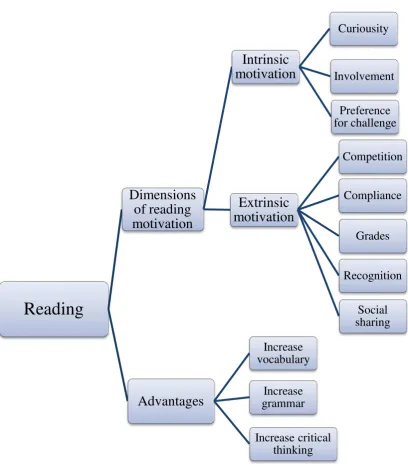
Reading motivation is divided into two kinds of motivation. They are intrinsic motivation and extrinsic motivation. In intrinsic and extrinsic motivation have some indicators in reading motivation. First one, in intrinsic motivation itself, it is concluded into three indicators such as curiosity, involvement, and preference for challenge. Secondly, in extrinsic motivation, it is concluded into five indicators such as competition, compliance, grades, recognition and social sharing.
Besides, there are a lot of advantages in reading texts. The first one is about increase students’ vocabulary. The second one is about increase students’
grammar. The last is about increase students’ critical thinking. In fact, these
Chapter Three Research Methodology
This chapter explains about methodology which was used by the
researcher in this research. Firstly, this chapter presents about the research design, research setting, research participants, data collection technique and data
analyzing technique. Research Design
In this research, the researcher used qualitative approach. Creswell (1994) mentioned that a qualitative approach is best used in informal situations, where it is made possible by a sensitive subject for the respondent, demographic
background (education, shelter and so on), and the other things that cause the a quantitative approach is difficult to apply.
Besides, this research was designed as a qualitative descriptive method. According to Louis, Manion, & Morrison (2011), “qualitative descriptive method is a qualitative data analysis which are divided into organizing, accounting and exploring the data, in short, making logic of data in terms of the participants’ meaning of the situation, noting patterns, themes, categories and regularities”(p.
537). Sandelowski (2000) stated that this method has amenable to getting true answers to relevance questions.
providing information from another perspective. In addition, it was also provide information that can help isolate the variables that was eventually used to measure cause and effect, and at least it could help provide surrounding information that would be aid logical interpretations of research question within the context of specific situation.
Research Setting
The research was conducted on October 2015 in EED of UMY. The researcher had three reasons in choosing EED of UMY as the research setting. Firstly, EED of UMY requires the student to read English journal articles. Secondly, the students of EED of UMY might have different motivation in reading English journal articles. The last was the accessibility of EED of UMY because the researcher was studying at EED of UMY.
Research Participants
In this research, the participants were the students of batch 2011. The population of students at batch 2011 was 84 students. The researcher took only three students as the sample from the total population. In qualitative research, there are no standard rules on the minimum number of participants (Patton, 1990). On the other hand, Glaser and Strauss in Gilgun (1992) determined that the
reading English journal articles. The names of participants will be changed using pseudonyms: R1, R2, and R3.
Data Collection Method
The data was collected using interview. It was to find out the answer of formulated research questions. According to Cohen, Manion, & Morrison (2011), “The interview is a constructed and usually a specifically planned event rather
than naturally occurring situation, and the renders it different from an everyday conversation therefore the researcher has an obligation to set you, and abide by, the different „rules of the game’ in an interview” (p. 409).
The researcher interviewed the participants using open-ended questions. The length of the interview in this research was about 7-10 minutes in each participant. The interview was voice-recorded and then be transcribed. The transcription was typed by the researcher himself. It was conducted by listening the voice-recorded and transcript that. The researcher used Bahasa Indonesia in interview in order to avoid misunderstanding.
When all of data has been gathered, the transcription of the interview was clarified to get the interview validity by doing member checking. Member
interview. The result on this member checking in this research, all of participants agreed with the researcher interview transcript.
Data Analysis
that has analytic power because it has ability to pull the other categories
Chapter Four
Finding and Discussion
This chapter highlights the finding and discussion of the research. There are two findings based on two research questions. Each of the finding is presented and is followed by the discussion.
Finding and Discussion
The first research question is about the kinds of motivation in reading English journal articles at English Education Department Universitas
Muhammadiyah Yogyakarta. It has been found that there were eight constructs of motivations in reading English journal articles. From those eight motivations, three were included in intrinsic motivation, and the other five were included in extrinsic motivation.
Intrinsic Motivation. There were three constructs of motivation in reading English journal article for example; students’ curiosity, students’ involvement, and students’ preference for challenge.
Students’ Curiosity. The first intrinsic motivation in reading English journal articles was students’ curiosity. The first respondent stated that he got curiosity in
The second and the third respondents also stated the same idea like the first respondent. “Yeah, I have ever got curiosity in reading journal articles. If the
title gets me interested, I really want to read it immediately” (R2.5). “Yeah usually if the topic is interesting, I get more interested to read the journal articles” (R3.3).
Therefore, there were two reasons why the respondents were curios in reading English journal article. The first was that the journal articles were long to read, and the second was that the title was interesting for the respondents.
These finding of the constructs of reading motivation are in line with Wigfield & Guthrie (2004) cited in Komiyama (2013) stating that; Students’ curiosity in reading motivation it was caused by intrinsic motivation. It does mean that students read about the particular topic based on students interest. Therefore, students will satisfy if students’ curiosity was fulfilled.
Students’ Involvement
The second intrinsic motivation in reading English journal articles was students’ involvement. The first respondent mentioned that he got involve in
reading English journal articles if the text was suitable with what the respondent hoped, so it makes respondent feel enjoyment on it. “If the text of journal articles
is suitable with what I hoped, I will involve in reading English journal articles” (R1.12)
The second respondent also confirmed that “if the journal article is suitable
some activities, including doing some assignments and class discussion, so there is involvement that I get after reading it” (R2.9).
The third respondent stated that “If the contents of journal articles are
based on my desire, I will involve in reading journal articles and I really understand it” (R3.4).
Therefore, there was one reason why the respondents are involved in reading English journal articles. It was when the text of journal articles was suitable informations what they hoped.
These finding of the constructs of reading motivation are in line with Wigfield & Guthrie (2004) cited in Komiyama (2013) stating that; Students’ involvement in reading motivation caused by students pleasure and enjoyment experienced from reading certain kinds of good written book, articles and informational text.
Students’ Preference for Challenge. The third intrinsic motivation in reading English journal articles was students’ Preference for challenge. The first
respondent stated that he got challenge to find out the complexity of main idea in reading English journal articles. “Because not all of main ideas in journal articles
The third respondent argued that “I will challenge myself if the contents of journal articles make me read more and find more the main idea on the reading”
(R3.3).
Therefore, there was one reason why the respondents were challenge in reading English journal article. It was when the journal articles main idea was complicated to find out.
These finding of the constructs of reading motivation are in line with Wigfield & Guthrie (2004) cited in Komiyama (2013) stating that; The students’ preference for challenge in reading motivation is to gain the satisfaction from tackling challenging of the ideas has presented in text. It was indicated more to intrinsic motivation.
Extrinsic Motivation. There were five constructs of motivation in reading English journal article for example; students’ competition,students’ compliance,
and students’ grades, students’ recognition, and students’ social sharing.
Students’ Competition. The first extrinsic motivation in reading English journal
articles was students’ competition. The first respondent mentioned that he got
competition in reading English journal articles because they want to get the best in the class, usually the competition was likes pursuing high score.”Yeah, I ever
compete with my peers because I want to get the best in the class” (R1.11).
that if we master the journal, we were able to deliver our ideas in class discussion. So, I want to compete with my friends” (R2.8).
The third respondent stated that “I often compete because if I do not
compete surely we do not have the challenge to do the assignment in learning class. If our atmosphere is like to compete, surely we do the best. It makes us get the maximal score” (R3.7).
In order that, there were three reasons why the respondents are competing with their peers in reading English journal article. The first was when he wants to get the best score, the second reason was when reading journal in class discussion, and the third reason was when she wants to get the maximal score.
These finding of the constructs of reading motivation are in line with Wigfield & Guthrie (2004) cited in Komiyama (2013) stating that; the build of reading motivation was students’ competition. It was associated with extrinsic motivation, students’ competition in reading motivation to outperform with other
in that reading like as students read because students want to compete with their peers.
Students’ Compliance. The second extrinsic motivation in reading English journal articles was students’ compliance. The first respondent confirmed that he
The second respondent stated that “Because the articles that should be read
in that subject are English articles and not Indonesia articles, they should be read in English” (R2.2).
Therefore, there was one reason why the respondents were compliance in reading English journal article. It was when the journal articles become the assignment.
These finding of the constructs of reading motivation are in line with Wigfield & Guthrie (2004) cited in Komiyama (2013) stating that; Students’ compliance in reading motivation caused to fulfill requirement in academic reading. It was related with extrinsic motivation.
Students’ Grades. The third extrinsic motivation in reading English journal articles was students’ grades. The first respondent mentioned that he got grades if
he answered the questions in the discussion class. “The grades will be different
when I read or do not read articles, and I will be tested by the lecturer. The outcomes were like grades” (R1.10).
The second respondent argued that “Yeah, for grade it becomes one of
purposes because if I read journal, I can do the journal assignment, so my grade will be great” (R2.7).
The third respondent mentioned that “we read journal articles besides for
Therefore, there was one reason why the respondents wanted to get grades in reading English journal article. It was when they were tested by the lecturers because it influenced their grades.
These finding of the constructs of reading motivation are in line with Wigfield & Guthrie (2004) cited in Komiyama (2013) stating that; Students’ grades were built by reading motivation. It was associated with extrinsic
motivation. It was shown to get great score which was evaluated by the teachers. It could describe that teachers role was to evaluate of their students in academic that reading and gave them good or bad score. It depends on students’ proficiency
in the reading
Students’ Recognition. The fourth extrinsic motivation in reading English journal articles was students’ recognition. The first respondent stated that he got
recognition likes commendation if he be able to answer the questions in reading English journal article. “Usually when we are asked to answer the questions, the
lecturer will give appreciations like commendation. It means that friends will give applause then the lecturer calls our name” (R1.15).
The second respondent mentioned that “For example when I make
The third respondent confirmed that “Usually the lecturer give some feedback. Like giving more opinion that should be improved. Then usually the lecturer asks about point of view or the lecturer gives appreciation like grades and also like correction about the grammar or content” (R3.9).
Therefore, there were three reasons why the respondents recognized in reading English journal article. The first was when he could answer the questions, the second reason was when he did the great assignment, and the third reason was when she delivered her opinion about the journal articles.
These finding of the constructs of reading motivation are in line with Wigfield & Guthrie (2004) cited in Komiyama (2013) stating that; Students’ recognition in reading motivation it was connected with extrinsic motivation. It was shown that to get receiving a verification form of the recognition for success in academic reading. That recognition, it came from their teachers because if students want to success in that academic reading, they should prove that they can understand better what they read especially in academic reading”.
Students’ Social Sharing. The fifth extrinsic motivation in reading English
journal articles was students’ social sharing. The first respondent stated that he got
social sharing in the class discussion. “Usually the lecturer gives the text and we were asked to read it then the lecturer will give the questions which was related with the text” (R1.9).
The third respondent argued that “Usually the lecturer opens the answer
journal. If there was discussion session I should join in discussion, likes giving some opinion and also giving some comment about the journal articles” (R3.8).
Therefore, there were two reasons why the respondents are sharing in reading English journal article. The first was when he asked to read by the lecturer, and the third reason was when she follows the class discussion to give her opinion.
These finding of the constructs of reading motivation are in line with Wigfield & Guthrie (2004) cited in Komiyama (2013) stating that; the build of reading motivation was students’ social sharing. It was extrinsic motivation. It was showing that students’ will share the meaning of reading content of that text
to their peers. At least, in this section it has been explained that there were some of sharing section between student and another student.
These finding of the constructs of reading motivation such as, curiosity, involvement, preference for challenge, competition, compliance, grades,
recognition and social sharing are in line with Wigfield & Guthrie (2004) cited in Komiyama (2013) stating that;
“There are three constructs—Curiosity, Involvement, and Preference for
Challenge—were associated with intrinsic motivation, indicating that intrinsically-motivated readers would read because they want to learn about topics of personal interest, to experience pleasure reading interesting materials, and to gain satisfaction from tackling challenging ideas
Competition, Compliance, Recognition for Reading, Grades, and Social— were associated with extrinsic motivation”.
The Advantages of Students Get by Reading English Journal Articles. The second research question is about the advantages the EED of UMY that students get by reading English journal articles. It has been found there were three advantages in reading English journal articles. They were increasing the
vocabulary, increasing the grammar, thinking critically, and increasing imagination.
Improving Students’ Vocabulary. The first respondent argued that his vocabulary
improved when he read English journal articles. “My vocabulary can improve. For example; I do not know the meaning of makan which was in English it was eat, in fact I challenge to open the dictionary and the meaning of makan was eat, and then my vocabulary improve” (R1.18).
The second respondent stated that by reading a lot of English journal articles, his vocabulary also increased. “My vocabulary can increase, because by reading many of text which was read, my vocabulary gets more” (R2.14).
Therefore, there was one reason students got improve their vocabulary in reading English journal articles. Students’ vocabulary improved when they got
much read.
These finding are in line with Pazhakh and Soltani (2010) stated in the effect of extensive reading on vocabulary development showed that; they were agreed that extensive reading enhanced their vocabulary knowledge and it also changed their attitudes toward reading in a positive way. They enjoyed reading and because of its benefits they recommended it to their friends. Therefore, these results indicated that extensive reading could enhance positive attitudes toward reading.
Improving Students’ Grammar. The second advantage was about improving
students’ grammar in reading English journal articles. The first respondent stated
that he believed that his grammar improved because each text of English journal articles had a good grammar. “My grammar will improve because when I read
English automatically the grammar has been good, there was no text which was the grammar in random, so the text in English journal articles has valid then when I follow it I will train me the grammar” (R1.19).
The third respondent stated that his knowledge, vocabulary and grammar got improve in reading English journal articles. “The advantages were getting much, one of that it can improve my knowledge, then my vocabulary get more increase, furthermore my grammar can increase too” (R3.13).
In order that, there were two reasons students’ got improve grammar in
reading English journal articles. The first was when he follows it because the journal article has a good grammar and, the second was when she getting much read it.
These finding are in line with Daskalovska (2008) mentioned that reading can improve grammar and vocabulary. “through reading it can improve te learning grammar and vocabulary. The result has found that; The grammar test shows that there was improvement in the participant’s grammar knowledge. The areas of
improvement were the use of tenses, the choice of correct sentences, the place of adverbs in sentences and the order of adjectives, which indicates that reading can contribute to acquiring grammar knowledge.
Improving Students’ Critical Thinking. The third advantage was about being
critical thinking in reading English journal articles. The first respondent
mentioned that he got more critical in reading English journal articles because by a lot of reading his knowledge improved, by reading a lot of kinds of texts it could influence my critical thinking. “Because when I read more knowledge,
of kinds of texts can influence critical thinking the other people in read it”
(R1.21).
The second respondent stated that he can be able to analyze of the text in English journal articles, by reading more he can compare the content of one articles and the other articles. “By reading more, I can compare with my peers, it
means that my critical pattern started from it, so from this text, there was relation from the journal which was I read, it can appear my critical thinking” (R2.17).
The third respondent argued that her critical thinking will be more critical in reading English journal articles because the characteristic of articles contents were negative and positive opinion, so it makes her being more critical thinking in it. “So, I get more critical in it because the contents or opinion are contradiction in
the articles with my arguments, sometimes the characteristic of articles content was negative and positive opinion, by that way it can improve my critical thinking” (R3.15).
Therefore, there were three reason students got think critically in reading English journal articles. The first was when he was getting much read it my think will critically, the second was when he can analyze and compare the other journal articles, and the third was when she got contents of journal articles were positive or negative opinion.
The reading journal enabled students to think critically. One source of critical thinking, which is taking control of our conscious thought processes, is the summary writing. It is possible that when students wrote the summary of their readings, they had to analyze, synthesize and evaluate what they read, which are essential steps in critical thinking process. Another source of critical thinking is finding an intriguing sentence or passage then interpreting the idea or situation by writing extended comments.
In addition, as Facione (1990) has explained, when we think critically, we make purposeful, self-regulatory judgment, which results in interpretation. Students had to interpret what they read in order to write extended comments about intriguing sentences and passages. They had to formulate inferential or critical questions and had to write the possible answers to those questions. They had to express opinions, specifically what they liked and did not like about the readings and had provide explanations for such response.
Improving Students’ Speaking and writing Skills. The fourth advantage was about improving students’ speaking skills and writing in reading English journal
articles. The first respondent argued that he read English journal articles because he wanted to improve his English skill like speaking and writing because he believe that by reading English journal articles automatically he knew about the good English grammar. “I choose reading English journal articles rather than
These finding are in line with Mart (2012) who said that in the developing speaking skills through reading as cited in Oya, Manalo, and Greenwood suggest that better vocabulary knowledge produces better oral performance (2009, p.11). Accuracy and fluency of learners will get better through reading. They also claim that having good vocabulary knowledge is one of the essential components to gain fluency in speaking performance (Oya, Manalo, Greenwood, 2009, p.19). It needs to be noted that good vocabulary knowledge will give learners confidence in their speaking performance. Better vocabulary knowledge and having more words at one’s disposal is likely to facilitate the ability to tell a story better, to demonstrate
a more extensive range of language resources, and to come across more
intelligibly. Better vocabulary knowledge could also contribute to boosting the speaker’s confidence, which would come across when speaking and influence the
Chapter Five
Conclusion
Conclusions. This research was designed descriptive qualitative. It was purpose to find out the kinds of students’ motivation in reading English journal
articles among English Education Department of Universitas Muhammadiyah Yogyakarta students and also to find out what were the advantages did among English Education Department of Universitas Muhammadiyah Yogyakarta students in reading English journal articles. To analize the data, the researcher checked the interview transcribes and coded it. In coding, they were included open coding, axial coding and selective coding.
Based on the result of the finding and discussion in this research, it can be concluded that;
1. In intrinsic motivation. The kinds of motivation among students of EED of UMY in reading English journal articles got curiosity, involvement and preference for challenge. These items were the kinds of reading motivation like intrinsic motivation.
3. The students’ vocabulary of EED of UMY will improve after reading English journal articles because the text on journal articles was complicated to understand, it makes students open the dictionary. 4. The students’grammar knowledge of EED of UMY will improve in
reading English journal articles because each journal articles have a good grammar structure.
5. The students of EED of UMY will more critical in reading English journal articles because the contents of the journal articles are different perception the other. So, the students can compare the content based on their opinion. Indirectly, it makes them more critical thinking in reading English journal articles.
6. The students’ speaking and writing skill of EED of UMY will improve in reading English journal articles because by reading English journal articles indirectly students of EED of UMY will know about the good English grammar.
Recomendations. There were some recomendations in this research. The English journal articles for this study were intended to investigate the kinds of motivation in reading English journal articles. Furthermore, the lecturers of EED of UMY should know two kinds of reading motivation in reading English journal articles for example; intrinsic motivation and extrinsic motivation. Therefore, they will know how to motivate their students.
improve, improve students’ critical thinking and improve students’ speaking and
References
Akhadiah (1991). Bahasa Indonesia 1. Jakarta: Depdikbud.
Aliponga, J. (2013). Reading Journal: Its benefit for extensive reading. International Journal of Humanities and Social Sciences , 73-80.
Al-Tamimi, A. (2009). Motivation and attitude towards learning English: A study of petroleum Engineering Undergraduates at Hadhramount University of sciences and technology. Gema Online Journal of Language Studies , 29-55.
Badariah, & Noor, M. (2011). The reading motivation and reading strategies used by Undergraduates in University Technology MARA Dungu, Terenganu. Journal of Language Teaching and Research , 32-39.
Ball, S. J. (1990). Politics and policy making in education. London: Routledge. Barbour, R. S. (2001). Checklist for improving rigor in qualitative research: A
case of the tail wagging the dog. British Medical Journal , 1115-1117.
Binker, A. J. (1990). Critical Thinking: What, Why, and How. In R. Paul, Critical Thinking: What Every Person Needs to Survive in a Rapidly Changing World (pp. 45-56). California: Sonoma State University.
Carrell, P.L. and Carson, J.G. (1997) Extensive and intensive reading in an EAP setting. ESP Journal. 16 (1). 47-60.
Chen, P. H. (2002). Rewards for reading: Their effects in reading motivation. Journal of Instructional Pedagogies , 1-8.
Clement, R., Dornyei, A., & Noels, K. A. (1994). Motivation, self-confidence, and group cohesion in the foreign language. Language Learning , 417-448.
Cohen, L., Manion, L., & Morrison, K. (2011). Research methods in education. Seventh Education. New York: Routledge.
College, P. C. (2015). Retrieved April 20, 2015, from http://www.pcc.edu/library/research/what-journal
Cook, V. (2000). Linguistics and second language acquisition. Beijing: Foreign Language Teaching and Research Press and Macmillan Publishers Ltd.
Council of Writing Program Administrators, N. C. (2011). Framework for success in postsecondary writing. CWPA, NCTE & NWP.
Creswell, J. W. (1994). Research design : Quantitative and qualitative approach. London : Sage.
Desi. (1975). Intrinsic motivation. New York: Plenum Press.
Ryan, R. M. and Deci, E. L. (2000). Intrinsic and extrinsic motivations: Classic definitions and new directions. Contemporary Educational Psychology, 25:54–67.
Dornyei, Z. (1997). Motivational factors in the second language attainment: A review of research in Hungary. Acta Linguistica Hungraia , 261-275.
Ellis, R. (1997). Second language acquisition. Oxford: Oxford University Press.
Facione, P. A. (1990). Critical thinking: A statement of expert consensus for purposes of educational assessment and instruction. Millbrae, CA: The California Academic Press.
Gambrell, L.B. (2009). Creating opportunities to read more so that students read better. InE.H. Hiebert (Ed.), Read more, read better (pp. 251–266). New York: Guilford.
Gardner, R. C. (1985). Social psychology and second language learning: The role of attitudes and motivation. London: Adward Arnold.
Gardner, R. (2006). The socio-educational model of second language acquisition: A research paradigm. EUROSLA Yearbook , 236-260.