164
Singh et al Med J IndonesAssessment
of
utility
of
Siriraj
Stroke Score
(SSS)
in
stroke patients
of
Pt.
BD Sharma
PGIMS hospital, Rohtak, India
H.
Singh, J.B. Gupta,M.S.
Gupta,Rohit Aggarwal
Abstrak
India mempunyai populasi rural yang mayoritas miskin,
di
mana pemeriksaan CT-scan otak yang paling sering dianjurkan pada pasien stroke tidak selalu tersedia, sehingga para dokter India dalam membangun diagnosis seringkali harus mengandalkan hasiL evaluasi gejala klinik yang dapat dilakukon dengan menggunakan SSS (Siriraj Stroke Score). Obyektif penelitian: untuk menilai kegunaan SSS pada pasien stroke. Metodologi: sejumlah 60 pasien stroke dievaluasi menggunakan SSS dan perkiraan diagnosis dibuat dan kemudian dibandingkan dengan diagnosis pasti hasil pemeriksaan CT-scan otak. Penemuan utamd: dengan menggunakanSSS, diagnosis perkiraan ialah: infark otak(SSS < - 1) pada32 subyek, perdarahanotak(SSS>
+ l)
pada24 subyek, sedangkan4 subyek tak dapat ditentukan diagnosisnya (SSSdi
antara-l
dan+l).
Limapuluh subyek dengan diagnosis perkiraan dipasangkan dengan hasil diagnosis pasti menggunakan CT-scan. Hasilnya menunjukkan bahwa SSS mempunyai sensitifitas 93,7Vo, spesifisitas 76,6%, nilai prediksi positif 8I ,2Vo, nilai prediksi negatif 92Vo dengan akurasi keseluruhan sebesar 93,77o untuk diagnosis infark otak. [Jntukpasien dengan perdarahan otak, sensitifitas 83,37o, spesifisitas 92,5Vo, nilai prediksi positif86,8Vo, nilai prediksi negatif92,5Vo dengan akurasi keseluruhan 83,3Vo. Kesimpulan utama: bagi para dokterdi
daerahrural,
SSS tampaknya cukup berguna dalam penatalaksanaan stroke, terutama bila pemeriksaan radiologi yang lebih canggih untuk penetapan diagnosis tidak tersedia oleh karena harga tak terjangkau atau apabila transportasi ke tempat pemeriksaan CT-scan terdekat berisiko tinggi bagi pasien. (MedJ
Indones 2001;l0:
164-8)Abstract
India has predominantly poor rural population where
braii
CT scan, most often advised investigation in patients of stroke, may not always be available, hence Indian physician in such setting base his diagnosis on bed side sign evaluationfor
which Siriraj Stroke Score (SSS) could be helpful. Objective of stuily: to assess the utility a/SSS ln patienti of stroke. Methodology: sixty subjects of stroke were evaluated on SSS and 'probable' diagnosis so made was compared with CT scan's (brain) 'certain' diagnosis. Mainfinilings:
b1t r.rslng SSS, the probable bedside diagnosis was cerebral infarct (score < -) ) in 32 subjects and cerebral haemorrhage (score>
+ 1 ) in 24 subjects while 4 subjects had indeterminant score (-1 to+l).
Fifty subjects had their probable diagnosis matched with brain CT scan certain diagnosis. The above findings showed that SSS had 93.7Vo sensitivity, 76.6Vo specificity, 8J.2Vo positive predictive value, 92Va negative predictive value with an overall accuracy as 93.7Vofor
diagnosisof
cerebral infarction. For patientsof
cerebral haemorrhage the sensitivity was 83.3Vo, specificity was 92.5Vo, positive predictive value was 86.9Vo, negative predicitive values was 92.5Vo with overall accuracy as 83.3Vo. Prtncipal conclusion: physicians in the rural settings mayfind
SSS to àe quite useful in the managementof
stroke especially where more sophisticated radiological investigations may not be availablefor
confirmationof
diagnosis due to high cost or attended due to transportation risk. (Med J Indones 2007; 10: 164-8)Keywords : stroke, cerebrovascular accident, infarction, haemorrhage
WHO
has
defined stroke
as "rapidly
developing
clinical
signsof focal or global
disturbanceof
cerebralfunction, lasting
for
more than
twenty four
hours or
leading
to
death,
with
no
apparent
causeother
than vascularorigin."l
The
disturbanceof
cerebralfunction
due
to
vascular cause
could
be caused
by
threemorphological abnormalities
i.e.
(a) stenosis
(b)Department of Medicine, Pt. B.D. Sharma PGIMS, Rohtak, Haryana, India
occlusion
or
(c) rupture
of
arteries.l The net
neuro-logical defect
dependsupon the extent
of
site
ol
the areainvolved along
with
underlying
cause. Cerebralinfarction
accounts
for approximately
80Vo
of
the stroke as opposed to 9-l5Vo due to intracerebral bleed.2The bedside
clinical diagnosis of the pathology of
stroke
(haemorrhage
and infarction)
is
difficult
to makeby clinical
featuresalone
dueto unreliability of
Vol 10, No 3, JuIy
-
September 2001Guy's Hospital score
based
on eight variables
butrequiring
cumbersome calculations showed that
89Voof
cerebralinfarction
and 55Voof
cerebral haemonhagecould
becorrectly
diagnosed at bed side.3von
Arbin's
study
showed 69Va
correct
bed
side
diagnosis.aSimilarly, Siriraj
Stroke Score (SSS) was
postulatedto distinguish
supratentorial intracerebral haemorrhagefrom
infarction
at
Bangkok using thirteen
chnical
variables
and simple
calculations showed sensitivity
of
89.3Vafor
cerebral
haemorrhage
and
93.2Vofor
bedside diagnosis
of
cerebral infarct.sRadiological
investigations have
beenquite
useful in
establishing
the
cause
of
stroke
i.e.
occlusion
orhaemorrhage.
Head
CT
scan allows
the
accuratediagnosis
between the
above
two
main groups
but
may miss
small
lesionsespecially of posterior
fossa orif
attemptedearly
(less than 12 hours)of
stroke.6But
majority
of
patients
of
stroke especially
in
developing countries continued
to
be
managed
byphysicians
who do not
have
an
easy
accessto
theseradiological
facilities. Hence clinical
diagnosis
in
most
circumstances
is
only more
or
less
"probably
correct". This
study
is
therefore
to look for utility
of
Sisiraj Stroke Score (SSS)
as
a
clinical bed
sidemethod
for
assessingthe "most probable"
etiological
diagnosis
by information
available
at patients bedsidewhich could
be
quite helpful in
developing
countrieslike
ours.METHODS
Sixty
c_onsecutivepatients
of
stroke (as per WHO
criteria)) admitted
in
medical wards
of
Pt. B.D.
Sharma
PGIMS,
Rohtak were included
in
the
present study.However,
thosewith
evidenceof
severe hepatic,renal
or pulmonary
diseaseswere excluded
from
the study.Patients' history of
both past and present illnesswere taken
in
detail along
with
complete clinical
examination
(including
fundus). Based
on the
aboveclinical
profile, Siriraj Stroke Score (Table 1)
wasapplied
for
making
a
clinical
diagnosis
of
type of
stroke.
Brain CT
scan(within forty eight
hoursof
admissionbut not
less than twelve hours
of
episode)
of all
patients
included
in the
study was than
done.Radiological
diagnosis obtained
on CT
scanof
everyBedside clinical scoring in
stroke
1 65patient included
in
the study
rwas comparedto
clinical
diagnosis madeby
SSS.Table 1. Siriraj stroke score
SSS
=
2.5 (consciousness)+2
(vomiting)+2
(headache) + 0.1 (diastolic blood pressure) - 3 (arheroma)-
I 2.Where,
Point (a)
Consciousness:
alert)
0drowsy&stupor)
I semi-coma and coma)
2(b) Vomiting/headache:
No
)
0within 2
hours
yes)
I(c) Atheroma,/diabetic None
)
0history,
angina,
One or more)
I peripheral claudicationIf
SSSis
>I
diagnosis of cerebral haemorrhage <-1
diagnosis ofcerebral infarction -1 to1
uncertain diagnosisAll
the
datacollected were then
analysedby
standard error methodand'Z'
test.RESULTS
The present study was undertaken
in
the
medicalwards
of
Pt.
B.D.
Sharma
PGIMS, Rohtak
which
included sixty
subjectsof
stroke.Demographic data
The
mean ageof
thepatients
in
the present study was58.05
+ 14.8 years
with
youngest
being 20
years
of
age and oldestbeing
82 yearsof
age.The male: female
ratio
was3
:
I
(Table
2).Tabel 2. Showing agelsex distribution
Age (in years) Male Female Total
<40 41-60 61-80 80 and above
J
15
25
2
2
3
8
2
5
18
33 4
[image:2.612.311.542.196.361.2] [image:2.612.303.545.626.715.2]-l
166
Singh et alRisk
and symptoms
profïle
Table
3
shows
the
risk
factor
profile
seen
in
the present study.Hypertension were
seenin
23 patients, 6
patients hadevidence
of
previous stroke, t'"vo patients
had evidenceof
mitral
valve rheumatic
heart disease, threeeach had evidence
of
ischaemic heart
disease
and diabetes.None
had evidenceof
intermittent
peripheral [image:3.612.44.281.258.420.2]claudication.
Table 3. Showing risk factor profile
Risk factor Patients
Number
PercentageMed J Indones
Siriraj
Stroke
ScoreTable 5 shows SSS
aplication
in
the present study.The
average SSS ofall
patients wasfound to
be +0.26+ 0.48.
As per
SSS,32
patients
had a
score of
less than onei.e.
cerebralinfarct
whereas 24 patients had ascore
of
more than one
i.e.
cerebral
haemorrhagewhile
4
patients had
an
indeterminate score.
The averagescore
of
those having cerebral
infarct
as perSSS
was -2.08
+ 0.24 while
those diagnosed
ascerebral haemorrhage was +3.77
+
0.47.CT
Scanresults
Thirty
seven patients
(61.67Vo)were found
to
have intracerebralinfarction
and 23 patients (38.33Vo)were
found
to have
intracerebral
bleed
after
CT
scan (TableV).
Tabel 5. Showing SSS and CT scan results
Score Patients
Number
Percentage2.
l.
Siriraj Stroke Score Score<-1 >+1
-l
to+l
CT scan
Infarct
Haemorrhage
53.33
40.00
6.67
6t.67
38.33
Comparison
of
SSS vsCT
scanOf
the
60
patients,
50
patients
(83.3Vo)had
matcheddiagnostic
finding of SSS
andCT scan
brain.
Of these
50 patients,30
(SOVo) had evidenceof
cerebralinfarct
and20
(33.3Vo) had evidenceof
cerebral haemorrhage (table 6).Table 6. Showing comparative results of SSS and CT scan
SSS & CT Scan Infarct UC Bleed Total Hypertension
Previous stroke CVA
ÏA
Rheumatic heart disease
Atheroma marker
(a) Peripheral claudi cation (b) IHD
(c) DM
23
4
2
2
367
66
-tJ 33
None
3 3
0
5 5
Clinical profile
[image:3.612.305.544.355.494.2]Table
4
showsclinical profile
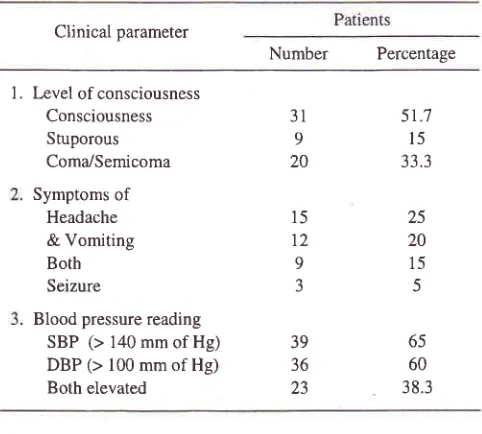
usedfor SSS
scoring.Table 4. Showing clinical parameters
Clinical parameter
Number
Percentage1. Level of consciousness Consciousness Stuporous Coma,/Semicoma
Symptoms of
Headache
& Vomiting Both
Seizure
Blood pressure reading SBP (> 140mmof Hg) DBP (> 100 mm of Hg) Both elevated
15
t2
9 J
5r.7
l5
33.3
25 20
15 5
65 60
3 8.3
Only
in
10 patients (16.67o) the
diagnoses
with
SSS
did
not
'certain'
diagnosis
of
CT
scan.32 24
4
3l
23
31 9
20
39 36
23
Matched Unmatched
20
3
30
7
50
10
[image:3.612.46.287.521.738.2]'t
Vol 10, No 3, July
-
September 2001were
in
indeterminate range,
2 patients
of
probable cerebralinfarct
and4
patientsof
cerebral haemonhage on SSS were otherwise provedby CT
scan.Based
on the
above
finding,
for
cerebral
infarct,
thesensitivity was
93.757o,
specificity
76.66%o,overall
accuracy
was 93.7Vo,positive
predictive valle
87.2Vo and negativepredictive
vahte 92Vo,by
using
SSS.For
patients
of
cerebral
haemorrhage,the sensitivity
was 83.3Vo,specificity
was
92.5Vo,overall
accuracy
was83.3Vo,
positive predictive
value
as
86.9Vo
and negativepredictive value
as 92.5Vo.Mortality
data
A
total
of l6
patients
(l6.6Vo) expired
during
hospitalisation.
Of
these,7
were
with
cerebral infarct
and 9
were
with
evidence
of cerebral
haemorrhage.Amongst
them,
l0
patients expired due
to
raisedintracranial tension
andits effèct
while
theremaining
6
had
developed aspiration pneumonia
and
itscomplication
as causeof
death.DISCUSSION
Stroke ranks
fbremost
among
the
disorders of
CNSand it
is
the
third
main
causeof
deathafter
IHD
andcancer
in
the
present
time.l
In
order
to
reducemortality
in stroke,
prompt
and
correct
diagnosis
of
pathological
type and early
institution
of
therapythereupon
helps.
Brain
CT
scan
(a
non-invasive
method)
is
quite
helpfïl
in
differentiating
intra-cerebral bleedfrom
infarction. This
facility is still
not
always available countrywide
in
India
specially
in
rural
settings. So
the
dealing physicrans
is
generally dependentupon
areliable history
and bedsideclinical
examination
for
making a 'probable'
diagnosis.In
thisregard,
basedon clinical
presentation
SSSmay
be
a good bedsidetool
todifferentiate
cerebral haemorrhagefrom
infàrct.r'5The
present
study
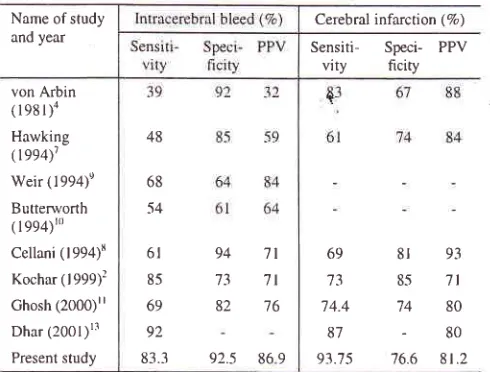
has shown
sensitivity
of
SSSfor
cerebral
haemorrhage
to
be
83.3Vo.This
has
beenreported
to
be varying
from
39
to
92%
by
variousauthors and
69
to
92Vo
in
various
Indian
studies(Table
1).+'t-tz
The
specificity
of
SSS
for
cerebral haemorrhage was 92.5Vowhich
has beenreported by
various
authors as 6lto
94Vo andby
Indian
studies as73
to
82Eo.4'7-'8 Based on these valuesvarious
authorshave shown posrtrve predictive value
of
SSS for
cerebral haemorrhage
varying
from
32 ro 65%o.a'1-t&In
Bedside clinical scoring in stroke 16'7
the
present study
it was found
to be
86.970
for
cerebral haemorrhage.
Table 7. Showing comparison of resuits bAsed on SSS in stroke
Name of study
and year
Cerebral infarction ( %)
Sensiti-
Speci- PPVvity
ficityvon Arbin
(rssr)4
Hawking
099q1
Weir (1994)'
Butterworth ( 1 994)r0
Cellani (1994)8
Kochar ( I 999)2 Ghosh (2000)rl Dhar (2001)'3
Present study
69
73
74-4
87
91.75
81
938-s
7l74
80-80
'76.6
8 r .2For
the cerebral
infarction
group,
the sensitivity
was93.7Vo
using
SSS.
Various
authors
have
found
sensitivity
of SSS
of
cerebral
infarction
to vary from
61
to
87Eo whereasIndian
studies
in
particular
haveshown
it
to vary from
73
to
87Vo.a'7-t9The
specificity
for
cerebral
infarction
was
found
to
76.6Voby
usingSSS.
Specificity
of
SSS
for
cerebral infarction
hasbeen shown
to
be
67 to
85Voby
various authors
and74
to
85Voby Indian
studies
(in
particular;.4'7-'6 Thepositive predictive value varies
from
7l
to
937oin
these studies
which was
8l.2Vo
in
the
present
study (table 7).4'7-r8Thus
to
summarisethis
study has shown
that
Siriraj
Stroke Score is an
important
bed sidetool in
the handsof physicians
which help
in
differentiating
cerebral haemorrhage andcerebral
infarct without
adding
anyextra cost
to
the patients.
As
the
overall
accuracy
of
SSS
in
the
present study
was 83.3Vo
for
cerebral haemorrhage and 93.7Vofor
cerebral
infarction,
so it
may be
concluded
that
physicians
in
the
periphery
rural
settingsmay
find SSS
to
be
quite useful
in
themanagement
of
patients
of
stroke especially
wheremore
sophisticated
radiological investigations for
confirmation
of
stroke diagnosis may
not
be
avaiabledue
to
high cost
or attended,
due
to
transportation risks. The present studyreaffirms
thehigh
accuracyof
diagnosis made
by
using
SSS
for
differentiation
of
two pathological type
at bed sidein
patientsof
stroke.48
68
54
6t 85
69 92
83.3
94
7l73
'7t82
76 [image:4.612.302.547.151.337.2]168
Singh et alREFERENCES
1.
Park
K.
Epidemiologyof
chronic non-communicablediseases and condition. In: Park's Textbook ofPreventive and Social Medicine, 14'h ed. Jabalpur: M/s Banarsi Dass
Bl.ranot, 1994;258-9.
2,
Seisjo BJ, Pathophysiology and treatment offocal cerebral ischaemia-
PartII.
Mechanism of damage and treatment.J Neuro Surg 1992; '77: 337 -54.
3.
Allen CMC. Clinical
diagnosisof
acute stroke fromdepartment
of
Neurology,
Guy's
hospital
London.Quarterly Journal
of
Medicine. New SeriesL-II, 1983;
208:515-23,4,
von Arbin M, Briton M, DeFaire U, Helmers C, Miah K, MurrayV.
Accuracyof
side diagnosisof
stroke. Stroke 1981; l2:288-93.5.
PoungvarinN,
ViriyavejakulA,
Komontri
C.
Siriraj Stroke Score-
bedside and validation study to distinguish supratentorial intracerebral haemorrhage from infarction. Br Med J I 991; 203:1565-7.6.
ShroffMM,
Shetty PG, Joshi P. Imagingin
stroke. In: Medicine Update. Bhopal: Dristi Offset, APICON 1996; 6:II:2-8.7.
Hawkins
GC, Bonita
R, Broad
JB,
Anderson NE.Inadequacy
of
clinicalof
scoring system to differentiatestroke subtypes
in
population based studies. Stroke 1992:26:1338-42.8.
Celani MG, Righetti E, Megliacci R. Comparability andvalidity
of
two clinical
scoresin
the early differentigldiagnosis of acute stroke. BMJ 1994;308:16'74-76.
9,
Weir CJ, Murray GD, Adams FG, Muir KW, Grosset DG,Lees
KR.
Poor
accuracyof
stroke scoring stems forMed.l Indones
11
differentiating
clinical
diagnosis
of
intracranial haemorrhage and infarction. Lancet 1994; 344:999-1002. ButterworthR,
BathP,
Stroke scoring systems. Lancet1994;344:1782-5.
Ghosh S, Sarkar N, Chanda PR, Bhandari BN, Biswas K, Das K, Basu D. Evaluation of Accuracy of Siriraj Stroke
Score
in
differentiating supratentorial ischaemic and haemorrhagic strokesin
study population.JAPI
2000; 48:32.Kochar DK, Joshi A, Aggarwal N, Aseri S, Sharma BV.
Poor
diagnostic accuracyand
applicabilityof
SirirajStrokes Score,
Allen
Score andtheir
combination in differentiating acute haemorrhagic and thrombotic stroke. JAPI 1999;48:584-88.Dhar
MC,
ChaudharyS,
SanTJ,
BasuK,
Mitra
M.Significance
of
Siriraj
Stroke Score
in
differential diagnosis of cerebral haemorrhage from cerebral intàrct. JAPI 2001;49:51.Logan
R,
PultonS,
SeversMP.
Clinical scoresin
the differential diagnosis of acute stroke, BMJ 1994; 309:807-8. DagaMK,
SarinK,
Negi VS. Comparisonof
Siriraj andGuy's
hospital score
to
differentiate
supratentorial ischaemic and haemorrhagic strokes in Indian population.Negi
VS,
SinghS,
Kukriti R,
Kalra OP.Profile
and clinicoradiological correlationin
patientswith stroke.
JAPI 2000:48:31.t7.
Bhattacharya PC, Mahanta N, Math M. A clinical study ofcerebrovascular accident
with
special referenceto
CT correlation. JAPI 2000; 48:33.18.
Vij
A, Kaur K, Kapilla A, Singh GP, Kumar A, Ghalib A.A
clinical studyof CVA
from North India. JAPI 2000; 48:61 .10
t2
13
t4
l5