34 Kusmana Med J Indones
The
profile
of physical
activity
and coronary
risk
factors
in
Monica
Jakarta
survey
Dede Kusmana
Abstrak
Untuk mengetahui gambaran aktifitas
fisik
harian (termasuk olahraga) dan pengaruhnya terhad.apfaktor risiko
koroner telahdilakukan sut'vei pada penduduk
di
tiga
kecamatan wiLayahDKI
JakartaRaya
menggunakan'kuistioner, pemeriksaan fisik, laboratorium dan rekaman EKG 12 hantaran. Dari kuestioner didapat data aktivitas fisik (beban kerja d.an oLah raga), tlan kebiàsaan merokok. Beban kerja dibagi atas ringan, sedang dan berat, sedangknn aktifitas oLahraga dinilai teratur (>2 kali perminggu), tielak teratur(<l kali), serta tidak ada kegiatan olahraga. Selain itu, dilakukan pemeriksaan tekanan darah (dengan penggolongan menurutkriteria WHO), kolesterol (hiperkolesterolemia >200 mgVo), dan EKG (memakai kode Minnesota). AnaLisis stails;ik memp"rgrnokon perangkat SPSJ.
Dari
2400 orang terdapat 2073 (86,4Ea) responden yang terdiridari 1086
wanita dan 987 laki-taki. Gàmbaran aktifitas fisik secara keseluruhan: 33,4Vo ringan, 50,7Vo sedang dcn I5,8Voberat.
BeroLahraga teratur 22,5Vo, tidak teratur 30,3Vo dan tidak berolahraga 47,2 Vo. Olahraga yang diLakuknn: jalan kaki 45,1Vo, senam 22,0Vo,joging/lari
I5,6Vo, buLu tangkis 6,5Vo, bola voli./sepakbola 4,I Va, tenis 3,8Vo dan golf 0,l %. Prevalensi hipertensi secara bermakna lebih rendah pada arang d"ngàn aktifitasfisik
berat (l2,}Vo) dibanding akrifltas sedang (44,87o) maupun ringan (43,2Vo) (P<0.003), demikian puiapreuo!"iri
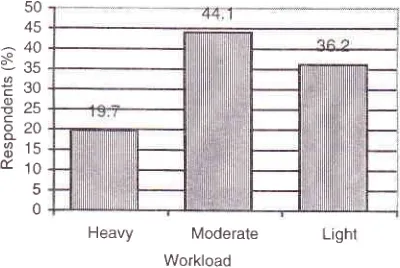
hiperkoleiteroLimia (13,2Va:50,8Vo: 36,0Vo) (P<0.0003) dan merokok(19,7%:44,lVo; 36,2Vo) (P<0.00001). Prevalensi kelainan EKG (inforklamaatauiskhemia) Iebih rendah pada yang teratur berolahraga (l9,0Vo) dibanding yang tidak teratur (22,7Vo) atau sama sekali tidak berolahraga (58,3Eo) (P<0.05).
Dari
penelitianini
ternyata jumlah penduduk dengan aktifitas cukup (termasuk oLahraga yang teratur) masih rendah. Oleh karena itu, diperlukan promosi dalam upaya preventif mengatasi faktor risiko penyakit kardiovaskular. (Med J Indones 2001; 10: 34-41)Abstract
A
population
study was done to know the profile of daily physical activity including sports, an(l its influence on major coronary riskfactors in three districts of Jakarta using questionnaire, physicaL and laboratory examination, and
l2
leads ECC.ihe
questioinaire gave the data about physical activity (work load and sport), and smoking habit. Work Load was divided into Light, modera-te antl heavy. Sport activity was divided into regular(>
twice a week, 20 minutes or more), irregulctr (< once or occasionaL), and no sport activity.In
addition,
blood
pressure (hypertensionwas
groupedaccording
to
WHO
criteria),
total
choLesterol (regarded as hypercholesterolemia when>
200 mgTo), and ECC were measured. ECG interpretation was done using Minnesota Code. Statistical analysis was done aslng SPSS. Out of 2400 people there were 2073(86.4Vo) respondents that consisî of t0S6femaLes and9B7 males. The profile of physical activity as a whole showed 33.4Vo light, 50.7Vo moderate and l5.8Vo heavy activity. OnLy 22.5Vo of respondents had sport regularly, while 30.3% hadsport
irregularly, and 47.2% had no sport activity. The type of sport was walLing'(45.0Vo), calListhenic (22.0Eù, jogging/running (l5.6Vo), badminton (6.580), volLey ball/soccer (4.1Va), tennis 13.8%1, arul golf (0.iVnS. There was a significant difference in lhe prevaLence of hypertension between people with heavy (l2.0Vo), moderaîe (44.8E"j and light work load (43.2Va) (P<0.003), in the prevalence of hypercholesterolemia (t3.2Vo: 50.8Vo: 36Vo) (P<0.0003), and smoking(Ig.7T;
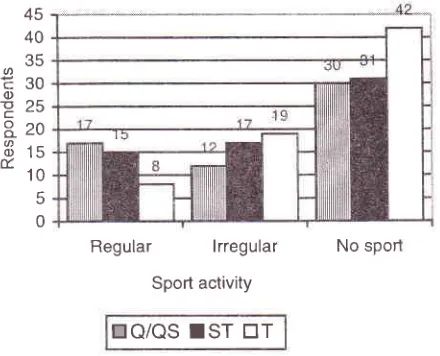
44.lVo: 36.2Vo) (P<0.00001), respectively. The difference also occurred in the prevalence of abnormat ECG (Q/QS, ST anàT abnormalities) between people having regular sport (t9.0Vo), irregular (22.7To), and no sport activity (58.3Vù (P<0.05). The number of respondents having enough physical activity (including regular sport) was rekttively low. Therefore, promotion should be doneai
a preventive method to overcome cardiovascular risk factors. (Med J Indones 2001;l0: 34-41)
Keywords: Sport, ECG.
Physical
rnactivtty
has been known
to
be one
of
thecoronary risk factors but
reference datain
Indonesia isvery limited.
CharlesDarwin with
hisevolution
theory"survival
of
thefittest"
hadshown
us that thefittest
or the strongestwill
survive or win, and
gave us the ideaabout
it.r From
his study on
busdriver
and conductor,* Department
of
Cardiology, Facultyof
Medicine, University oJ lndonesia./ National Cardiac Center Harapan Kita, Jakarta, lndonesiaMorris
et
al.
reported
tbr
the
first time
that
theprevalence
of coronary
heart disease waslower
in
busconductor.
His
second study on postmenconfirmed
thatc
lower
in
physically
a
active group.2 Rosera
the result
of Monis
study base on their
five
years study ontrain
workers.Vol 10, No
l,
January-
March 2001lower
in men
with heavy compared
to
those with lightwork load, both
in
morbidity
and
mortality.
Survival
ratewas higher
in
men
with
heavy
comparedto
thosewith moderate
or
light work
load.5The
same result wasreported
by
Paffenberger
in
his
study
on
HarvardAlumni
family.
Coronary
disease incidence waslower
in
alumnus
who was physically active
compared
to those who wasphysically inactive.
Minimal
physically
active was equal
with
walking
6
kilometers
on
flat
surface
or
two-block
distance,
or
with climbing
two
flights of
stairs.In the last decade,
Coronary Heart
Disease prevalence has decreasedin
the United
Statesof
America.
This
fact
shows
us that
this
decreaseis
correlated with
increased
daily
physical
activity
including
sport activity.Ô-"In
addition, no data
showed that
increasedphysical
activity would
increase
morbidity
ormortality due
to coronary
disease incidence,neither
inhealthy
individual nor
in
coronary heart
patient who
performed cardiac rehabilitation
p.og.am.u-oTo know
the
profile of
physical
activity including
sport
and itsinfluence on coronary
risk
factors, we
did
a survey on thepopulation of
threedistricts
of South
Jakarta.rr-r6METHODS
The study was
done
on
the population
of
MampangPrapatan, Kebayoran
Baru, and Cilandak located in
South Jakarta
from
July
1988
ro
December
1988. Inthis
study
a
complete questionaire
was
used. In
addition, physical examinations,
l2lead
electrocardio-grams and laboratory examinationswere
done.
A
multi
stage cluster
randomized sampling
was done on 57,000people,
andat last 2073
respondentswere included
inthe study.
Their
agerange was 25-64
years, and theyconsisted
of
1086 females and 987 males.
Specialphysical
activity
questionnaire was
usedaccording
toMonica Optional Study
on
Physical
Activity, and
physical
activity
wasdivided
into work
load
and sportactivity.
Work loads-to
Work
load
wasdivided
into
3 categories :Light
work load
All
kind of
job,
which is mostly
done in sitting position(desk
job)
and causes
no
significant
haemodynamic changes such asno
increasein heart
or
respiration rate,or
sweating,or
equivalentwith
3
-
5 METV4-6 kcaVl0
mVkg/min, is considered asgiving light work
load.Coronary risk
factors
35Moderate work
load
All
kind
of
job
which
slightly
increases
heart
andrespiration
rate, andsweating, or equivalent
with 5
-7
METs/6-8
k
call25 mllkg/min,
is
considered
asgiving
moderatework load.
Heavy
work load
Job
which is mostly done
using muscle strength
suchas laborer, and
causes a significantincrease
in
heartand respiration rate, and
sweating,
or
equivalent to
more than
7
METs/8
k
cal/25 ml/kg/min, is
considered asgiving heavy
work load.
To
weigh
the
work load
we
use haemodynamic
changes caused
by
respondents'
occupation.Govemment
employees
who
did
desk
job
such
aswriting
or
doing
administration were classrfied
ashaving
light work load.
A
tailor
or
abarber or
womenwho
served
herself
in
her
house
were classified
ashaving
a moderatework load.
A
laborer or
afàrmer or
a
mechanics
were classified as having heavy work
load.Sport
activity
According
to
sport activity
the
respondents
weredivided
into those who have
a
spoft
activity or
not.
If
the respondents
were engaged
in
sport
activity, they
were turther divided
into
those having regular
andiregular sport.
They were regarded
as
having
regularsport
if
sport was done
twice a
week
for
at
least
20minutes each
or
more,
and they were
regarded
ashaving
inegular
sport,
if it
was done once a week
or occasionally.In addition, each sport
activity was
stated,such as calisthenics,
walking, jogging, running,
bad-minton, soccer, volleyball, golf, martial art, and others.Coronary
risk
factor included
in this
study
washyper-tension (the blood
pressurewas grouped according
toWHO
criteria), hypercholesterolemia (the
respondentswere
regarded ashaving
hypercholesterolemiaif
their
cholesterol
levels were
>200
mgVo),
and
smoking.Electrocardiogram
was
evaluated
according to
Minnesotacode.'t-'n Statistical
analysis was performed using computer SPSS package.RESULTS
Work
load
36
KusmanaTable
l.
Distributionsex
of respondents based on occupation and
Med J Indones
and 47.2Vo
of
respondents didno
sport activity,
respectively
Sport
activity
About
22.5Vo, 30.3Va,regular, irregular
and(Figure
2). MaleGE
P
M
B R
F
S H J
50 45 40 35 30 25 20
15 10 5 0
202 (20.s%) 332 (33.6Eo)
t27 (l2.9%o) 122 (t2.4Vo)
85 (8.57o)
28 (2.8Eo) 16 (1.6Eo)
4 (0.4vo)
72 (7.3Vo)
68
(6.3%)
270 (13Vo) 50(4.6Eo)
382 (18.4vo)70
(6.5Vo)
197 (9.5Vo)58
(5.3Vo)
180 (8.'7vo)7
(0.6%)
9t
(4.4vo)4
(0.4Eo)
32 (1.5V")5
(0.5%)
2t
(r.jVo) 795(73.3Va)
799 (38.6%)28
(2.67a)
lO0 (4.8V")s
o c q) Eco o_ aoÉ.
Toral
987(I00Eo)
1085 (10070) 2072(lOOVo) Oc=Occupation, GE=Govemment employee; P=Private, M=Merchan-diser,
B=
Businessman, R= Retired, F= Farmer, S= Student, H= Housekeeping, J=JoblessBased
on
gender difference, men have
both
morevariable
and
heavy
job
(with the
exeption
of
housekeeping) compared to women.
Based
on
gender
difference it
is
apparent
that
therewere more
men
working
for
each
type
of
job
compared
to women. The
same was truefor
those thatdid not work,
with
the exception
of
housekeeping.However,
there were also menwho did
housekeeping.Men
who
werenot
working
were 7 .3Vo,while
womenwere
only
2.6Vo,tt
seems thatwomen
are easierto
getjobs
than
men,
although
most
women
had housekeepingjob.
As
awhole,
basedon
work load,
about33.4Vo,50.7Vo and 75.8Voof
the respondents hadlight,
moderate andheavyjob
respectively (Figure
1). [image:3.612.46.280.113.254.2] [image:3.612.315.538.160.339.2] [image:3.612.319.528.481.676.2]Heavy
Figure
I.
Distribution
load (n=2071)
Moderate Light
Work load
of
respondents basedon
work [image:3.612.69.273.542.686.2]Regular lrregular
No sporl Sport activityFigure
2.
Distribution
of
respondentsbased
on
sport activity(n=207l
)The type
of
sport
done wasshown
in
Figure 3.
Basedon
sexdifference, more men
do
regular and irregular
sport compared
to
women
(Figure
4).= !,ô
8È
6
Type of sport
Figure
3.
Distribution
of
respondents basedon
typeof
sport (n=1087)s
640
c€so
co
Èzo
0)
É. 10
50 45
^40
o\ âÊ9eac ""
€zs
c920
E
ts
*10
0
o)cDcho(J v=
È 3F U E
6 ;or.=oG)-cÈ_9Êg)Ft;
(oâ'(IJ
Vol 10, No
I,
January-March200I
Regular
lrregular
No sport Sport activity [image:4.612.313.520.57.248.2] [image:4.612.58.268.82.246.2] [image:4.612.308.523.306.466.2] [image:4.612.318.518.527.661.2]l![Male trFemale
Figure
4.
Distribution
of
respondents based onactivity
and sex (n=207 I )Calisthenics
was
mostly done
by
women,joggingirunning, badminton,
volley
ball/soccer, tennis weremostly
doneby
rnen(Table
2).Table
2.
Distribution of respondent base on type of sport and sexTS Male Female Total
w
JR
C
B
T
G
o
215 (4.lEa)
138 QA.9Vo)
93 (t4.tVo) 59 (8.9E0)
36 (5.4Vo)
35 (5.3Ea)
25 (3.8Eo)
214 (50.2Vo)
32 ('7.5Eo)
146 (34.3Vo) 12 (2.8Va)
9 (2.lVo)
6 (1.4%)
I (0.2Vo)
6 (l.4Vo)
489 (45.Ùqa) 170 (l5.6Va)
239 (22.0Vo)
7t
(6.s%) 45 (4.t%)4l
(3.8Va)1 (O.tVa)
3l
(2,9Vo)Total 661 t 100%) 426 (100%) 1087 (r00%)
TS=Type of Sport, W=Walking, JR=Jogging/Running, C=Calisthenics, B=Badrninton, VS=Volley/Soccer, T=Tennis, G=Golf, O=Orhers
Regular
sport activity
of
male
respondents increasedwith
age,but
in
fèmale
these was no changein
regular sportactivity
(Figure
5 and 6).Correlation
between physical activities
and
risk
factors
Correlation
betweenwork
load and smoking
Smoking
habit
was
correlated
with work
load.Respondents
who
smoked
regularly
tended
to
havelighter
work
load (Figure
7).Statistical analysis showed significance
difÏerence
(P<0.00001)
in
the
percentageof
respondentshaving
heavy, moderate and
light work
load among
smokers(Figure
7).Coronary risk factors 37
25-34
35-44
4s-s4
AgeERegular Elrregular trNo Sport
Figure 5. Distribution
of
respondents basedon
regular
activity correlated with age in male
(n=986)
50 45
^40
el
35Ëso
o^-Ezc
Vro
315
É10
5 0
s
oc
q)
Eco
o-o) É.
70 60
50
40 30 20
10
0
sporl
but
and
s
c o !co
a-0) É.
BO 70
60
50 40
30
20
10 0
25-34
35-44
45-54
ERegular
Ilnegular
trNo SportFigure 6. Distribution
of
respondents basedon
regular
activity
correlated with ageinfemale (n=1085)
Age
50 45
:40
ùss
€so
€zs
c320
3
1sd10
5 0
Heavy
Moderate WorkloadFigure 7. Distribution
of
respondentsload among regular smokers
Lighl
Vol 10, No
l,
January-
March 2001Calisthenics
Respondents
who did
calisthenics exercise regularly,
45.6Vo, 47.7Vo, and 6.7Vo
of
them hadlight,
moderate, and heavywork load,
respectively.Tennis
R.espondents who did tenni s, 56. I Vo, 39Vo, and 4.97o of them had light, moderate, and heavy work load, respectively.
Badminton
Respondents
who did badminton,
39.4Vo,4A.87o, and 19.77oof
them had
light, moderate, and heavy
work
load, respectively.
Volley and soccer
Respondents who played volley and soccer,
37.8Vo, 46.7Vo,and
15.6Voof
them had light, moderate,
and heavywork load,
respectively.Golf
Unfortunately
only
I
woman played
golf and
she hadlight work
load.As
awhole, between the various kind
of
sports therewere
significant diffèrences
in
the
percentage
of
respondents
having light,
moderate, and heavy
work
load
(P<0.0035).
Correlation
between
sport activity
urrà
abnormal
BCG
Among the
respondents,
211 had
abnormal
ECG
according to Minnesota
Code(Q/QS,
ST andT).
Q/QS
was
observedin
17 respondentswho had
sportregularly,
12 respondentswho
had sportinegularly,
and 30 respondents who had no sport activity.ST
was observed
in
15 respondents who had
sportregularly, 17 respondents who had sport irregularly,
and 31 respondents
who
had no sportactrvity.
T
was observed
in
8
respondents
who
had
sportregularly, 19 respondents who had sport
inegularly,
and
42
respondentswho
had no sportactivity.
This study showed that sport activity
had a protectiveeffect (less
abnormal
ECG), and statistical
analysisshowed
a
significant difference between
respondentshaving
regular,
irregular
and no sport
activity
in
the occqranceof
abnormalECG
(P < 0.05)(Figure
Il).
DISCUSSION
Until
recently, common coronaryrisk
factors, i.e.hyper-tension,
hyperlipidemia,
diabetes
mellitus,
smoking,Coronary risk
factors
39obesity, and stress are
well
studiedin
Indonesia aswell
as abroad. However, physicalactivity
was neglected.Regular
lrregular Sport activityNo sporl
[image:5.612.304.524.134.312.2]MO/OS
TST trT
Figure l
I.
Correlation betvveen sport activity and abnormal ECG (n=21I )This
study showed
that physical
activity
including
sport had a good
effect
on coronaryrisk
factors.The profile
of work load
as awhole
was 33.4Volight,
50.7Vo moderate, and 15.8Vo heavy.The population in
metropolitan
city
had more
light
and moderate work
load.
According to
gender, more male had heavywork
load than female
(l1.3Vo
:
14.3Vo),and more
female hadlight
or moderatework load
than men.The
prevalenceof
respondentswho had regular
sportwas only
22.5Vo,
whlle
30.3Vo
had
irregular
and 47.2Vohad
no
sport activity.
It
means that
physical
inactivity
occurred
in
a
high
percentage
of
thepopulation.
From this
datawe have to
encourage the people to exercise moreregularly.
In this
study, there was asignificance difference
in
theprevalence
of
hypertension in people
who had
heavywork load
(l2.0%o)compared with
moderate
(44.8Vo) andlight work load
(43.2%o)(P<0.003).
In
various studies,
physical
activity have shown
toreduce overweight, maintain
body weight,
reduce peripheral resistance and decreaseblood
pressure.There was a
significant difference
in
the prevalenceof
hypercholesterolemia
in
respondents who had
heavywork
load
(l3.2Va)
comparedwith moderate
(50.87o)and
light
work
load
(36.OVo)(P<0.0003).
Physical
45 40 35 o
Ë30
o:.25
&20
3
rs
t
-t
40 Kusmana
activity
increases
metabolism as
a
whole
including
lipid
metabolism,
and decrease cholesterol level.Also
there
was
a
significant
difference
in
the prevalenceof
smoking
in
peoplewho
had heavywork
load (l9.7Vo)
compared
with
moderate (44.l%o)
andlight
(36.2Eo)
work
load
(P<0.00001).
Ir
wassurprising that
heavyjob
decreased the prevalenceof
smoking;
it
seemedthat people
with light work
loadhad more
opportunity to
smoke compâred
with those
with
heavywork
load.In
addition,
in
this
study, sport
activity had
aprotective effect
against
the
occurrence
of
abnormalECG.
Recent datahave
shownthat regular
sport
will
enhance endothelial
function
and
prevent atherosclerotic process.20-2'This
study revealed
that
heavy
physical activity and
regular sport
reduced theprevalence
of
hypertension,hypercholesterolemia,
smoking, and
abnormal ECG.
This
study
supports
the
result
of
Morris
andPaffenberger. Heavy physical
activity and
regular
sport
reduced coronary
heart
disease
prevalencethrough
decreasing coronaryrisk
factors.The
prevalence
of
population who had heavy work
load
was
15.8
Vo,and
who
did
regular sport
was 22.5Vo,this
meansthat
only
38.3 Voof
thepopulation
had enough
physical
activity,
so we have to encouragethe other
6l.7Vo
to
change
their daily activity
by
working
hardor doing regular
sport.Regular
walking should be introduced widely
sincechildhood,
becauseit
is
very
easy and cheap, and thegovernment should
increasethe sidewalks
for
peopleto
walk, and forbid the use
of
side walks
by
street vendors.From the different kinds
of
sports,walking,
jogging/
running,
and calisthenics,
which
are inexpensive
and easyto
do, are the most popular.What
is needed is the encouragementto
be more physically active and do
regular sports
for
those
with
light to
moderatework
load.
For
thosewho
have heavywork
load, sport is nota must,
but
if
neededthey can
do light
sport
such ascalisthenics.
The government's campaign
for
the community
tomotivate them
to
do
sport
with
the motto:
"no
daywithout sport" should
perhaps
be
added to "regular
and
continuous sport." Another campaign should
also be added:"run
if you
can,or
at leastwalk,
andif
it
is not possible, then docalisthenics."
Med J Indones
In
conclusion, the number
of
respondents engagedin
physical
activity including
sport
was
low.
Heavy
physical
activity
andregular
sportwere
relatedto
less prevalenceof
hypertension, hypercholesterolemia
and abnormalECG.
Physical
activity including
sport should be promoted
especially
those
that are
inexpensive
and
relatively
easy,
such
as
calisthenics,
walking,
jogging
and runningAcknowledgement
The
author
appreciated
very
much
the
support
of
Monica
Jakarta
ResearchTeam
(Prof
Dr.
R.
Boedhi
Darmojo,Pl-Research Department
of
Faculty of
Medicine, University
of
Diponegoro,
Dr.dr.
Budhi
Setianto,
dr.
Sutedjo,
Dr.
dr.
Fadilah
Supari-Department
of
Cardiology,
Faculty
of
Medicine,
University
of
Indonesia./National
Cardiac
CenterHarapan
Kita,
dr.Andradi-Department of Neurology,
Faculty
of
Medicine,
University of Indonesia/General
Hospital Cipto
Mangunkusumo,
dr.
Lucia
Tarigan-Research
and Depevelopment
of Ministry of
Health),
the Director
of
National Cardiac Center,
doctors,nurses and paramedic personnel
who
participated in
this
study.REFERBNCES
l.
Charles Darwin. Encyclopedia Americana. International edition. Volume 8. Danbury: Americana, 1980.2.
Morris JN, Heady JA, Raffle PAB, Roberrs CG, parks JN.Coronary heart disease and physical
activity
of
work. Lancet 1953; 2: 1053-120.3.
RoseG. Physical
activity
and coronary heart disease, symposium on the meaningof physical fitness.
proc R Soc Med 1969;62: 1183.4.
Taylor HL, Bleckburn H, Keys A, Parlin RW, Vasques C,and Pucher
T.
Death rates among physically active andsedentary employees
of
the railroad industry. Amer JPublic Health 1962; 52:l 697 -707.
5.
Parffenberg RS Jr, Laughlin ME, Gima AS. Work activity of longshoremen as related to death from coronary heartdisease and stroke. New Eng J Med. 1970;
282
llOg-14.6.
SanneH,
Rydin
C.
Feasibilityof
a
physical trainingprogram. Acta Med Scan 1973; 551 (suppl): 59.
7.
Kusmana D, KasimM,
Abdusalam. Evaluasi programkesegaran jasmani (Physical fitness) dari karyawan suatu
pemerintah daerah selama
satu
tahunkoperki
ke
II,Surabaya 1978.
8.
Wenger NK, Hllerstein
HK.
Rehabilitationof
thecoronary patient. Second
edition.
New York:
Willey medical, 1988.Vol 10, No
l,
January-
March200lil.
kwalitas hidup simposium rehabilitasi jantung Indonesia
II. Jakarta: 1988 Perhimpunan Kardiologi .
WHO Monica Project. Physical activity surveys. Revised
draft.
Geneva: 27. Cardiovascular DiseaseUnit
WorldHeart Organization CH- I 2l
I,
1983.WHO
expert
committee. Community prevention andcontrol
of
cardiovascular disease. Report no TRS 732.Geneva: WHO, 1986.
Mancia G. The need to manage risk fâctors
of
coronaryheart disease. Am H J 1988; I l5: 240-2.
WHO
Monica Project.
Cardiovascular Disease Unit.Monica Manual. CVD/MNC Version 1.1. Geneva: WHO, r 986.
WHO
Expert Committee. Cardiovascular Disease Unit.Prevention of coronary heart disease. Report no. TRS 678, Geneva: WHO, 1982.
Tunstall-Pedoe.
Monitoring trends
in
cardiovasculardisease and risk factors. The WHO Monica project. WHO chronicle 1985;39
(l):
3-5.The WHO Monica project. Geographical variation
in
themajor risk t'actors
of
coronary heart diseasein
man andwomen aged
35-64
years.
World
Health
statisticsquarterly 1988; .41 (3-4): I l5-38.
Coronary risk
factors 4l
Rose G, Reid DD, Hamilton PJS, McCartney P, Keen H, Jarrett RJ. Myocardial ischemia,
risk
factors and deathfrom coronary heart disease. Lancet 1977 ; I : I 05-9.
Bartel
A,
Heyden
S,
Durham. Electrocardiographic predictorsof
coronary heart disease.Arch
intern Med 1971; 128:929-37 .Coronary drug project reseârch group. Factors influencing
long
term
prognosisafter
recoveryfrom
myocardial infarction three year findings of the coronary drug project.J Chronic Dis 1974; 27:267-85.
Uemâtsu
M,
OharaY,
Navas JP, NishidaK,
Murphy TJ.Regulation
of
endothelialcell
nitric oxide
synthasemRNA expression by shear stress. Am J Physiol 1995;269 (6ptl ):Cl37l-8.
Anderson TJ, Uehata A, Gerhard MD, Meredith IT, Knab
S,
DelagrangeD,
et al.
Close relationof
endothelial function in the human coronary and peripheral circulation. JACC 1995; 26(5):1235-41.Niebauer J, Cooke JP. Cardiovascular Effect of Exercise :
Role of Endothelial Shear Stress. JACC, 1996;
28
1652-60.
l't .
t0
l8
l9
20
t2
l3
t4
15.
l6
2l