1
ANTIBACTERIAL ACTIVITY OF ETHANOL
LEAF EXTRACT OF PURSLANE (
Portulaca
oleracea
)
AGAINST
Salmonella typhi
AND
Shigella dysentriae
Elly Nurus Sakinah, Diana Chusna Mufida
Laboratory of Pharmacology, Medicinal Faculty, University of Jember Laboratory of Microbiology, Medicinal Faculty, University of Jember
ABSTRACT
The research has been conducted to examine antibacterial activity of ethanol leaf extract of Purslane (Portulaca oleracea) against Salmonella typhi and Shigella dysenteriae determined by growth on Mueller-Hinton media (in vitro). The research used a posttest-only control group design which used eight times dilution of ethanol leaf extract of Purslane (1 g/ml; 0,5 g/ml; 0,25 g/ml; and 0,125 g/ml). A solution of 0.5 % CMC-Na was used as a negative control. The positive control for Salmonella typhi Chloramphenicol and Siprofloksasin suspension served as positive controls for Shigella dysenteriae, respectively. The results showed that all concentrations of ethanol leaf extracts of Purslane affected the zone of inhibition against Salmonella typhi and Shigella dysenteriae. The extract with concentration of 1 g/ml showed the greatest zone of inhibition against Salmonella typhi (60.25 cfu/ml) and Shigella dysenteriae (25.125 cfu/ml); concentration of 0.5 g/mL (88.25 cfu/ml and 30.125 cfu/ml), concentration of 0.25 g/ml (146 cfu/ml and 38.25 cfu/ml) and concentration 0.125 g/mL (204.25 cfu/ml and 48.25 cfu/ml).
2 INTRODUCTION
Infectious diseases has
become Indonesia’s most
common health problem especially typhoid fever and diarrhea caused by Salmonella typhi and Shigella dysenteriae. (Hadinegoro, 1999). Based on intensive and longitudinal epidemiological research of typhoid fever by Simanjuntak (1993) in Paseh, West Java, showed that the insidence of typhoid fever in semiurban area was 357,6 cases per 100.000 people in a year, 77% are 3-19 years old with the highest incidence are 10-15 years old.
Because of high treatment cost and resistance of standard antibiotic we need to find alternatif ways treating thoose disease, one of them are using herbal medicine. Research by Bae (2004) showed that Purslane (Portulaca oleracea) has an antibacterial effect against positive gram Bacillus cereus and negatif gram Pseudomonas aerogenosa, Eschericia coli and also antibacterial effect against Staphylococcus aureus and Bordetella bronchiseptica (Shahidi et al., 2004). Another research by Bongoh et al. (2000) showed that Purslane (Portulaca oleracea) has an antifungal effect against
Candida albicans and Aspergillus niger.
Flavonoid responsible for this antibacterial and antifungal effect (Cowan, 1999). Quercetin, a flavonol form of flavonoid, is the greatest compound inside Purslane and it has the greatest antibacterial effect. It also has antihistamin, antiinflamatory, antiviral, and also cancer prevention activity. (Basile et al., 2000; Gutzeit et al, 2005; Jegtvig, 2008).
METHODS
3 served as positive controls for S. dysenteriae, respectively (Notoatmodjo, 2005).
RESULT
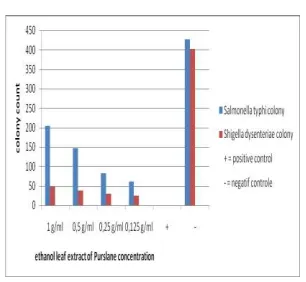
After incubate for about 24 hours in 37o C, each disc were obserbed by counting the ammount of the growth of the colony manually using Colony counter. The result are shown on figure 1.
Figure 1. Salmonella typhi and
Shigella dysentriae
Colony count
DISCUSSION
The results showed that all concentrations of ethanol leaf extracts of Purslane affected the zone of inhibition
against S. typhi and S. dysenteriae.
The extract with concentration of 1 g/ml showed the greatest zone of inhibition
against S. typhi (60.25 cfu/ml) and S. dysenteriae (25.125 cfu/ml); concentration of 0.5 g/mL (88.25 cfu/ml and 30.125 cfu/ml), concentration of 0.25 g/ml (146 cfu/ml and 38.25 cfu/ml) and concentration 0.125 g/mL (204.25 cfu/ml and 48.25 cfu/ml). LSD test showed significant result on antibacterial effect of ethanol leaf extract of Purslane against S. typhi and S. dysenteriae.
CONCLUSION
The conclution of this research is that all concentrations of ethanol leaf extracts of Purslane have significant antibacterial effect. The higher the concentration the greater the antibacterial effect.
However it is need to do some following research on Phytochemical test of active compound inside purslane leaft (P. oleracea) especially quercetin then spesifically tested with antibacterial activity test against S. typhi and S. dysenteriae.
REFERENCES
4 Food-Borne Pathogens. J. Food Sci. Nutr., 9: 306-311.
Basile, Sorbo, Giordano, Ricciardi, Ferrara & Montesano. 2000. Antibacterial and Allelopathic Activity of Extract From Castanea sativa Leaves. Fitoterapia, 71: 110-116.
Bongoh, Moochang, & Hwang, J. 2000. Detection of Antifungal Activity and Portulaca oleracea by A Single Cell Bioassay System. Phytotherapy research, 14 (5): 329-332.
Cowan, M. M. 1999. Plan
Product as
Antimicrobial Agent. Clinical Microbiology Review, 12 (4): 564-582.
Gutzeit, Tokalov, Muller & Rusake. 2005. Monitoring Flavonoid Metabolism in Human Cells by Exploiting Flourescence Elicited Upon Quercetin/Protein Interactions. Croatica Chemica Acta, 78 (3): 337-342.
Hadinegoro, S. R. 1999. Masalah Multi Drug Resistance pada Demam Tifoid Anak.
Degranulasi Mastosit yang Tersensitisasi Terhadap Ekstrak Metanol Spon Laut Acathodendrilla sp. J. Sains & Tek. Farm, 13 (1).
Musnelina, Afdhal, Gani, dan Andayani. 2004. Analisis Efektivitas Biaya Pengobatan Demam Tifoid Anak Menggunakan
Kloramfenikol Dan Seftriakson di Rumah Sakit Fatmawati Jakarta Tahun 2001-2002. Makara, Kesehatan, 8 (2): 59-64.
Nelwan, R. H. H. 1999. Alternatif Baru Pengobatan Demam Tifoid yang Resisten.
Cermin Dunia
Kedokteran, No. 124: 9-10.
5 Simanjuntak, C. H. 1993.
Demam Tifoid, Epidemiologi, dan Perkembangan
Penelitiannya. Cermin Dunia Kedokteran, No. 83: 52-54.
Stauth, D. 2007. Studies force New View on Biology of Flavonoids. Oregon: Oregon State University. [serial online]. http:// eurekalert.org.htm. [10 Maret 2009].
Suswati, E. dan Mufida, D. C. 2007. Petunjuk Praktikum
Mikrobiologi II. Jember: Laboratorium Mikrobiologi Fakultas Kedokteran Universitas Jember.
Thaver, Zaidi, Critchley, Azmatullah, Madni, & Bhutta. 2009. A comparison of fluoroquinolones versus other antibiotics for treating enteric fever: meta-analysis. BMJ, 1-11.
Triatmodjo, P. dan Oktarina, C. 1997. Pola Resistensi Bakteri Enteropatogen terhadap Antibiotik.
Cermin Dunia