“I admit have read this report and from my opinion this report is adequate from it quality and scope in Partial Fulfillment of Requirement for the
Degree in Bachelor of Mechanical Engineering (Thermal-Fluids)”
Signature :………..
DEVELOPMENT OF SOLAR COLLECTOR FOR HOT WATER SYSTEM
MUHAMMAD SYIMIR BIN YUSOF
This report for Projek Sarjana Muda is submitted in partial fulfillment for Bachelor of Mechanical Engineering (Thermal-Fluids)
Faculty of Mechanical Engineering Universiti Teknikal Malaysia Melaka
ii
“I hereby, declare the content of this report is the result of my own research except as cited in the reference”
iii
iv
ACKNOWLEDGEMENT
First of all, thank to Allah for His blessing and His Messenger Muhammad S.A.W for his bonds of love in order to allow me undergoing my Projek Sarjana Muda (PSM) and being able to finish it within the time given.
I would like to give my deepest gratitude to my supervisor, Encik Mohamad Firdaus bin Sukri for all his concern and time. He had put up for me to ensure that my PSM finish on time.
v
ABSTRACT
vi
ABSTRAK
vii
CONTENTS
CHAPTER ITEMS PAGES
Confession ii
Dedication iii
Acknowledgment iv
Abstract v
Abstrak vi
Content vii
List of Table xii
List of Figure xiii
List of Symbols xv
List of appendix xvii
CHAPTER 1 INTRODUCTION
1.1 Introduction to solar energy 1
1.2 Background research 3
1.3 Objective 5
1.4 Scope 5
viii
CHAPTER 2 LITERATURE REVIEW
2.1 Heat transfer 7
2.2 Conduction 8
2.3 Fourier's law 10
2.4 Conductance 10
2.5 Convection 12
2.6 One dimensional Application 13
2.7 Previous research 15
2.8 Previous experiment. 15
2.9 Types of solar collector 17
2.9.1 Flat-Plate 17
2.9.2 Evacuated Tube 18
2.9.3 The efficiency of solar collector tubes 19 2.10 Types of Solar Water Heating Systems 21
2.10.1 Active Systems 21
2.10.2 Open-Loop Active Systems 22
2.10.3 Closed-Loop Active Systems 23 2.10.4 Advantages of a Closed Loop 24 2.10.5 Disadvantages of a Closed Loop 25
2.11 PVC Pipes 25
2.11.1 Thermal effect on PVC pipes 26 2.11.2 Resistance to biological attack 28
2.11.3 Weathering resistance 28
2.11.4 Polyvinyl chloride specification 29
2.11.5 Benefits of PVC pipes 30
2.12 Flows Formulas 31
2.12.1 Darcy-Weisbash Equation 31
ix
CHAPTER 3 METHODOLOGY
3.1 Methodology of project 36
3.2 Collecting information 39
3.3 Design 39
3.4 Fabrication concept 40
3.5 Part of design 41
3.5.1 Water storage tank 41
3.5.2 Parallel and series pipes solar collector 43 3.5.3 Cut view of hot water system 44
3.5.4 Pump 45
3.5.5 Pump specification 46
3.6 Experimental rig 47
3.7 Design and fabrication 48
3.8 Testing 48
3.9 Research and Equipment study 49
3.10 Standard Procedure 50
3.11 Experiment Procedure 51
3.11.1 Part A 51
3.11.2 Part B 54
x
CHAPTER 4 DATA AND ANALYSIS
4.1 Experimental 56
4.2 Specification of PVC pipe 57
4.3 Analysis of series and parallel of solar collector 58
4.4 Experiment data 59
4.5 Calculation for hot water system 66
4.6 The rate of heat transfer 67
4.6.1 Parallel solar collector system 67 4.6.2 The series solar collector system 71 4.6.3 Comparison between two types of 72 solar collector
CHAPTER 5 DISCUSSION
5.1 Losses in Pipe networks 73
5.2 Explanation of solar collector types effect 74 5.3 Factor affecting the solar collector types 76
5.4 Problem analysis 77
5.5 Overall performance overview 80
CHAPTER 6 CONCLUSION
6.1 Conclusion for overall project 81
xi
REFERENCES 83
BIBLIOGRAFI 85
APPENDIX A1 86
APPENDIX A2 87
xii
LIST OF TABLE
NO. TITLE PAGE
2.1 Equation for different heat transfer modes 13
and their thermal resistance
2.2 Set of experiments data collected 16
2.3 Solar collector of performance 20
3.1 Polystyrene properties 42
3.2 Table for experimental data 55
4.1 Pump specification 57
4.2 PVC pipe specification 57
4.3 Raw data collected on 4 March 2009 59
4.4 Raw data collected on 7 March 2009 60
4.5 Raw data collected on 18 March 2009 62
4.6 Actual flow rate (parallel solar collector) 66
4.7 Comparison for both types of solar collector 72
5.1 Performance of solar collectors 80
xiii
LIST OF FIGURE
NO. TITLE PAGE
1.1 Components of hot water system 2
1.2 Flow chart of PSM 4
2.1 Conduction process 9
2.2 Representation of heat flow diagram as a thermal circuit 14
2.3 Sketch of a flat-plate collector 17
2.4 Sketch of a heat pipe collector 18
2.5 Efficiency graph of solar collector performance 19
2.6 The open loop system diagram 22
2.7 Indirect Glycol Closed Loop System 24
2.8 Approximate relationship for 12454 PVC 27
for PVC pipe strength properties versus temperature
2.9 Moody diagram (friction factor) 34
2.10 Moody diagram (relative roughness) 35
3.1 Detailed Flow chart for PSM 38
3.2 3D view of water storage tank 41
3.3 Series and parallel solar collector 3D assembly 43
3.4 Parallel solar collector cut view section 44
3.5 Series solar collector cut view section 44
3.6 3D view of pump 45
3.7 Fabrication of solar collector tubes 48
3.8 Thermocouple 49
xiv
3.10 Polystyrene box with pump 51
3.11 Temperature measurement 51
3.12 Closed box 52
3.13 Complete system 52
3.14 Both hot water systems exposed at same location 52
3.15 Front view of system 54
3.16 Top view of system 54
4.1 Graph overview 63
4.2 Graph overview 64
4.3 Graph overview 65
4.4 Parallel solar collector pipe distribution 67 5.1 Direction of water flow in parallel solar collector tube 75 5.2 Direction of water flow in series solar collector tube 75 Fig B1 Hot water system with parallel solar collector 87
Fig B2 Drawing view (Parallel) 88
Fig B3 Parallel solar collector with pump 89 Fig B4 Hot water system with series solar collector 90
Fig B5 Drawing view (Series) 91
Fig B6 Series solar collector with pump 92
Fig B7 Fabricated hot water system (parallel) 93
xv
LIST OF SYMBOL
U: Conductance.
Q: Flow rate, m3/s
A: Internal surface area of pipe, m2. ∆T: Temperature difference, (°C) R: Resistance, Ohm
∆x: Distance
Ø: Angle of deflection
Tin,: Inlet water temperature (°C) Tout, Outlet water temperature (°C)
p
C : Heat capacity, W/m2.k Nu: Nusselt number Re: Reynolds number Pr: Prandlt number
xvi
Tsu: Surrounding temperature, (oC) Tin: Water in temperature, (oC) To: Water out temperature, (oC) Tso: Outside surface temperature, (oC) Tsi: Inside surface temperature, (oC) h: Heat transfer coefficient, W/m2.K
xvii
LIST OF APPENDIX
TITLE PAGE
Appendix A1 86
Appendix A2 87
1
CHAPTER 1
INTRODUCTION
1.1 Introduction to solar energy
Solar energy is a clean and abundant energy resource that can be used to supplement many of energy needs. Solar energy can be utilized as a form of heat, such as solar water heating, and as electricity, such as solar photovoltaics.
Water heating is one of the most cost-effective uses of solar energy, providing hot water for showers, dishwashers and clothes washers. Every year, several thousands of new solar water heaters are installed worldwide.
2
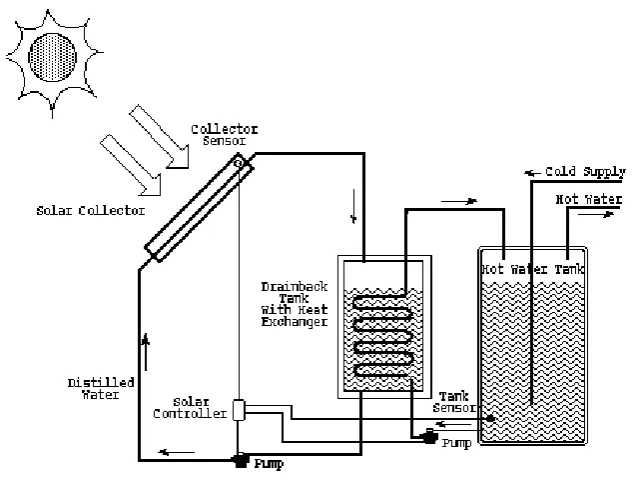
There are many possible designs for a solar water heater. In general, it consists of three main components:
Figure 1.1: Components of hot water system
(Source: http://images.google.com, retrieved on 4thAugust 2008)
1. Solar collector, which converts solar radiation into useable heat.
2. Heat exchanger/pump module, which transfers the heat from the solar collector into the portable water.
3
1.2 Background Research
In order to reduce the waste of energy usage and reduce the air pollution, there are many research about the solar collector have been done by scientist and engineers as an alternative way replacing the used of energy such as electricity, wind and nuclear. The use of solar energy is more economic because it is renewable energy which we can get almost every day in our life.
Many researchers have been done to improve the quality of solar collector tube. This can be done by using good material which can absorb maximum energy generated from the sun. One of the current research is to develop solar collector tube at low cost and it can operates automatic depend on the weather. As a result, this method can save cost of electricity used and also the used of pump system.
4
The flow for PSM is illustrated below:
Figure 1.2: Flow chart of PSM
Selecting PSM title
Problems analysis Literature review
Determine all the parameter, objective and the scopes
Study on previous research
Discuss with lecturer about the title given
Data collected and specification
Recommendation
Study on previous design
Sketching hot water system
Conclusion
Sketch and design basic hot water
Methodology of project
5
1.3 Objective
a. The objective of this project is to investigate the effect of series and parallel types of solar collectors for hot water system or in thermal energy storage system.
1.4 Scopes
a. Literature review on heat transfer process, solar collector systems, thermal energy storage and etc
b. Design and fabrication of series and parallel solar collector systems by using PVC pipe.
c. Conduct experiments to investigate the difference between both types of solar collector.
d. Conduct data and analytical analysis to show the difference both types of solar collector.
1.5 Problems statement
6
Furthermore, the difference in the pipes arrangement in series or parallel pipe may cause some changes to the heated water. The water flow rate used is constant but the actual flow inside the tubes is depending on the types of solar collector which may cause the head loss or pressure loss in the tube. These losses caused by the internal friction or maybe have some leaking from assembly fitting.
From general equation, the flow of water give great influence on the performance of solar collector whether the flow of water will occupied all tubes area or occupied half of tubes area which can give difference in water temperature. By do this project, the heat transfer rate to the water can be determined and give overall overview about convection process which occurs between pipe surfaces to the water inside tubes.
a. In the past time, we used electric current to run the water heater. For now, to save cost we have to use solar energy from heat which generated from the sun.