Vol 8, No 2, April. - June 1999
*
Department of Prct,entitte Meclicine, Sclnol of Medicine, Nagol,a Urzit,ersib', Nagoya 466, JcLpan
# Department of An.atontic PatlnLogy, Fauilll' of Metlicine, U tùtt e r.s ity of I n.cl on e s ict, J akar t a I 04 3 0, I ttclo ne s kt
Nutritiort-orientetl epidetniology 67
this collaboration and its chronological developments
of the project were described elsewherel).
In this communication, the authors
will
describe and discr-rss the rationale and necessityfor conducting
anutrition-oriented epidemiological sttrdy of breast
cancer
in
Indonesian female population, based onseveral dietary findings that emerged from
a
case-control study
of our first-batch
studies conducted in1989-1991, and also
will
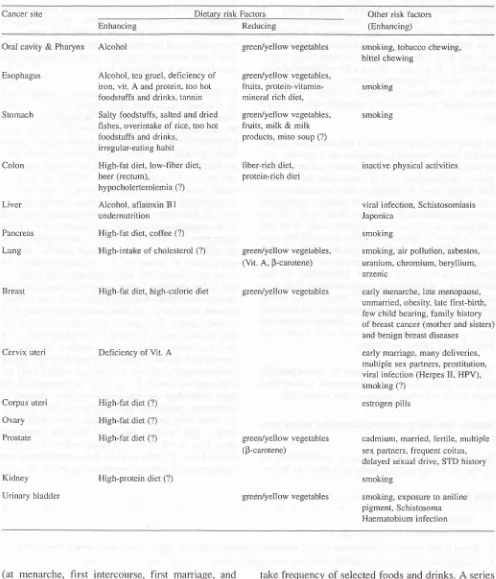
show the dietary risk andprotective factors for cancer of major sites, including breast cancer,
by
summarizing numerous dietaryepidemiological studies undertaken
so
far
in
the world. The authorswill
finally
present the dietary guidelines, which are now suggested for preventing the occurrenceof
such major maladiesin
adulthood as cancer and cardio- and cerebro-vascular diseases among Japanese population, emphasizing inparticu-lar the
scientific contributionof
our collaborative
studies to formulating Indonesian or ethnic-specific dietary/life-style guidelines fbr reducing cancer
inci-dence in Indonesia.
of breast cancer
in
Indonesia
Yoshiyuki Ohno*, Santoso Cornain#
Abstrak
etnik Indoncsia wt.tuk rnerurrLutkan utgko kejadian kanker di IndonesLa.
Abstract
guklelines for reducing cturccr in.citle nce in Ind.onesia.
Keywords: Ja.pttn, Intloneskt, breasl cuncer, rtutrition, dietary guidel.irtes, epidentiology
Rationale
for nutrition-oriented
epidemiological study
INTRODUCTION
Japan-Indorresia Joint-Study on Etiology and Clini-copathology of Breast Cancer, which was extended in
1992 as Japan-Indonesia Joint Study on Nutritional Epidemiology of Breast Cancer, had been undertaken
at
Jakarta,with
the large
financial supports from Ministry of Education, Science, Sports and Culture of Japanese Government (Grant No. 0l042001 ,04042013and 06042006) and with a partial support from the
In-donesian Cancer Foundation.
This collaborative study officially started
in
1989,Oltno and Cornain
Table 1. Possible/actual ways of means whereby diet can affect cancer incidence
Med J Indones
6
L
Carcinogens are contained in natural foodstuft's (plant products) Example : Blacken fern, Clotsfoot, Dandelion, Cycad, etc.Most of them are considered of low carcinogenecity when consumed in usual amounts.
7.
8.
Grains (e.g., peanuts and corn) harvested in the hot and humid regions in some countries are possibly contaminated with carcinogenic mycotoxins (e.g. Aflatoxin Bl)
Some fbod additives (e.g., AF2 and butter yellow) are known to be mutagenic and carcinogenic, though such activities were banned for use.
Mutagens and carcinogens are produced on cooking, particularly when heating. Example : Trp-p-1, Trp-p-2, Glu-p-1, Clu-p-2, MeIQx, etc.
Carcinogens are produced in the body (e.g., in gastrointestinal tract) from food constituents
(e. g., nitrates, nitrites, secondary ami nes).
Example : Nitrosamines are formed in the mouth or stomach, when nitrites (contained in the saliva and foods or produced by reduction of nitrates contained in pickled vegetables or some other foods) react with the low grade amines
Diet rich in fat and poor in fiber is considered to enhance colorectal cancer risk, and so does concentrated salt for stomach cancer risk.
Indirect effects of under/mal-nutrition.
Possibly by increasing susceptibility to virus infection, including oncogenic virus infection.
I ndirect effècts of over-nutrition
Possibly by promoting cancer growth, changing the age at menarche, or by adipose-tissue-derived estrogen, etc. Foodstuffs rich in Vitamin A, -carotene and Vitamin C have inhibitory effects for carcinogenesis.
Major dietary
findings found
in
a
case-control study conducted atjakarta in
L989-1991Research efTorts for past several decades have clearly provided evidence, which strongly suggests the im-portance of life-style or environmental modihcations for the risk of certain cancers. Among such modifica-tions, dietary ones have been most extensively stud-ied, and possible/actual ways or means whereby diet can affect cancer incidence have been suggested2'3 as shown in Table 1, though the underlying biochemical mechanism are not yet fully known.
Life-style
or
environmental factors other than diet have also been suggested to be significantly related to breast cancer such as smoking and drinking habits, obesity, reproductive episodes (menarche, pregnancy, child birth, breast feeding, menopause), contraceptive use, family history of breast diseases, and so fortha. Since these factors suggested areall
detected by epidemiological investigations conducted mostly in the well-developed countries, thenit
is of
essential importance to examine whether they are applicable to Indonesian females whose breast cancer is the second most common malignancy following cervical can-cer.s'6 Based on this scientific interest, we initiated a joint study on breast cancer atlakafta with three-fold approaches, i.e., epidemiological, clinical and patho-logical.As an epidemiological investigation,
a case-control study was adoptedin
orderto
explore Indonesian-specific risk factors for female breast cancer. In this case-control study, we designed and recruited 300 cases and 600 controlsT as defined below. Eligible cases wereall
hospitalized and ambulatory female patients with primary breast cancer, irrespective of itsclinical
stage, histopathologically confirmed and newly diagnosed at the Departmentof
Surgery, Dr. Cipto Mangunkusumo National Central General Hos-pital, Universityof
Indonesia, Jakartafor 3
years, from November 1988 to December 1991. Only inci-dent cases aged25-79 years were included, and those with other malignancy were excluded. Controls were female patientswith
disease other than cancer and without breast lumps, admitted to or visited the same department. Controls were individually matched to the cases for such variables as sex (female), age (+ 3 years), socio-economic level (type of hospital room used or intended to use), and dateof admittance or
visit (+ 3 months). Controls were collected twice as many as cases.VoL 8, No 2, April - June 1999
Table 2. Dietary factors associated with cancer occurrence by site
N ut r itio n- o r ient ed ep ide mio lo gy 69
Cancer site Dietarv risk Factors Other risk tactors
(Enhancing)
Enhancing Reducing
Oral cavity & Pharynx
Esophagus
Stomach
Colon
Liver
Pancreas
Lung
Breast
Cervix uteri
Corpus uteri
Ovary
Prostate
Kidney
Urinary bladder
Alcohol
Alcohol, tea gruel, deficiency of
iron, vit. A and protein, too hot foodstuffs and drinks, tannin
Salty tbodstuffs, salted and dried fishes, overintake of rice, too hot tbodstuffs and drinks,
irregular-eating habit
High-fat diet, low-fiber diet, beer (rectum),
hypocholerterolemia (?)
Alcohol, aflatoxin Bl u ndernutrition
High-fat diet, coffee (?)
High-intake of cholesterol (?)
High-fat diet, high-calorie diet
Deficiency of Vit. A
High-fat diet (?)
High-fat diet (?)
High-fat diet (?)
High-protein diet (?)
green/yellow vegetables
green/yellow vegetables, fruits, protein-vitamin-mineral rich diet,
green/yellow vegetables, fruits, milk & milk
products, miso soup (?)
fiber-rich diet, protein-rich diet
green/yellow vegetables, (Vit. A, p-carotene)
greerVyellow vegetables
green/yellow vegetables (p-carotene)
green/yellow vegetables
smoking, tobacco chewing, bittel chewing
smoking
smoking
inactive physical activities
viral infection, Schistosomiasis Japonica
smoking
smoking, air pollution, asbestos, uranium, chromium, beryllium, arzemc
early menarche, late menopause, unmarried, obesity, late first-birth, few child bearing, family history
of breast cancer (mother and sisters) and benign breast diseases
early marriage. many deliveries, multiple sex partners, prostitution, viral infection (Herpes II, HPV), smoking (?)
estrogen pills
cadmium, married, fertile, multiple sex partners, frequent coitus, delayed sexual drive, STD history
smoking
smoking, exposure to aniline pigment, Schistosoma Haematobium infection
(at
menarche,first intercourse,
first marriage,
andmenopause), breast trauma, reproductive episodes,
menstruation status at each decade, breast feeding, exposures to hormonal contraceptives and radiation,
family history of cancers and dietary practices as
in-take frequency of selected foods and drinks. A series
of
logistic regression analysis which controlledpo-tentially confounded variables disclosed many
[image:3.595.74.570.97.676.2]70 Ohno and Cornain
Among dietary practices which were questioned by
intake frequency
of
5
categories (almost daily, 3-4 times/week,l-2
times/week, less than once a week and almost never taken), daily consumers of milk and fatty meats,for example, significantly
increased therisk and so did frequent intake of fresh fruits.
Coco-nut nrilk food was also related with an increased risk,
when taken
frequently among
post-menopausalwomen. In contrast, daily eaters of cooked vegetables
experienced
a
significantly reducedrisk of
breast cancer.9In short, these dietary findings detected by the
case-control study essentially indicated an important
con-tribution of diet itself to female breast cancer carcino-genesis in Indonesia as well. And since these results
also rationalized to conduct further epidemiological study which would examine
in
details, responsiblenutrients
in
foodstuff-s, we then decidedin
l99l
toundertake
the second case-control
studywith
the same schemeof identifying 200
cases and 400con-trols from February 1992to September 1995, For this
purpose, we recruited a few nutritionists who directly interviewed the study subjects. Meanwhile, we had
developed
a
standardized questionnairel0 aftersev-eral pre-tests and revisisns,ll'12 which could obtain
reliable and reproducible nutritional data for
calculat-ing macro- and micro- nutrients consumed before and
after marriage,
using Indonesian and South EastAsian Food Conversion Tables.
The readers would be able to find the major findings obtained
from this
nutrition-oriented case-control study in the following papers in this monograph.Dietary
risk and protective factors for
major can-cersIn conjunction with several dietary factors disclosed
by the
first case-control
study and thoseto be
ex-Table 3. Dietary guidelines for primary prevention of cancer in Japan
Med J Indones
plored by the second case-control study at Jakarta,
dietary factors and nutrients in diet now ubiquitously
recoqnized to enhance or reduce the risk of cancer are
summarized by site in Table 2, based on numerous
epidemiological investigations performed in tl-re
well-developed countries, together
with
well-establishednon-dietary risk-enhancing factors. t3
In Table 2, at a glance, green/yellow vegetables are
protectively associated
with
cancerof seven
sites, whereas high fat diet definitely or suggestively withan increased risk of six cancer sites. Large ingestion
of green/yellow vegetables may not exert any serious health hazards and , therefore, are believed to be rec-ommendable for everyone as one of primary
preven-tive measures common to cancer. A biomedical
ingre-dient, beta-carotene, which
is
much contained in green/yellow vegetables, might reduce cancer risk as a result of its conversion to retinol, which is involved in the regulation of cell differentiation and has beenexperimentally shown
to
inhibit carcinogenesis, or
through its action as an antioxidant and free radicalscavenger. 14
It
seems also to be recommendable toavoid high-fat diet, but not commonly to all countries and not to everyone in one country, because the level of fat consumption does apparently vary greatly from country to country, and from individual to individual
in one country.
It
is quite conceivable that high-fatdiet
in one country
is the diet,in reality, that
most persons cannot afford to eat in another country, andlow-fat diet in one country is already high-fat diet in
another country. Adequate dietary amount of daily fat consumption should be correctly recommended for
each individual
by
nutritional analysis personallyperformed; reduction (increase) to adequate amount for those with too much fat intake (those with short
intake), that is daily amount of fat
to be
consumed sl-rould be,it
self more cautiously indicated on indi-vidual basis. In order tofulfil
this, chronologicalin-vesti gations of curren t coun trylarea- spec
ific
averageL
Avoid highly-salted foodstulfs2.
Avoid overintake of firt and total calorie3.
Intcncl to take vegetables (green/yellow & fiesh vegetables in particular) and fruits, which contain much carotenes and vitamin C4.
Intcnd to take such fiber-rich fbodstuffs often as unrefined grains. vegetables, beans, mushrooms and seaweed5.
Avoid over-drinking of alcoholic beverage6.
Avoid too hot drinks and tbodstutTs7.
Avoid ill-balanced dietary practise and repeated intake ol the same lbodstuffs, that is take many kinds of foodstuUi well-balancedlyVol 8, No 2, April - June 1999
Table 4. Dietary guidelines for primary prevention of chronic diseases in adulthood in Japan
N utrition - o ri ent e d e pid.emio Io gy 71
l.
Intend to take more than 30 kinds of food-materials a day2.
Take soybean products or fishes once a day3.
Take green/yellow vegetables at least once a day4.
Intend to take milk and/or milk product5.
Take meats and fishes with a ratio of 1 : 16.
Use vegetable oils, when preparing oil-cooked dishes7.
Avoid foodstuffs which contain too much sugar'8.
Intend to take less foodstuffs which contain too much salt9.
To reduce salt intake, try to cook foodstuffs with other seasonings such as pepper, garlic and vinegar10. Alcoholic beverages should be taken moderately [up to 2 Goes (50 grams of alcohol) a day.
amount of daily fat consumption should, at least, be
disclosed by well-designed national nutrition survey,
together with countrylarea specific daily nutrient
al-lowance and its adequate amount, which
will
noten-hance the risk of cancer and other chronic diseases in
adulthood. Based on these national/area-specific
fig-ures and actual nutrient intakes to be calculated by
personal nutritional analysis, recomrnendable daily
amounts of fat and other nutrients are to be decided
for each individual.
Dietary guidelines
for primary
prevention ofcan-cer and chronic diseases
in
adulthoodin
JapanIn
Japan, dietary guidelinests were proposed by theAd
hoc Committeesfor
the primary preventionof
cancers and chronic diseases
in
adulthoodby
thethorough review of dietary findings disclosed by
nu-merous epidemiological investigations conducted
mostly in the developed countries and Japan, and also
by referring to traditional dietary habits and dietary
chan ges/practices amon g Japanese population.
Table 3 in the guidelines for cancers, and Table 4 for
such chronic diseases
in
adulthood as cardio- andcerebro-vascular diseases and cancers. The
guide-lines are all quite corrnon sense, but usually hard to
be complied without the strong self-imposed will.
These guidelines are applicable and recommendable
for
Japanesein
Japan, i.e., Japanese-specific. Thisdoes essentially
imply
that different dietaryguide-lines should be prepared for different countries or
dif-ferent ethnic groups (particularly in Indonesia), based
on
genuinefindings
from
country/ethnic-specific epidemiological investigations likewise our collabo-rative study, since each country or ethnic group hasits
own life-styles and dietary habits/practices as apart of its own culture and tradition. In this meaning,
therefore,
our
nutrition-oriented epidemiologicalstudy of breast cancer are deemed to be quite
ration-ale with large scientific contributions to Indonesian investigators.
Finally, highly hoped is a series of
Indonesian/ethnic-specific epidemiological studies by Indonesian
inves-tigators, which aim at exploring probable association
between diet and major maladies in adulthood in
In-donesia. This
is
inevitably required notto
proposemisdirected dietary guidelines, which may be often
be prepared by simply adopting the findings detected
in the countries other than Indonesia.
AcknowledgmentS
We are highly grateful to all investigators and inter-viewers
who
were involvedin
this
collaborative studywith
great enthusiasm, Japanese Governmentand Indonesian Cancer Foundation who had provided
Iong-term financial supports.
REFERENCES
1.
Ohno Y. Initiation of the International collaborative study on breast cancer between Japan and Indonesia. Med J Indon 1995:4: l3l-4.2.
Miller AB. Nutrition and cancer. Prev Med 1980; 9: 186-963.
Tominaga S, Kato I. Diet, nutrition and cancer in Japan.Nutr-Health 1992; 8:125-32.
4.
Vorherr H. Breast cancer: Epidemiology, endocrinology, bio-chemistry and pathology. Urban & Schwarzenberg, Inc., Bal-timore Munich, 1980.72
Ohno ancl Cornain6.
Prihartono J, Mangunkusumo R, P?rtoatmojo P. Establishingpathology based cancer registry: Indonesian experience. In :
Sasaki R, Aoki K, editors. Epidemiology and Prevention of
Cancer. Proceedings of Monbusho (Ministry of Education,
Science and Culture) International Symposium on
Compara-tive Study of Etiology
&
Prevention of Cancer, Nagoya,1989. Nagoya: University of Nagoya Press, 1990: 21 l-6.
7.
Budiningsih S, Ohno Y, Prihartono J, Ramli M, Wakai K,Cornain S, et al. Epidemiological analysis of risk factors for
breast cancer in Indonesian females. Med J Indon 7995;4:
1 63-8.
8.
Cornain S. Planning, organizing and management ofthecol-laborative project on breast cancer, Appendix A. 1995', 4:
l9l-6.
9.
Suzuki S, Prihartono J, Ohno Y, Budiningsih S, Wakai K,Cornain S, et al. Epidemiologic risk factors fbr breast cancer
related to menopausal status in Indonesia. Med J Indones
1995:4: 169-76.
10. Cornain S. Planning, organizing and management ofthe
col-laborative project on breast cancer, Appendix E. 1995; 4:
206-11.
Med J Indones
Herman S, Ohno X Dillon D, Cornain S, Sakamoto G,
Dar-wis I, et al. Pilot study of food consumption pattern:
Assess-ment of validity of dietary history method. Med J Indon
1995;4: 183-6.
Dillon D, Herman S, Ohno
X
Prihartono J, Cornain S,Sakamoto G, et al. Preliminary analysis of nutritional factors
in breast cancer. Med J Indon 1995;4: 187-90.
Tominaga S, Ohno Y editors. Introduction to epidemiology
for clinicians: Focusing cancers and cardiovascu.lar diseases.
Tokyo : Nihon-Izishinposya, 1989 (in Japanese).
Ziegler RG. Vegetables, fruits and carotenoids and the risk of
cancer. Am J Clin Nutr 1991;53 (Suppl): 251-9.
Division of Nutrition, Public Health Bureau, Minlstry of
Health and Welfare. Prevention of cardiovascular diseases,
cancers and diabetes mellitus and dietary practises - Report
from Ad hoc committees for disease prevention and nutrition.
Tokyo: Nihon-Eiyoshikai, 1983 (in Japanese).
11
t2
l3
l4