DINDIN ROSYIDIN
NI11. 102026024587
ENGLISH LETTERSUEPARTMENT
LETTERS AND HUMANITIES FACULTY
STATE ISLAMIC UNIVERSITY "SYARIF HIDAYATULLA.H"
JAKARTA
THE MASTERY OF PASSIVE VOICE:
A CASE STUDY AT THE THIRD YEAR STUDENTS OF
SENIOR HIGH SCHOOL "DHARMA KARYA UNIVERSITAS
TERBUKA" PONDOK CABE
A PAPER
Submitted to Letters and Humanities Faculty in Partial Fulfillment ofthe Requirements for
the Degree of Strata. I
DINDIN ROSYIDIN niセN
102026024587
ENGLISH LETTERS DEPARTMENT
LETTERS AND HUMANITIES FACULTY
STATE ISLAMIC UNIVERSITY "SYARIF HIDAYATULLAH"
JAKARTA
A CASE STUDY AT THE THIRD YEAR STUI>ENTS OF
SENIOR
HIGH
SCHOOL "DHARMA KARYA UNIVERSITAS
TERBUKA" PONDOK CARE
A PAPER
Submitted to Letters and Htilllanities Faculty in Partial Fulfillment of the Requirements for
the Degree of Strata. 1
DINDIN ROSYIDIN NIM. 102026024587
Approved by:
Drs. H. Abdul Hamid, M.Ed NIP. 150181 922
ENGLISH LETTERS DEPARTMENT
LETTERS AND HUMANITIES FACULTY
STATE ISLAMIC UNIVERSITY "SYARlFHIDAYATULLAH"
JAKARTA
LEGALIZATION
rhe paper entitled"The Mastery of Passive Voice: A Case Study at the Third Year itudents of Senior High School "Dharma Karya Universitas Terbulm" Poridok
:abe has been defended before the Letters and Humanities Faculty's Examination セッュイョゥエエ・・ on May, 25 2007. The paper has already been accepted as a partial
ulfillment of the requirements for the degree of Strata. 1.
Jakarta, May 25, 2007
The Examination Committee
:hair Person,
Members:
Secretary,
fIP. 1
M.Pd.
.
(':),
,;1V
Oセセ
lereby declare that this submission is my own work and that, to the best of my knowledge ld belief, it contains no material previously published or written by another person nor aterial which to a substantial extent has been accepted for the award of any other degree diploma of the university or other institute of higher learning, except where due knowledgment has been made in the text.
ABSTRACT
indin Rosyidin, The Mastery of Passive Voice: A Case Study at the Third Year 'udents of Senior High School "Dharma Karya Universitas Terbuka" Pondok Cabe. A
lper, Letters and Humanities Faculty, State Islamic University "Syarif idayatullah" Jakarta, May 2007.
The research is aimed at knowing to what extent the third year students of Senior igh School "Dharma Karya Universitas Terbuka" Pondok Cabe have mastered the passive lice and finding out the problems found by them.
The research uses field study. The sample of the research is randomly taken from e population of the third year students of senior high school "Dharma Karya Universitas :rbuka", Pondok Cabe in the academic year of2006/2007. The data collected through the ,t are analyzed qualitatively using descriptive comparative analysis t(:clmique.
The data collected shows that the students get more difficulties in mastering the Issive voice of Past Continuous Tense and Present Perfect Tense. The percentage of the correct answers in passive voice of Past Continuous Tense achieves 95 % and followed , Present Perfect Tense that achieves 85 %.
First of all, the writer would like to thank to Allah, because his guidance always :companies the writer in completing this paper. The blessing and salutation be delivered to e most honorable Prophet and Messenger Muhammad SAW,his families, his companions ld his followers.
The writer would like to say his gratitude to:
I. Dr. H. Abdul Chair, the Dean of Letters and Humanities Faculty, Dr. Muhammad Fark/lan, the Chief of English Letters Department, Drs. A. Saepuddin, M.Pd, the Secretary of English Letters Department, Drs. H. Abdul Hamid, M.Ed, the writer's supervisor, the staffs of Letters and Humanities Faculty. They all have helped the writer to complete this paper.
2. Bambang Sutoyo, SP, the Head Master of Senior High School "Dharma Karya Universitas Terbuka" Pondok Cabe. He has permitted the writer to do research in his institution.
4. Writer's parents; Abdul Hafidz and eucu Sowifah. They always SUppOlt and guide the writer in completing this paper.
5. All of the writer's classmates who have motivated the writer to finish his study quickly.
Finally his paper may benefit the readers who want to master the passive voice deeply.
LEGALIZATION ... II
DECLARATION... 111
<\BSTRACK IV
<\CKNOWLEDGMENT .
r
ABLE OF CONTENTS " .:::HAPTERI.NTRODUCTION .
V
Vll
1
A. Background of Study ... ... ... ... ... ... ... ... ... ... ... ... ... ... ... ... ... ... 1
B. Focus of the Study .
C. Research Questions .
4
4
D. Significances of the Study ... ... ... ... ... ... ... ... ... ... ... ... ... 5
E. Research Methodology ,. 5
1.The Method of the Research... 5
2. Data Analysis Technique , '.' 6
3. Data Collection... 6 4. Unit of Analysis... 7 5. Time and Location... 7
セhapter II. THEORETICAL FRAMEWORK... 8
A. Grammar. .. ... ... ... ... ... ... ... ... ... ... ... ... ... ... ... ... ... ... ... ... 8
1.Definition... ... ... ... ... ... ... ... ... ... ... ... ... ... ... ... ... ... ... ... ... 8
B. Structure... 10 C. Sentence. . . .. . . .. . . .. . . .. . . .. . . .. 10 1. Definition ... .. . . .. . . .. . . .. . . .. .. . . .. . . .. .. . . .. .. . . .. . . .. . . . .. . 10
2. Kinds of Sentence , 12
D. Passive Voice. 13
1. Definition _... 13
2. Fonn 14
3. Usages 16
E. Mastery .
CHAPTER III DATA FINDINGS ... A. Data Description ...
B. Data Analysis .
18 21 21 22
CHAPTER IV. CONCLUSION AND SUGGESTION... 47
A. Conclusion... 47
B. Suggestion . 47
BIBLIOGRAPHY , , 49
A. Backgl"Ound of Study
Language is the specialized sound signaling system, which seems to be genetically programmed to develop in humans. Humans can, of course, communicate in numerous other ways: they can wink, wave, smile, tap someone on the shoulder, and so on.'
Language is a system of communication. When humans know a language, they can speak, and be understood by others who know that language. They can also transfer language to various other mass Medias, for examples newspaper, magazine, tabloid, and so on. From the explanation above individuals who have the same roles in language can hold communication each other; meanwhile individuals who have different roles in language cannot hold communication.
Today world is borderless. Many people from a country can come to another country for some reasons, such as politics, economy, education, and amusement. They bring their own way to communicate with any other citizens who they visit. This case produces the problems of communication.
Therefore, language plays very important role. The important role oflanguage
IS seen when people from one country shares idea and communicates with other
2
people from any different countries. They need international language. Here, English is considered as an international language used as medium of communication between a country and another foreign country. As an international language, English is used for trade transaction, politics, science and technology. culture, and so on. Thus, English is widely used most people in the world. Rudo lph wrote English is generally acknowledged to be the world's most important language. One criterion is the number of speakers of the language. The spread of English over the world as international language is unique phenomenon in world's history: about 1500 million people -over a third of the world populations- live in countries where English has some official status or is one ofthe native speakers. 2
In this era, English in almost every aspect of life is needed in accordance with the world which economy and teclmology develop recently. Indonesian people also feel the need to be able to use English, because Indonesia as a developing country has opened an opportunity for investors from many different countries to invest their capitals. So that, it cannot be avoided, the mastery of English is required.
Every human being who speaks a language knows its grammar. When linguists wish to describe a language, they attempt to describe the grammar of the language that exists in the minds of its speakers. There may be some differences
2 Radolph Quirk, A Comprehensive Grammar of The English Language, (New York:
among speakers knowledge, but there must be shared knowledge, because it is this grammar that makes it possible to communicate through language.)
So that, whoever wants to master English, he/ she has to master English grammar, too. It CaIillot be avoided because English as foreign language, exactly, is very different from Indonesian language.
Grammar covers a lot of language elements. One of them is passive voice. When a writer or a speaker wants to emphasize or direct attention to the receiver of the action and he/ she wants to eliminate the necessity of naming agent of the action when that agent is unknown or unimportant, the writer or the speaker has to use passive voice in his/ her sentences. The passive voice form can be constructed from active voice. There are some problems that arise especially for adults who want to master the passive voice because the passive voice is very diffi:rent from the active voice. This case is often felt by almost of all non-English speaking students. For example in the sentence of"some one smashed the window" is active voice. If they do not master the rules, they maybe change its sentence to be "the window smashed by someone". That sentence is grammatically incon-ect. The correetiXOlieis.the window was smashed. Some one can be omitted because it is an unimportant agent to be written. Without knowing the formula of the passive voice, the students will feel difficult to write a sentence of the passive voice correctly. Other possible errors done by them are, for instaI1Ce, in changing 'to be', 'to have', past participle(V3). 'To be'
4
and 'to have' change in harmony with the kind of tense. Students may put 'is/ are/ am' in the past tense instead of was/ were. For example, the students may change the sentence 'the gardener planted thejlower(active voice) to be "thejlower is changed by the gardener" (passive voice). They also may put 'has/ have' in the past perfect tense instead of 'had'. For example, the students may change the sentence "Sue had cleaned the jloor" (active) to be "the jloor has been cleaned by Sue" (passive). The students sometimes make en'or in writing irregular past participle (V3). For example, 'thrown' (past participle of throw) is written 'thrawen', 'taught' (past participle of teach) is written 'tought' or 'teached'.
From description above, the writer intends to do a research connecting to the passive voice. In conducting the research the writer chooses the third year students of Senior High School "Dharma Karya Universitas Terbuka" Pondok Cabe. Selecting the third year is appropriate enough, because the third year students have already studied about the passive voice. In this research, the researcher would like to know their mastery of passive voice. Thus, the title of this research is "The Mastery of Passive Voice" a Case Study at the Third Year Students of Senior High School
"Dharma Kal'.va Universitas Terbuka" Pondok Cabe.
B. The Focus of the Study
C. The Reseal'ch Question
From the focus of the study above, then the writer would like to propose the following questions:
I. To what extent have the third year students of Senior High School "Dharma Karya Universitas Terbuka" Pondok Cabe in the Academic Year
of2006/2007mastered the passive voice?
2. What are the problems found by the third year stud,ents in mastering the passive voice?
D. The Significance ofthe Research
The writer expects this research can benefit the readers who want to know further about "the passive voice". In addition, the writer expects that the readers can understand how to write passive vo ice correctly whether in forms of the tenses or in the modal auxiliaries of can, may and must.
E. Research Methodology 1. The Method ofthe Research
6
The writer does this research by using field research. Field research involves the collection of primary data or information that is new. This is collected through smveys and questionnaires that are made out specifically for a purpose.4
2. Data Analysis Techniqnc
For the data analysis technique, the writer uses descriptive comparative analysis technique. Here, the writer wants to compare the different structme between the students' test results and the written-theories.
In
calculating the tests' results, the writer uses the following formula:F
P = - - x 100% N
P= Percentage
F= Frequency of wrong answers N= Total Number of Test
3. Data Collection
To find out the data, the writer uses test. The writer gives the test which focuses on passive voice in some tenses to the informants (the sample of students). It
is essay test, which consists of 20 items covering: Simple Present, Present Progressive, Simple Past, Past Progressive, Present Perfect, Past Perfect, Futme, Futme Perfect, Be going to, and Modal of 'can', 'may' and 'must'
The writer assumes those items represent 16 tenses that will be analyzed. The instrument of the research was selected fi'om Understanding English Grammar by Betty S. Azar. Itis expected that the writer can get representative data relating to the goals ofthis research. The test-instruments can be seenin(Appendix I).
4. Unit of Analysis
The unit of analysis in this study is the test results from the twenty selected studeI1ts from the third year students of Senior High School "Dharma Karya Universitas Terbuka" Pondok Cabe in Academic Year of 2006-2007. This grade contains two classes, and each class consists of 20 students. The writer then takes 10 students randomly from each class. Therefore the number of sample is 20 students.
8. Time and Location
CHAPTER II
THEORETICAL FRAMEWORK
A. Grammar
1.Definition
There are some definitions of grammar. Noah Webster ,;vrote grammar is the part of the study of language which deals with the forms and structures of words (morphology) and with their customary arrangement in phrases and sentences (syntax), formerly used to denote all phases of language study (except that of the detailed meaning of words), as centered on morphology and syntax; now often distinguished from the study of pronunciation(phonology) and that of word meanings (semantics, semasiology).l Grammar is the rules in a language Jbr changing the form of words and combining the sentences.2 According to Penny. Ur, grammar is a set of rules defined as how words (or parts of words) are connected or changed fi'om acceptable units of meaning within language.'
David Nunan stated Grammar is:
1. An analysis of the structure of language, either as encountered a corp of speech or writing (performance grammar) or a predictive of a speakers' knowledge (a competence grammar).
I Noah Webster, Webster's New Twentieth Century Dictiollary,(USA: William Collims
Publishers. Inc, 1980), p.792
2A S Hornby,O.iford Advallced Leamer's Dictiollary of Currelll Ellglish,(NewYork:
Oxford University Press, 1995), p.517
JPenny. Ur.,A CourseillLallguage Teachillg: Practice alllitィ・ッセカL (Cambridge:
2. An analysis of that structural property which defines human language (a universal grammar).
3. A level of structural organization, which can be studied independently 0f phonology and semantics.4
From some definitions above, the writer can conclude grammar is the study of structure to form word or phrase to be a correct sentence then nnally we can sayan interpretation correctly in the basic meaning of what someone has been said and can send written massage grammatically.
2. Usage
There are many functions of gralmnar. Grammar helps some learners to extend their control over the resources of language, helps the leal'ners to analyze sentences and helps them to use patterns and constructions.5
The learners can apply the grammatical word to units smaller than sentences. Grammal' does not only affect how units of language are combined in order to be con'ect, but also to affect their meaning. Itwill be useless if the learners know how to form new verb, but they do not know exactly the meaning when the new verb has been used.
Grammar is important to practice.Itis aimed to get learners learn the structure thoroughly that. The leal'ners will be able to produce the sentences cOlTectly, if
4David Nunan,Second Language Teaching and Learning,(New York: Heinle and Heinle
Publisher, 1999), p.96
10
they are able not only to produce and understand structures but also use them to express the communicative competence oflanguage.
B.StructUl'e
Structure is a specific grammar; examples of structure are tense, direct and indirect speech, passive voice and so on. It often refers to sequence oflinguistics unit, that is, in certain relationship to another.6
Structure will help the listener or reader understand the speaker or written language and it can determine meaning and function of word in a sentence. Without structure, language would simply be chaotic. Therefore mastering structure is absolute.
C.Sentence 1. Definition
Sentcnce is a group of words expressing a complete thought.7In a different book, Warriner defined sentence as a group of word containing a subject andverb.8
P.H. Matthew defined:
"Sentence is a full predication containing a subject plus a predicate with a finite verb. Its arrangement may be symbolized by such formulas as SVO
61. Richard, J Platt and H Webber,Longman Dictionary ofApplied Linguistics,(London: Longman, 1985), p.227
7W. Nelson Prancis,The English Language: An Introduction backgroundfor writing,
(New York: Brown University Press, 1965), p.61
8John E Warriner,English Grammar and Compo.,ition,(New York: Harcouri Brace
(subject+verb+object), Nl V N2 (noun+verb+noun), orNP + VP (noun phrase+verb phrase). In popular view, a sentence is a series of words in con-ected speech or writing, forming the grammatically complete expression of singl1e thought.,,9
From definitions above, the writer can conclude that sentence is a group of word containing a snbject and verb, expressing a complete thought.
The subject consists of one item or several items. The predicate also consists of one item or several items, as the following chart:
NO SUBJECT PREDICATE
I Birds Sing
2 The sun Shines
3 Rumors Spread out
4 The security of the building Checked every visitor with great care The subject is often a noun or noun-equivalent. In (I) to (3), the subjects 'birds, the sun, rumors are all nouns. In (4), the ウオセゥ・」エ 'the security' is a noun with an adjective phrase 'of the building'. As for the predicate, it may have one item or more. If it has only one item, that item must be the verb when the predicate consists of several items, the main item must be the verb; other may be the object ifthe verb is transitive or adverb! adverb equivalent or both the object and the adverb! adverb equivalent. In (I), the predicate is the verb 'sing'. In (2), the predicate is the verb 'shines', in (3), the predicate is verb 'spread' and the object is 'every visitor' and the adverb phrase is 'with great care'. The verb may be linking verb. If so, it requires a complement.10
9P.H. Mathews,Syntax, (New York: Cambridge University Press, 1996), p. 26 10Dr. Tan Cheng Lim.P.hD,Practical English Grammar,(Singapor,,, Singapore Asian
12
2. Kinds of Sentence
According to its construction, a sentence may be simple, compound or complex.
I. Simple Sentence
Simple sentence is a sentence, which consists of only one clause called dependent clause. This dependent clause may only have subject and one verb
d· II
or pre lcate.
James bought a new car.
In the sentence above there is only one subject 'James' and one verb 'bought'. 2. Compound Sentence
Compound sentence can be made up with two independent clauses combined with a conjunction'and, or, orbut.12 Here are the examples:
Anne wants to go to a playground, but his sister wants to see a movie.
!VIr. Simon will go Bali tomon-ow, and he will be there for a week. You have to study hard or you will fail the exam.
3. Complex Sentence
A complex sentence consists of one or more full predications. One ofthese is an independent clause (or main clause) that is similar to the form of simple
11 Dedy Setiawan, Drs, MA, M.Ed.,PrllcticlIl Guide to TeclmiclIl Writillg/or Tertillry
Studell/s lIllll pro/essiolls,(Bandung: Politeknik Negeri Bandung, 2002), p.69
sentence and one or more of these are dependent clauses (or, subordinate clauses. 13
Examples:
The man who stole the jewelry hid it in his home She should not come because she was busy.
Both sentences above have independent clause and dependent clause. 'The man hid it in his house' and 'she should not come' are independent clause. 'Who stole the jewelry' and 'because she was busy' are dependant clauses that cannot stand independently.
D. Passive Voice
1.Definition
Passive is accepting what happens or is done to one without responding actively or asseliing oneself; not active14. Voice in English grammar refers to the active or passive use of a verbis. From these definitions it can be inferred passive voice is a grammar etymology to state what happens or what is done.
A sentence is called the passive voice when the subject receivesthe action of the verb. Therefore in the passive voice, the original receiver of the action is
13Marcella Frank,Modem English: A Practical Referellce Guide,(New York: New York
Universily, 1972),p.223
14
the grammatical subject aJ1d the original doer of the action is the grammatical object of preposition byl6. For example:
I.The Janitor ('doer' of the action) always opened the door. ('receiver' of the action) (Active Voice)
2.The door ('receiver' of the action) is always opened by Janitor.('doer' of the action) (Passive Voice)
Because the grammatical subject of a passive verb is the original object of an active verb, only traJ1sitive verb may be used in the passive voice.17
David Kilby defined something as a passive voice if it meets two conditions: firstly, it must contain a 'past participle' not dependent on the auxiliary has, aJ1d secondly, the subject (or understood subject) must be interpretable in the same way as the object of the cOlTesponding verbis.
2. Fotm
The passive voice of an active tense is formed by putting the verb 'to be' into the same tense as the active verb and adding the past participle of the active verb.19
16Loc.cit
17Marcella Frank,Modern English: A PTilctical Reference Guide,(New York: New York
University, 1972), p.56
18 David Kilby, Descriptive Syntax and the English Verb, (Australia: Croom Helm,
1985), p. 57
19A.J. Thomson and A.V. Martinet,A Practical English Grammar,INew York: Oxford
The objeet of an active voice corresponds to the subject of a passive verb?O
Active A does
Passive done by A
We make the passive verb with the different tenses of'be'followed by the
past participle. Here is the table printed by Swam:21
tense StmctUl'e
I. Simple Present am / are / is + pp
2. Present Progressive amI are / is + being + pp
3. Simple Past was / were + pp
4. Past Progressive was/were + being + pp
5. Present Perfect have / has + been + pp
6. Past Perfect had + been + pp
7. Future will + be + pp
8. Future Perfect will have + been
9. Going to Going to be + pp
After modal, we use the base form "be"followed by the !past participle.22The
passive form of modal is formulated in the table below.
NO MODAL PASSIVE FORM EXAMPLE
02
Can S+Can+be+pp The window can be opened04
May S + May + be + pp You may be excused fi'om class05
Must S + Had better + Marry must be told about om change inplans
20Michael Swam,Basic E/lglish Usage,(New York: Oxford University Press, 1986), p.237
21 Ihid, p. 238
16
The past passive form of modal is explained in table below:
NO
MODAL PASSIVEFORM EXAMPLE01 May S + Should + I-lave This letter may have been sent last week been + pp
02 Must S + Must + have + This house must have been built over 200 been +pp years a go
To change an active voice to be the passive voice, Dr. Tan Cheng Lim offered the following steps:
1. Move the object of the active sentence to be the subject of the passive form. 2. Add the correct form of the verb'be' according to the tense of the verb and
the number of the subject.
3. Place the past pmticiple of the verb after the verb 'be'. If there is a modal verb, it must be kept in this form: (modal verb + be + j:Jast pmticiple.
4. Move the subject of the active sentence to the back of the passive sentence with the aid of the preposition 'by'. If the subject of the active sentence is not impOitant, omit it.
5. If there are two objects, use one of them (direct or indirect) to the subject of the passive sentence, normally, the indirect object (that is, the person) is used.23
3. Usages
Since it is generally preferable to make a direct statement of an action, a good writer chooses the active voice wherever necessary when greater emphasis is to be placed on the "event" represented by a verb plus its complement than on the "action" involved in this event. Thus, the passive voice will be preferred in the following instances:24
23 Dr. Tan Cheng Lim, PhD,op.cit,p.217
1. Attention is to be drawn especially to the "receiver" of the action. Example: My dog was hit by a car.
In a peace of connected prose, the use of the passive voice permits the subject under discussion to remain a grammatical subject even when it is not the "doer" of an action. For example:
William Faulkner wrote a number of books about a mythological county in
the sOllth.Hewas awarded the Nobel Prize for literature in1949.
2. The "doer" of an action is unimportant or is not known. The omission of the agent makes it possible for an impersonal tone to be maintained. Examples:
1. Your little boy threw my kitchen window in the morning (active voice) 2. That window was thrown (passive voice)
In the first example above, the speaker knows the 'doer' of the action. Meartwhile in the second example the doer of the action is unknown. It means the doer is not refening to any particular person who has done the action.
The use of the passive voice for impersonal statements occurs frequently in textbooks, in scientific, technical or business reports, and in newspapers stories.
Example: The Yalta agreement was signed during World War Two The central jewelry store has been robbed several times The repOit was confirmed yesterday
18
Sidneyin A student's Grammar ofthe English Languageexplained:
"Speakers or writers use the passive for the following reasons. In considering the examples, bear in mind that more than one reason may apply. Reason 1-4 illustrate the uses of the passive without agent 'by' phrase, which is commonly omitted:
I. They do not know the identity of the agent of the action. For example: Many lifeboats were launched from the titanic only partly filled.
2. They want to avoid identifying the agent because the do not want to design or accept responsibility. For example: My letter has not yet been answered.
3. They feel that there is no reason for mention of the agent because the identification is unimportant or obvious from the context.
For example: The small thin pieces of metal at the sides are to protect the appliance during handling andmay be discarded.
4. In scientific and technical writing, writers often use the passive to avoid the constant repetition of the subject 'I' or 'We' and to put emphasis on processes and experimental procedures. This use of the passive helps to give the writing the objective tone that the writers wish to convey.
For example: The subject was blindfolded and a pencil was placed in the left hand.
5. To put emphasis on the agent of the action
6. To avoid what would otherwise be a long active subject.
7. To retain the same subject through a combination of these last tlU'ee reasons for using the passive.,,25
E.
Mastel)'Mastery IS a noun borrowed Ji-om old French 'maistrie' fi'om 'maistre,26. According to Merriam mastery is:
1. a. The authority of a master: Dominion b. The upper hand in a contest of competition
2SSidney Greenbaum and Randolph Quirk,A Stut/ellt's Grammar ofthe Ellglish Lallguage,
(New York: Longman, (990),p. 121
26 Robert K. Barnhart, The Bamllllrt COllcise Dictiollary of Etymology,USA: HW. Wilson
2. a. Possession or display of great skill or technique
b. Skill or knowledge that makes one master of a subject27 Meanwhile Noah Webster defines mastery as:
"I. Mastership; Dominion; power of govemment or commanding 2. Superiority or victOlY in competition or war; the upper hand 3. A struggle for advantage
4. A masterpiece
5. Masterly ability; expert knowledge; eminent skill or power"28
From some definitions above, the writer uses definition written by Merriam in 2.b and Noah Webster in point 5. The writer concludes that mastery means complete knowledge or great ability in a subject, in this research the subject is the passive vOIce.
The criteria which indicate the students master the passive voice in this study are:
I. The students are able to change the active voice to the passive voice
2. The students are able to use 'to be' (is, am, are, was, were, be, been) in any different tenses
3. The students are able to use 'to have' correctly
4. The students are able to change the verb (VI) to past participle (V3) regularly or irregularly
27Merriam-Webster,Merriam Webster's Collegiatedゥ」エゥッョ。セカL USA: An Encyclopedia
Company, 2003, edition II, p. 764
28Noah Webster, Webster's New Twentieth Cel/tury Dictionary ofthe English Langnage,
5. The students are able to put adverb in the right place.
6. The students are able to differentiate countable and uncountable noun 7. The students are able to differentiate singular and plural noun
8. The students are able to match subject and verb to meet subject-verb agreement
A. Data Description
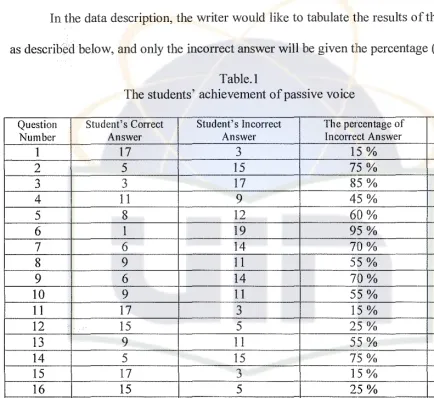
In the data description, the writer would like to tabulate the results of the test,
as described below, and only the incorrect answer will be given the percentage(%).
[image:31.595.51.486.221.619.2]Table. I
The students' achievement of passive voice
Question Student's Correct Stndent's Incorrect The percentage of Remark
Number Answer Answer Incorrect Answer
I 17 3 15 %
2 5 15 75 %
セ
3 17 85 %
.)
4 11 9 45%
5 8 12 60%
6 I 19 95%
7 6 14 70%
8 9 11 55 %
9 6 14 70%
10 9 11 55%
11 17 3 15 %
12 15 5 25%
13 9 11 55 %
14 5 15 75 %
15 17 セ
15 % .)
16 15 5 25 %
17 11 9 45%
18 12 8 40%
19 6 14 70%
22
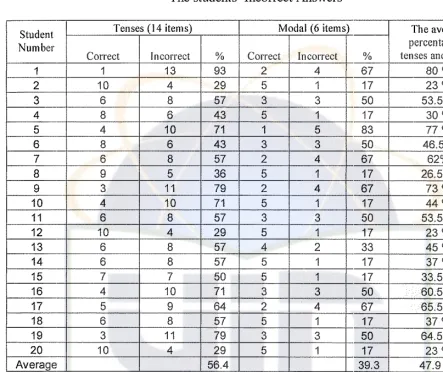
Table.2
The students' Incorrect Answers
Student Tenses (14 items) Modal (6 items) The average
Number percentage of
Correct Incorrect % Correct Incorrect % tenses and modal
1 1 13 93 2 4 67 80 %
2 10 4 29 5 1 17 23%
3 6 8 57 3 3 50 53.5 %
4 8 6 43 5 1 17 30 %
5 4 10 71 1 5 83 77%
6 8 6 43 3 3 50 46.5%
7 6 8 57 2 4 67 62%
8 9 5 36 5 1 17 26.5%
9 3 11 79 2 4 67 73%
10 4 10 71 5 1 17 44%
11 6 8 57 3 3 50 53.5%
12 10 4 29 5 1 17 23%
13 6 8 57 4 2 33 45 %
14 6 8 57 5 1 17 37 %
15 7 7 50 5 1 17 33.5%
16 4 10 71 3 3 50 60.5%
17 5 9 64 2 4 67 65.5%
18 6 8 57 5 1 17 37%
19 3 11 79 3 3 50 64.5 %
20 10 4 29 5 1 17 23 %
Averaae 56.4 39.3 47.9 %
B. Data Analysis
The item Indicators The purposes
The collected data that will be analyzed are as follows: I. Question 2 (Past Tense)
: I. To measure the students' ability of the passive voice of past tense
2. To find out the problems faced by the students
1. The students know the formula of the passive voice of past tense
2. The students know the use of to be "was/ were" and its position
3. The students know singular and plural nOlm or pronoun 4. The students know the regular and irregular form of past
participle (V3)
"The teacher collected the students' paper at the end ofthe test yesterday"
Possible answer: "The students' paper was collected by the teacher yesterday".
24
a. Group 1
Group 1 is the incorrect answers caused by the errorinusing "to be". Here are the examples of the students' sub-group:
1. The students' paper is collected by the teacher at the end of the test yesterday. (Student no 1,2,3,7,11,15,16, and 17)
2. The students' paper are co lIected by the teacher at the end 0f the test yesterday. (Student no 9 and 10)
3. The students' paper were collected by the teacher at the end ofthe test yesterday. (Student no 6, 14, 18, and 19)
Such responses indicate the students are not able to use 'to be' correctly. The examples of students' sub-group 1 and 2 above are the evidences of incorrect answers. From 15 students' incorrect answers, 10 students' cannot differentiate the use of 'to be'. Those ten students choose 'is' in their answers. The correct 'to be' that should be used is 'was! were' because of the past tense.
The students also do not know the agreement between 'To be' and subject (nolm). The example of students' sub-group 3 is the evidence of incorrect answers. It
means 'to be' as a verb agrees with the subject. The verb be hail two separate forms for the past -was for the singular,were for the plural.I In this case the subject taken
from noun (the students' paper) is singular, therefore in that sentence the correct 'to be' is 'was'.
I Marcella Frank,Modem Ellglish: A Procticill Referellce Gllide, (New York: New York
b. Group 2
Group 2 is the inconect answers caused by using the incorrect passive formula of past tense. Here are the examples of the students' sub··group:
I. The student's paper being collected at the end of the te:>t by the teacher yesterday. (Student no. 4)
2. The student's paper were being collected at the end of the test by the teacher yesterday. (Student no 12 and 20)
The passive formula of past tense is 'wasIwere
+
past participle'. From IS students who have incorrect answers, two of them indicate they are still confhsed to use the passive voice formula in the past fOffil of 'to be'. Here they used present continuous instead of the past tense of ' to be' such as in the example of student's sub-group 1. Meanwhile, the students' sub-group 2 used past continuous tense instead of the past tense of 'to be'.The students cannot differentiate the use of 'to be' and don not know subject-verb agreement because they are influenced by Indonesian grammar. 'To be' and subject-verb agreement in Indonesian grammar are not recognized. For example:
I. Guru telahmengumpulkantugas siswa kemarin (active voice) 2. Tugas siswa telahdikumpulkan oleh guru kemarin (pa:,sive)
Indicators
The item
26
Another cause is teaching method. It is not explained clearly about the forms of 'to be' that has some forms (am, is, are for present and was, were for past tense). It is also not explained clearly the differences among them.
2. Question 3 (Present Perfect Tense)
The purposes : I. To measure the students' ability of passive voice of present perfect tense
2. To find out the problems faced by the students
I. The students know the formula of the passive voice of present perfect tense
2. The students know the use of to be "been" and its position
3. The students know the use of "have and has" which connect to the subject
4. The students know the regular and irregular form of past participle (V3)
"People in Latin America have spoken Spanish for nearly 600 years"
From table 1 above the writer finds 17 stndents (85 %) cannot answer the question correctly. The writer groups 17 incorrect answers into 2 groups based on the similarity of the error:
a. Group I
Group I is the incorrect answers caused by using incorrect 'to have' (have/ has). Here are the examples of students' sub-group:
I. Spanish had been spoken by people in Latin America for nearly 600 years. (Student no 9, 10, and 13).
2. Spanish have been spoken by people in Latin America for nearly 600 years. (Student no 3, 4, 6, 8,12,15,18,19, and 20).
Such responses indicate the students are not able to use 'to have' correctly. 'To have' is used with the past participle to form the following tenses present perfect, past perfect, future perfect and perfect conditional2. 'To have' has three forms: Have/
has (present), had (past and past perfect{ In this case, the correct 'to have' that should be used is 'have/ has' because the sentence is present perfect tense. The example of students' sub-group 1 is the evidence of incorrect answer. From 17 students' incorrect answers, 9 students cannot use 'to have' 」ッイイ・LセエャケN They used past tense of 'to have' instead of present perfect of ' to have'.
2AJ. Thomson and A.V. Martinet,A Practical English Grammar, (New York: Oxford University Press, 1979), p.105
28
Such responses above also indicate the students also don not know the agreement between 'to have' and subject (noun). The example of students' sub-group 2 is the evidence of incorrect answers. It means they use incorrect 'to have'. 'To have' has two forms either in the active voice or in the passive voice. They are 'have' and 'has'. The form of 'Have' is used for I, you, we, they, and plural noun, meanwhile the form of 'has' is used for he, she, it, and singular noun.4In this case the subject of the sentence is 'Spanish'. Then, the correct form of 'to have' in that sentence is 'has', because Spanish includes singular noun.
b. Group 2
Group 2 is the incorrect answers caused by usmg the incorrect passive formula of present perfect tense. I-Jere are the examples of student' sub-group:
1. The people America have been speaking Spanish by nearly 600 years. (Student no. I)
2. Spanish in Latin America are spoken for nearly 600 years. (Student no. 5) 3. For nearly 600 years have been spoken Spanish by people in Latin
America. (Student no 7,11,16 and 17)
The passive formula of present perfect tense is 'have/ has + Past Pmticiple'. From 17 students who have incorrect answers, 6 students indicate they are still confused to use the passive voice formula in the present perfect lorm. In the example of student's sub-group I above, the student used the active formula of present perfect continuous tense instead of the passive formula of present perfect tense. It proved
the student cannot form the passive voice. The sentence in student's sub-group I is still in active voice of present perfect continuous tense, although, grammatically its sentence is incorrect, because the subject does not agree with the verb. Inexample of students' sub-group 2, the student used the passive formula of present tense instead of the passive formula of present perfect tense. It also indicates that the student cannot detect the kind of tense in an active sentence. If the student can detect it, the student will be able to form the passive voice, in this case, the passive of present perfect tense. In the example of students' sub-group 3, the students are influenced by Indonesian interference.
The causes are the influence of Indonesian grammar and the lack of students' knowledge of 'to have'. In Indonesian grammar, there are only three kinds of tenses; past tense, present tense and future tense. The present perfect tense where 'to have' is always involved in, is not recognized in Indonesian grammar, finally the students' knowledge of 'to have' is very poor. InIndonesian grammar, there is also no subject-verb agreement. It causes the students miss to match subject and its verb in order to meet subject-verb agreement. Another cause is teaching methodology. The students are not explained clearly the use of 'to have' and its agreement between subject and verb.
3. Question 5 (Present Continuous Tense)
30
2. To find out the problems faced by the students Indicators
The item
I. The students know the formula of the passive voice of present continuous tense
2. The students know the use of to be 'is! are' and its position
3. The students know the singular and plural noun
4. The students lmow the regular and irregular form of past participle (V3)
"Mr. Rice is teaching our class now"
Possible answer: "Our class is being taught by Mr. Rice now".
From table I above, the writer fmds 12 students cannot answer the question cOITectiy. The writer groups 12 incorrect answers into 2 groups based on the similarity of the error.
a. Group I
Group I is the incorrect answers caused by the error of the past participle (V3). Here is the example of student' sub-group:
"Our class is being teach by Mr. Rice now. (Student no 16)"
The response above indicates the student is not able to change a verb into irregular past participle (V3). The example of student's sub-group is the evidence of incorrect answer. 'Teach" in the sentence above is simple form, whereas the verb
which is needed in the sentence is past participleHvSヲq\ャNウセNG\G^e ..A⦅セAGZAセセ_Zl
b. Group 2
Group 2 is the incorrect answer caused by using the incorrect passive formula of past tense. Here are the examples:
1. Our class is teached by Mr. Rice now. (Student no 1, 3, 7, 11, 17, and 19) 2. Our class is tought by Mr. Rice now. (Student no 15)
3. Our class are teaching by Mr. Rice now. (Student no.S)
The passive formula of present continuous tense is " is/ are + being + past participle (V3). From 12 students who have incorrect answers, 9 students used the incorrect passive voice formula of the present continuous tense. The examples of students' sub group I, 2 and 3 are the evidences of incorrect answers. In example of students' sub-group 1 and 2, the students used the passive formula of present tense, although the past participle (V3) in that sentence is incorrect. The past Participle (V3) of "teach" is "taught". In the example of student's sub-group 3, the student is not able to use the passive formula of present continuous tense. The sentenceinthat sub-group is grammatically and semantically incorrect. Granmmtically the subject should agree with the verb. The subject of the sentence "our class" is singular. Therefore the verb should be singular, too. So, the correct verb should be "is". The sentence also is semantically incorrect, because the class in that sentence cannot do an action.
The causes are the influence of Indonesian verb and the teaching methodology. The verb in Indonesian does not change in form. For example:
32
Unlike Indonesian, the verb in English changes in accord311ce with the kind of tenses. This case makes the students obtain the English verb in form. Teaching methodology also influences the students in mastering the passive voice of present continues tense. They are not explained the irregular past participle and the differences of verb between English and Indonesian clearly.
4. Question 6. (Past Continues Tense)
The purposes : 1. To measure the students' ability of passive voice of past continuous tense
The item Indicators
2. To find out the problems faced by the students
1. The students know the formula of the passive voice of past continuous tense
2. The students know the use of to be 'was/ were' and its position
3. The students know countable and uncountable noun 4. The students know the regular and ilTegular form of past
participle (V3)
'The movers were moving the furniture fi'om my apartment to a truck last week"
From table 1 above, the writer finds 19 students (95 %) cannot answer the question correctly. The writer groups 19 incorrect students into 2 groups based on the similarity of the error.
a. Group 1
Group 1 IS the incorrect answers caused by nllssmg 'Subject-Verb
Agreement'. Here is the example of students' sub-group 1:
"The furniture were being moved by the movers ll-OJll my apartment to a truck last week". (Student no 2, 3, 4, 6, 7, 8, 9,12,14,16,17,18,20)
Such responses above indicate the students are not able to match the subject with the verb. They also cannot recognize the countable and uncountable noun; and its consequence to the verb. The example of students' sub-group I is the evidence of incorrect answer. They used 'were' instead of 'was', whereas the subject of the sentence is uncountable noun. Referring to the theory, Uncountable noun is not used in the plural.sTherefore in the sentence above the conect 'to be' is 'was'.
b. Group 2
Group 2 is the incorrect answers caused by using the incorrect formula ofpast continuous tense. Here are the examples of students' sub-group:
I. The furniture were moves by truck last week. (Student no 1 and 19)
2. The furniture my apartment to a truck are movers last week. (Student no 5)
Indicators
34
3. My apartment were being moved the furnitme by a truck. (Student no 10 and 13)
The passive formula of the past continuous tense is 'was/were
+
being+
past participle (V3). From 19 students who have incorrect answer, 5 students indicate they are still confused to use the passive formula of past continuous tense even they do not know the passive formula of past continuous tense. The three sentences above do not correlate to the passive form of past continuous tense.The writer assumes the causes of those problems above are the influence of Indonesian grammar and teaching methodology. In Indonesian grammar, there is no subject-verb agreement. It causes the students miss to match subject and its verb in order to meet subject-verb agreement. Another cause is teaching methodology. The students are not taught clearly the passive formula of past continues tense and how to use the formula into a sentence.
5. Question 7 (Futme Perfect Tense)
The pmposes : 1. To measme the students' ability of passive voice of future perfect tense
2. To find out the problems faced by the students
1. The students know the formula of the passive voice of future perfect tense
3. The students know the regular and irregular form of past participle (V3)
4. The students know the place of adverb of time The item "Soon Maria will have bought the book"
Possible answer: "The book will have been bought soon by Maria".
From table 1 above, the writer finds 14 students (70 %) cannot answer the question correctly. The writer groups 14 incolTect students into 2 groups based on the similarity of the elTor.
a. Group 1
Group 1 is the incolTect answers caused by using of incorrect passive formula ofthe future perfect tense. Here are the examples of students' sub-group:
1. The book will have be bought by Maria soon. (Student no. 6)
36
'have', but they, in the student's sub-group 2 above, laid 'to be' before the auxiliary of 'have'. In the students' sub group 3, the students really do not know the passive formula of the future perfect tense. There is no 'to be' in the example of students' sub-group 3, whereas, the being of 'to be' in the passive form is a must, because generally the formula of passive voice is 'to be'
+
Past Patticiple (V3). The problems arise because 'to be' changes according to the tense. In the present tense, 'to be' changes to be"ami is! are', in the past tense 'to be' changes to be "was and were', in the perfect tense, 'to be' changes to be 'been'. Here is the form of tense ofPRESENT PAST PERFEe
am Was been
are were
is
b. Group 2
Group 2 is the incorrect answers caused by placing incorrect adverb of manner. Here is the example of students' sub group:
- The book will have been bought by soon Maria. (Student no 5, 7, II, 13, 14 and 16).
From 16 students who have incorrect answers, 5 students are not able to lay adverb in the correct place. Adverb of manner usually comes after verb,
after the object when there is one.7The adverb of manner is com,ctly, in the example of sub-group 2 above, put after the verb 'bought.
The causes are the lack of students' knowledge of the adverb of manner. They think 'soon' is a fi'ont name of Maria, whereas 'soon' in that sentence is one of the adverbs of manner.
6. Question 9 (Be going to)
The purposes :I. To measure the students' ability of passive voice of Be Going To
2. To find out the problems faced by the students Indicators
The item
I. The students know the formula of the passive voice of Be Going To
2. The students know the use of to be 'be' and its position 3. The students know the regular and irregular form of past
participle (V3)
4. The students know the position of adverb of place "Eric's cousins are going to meet him at the airport this
afternoon"
Possible answer: "He is going to be met by Eric's cousin at the airport this afternoon".
38
From table I above, the writer finds IS students (75 %) cannot answer the question correctly. The writer groups IS incorrect students into 2 groups based on the similarity of the error:
a. Group I
Group I is the incorrect answers caused by using of incon'ect passive formula of 'be going to' and the incorrect subject of the sentence. Here are the examples of students' sub-group I:
I. The airport Eric's cousins is going to meted at this morning. (Student no. 5) 2. The airpOli is going to be him by Eric's cousins this morning.
(Student no 9 and 10)
3. The airport was going to be met him by Eric's cousins this morning. (Student no 13)
Such responses indicate the students are not able to recognize not only the passive formula of 'be going to', but also the subject arid the object of the sentence. The subject of the question above is 'Eric's cousins' and the object is 'him'. To form the passive voice, the subject of the sentence should be moved to be the object of the sentence. On the contrary, the object of the sentence should be moved to be the subject of the sentence. The adverb of place and the adverb of time never became the subject of the sentence. An adverb is a word to modifY a verb, an adjective or another adverb.8Therefore the airport, in the example of student's sub-group! has no function. Besides the students used the incorrect passive formula in the examples of
students' sub-group 2, they also used the wrong subject grammatically. In the example of student' sub-group 2 there has no past participle (v3), whereas, the passive formula of ' be going to' is 'be going to' -I-be-I- past participle (v3).
b. Group 2
Group 2 is the incorrect answers caused by using the incorrect passIve formula of ' be going to' and the incorrect form of the personal pronoun. Here is the example of student's sub-group 2:
I. Him is being meet by Eric's cousins at the airport. (Student no 2, 4, 14, 18 and 20)
2. Him are going went to meet by Eric's cousins at the airport this afternoon.
(Student no 12)
Such responses above indicate the students who have incorrect answer like above are not able to change an objective case to be nominative case. The students can put the subject correctly, but they used 'him' instead of 'he'. 'Him' is used when it places the object position. The pronoun in the example of student's sub-group 2 places the subject position; therefore the correct pronowl should be 'he'.
Indonesian
ウセュオ
Dia suka saya
English
I love'IOU
セ
---..
She loves me
40
In teaching methodology, the students are not explained the change of pronoun in English clearly, whereas the change of pronoun in the English passive voice is very important especially the pronoun of subject (nominative case) and object (objective case).
7. Question 14 (Past Tense) The purposes
Indicators
The item
: I. To measure the students' ability of the passive voice of past tense
2. To find out the problems faced by the students
I. The students know the formula of the passive voice of past tense
2. The students know the use of to be "was! were" and its position
3. The students know singular and plural noun or pronoun 4. The students know the regular and irregular form of past
participle (V3)
"An old man told a story this morning"
From table I above, the writer finds IS students (75 %) cannot answer the question correctly. The writer groups IS incorrect students into 2 groups based on the similarity of the error:
I. Group I
Group I is the incorrect answer caused by using the incorrect "to be". Here is the example of student's sub-group:
- A story is told by an old man this morning. (Student no 1,2,3,4,5,8, IS, 17, 18, 19, and 20)
Such response indicate the students are not able to use 'to be' correctly. The example of students' sub-group above is the evidence of incorrect answer. From IS students' incorrect answers, II students' cannot differentiate the use of 'to be'. Those eleven students choose 'is' in their answers. The COlTect 'to be' that should be used is
'waslwere' because of the past tense.
b. Group 2
Group 2 is the incorrect answers caused by usmg the incorrect passive formula of Past Tense. Here are the examples of students' sub group:
I. A story has been told by an old man this morning. (Student no 14)
42
The passive formula of Past Tense is 'was /were
+
past participle'. From 15 students who have incorrect answers, two of them indicate that they are still confused to use the passive voice formula in the past form of 'to be'. In example of student's sub-group 1, the student used the passive formula of present ー・イヲエセ」エ tense in stead of the passive formula of Past Tense. She cannot recognize the kind of tense. The sentence in that question is Past Tense. If the student changes the sentence to be passive voice, she should form the passive sentence in Past Tense, too based on the formula of past tense that has been written above. Meanwhile, the students' sub-group 2 did not use 'to be' at all, whereas, the being of ' to be' in the passive form is very essential, because generally the formula of passive voice is "be+
Past Participle (V3).The causes of those problems above are influenced by Indonesian grammar. 'To be' and subject-verb agreement in Indonesian grammar are not recognized as it has been explained clearly above. Another cause is teaching methodology. The students may not be clearly explained how to use the passive formula of past tense in a sentence.
8. Question 19 (Perfect Modal "May")
The purposes : 1. To measure the students' ability of the passive voice of perfect modal 'may'
Indicators I. The students know the formula of the passive voice of past tense
2. The students know the use of to be "been" and its position
3. The students know singular and plural noun or pronoun 4. The students know the regular and irregular form of past
participle (V3)
The item "The teacher may have permitted the students to go to the toilet"
Possible answer : "The students may have been permitted by the teacher to go to the toilet".
From table I above, the writer finds 14 students (70 %) cannot answer the question correctly. The writer groups 15 incorrect students into 2 groups based
on
the similarity of the error:a. Group I
Group I is the incorrect answers caused by using the incorrect "to be" and its position. Here are the examples of student's sub-group:
I. The students may have be permitted by the teacher to go to the toilet. (Student no 6)
44
Such responses indicate the students are not able to use "to be" and put it cOlTectly. The example of students' sub-group 1 above is the evidence of incorrect answer. The student in the example of student's sub-group 1 put "to be" in the correct position, but she used incorrect "to be". She used "be" instead of "been". Putting "to be" of "been" in that sentence is a must, because "to be" in that case is preceded by "to have" as auxiliary. The verb, proceeded by "to have" as auxiliary, should be past participle (V3). Then, the verb "be", in that case, should be in past participle (V3). The past participle of the verb "be" is "been".
In the example of students' sub-group 2, the students not only used the incorrect "to be", but they also put "to be" in the wrong position. "To be", in the passive voice of perfect modal "may", is put after "to have" based on the perfect passive form of modal. The perfect passive formula of modal "may" is "May
+
Have+
Been+
Past Participle (V3)".b. Group 2
Group 2 is the incorrect answers caused by using incorrect passive formula of perfect modal "may". Here are the examples of students' sub-group:
1. The student have been permitted by the teacher to go to the toilet. (Student no 16)
3. The student is have permitted by the teacher to go to the toilet. (Student no 1, 3 and 17)
Such responses indicate the students in the example of students' sub-group above are not able to use the passive formula of perfect modal "May". In the example of student's sub-group 1, the student used the incorrect passive form of present perfect tense in stead of the passive form of past passive of modal "May". In the example of student's sub-group 2, the student has used the Perfect Modal "May", but he do not put "to be" after "to have", Whereas, based on theory, the passive formula of perfect modal "May" is May
+
Have+
Been+
Past Participle (V3). In the example of students' sub-group 3, the students are not able to form the passive voice.Those problems above arise because the students have poor knowledge of 'to be' and its change. Another cause is teaching methodology. The students are not explained how to use the perfect modal formula of 'May' in a sentence clearly.
After finding some problems found by the students in mastering the passive voice, the writer interprets the data using the measurement below to know to what extent the students have mastered the passive voice.
The measurement used as follows: Score Categol"y
a
-
25
Very Poor26
-
50
Poor51
-
75
Enough46
From the data description, table 2, the writer can interpret the average score and categorize into measurement above. The average score of the student can be accounted by using average formulation:
A=
A
s
N
s
N
= Average Score
= Total Score
= Number of student
After processing the data the writer accounts the average of score as follows:
A
=
1.5+7,5+4,5+6,5+2,5+5.5+4+7+2,5+4.5+4.5+7,5+5+5,5+6+3,5+3,5+5,5+3+7,520
=
4.9A. Conclusion
The result of the research can be concluded as follows:
I. Most of the students at the third year of Senior High School "Dharma Karya Universitas Terbuka" Pondok Cabe have a poor ability of the passive voice. 2. There are a number of problems found by the students in mastering the passive
vOlce:
a. The use of incorrect 'to be' in different tenses
b. The use of incorrect formula of the passive in a sentence d. The use of incon·ect past participle (V3)
e. The use of incorrect 'to have'
f. The incorrect position of adverb; adverb manner
g. The incorrect pronoun nmctioned as the subject of the sentence 3. The causes of those problems are:
a. The influence ofIndonesian grammar
b. The teaching methodology used by the teacher
B.Suggestions
48
1. The institution (Senior High School "Dharma Karya UT") to:
a. provide book collections of English basic grammar in the school library to support the students' ability of English basic grammar
b. provide any different books containing the passive voice of English from any different publishers.
2. The English teacher to:
a. improve the effectiveness of teaching methodology
b. improve learning process in teaching passive VOIce by explaining the differences between English and lndonesian grammar clearly, especially 111 the passive voice.
3. The learners to:
a. distinguish the formulae of the passive voice
b. memorize the irregular past participle (V3) because it is always involved in the passive voice
c. consider the correct form of 'to be' to meet subject-verb agreement
d. point out the object of the sentence in the active voice, because the subject of the sentence in the passive voice is constructed from the object ofthe sentence in the active voice.
e. point out the kind of tense in the active voice, because the passive voice changed from the active voice obtains the tense in the active voice.
University Press, 1979
A S Hornby, Oxford Advanced Learner's Dictionary of Current English, New York: Oxford University Press, 1995
Betty Schrampfer Azar, Understanding and Using English Grammar, USA: Prentice hall, Inc, 1989
David Nunan,Second Language Teaching and Learning,New York: Heinle and Heinle Publisher, 1999
Dave Willis,Student's Grammar, London: Harper Collin Publisher, 1991
Dedy Setiawan, Drs, MA, M.Ed.,Practical Guide to Technical Writing for Tertiary Students and professions, Bandung: Politeknik Negeri Bandung, 2002 Dr. Tan Cheng Lim.P.hD,Practical English Grammar, Singapore: Singapore Asian
Publication, 2002
Hans P Guth,the Uses of language,New York: McGraw-HilI. Inc, 1989
Http://linguistics.byu.edu/faculty/henrichsenl/researchmethods/RM_2_05 .htm, May 2007
Jean Aitchison,Linguistics, London: Hodder and Stoughton, 1987
John E Warriner, English Grammar and Composition, New York: Harcouri Brace Jovanovich Publisher, 1985
.J. Richard, J Platt and H Webber, Longman Dictionary ofApplied Linguistics,
London: Longman, 1985
50
Michael Swam,Basic English Usage, New York: Oxford University Press, 1986 Noah Webster, Webster's New Twentieth Century DictionOlY, Cambridge:
Cambridge University Press, 1983
Noah Webster, Webster's New Twentieth CentUly Dictionary, USA: William Collims Publishers. Inc, 1980
Penny. Ur,A Course in Language Teaching: Practice and TheOlY, Cambridge: Cambridge University Press, 1996
P.H. Mathews,Syntax, New York: Cambridge University Press, 1996
Radolph Quirk,A Comprehensive Grammar of The English Language, New York: Longman, 1985
Sidney Greenbaum and Randolph Quirk,A Student's Grammar o.fthe English Language, New York: Longman, 1990
Victoria Fromkin and Robert Rodman, An Introduction to Language, Orlando: Harcourt Brace College Publisher, 1998
Appendix I
Jay/ Date rime Duration <\venue
::omplete Name ::lass
I
TEST INSTRUMENT
1
: Friday, December 22ml2006 : 90 minutes
: Senior High School "Dharma Karya Universitas Terbuka"
CHANGE THE ACI1VE SENTENCE INTO THE PASSIVE VOICE
I. The big fish eats the small fi sh :
2. The teacher collected the student's paper at the end of the test yesterday:
3. People in Latin America have spoken Spanish for nearly 600 years:
4. Thousands of tourists will visit Hawaii this year:
5. Mr. Rice is teaching our class today:
6. The movers were moving the furniture from my apartment to a truck last week:
7. Soon, Maria will have touched the book:
1J. People must obey all traffic regulations:
12. My mother may cook lice at home:
13. People grow rice in India:
14. An old man told the stOly this morning
J5. The chefwill prepare the lood :
16. Lookl Someone can open the door :
17. Someone was reading book in the library yesterday morning:
l8. Many people must have built this house over 200 years a go :
J9. The teacher may have permitted the student to go to the toilet:
ARYA
YAYASAN PEMBINA UNIVERSITAS TERBUKA
BIDANG PENDIDIKAN
SMA DHARMA IKARYA UT
STATUS TERAKREDITASI B
SK. NO. : 02
I
BASDA-BTNI
SKI
VI 2004
JI.Talas 11/30, Pondok Cabe IIiI., Kecamalan Pamulang, Tangerang 15418 Telp (021) 74701542
. . . IM
SURAT
KETERANGAN
Nomor: 063/102.J/SMA DK-UT/I/2007
セ・ー。ャ。 SMA Dharma Karya UT dengan ini menerangkan :
セ。ュ。 -lIM. urusan 'akultas udul Skripsi セ・ュー。エOエ。ョァァ。ャャ。ィゥイ enis Kelamin セァ。ュ。 Vamat
: Dindin RosyicJin : 102026024587
: Bahasa dan Sastra Inggris : Adab dan HUl11anioro
: The Mastery of Passive Voice
"a care study on the third year of SMA Dharma Karya UT Pondok Cabe Academic Year 2006/2007".
: Sukabumi, 04 Mei 1983. : Laki-laki
: Islam
: Jl. ABO Wahab No. 20 Rt. 02/08 Cinangka 16516 Sawangan Kola Oepok
Ilenerangkan bahwa yang bersangkutan benar-benar telah melaksanakan Penelitian elama satu bulan, (tanggal, 1 Desember 2006 s.d I Januari 2007)
)emikian surat keterangan ini dibuat untuk clipergunakan sebagaimana mestinya.