HYBRID ARIMAX-NN MODEL FOR
FORECASTING INFLATION
Santi Eksiandayani, Suhartono, Dedy Dwi Prastyo
Institut Teknologi Sepuluh Nopember, Department of Statistics,
Faculty of Mathematics and Natural Sciences,
Jl. Arief Rahman Hakim, Surabaya 60111, Indonesia
[email protected] (Santi Eksiandayani)
Abstract
Inflation became an important component in the economy as an indicator of the increase in
prices of goods and services. In addition to general inflation, there are also seven groups of
inflation categorized based on expenditure. Inflation particularly in Indonesia is influenced by
internal and external factors. These factors may effect inflation not only at a single point of
time, but also at certain periods. Money supply is one factor strongly considered to influence
inflation. Consequently, it is important to forecast inflation by involving money supply as
input series. The effect of money supply on inflation was analyzed in this study. This research
focused on hybrid method which is the combination between Autoregressive Integrated
Moving Average with Exogenous Factor (ARIMAX) and Neural Network (NN). The results
of hybrid method were compared to individual forecasting method, i.e. ARIMA and
ARIMAX. The result indicated that hybrid ARIMAX-NN provided precise inflation
prediction compared to ARIMA or ARIMAX method. Hybrid model can be an effective and
efficient way to improve forecasting.
Keywords: forecasting inflation, hybrid model, ARIMAX, neural networks.
Presenting Author’s biography
1.
Introduction
Inflation rate is always volatile from period to period. High inflation will harm the economy, social life and stability of a nation. In Indonesia, Bank Indonesia as a national central bank is assigned to maintain the stability of inflation though monetary policy, i.e. to control money supply. Hence, the models to forecast inflation are required to assess the effect of money supply as an input variable. By utilizing forecasting model, the government policies particularly dealing with monetary is expected to be preoccupied.
Numbers of researches on inflation forecasting have been done, yet discussion on inflation forecasting is always be an interesting topic. From the search results through Google search engine updated on September 23, 2015 there were 238,000 informations relating to inflation forecasting. On the search results through direct science sites on October 7, 2015 acquired 21,588 books and journals were analyzed regarding the inflation forecasting.
Forecasting inflation is performed using time series data analysis. One widely used method is the Autoregressive Integrated Moving Average (ARIMA) model. The ARIMA models that involves the existence of exogenous factors is known as ARIMA with Exogenous Factor so-called ARIMAX model. In recent years, the non-linear models for time series analysis began to evolve. This model is considered to be more representative to the conditions of existing data. Artificial Neural Network (ANN) or commonly called the Neural Network (NN) is one of the non-linear models are often used. Zhang [9] proposed a hybrid approach to time series forecasting using both ARIMA and NN models. The motivation of the use of hybrid model comes from the following perspectives. First, it is difficult in practice to determine whether a time series under study is generated from a linear or non-linear process. Second, real-world time series are rarely pure linear or non-linear. Third, it is almost universally agreed in the forecasting literature that no single method is best in every situation. Makridakis [10] and Palm and Zelner [11] stated that both combining different methods can be an effective and efficient way to improve accuracy of forecast.
In recent years, a hybrid model ARIMA-NN have been applied to time series forecasting that resulted in good prediction performance. Faruk [12] used a hybrid ARIMA and NN model for water quality time series prediction. Diaz-Roble et al. [13] employed the ARIMA and NN model to forecast particulate matter in urban case (the case of Temuco, Chile). Wang et al. [14] proposed a hybrid approach combining Exponential Smoothing Model (ESM), ARIMA, and Back Propagation Neural Network (BPNN) to forecast stock index.
This paper applied the hybrid method for forecasting inflation with money supply as an exogenous factor. The ARIMAX model was employed at first level continued by Feedforward Neural Network (FFNN) as the second level model. The hybrid ARIMAX-NN model was compared to both ARIMA and ARIMAX models. It is expected this hybrid method will improve the accuracy of inflation forecasting.
This paper was structured as follows: Section 2 presented a brief review of the literature on the use of hybrid ARIMAX-NN. Section 3 presented the methodology used in this study. Section 4 presented the result based on the best model and the evaluation of the forecasting. Section 5 was the conclusion.
2.
Literature Review
2.1 Time Series Modelling
ARIMA model is a combination of Auto Regressive (AR) and moving average (MA) models. The ARIMA model is a linear model that can be applied to the seasonal and non-seasonal time series �� over time �. Given �̇�=��− �, with � =�(��), the seasonal ARIMA model is expressed as [15]:
Φ�(��)��(�)(1− �)�(1− �)��̇� =��(�)Θ�(��)�� , (1)
Φ�(��) = (1− Φ1��− ⋯ − Φ����)
��(�)
=
(1− �1� − ⋯ − ����)Θ�(��)
=
(1− Θ1��− ⋯ − Θ����) ,with � is seasonal period, � is backshift operator, and �� is a sequence of white noise with zero mean and constant variance.
ARIMAX model is ARIMA model with additional variable. In this research, there is one additional variable, i.e. money supply. The ARIMAX model can be written as:
�� = �
(�)��
�(�) ��−�+�� , (2)
where
�(�)
=
(�0− �1� − ⋯ − ����) �(�)=
(�0− �1� − ⋯ − ����)and �is a delay parameter representing the actual time lag that elapses before the impulse of the input variable produce an effect on output variable, and ��R is the white noise of the system that is
independent of the input series ��. 2.2 Artificial Neural Networks
Artificial neural networks (ANN) are one of such models that are able to approximate various nonlinearities in the data. Single hidden layer feedforward network is the most widely used model form for time series modeling and forecasting. This research use the feedforward network with one hidden layer consisting of n neurons and output layer consists of only one neuron. The values of the response or output �� is calculated by [16]:
��(�)=���� ������ℎ�� ���ℎ��−�(�)+��ℎ
�
�=1
�+���
�
�=1
� (3)
where ���(j = 0,1,2,…, n) and ���ℎ (i = 1,2,…, m; j = 1,2,…, n) are the model parameters often called the connection weights at output and hidden layer, respectively, m is the number of input nodes, and n is the number of hidden nodes. The � is intercept and � represent pairs of input-target data. The following logistic function is often used as activation function:
�(�) = 1
1 +�−� (4)
The superscript “o” and “h” at activation function and weight denote output and hidden layer, respectively.
2.3 Hybrid Model
Both ARIMAX and ANN models have achieved successes in their own linear or nonlinear domains. However, none of them be a universal model that is suitable for all time series data. Since it is difficult to completely know the characteristics of the data in a real problem, hybrid method that has both linear and nonlinear modeling capabilities can be a good strategy for practical use. Zhang [9] considered a time series to be composed of a linear autocorrelation structure and a nonlinear component:
�� =��+��+�� , (5)
2.4 Measure of Accuracy
The performance of ARIMAX-NN is compared to the individual forecasting method of ARIMA and ARIMAX. The Geometric Mean of the Relative Absolute Error (GMRAE) and Median Absolute Percentage Error (MdAPE) [17] was used to compare the forecasting accuracy of the three methods. The GMRAE is defined as:
������,�=�������,�− ��� ��,�− ��� �
�=1
� 1 �
100% , (6)
where u is forecasting method, l is forecasting time, and M is the number of forecast. The ��,� is
forecasting value obtained from method u for l-step ahead. The rw denoted the random walk method. The �� is the actual value at time l.
The Md����,� is the forecasting value at ��+1
2 � if � is odd, or the average of forecasting value at � � 2�
and ��
2 + 1� if � is even, where the forecasting values are rank-ordered by ����,�:
����,�=�
��,�− ��
�� � , (7)
3.
Methodology
This research used two series data, i.e. the inflation data as output series (��) obtained from Statistics Indonesia and money supply data (��) as input series obtained from Bank Indonesia. Each series consisted of 186 monthly data from January 2000 until June 2015 for each series. In-sample dataset consisted of 168 observations, while the remaining data as out-sample data. The hybrid ARIMAX-NN model was applied to these two time series data.
Hybrid ARIMAX-NN model building procedure was commenced by analyzing the characteristics of inflation data. Subsequently, forecasting inflation used ARIMAX model with money supply as exogenous factor. The residuals from ARIMAX model were used in second level modeling by means of FFNN. The forecasting accuracy of ARIMAX-NN was compared with the accuracy yielded by either ARIMA or ARIMAX model.
4.
Result
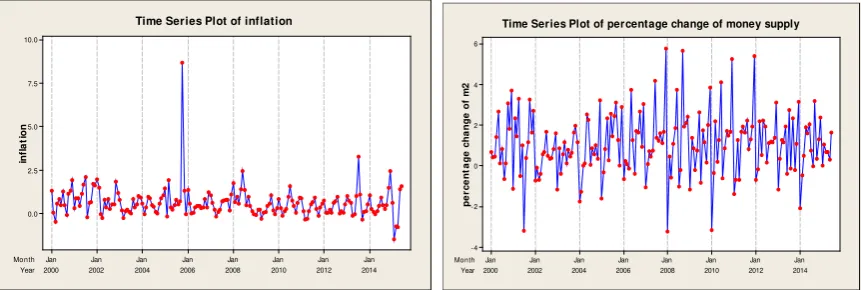
4.1 Characteristics of Inflation Data
Year
Time Series Plot of percentage change of money supply
Fig 1. Time series plot of Inflation (left) and percentage change of money supply (right)
4.2 Result of Hybrid ARIMAX-NN Model
The in-sample data was used to train model and the out-sample data was used to evaluate the performance of the established model. At first level modeling, the linear model using ARIMAX is:
��� = 0.13432 (1 + 0.21845 �) ��+
1
(1−0.28078 �) �� (8)
In (8), the ARIMAX part informed that money supply gives positive impact to inflation. The increasing of money supply by 0.22% affected the increment of inflation by one percent. At second level modeling, the nonlinier model using FFNN was employed to model the residual �� in (8). The best architecture of FFNN is composed from one input, two hidden layer, and one ouput as reported in Tab. 1.
Tab. 1 Forecast accuracy between architecture FFNN Architecture FFNN MSE in MSE out
(1) (2) (3)
Year
Fig. 2 Time series plot of actual inflation and their out-sample forecast using ARIMA, ARIMAX, and hybrid ARIMAX-NN
Tab. 2 Forecast accuracy between models
Accuracy Measure ARIMA ARIMAX ARIMAX-NN
(1) (2) (3) (4)
GMRAE 0.9060 0.8723 0.7065
MdAPE 0.7433 0.7540 0.6719
5.
Conclusion
Linear and non-linear approach for time series forecasting were combined. The linier ARIMAX model and the non-linear ANN model were combined to forecast inflation with money supply as an exogeneous variable. This hybrid model ouperformed the benchmark models, i.e. ARIMA and ARIMAX. In the hybrid model, the ARIMAX part indicated positive impact of money supply on inflation. The increasing of money supply by 0.22% affected the increment of inflation by one percent.
References
[1] S. Moshiri and N.E. Cameron. Neural network versus econometric models in forecasting
inflation. Journal of forecasting, 19,1999.
[2] X. Chen, J. Racine and N.R. Swanson. Semiparametric ARX neural-network models with an
application to forecasting inflation. Neural Networks, IEEE Transactions on, 12(4), 674-683,
2001.
[3] C. W. Granger and Y. Jeon. Comparing forecasts of inflation using time distance. International
Journal of Forecasting, 19(3), 339-349, 2003.
[4] P. McAdam and P. McNelis. Forecasting inflation with thick models and neural networks.
Economic Modelling, 22(5), 848-867, 2005.
[5] E. Nakamura. Inflation forecasting using a neural network. Economics Letters, 86(3), 373-378,
[7] M. A. Choudhary and A. Haider. Neural network models for inflation forecasting: an appraisal.
Applied Economics, 44(20), 2631-2635, 2012.
[8] M. Kichian and F. Rumler. Forecasting Canadian inflation: A semi-structural NKPC approach.
Economic Modelling, 43, 183-191, 2014.
[9] G. P. Zhang. Time series forecasting using a hybrid ARIMA and neural network model.
Neurocomputing, 50, 159-175, 2003.
[10] S. Makridakis. Why combining works?. International Journal of Forecasting, 5(4), 601-603,
1989.
[11] F. C. Palm and A. Zellner. To combine or not to combine? Issues of combining forecasts.
Journal of Forecasting, 11(8), 687-701, 1992.
[12] Faruk, D. Ö. (2010). A hybrid neural network and ARIMA model for water quality time series
prediction. Engineering Applications of Artificial Intelligence, 23(4), 586-594.
[13] L. A. Diaz-Robles, J. C. Ortega, J. S. Fu, G. D. Reed, J. C. Chow, J. G. Watson and J. A.
Moncada-Herrera. A hybrid ARIMA and artificial neural networks model to forecast particulate
matter in urban areas: the case of Temuco, Chile. Atmospheric Environment, 42(35), 8331-8340,
2008.
[14] J. J. Wang, J. Z. Wang, Z. G. Zhang and S. P. Guo. Stock index forecasting based on a hybrid
model. Omega, 40(6), 758-766, 2012.
[15] W.W.S. Wei. Time Series Analysis: Univariate and Multivariate Methods, Second Edition.
United State of America: Addison-Wesley Publishing Co., USA, 2006.
[16] Subanar, P. P. D. H.. Feedforward Neural Networks untuk pemodelan runtun waktu (Doctoral
dissertation, Universitas Gadjah Mada), 2007.
[17] J. S. Armstrong. (Ed.). Principles of forecasting: a handbook for researchers and