Clinical Manifestation of Acute Myocardial Infarction in the Elderly
Miftah Suryadipradja*, Wahyu Dewabrata*, S. Harun*, Idrus Alwi*, Lukman Hakim*, Shufrie Effendy*, Dasnan Isamailƒ
Abstrak
Telah dilakukan penelitian retrospektif terhadap pasien infark miokard akut (IMA) yang dirawat di ICCU RSUPN Dr Cipto Mangunkusumo, Jakarta antara Januari 1994 sampai Desember 1999. Dari 513 pasien yang dirawat dengan IMA, 227 pasien adalah usia lanjut, di mana 35,2 % dari mereka adalah wanita. Sebagian besar IMA usia lanjut mengeluh nyeri dada yang khas seperti pada pada kelompok usia muda. Pasien IMA usia lanjut cenderung terlambat datang ke rumah sakit dan lebih banyak menderita IMA gelombang Q. Faktor risiko diabetes melitus dan hipertensi lebih sering dijumpai pada usia lanjut. Prevalensi fibrilasi atrial dan mortalitas lebih tinggi pada usia lanjut. (Med J Indones 2003; 12: 229-35)
Abstract
A retrospective study were performed in patients with acute myocardial infarction (AMI) that hospitalized in ICCU Cipto Mangunkusumo hospital, Jakarta during the period of January 1994 until Decmber 1999. There were 513 patients hospitalized with MCI, 227 patients (44.2%) were classified as elderly, and 35.2% of them were female. Most of the elderly AMI patients reported typical chest pain just like their younger counterparts. Elderly AMI patients tend to come later to the hospital, and more Q-wave myocardial infarction were identified compared to non-Q-wave myocardial infarction. Risk factors of diabetes mellitus and hypertension were more common among the elderly. The prevalence of atrial fibrillation and the mortality rate were higher among elderly AMI patients. (Med J Indones 2003; 12: 229-35)
Keywords : clinical manifestation, acute myocardial infarction, elderly
Coronary heart disease is the most common disease found in the elderly and makes up two thirds of all causes of cardiac death. Approximately 60% of patients hospitalized with acute myocardial infarction (AMI) are over 65 years old.1 Clinical manifestations of acute myocardial infarction in the elderly differ from that in younger patients. Typical chest pain is rarely found among the elderly, and complaints are usually atypical.1-8 There is an increase in the morbidity and mortality of AMI in the elderly. Approximately 80% of all deaths due to AMI occur in patients over 65 years of age.9 Non-Q wave myocardial infarction is more commonly found among elderly patients with AMI and
is more common among women.1,5,6,7 Elderly patients with AMI demonstrate a minimal increase in creatine kinase (CK) enzyme.10 Atypical complaints, atypical electrocardiogram (ECG) and minimal increase in creatine kinase makes establishing the diagnosis of AMI among the elderly difficult.
The aim of the study is to determine clinical manifestation, prognosis, and the complications of acute myocardial infarction among the elderly hospitalized in the Intensive Cardiac Care Unit (ICCU) of Dr. Cipto Mangunkusumo Public Central Referral General Hospital and compare them to those of younger patients.
METHODS
This retrospective study was performed on AMI patients hospitalized in the ICCU of Dr. Cipto Mangunkusumo General Hospital from January 1994 to December 1999. A diagnosis of AMI is established *
Division of Cardiology, Department of Internal Medicine, Faculty of Medicine University of Indonesia, Dr. Cipto Mangunkusumo Hospital, Jakarta, Indonesia
ƒ Department of Internal Medicine, Faculty of Medicine
if two out of three of the AMI criteria are found: 1) typical chest pain, 2) typical electrocardiogram, 3) an increase of creatine-kinase (CK-CKMB) enzyme of at least twice the highest normal level.11 Elderly AMI patients refer to patients aged 60 years or above. Some characteristics of the patients were recorded, consisting of subjective complaints, risk factors, infark type, hospital arrival time, proportion of patients receiving thrombolytic agent and complications of AMI.
All of the above characteristics in elderly patients were compared with those in patients younger than 60 years. Statistical analysis used were Chi-square and Fisher’s exact test.
RESULTS
Five hundreds and thirteen patients have been hospitalized for AMI during the periode of January 1994 to December 1999. Two hundred and twenty seven (44,2%) were classified as eldrely and 35,2% of them were female.
Distribution of complaints
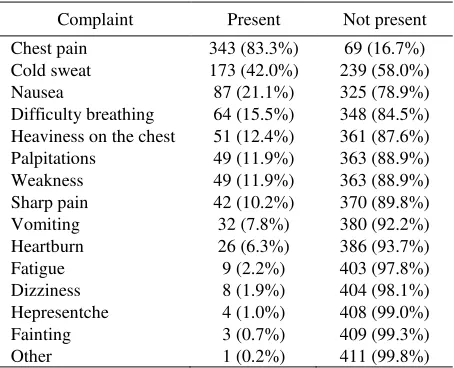
In general, chest pain was still the most common complaint, found in 83.3% among patients with AMI (see Table 1), and typical AMI is still in a higher rank than atypical complaints. Epigastric pain is found in 4.9% of patients, while dizziness and headache accompanied by myocardial infarction is found in 1.9% and 1% of cases. Another complaint was found in 1 patient (0.2%).
Table 1. Distribution of complaints in 412 AMI patients
Complaint Present Not present
Chest pain Cold sweat Nausea
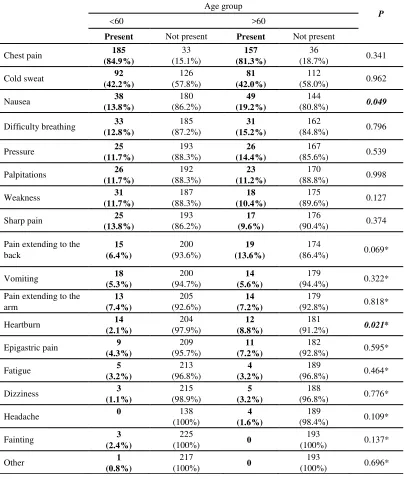
Difficulty breathing Heaviness on the chest Palpitations classified according to age group. Aside from nausea and heartburn, which were more prevalent among the elderly AMI patients, no complaints showed a significant difference in prevalence among the elderly AMI patients and the younger ones.
Characteristics of AMI patients according to age group
There were more female elderly patients than younger ones with AMI, as shown in Table 3. The length of time spent before entering the hospital was significantly longer for elderly AMI patients compared to younger ones. There were more elderly non-Q wave AMI patients than younger ones. There was significantly lower increase in the level of creatinase kinase (CK) among elderly AMI patients than younger ones, while the difference in the increase in the level for CKMB between the two age groups was not significant. Treatment with thrombolytic was significantly less often used among elderly AMI patients compared to younger ones.
Risk factors according to age group
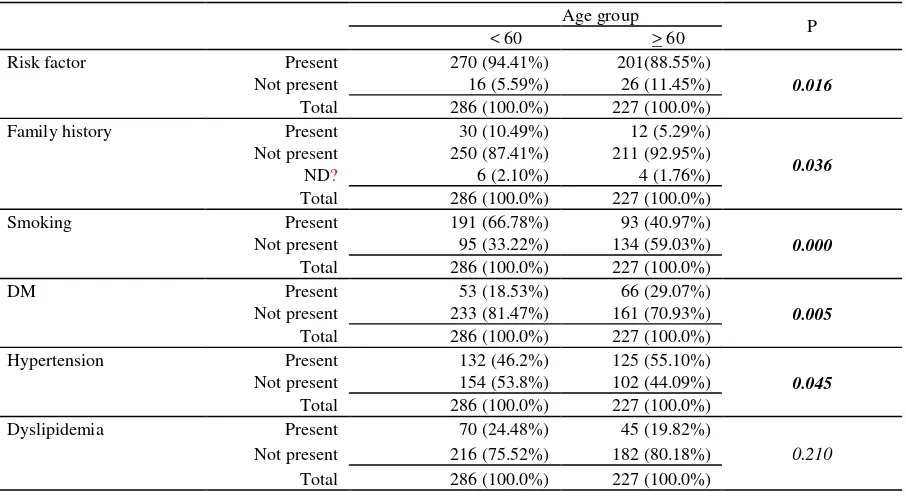
More elderly AMI patients presented no risk factors than younger ones. There was significantly more elderly AMI patients who were non-smokers and had no family history of AMI. Diabetes mellitus and hypertension was significantly more prevalent among elderly AMI patients compared to younger ones. (Table 4)
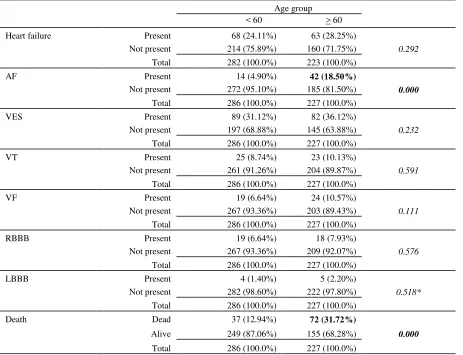
Complications of AMI according to age group
Table 2. Distribution of complaints according to age group
Age group
P
60 >60
Present Not present Present Not present
Chest pain 185
Difficulty breathing 33
(12.8%)
Pain extending to the back
Pain extending to the arm
Epigastric pain 9
Table 3. Characteristics of AMI patients according to age group
Age group
P 60 60
Sex Female 36 (12.59%) 80 (35.24%)
0.000
Male 250 (87.41%) 147 (64.76%)
Total 286 (100.0%) 227 (100.0%)
Hospital arrival time 6 hours 133 (50.76%) 76 (37.25%)
0.013
6-12 hours 42 (16.03%) 38 (18.63%)
12 hours 87 (33.21%) 90 (44.12%)
Total 262 (100.0%) 204 (100.0%)
Infarct type Non-Q 67 (23.43%) 71 (31.28%)
0.046
Q 219 (76.57%) 156 (68.72%)
Total 286 (100.0%) 227 (100.0%)
CK 380 125 (47.71%) 118 (57.56%)
0.034
380 137 (52.29%) 87 (42.44%)
Total 262 (100.0%) 205 (100.0%)
CKMB 50 160 (67.1%) 133 (65.84%)
0.632
50 102 (38.93%) 69 (34.16%)
Total 262 (100.0%) 202 (100.0%)
Thrombolytic agents Administered 59 (20.63%) 19 (8.37%)
0.000
Not administered 227 (79.37%) 208 (91.63%)
Total 286 (100.0%) 227 (100.0%)
Table 4. Risk factors of AMI patients according to age group
Age group
P < 60 > 60
Risk factor Present 270 (94.41%) 201(88.55%)
0.016
Not present 16 (5.59%) 26 (11.45%)
Total 286 (100.0%) 227 (100.0%)
Family history Present 30 (10.49%) 12 (5.29%)
0.036
Not present 250 (87.41%) 211 (92.95%)
ND? 6 (2.10%) 4 (1.76%)
Total 286 (100.0%) 227 (100.0%)
Smoking Present 191 (66.78%) 93 (40.97%)
0.000
Not present 95 (33.22%) 134 (59.03%)
Total 286 (100.0%) 227 (100.0%)
DM Present 53 (18.53%) 66 (29.07%)
0.005
Not present 233 (81.47%) 161 (70.93%)
Total 286 (100.0%) 227 (100.0%)
Hypertension Present 132 (46.2%) 125 (55.10%)
0.045
Not present 154 (53.8%) 102 (44.09%)
Total 286 (100.0%) 227 (100.0%)
Dyslipidemia Present 70 (24.48%) 45 (19.82%)
0.210
Not present 216 (75.52%) 182 (80.18%)
Table 5. Complications of AMI patients according to age group
Age group < 60 > 60
Heart failure Present 68 (24.11%) 63 (28.25%)
0.292
Not present 214 (75.89%) 160 (71.75%)
Total 282 (100.0%) 223 (100.0%)
AF Present 14 (4.90%) 42 (18.50%)
0.000
Not present 272 (95.10%) 185 (81.50%)
Total 286 (100.0%) 227 (100.0%)
VES Present 89 (31.12%) 82 (36.12%)
0.232
Not present 197 (68.88%) 145 (63.88%)
Total 286 (100.0%) 227 (100.0%)
VT Present 25 (8.74%) 23 (10.13%)
0.591
Not present 261 (91.26%) 204 (89.87%)
Total 286 (100.0%) 227 (100.0%)
VF Present 19 (6.64%) 24 (10.57%)
0.111
Not present 267 (93.36%) 203 (89.43%)
Total 286 (100.0%) 227 (100.0%)
RBBB Present 19 (6.64%) 18 (7.93%)
0.576
Not present 267 (93.36%) 209 (92.07%)
Total 286 (100.0%) 227 (100.0%)
LBBB Present 4 (1.40%) 5 (2.20%)
0.518*
Not present 282 (98.60%) 222 (97.80%)
Total 286 (100.0%) 227 (100.0%)
Death Dead 37 (12.94%) 72 (31.72%)
0.000
Alive 249 (87.06%) 155 (68.28%)
Total 286 (100.0%) 227 (100.0%)
DISCUSSION
According to literature, elderly AMI patients rarely present typical chest pain. AMI patients present chest pain in 80% of cases among those 65 years or less, 72% among 66-74 years olds, and 49% in those 75 years or more. Patients often present atypical complaints such as fatigue, weakness, syncope, confusion, cold sweats, difficulty in breathing, vertigo, vomiting, epigastric pain, or even often present to complaints at all.1-8 In the elderly, acute myocardiac infarct present difficulty breathing in 22% of cases, chest pain in 21%, syncope in 8%, stroke in 7%, confusion and giddiness in 20%, sudden death in 8%, and other symptoms in 14%.7 These findings differ from data obtained from the ICCU of Cipto Mangunkusumo Hospital, where most of the elderly
patients still presented typical chest pain and statistically did not significantly differ in presenting symptom compared to their younger counterparts. Nevertheles, the elderly were more commonly found with gastrointestinal symptoms, particularly nausea (p< 0.05). Thus, we have to be alert when an elderly patient comes with dyspepsia. The prevalence of chest pain did not significantly differ among age groups. There were significantly a larger proportion of females among elderly AMI patients than among younger AMI patients, which has also been noted by Paul.5
affects the choice of treatment at the hospital, since they have often passed the golden period. We can see from the data above that fewer elderly patients receive thrombolytic agents. This is also associated with arrival at the hospital past the golden period. The Second International Study of Infarct Survival (ISIS-2) reported that thrombolytic agents can reduce the mortality risk in the elderly. The mortality rate of elderly patients receiving streptokinase and aspirin is 15.8%, compared to 23.8% of those receiving placebo.12
Paul SM et al found that there were more elderly myocardial infarction patients with non-Q wave MI. Non Q-wave MI is found in 76% of AMI patients over 75 years of age, 67% of those ages 66-74 years, and 56% in those 65 years or less.5 However, data from the ICCU of Cipto Mangunkusumo General Hospital demonstrated a higher prevalence of Q-wave MI than non Q-wave MI, even though the proportion of non-Q wave MI was still significantly higher among elderly AMI patients than among their younger counterparts. Non-Q wave MI is more common in the elderly due to increased collaterals in order to protect the heart from transmural infarction.
There is a lower increase of CK enzyme in elderly AMI patients compared to younger patients, it is thought to be associated with reduced lean body mass in the elderly.10
Risk factors of diabetes mellitus and hypertension were more common among the elderly, while smoking, dyslipidemia and family history of AMI were more common among the younger patients. The same findings were reported by Paul.5
Atrial fibrillation was significantly more common among elderly AMI patients than among their younger counterparts, while the prevalence of other complications were not significantly different among the two age groups. Other complications are more common among elderly AMI patients.1 The mortality rate is significantly higher among elderly AMI patients than among younger AMI patients. Paul reported a 5% mortality rate among AMI patients less than 65 years of age, 8% among AMI patients ages 66-74 years, and 19% among patients over 75 years of age (p <0.001).5
Smith SC reported a hospital mortality rate of 20% among AMI patients over 75 years of age, and 12% among those ages 65-75 years.13 Due to atypical complaints, elderly AMI patients often come to the
hospital too late, and atypical electrocardiogram causes a lower use of thrombolytic agents, which influences mortality.14,15
It is concluded that the elderly constitutes 44,2% of AMI patients and 35,2% of them were female. Most of the elderly AMI patients reported typical chest pain just like their younger counterparts. Elderly AMI patients tend to come later to the hospital, and more Q-wave myocardial infarction were identified compared to non-Q-wave myocardial infarction. Risk factors of diabetes mellitus and hypertension were more common among the elderly, while smoking, dyslipidemia, and family history, were more commonly identified among the younger AMI patients. The prevalence of atrial fibrillation and the mortality rate were higher among elderly AMI patients.
REFERENCES
1. Wenger NK. The eIderly patient with cardiovascular disease. Heart Dis 2000; 2:31-61.
2. Golberg RJ, Gore JM, Gurwitz JH et al. The impact of age on the incidence and prognosis of initial acute myocaraial infarction. The Worcester Heart Attack Study Am Heart J 1989:117:543-9.
3. Nadelmann J, Firshman WH, Ooi W(J. et al. Prevalence, incidence and prognosis of recognized and unrecognized myocardial infarction in per persons age 75 years or older: the Bronx Aging Study.Am J Cardiol1990; 66:533- 7. 4. Solomon CG, Lee TH, Cook EF et al. Comparison of
clinical presentation.of acute myocardial infarction in patients older than 65 years of age to younger patients: the Multicenter Chest Pain Study experiene. Am J Cardiol 1989; 63: 772-6.
5. Paul SD, O'Gaza PT, Mahjoub ZA et al. Geriatric patients with acute myocardial infarction: cardiac risk factor profiles, presentation, thrombolysis coronary interventions and prognosis, Am Heart J 1996; 131: 710-5.
6. Wei JY. Coronary heart disease In: Hazzard WR. Blass JP, Ettinger WH et al, Editors. Principles of Geriatric Medicine and Gerontology 4th ed. New york; McGraw-HiI1:1999.p. 661- 8.
7. Crepaldi G, Scognamigli R. Myocardial infarction in Evans JG, Williams TF, Bcattie BL, editors. Oxford Text book of Geriatric Medicine. 2 nd. Oxford: Oxford university Press; 2000.p. 394-402.
8. Gurwitz JH, MC L.aughlin T J, Willison DJ et al. Delayed hospital presentation in patien whO have had acute myocardial infarction. Ann Intern Med 1997; 126: 593- 9. 9. Marcus, Friday K, Mc Cans J, et al. Age related prognosis
after acute myocardial infarction: the multicenter Diltiazem Postinfarction trial. Am J Cardiol 1990; 65:559-66. 10. Hong RA, Licht JD, Wei JY et al. Elevated CK-MB with
11. The Joint European Society of Cardiology/American College of Cardiology Committe. Myocardial infarction redefined. A consensus document of The Joint European Society of Cardiology/American College of Cardiology Committee for the Redefinition of Myocardial Infarction. Eur Heart J 2000; 21: 1502-13.
12. Gruppo Italiano per 10 Studio della Streptocinase neil Infarcto Micardico (GISSI). Effectiveness of intravenous thrombolytic treatment in acute myocardial infarction Lancet 1986; 277:397-401.
13. Smith SC, Gilpin E, Ahnve S. Outlook after acute myocardial infarction in the very elderly compared with that in patients aged 65 to 75 years. J Am Coll Cardiol 1990; 16: 784-92.
14. Delvin W, Cragg Do Jack M, et al. Comparison of outcome in patients with acute myocardial infarction aged > 75 years with that in younger patients. Am J Cardiol 1995; 75: 573- 6.