(A Ca セエオ、ケ@ at the Second Year Students ofSMA Darul Ma'arifCipete, Academic Year 2005/2006)
Skripsi' presented to the Faculty ofTarbiyah and Teachers' Training >artial fulfillment of the Requirements for the Degree ofSai:jana (S-1)
By
IFAI-1 FATHILLAH 101014020799
ENGLISH DEPARTMENT
F ::'UL TY OFT ARBIYAH AND TEACHERS' TRAINING
SC
1!: DIFFICULTIES ENCOUNTERED BY HIGH SCHOOL
5 )DENTS IN LEARNING ENGLISH PRONUNCIATION
(A Ca Study at the Second Year Students ofSMA Darn! Ma'arifCipete, AcademicYear 2005/2006)
'Skripsi' presented to the Faculty ofTarbiyah and Teachers' Training Jartial fulfillment of the Requirements for the Degree of Smjana (S-1)
By: Ifah Fathillah 101014020799
Approved by: Advisor
DR.Atig Susilo, M.A. NIP. 150 182 900
ENGLISH DEPARTMENT
F
セulty@OF TARBIYAH AND TEACHERS' TRAINING
S'\'
llF HIDAYATULLAH STATE ISLAMJ[C UNIVERSITY
A 'skr
i'
titled : "Some Difficulties Encountered by High School Students inLearn. English Pronunciation" (a case study at the second year students of SMA
Dami .'arif Cipete, academic year 2005/2006) was examined at examination
session ·the faculty of Tarbiyah and Teachers' Training Syarif Hidayatullah State
Islamic 1iversity (UIN) Jakarta on March 3'ct, 2006. This 'skripsi' has fulfilled the
require 1ts for the degree of Strata I (SI) at English Department.
The F. d of Committee
Thr xaminer I
IL
Drs.Na: 11 Mahmud, M.Pd NI 50 041 070
Jakarta, March 9"1, 2006
Examination Committee
The Secretary of Committee
J/P
セセセイイッコゥL@
M.ANIP. 150 202 343
The Examiner II
ᄋセG|スセ@
ACKNOWLEDGEMENT
the name of Allah, the Beneficent and the Merciful. All praise be to Allah, lord of : world who has bestowed upon the writer the be:st grace and guidance in writing s 'skripsi'. Peace be to our Prophet Muhammad SAW, his descendants and his fo]J. ;rs.
st of all, the writer would like to express her greatest appreciation to her belovec 1rents, sister and brother, who have continuously given a motivation and great st )rt during her study.
; writer also would like to give her gratitude to DR.Atiq Susilo, M.A., her advisor io has given a precious advice and suggestion in writing this 'skripsi'. To Drs.Na: 1 Mahmud, M.Pd., the Head of English Department, for his precise thinkini 1d suggestions along the writer's period of study. And to all lectures who have tai t her.
d the writer also gives her special thanks to all her bestfriends who have support ler, shared their ideas, and spent wonderful time together: Pay, Indi, Ertin, Y enni, da, Jovi, Titin, Yuni and others that the writer could not mention one by one.
wever, the writer realizes that this 'shipsi' is still far from being perfect. Therefc :he writer would like to accept any constructive criticism and suggestion to make ti: skripsi' better.
ACKl' V\ILEDGEMENT ... .
TABL )F CONTENTS ... ii
LIST l TABLE ... v
CHAP RI INTRODUCTION ... . 1
A. Background of the Study ... . B. Limitation and Formulation of the Study... 3
C. The Objective of the Study... 4
D. The Research Methodology... 4
E. The Organization of the Writing... 5
CHAP' RII THEORETICAL FRAMEWORK ... . 6
A. PRONUNCIATION... 6
1. The Definition of Pronunciation... 6
2. The Goal of Teaching Pronunciation... 7
3. Aspects of Pronunciation... 8
a. The Sounds of the Language ... ·... 8
b. Stress and R11yth111... 12
CHAP RIII
B. FACTORS AFFECTING THE
ACQUISITION OF A REASONABLE
PRONUNCIATION IN ENGLISH... 26
1. The Learner's Native Language... 26
2. The Learner's Age... 26
3. The Learner's Exposure... 27
4. The Learner's Innate Phonetic Ability... 28
5. The Learner's Attitude and Sense ofidentity ... 28
6. The Learner's Motivation and Concern for Good Pronunciation ... 29
C. The English Pronunciation Teaching at the Second Year Students of SMA Darul Ma'arif... 29
RESEARCH METHODOLOGY AND FINDINGS . A. Research Methodology ... : ... .
30
30 · l. Place and Time of Study... 30.2. The Technique of Sample Taking... 30
3. The Technique of Data Collecting... 30
4. The Instrument of Research... 31
5. The Technique of Data Analysis... 31
B. Research Findings... 32
1. The Data Description ... 32
BIBLI :RAPI-IY
APPEl
lXES
A. Conclusion... 42
Table Table: Table: Table' Table: Table ( Table'.
LIST OF TABLE
List of Problem Area in The Aspects of Pronunciation ... . Frequency of Error in Vowels ... .. Frequency of Error in Consonants ... .' ... .. Frequency of Error in Word Stress ... .. Frequency of Error in Sentence Stress ... . Frequency of Error in Intonation ... . The Sequence of Aspects of Pronunciation
Problem Area Based on The Highest Frequency
32 33 35 36
38
39
[image:8.595.77.490.81.702.2]A. Bai 1round of the Study
nguage plays a great part in our life. Among the languages that are spoken today, y few are even tolerably well known to science. One of them is English, which poken by more native speakers than any other ャ。ョァオセァ・N@
glish is the most widespread of languages. More than 300 million people in the wo speak English. Different authorities put the number of people who speak Englisl a first language at anywhere between 300 million and 400 million, and it is still m competently as a second language by perhaps as many as 400 million globall ;l,lithout any doubt, English is the most important language in the world.
Indonesia, nowadays, English is taught as a foreign language since in the play g1 ) up to the university. The goal of teaching English is to enable students to use En h as a means of communication.
:cording to the curriculum of 2004, English language teaching includes four langua skills such as speaking, listening, reading, writing, that should be taught integra . The compo1)ents of language such as grammar, pronunciation and spelling could 1 aught to support the development of those skills, not ュ。セエ・イゥョァ@ the language compo tts themselves. 1
involv
2
セゥョァ@ able to speak English of course includes a number of sub-skills, vocabulary, grammar, pragmatics, etc. But m the process of comm cation, pronunciation is paramount important in foreign language teaching, since
s
:essful communication cannot take place without correct pronunciation.2onunciation is definitely the biggest thing that people notice when someone is spe< ,g English. Pronunciation is the aspect that most affects how the speaker is judged ' others, and how they are formally assessed in other skills. The way the speake )Unds when he or she speaks a foreign language has a strong influence on the ass ,ptions that people make about the speaker and the judgements they make about 1 sort of the speaker is.3
)nunciation is also the aspect of language that is most difficult to acquire. Althou some people with 'an ear for language' can 'pick up' pronunciation very effecfr r, for most it requires special training. Most learners are highly aware of this and co: mtly request further tuition in pronunciation.
spoken English, slight variations in sounds can present problems for ESL learner "hat is because some sounds and sound combinations that occur commonly in Engl may occur rarely or not at all in other language.4
munciation teaching should not only focus on segmental features (teaching specifii •lmds) but also on suprasegmental features (stress., rhythm, and intonation).
tp://www .developingteachers.com/articles _ tchtraini ng/pronp(_ d imitrios. ィエュセ@
tp://www.antimoon.com/how/pronounc.htm
Becau: poorly pronounced segments and suprasegments may have the result of disorie Jg the listener and inhibiting comprehension. Of course, the notion of correc· iS with regard to pronunciation is not tantamount to adherence to native speake )l'illS or Received Pronunciation (RP) rules and General America (GA).5
1e student who wishes to learn a second language well, especially if he will use it oral communication, must pay attention to some difficulties of mastering pronur tion. The teacher should understand some difficulties her students face and should . able to give specific help and guidance through proved techniques and proced s based on the scientific study oflanguage and language learning theory.
)111 the statements above, the writer tries to present the research about some
difficu s encountered by high school students in learning English pronunciation.
B. Li1 セエゥッョ@ and Formulation of the Study
:munciation has three aspects such as sounds, stress and rhythm, and intona1 . The writer limits herself to just focus on research of some difficulties encour ed by second year of high school students of SMA Darn! Ma'arif Cipete in learnin nglish pronunciation specifically in the aspects of pronunciation.
sed on the limitation above, the writer wants to formulate the problem of the stu as follows : "What are the difficulties encountered by high school students in lean i English pronunciation?"
4
C. TI: )bjectives of the Study
ie objective of the study is to know some difficulties In the aspects of pronm 1tion which encountered by high school students in learning English pronu1 1tion. Beside that, the result of this research is expected to be an input and consid tion for English teacher in developing the teaching English pronunciation.
D. Tl1 lesearch Methodology
1is writing is based on two researches : library and field research. To find the el1' theoretical framework, the writer collected some books from the library of UIN S ·if Hidayatullah Jakarta, the library of Tarbiyah Faculty UIN Jakarta, the library f American Corner UIN Jakarta, the library of American Indonesian Excha Foundation (AMINEF), and the library of British Council (now perpus aan Departemen Pendidikan Nasional). The writer also collected some article: )m the internet which related to the topic of discussion.
the field research, the writer conducted a research at the second year of high S· ol students of SMA Darn! Ma'arif Cipete Jakarta Selatan. The writer gave
E. Tl )rganization of the study
Jis 'skripsi' contains four chapters:
lmpter one is introduction. It consists of background of the study, limitation
and fo ulation of the study, the objectives of the study, the research methodology,
and th ·ganization of the writing.
mpter two is theoretical framework. It consists of the definition of
promu 1tion, the goal of teaching pronunciation, aspects of pronunciation : the
sound: ·the language, stress and rhytlun, intonation, factors affecting the acquisition
of a re ·nable pronunciation in English : the learner's native language, the learner's
age, tl: ;arner's exposure, the learner's innate phonetic ability, the learner's attitude
and se • of identity, the learner's motivation and concern for good pronunciation,
and th• tglish pronunciation teaching at SMA Darul Ma' arif.
!apter three is research methodology and findings. It consists of place and
time o e study, the technique of sample taking, the technique of data collecting, the
instrur .t of research, the technique of data analysis, the data description, the data
analys md the interpretation of data analysis.
CHAPTER II
THEORETICAL FRAMEWORK
A. Pn nciation
munciation is a language feature that most readily identifies speakers as non-na :. It is a filter through which others see them and often discriminate against them.
I. e Definition of Pronunciation
In some books which content about pronunc:iation, there are not any :cific explanation about the definition of pronunGiation that given by the hors of the books. Martin H. Manser and others in their dictionary define 1mmciation in general as "a way in which a language is spoken". munciation is also "a way in which a word is spoken".6
Michael Agnes and others define pronunciation as "the act or manner pronouncing syllables, words, and phrases with regard to the production of mds and the placing of stress, intonation, etc". Pronunciation is also "the :epted or standard ways of pronouncing a word, etc". 7
lartin H. Manser, Oxford Learner ·s Pocket Dictionary, (New York : Oxford University
Press, l 5 , p.331
2. le Goal of Teaching Pronunciation
Morley has outlined four important goals for pronunciation struction: functional intelligibility, functional communicability, increased lf-confidence, and speech monitoring abilities. 8
Intelligibility is defined as spoken English m which an accent, if esent, is not distracting to the listener. In other words, the aim of onunciation improvement is not to achieve a perfect imitation of a native cent, but simply to get the learner to pronounce accurately enough to be sily and comfortably comprehensible to other (competent) speakers. 9
Attempting to completely eradicate a foreign accent in an EFL class is unrealistic goal. It would be more reasonable to bring learners up to a point lere they do not make pronunciation mistakes that would affect their being .derstood.
Functional communicability is the learner's ability to function ccessfully within the specific communicative situations he or she faces. By amining the discourse our students will need to use in real life, we can see lich features of pronunciation might be particularly important for them to aster.10
1arianne Celce Murcia (ed), Teaching English as a Second or Foreign Language, (USA : Heinle< セゥョャ・L@ 2001), Third edition, p.118
)id
8
Increasing self confidence to our learners is also needed. Learners tve to gain confidence in their ability to speak and be understood.
Speech monitoring abilities is the learner's ability to pay attention to r or his own speech as well as that of others. Speech monitoring activities n help the learners to make better use of the input which they receive.11 3. :pects of Pronunciation
'
.
,.
Teaching pronunciation involves tlu·ee aspects of pronunciation, they
The sounds of the Language
Each language has its own distinctive set of categories, and pmt of the process of learning a new language is learning the significant sounds. The person who begins the study of a foreign language is faced with the problem of having to produce unfamiliar sounds. A system that would represent each different sound with different symbol would help him identify and imitate those sounds.
There are many different phonetics symbols that are used in some pronunciation books and some dictionaries. In this 'skripsi', the writer presents the American English phonetics symbols which mostly is used by Indonesian high schools.
American English has 40 (forty) sounds which consist of 16 (sixteen) vowels and 24 (twenty four) consonants. The sound system can be demonstrated in the following terms.12
1) Vowel sounds
In ordinary speech, a vowel is a voiced sound in the pronunciation of which the air passes through the mouth in a continuous stream, there being no obstruction and no narrowing such as would produce audible friction.13
Vowels are vocalic sounds, which mean that they are produced with the voice. The vowels are divided into two major categories; single vowel sounds (monophthongs) and combined vowel sounds (diphthongs).14
There are eleven monophthongs which can be distinguished in the following list of words :
I i I as in beat, feed /a/ as in box, father
I I I as in did, bit l '.) I as in bought, clog I u I as in book, good I re I . as in bat, bad /u/ as in student, food
/"I
as in but, mother\dam Gadsby (ed), Longman Handy Learner's Dictionmy of American English, (England: Pearson 1cation Limited, 2000), p. I
)aniel Jones, An Outline of English Phonetics, (New York: Cambridge University Press, 1960), 1' 1 edition, p.23
edition,
JO
I e I as in bet, bed iセ@ I as in shirt, murder
I ;i I as in among, about
Diphthongs are combinations of two single vowel sounds. These are two groups of diphthongs, each of which has a dominant monophthong in the combination.15 They are as follow:
• Combinations with I I I
I e1 I
/,1 I
I ai I
• Combinations with I u I
I au I I OU I
2) The consonants
as in date, paid as in boy, voice
as in bite, buy, cry, eye
as in about, how as in boat, road
A consonant is a sound accompanied or unaccompanied by voice which there is either a complete or partial obstruction which prevents the air from issuing freely from the mouth.16
Consonants are produced by positioning the tongue, lips and teeth in order to modify the passage of air through the mouth.17 There are many examples of this, and they can be paired as follows :
bid, p.9
da C. Ward, The Phonetics of English, (England: W,Heffor and Sons LTD., 1929), First
Unvoiced p f 8 t s tf f k
Voiced b v 0 d z d3 3 g
For example:
/p/ as in pack, happy lb/ as in bad, back
I fl as in fan, photograph /v/ as in voice, van /8/ as in thing, breath 101 as in then, breathe
I ti as in tie Id I as in dog, die
Isl as in sip, city, psychology lzl as m zoo, goes
I tf I as in church, nature, watch I d3 I as in jump, judge, major
If! as in she, ship, machine
13
I as in vision, measure /k/ as in cat, came, key lg/ as in got, gameThis difference between voiced and unvoiced consonants can be demonstrated to students by getting them to produce the two contrasting sounds. The other consonant sounds can be considered as miscellaneous. They can be distinguished in the following words :
/m/ as 111 man, some Ir I as in red, right /n/ as 111 no, sun /w I as in week, wet
I 1J I as in sing, ringing /y/ as in yes, use, music
12
Stress and Rhythm l) Stress
Stress is the relative degree of force used by a speaker on the various syllables he is uttering. It gives a certain basic prominence to the syllables, and hence to the words on which it is used. It is also incidentally assists in avoiding monotony .18
Stress is the term that speakers use to describe the point in a word or phrase where pitch changes, vowels lengthen, and volume increases: Stress is vitally important in conveying meaning in phrases and sentences. 19
Unlike vowel and consonant, which are single speech sounds, suprasegmental features (stress, rhythm, and intonation) normally stretch over more than a single segment, possibly a syllable, a complete word or phrase, whole sentences or even more.20
There are two types of stress : word (lexical) stress and sentence (syntactical) stress.
oger Kingdon, The Groundwork of English Stress, (Great Britain : Western Printing Services I I Bristol, 1958), p. I
remy Hanner, The Practice of English Language Teaching, (England : Longman, 200 I), Third edi· . p.32
Press, 19
a) Word stress
The smallest domain in which the contrast between stressed and unstressed syllables surfaces in the word. The characteristic patterning of these two kinds syllables is commonly called word stress. 21
Word stress 1s the relative degree of force used in pronouncing the different syllables of a word of more than one syllable. Monosyllables cannot be said to have word stress. In English, word stress is usually considered to occur in three degrees which have been given various names by different authorities : I.
Primary, strong, main or principal. 2. Secondary, half strong or medium. 3. Weak or unstressed.22
Word Stress Rules
There are many different ways to show stress and stress rules in some pronunciation books, but the writer presents only one kind of stress rule to focus the research in the next chapter.
N Candlin and H G Widdowson (ed), I'ro111111ciatio11, (New York : Oxford University p.38
14
Rogerson and Gilbert shows a set of clear headings helps to avoid the proliferation of confusing detail about word stress.23 They use capital letters to show the stress.
(1) Stress on first syllable
Most two syllable nouns and adjectives have stress on the first syllable.24 More than 90 percent of all English nouns of two syllables are stressed on the first syllable. For example :
- butter = BUTter - culture = CULture (2) Stress on last syllable
Most two syllable verbs have stress on the last syllable.25 More than 60 percent of all English verbs are stressed on the second syllable. For example :
- produce - begin
=proDUCE =beGIN
(3) Stress on penultimate syllable (second from the end).26
=>
Words which end in 'ic', for example :- static = STAtic
N Candi in and H G Widdowson ( ed), op cit, p. I 02
)id, p. I 03 ,;d
bid
bid
?id
Often such words contain a prefix (as with 'inter' and 'anti' above), and this prefix has a secondary stress (this is common with many long technical words).
(6) Compound words
=>
If the compound word is a noun, the stress goes on the first part.29 For example :- greenhouse - blackbird
= GREENhouse =BLACKbird
=>
If the compound word is an adjective, the stress goes on the second part. 3°
For example :- bad - tempered = bad - TEMpered - old - fashioned =old - FASHioned
=>
If the compound word is a verb, the stress goes on the second part. 31 For example :- understand - overlook b) Sentence stress
= underSTAND =overLOOK
1987), p
17
from word stress in either of two ways : Monosyllables may take sentence stress if they play an important enough part in the utterance, and words of more than one syllable may be unstressed if their function in the sentence is sufficiently unimportant. 32
2) Rhythm
Rhythm 1s a product of word stress and the way in which imp01iant items are foregrounded through their occurance on a strong beat, and unimportant items are backgrounded by their occurance on a weak beat. 33
The Stress - timed rhythm of English
English is a stress-timed language.
In
a stress-timed language, there is a tendency for stressed syllables to occur at regular intervals. The amount of time it takes to say a sentence in a stress-timed language depends on the number of syllables that receive stress. For example :The
birds
willeat
theworms.
When the speaker says each of these sente111;:es, the same tlu·ee syllables are stressed 'birds', 'eat', and 'worms'. Although the
toger Kingdon, foe cit
sentences become increasingly longer in terms of the number of syllables, it takes approximately the same amount of time to say them.
Placement of stress in sentences
For students to produce sentences that have the appropriate stress pattern and thus the appropriate English rhythm, it is necessary that they know which words of a sentence are stressed and which are not stressed.
English words can be divided into two groups : content words and function words. Content words are those that express independent meaning. Included in this group are; nouns, main verbs, adverbs, adjectives, question words, and demonstratives. Content words are usually stress.34
Function words are words that have little or no meanmg m themselves, but which express grammatical relationship. Function words include; articles, prepositions, auxiliaries, pronouns, conjunctions, and relative pronouns. Function words are usually unstressed, unless they are to be given special attention.35
Stress in connected speech is determined by the meaning that the speaker wants to convey through the content or information words
overley Collins and Inger M.Mees, op cit, p.115
19
in the utterance.36 For example, in the following situation, the speaker wishes to stress his or her concern for the other person by giving strong advice :
- You really SHOULD see a doctor a.bout that cough !
Intonation
Intonation is the rises and falls in tone that make the 'tune' of an utterance. It is an imp01iant aspect of the pronunciation of English. Intonation often makes a difference to meaning or implication.37
Intonation is often called the melody of language since it refers to the pattern of pitch changes that speakers use when they speak.
Functions of Intonation in English
Intonation has four important linguistic functions, they are :
1) Focusing function, by which the speaker focuses on the most significant information by means of the location of the nucleus. The nucleus .is typically at the end of the intonation group, and shift to an earlier syllable is often used to hightlight some information elsewhere in the utterance. 38
This can easily be demonstrated, nucleus shown in bold type :
'rank Fitzpatrick, op cit, p.42
:>enny, U.R., A Course in Language Teaching (Practice and theo1y), (London : Can1bridge Univcrs 'ress, I 996), p.49
Sophie adored her gorgeous new motorbike. (Not the old one) Sophie adored her gorgcons new motorbike. (Not the horrid one) 2) Attitudinal fonction is what allows speakers constantly to superimpose
an attitude on top of the bare semantic content of what is being said. 39 Neve1iheless, two tones -fall-rise and rise-fall- seem noticeably attitudinally marked, these tones are inherently laden with ce1tain implications :
Fall-rise -> doubt, correction, reservation, appealing to the listener to reconsider.
Rise-fall -> impressed, arrogant, confident, self-satisfied, mocking, putting down.
3) Grammatical function, which permits speakers to distinguish certain syntactic relationships, for example phrase and clause boundaries, question versus statement.40 One occasional example of the grammatical function of intonation in Eng!i:lh is where a grammatical statement is conve1ied to a question.
'bid, p.125
'bid
21
4) Discourse function, which covers diverse matters as the organization
of conversation between two or more speakers (e.g. signals for turn
taking), the indication of speaker or listener relationship (e.g. in
relation to power and authority) and the indication of new versus old
information.41 For example :
セ@
a) What is your name ?
セ@
•
b) what is your name ?In sentence a, the speaker uses falling pattern which tends to
sound distant and businesslike. It would not be inappropriate for a
policeman interviewing a suspect. In sen1ence b, the speaker uses
rising pattern which sounds far more friendly, as opposed to
interrogation, and could quite easily be a stage in ュセャ、ョァ@ a date.
Type of basic intonation pattern in the utterance
1) Statements
Falling tunes are most frequent with statements.42 For example:
Ibid, p.125-126
/\____
(When did John leave ?) A month or so ago.
In other book, rising-falling intonation is used with a statement or a simple declarative sentence. For example :
•
Susan bought a new sweater.
The pitch of the speaker voice rises at the major sentence stress, the first syllable of the word 'sweater', and falls over the second syllable of this word. When the voice falls to the bottom of the pitch range, it
usually indicates that the speaker has finished speaking.
If a rising intonation is used with a statement, an element of non-finality is imposed on the utterance. Sometimes it will imply that the speaker is questioning a statement. For example :
----<
It's well worth a visit? (well, I don't think so). 2) CommandsCommands are often said with a falling pattern. This is particularly the case if a superior is talking i:o an inferior (e.g. teacher to student), and if there is no possibility of discussing the issue. For example:
セ@
23
Rising-falling intonation is also used with commands. The pitch rises at the major sentence stress and falls over the remaining part of the sentence. For example:
Give her a sweater !
Commands are also said on a rising nucleus to express a gentler, warmer tone, with a kind of deference to the other person's feeling. The discourse effect given is one of non-finality, that something will soon follow. For example :
セ@
Don't worry. (It'll be alright.) 3) Wh-questionsIf the utterance is neutral or business-like, the most common pattern for wh-question is a fall tm1e-often al.ow fall. For example :
•
How can we possibly pay this bill ?
•
- What do you want to do with it ?
Wh-question frequently have rising tunes. As in the case of commands, a rise makes the utterance friendlier and more intimate. For example :
•
- How can I help you ? 4) Yes-no questions
The most common pattern for yes-no questions is a rise tune. For example :
•
Is he still married to Lisa ?
If yes-no questions are said on a falling pattern, they give the impression of being more like exclamatory statements. For example :
セ@
Do we have any choice? (it doesn't look as we have)
25
John left town ? 5) Tag question
If the tag rises, the implication is that the speaker is not really certain of the statement (perhaps 60 per cent). In meaning terms, it is equivalt;nt to a true question. For example :
Peter has seen a jaguar, hasn't he?
If the tag has a fall pattern, this indicates a far greater confidence in what the speaker is saying (perhaps 90 per cent). The falling tag here is not so much a true question as a request for confirmation of the statement. For example :
Peter has seen a jaguar, hasn't he ?
Tag question with rising-fallingfotonation are very often used to begin conversation. The speaker is not demanding an answer to a question but rather opening the lines of communication. For example :
B. F ors Affecting the Acquisition of a Reasonable Pronunciation in English
セ・ョキッイエィケ@ provides the variables that seem to impede or enhance the
acqui )n of a reasonable pronunciation in English.43 They are :
1. earner's Native Language
He Native Language is an important factor to consider in learning
nglish pronunciation. This is clearly demonstrated by the fact that a foreign
;cent has some of the sound characteristics of the learner's native language.
l1ese are often obvious enough to make a person's origins identifiable by
1trained as well as trained people. 44
Mother tongue transfer is generally more systematic, pervasive, and
:rsistent in the area of pronunciation (the foreign accent) than it is in
ammar or lexicon. The more differences there are, the more difficulties the
arner will have in pronouncing English.
2. 1e Learner's Age
We commonly assume that if we learn a second or foreign language in
:iJdhood, we generally learn to speak it fluently and without a foreign
cent. If we le.arn in adulthood, though we may attain considerable fluency
cl versatility, it is very unlikely that we will ever attain a native accent.
1ese two scenarios of the exact age-related limit on the mastery of
:munciation in a second or foreign language is stilJ debatable.
loanne Kenworthy, op cit, p.4
27
Eric Lenneberg in his book, The Biological Foundation of Language, .aims that linguistic ability is innate in humans. Innate behaviors have a ·itical period associated with their emergence. This theo1y based on this 1enomenon is called the "Critical Period Hypothesis"(CPH).45
Research on the acquisition of authentic control of the phonology of a •reign language supports the notion of a critical period. Most of the evidence dicates that persons beyond the age of puberty do not acquire what h2.s come
be called authentic (native speaker) pronunciation of the second language. Conversely, Emil Flege strongly rejects the CPH. He cites many Jdies showing adults often produce or perceive second language sounds as ell as or even better than children.46 Adult learners can succeed in acquiring 1ative-like pronunciation with theirs efforts and artificial instructions.
3. ie learner's Exposure
Another factor is the amount of exposure to English learner receives. It tempting to view this simply as a matter of whether the. learner is living in
English speaking country or not. If this is the case, then the learner is n·ounded by English and this constant exposure should affect pronunciation ills. Conversely, many people live in non English speaking countries but e English in many areas of their lives, such as work or school. It is not
i. Dough las Brown, Principles of Language Learning and Teaching, (New York : Addison Wesley gman Inc, 2000), p.58
ierely exposure that matters, but how the learner responds to the
pportunities to listen to and use English.47 4. he Learner's Phonetic Ability
Some people simply have more skill at or aptitude for imitating and
:oducing sounds and sounds patterns that are new to them. This skill has
セ・ョ@ variously termed 'aptitude for oral mimicry', 'phonetic coding ability' or
:uditory discrimination ability'.
One study has indicated that those with good phonetic abilities benefit
om pronunciation drills, tasks in which particular sounds are heard and the
arner has to imitate again and again. Because of the compiexities involved,
is seems a factor which is very much out of the control of the teacher. We
:n only operate on the assumption that our learners have the basic equipment
1d provide a variety of tasks so that something will suit the needs and
1ilities of each learner.48
5. 1e Learner's Attitude and Identity
It has been claimed that factors such as a person's sense of identity :d feelings of group affiliation are strong determiners of the acquisition of
curate pronunciation of a foreign language.49
foanne Kenw011hy, op cit. p.6
rbid, p.7
29
In many studies of attitude and motivation in language learning, it has een shown that those who show positive feeling towards the speakers of the ew language tend to develop more accurate, native like accents. 50
6. he Learner's Motivation and Concern for Good Pronunciation
Some learners seem to be more concerned about their pronunciation an others. When we talk in terms of strength of concern for pronunciation, e are really pinpointing a type of motivation. The desire to do well is a kind ·achievement motivation. 51
Learners may also be unconcerned because they simply are not aware at the way they speak is resulting in difficulty, irritation or misunderstand
i
r the listener.C. Th :nglish Pronunciation Teaching at the Second Year Students of SMA
Darul 11arif
1111e features of pronunciation can only be learnt with the aid of a teacher, and th thers can be learnt from the books. In English pronunciation teaching, the teache1 ies not use a book which has a phonetics symbols theory. The students only use a ' ksheet as their source in English learning. Beside, the teacher corrects the studen 1hen they do mispronounce.
bid, p.8
A. Re rch Methodology
1. ace and Time of Study
The research took place at SMA Darul Ma'arif which is located in JI. RS
Fa1 wati No.45 Cipete Jakarta Selatan. The writer conducted the research at
Slv Darul Ma'arif on December 1" 2005.
•2. te Technique of Sample Taking
SMA Darul Ma'arif has 451 students. They are divided into 12 classes; 5
cla ; of the first year, 4 classes of the second year, and 3 classes of the third
yez fhe total number of the second year students is 156. But the writer only
tak 10 students or about 20 % of the population as the sample of the research ..
3. 1e Technique of Data Collecting
In collecting the data, the writer used an oral test. This test was aimed for
the ;ond year of SMA Darul Ma 'arif students as a sample. The writer gave 20
ite1 that had to be pronounced by the students. Then the writer recorded each
31
4. te Instrument of Research
In this research, the writer gave an oral test to the second year students of Slv Darul Ma'arif. This test was focused on the aspects of pronunciation; seg ntal features (sounds; vowels and consonants), and suprasegmental features (sti and rhythm; word stress and sentence stress, and int01ption in different utt< tee types).
The instrument of the research for the SMA Darul Ma'arif students was cor led from Pronunciation by CN Candlin and HG Widdowson (ed), Longman Arr can English Dictionary, and Practical Phonetics and Phonology by Beverly
Coj > and Inger M.Mees.
5.
c Technique of Data AnalysisThe writer analyzes the data by using quantitative descriptive technique. It
wil described in the table percentage and the formula as follows :
No1
P = F x 100 N
P )ercentage
B ..
Re
.rch Findings1. ie Data Description
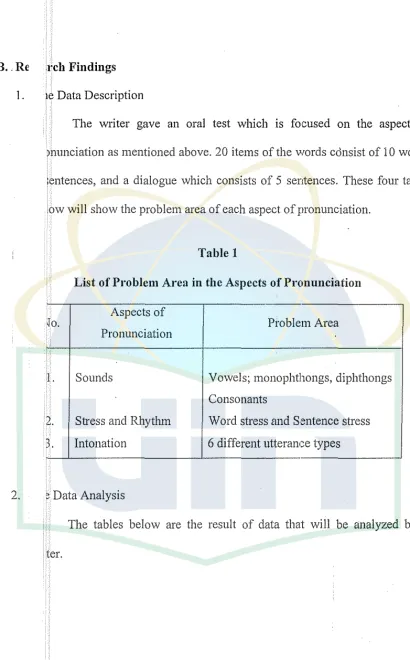
The writer gave an oral test which is focused on the aspects of )nunciation as mentioned above. 20 items of the words consist of 10 words, :entences, and a dialogue which consists of 5 sentences. These four tables low will show the problem area of each aspect of pronunciation.
Table 1
List of Problem Area in the Aspects of Pronunciation
fo.
Aspects of
Problem Area Pronunciation
1. Sounds Vowels; monophthongs, diphthongs
Consonants
2.
Stress and Rhythm Word stress and Sentence stress3.
Intonation 6 different utterance types2.
e
Data Analysis [image:39.595.86.497.45.706.2]33
Sounds
I) Vowels
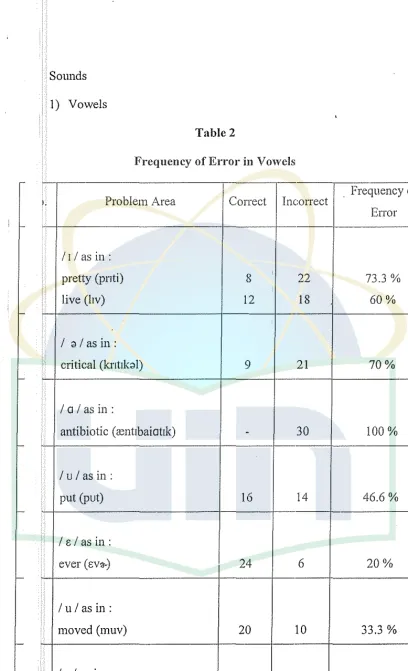
Table 2
Frequency of Error in Vowels
Problem Area Correct Incorrect . Frequency of
;,
Error
/r/asin:
pretty (pnti) 8 22 73.3 %
live (hv) 12 18 60%
•
I セO。ウ@ in:
critical HォョエQォセャI@ 9 21 70%
/a/asin:
antibiotic (rent1baiat1k)
-
30 100 %/u/asin:
put (put) 16 14 46.6%
/e/asin:
ever (evil--) 24 6 20%
/u/asin:
moved (muv) 20 10 33.3 %
[image:40.595.91.500.34.706.2]'
.
-some (sAm) 19 11 36.6%
he I as in:
last (ires) 19 11 36.6 %
Im I as in :
reliability (nla1ab1lati)
-
30 100 %I e1 I as in :
train (trem) 12 18 60%
/au/asin:
house (liaus)
3
27 90%
-Total 218 60.53 %
The phoneme I a I and I a1 I in the word 'antibiotic' (rent1bma t1k) and 'reliability' (nla1abilati) become the items with the highest frequency of error that reach up to 100 %. The students seem can not pronounce the phonemes correctly. They transferred the phonemes into their native language. It proves that the students have not got the knowledge of English monophthongs and diphthongs.
35
2) Consonants
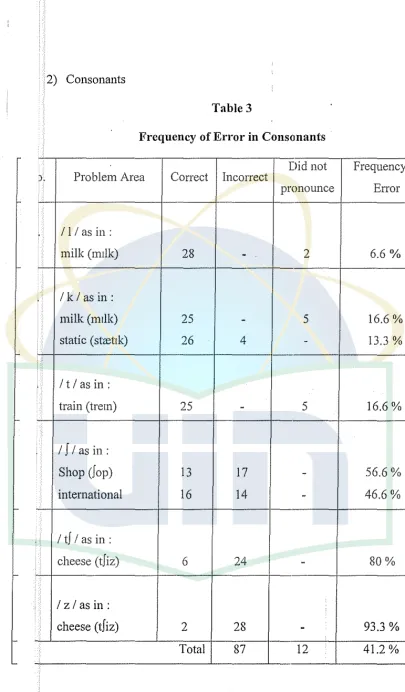
Table 3
Frequency of Error in Consonants
Did not Frequency of ). Problem Area Correct Incorrect
pronounce Error
/I/as in:
milk (mrlk) 28
-
2 6.6%/k/asin:
milk (milk) 25
-
5 16.6 %static ( stret1k) 26 4
-
13.3 %/t/asin:
train (trern) 25
-
5 16.6%If I
as in :Shop (fop) 13 17
-
56.6 %international 16 14
-
46.6%!tf/asin:
cheese
(tf
iz) 6 24-
80%/z/asin:
cheese (tfiz) 2 28
-
93.3 % [image:42.595.95.500.30.722.2]There were 28 or 93.3 % students who made error in pronouncing the phoneme I z I in the word 'cheese' (tfiz). The students pronounced the phoneme I z I as I s I (tfis). It shows that the students pronounced the phoneme I z I in the word 'cheese' like their mother tongue I s I for the word 'es'.
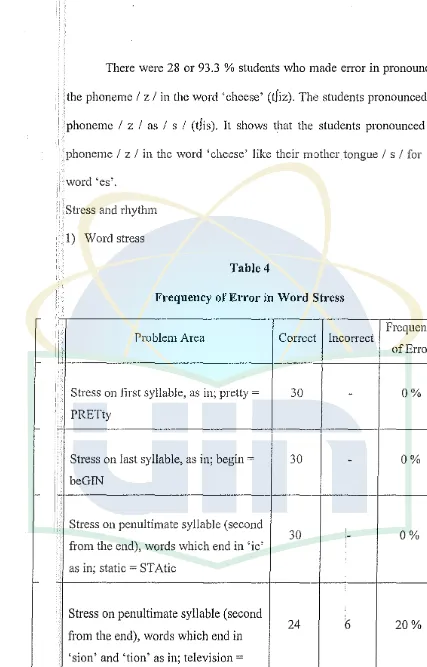
Stress and rhythm 1) Word stress
Table 4
Frequency of Error in Word Stress
Problem Area Correct Incorrect
Stress on first syllable, as in; pretty =
30
-PRE Tty
Stress on last syllable, as in; begin=
30
-beGIN
Stress on penultimate syllable (second
30
-from the end), words which end in 'ic' as in; static = ST Atic
.
Stress on penultimate syllable (second
24
6
[image:43.595.74.501.40.707.2]from the end), words which end in 'sion' and 'tion' as in; television=
Frequency of Error
0%
0%
0%
37
teleVIsion
Stress on ante-penultimate syllable
(third from the end), words which end 12 18 60% in 'cy, 'ty, 'phy, 'gy, as in; reliability
= reliaBility
Stress on ante-penultimate syllable,
2 28 93.3 %
words which encl in 'al', as in; critical
= CRitical
Compound word that is a noun, the
18 12 40%
stress goes on the first part, as in; greenhouse = GREENhouse
Compound word that is an adjective,
9 21 70%
the stress goes on the second part, as
.
in; bad-tempered = bacl-TEMpereclCompound word that is a verb, the
29 1 3.3 %
stress goes on the second part, as in;
.
understand = unclerST AND
Polysyllabic words, as in;
12 18 60%
international antibiotic = interNational antibiOtic
.
The table above shows that the highest frequency of error
comes at problem area number 6 with 93 .3 %. The word of number 6 is 'critical' which should be stressed the third from the encl, as
'CR!tical '. Twenty eight students stressed the first syllable from the
end.
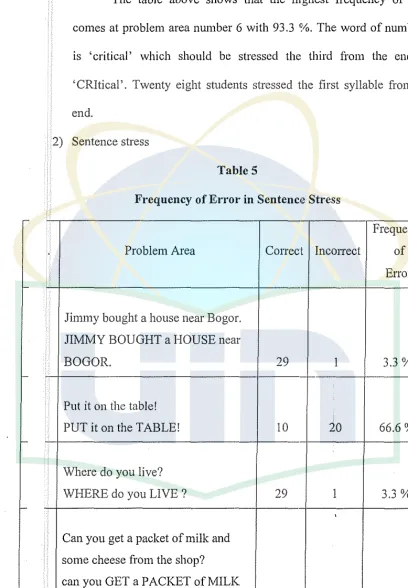
[image:45.595.87.496.111.700.2]2) Sentence stress
Table 5
Frequency of Error in Sentenc1e Stress
Frequency
Problem Area Conect Inconect of
Error
Jimmy bought a house near Bogor.
JIMMY BOUGHT a HOUSE near
BOGOR.
29
1 3.3 %Put it on the table!
PUT it on the TABLE! 10 20 66.6 %
Where do you live?
WHERE do you LIVE ?
29
1 3.3 %' Can you get a packet of milk and
some cheese from the shop?
No.
L
2,
3.
4,
39
I
and some CHEESE from the SHOP?I
16 14 46.6%Total 36 '29.95 %
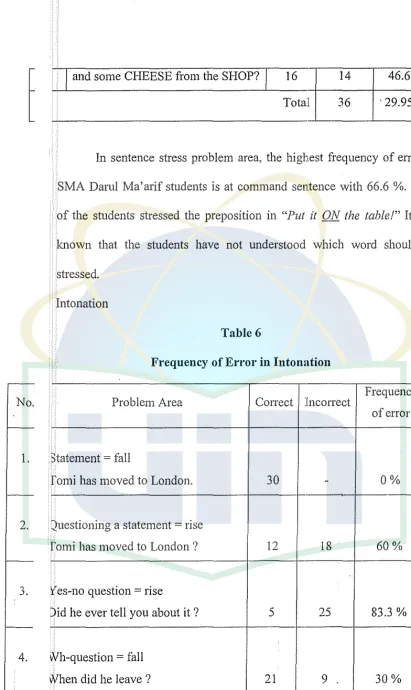
In sentence stress problem area, the highest frequency of error of SMA Darul Ma'arif students is at command sentence with 66.6 %. Most of the students stressed the preposition in "Put it ON the table!'' It was known that the students have not understood which word should be stressed.
Intonation
Table 6
Frequency of Error in Intonation
Problem Area Correct Incorrect Frequency of error
Statement = fall
fomi has moved to London. 30
-
0%:;/uestioning a statement =rise
fomi has moved to London ? 12 18 60%
I' es-no question = rise
)id he ever tell you about it ? 5 25 83.3 %
W'h-question = fall
[image:46.595.80.492.30.721.2]5.
6.
Command = fall
Put it on the table ! 30
-
0%Tag question= rise
He missed the train, didn't he ? 9 21 70%
Total 73 40.55%
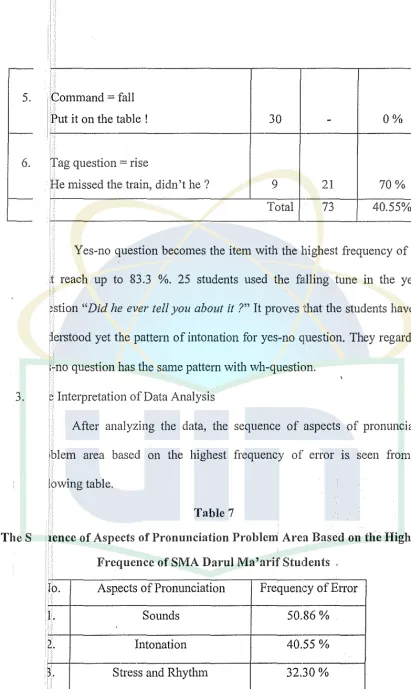
Yes-no question becomes the item with the highest frequency of error
.t reach up to 83.3 %. 25 students used the falling tune in the yes-no estion "Did he ever tell you about it ?" It proves that the students have not derstood yet the pattern of intonation for yes-no question. They regard that I-no question has the same pattern with wh-question.
3. e Interpretation of Data Analysis
After analyzing the data, the sequence of aspects of pronunciation iblem area based on the highest frequency of error is seen from the lowing table.
Table 7
The S 1.ence of Aspects of Pronunciation Problem Area Based on the Highest
Frcquence of SMA Darul Ma'arif Students ,
lo. Aspects of Pronunciation Frequency ofEiTor
I. Sounds 50.86 %
2.
Intonation 40.55 % [image:47.595.83.494.34.723.2]41
From the data analysis, there are some problems made by the students
tt can be found. First, the common problem is most of the students did not ow the difference between phonetic symbols with spelling rules. They used : spelling rules to pronounce English words. Therefore _the students seem counter some difficulties in pronouncing some English words. Second, lack students' knowledge of suprasegmental features has brought them to have ne difficulties in determining which word should be stressed and what onation pattern should be used in connected speech.
A. 'Co usion
· accomplishing the research, it can be concluded that SMA Darul Ma'arif
stuclen1 iacle error up to 60.53 % in English sounds that is vowels, which is divided
intd t\\ terns; monophthongs and diphthongs. This problem area takes the highest
freque1 of error.
B. Su: stion
sec! on the result of the research, the writer would like to offer some
sugges 1s, both for the students and the teacher. Phonetic symbol is different from
spellin: t is necessary for the students to know a distinction between the English
phonet ymbols and the English spelling rules. Therefore, the students should study
the phc ics symbols.
e students must also accustom themselves to the sounds, not only in the
orclinar peech of different people but in systematic exercise devised for the purpose.
side, the students must be able to use the clictionar·y in pronouncing some
words. this case, they have to know the authors and publisher background, whether
the dic1 1ary is used for American English, British English, or anything else.
ess, rhythm, and intonation are a complex system that operates at all levels
43
cau:ie 1 understanding, particularly in formal situations or when it is important to
sound lite. As a result, students need to be aware of and concerned about
supras< 1ental features and will need a lot of practice in producing them. Therefore,
a lot of :-training will be required in this area.
teaching pronunciation, the teacher should have a segmental features
(phone symbols) and suprasegmental features (stress, rhythm, and intonation)
knowle : and know how to use them in connected speech. His theoritical
knowle : and practical skill will enable him to devise exercises to get rid of wrong
and tea, :orrect sounds in the quickest time possible.
1ddition, it is essential for a teacher to have an ear-trained to recognise fine
distinct s in speech sounds if the teacher is going to correct pronunciation.
ally, based on the data, the core conclusion and suggestion the writer gives
to this セ。イ」ィ@ is that the competency of English pronunciation of the second year
ddison Wesley Longman Inc, 2000.
Candi CN, and HG Widdowson, Pronunciation : Language Teaching (A Scheme
1· Teacher Education), New York : Oxford University Press, 1994.
Celce, [arianne and Murcia (ed), Teaching English as a Second or Foreign mguage, USA: Heinle & Heinle, Third edition, 2001.
Collin leverly, and Inger M.Mees, Practical Phonetics and Phonology, USA dan mada: Routledge, 2003.
Depar .en Pendidikan Nasional, Standar Kompetensi !Ylata Pelajaran Bahasa :ggris SMA dan MA, Jakarta: Pusat Kurikulum Balitbang Depdiknas, 2003. Fitzpa k, Frank, A Teacher's Guide to Practical Pronunciation, UK : Phoenix
セtL@ 1995.
Hanm eremy, T/ze Practice of Englislz Language Teaching, England : Longman, iird edition, 200 I.
http://( 'f.cc. utexas.eclu/-birdsong/classnotes/CNFall2003/psy34 l k/age _ effects2Asu
1tm
http://' w.antimoon.com/how/pronounc.htm
http://' w.clevelopingteachers.com/articles _ tchtraining/pronpf _ climitrios.htm.
http://' w.formavision.com/catelt/it040005.htrnl
http://' w.natek.freenet.kz/galloway.htrn.
http://' w.stolaf.edu/clepts/cis/wp/hoyt/DeveloprnentalDesign.htrn.
Jones, miel, An Outline of English Phonetics, New York : Cambridge University :ess, Ninth edition, 1960.
Kenw :1y, Joanne, Teachi11g E11glislt Pro111111ciatio11, New York Longman Jblishing, 1987.
Kingd Roger, Tlte Groundwork of E11glish Stress, Great Britain Western 'inting Services LTD., 1958.
Penny .R., A Course in Language Teaching : Practice and Theo1y, London : unbridge University Press, 1996.
Thom: Charles-Kenneth, An Introduction to the Pfto11etics of American English,
SA: The Ronald Press Company, 1958.
I. Individual words : pretty
begin static television reliability critical
Compound words : greenhouse bad tempered understand Polysyllabic word :
international antibiotic 2. :ntences :
3.
Jimmy bought a house near Bogar. Put it on the table!
Where do you live ?
Can you get a packet of milk and some cheese from the shop ? He missed the train, didn't he?
alogue:
1to : Tomi has moved to London. mny : Tomi has moved to London? 1to : Yes. Did he ever tell you about it?
SEKOLAH MENENGAH ATAlS (SMA)
DARUL
maGaャセifᄋ@
statuセ⦅disamakan@
Jalan R.S. Fatmawati No. 45 Cipete Jakarta Selatan 1241 O Telp. (021) 7694127, 7666786
Fax. (021) 7668744
SURAT KETERANGAN
N0.012/SMA DM/U/XI/2005
'WWW
-Yang bertan , tangan dibawah ini :
Menarangka
セ。ュ。@
fabatan Afamat
セ。ュ。@
fomsan
: Sutarjo,S.Pd
: Kepala SMA Dami Ma'arif : Jl.RS.Fatmawati No.45
Cipete Selatan Cilandak Jakarta Selatan 12410
: Ifa11 F athillah : 101014020799
: Pendidikan Bahasa Inggris
Telah mengi rnn Riset di SMADaml Ma'arifJakarta, pada tanggal lDesember 2005. Di Kelas : SMA Dami Ma' arif Surat keterangan ini dibetikan kepada yang bersangkuta: 1tuk dipergunakan sebagaimana mestinya.