Quality of life after irst- and second- eye cataract surgery on community
project in Lombok Island, West Nusa Tenggara, Indonesia
Tjahjono D. Gondhowiardjo, Retno U. Hapsari
Department of Ophthalmology, Faculty of Medicine, Universitas Indonesia, Cipto Mangukusumo Hospital, Jakarta, Indonesia Abstrak
Latar belakang: Penelitian ini bertujuan untuk menilai adanya perbedaan nilai quality of life (QoL) dan time trade-off utility (TTO), pasca tindakan bedah katarak pada mata pertama dan mata kedua pada penduduk Lombok, Indonesia.
Metode: Data epidemiologis dan penilaian QoL dan TTO didapat dari subjek, sebelum dan tiga minggu setelah menjalani tindakan bedah katarak pada sarana bedah komunitas di Pulau Lombok. Kelompok A adalah pasien yang menjalani operasi pada mata pertama, sedangkan kelompok B adalah pasien yang menjalani operasi pada mata kedua. Pertanyaan kuesioner ditujukan untuk mendapatkan data kemampuan mengurus diri sendiri, kemampuan mobilitas, kehidupan sosial, dan status mental. Data dianalisis dengan uji chi-square untuk data kategorik dan uji t tidak berpasangan atau Mann-Whitney untuk data numerik.
Hasil: Data didapat dari 77 subjek, yang terdiri dari 50 subjek dari kelompok A dan 27 subjek dari kelompok B. Pasca bedah didapatkan adanya peningkatan QoL dalam hal kemampuan mengurus diri sendiri, kemampuan mobilitas, kehidupan sosial, dan status mental yang bermakna (p < 0,001), pada kedua kelompok. Peningkatan QoL terjadi pada 46 subjek di kelompok A, dan lebih meningkat lagi pada 22 subjek di kelompok B. Pengukuran TTO dapat diterima oleh 35 subjek pada kelompok A dan 22 subjek pada kelompok B. Delapan puluh tujuh persen subjek menyatakan hasil operasi yang sesuai dengan harapan mereka.
Kesimpulan: Tindakan bedah katarak pada mata kedua terbukti dapat lebih meningkatkan QoL pada subjek dengan hasil penglihatan mata pertama yang baik. Peningkatan kemampuan penglihatan pasca bedah telah sesuai dengan harapan para subjek. (Med J Indones. 2013;22:107-13)
Abstract
Background: This study aims to assess the quality of life and the time trade off-utility value of the irst eye cataract surgery and the second eye cataract surgery in Lombok Island-Indonesia.
Methods: This was an epidemiologic survey study on community of cataract surgery. Evaluations of quality of life (QoL) and time trade-off (TTO) were performed using questionnaire prior and three weeks after cataract surgeries who had either irst (group A) or second eye cataract surgery (group B). Personal data was noted especially on self-care, mobility, socially, and mentally status. Data was analyzed by chi-square test for categorical data and unpaired t-test or Mann-Whitney test for numeric data.
Results: A total of 77 subjects was included in this study, there were 50 subjects in group A and 27 subjects in group B. Elements of QoL were improved after surgeries including self care, mobility, social, and mental status in both groups (p < 0.001). The modiied TTO was accepted in 35 subjects in group A and 22 subjects in group B. Quality of life was improved in 46 patients in group A, there was further improvement in 22 patients in group B. The degree of patient’s expectation was good in 87% of all subjects.
Conclusion: Second- eye cataract surgery showed further improvement in QoL despite better outcome of the irst- eye cataract surgery. The outcome of cataract surgery conducted was relevant to the patient’s expectation.
(Med J Indones. 2013;22:107-13)
Keywords: First and second cataract surgery, quality of life, senile cataract, time trade-off
Correspondence email to: [email protected]
The objective of cataract surgery outcome on community is derived not only from the inal result of visual acuity but also based on patient’s preference and perception of quality of life (QoL).1,2 Utility value instruments show patient’s expectation after treatment for getting a better QoL using a health related QoL (HRQL) questionnaire.3-5 Another method used to determine QoL in cataract patients is time trade-off (TTO) method, a measurement of QoL based on the relative amount of remaining life time a patient willing to sacriice to obtain better vision. The higher the amount of time willing to be traded, the lower the utility value, relecting the lower quality of life due to cataract.5,6
Controversies in the role of second- eye cataract surgery on improving patient’s QoL persist in community. There were studies showed persistent limitation of daily activities in patients with irst- eye cataract surgery. They reported a better QoL improvement on patients with second- eye cataract surgery.7.8
Patients’ QoL can be assessed by combined instruments of TTO and QoL questionnaire which expected to show more obvious needs to do second- eye cataract surgery.
A community project of cataract surgery has been done since 1995 in this region.
The main purpose of this study was to assess the differences of QoL and TTO of cataract patients who have irst- eye cataract surgery compared with patients who have second- eye cataract surgery.
METHODS
This study was a prospective, before and after interventions in Kopang primary health care, Lombok, West Nusa Tenggara, Indonesia during a period of July 10th to August 21st 2009. Population target was senile cataract patients who plan to undergo cataract surgery.
The inclusion criteria was all senile cataract patients with the age of over 50 years old, best visual acuity (VA) of ≥6/60 in the superior eye or best VA of ≤ 6/60 in the cataract eye (irst- eye cataract surgery group), intra-ocular pressure (IOP) of ≤ 21 mmHg, no ocular disease or condition other than cataract which would affect visual acuity, no physical or mental handicap which would limit daily activities and cause dificulties on answering the questionnaire. The exclusion criteria were patients with complications during the surgery, refused to be interviewed, and with post surgical complication.
All patients who met the inclusion criteria were invited. Candidates for cataract surgery were divided into two groups based on history of cataract surgery; group A was a group with no history of previous cataract surgery and the cataract surgery was done on the eye with worse VA. Group B was the group with history of previous cataract surgery on the fellow eye. All patients underwent eye examination such as; VA (using Snellen chart), IOP measurement (Schiotz tonometer), anterior and posterior ocular segments evaluation (slit lamp, Innami, Japan). Subjects were interviewed using pre-surgical cataract questionnaire of TTO and QoL. One surgeon performed the extra capsular cataract extraction technique surgery, one day after the irst interview. Subsequent follow-ups were done on day 1, 7, and 21 to assess uncorrected visual acuity (UCVA) and to detect any complications. Twenty-one days after surgery, best-corrected visual acuity (BCVA) was assessed and each subject was once again interviewed using the post-surgical questionnaire for TTO, QoL and degree of patient’s expectation chart. All the questionnaires were completed and done by 5 trained local healthcare (local interpreter) supervised by one ophthamologist. The questions on TTO and QoL had been adjusted to meet the local language and culture. The QoL
questionnaire focused on 4 aspects of self-care, mobility, social, and mental status. Time trade-off is utility instrumentation describing cataract patient’s expectation to get the better VA. The produced value is called as utility value, describing the satisfaction level of the patient’s QoL up until the time of test and their desire to change the rest of their life to get the better QoL. The range of utility value is between 0.0 (very unsatisied with their life and want to change the rest of their life to get the normal vision) and 1.0 (very satisied with their present life, and need not change their life to get better VA). Utility value was assessed before the cataract surgery.
Quality of life was assessed based on cataract QoL questionnaire that already undergone validity study. Cataract QoL questionnaire focuses on four aspects: self-care, mobility, social, mental. Self-care relects a person’s ability to perform daily personal care; mobility deines a person’s ability to conduct activities outside the house; social status relects the ability to participate in social events and to interact with the surroundings; and effects of a disease on mental status such as patients feeling. Quality of life was assessed before the cataract surgery and on 21st day afterwards. Quality of life value was calculated from observed total value, divided by maximal total value and multiplies with 100. The range of QoL value is between 0-100%.
The expectation achievement was assessed by asking patients’s VA expected after cataract surgery using a grading method. The range of expectation achieved is between 0 (no achievement at all) and 10 (achieved based on the expectation before the operation). The assessment of expectation achievement was administrated on the 21st day post operation.
The expectation achievement was divided into three categories: 1) Bad: expectation value 0-3; 2) medium: expectation value 4-6; 3) good: expectation value 7-10
Time trade-off questionnaire
Time trade-off questionnaire used was a modiied questionnaire based on Lombok-Indonesia culture that already experienced the validity test.
need to present when the child undergo important moment (graduation, getting married). If the child has already married, patient was asked the next question; 3) Grandchildren, subject was asked about their desire to experience their grandchildren important moment (circumcision, graduation, getting married). If grand children were older and married, the question will be modiied to any life moment that deemed important for the subject.
Deducted from the irst question, we decided on desired subject life period that named (X). This was then used as a standard to answer the next question, “for the period of X years, how long did his or her visual acuity will decline?”: 1) The related answer of the subject, called as Y; 2) The next question was “which one is more appealing to subject, X years with visual impairment condition or (X-Y) years without visual impairment.” 3) The life period that subject will exchange can be determined as X or (X-Y); 4) The life period that will exchange, can be asked again to the subject on question form or local language that can be understood by the subjects; 5) All collected numbers can be insert into the formula below.
Cataract QoL questionnaire
Cataract QoL questionnaire used in this research was a cataract standard assessment form created by WHO, and already modiied and adjusted with Lombok-Indonesian culture and undergone validity study.
Questions about the QoL were divided into four aspects that are self care, mobility, social, and mental. Every aspect consists of 3-4 questions. Subject was asked to answer the questions in range of 4-0 values. Four values were given if the subjects don’t get any handicap at all and 0 is given if the subjects need other help for such activities. Total QoL value was then calculated with this formula.
QoL value = ( value X 100) / max value
All collected data was analyzed using computerized SPSS 13 program. Chi-square test was used to determine relation of gender, educational background, and occupation with the outcome. The mean TTO and QoL value were calculated and compared using unpaired t-test or Mann-Whitney test. Signiicance level or critical p-value was < 0.05 with a power of 80%. complications during surgery, and 2 were identiied with posterior segment disorder. Fifty subjects in group A and 27 subjects in group B were included in this study. Only 35 subjects from group A and 22 subjects from group B were interviewed using the TTO measurement.
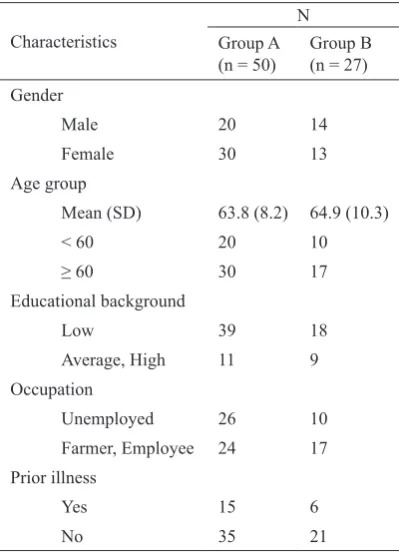
Table 1 showed the characteristics subject between the groups. There was 30/50 female in group A with the mean age of 63.8 ± 8.2 years old. There were 13/27 female in group B and the mean age of 64.9 ± 10.3 years old. The majority of subjects on both groups had low level educational background, group A 39/50 and group B 18/27, respectively.
Figure 1 showed the age and occupation characteristics of the subjects on both groups. The majority of the subjects (52%) in the group A were unemployed, albeit 22% of them were in the productive age. Meanwhile, the majority of the group B (63%) had jobs. More
Farmer, Employee 24 17
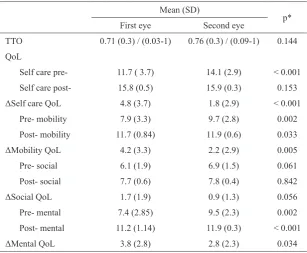
signiicant on QoL aspects of mobility (p = 0.033) and mental (p < 0.001), but not in self-care (p = 0.153) and social (p = 0.842) aspects (Table 3). A total of 35/50 subjects of group A and 22/27 subjects (22) of group B answered the TTO questionnaire. Fifteen subjects from group A refused to answer the TTO study. Only 5 subjects from group B refused to answer the TTO questionnaire. Their mean age was 64.2 ± 10.4 years old.
The mean life expectancy in group A was 54.3 ± 32.5 (7-150) years, while in group B was 61.45 ± 32.3 (18-100) years. The mean remaining life time willing to be traded by group A was 17.95 ± 26.6 (1-97) years, and in group B was 16.73 ± 24.9 (1-73) years. A bigger amount of remaining life willing to be traded by group A showed higher determination to undergo cataract surgery than in group B. The TTO value was then calculated and A group showed a slightly and insigniicantly (p > 0.05) lower TTO value compared to B group, showing lower QoL of the irst group, then higher expectation on having cataract surgery. (Table 3) Figure 1.
Figure 2.
Distribution of employment status after surgeries
Gender’s and employment status distribution
Figure 2 showed large number of employed males (24% out of 40%) compared to the females (24% out of 60%) in group A. The group B showed higher percentage of employed subjects from both genders, 37% of males and 26% of females were employed.
QoL and TTO outcome
All VA subjects participated in this study improved signiicantly after surgery (p < 0.001). Both groups showed signiicant improvement with mean VA of < 0.5 (logMAR) or equal to > 6/18 using Snellen chart. The QoL improvement was also signiicantly different in all aspects on group A; self-care, mobility, social, and mental (p < 0.001). The same result also shown in group B: self-care (p = 0.005), mobility (p = 0.001), social (p = 0.004) and mental (p < 0.001) (Table 2). An improvement of QoL was identiied in 46 subjects in the group A and 22 subjects in the group B.
Mean (SD) / Range
p*
Pre-surg Post-surg
First eye
UCVA (logMAR) 2.57 (0.83) 0.53 (0.3) < 0.001
BCVA (log MAR) 2.57 (0.83) 0.46 (0.3) < 0.001
QoL
Self care 10.8 (3.9) / (5-16) 15.5 (1.2) / (9-16) < 0.001 Mobility 7.2 (3.5) / (3-12) 11.4 (1.2) / (8-12) < 0.001
Social 6.1 (1.9) / (2-8) 7.7 (0.6) / (5-8) < 0.001
Mental 7.4 (2.9) / (3-12) 11.2 (1.2) / (6-12) < 0.001
Second eye
UCVA (logMAR) 3.04 (0.6) 0.4 (0.2) < 0.001
BCVA (log MAR) 3.04 (0.6) 0.3 (0.2) < 0.001
QoL
Self care 14.1 (2.9) / (7-16) 15.9 (0.3) / (15-16) 0.005
Mobility 9.7 (2.8) / (3-12) 11.9 (0.6) / (9-12) 0.001
Social 6.9 (1.5) / (4-8) 7.8 (0.5) / (7-8) 0.004
Mental 9.5 (2.3) / (5-12) 11.9 (0.3) / (11-12) < 0.001
Table 2. Comparison of pre- and post-surgical UCVA, BCVA, and QoL on both groups
*Wilcoxon test
Mean (SD)
p*
First eye Second eye
TTO 0.71 (0.3) / (0.03-1) 0.76 (0.3) / (0.09-1) 0.144
QoL
Self care pre- 11.7 ( 3.7) 14.1 (2.9) < 0.001
Self care post- 15.8 (0.5) 15.9 (0.3) 0.153
ΔSelf care QoL 4.8 (3.7) 1.8 (2.9) < 0.001
Pre- mobility 7.9 (3.3) 9.7 (2.8) 0.002
Post- mobility 11.7 (0.84) 11.9 (0.6) 0.033
ΔMobility QoL 4.2 (3.3) 2.2 (2.9) 0.005
Pre- social 6.1 (1.9) 6.9 (1.5) 0.061
Post- social 7.7 (0.6) 7.8 (0.4) 0.842
ΔSocial QoL 1.7 (1.9) 0.9 (1.3) 0.056
Pre- mental 7.4 (2.85) 9.5 (2.3) 0.002
Post- mental 11.2 (1.14) 11.9 (0.3) < 0.001
ΔMental QoL 3.8 (2.8) 2.8 (2.3) 0.034
Table 3. Comparison of TTO and QoL differences (ΔQoL) on the two groups
*Mann Whitney test
Table 3 showed that despite of signiicant improvement of QoL found on both groups after the surgery, the QoL difference (ΔQoL) was found higher on all aspects of QoL in group A compared to group B. The differences
Table 4.
Table 5.
TTO and ΔQoL according to the UCVA of the fellow eye in the second- eye cataract surgery group
Comparison of fellow eye VA with TTO value and the degree of expectation met *Kruskal Wallis test
UCVA of the fellow eye ΔQoL TTO
Self care Mobility Social Mental
Normal (n = 13) 2.1 (2.9) 2.5 (3.2) 1 (1.53) 3.2 (2.4) 0.84 (0.27)
Low vision (n = 11) 1.4 (2.9) 1.75 (2.4) 0.83 (1.3) 2 (2.1) 0.72 (0.36)
Blind (n = 3) 2 (3.5) 2.3 (4) 0.67 (1.2) 1.3 (1.53) 0.49 (0.4)
p* 0.68 0.8 0.95 0.37 0.33
UCVA TTO Degree of expectation met
Good Average Poor
First eye Low vision (n = 7) 0.90 7 (14) 0 0
Blind (n = 43) 0.69 35 8 (16) 0
Second eye Normal (n = 13) 0.84 11 (41) 2 (7) 0
Low vision (n = 11) 0.72 11 (41) 0 0
Blind (n = 3) 0.49 3 (11) 0 0
Total N = 77 67 (87) 10 (13) 0
Variations of fellow eye’s visual acuity in the second- eye group might be the factor that affected the value of TTO and QoL.
The quality of life difference (ΔQoL) in group B, according to UCVA of the fellow eye (13 normal eyes, 11 low vision eyes and 3 of blind eye) did not show signiicant difference. The result were as follow; self-care (p = 0.68), mobility (p = 0.8), social (p = 0.95) and mental status (p = 0.33)(Table 4).
The degree of patient’s expectation had a good result in 87%. The expectancy was better at group A than group B (Table 5).
DISCUSSION
This study showed the QoL of patients from both groups was signiicantly improved in all aspects after cataract surgery. The QoL difference (ΔQoL) was signiicantly higher on group A than group B, especially on the aspects of mobility, and mental status. There were two main reasons why the patients keen to do for a second- eye cataract surgery; they were hoping to have longer life expectancy and chances to have more opportunity in life because of better their VA, visual ield, motion of perception and stereo vision capability.
Another issue considered by the subjects was unsatisfactory result of the irst surgery (VA below the WHO normal category of more than 6/18); those subjects (22 out of 77) had higher expectations of undergoing the second- eye cataract surgery. This inding was similar to a study done by Desai et al10 (1997) in United Kingdom. Although our study was a decade behind compared to European countries, this data could act as a reference for eye healthcare providers to increase the number of second- eye cataract surgery. This will enhance Cataract Surgical Rate (CSR) in Indonesia, aiming at improving its community’s QoL.11
The effects of cataract surgery on patient’s QoL have been vastly studied using various instrumentation.12-15 The instrument used in this study was a valid, WHO standardized QoL questionnaire. Using the QoL questionnaire as a tool, not only give more accurate portrait of patients’ aspect of life beside VA assessment, but also relect the physical, mental characteristics and functional capability of patients.12
gender found in this study suggests an increment in male patients’ desire to undergo second- eye cataract surgery compared to the irst- eye cataract surgery. They were willing to do the second surgery because of satisfying results from the irst surgery, also the subjects’ need for binocular vision and spatial perception.
This study suggested when doing bilateral cataract surgeries; ability to have employment will increase. The second surgery was proicient to increase one’s conidence to do work more independently, even in patients who was in the non-productive age (more than 60 years old). The patriarchy system embraced the mindset of the people of Lombok with their believes that male are the main wage earner of their family.
Comparable studies in cataract surgeries outcome in VA and QoL improvement have similar result with our study.15,16
The improvement of QoL in the group A showed that by performing one-eye cataract extraction on patients with bilateral cataract, some dificulties remained unsolved. Unilateral vision on bilateral cataract patient caused anisometropic condition which might establish post-surgical visual disturbances. It is important to do second- eye cataract surgery to improve patient’s mobility, orientation, and avoidance to fall were studied.16-18
According to the TTO values, group A had lower level QoL than group B. Even though it was not statistically different, this value was prone to have a greater life expectancy for group A than group B. Time trade off subject distribution according to UCVA of the fellow eye showed that subjects with worse VA of the fellow eye had inferior QoL and higher expectation for getting cataract surgery.
This study has a limitation because it was conducted in a community with the majority of the people living as farmers and ishermen with low level of educational background, which technically does not require excellent VA. Therefore, the subjects might not be sensitively aware of the impact the VA of the fellow eye for their daily activities, this is affecting the assessment of TTO and QoL value. Only 74% of the subjects were willing to answer the question. The majority of subjects who refused had low level of education, language dificulties, problems with interview delivery process and interviewer’s choices of words, and also religious issue.
In conclusion, a higher value of TTO was found on post-cataract surgical patients with second- eye cataract surgery, as compared to patients with irst- eye cataract
surgery. There was a signiicant difference of QoL before and after cataract surgeries in both group (ΔQoL), and the difference was higher on subjects with irst- eye cataract surgery. The majority of subjects met their expectancies (87%).
REFERENCES
1. Pesudovs K. Patient-centered measurement in ophthalmology - a paradigm shift. BMC Ophthalmol. 2006;6:25.
2. Asadi-Lari M, Tamburini M, Gray D. Patient’s need, satisfaction and health relaed quality of life: towards a comprehensive model. Health Qual Life Outcomes. 2004; 2:32-47.
3. Rahman MM, Rahman S, Begum N, et al. Client expectation from doctors: expectation-reality gap. Kathmandu Univ Med J. 2007; 5(4):556-73.
4. Guyatt GH, Feeny DH, Patrick DL. Measuring health-related quality of life. Ann Intern Med. 1993:118(8):622-9. 5. Measuring healthy days: population assessment of health
related quality of life. Georgia: US Department of Health and Human Services;2000.p.1-7.
6. Brown GC, Sharma S, Brown MM, Kistler J. Utility value and age-related macular degeneration. Arch Ophthalmol. 2000;188(1):47-51.
7. Lundstrom M, Stenevi U, Thorburn W. Quality of life after irst and second eye cataract surgery. J Cataract Refract Surg. 2001;27(10):1553-9.
8. Castells X, Alonso J, Ribo C, et al. Comparison of the result of irst and second cataract eye surgery. Ophthalmol. 1999;106(4):676-82.
9. Agustiawan R. Prevalence of cataract in Lombok Island [thesis]. Mount Pleasant (MI): Universitas Indonesia; 2006. Indonesian.
10. Desai P, Reidy A, Minassian DC, Vaidis, Bolger J. Gains from cataract surgery: visual function and quality of life. Br J Ophthalmol. 1996;80(10):863-73.
11. National strategic planning to prevent blindness in vision 2020. Jakarta. Association Ophthalmology of Indonesia. Indonesia Minister of health. 2003;p.1-4. Indonesian. 12. O’Connor R. Issues in the measurement of health-related
quality of life. NHMRC National Center for Health Program Evaluation 1993; Melbourne, Australia;1993. 13. DG Jayamanne, Wood CM. Correlation between early,
measureable improvement in quality of life and speed of visual rehabilitation after phacoemulsiication. J Cataract Refract Surg. 1999;25(8):1135-9. Quality of life associated with unilateral and bilateral good vision. Ophthalmology. 2001;108(4):643-7.
17. Laidlaw DA, Harrad RA, Hopper CD, et al. Randomized trial of effectiveness of second eye cataract surgery. Lancet. 1998;352:925-9.