OIL PARTICLE ANALYSIS USING FOURIER
TRANSFORM INFRARED SPECTROSCOPY
NURUL ASYIKIN BINTI
ADENAN
'.I1 p.
UNIVERSTI
TEKNIKAL
MALAYSIA MELAKA(UTeM)
Oil Particle Analysis Using Fourier Transform
Infrared Spectroscopy
Report submitted in accordance with the partial requirements of the Universti Teknikal Malaysia Melaka (UTeM) for the Bachelor of Manufacturing
Engineering (Material Engineering)
NURUL ASYIKIN
BINTI
ADENANUTeM Library (Pind.112007)
UNiVERSlTl TEKMIKAL MALAYSIA MELAKA
JUDUL: O I L PARTICLE ANALYSIS USING FOURIER ---- TRANSFORM INFRARED
SPECTROSCOPY.
SESl PENGAJIAN : 2004/2008
Says - NURUL ASYIKIN BINTI ADENAN
mengaku membenarkan tesis (PSMISarjanalDoktor Falsafah) ini disimpan di Perpustakaan Universiti Tekni kal Malaysia Melaka (UTeM) dengan syarat-syarat kegunaan seperti berikut:
1. Tesis adalah hak milik Universiti Teknikal Mataysia Melaka
.
2. Perpustakaan Universiti Teknikal Malaysia Melaka dibenarkan membuat salinan untuk tujuan pengajian sahaja.
3. Perpustakaan dibenarkan membuat salinan tesis ini sebagai bahan pertukaran antara institusi pengajian tinggi.
4. **Sila tandakan
( 4 )
(Mengandungi maklumat yang berdarjah keselamatan SULIT atau kepentingan Malaysia yang termaktub di dalam
AKTA RAHSIA RASMl 1972)
' TERHAD (Mengandungi maklumat TERHAD yang telah ditentukan oleh organisasilbadan di mana penyelidikan dijalankan)
TIDAK TERHAD
Disahkan oleh:
(TANDATANGAN PENULIS)
Pensyerah Alamat Tetap: 295, PENGKALAN LEBN MAN, Cop Rasmi: FekulZ [email protected] PembuaBn
08000, S m G A I PETANI, Univers~ti Tekntnal Malaysia Melaka
KEUAH Karung Derkunci 75450 M c ~ K ~ 1'200, Ayer Keroh
Tarikh: 10 MAY 2008 Tarikh: 20 APRIL 2008
' Tesis dimaksudkan sebagai tesis bagi ljazah Doktor Falsafah dan Sarjana secara penyelidikan, atau disertasi bagi pengajian secara kerja kursus dan penyelidikan, atau Laporan Projek Sarjana Muda (PSM)
** Jika tesis ini SULIT atau TERHAD, sila lampirkan surat daripada pihak berkuasa/organisasi berkenaan
UNlVERSITl TEKNIKAL MALAYSIA MELAKA
Karung Serk~mci 1200, Ayer Keroh, 75450 Melaka
Tei : 06-233 2421, Faks : 06 233 2414
Email : [email protected]
FAKULTI KEJURUTERAAN PEMBUATAN
Rujukan Kami (Our Ref) :
Rujukan Tuan (Your Ref):
10 May 2008
Pustakawan
Perpustakawan Universiti Teknikal Malaysia Melaka UTeM, No 1, Jalgn TU 43,
Taman Tasik Utama, Hang Tuah Jaya, Ayer Keroh, 75450, Melaka.
Saudara,
PENGKELASAN TESlS SEBAGAI SULITlTERHAD
-
TESlS SARJANA MUDA KEJURUTERAAN PEMBUATAN (BAHAN KEJURUTERAAN): NURUL ASYlKlN BINTI ADENANTAJUK: OIL PARTICLE ANALYSIS USING FOURIER TRANSFORM INFRARED SPECTROSCOPY
Sukacita dimaklumkan bahawa tesis yang tenebut di atas bertajuk "Oil Particle Analysis Using Fourier Transform Infrared Spectroscopy" mohon dikelaskan sebagai terhad untuk tempoh lima (5) tahun dari tarikh surat ini memandangkan ia mempunyai nilai dan potensi untuk dikomenialkan di masa hadapan.
Sekian dimaklumkan. Terima kasih.
"BERKHIDMAT UNTUK NEGARA KERANA ALLAH"
Yang benar,
...
MOHD. ASYADI' AZAM BIN MOHD. ABlD Pensyarah,
APPROVAL
This PSM submitted to the senate of UTeM and has been as partial fulfillment of the
requirements for the degree of Bacheior of Manufacturing Engineering (Materials
Engineering). The members of the supervisory committee are as follow:
(Main Supervisor: Mohd. Asyadi 'Azam bin Mohd. Abid)
Peqsyarah
Fakulti Kejuruteraan Pernbuabn Universiti Tekn~ka~ Malaysia Melakp
Karung Berkurrct 1260, Ayer K e M .
75458 Melaka
...*..,...,...
Co-Supervisor
ABSTRACT
The purpose of doing this project is to study the oil being used in stamping machine at
Miyazu is the main cause of dings and dent of the stamped automotive parts. The FT-iR
spectrum of clean and used oil is analyzed using the difference spectroscopy method to
pinpoint the impurities, oxidation and water content level which is identified as the main
cause of cleaning degradation. This achieved through a series of systematic experiments
through following studies. The studies of oil used in production line tools is covered the
properties of clean oil. The results are beneficial in order to understand the original
characteristics of materials used in this investigation. In order to determine the sources
of the contaminant, several aspects of the mechanism of oil flow, oil recycle and
cleaning actions and is studied in details. The results are the important input for oil
particle analysis. The oil quality is investigated by using FTIR Spectroscopy
equipments. The samples of clean oil and used oil in four stage process at upper die and
lower die stamping machine area is analyzed of water content in oil, soot loading
(resulting in increased wear and viscosity), oxidation, nitration, antiwear components,
sulfating (sulfate by-products), and ethylene glycol contamination. The result is
ABSTRAK
Projek ini adalah bertujuan untuk mengkaji minyak yang digunakan dalam mesin
penghentakan di kilang Miyazu(M) Sdn.Bhd. yang berkemungkinan menjadi punca
utama menyebabkan hasil pengeluaran automotif tersebut mempunyai kesan lekuk.
Spektnun FT-iR untuk minyak yang belum digunakan dan minyak yang telah digunakan
dianalisa menggunakan beberapa kaedah untuk mengkaji bendasing, pengoksidaan, dm
kandungan air yang menyebabkan kurangnya keberkesanan dalam proses pembersihan.
Ini dapat dicapai melalui beberapa siri sistematik eksperimen dalam kajian. Kajian
terhadap minyak yang digunakan di bahagian pengeluaran ini adalah meliputi kajian
terhadap kandungan yang terdapat dalam minyak tersebut. Hasil dari kajian tersebut
adalah penting untuk memaharni dan mengetahui kandungan asal dan sifat dalam
minyak yang sedang dianalisis. Dalarn usaha untuk menentukan punca sebenar yang
menyebabkan pencemaran terhadap rninyak tersebut, beberapa aspek telah diambilkira
untuk dianalisa. Aspek-aspek tersebut adalah seperti mekanisma kadaran rninyak, kadar
pertukaran minyak
dan
pembersihan di kawasan pengeluaran tersebut. Kuditi minyakpula dikenalpasti dengan menggunakan peralatan FTIR Spectroscopy. Contoh minyak
sebelum digunakan dan selepas digunakan di empat kawasan atas acuan
dan
bawahacuan proses mesin hentakan ini dianalisa kandungan air, jelaga (yang mempengaruhi
kelikatan), pengoksidaan, penitratan, bahan pengelak kehausan, pengsulfuran dari
produk clan pencemaran bahan ethylene glycol. Keputusan dari ujikaji ini adalah penting
untuk menentukan punca utama ke atas kurangnya keberkesanan proses pembersihan
DEDICATION
For My beloved father and mother.
Thank you very much for your continuous support and eflort towards the publication of
this thesis.
ACKNOWLEDMENTS
Bismillahirrahmanirrahim
...
Firstly, I would like to convey my gratitude towards the Al-Mighty for giving me the
strength and willingness to complete Final Year Project. I am indebted to many people
in this dissertation effort. First and foremost, I would like to express my sincere
gratitude and appreciation to Mr. Mohd. Asyadi' Azam Bin Mohd.Abid, my supervisor,
Mr. Fairuzdimin, my co-supervisor 1, and Mr. Mohd Hazley Bin Abu Bakar, my co-
supervisor 2 for their advice, support and tireless effort, who guided me to this end in
this area that I like most: oil particle analysis using Fourier transform infrared
spectroscopy. I deeply appreciate for the countless hours spent by them all on this
dissertation since it was first started as a pilot study. Them refinement of this
dissertation is invaluable.
An extended note of appreciation is in order for Madam Intan Shahrida and h4R.Haidir
for his constructive comments and suggestions as my panel presentation.
Special thanks and appreciation are due to my parent, Mr. Adenan
Bin
Ahmad andMadam Siti Meriam Binti Md.Isa for their sacrifice, encouragement, understanding and
assistance in the dissertation effort. Acknowledgement of appreciation also goes to my
friends for their patience and support. Without all of you, I cannot achieve what I have
today.
Thank
you agqin.Wassalarn.
..
TABLE OF CONTENTS
Abstract
Abstrak
Dedication
Acknowledgement
Table of Contents
List of Figures
List of Tables
List of Abbreviations, Symbols, Specialized Nomenclature
1. INTRODUCTION
1.1 Background of Project
1.1.1 Background of Metal Stamping Machines
1.1.2 Background of Oil Particle Analysis
1.1.3 Background of FTIR
1.1.4 Backgr~und of Miyazu (M) SDN.BHD.
1.2 Problem Statement
1.3 Objective of Project
2. LITERATURE REVIEW
2.1 Product Cleaning System
2.1.1 Metal Stamping Process
2.1.2 Metal Stamping Operation
2.1.3 Metal Stamping Technique
2.1.4 Metals used in stamping process
2.2 Oil Particle Analysis
2.2.1 Oil Oxidation
2.2.2 The Why and How of Oxidation Testing
2.2.3 The Effect of Oxidation on Lubricant Properties 14
2.2.4 Oil Analysis Indications of Lubricant Oxidation 15
2.2.5 The Signs of Trouble 16
2.2.6 Proactive Maintenance and Off-line Oil Filtration Stamping Press 18
2.2.7 The Limitations of Oil Analysis 18
2.2.8 Causes of Wear 19
2.2.9 Why Particles Need to Be Monitored and Controlled 20
2.2.9.1 Proactive Maintenance 20
2.2.9.2 Managing Particle Contamination 2 1
2.2.9.3 Particle Counting - The "Invisible" Filter 22
2.1.1 0 Conclusion of Lubricant Oxidation 24
2.2.1 1 Normal Equipment and Method for Oil Particle Analysis
2.2.1 1.1 THY-1 8F intellectualized Oil Quality Analyzer 25
2.2.1 1.2 THY-21AIntellectualized Oil Quality Analyzer 26
2.2.1 1.3 THY-XW Portable Type Octane Analyzer 26
2.3 Introduction to FTIR Spectroscopy 27
2.3.1 Operation of FTIR 28
2.3 -2 Spectroscopy
2.3.3 Origin of Spectra
2.3.4 Instruments
2.3.5 Methods and Applications 3 1
2.3.6 Attenuated Total Reflectance
2.3.7 Signal-Averaging
2.3.8 AdvanQges
2.3.9 Computers
2.3.10 Spectra
2.3.1 1 Troubleshooting of FTIR Process
3. METHODOLOGY
3.1 Introduction
3.2 Specimen/Material and Equipment
3.2.1 Lubricant Oil Sample
3.2.2 Fourier Transform Infrared (FTIR) Spectroscopy
3.2.3 EssentialFTIR Software
3.3 FTIR Analysis
3.3.1 EssentialFTIR
3.3.2 Setting vp Widows Login
3.3.3 Setting up PerkinElmer Login
3.3.4 Viewing data files
3.3.5 Browse the Library
3.3.6 Search
a
Spectrum3.4 Flow Process to perform this project
4. RESULT AND DISCUSSION
4.1 Introduction 49
4.2 Observation of FT-Ir Spectrum using ATR method for oil sample
of clean, F-Line, D-Line, G-Line, H-Line, J-Line and Blank 50
4.3 Observation of FT-Ir Spectrum using ATR method for sample of
clean oil and used oil at G-Line Miyazu (M) Sdn. Bhd. 54
4.3.1 Observation of sulfating (sulfate by-products) in oil lubricant
at upper die and lower die stamping machine. 56
4.3.2 Observation of water content in oil lubricant at upper die and
4.3.3 Observation of soot loading (resulting in increased wear and
viscosity) in oil lubricant at upper die and lower die stamping
machine. 61
4.3.4 Observation of oil oxidation at upper die and lower die
stamping machine. 63
4.3.5 Observation of nitration in oil lubricant at upper die and
lower die stamping machine. 65
4.3.6 Observation of antiwear components in oil lubricant at upper
die and lower die stamping machine. 67
5. CONCLUSION AND SUGGESTIONS
5.1 Conclusion
5.2 Suggestions
REFERENCES 71
APPENDICES
ASTM E 2412
Result clean oil scans using FTIR Spectroscopy
Result G1 LD scans using FTLR Spectroscopy
Result G2 LD scans using FTIR Spectroscopy
Result G3 LD scans using FTIR Spectroscopy
Result G4
L q
scans using FTIR SpectroscopyResult G1 UD scans using FTIR Spectroscopy
Result G2 UD scans using FTIR Spectroscopy
Result G3 UD scans using FTIR Spectroscopy
Result G4 UT) scans using FTIR Spectroscopy
...
LIST OF FIGURES
Metal Stamping Machine
The metal stamping machine that used for stamping process
Progressive (punch and Blanking) die with strip and punching
FTIR Spectroscopy
The basic idea of the FTIR operation
A single reflection diamond ATR accessory
Schematic of p typical attenuated total reflectance cell
A single reflection diamond ATR crystal
Castrol oil used in stamping machine
Sample clean Castrol is collected to test by using FTIR Spectroscopy
Sample used oil at Line D, F, G, H, J and Blank is collected to
test by using FTIR Spectroscopy
Sample used oil at G-Line (upper and lower die)
The sample of used oil is taken by using cotton buds for testing
FTIR Spectroscopy
EssentialFTIR Software
The start button on the monitor screen
The 'File Browser' from the menu bar
The 'File Browser' menu at the bottom of the screen.
A screen of EssentialFTIR Library
The search spectrum menu
The graph of the scan with the peak number
The graph without the peak number
The 111 view of the EssentialFTIR software
Graph for sample of clean oil, used oil at D-Line, F-Line,
G-Line, H-Line, J-Line and Blank Line.
Histogram graph of probability hit for each sample.
Scatter diagram graph of probability hit for each sample.
The graph for FT-Ir Spectrum using ATR method for sample of
clean oil and used oil at lower die in G-Line Miyazu OM) Sdn. Bhd.
Graph for FT-Ir Spectrum using ATR method for sample of clean
oil and used oil at upper die in G-Line Miyazu (M) Sdn. Bhd.
Graph result for sulfating in oil lubricant at upper die stamping machine.
Graph result for sulfating in oil lubricant at lower die stamping machine.
Graph for water content in oil lubricant at upper die stamping machine.
Graph for water content in oil lubricant at lower die stamping machine.
Graph for ethylene glycol contaminant in oil lubricant at upper die
stamping machine area.
Graph for ethylene glycol contaminant in oil lubricant at lower die
stamping machine area.
Graph comparison for oil analysis of the value soot loading in all
samples oil taken at upper die and lower die fiom G-Line by using
FTIR spectroscopy.
Graph result scanning by FTIR Spectroscopy of oil oxidation at
upper die area stamping machine.
Graph result scanning by FTiR Spectroscopy of oil oxidation at
lower die area stamping machine.
Graph result for nitration in oil lubricant at upper die stamping machine.
Graph result for nitration in oil lubricant at lower die stamping machine.
Graph result for antiwear in oil lubricant at upper die stamping machine.
LIST OF TABLES
Percentage silicate, ultrapol 2 and 3 black polishing media in
sample of clean oil, used oil at D-Line, F-Line, G-Line, H-Line,
J-Line and Blank Line.
Percentage arsenic brass 25, jade, inhgold coating and potassium
bromide in sample of clean oil, used oil at D-Line, F-Line, G-Line,
H-Line, J-Line and Blank Line. 5 1
Type of sample oil analysis in G-Line with the value of transmittance
LIST OF ABBREVIATIONS, SYMBOLS, SPECIALIZED
NOMENCALTURE
FTIR
-
IR
-
(M) Sdn.Bhd.
-
(CADICAM)
-
Utern
EDM
TAN
-
EDX
-
Sc
-
Det
-
ATR .
-
SNR
-
GI UD
-
G2UD
-
G3 UD
-
G4 UD
-
G1 LD
-
G2 LD
-
G3 LD
-
G4 LD
-
Fourier Transform Infrared Spectroscopy
I n b e d
Malaysia Sendirian Berhad
Computer-aided design and manufacturing
Universiti Teknikal Malaysia Melaka
Electrical Discharge Machining
Total Acid Number
Energy Dispersive X-ray Spectroscopy
Source
Detector
Attenuated Total Reflectance
Signal-to-noise
First stage at upper die
Second stage at upper die
Third stage at upper die
Fourth stage at upper die
First stage at lower die
Second stage at lower die
Third stage at lower die
Fourth stage at lower die
CHAPTER 1
INTRODUCTION
1.1 Background of Project
In this project, several samples of oil taken from the industry will be studied in
details using FTIR facilities provided by the university. Several lecturers and students
will be involved in analyzing and presenting the data from the analysis. The results
could be beneficial to the industry in understanding the quality of the materials used in
the production line. The university can employ these opportunities to enhance the
knowledge and skills of the students by experiencing real industry based projects.
For this research, I need to study about the metal stamping process, the oil
particle analysis and also the contamination that involve in the oil that they used in order
to help the industry to prevent the defect from occurring again.
In order to start progress with the oil particle analysis, I need to study about the
product cleaning system in stamping process that involve in the industry to gain
knowledge about the metal stamping process and the defect that occur in the metal
stamping process. By doing this study, I can define how the defect occur and what make
the defect occur in the process.
When the contamination and the sources of how the contamination occurs had
been identified, its can make improvement to prevent it from occur again. By doing this
research, hopefully it can help the industry in order to reduce the defect of the product
1.1.1 Background of Metal Stamping Machines
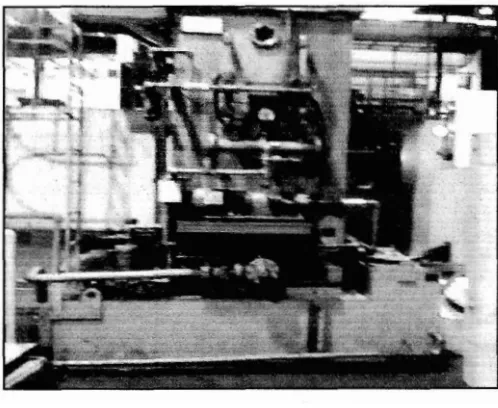
Figure 1.1 : Metal Stamping Machine
Metal stamping is a process where the sheet of metal is stamp for manufacturing
metal part according to the design that had be done. A metal alloy sheet is used as the
stock and the stock is either stamped on a press using dies and punches or drawn into
shapes on hydraulic deep drawing machines. Common product produce are automobile
parts, electronic parts, aerosol spray can and also household ware product such as pots
and pans. In metal stamping process, dies and punches are used to cut the metal into the
required shape which is called male components for the punches and the female
component for the dies. Press machine tools are used in the stamping process. This metal
stamping is use oil as lubricant for product cleaning system in dies and punches for
1.12 Background of Oil Particle Analysis
Oil particle analysis is an analysis to measurement of all particles that have
accumulated and contaminant within oil, including those metallic and non-metallic,
fibers, dirt, water, bacteria and any other kind of debris. It is most useful in determining
fluid and system cleanliness with a fluid viscosity.
Contamination can be defined as any unwanted substance or energy that enters or
contacts the oil. Contaminants can come in a great many forms; some are highly
destructive to the oil, its additives, and machine surfaces. It is often overlooked as a
source of failure because its impact is usually slow and imperceptible yet, given time;
the damage is analogous to eating the machine up from the inside out. While it is not
practical to attempt to totally eradicate contamination from in-service lubricants, control
of contaminant levels within acceptable limits is accomplishable and vitally important.
Particles, moisture, soot, heat, air, glycol, fuel, detergents, and process fluids are
all contaminants commonly found in industrial lubricants and hydraulic fluids. However,
it's particle contamination that is widely recognized as the most destructive to the oil
and machine. This explains why the particle counter is the most widely used instrument
in oil analysis today. And, the central strategy to its success in reducing maintenance
1.13 Background of FTIR
FTIR (Fourier Transform Inflated) Spectroscopy is an analysis technique that
provides information about the chemical bonding or molecular structure of materials. It
is used in failure analysis to identify unknown materials present in a specimen, good to
bad sample comparison and comparison of materials from different lots or vendors.
Fourier transform spectroscopy is a measurement technique whereby spectra are
collected based on measurements of the temporal coherence of a radiative source, using
time-domain measurements of the electromagnetic radiation or other type of radiation. It
can be applied to a variety of types of spectroscopy including optical spectroscopy,
inlimed spectroscopy(IR), nuclear magnetic resonance, and electron spin resonance
SpectrO='PY.
1.1.4 Background of Miyazu (M) SDN. BHD.
Miyazu (Malaysia) Sda Bhd., an anchor Class A large dies and moulds producer
in Malaysia, is a collaboration between Proton (5 1 %), Miyazu Seisakusho (Japan) (34%)
and Sojitz Corporation (15%). From a tooling shop in PROTON Shah Alam then
designing and engineering the stamping dies for various PROTON models, the company
expanded its operations by localizing the production of dies for PROTON W i Perdana
and GEN2 models between 1 994 and 2003.
In 2004 Miyazu went on to engineer and localize all the body parts for the
PROTON Savvy, with a total of 712 dies. It subsequently produced dies for PROTON
Persona and began exporting dies to Takao Thailand and Mazda in 2005 and 2006
respectively.
In April 2006, Miyazu expanded its portfolio to include stamping parts
production and thus commenced the implementation of TPS in collaboration with
standards. In April of this year, Miyazu launched an A-Class Tooling Plant in PROTON
City, Tanjung Malirn, further transforming the company into a key automotive tools
manufacturer in the ASEAN region.
Miyazu's new tooling plant marks Malaysia's entry into the highly specialized
and technology intensive industry of designing, engineering and manufacturing of
automotive tools. Miyazu Malaysia's position as an anchor Class A large dies and
moulds producer is expected to pave the way for the formation of Tool Maker
clusters. This in turn will result in the creation of an even bigger supporting industry
such as casting, hard chroming, machining, production of dies components, logistics and
calibration, to name a few.
The company has a paid up capital of RM17.5 million with strength of 250
personnel based at its Class A automotive tooling plant at the PROTON Tanjung Malirn
Vendor Park in Tanjung Malim. The 3,600-square metre plant, located on a 10.5-acre
site, houses state-of-the-art design, engineering, machining and finishing facilities which
include computer-aided design and manufacturing (CADICAM) applications, and
double-column, coordinate-measuring and pressing machines.
These are critical tools required to design, engineer and produce the dies and
moulds for the production of automobile components such as roof, bonnet, fender,
dashboard, and door, side and other body panels. At full operational capacity, Miyazu
Malaysia, together with its technology suppliers and business partners, is able to
manufacture and 1oc;flize over 400 dies annually, thus reducing dependency on foreign
1.2 Problem Statement
Several studies in production line show that the dusty environment of the
industry causes a lot of problems to the quality of the product. The deposited dust causes
defects on the surface of the stamped parts. In order to remove the deposited dust,
several cleaning actions have been employed to clean the product using specialized oil.
The oil have been used repetitively and recycled to clean numbers of parts. Up to several
time of usage, the oil has to be changed to maintain the cleaning quality. At the moment,
the limited studies to detect the level of contaminant for each cycle of oil. This research
emphasizes the analysis of contaminant level of oil based on the cycles or times of usage
using FTIR. The study involves the comparison between 'good' and 'contaminated' oil
and impurities detection of the oil compositions. This research will enhance the
information of the leyel of oil contaminants in each cycle. The results of the study also
1.3 Objective of Project
It is compulsory for an UTeM student to pass the "Project Sarjana Muda" before
being awarded the degree. The overall objective of this project is to determine if the oil
being used by the stamping line at Miyazu is the main cause of dings and dent of the
stamped automotive parts. The FTiR spectrum of clean and used oil will be analyzed
using the difference spectroscopy method to pinpoint the impurities, oxidation and water
content level which has been identified as the main cause of cleaning degradation. This
will be achieved through a series of systematic experiments through following studies:
13.1 To understand the characteristics of oil used in production line:
The studies of oil used in production line tools will cover the properties of clean
oil. The results would be beneficial in order to understand the original
characteristics of materials used in this investigation.
1.3.2 To understand the mechanisms of cleaning actions in production line:
In order to determine the sources of the con taminant, several aspects of the
mechanism of oil flow, oil recycle and cleaning actions and will be studied in
details. The results would be the important input for oil particle analysis.
13.3 To analysis the oil quality using
FTIR
spectroscopy:The oil quality will be investigated by using
FTIR
Spectroscopy equipments. Thesamples of clean oil and used oil in four stage process at upper die and lower die
stamping machine area is analysis of water content in oil, soot loading (resulting
in increased wear and viscosity), oxidation, nitration, antiwear components,
sulfating (sulfate by-products), and ethylene glycol contamination. The result
would be important to identifjr the main cause of cleaning degradation and part