AN ANALYSIS OF ENGLISH TRANSLATED COLLOCATIONS OF DAN
BROWN’S NOVEL “THE LOST SYMBOL” IN BAHASA INDONESIA
A THESIS
BY
JUWITA WULANDARI
REG. NO. 080705028
DEPARTEMENT OF ENGLISH
FACULTY OF CULTURAL STUDIES
UNIVERSITY OF SUMATERA UTARA
LIST OF ABBREVIATIONS
Adj adjective
Adv adverb
N noun
P preposition
Ph phrase
P.ph prepositional phrase
SL source language
TL target language
To-inf to infinitive
V verb
LIST OF TABLES
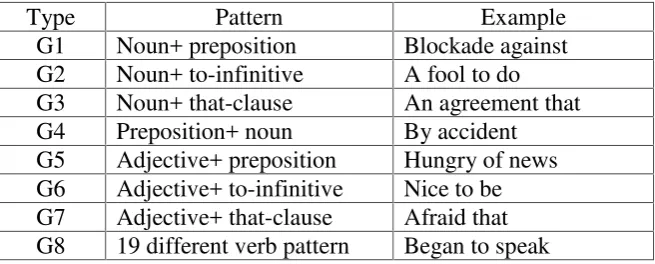
Table 2.1 Types of Grammatical Collocation by Benson et al Table 2.2 Types of Lexical Collocation by Benson et al
ABSTRAK
Skripsi ini berjudul An Analysis of English Translated Collocations of Dan
Brown’s Novel “The Lost Symbol” in Bahasa Indonesia. Skripsi ini menganalisis arti
ABSTRAK
Skripsi ini berjudul An Analysis of English Translated Collocations of Dan
Brown’s Novel “The Lost Symbol” in Bahasa Indonesia. Skripsi ini menganalisis arti
CHAPTER I
INTRODUCTION
1.1 Background of the Study
Language plays an important role in spreading information and communication with others. Since we were born with differences, we found it is also different in language we used to communicate. Language may be different because of some characteristics, for example the location of a nation, culture, people and the condition of nature.
Particularly we use language to express ideas, feelings, and opinions, to exchange information, to do business, to absorb and develop science, to transfer technology as well as to keep in touch with other. The differences of language bring us to the need of how to transfer the language from one to another. However, translation is very important to transfer the idea from all over the world. In the case of translating, we need a translator, someone who has a comprehensive knowledge of both the source language and the target language. In this case, source language is a language that is to be translated into another language and the target language is the language into which a text written in another language is to be translated.
nomenclatures and the concepts of one language may differ radically from those of another, since each language articulates or organizes the world differently, and languages do not simply name categories; they articulate their own. The conclusion likely to be drawn from what Culler writes is that one of the problems of translation is the disparity among languages. The bigger the gap between the source language and the target language, the more difficult it is to transfer the message from one to another. The difference between source language and target language, and the variation in their cultures make the process of translation become a real challenge.
Problems may come while translating a text, for example the problem of non-native speakers in translating a text. Usually with the use of English vocabulary and the use of combination of words. This is an aspect of language called collocation. The non-native translator may find it difficult to translate a collocation since collocation usually cannot be translated into the languages word by word. Furthermore, there are no collocation rules that can be learnt. The native speaker intuitively makes the correct collocation based on a lifetime’s experience of hearing and reading the words in a set of combinations in their own language. But it difficult for non native speakers to translate a collocation since they have a limited experience and may be frequently collocate words in a way that sounds odd or inappropriate to the native speaker’s hearings.
There is much interest in collocation partly because this is an area that has been neglected in structural linguistic traditions that follow Saussure and Chomsky. However, a tradition in British linguistics, associated with the names of Firth, Halliday, and Sinclair that pay close attention to the phenomena like collocation.
words, a collocation is an expression consisting of two or more words that correspond to some conventional way of saying things. Based on Sinclair (1999:170), collocation is the occurrence of two or more words within a short space of each other in a text, the usual measure of proximity is a maximum of four words intervening. Collocations can be dramatic and interesting because unexpected, or they can be important in the lexical structure of the language because of being frequently repeated. While Manning and Schütze (1999:141) characterized collocation by its limited compositionally. “We call a natural language expression
compositional if the meaning of the expression can be predicted from the meaning of the parts. Collocations are not fully compositional in that there is usually an element of meaning added to the combination.”
The analysis of this thesis is focused in collocations. Benson (1997) as cited by Martyńska (2004-3) divided collocations into two. Those are lexical collocations
and grammatical collocations. Moreover, Benson explained that lexical collocations has seven types, they are L1, L2, L3, L4, L5, L6, and L7. While grammatical collocations has eight types, they are G1, G2, G3, G4, G5, G6, G7, and G8.
The source of the data in this thesis is a novel entitled “The Lost Symbol”
both in English as a source language (SL) and in Indonesian as a target language (TL). The collocations found in the English novel (SL) will be analyzed and the translated collocations in Indonesian novel (TL) will also to be analyzed to find whether the English collocation is also a collocation in the target language or not.
An example of English collocation and the translated collocation that also a collocation in Bahasa Indonesia (TL) from the data:
Shaved head Kepala plontos
The novel “The Lost Symbol” is written by Dan Brown a well known
American writer and #1 bestselling novels, including The Da Vinci Code, which has become one of the best selling novels of all time. His novels are published in 52 languages around the world with 200 million copies in print and in 2005 Brown also named one of the 100 Most Influential People in the World by TIME Magazine.
The novel itself is about a Harvard symbologist, Robert Langdon whose mentor, Peter Solomon--a prominent Mason and philanthropist--is brutally kidnapped, Langdon realizes his only hope of saving Peter is to accept the mystical invitation he received from someone and follow wherever it leads him. Langdon is instantly plunged into a clandestine world of Masonic secrets, hidden history, and never-before-seen locations--all of which seem to be dragging him toward a single, inconceivable truth until he found peter and the secret reveal.
The explanation above becomes the main interest to find out more on what kinds of collocation found in the novel written by an American author. The novel entitled The Lost Symbol written by Dan Brown is chosen to be the source of data in this research since the novel is a best seller all over the world and has been published in Indonesia since 2010 both in English and the translation in Indonesian. This novel is a new novel but it already has a good respond from the readers.
1.2 Problems of the Study
The problem of the study can be shown in the following questions: (1) How are English collocations in the novel translated into Indonesian? (2) What is the most dominant collocation found in the novel?
1.3 Objectives of the Study
The objectives of the study are to find the meaning of the English collocations and classify the English collocations found in the novel. Therefore, based on the statement of problem above, the objective of the study can be shown in the following sentences:
(1) To show the Indonesian meaning of English collocations in the novel. (2) To find the dominant collocations in the novel
(3) To identify and analyze whether the English collocations also translated as a collocation in the target language.
1.4 Scope of the Study
Based on the background above, the scope of analysis of this thesis is focused on the collocations in the novel “The Lost Symbol” by Dan Brown to analyze and
identify how English collocations translated into Indonesian and the kinds of collocation found in the novel.
1.5 Significances of the Study
Based on the problems of the study and the objectives of the study, the significance of the study will be:
(1) The result of the study can be used as an additional knowledge to improve the vocabulary of collocations for Indonesian learners majoring in English. (2) This study is also useful for those who are studying translation. For the
translator this study can be used to improve the quality of translation.
1.6 Review of Related Literature
There are some theses that are reviewed in order to support this analysis. Nasution (2003) in her thesis, An Analysis of Collocations in Listening Comprehension Section of the TOEFL Test. The thesis discusses about the identification of collocation found in the listening comprehension section of the TOEFL test from the 9th edition of Baron’s How to Prepare for TOEFL pages 361-366 published by CV. Binarupa Aksara, Jakarta.
In this thesis, the writer uses Hill’s theory (2002-18) to identify the
collocations, corpus frequency, joint frequency, and the significance of each pairs, and also to determine the kinds of collocations of each data. Then the writer finally gets the result that there are 25 collocational pairs found in the LCS of the TOEFL Test from the 9th edition of Baron’s How to Prepare for TOEFL pages 361- 366. These collocations are categorized into adjective+ noun (10 pairs), adverb+ adjective (1 pair), verb+ objective/compliment (10 pairs), noun+ preposition+ noun (3 pairs), and adjective+ preposition+ noun (1 pairs).
Asih (2009) in her thesisThe Analysis on Indonesian Translated Collocations of J.K Rowling’s Novel, “Harry Potter and the Goblet of Fire”. This thesis discusses
about the strategy used to translate the collocations found in the novel “Harry Potter
and the Goblet of Fire” by J.K Rowling published by Bloomsburry in 2000 and the
translated novel in Indonesian published by PT Gramedia Pustaka Utama, Jakarta in 2001. In this thesis the writer uses Baker’s theory (1992:72-76) to describe the forms
CHAPTER II
THEORITICAL FRAMEWORK
A study is said to be valid when it is supported by literature. In this chapter, the writer quotes and explains some sources which are connected with the topic of the study. This chapter consists of three parts. The first part concerns with the definitions of translation, the second part discusses about the collocation and the third part discusses about shifts.
2.1 Translation
2.1.1 Definition of Translation
Brislin (1976:1) gives the definition of translation as a general term referring to the transfer of thoughts and ideas from one language to another, whether the language is in written or oral form, whether the language have established orthographies or not, or whether one or both language is based on signs, as with signs of the deaf. From the Brislin definition of translation, it can be said that doing translation is not only transferring language in text but also in oral, Orthographies, signs, or even signs of the deaf.
Finally, pragmatic understanding is related to the message or implication of a sentence. This definition does not states what is transferred. Rather, it states the requirement of the process.
Catford (1965) as cited by Muchtar (2011: 9) defined translation as the replacement of text material in language (source language) by equivalence textual material in another language (target language). If Catford emphasizes in the substitution of material then Pinchuck (1977) as cited by Muchtar (2011-9) defined translation as a process of finding TL equivalence for an SL, utterance.
Bell (1991:5) said that translation is the expression in another language (or target language) of what has been expressed in another, source language, preserving semantic and stylistic equivalence.
Translation has been defined by many theorists. Each definition shows how each theorist perceives language and translation. Bell (1991:13) said that there are three distinguishable meanings for translation. It can refer to:
1) Translating: the process (to translate; the activity rather than the tangible object);
2) A translation: the product of the process of translating (i.e. the translated text);
3) Translation: the abstract concept which encompasses both the process of translating and the product of that process.
2.1.2 Process of Translation
Bathgate (1981) as cited by Widyamartaya (1989:40-41), suggested seven steps in processing translation. Those are:
(1) Tuning. By this, we mean getting the feel of the text to be translated. Depending on their field of work, translators need to be able to produce the language of a poet or novelist, lawyer or economist, research physicist or factory manager, advertising copywriter or biblical prophet. Each ‘register’,
as it is often called, demands a different mental approach, a different choice of words or turn of phrase. If the text is difficult or of the type which is not so familiar to the translator, he may want to read some background literature or consult the author (if available) or some other adviser.
(2) Analysis. Once the translator has attuned his mind to the framework of the text to be translated, he will take each sentence in turn and split it up into translatable units-words or phrases. He will also establish the syntactic relation between the various elements of the sentence. At some points in this phrase (or the understanding or terminology phrase), it may be necessary to establish relation between elements in larger portions of the text, in the interest of consistency.
pay to the ‘content’ as opposed to ‘form’; it seems obvious that due attention
to both form and contents his essential.
(4) Terminology. The next step is to consider the key words and phrases in the sentence to make sure that apart from understanding them and feeling what they imply, one has a translation for them which is in line with standardized usage and is neither misleading, ridiculous nor offensive for the target language reader. Both in this phase and in the preceding (understanding) phase, discussion with the author or some other adviser is often advisable as the base way to help the translator solve some of his problems.
(5) Restructuring. When all the bricks needed for the edifice of the target language text have been gathered or made, the translator will fit them together in a form which is In accordance with good usage in the target language. This is the phase where ‘form’, as opposed to ‘content’, comes into
its own.
(7) Discussion. For this reason, a good way to end to translation process is often with a discussion between the translator and the expert on the subject matter.
Meanwhile, Robinson (2003: 91) divided the process of translation into three. Those are:
1. Translate:act; jump into the text feet first; translate intuitively.
2. Edit: think about what you've done; test your intuitive responses against everything you know; but edit intuitively too, allowing an intuitive first translation to challenge (even successfully) a well-reasoned principle that you believe in deeply; let yourself feel the tension between intuitive certainty and cognitive doubt, and don't automatically choose one over the other; use the act—response—adjustment cycle rather than rigid rules.
3. Sublimate:internalize what you've learned through this give-and-take process for later use; make it second nature; make it part of your intuitive repertoire; but sublimate it flexibly, as a directionality that can be redirected in conflictual circumstances; never, however, let subliminal patterns bind your flexibility; always be ready if needed "to doubt, argue, contradict, disbelieve, counter, challenge, question, vacillate, and even act hypocritically (be willing to break jour own rules).
2.1.3 Types of Translation
Jakobson (1959) as cited by Bassnett (2002:23) distinguishes three types of translation:
2) Interlingual translation or translation proper (an interpretation of verbal signs by means of some other language).
3) Intersemiotic translation or transmutation (an interpretation of verbal signs by means of signs of nonverbal sign systems).
Brislin (1976:3-4) states that according to the purpose, translation can be divided into four types:
a) Pragmatic translation. Pragmatic translation is the translation of a message with an interest in accuracy of the information meant to be communicated in the target language form. Belonging to such translation is the translation of technical information, such as repairing instructions. b) Aesthetic-poetic translation. Aesthetic-poetic translation is the one that
does not only focus on the information, but also the emotion, feeling, beauty involved in the original writing.
c) Ethnographic translation. Ethnographic translation is the one that explicates the cultural context of the source and second language versions.
d) Linguistic translation. Linguistic translation is the one that is concerned with equivalent meanings of the constituent morphemes of the second language and with grammatical form.
2.2 Collocation
2.2.1 Definition of Collocation
1. In corpus linguistics, collocation defines a sequence of words or terms that co-occur more often than would be expected by chance.
2. In phraseology, collocation is a sub-type of phraseme. An example of a phraseological collocation (from Michael Halliday)is the expressionstrong tea. While the same meaning could be conveyed by the roughly equivalent *powerful tea, this expression is considered incorrect by English speakers. Conversely, the corresponding expression forcomputer,powerful computersis preferred over *strong computers. Phraseological collocations should not be confused with idioms although both are similar in that there is a degree of meaning present in the collocation or idiom that is not entirely compositional. With idioms, the meaning is completely non-compositional whereas collocations are mostly compositional.
According to the Oxford Advanced Learner’s Dictionary (2003: 247),
collocation is: (1) a combination of words in a language that happens very often and more frequently than would happen by chance. (2) The fact of two or more words often being used together, in a way that happens more frequently than would happen by chance. On the study page B3 of Oxford Advanced Learner’s Dictionary,
collocation is defined as the way in which particular words tend to occur or belong together. For example:
Meals will be served outside on the terrace,weather permitting.
But notMeals will be served outside on the terrace,weather allowing.
Both these sentences seem to mean the same thing (‘they’ll bring us our meals
Based on Firth as cited by Leon (2007:3), says
Meaning by collocation is an abstraction at the syntagmatic level and is not directly concerned with the conceptual or idea approach to the meaning of words. One of the meanings of night is its collocability with dark, and of dark, of course, collocation with night (Firth [1951] 1957:196).
2.2.2 The Importance of Collocation
According to Manning (1999:142) collocations are important for a number of applications:
1) Natural language generation (to make sure that the output sounds natural and mistakes like powerful tea or to take a decision are avoided)
2) Computational lexicography (to automatically identify the important collocations to be listed in a dictionary entry)
3) Parsing (so that preference can be given to parses with natural collocations) 4) Corpus linguistic research (for instance, the study of social phenomena like the reinforcement of cultural stereotypes through language (Stubbs 1996)).
2.2.3 Kinds of Collocation
Hill (2002) as cited by Nasution (2003:15-17) states that collocation is divided into four kinds, they are:
1. Unique collocations.
2. Strong collocations.
A large number of collocations, although not unique, are strong or very strong. Predictably, we may talk of trenchant criticism or rancid butter, but this does not mean that other things cannot be trenchant or rancid. We often haveulterior motives orharbor grudgeswhile being reduced to tears or even moved to tears. Such strong collocations are not unique, but it is clear that any knowledge of the words trenchant, rancid, motive, grudge, or tears would be incomplete without some idea of their strong collocates. There words are classified as strong collocations.
3. Weak collocations.
All elementary students create combinations of words which are on the verge of the area we define as collocations i.e. those words which co-occur with a greater than random frequency. Many things can be long or short, cheap or expensive, good or bad. Colours are a good example. Early on, students learn the primary colour. They are able to make combinations such as blue shirt, red car etc. they know that they can apply the colours in English in a similar way to their own language.
4. Medium strength collocations.
Benson et al (1985) as cited by Martyńska (2004:3) divides kinds of collocation into two categories: lexical collocations and grammatical collocations. Grammatical collocations consist of the main word (a noun, an adjective, a verb) plus a preposition or ‘to+ infinitive’ or ‘that- clause’ and is characterized by eight basic
types of collocations.
G1= noun+ preposition e.g. blockade against, apathy towards
G2= noun+to-infinitive e.g. he was a fool to do it. They felt a need to do it
G3= noun+that-clause e.g. we reached an agreement that she would represent us in court. He took an oath that he would do his duty
G4= preposition+ noun e.g. by accident, in agony
G5= adjective+ preposition e.g. fond of children, hungry for news
G6= adjective+ to-infinitive e.g. it was necessary to work, it’snice to be here
G7= adjective+ that-clause e.g. she was afraid that she would fail, it was imperative that I be there
G8= 19 different verb patterns in English e.g. verb+ to-infinitive (they began to speak), verb+ bare infinitive (we must work) and other.
Table 2.1: Types of Grammatical Collocation by Benson et al (1985) as cited by
Martyńska (2004:3)
Type Pattern Example
G1 Noun+ preposition Blockade against G2 Noun+ to-infinitive A fool to do G3 Noun+ that-clause An agreement that
G4 Preposition+ noun By accident
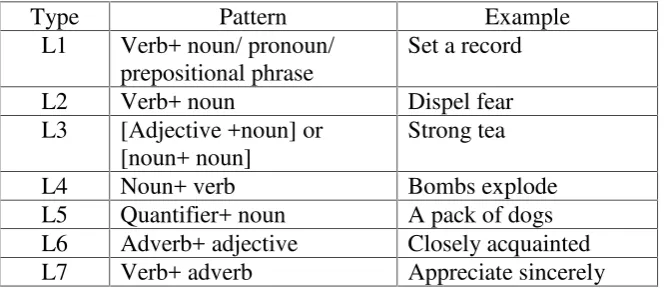
Lexical collocations do not contain prepositions, infinitives, or relative clauses but consist of nouns, adjectives, verbs, and adverbs. There are 7 types of them.
L1= verb (which means creation/action) + noun/pronoun/prepositional phrase e.g. come to an agreement, launch a missile
L2= verb (which means eradication/cancellation) + noun e.g. reject an appeal, crush resistance
L3= [adjective+ noun] or [noun used in an attributive way+ noun] e.g. strong tea, a crushing defeat, house arrest, land reform
L4= noun+ verb naming the activity which is performed by a designate of this noun e.g. bombs explode, bees sting
L5= quantifier+ noun e.g. a swarm of bees, a piece of advice L6= adverb+ adjective e.g. hopelessly addicted, sound sleep L7= verb+ adverb e.g. argue heatedly, apologize humbly.
Table 2.2: Types of Lexical Collocation by Benson et al (1985) as cited by
Martyńska (2004:3)
Type Pattern Example
L1 Verb+ noun/ pronoun/ prepositional phrase
Set a record
L2 Verb+ noun Dispel fear
L3 [Adjective +noun] or [noun+ noun]
Strong tea
L4 Noun+ verb Bombs explode
L5 Quantifier+ noun A pack of dogs
L6 Adverb+ adjective Closely acquainted
L7 Verb+ adverb Appreciate sincerely
While talking about Indonesian collocation, then Kridalaksana (1982) as cited by Arifin et al (2008-26) said that,
dengan demikian, kita akan menjumpai persandingan antara nomina dan nomina, nomina dan adjectiva, nomina dan verba, nomina dan numeralia. Kridalaksana wants to emphasize that the association of a word will be happened if the word gives the certain meaning to the other words where they collocate. Based on what has been stated above, there are four kinds of collocation suggested by Kridalaksana, they are: noun+ noun, noun+ adjective, noun+ verb, noun+ numeral.
Generally, collocation in Indonesian is classified into two. The first one is Kolokasi Kelompok I and the second is Kolokasi Kelompok II. Kolokasi Kelompok I has the pattern of noun+ adjective and it is divided into twelve types, they are:
1. Collocation type I A. Formed by noun which is semantic, human, concrete, and countable. While the adjective is semantic, character, and behavior.
Example:anak cerdas orang sabar
N Adj N Adj
2. Collocation type I B. Formed by noun which is semantic, human, non-concrete, countable, non- alive and time. While the adjective is semantic and situation.
Example:iklan penting malam aman
N Adj N Adj
3. Collocation type I C. Formed by noun which is semantic, human, non-concrete, countable, alive, and grouped. While the adjective is semantic, and situation.
Example:tanah subur Negara makmur
N Adj N Adj
Example:wajah bulat hati lembut
N Adj N Adj
5. Collocation type I E. Formed by noun which is semantic, human, non-concrete, uncountable, and non-alive. While the adjective is semantic and quality.
Example:nasib buruk cerita pendek
N Adj N Adj
6. Collocation type I F. Formed by noun which is semantic, human, concrete, and countable. While the adjective is semantic and situation.
Example:bapak gagah pemuda tampan
N Adj N Adj
7. Collocation type I G. Formed by noun which is semantic, human, concrete, and countable. While the adjective is semantic and age.
Example:janda muda orang tua
N Adj N Adj
8. Collocation type I H. Formed by noun which is semantic, non- human, concrete, and countable. While the adjective is semantic and colour.
Example:angsa putih kotak hijau
N Adj N Adj
9. Collocation type I I. Formed by noun which is semantic, non- human, concrete, countable, and non- alive. While the adjective is semantic and size. Example:barang berat bangku panjang
N Adj N Adj
10. Collocation type I J. Formed by noun which is semantic, non- human, concrete, countable, and non- alive. While the adjective is semantic and situation.
Example:bibir sumbing jari lentik
11. Collocation type I K. Formed by noun which is semantic, human, non-concrete, uncountable, and alive. While the adjective is semantic and situation.
Example:awan mendung cahaya redup
N Adj N Adj
12. Collocation type I L. Formed by noun which is semantic, non- human, concrete, countable, and non- alive. While the adjective is semantic and environment.
Example:pintu baru laut luas
N Adj N Adj
Kolokasi Kelompok II formed by adjective+ noun. Basically this type of collocation is the opposite of Kolokasi Kelompok I.
Example:kuning langsat merah darah
Adj N Adj N
2.2.4 Strategies in Translating Collocation
Baker (1992: 72-76) suggest three strategies in translating collocation. They are:
1) Translation by Using a Collocation of Similar Meaning.
2) Translation by Changing Meaning.
Mostly, translators used this strategy when they have to find the naturalness and accuracy. Therefore, they change the meaning of a certain word with its synonym or near synonym. For example, English collocation
run a car cannot be translated into Indonesian as mengendarai sebuah mobil
since it is not equivalent of the source language collocation. Meanwhile, the collocation means to own, use, and be able to maintain a car financially. Therefore, the translators need a change to find the equivalence, and get the natural and accurate translation.
3) Translation by Paraphrasing
Usually, this strategy is used when the translator cannot find the equivalences in translating the source language collocation into the target language although she/he has made some changes. This strategy is used when the source language collocation can only be expressed in another way (paraphrasing).
2.3 Shifts
2.3.1 Kind of Shifts
1. Level Shifts
As Catford (1965) in Venuti (2000:141) as cited by Simanjuntak (2011: 13) states “Level shifts. By a shift of level we men that a SL item at one linguistics level has a TL translation equivalent at a different level”. It
means that a grammatical unit in English, such as noun, affixes, etc, has a lexical unit in Bahasa Indonesia (Machali 1998:14). The following are the examples of level shifts:
1. (a)EvenMary does not want to buy those there things. (b)Marypuntidak mau membeli ketiga benda tersebut.
2. (a) Bonihassold his motorcycle, because he needs some money. (b)Bonisudahmenjual sepeda motornya, karena dia butuh uang.
In example (1), we can see that a unit (morpheme) in Bahasa Indonesia grammar ‘pun’is translated into ‘even’ a lexis in English. And also
in example (2), it can be seen that in English if ‘have’ comes together with past participle of ‘sell’. The form ‘have+ past participle’ in English is
translated into ‘sudah’, a lexis in Bahasa Indonesia.
2. Category Shifts
2.1 Structure Shift
Structure shift is about the changing of grammatical between the structure of the SL and the TL, because of the structure of the SL and TL is not correspondent.
Example:
The form of the noun phrase of SL is Modifier- head, while the form of the noun phrase of TL is Head- modifier.
New car mobil baru
Adj N N Adj
2.2 Class Shift
Class shift is about when the translation equivalent of a SL item is a component of a different class in TL.
Example:
Medical student mahasiswa kedokteran
Adj N N N
2.3 Unit Shift
Unit shift is about a change of rank in which the translation equivalent of a unit at one rank in the SL is a unit at a different rank in TL.
Example:
The lord tuhan
P W
2.3.1 Word Shift
Example:
Stranger orang asing
Adj P
2.4 Intra System Shift
Intra system shift is the last shifts; intra system shift is about the shift which occurs along with the names of the types of shift affecting the other fundamental categories of grammar unit, structure and class.
Example:
A pair of shoes sepasang sepatu
N (plural) N (singular)
2.3.2 Units of Ranks in English
Morley (2000) in Simanjuntak (2011: 16) identifies five grammatical units representing ranks in English: sentence, clause, group (or phrase), word, and morpheme.
1. Sentence
Sentence is a set of words expressing a statement a question, or an order, usually containing a subject and a verb. (Oxford Advance Learner’s
Dictionary, 2000:1212) 2. Clause
Clause is a group of related words that contains a subject and a verb and is used as part of a sentence. There are tow kinds of clauses: independent clause and dependent clause. (Foresman, 1997: 160)
Example:
(b) You have not yet said good bye or bought your ticket. (independent clause)
(c) Because Josephine and Haile whispered and giggled during the lecture, Mr. McKenzie gave them extra homework. (dependent clause)
3. Group (phrase)
Group (phrase) is a group of words without a finite verb, especially one that forms part of a sentence. (Oxford Advance Learner’s Dictionary
2000:988) Example:
There came a giant to my door 4. Word
Word is a single a single unit of language which means something can be spoken or written. (Oxford Advance Learner’s Dictionary 2000:988)
Example: (a) Book (b) Zebra 5. Morpheme
Morpheme is the smallest unit of meaning that a word can be divided into. (Oxford Advance Learner’s Dictionary 2000:862)
2.3.2 Word Classes in English
classes of word since the possibility to identify word shifts is larger than the minor classes of word.
1. Major Classes of Word
The major classes of word include noun, verb, adjective, and adverb. Here is the description of the major classes of words:
a. Noun
A noun is a word used to name a person, place, thing, or idea. And can be classified as either common nouns or proper nouns and as either abstract nouns or concrete nouns. (Foresman, 1997: 178)
Example: (1) Sailor (2) Ocean (3) Bird (4) patience
b. Verb
In a sentence, a verb either expresses action or it links the subject to a word or words in the predicate. A verb that tells what action is taking place is called an action verb. It can show either physical or mental action. (Foresman, 1997:202)
c. Adjective
Adjective is a word used to add something to the meaning of a noun. (Wren and Martin 1975:4)
Example: (1) Unique (2) Beautiful (3) Pretty (4) Full
d. Adverb
Adverb is a word used to add something to the meaning of verb, an adjective, or another adverb. (Wren and Martin, 1975:4)
Example: (1) Quickly (2) Beautifully (3) Tomorrow (4) This morning
2. Minor Classes of Word
The minor classes of word are pronoun, preposition, conjunction, and interjection.
a. Pronoun
and again. In the preceding example, David is the antecedent of the singular pronounshisandhe. (Foresman, 1997: 186)
Example: (1) I (2) You (3) He (4) She
b. Preposition
A preposition is a word used to show the relationship of a noun or pronoun to some other word in the sentence. That noun or pronoun, which always comes after the preposition, is called the object of the preposition. The preposition, its object, and any words that modify the object make up the prepositional phrase. (Foresman, 1997: 251)
Example: (1) Above (2) Between (3) In (4) Over c. Conjunction
The word junctionmeans a joining. The purpose of conjunction is to join words or word groups in a sentence. (Foresman, 1997: 255)
(3) Both
(4) Not only- but also
d. Interjection
Interjection is a word used to stand for a sound or to express emotions such as joy, pain, shock, excitement, approval, or displeasure. Some commonly used interjections are listed below:
Ugh Ouch Phew Ah Oops
Hey Shh Yuk Wow Oh
Alas Bam Psst Eek
Interjection may appear at the beginning or at the end of a sentence, or they may stand alone. They are generally followed by a comma or an exclamation mark. (Foresman, 1997: 257)
Example:
(1) Ugh, my stomach.
CHAPTER III
METHOD OF RESEARCH
The discussion of this chapter covers research method, data collecting method and data analysis procedures.
3.1 Research Method
The analysis in this thesis uses library research. Some related references are used to support the theory. The data are collected from the novel entitled “The Lost
Symbol”. This study uses descriptive qualitative method. Descriptive qualitative method deals with a research explaining the analysis of a research. The formula dealing with calculating data is only used to support the analysis of the data. The formula is not intended to be the main focus on the research. Nazir (1998) in Simanjuntak (2011:19) says that descriptive method is a method of research that makes the description of the situation of event or occurrence. This study analyzes how the English collocations are translated into Indonesian.
3.2 Data collecting Method
The main source of the data was a novel entitled “The Lost Symbol” written
by Dan Brown which is published by Doubleday, United states in 2009 as the source text and its translation in Bahasa Indonesia with the same title “The Lost Symbol”
3.3 Data Analysis Procedures
In collecting the data, the writer observed the English novel and its translation in Indonesian and documented them as the data. The data were the English sentences that contain collocations in it. Along with the English text, the Indonesian translation text was also observed in order to compare it with the source text.
There are some steps in collecting the data, those are: (1) Observing
Read the novel both the English and Indonesian versions. Then skimmed through both texts and mark the sentences with collocations found in the texts randomly for each chapter of the novel.
(2) Documenting
Typed the English sentences contain of collocations along with the Indonesian translation. The pairing of the sentences was set with the English sentences on top and the Indonesian texts below.
(3) Identifying the collocations
Identified which part of the sentences that deals with collocation. Then, analyzed how the original collocations were translated into Indonesian. (4) Analyzing the collocations
Analyzing the collocations by characterized the collocations based on the kinds of collocations suggested by Benson et al in English collocations and by Arifin et al in Indonesian.
(5) Listing the collocations
(6) Finding out the most dominant collocations
Finding out the most dominant collocations by counting the listing collocations and making the percentage of the collocations found in source text and in the target text. So there will be two most dominant collocations, both in English (SL) and Indonesian (TL).
Calculating the data by applying Butler’s formula (1985) as cited by
Simanjuntak (2011:20) of simple statistical analysis in percentage by using educational statistic:
100% =
CHAPTER IV
FINDINGS AND ANALYSIS
4.1 Data Findings
From the analysis of the datain Dan Brown’s novel “The Lost Symbol”, it is found that there are 111 collocations and is divided into two kinds of collocation. Containing Grammatical Collocations (G) which has eight types (G1, G2, G3, G4, G5, G6, G7, G8) and Lexical Collocations (L) which has seven types (L1, L2, L3, L4, L5, L6, L7).
[image:39.595.109.529.334.626.2]The frequency of collocations as shown in the table below:
Table 4.1: Total Percentage of All Types of English Collocations
NO
TYPES OF COLLOCATIONS
NUMBER OF
COLLOCATIONS PERCENTAGE
1 L1 12 10.81%
2 L2 -
-3 L3 49 44.14%
4 L4 5 4.50%
5 L5 3 2.70%
6 L6 7 6.30%
7 L7 12 10.81%
8 G1 -
-9 G2 3 2.70%
10 G3 -
-11 G4 4 3.60%
12 G5 3 2.70%
13 G6 7 6.30%
14 G7 -
-15 G8 6 5.40%
TOTAL 111 100%
6.30% of the findings, G8: 6 or 5.40% of the findings. The rest, L2, G1, G3, and G7 are found nothing in the data.
[image:40.595.110.531.195.312.2]The writer found 53 or 47.75% of the translated collocations also a collocation in the TL.
Table 4.2: Total Percentage of All Types of Indonesian Collocations
NO TYPES OF
COLLOCATIONS
NUMBER OF COLLOCATIONS
PERCENTAGE
1 N+ N 11 20.75%
2 N+ Adj 29 54.75%
3 N+ V 13 24.50%
4 N+ Numeral -
-TOTAL 53 100%
Based on the table above, it is found that N+ N: 11 or 20.75% of the findings, N+ Adj: 29 or 54.75% of the findings and N+ V: 13 or 24.50% of the findings while N+ Numeral is found nothing in the data.
4.2 Analysis of Result
As stated in chapter one, the aims of this research is to analyze how English collocations in the novel translated into Indonesian, find the dominant collocations and analyze whether the translated collocations is also a collocation in Indonesian (TL). Therefore, the writer uses theory suggested by Benson et al about kinds of collocations.
1. Lexical collocations
(1) L1= verb (which means creation/action)+ noun/pronoun/prepositional phrase e.g. come to an agreement, launch a missile
(2) L2= verb (which means eradication/cancellation)+ noun e.g. reject an appeal, crush resistance
(3) L3= [adjective+ noun] or [noun used in an attributive way+ noun] e.g. strong tea, a crushing defeat, house arrest, land reform
(4) L4= noun+ verb naming the activity which is performed by a designate of this noun e.g. bombs explode, bees sting
(5) L5= quantifier+ noun e.g. a swarm of bees, a piece of advice (6) L6= adverb+ adjective e.g. hopelessly addicted, sound sleep (7) L7= verb+ adverb e.g. argue heatedly, apologize humbly.
The following are some Lexical Collocations and the analysis found in the data.
(1) a. … againfeeling repulsedby his captor’s sadisticplay on words.(ch. 19) b. … dan sekali lagi merasa jijik atas permainan kata yang sadis dari penculik temannya itu.
Looking at the above sentence, there are two collocations found. The first one isfeeling repulsedand the second isplay on words.
1. feeling repulsed merasa jijik
V-ing V V Adj
2. play on words permainan kata
V P. Ph N N
class-shift. Class- shift happens when the translation equivalent of a source language item is a component of a different class in target language
For example:
Medical student becomes mahasiswa kedokteran
Adj N N N
It is also found that these two collocations stand for different kinds and types of collocation. Look at the difference below:
Grammatical Collocations type G8: feeling repulsed
V-ing V
Lexical Collocation type L2: play on words
V P. Ph
After the collocations above translated into Indonesian, it is found that one of them is a collocation in TL. As stated in chapter two, there are four kinds of collocation in Indonesian suggested by Kridalaksana, they are: noun+ noun, noun+ adjective, noun+ verb, noun+ numeral.
play on words permainan kata
V P. Ph N N
permainan kata(play on words) is a collocation in target language since it is formed bynoun+ noun. While merasa jijik (feeling repulsed) is not a collocation in the target language because it is formed by verb+ adjective which is not part of Indonesian collocation.
The collocation from the above sentence is made a call and it is a Lexical Collocation type L1 which is formed byverb + noun
Made a call menelepon
V N V
When this collocation translated into its Indonesian meaning based on the translated novel, the form of the word is definitely changing from its original form.
Made a call translated into menelepon in TL. This kind of thing called unit-shift. Unit- shift happens when the translation equivalent of a unit at one rank in the SL is a unit at a different rank in the TL.
For example:
The lord becomes tuhan
P W
It is found thatverb+ nounbecomes averbin target language. If we translate the collocation word by word it will be membuat sebuah panggilan. But the translator translate it into menelepon while ‘menelepon’ in English is ‘phone someone’ Since the collocation in target language become a verb, so it is clear that
the translated collocation is not part of Indonesian collocation.
para pendiri Amerika dalam menetapkan undang-undang dan kebudayaan
republik baruitu.
Looking at the above sentence, there are three collocations found. They are
neoclassical architecture, ancient Rome, and new republic. Each of them states the same kinds and types of collocation.
1. Neoclassical architecture arsitektur neoklasik
Adj N N Adj
2. Ancient Rome Roma kuno
Adj N N Adj
3. New republic republik baru
Adj N N Adj
While looking at the form, the SL is adjective+ noun and the TL is noun+ adjective, this kind of thing called structure shift. Structure shift happens when the form of the noun phrase of SL is modifier- head, while the form of the noun phrase of TL id head- modifier.
For example:
New book becomes buku baru
Adj N N Adj
Since the English collocations formed by adjective+ noun, it is known as Lexical Collocation type L3 and the translated collocations formed by noun+ adjective,it is also known as Indonesian collocation.
(4) a. Katherine immediately looked away, hereyes scanningfor Peter.(ch.124) b.Katherine langsung memalingkan wajah,matanyamencari-cariPeter.
4. Eyes scanning mata mencari-cari
N V N V
When it is translating into the target language it is found that the English collocation is also a collocation in the target language based on what has been stated by Kridalaksana that there are four kinds of collocation, they are: noun+ noun, noun+ adjective, noun+ verb, and noun+ numeral. Since it is found that mata mencari-cari is formed bynoun+ verb, so it is categorized as a collocation in target language.
(5) a. Katherine had never seen a piece of gold this large, and it took her an instant to realize (ch.64)
b. Katherine belum pernah melihat bongkahan emas sebesar ini, dan perlu sejenak sebelum dia menyadari
Looking at the above sentence, the collocation isa piece f gold.
A piece of gold bongkahan emas
Quantifier N N N
When the collocation translated into the target language, the form of the word has changed. It is found that quantifier becomes noun and adjective becomes
prepositionin TL. It is has been said before that this kind of thing called class-shift. It is also found that the collocation stand for different kinds and types of collocation.
Lexical Collocations type L5 A piece of gold Quantifier N
A piece of gold bongkahan emas
Quantifier N N N
Bongkahan emas(a piece of gold) is a collocation in target language since it is formed by noun+ noun. As stated by Kridalaksana that kinds of collocation in Indonesian arenoun+ noun, noun+ adjective, noun+ verb, and noun+ numeral.
(6) a. The assembly of brothers encircling him all were adorned in their full regalia of lambskin aprons, sashes, andwhite gloves.(prologue)
b. sekumpulan saudara yang mengelilinginya mengenakan pakaian kebesaran lengkap, terdiri atas penutup dada dari kulit domba, selempang,
dansarung tangan putih.
Looking at the above sentence, there are two collocations found. They arethe assembly of brothersandwhite gloves.
The assembly of brothers sekumpulan saudara
Quantifier N N N
White gloves sarung tangan putih
Adj N N Adj
When these two collocations translated into its Indonesian meaning, the form of the word has changed. It is found that quantifierbecomesnounin TL, this kind of thing called shift. The first collocation (the assembly of brothers) is a class-shift and the second collocation (white gloves) is a structure shift.
It is also found that these two collocations stand for different kinds and types of collocations.
Lexical Collocations type L5 The assembly of brothers
Lexical Collocations type L3 White gloves
Adj N
After the collocations above translated into TL, it is found that both of them are a collocation in Indonesian because the form has changed. But represent the different kind of collocation in TL.
Sekumpulan saudara(the assembly of brothers) is a collocation in TL since it is formed by noun+ noun. And sarung tangan putih (white gloves) is also a collocation in the target language because it is formed bynoun+ adjective and based on Arifin et al as stated in chapter two, this kind of collocation is classified as Kolokasi Kelompok I type I H which is Formed by noun which is semantic, non-human, concrete, and countable. While the adjective is semantic and colour.
Example:angsa putih kotak hijau
N Adj N Adj
(7) a. Helet the words hang for a moment. “My intentions arepurely noble, b. Dia membiarkan kata-katanyamenggantung sejenak. “kuyakinkan kau,
tujuankubenar-benar mulia,(ch.9)
Looking at the above sentence, there are three collocations found. They are
let the word, hang for a moment,andpurely noble.
1. Let the words membiarkan kata-kata
V N V N
2. Hang for a moment menggantung sejenak
V P. Ph V P
3. Purely noble benar- benar mulia
When these three collocations translated into its Indonesian meaning, the form of the word has changed. It is found that adjective becomes verb in target language (as inpurely noble). This kind of thing called shift.
Hang for a moment menggantung sejenak
V P. Ph V P
Looking at the above collocation, the word class has changed from
prepositional phrase into prepositional in TL. This kind of thing called class-shift. While in:
Purely noble benar- benar mulia
Adv Adj V Adj
The word class has changed fromadverbinto verb. It is also found that these two collocations stand for different types of collocation.
Lexical Collocations type L1 1. Let the words
V N
2. Hang or a moment
V P. Ph
Lexical Collocations type L6 Purely noble
Adv Adj
After being translated into TL, these collocations are not a collocation in Indonesian because the three of them is not at form of an Indonesian collocation at all.
The collocation in the above sentence islook closelywhich is the meaning is memandang dengan cermat.
Look closely memandang dengan cermat
V Adv V P Adj
It is found that the English collocation has the form ofverb+ adverbwhich is categorized as Lexical Collocations type L7. While the translation has the form of
verb+ preposition+ adjective. It is found that there are several changes and addition to the translated collocation. The adverb closely is translated into dengan cermat which is formed bypreposition+ adjective. After all the translated collocation is not a collocation in target language.
2. Grammatical Collocations
Grammatical collocations consist of the main word (a noun, an adjective, a verb) plus a preposition or ‘to+ infinitive’ or ‘that- clause’ and is characterized by eight basic types of collocations.
(1) G1= noun+ preposition e.g. blockade against, apathy towards
(2) G2= noun+to-infinitive e.g. he was a fool to do it. They felt a need to do it (3) G3= noun+ that-clause e.g. we reached an agreement that she would
represent us in court. He took an oath that he would do his duty (4) G4= preposition+ noun e.g. by accident, in agony
(5) G5= adjective+ preposition e.g. fond of children, hungry for news
(6) G6= adjective+ to-infinitive e.g.itwas necessary to work, it’snice to be here (7) G7= adjective+ that-clause e.g. she was afraid that she would fail, it was
(8) G8= 19 different verb patterns in English e.g. verb+ to-infinitive (they began to speak), verb+ bare infinitive (we must work) and other.
The following are some grammatical collocations and the analysis found in the data. (1) a. The guard barely hadtime to processwhat he was seeing… (ch.54)
b. Penjaga itu hampir tidak punya waktu untuk mencerna apa yang dilihatnya.
From the above sentence it is found that the collocation istime to process.
Time to process waktu untuk mencerna
N To-inf N P V
The collocation categorized as grammatical collocation type G2 which is formed by noun+ to-infinitive. It is usually found that time+ to-infinitive collocates with:
a. time to kill b. time to go c. time to get d. time to try, etc.
(2) a. …hisright armwasin a sling, and he moved with aslight limp. (ch.4) b. …lengan kananya berada dalam kain gendongan dan jalannya sedikit pincang.
From the above sentence it is found that there are three collocations exist. They areright arm, in a sling, andslight limp.
Lexical collocation type L3 1. Right arm
2. Slight limp Adj N
Grammatical collocation type G4 In a sling
P N
There are two kinds of collocation that has the same kinds and type of collocation; they are right arm and slight limp which are categorized as lexical collocation type L3 which is formed byadjective+ noun.And the other,in a sling is categorized as grammatical collocation type G4 which is formed by preposition+ noun.
1. Right arm lengan kanan
Adj N N Adj
2. In a sling berada dalam kain gendongan
P N V P N
3. Slight limp sedikit pincang
Adj N Adj V
However the above collocations have changed in form.
Right arm lengan kanan
Adj N N Adj
The form of the above collocation changed when it is translated into TL. The form adjective+ noun becomes noun+ adjective however; lengan kanan is also a collocation in TL. In the case of shift, it is called structure shift where the form of the noun phrase of SL is modifier- head and the form of noun phrase of TL is head-modifier.
In a sling berada dalam kain gendongan
P N V P N
In a sling is categorized as grammatical collocation type G4 with the form
dalam kain gendonganwith the form verb+ preposition+ noun. In the SL there are only two kind of word class exist (preposition+ noun) but when it is translated into TL it becomes three (verb+ preposition+ noun). The word in translated into berada dalam. Whilea slingtranslated intokain gendongan.
In a sling
Berada dalam kain gendongan
Both of the words in SL translated into TL and it becomes a phrase.
In berada dalam
W P
A sling kain gendongan
W P
This kind of thing called unit-shift. Unit shift happen when the translation equivalent of a unit at one rank in the SL is a unit at a different rank in the TL.
Slight limp sedikit pincang
Adj N Adj V
The above collocation is categorized as lexical collocation type L3 which formed by adjective+ noun. The form of this collocation is also changing after the translation process. The form adjective+ noun becomes adjective+ verb in the TL however the translation is not a collocation in TL.
(3) a. …but he was apparently verygood atdoctoring.(ch.24) b.…tapi tampaknya dia sanagtbagus dalampekerjaannya.
In the above sentence, it is found that the collocation is good at and categorized as grammatical collocation type G5 which is formed by adjective+ preposition.
Good at bagus dalam
Having analyzed the English collocation and the translation in Indonesian, it is found that there is no changing in the form. But the translated collocation is not a collocation in the TL because there is no form (adjective+ preposition) found in the form of Indonesian collocation.
(4) a. “Good morning, Robert.Surprised to seeme?” (ch.24) b. “Selamat pagi, Robert.Kaget melihatku?”
From the underline collocation, it is found that surprised to see is categorized as grammatical collocation type G6 which is formed by adjective+to-infinitive.
Surprised to see kaget melihat
Adj To-inf Adj V
Having analyzed the English collocation and the translation in Indonesian, it is found that there is no change in the word class. However, the translation in TL is not a collocation in Indonesian.
(5) a. A young couple on the side walk straind to see through the tinted rear windows,hoping to glimpsea VIP. (ch.14)
b. Pasangan muda di trotoar memanjangkan leher untuk melihat memalui
jendela- jendela belakangyang gelap,berharap bias melihatsesosok VIP.
From the above sentence, it is found that there are three collocations exist. They are young couple, rear windows, and hoping to glimpse. These three collocations also stand for different kinds and types of collocation, they are:
Lexical collocation type L3: 1. Young couple
2. Rear windows
Adj N
Grammatical collocation type G8: Hoping to glimpse
V To-inf
There are two collocations that categorized as lexical collocation type L3, and one collocation categorized as grammatical collocation type G8.
1. Young couple pasangan muda
Adj N N Adj
2. Rear windows jendela-jendela belakang
Adj N N N
3. Hoping to glimpse berharap bisa melihat
V To-inf V N V
When these three collocations translated into its Indonesian meaning, the form of the word has changed. It is found that young couple changes in structure-shift; adjective+ noun becomes noun+ adjective in TL. While Rear windows and
hoping to glimpse change in class shift, adjective+ noun becomes noun+ noun in TL.
CHAPTER V
CONCLUSIONS AND SUGGESTIONS
5.1 Conclusions
Translating a collocation is not as easy as to translate a word because in translating a collocation we cannot translate it word by word. Having analyzed how the English collocation translated into Indonesian, the writer found there are some changes in the word shift. For example the category shift, the class shift, and the unit shift. Sometimes in translating a collocation, the translator needs to omit some words, replace, or even include a new word in the translation.
Having analyzed the data, it is concluded that not all types of collocations proposed by Benson et al are found in the novel. Totally there are 15 types of collocations proposed by Benson et al (Grammatical Collocations: G1, G2, G3, G4, G5, G6, G7, G8 and Lexical Collocations: L1, L2, L3, L4, L5, L6, L7) but it is only 11 types exist in the novel, they are G2, G4, G5, G6, G8, L1, L3, L4, L5, L6, L7. And each of the types has different number of collocations. They are, G2: 3 or 2.70% of the findings, G4: 4 or 3.60% of the findings, G5: 3 or 2.70% of the findings, G6: 7 or 6.30% of the findings, and G8: 6 or 5.40% of the findings, L1: 12 or 10.81% of the findings, L3: 49 or 44.14% of the findings, L4: 5 or 4.50% of the findings, L5: 3 or 2.70% of the findings, L6:7 or 6.30% of the findings, and L7: 12 or 10.81% of the findings. So it is concluded that L3: 49 or 44.14% of the findings is the most dominant collocations found in the novel.
(N+ V) collocation: 13 or 24.50% of the findings while (N + Numeral) collocation is found nothing in the data.
5.2 Suggestions
Studying the translation focuses on collocation in Dan Brown’s novel “The
Lost Symbol” is an interesting subject because we can get many advantages from
REFERENCES
Arifin, Z and Junaiyah. 2008.Sintaksis. Jakarta: Grasindo.
Asih, Dini Puspa. 2009.The Analysis on Indonesian Translated Collocations of J.K
Rowling’s Novel, “Harry Potter and the Goblet of Fire”(unpublished thesis). Semarang: Semarang State University.
Baker, Mona. 1992.In other words: A Course Book on Translation. New York: Routledge.
Bassnett, Susan. 2002.Translation Studies. New York: Routledge.
Bell, Roger T. 1991.Translation and Translating: theory and Practice. London: Longman.
Brislin, Richard W. (ed). 1976.Translations; Application and Research. New York: Gardner Press Inc.
Brown, Dan. 2009.The Lost Symbol. New York: Doubleday. Brown, Dan. 2010.The Lost Symbol. Yogyakarta: Bentang.
Foresman, Scott. 1997. Literature and Integrated Studies: Grade 11 Reading, Writing, and Grammar SkillBook Student Edition. Glenview: United States of America.
Hartono. 2003.Bagaimana Menulis Tesis?. Malang: UMM Press.
Kibbee, D. (ed). 2007.Proceedings of ICHoLS X.10thInternational Conference on the History of Language Sciences. John Benjamin’s Publishing Company: 404-415.
Larson, Mildred. 2008.Translation: Theory and Practise, tension and Interdependence. Amsterdam: John Benjamins Publishing Company. Manning, C and Schütze, H. 1999.Collocation.Cambridge: The MIT Press. Martyńska, Malgorzata. 2004.Do English Language Learners Know Collocation?
Investigationes Linguisticae. Poland: Adam Mickiewica Univesity. Muchtar, Muhizar. 2011.Penerjemahan: Teori, Praktek, dan Kajian. Medan:
bartong Jaya.
Munday, Jeremy. 2008.Introducing Translation Studies: Theories and Applications. New York: Routledge.
Nasution, Darlis Satrya. 2003.An Analysis of collocations in Listening
Comprehension Sectionof the TOEFL Test(unpublished thesis). Medan: University of Sumatera Utara.
Robinson, Douglas. 2003.Becoming a Translator: An Introduction to the Theory and Practice of Translation. New York: Routledge.
Setiawan, Dedy. 2002.Practical Guide to technical Writing: for Tertiary Students and Professionals. Bandung: Politeknik Negeri Bandung.
Simanjuntak, Elisa Hari Septy. 2011.An Analysis of Word Shifts in Sherlock Holmes Movie Subtitles(unpublished thesis). Medan: University of Sumatera Utara. Sinclair, John. 1991.Corpus, Concordance, Collocation. Oxford: Oxford University
Press.Walton Street.
Sokolovsky, Yaroslav. 2010.On the Linguistic Definition of Translation. Rusia: Siberian Federal.
Suryawinata, Zuchridin dan Laryanto, Sugeng. 2003.Translation: Bahasan Teori dan Penuntun Praktis Menerjemah.Yogyakarta: Kanisius.
Torop, Peeter. 2002.Translation as Translating as Culture. Estonia: University of Tartu.
Widyamartaya, A. 1989.Seni Menterjemahkan. Yogyakarta: kanisius.
Oxford Advanced Learner’s Dictionary.
Collocation, http://en.wikipedia.org/wiki/Collocation, accessed on 17thApril 2012, 11.23 WIB.
4. Table of Collocations Found in the Novel
NO SOURCE TEXT TARGET TEXT
ENGLISH COLLOCATI -ONS INDONE-SIAN COLLOCAT I-ONS
1 Pale chest adj n
Dada pucat n adj
L3
2 The assembly of quantifier brothers n Sekumpulan n saudara n L5
3 Full regalia adj n
Kebesaran lengkap n adj
L3
4 White gloves adj n
Sarung tangan n putih adj L3
5 Ceremonial jewels adj n
Perhiasan upacara n n
L3
6 Ghostly eyes adj n
Mata hantu n n
L3
7 Muted light adj n
Cahaya suram n adj
L3
8 Sworn brothers adj n
10 Ancient Rome adj n
Roma kuno n adj
L3
11 Shaved head adj n
Kepala plontos n adj
L3
12 Right arm adj n
Lengan kanan n adj
L3
13 In a sling p n
Dalam kain p
gendongan n
G4
-14 Slight limp adj n
Sedikit pincang Adj v
L3
-15 Verbally engaging adv adj
Mengajak bicara v v
L6
-16 For a reason p n
Ada alasan v n
G4
-17 Let the words v n
Membiarkan kata-kata
V n
L1
-18 Hang for a moment v p.ph
Menggantung v sejenak p L1
-19 Purely noble adv adj
Benar-benar mulia v adj
L6
-20 Serious line adj n
Garis yang serius n n adj
-21 Sharp breath adj n
Terkesiap V
L3
-22 Deepest secrets adj n
Rahasia- rahasia n
terdalam v
L3
23 Young couple adj n
Pasangan muda n adj
L3
24 Rear windows adj n
Jendela- jendela n belakang n L3
25 Hoping to glimpse v to-infinitive
Berharap bisa v n melihat
v
G8
-26 Take the chance v n
Mengambil resiko v n
L1
-27 Arms folded n v
Kedua tangan n terlipat
v
L4
28 Locked skeptically v adv
Terpaku skeptik v adj
L7
-29 Shrugged weakly v adv
Mengangkat bahu v n dengan lemah.
p adj
L7
-30 New republic adj n
Republik baru n adj
31 Play on words v p.ph
Permainan kata n n
L1
32 Point the way v n
Menunjukkan jalan v n
L1
-33 Voice sharpening n v
Suara menajam n v
L4
34 Suspicious eyes adj n
Mata curiga n v
L3
35 Jaw clenched n v
Menggerakkan v rahang
n
L4
-36 Began replaying v v-ing
Mulai mengulangi v v kembali
v
G8
-37 Cold morning adj n
Pagi yang dingin n n adj
L3
-38 Elegant gentle man adj n
Lelaki elegan n adj
L3
39 aquiline face adj n
Wajah berhidung n v bengkok
adj
L3
-40 Surprised to see adj to-infinitive
Kaget melihat v v
G6
-41 Blue blood adj n
Bangsawan N
L3
-42 Good at adj p
Bagus dalam adj p
G5
-43 Call a head v n
Sudah menelepon n v
L1
44 Stealing a glance v n
Melirik v
L1
-45 Require to scan adj to-infinitive
Perlu menindai n v
G6
46 Nice to meet adj to-inf
Senang berjumpa adj v
G6
-47 Quick recovery adj n
Menghilang dengan v p cepat
adj
L3
-48 Square hole adj n
Bentuk persegi-n
Empat N
L3
49 A series of bricks quantifier n
Serangkaian batu– n
bata n
L5
50 Solid gran