Filariasis
in
the
new millennium
R.H.H. Nelwan
Abstrak
Pengendalian filariasis di Indonesia yang bertujuan mencapai microfilaria rate
di
bawahl%
di
daerah endemik sanpai terjadinya krisis ntoneter 3 tahun yang lalu selalu ntenutlukkan kemajuan yang cukup nrengesankan dari tahun ke tahun. Ternl,ata bahwa saatini
di
berbagai wil.ayah ))ang wttL.k jangka waktu )tang lama sudah bebas darifilariasis
ntulai lagi pelaporan kasus kaki gajah. Keadaanini
ntungkin tidak leytasdari
pergolakan muLtidintensi l,ang telah ntengakibatkan penguttgsian penderitadari
daeralr endemik ke wilayah-wila1,ah antan 1'ang non-endemik unruk filariasis. Makalahini
bertujuan utttuk ntengingatkan kita akan cara penyebaranfilaria
dan berbagai gejala klinis lang berhubtutgan erat dengaru4'a serta mengenai penatalaksanaannya masa kini. Juga akan dibahas kennjuan mutakhit'\'ot1g telah dicapai terutama di bidang diagnostik dan pengobatan penduduk secara massal, terfokus dan bebas efek samping ),ang pada saatitli
sangat menonjoL Tulisan ini juga dimaksudkan sebagai pengantar mengenai peluang pemberantasan ftl.ariasis ntelalui apa ycitxg dikenal sebagai suatu aliansi penunlasan global dengan mengikutsertakan berbagai pihak antara lain fartnasi nutltinasional yang telah ntengikrarkan penyediaan obat secara graîis sesuai kebutulnn dari organisasi keselntan tlunia WHO. Badanini
menrcgang kentlali pentberarûasannya ntelalui Progrant TropicaL Disease Research (TDR) Task Force ort Fil.ariasis hûentention Research tang bersann TDR Product Developntent )'ang n'Ien?atur pengembangan lerapi nrerupakan bagian dari program WH O tuttuk elirninasi total filariasis dari nruka bunri tlunio. (Meil J Indones 2001; 10: 191-6)Abstract
The lndone"^ian national filariasis eradication prograrn
in
its pursuil in obtaùùrtgnicrofllarial
rates below l7a in filariasis endemic l.ocations was on its right track until the ntonetat)) crisis starled 3 years ago. This crisis which is rlot over)tet at present is complicated by unstable pubLic safety causirtg population shifts wlrcre peoile fromfilaria
endenùc locations seek refuge in non-endernic areas. This u1tùtted review wilL hopefulLy serve as a timely rerninder to our plD,sicians and health workers especiallyon
the modeof filarial
transntissiott as wel.l ason
its clinical presentations and presently accey;ted wa1,s of manaqement. This paper alsowill
serve as an introductiort ittto Ilrc pre.sent breakthrougltsin
this new milleniunt as noted in thefield
of diagnostics and simplified mass treatment .rcheclules tnakingit
possiblcfor
tlrc elinination of lynrplnticfilariasis
as a public health problern.A
global alliance wtder the guidance of the World Health Organizatiort with support of the multinational pharmaceutical compaties for providing free expensive ntedicatiott as needed. The WIIO also cooperaîes closely with the Tropical Diseases Research taskforces of Filariasis Intervention Research and of Product Dct,elopntent, that in the end will provide tlrc means 1o eradicate this diseasefor
once and forever from the .face of the earth. (Med J Irtdones 2001;l0:
191-6)Keywords: Lyntphatic filariasis, f larial lifecycle, global alliance, historicaL mileslones
Inf'ection
with filarial
nematodes are the main causeof
lymphatic
filariasis
andall
its
consequences.Near
theend
of
the
XXth
century
WHO
estimation
of cases
stoodat
120million with
onethird of
thembelonging
to
the
disabled category. These
cases
are
mostly
spread
over the tropical
belt on
both.sides
of
theequator
with
an approximate
of
1.2billion
people
atrisk.'
The
present state
of
its
epidemrology,
clinical
Division of Tropical and Infectious Diseases, Department
of
lntemal Medicine, Faculty of Medicine University of Indonesia, Jakarta, IndonesiaPresented at the 2nd Maastricht Travel and Tropical Medicine Symposium September 2000 in Maastricht, The Netherlands.
features, diagnosis, treatment and prevention
will
beoverviewed
in
this article.
EPIDEMIOLOGY
't
192
NelwanIslands,
it
is
also
present
focally
in
the
EasternMediterranean
and
in
Latin
America.
B.
malayi
is spread throughout the South EastAsian region
with
somesmall foci in other parts
of Asia, in contrast
with
B.timori
that
is
found
only
in
the
islands of
SoutheasternIndonesia formerly known
as the LesserSunda
Islands.2'3
A
historical
account
aboutinvestigators
and
reports
closely
connected with
lymphatic filariasis
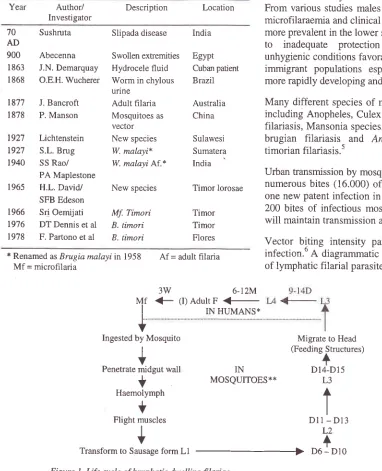
is depictedin table
l.
Table
l.
Lymphatic filariasis: historical mulestonesYear
Author/ InvestigatorDescription Location
Med J Indones
The host
of
all the three types
of filarial
infection
is man exceptfor the
subperiodic
form
of B.malayi that
may also infect monkeys, domestic cats and forest
carnivores.Infection
may be acquired at anearly
age, however thereis
alow rate of microfilaraemia
in early
childhood,
afairly rapid rise between the
ageof
5 to
20
years reaching
a
certain plateau thereafter. As
densities
of
Mf
may rise and
fall
in
individuals
it is
not
a
useful indication
for
infection
intensity
or
disease individually.In
the community, however,
thecollective
Mf
rate and log medianmicrofilarial
density reflect the intensityof transmission and
disease impact.From various studies males
often have
higher rates of
microfilaraemia
andclinical
signs. Theinfection
is also more prevalentin
thelower
socio-economic groups dueto
inadequate
protection
from
mosquitoes
and unhygienic conditions favorableto breeding
of
vectors,immigrant populations especially adults
may
show more rapidly developing and severe disease.*Many different
species of mosquitoes serve asvector
including
Anopheles,Culex
and Aedesfor bancroftian
filariasis, Mansonia
species,Anopheles
and Aedesfor
brugian
filariasis
-
and Anopheles
barbiroslris
for
timorian filariasis.r
Urban transmission by mosquitoes is very low requiring numerous
bites (16.000)
of
infectious mosquitoes for
one new patentinfection in man.
Contrary to this
only
200 bites
of
infectious mosquitoes
a
year per person
will
maintain transmission
at endemic levels.Vector
biting
intensity parallels age prevalence of
infection.bA
diagrammatic
flow
chart of the lifecycle
of lymphatic
filarial
parasites is shownin figure
l.
70 AD 900
1863 I 868
Sushruta
Abecenna J.N. Demarquay O.E.H. Wucherer
1877
J. Bancroft1878
P. Manson1927 Lichtenstein
1927
S.L. Brug1940
SS Rao/PA Maplestone
1965 H.L. David/
SFB Edeson
1966 Sri Oemijati
19'16
DT Dennis et al1978
F. Partono et alSlipada disease
Swollen extremities Hydrocele fluid Worm in chylous urine
Adult filaria Mosquitoes as
vector New species
W. malayi*
W. malayi Af.*
New species
Mf. Timori B. timori B. timori
India
Egvpt
Cuban patient
Brazil
Australia China
Sulawesi Sumatera India
Timor lorosae
Timor Timor Flores * Renamed as Brugia malayi in 1958
Mf = microfilaria
Af = adult filaria
3W
6-12Mt
rl,,Aduli FIN HUMANS*
Mf
l
Ingested by Mosquito+
Penetrate midgut wall
i
Haemolymph
t
Flight muscles
+
Migrate to Head (Feeding Structures)
+
IN
DI4-D15MOSQUITOES**
L3A
I
Dl1-D13
L2
+
Transform to Sausage formLl
-
[image:2.612.50.432.238.709.2]D6
-
D10 FigureI.
Life cycle of lymphatic dwellingfi.laiae
[image:2.612.45.507.241.735.2]CLINICAL
PICTURE
Infection with filarial
speciesmay manifest
itself
afteran
incubation
period
from
3
Il2 to
12
months.Lymphatic filariasis
is marked
by
an acute attack
of
localized
pain, tenderness,
swelling and
erythema.This
kind of
attackmay vary
from
only
a few during awhole lifetime
to more
than
one attack
monthly
andare
most frequently
experienced
by adolescents
andyoung adults.
Filarial
adenolymphangitis
is
mainly
causedby
the adult worms.
Living
microfilariae
donot
generally produce any lesions.'
In
bancroftian
filariasis
recurrent attacks
of
fever
with
lymphadenitis
are less frequent
seen
than
in
brugian filariasis.
[n
filariasis
the affected lymphnodes
aremostly
in
the
rnguinal
and axillary
regions.'
In
bancroftian
filariasis besides
inguinal
and axillary
regions also
include the
epitrochlear regions and the
lymphatic system
of
the
male
genitalia.
Orchitis,
funiculitis
andepididymitis
last
for
3-5 days
but
maypersist
for
1
to
2
weeks
and may recur.
Wheneverrepeated
acute
inflammatory attacks occur
chronic
lymphedema
and hydrocele
may
appear
late
in
the second decade,with
peak incidence
in
the third
andfourth
decade.
Areas
with
intense transmission
may cause developmentof clinical
severity at an early age.
Besides
this
one should
become
alert when
edemapersist
for
a
period
of
more
than
6
months
aselephiantiasis
could occur
within
7-2
years
in
non-indigenous persons
moving
to
endemic a."as.t
A
diagram
on
possible
clinical
manifestation
in
filarial
infection is
shown
in figure
2.Mrnimal
damagein
thekidney
due
to
the
high
concentration
of
microfilariae
during
the day time
in
the
microvasculature
of
thedeep
lying
internal
organs
may
cause
either
microscopic haematuria,
microscopic proteinuria
or
both.
The majority of
Mf
however
is
predominantely
concentratedin
the lungs and may cause eosinophilia.Most
of
the elephantiasis
new cases
are
recorded between the ageof
25 and 40.
Progressionmay cause
the soft
and
pitting
edematransfer
into
a non-pitting
solid
firmness
due
to
hypertrophy
and
fibrous
hyperplasiaof the skin
and subcutaneous tissues.Bancroftian
filariasis involves the whole
of
the
armsor
legs
while
brugian
filariasis involves mostly
partsbelow the elbow
or knee.The
swelling
may
reach great
deformity causing
incapacitation and psychosocial problems.
This
con-dition
may either develop
insidious without
recurrent
episodesof
acute symptoms. Besidethe legs, scrotum
and arms, also
the
labia, penis
or
breast may
beinvolved and
these
conditions hold true mainly for
bancroftian filariasis.e
Two
other
clinical
conditions
associatedwith filarial
infection
include the passage
of
chylous
urine
due torupture
of
the abdominal lymphatics
into
the urinary
tract
that so
far
is
also
only
limited
to bancroftian
filariasisrO
and the tropical puimonary
eosinophilia
syndrome
marked
by
paroxysmal coughs without
sputum production responding
rapidly
to
treatmentwith
diethylcarbamazine.''
ADULTWORMS
I
V
Microfilariae- Tropical pulmonary Eosinophilia Syndr.
- Microscopic Haematuria
- Itllicroscopic Proteinuria
I
V
Extensive lymphangiectasi a
I
V
Lymphatic dysfunction
Lymphedema Elephantiasis
Sec Bact Inl -+ Dermatolymph-angioadenitis
I
t
DeathAdenitis and Retrograde lymphangitis (string sign)
In males :
Funiculo- epididymo-orchitis
Hydrocele
Lymphorrhea [image:3.612.98.497.511.679.2]Chylocele
Chyluria194
NelwanDIAGNOSIS
Present
day diagnostic
techniqueswill
be
doing well
in
thenew
millenium to
come
andis not
limited
only
to
examination
of
the
parasites
in
the blood
or
by
quantitative
blood count (QBC)
systemsfor
quicker
results
or by
concentration techniques and
usageof
membrane
filters which
is
perhaps the bestdirect
wavto
show the microfilaria'
in-peripheral
night
blood. I 2-f4In
certain situations
the
diethylcarbamazine (DEC)
provocative
test
of
50
-
1009
DEC may
causesequestered
microfilariae
to
appear-in
the
peripheralblood
15
to
90
minutes later.r)'rb Certain
contra-indication to its
use haveto
be observed.Adult filaria
may be
diagnosed
from surgically
removed material
or by
ultrasonographic examination where the motile
adult within
the dilated lymphatics have
adistinctive
pattern
of
movement described
asthe "Filaria
Dance Sign".r7Besides
the
detection
of
the
parasite
itself,
itsproducts
or
antigens
and
even
its DNA
may
betargeted
for
diagnosis.
Circulating filarial
antigen
canbe
detected
by the
capture
Elisa
test.
Thesepositive
test
should
be
interpreted
as
evidence
for
actiyeinfection. These
tests are limited
only
for
thediagnosis
of
bancroftian
filariasis
at
the present
moment.
Two
independently
char acterized antib odies AD12 and OgoC, that recognizeprotein
moietiesof
theprominent excretory-secretory
product
phosphoryl
choline
from
filarial
parasites were developed
asmonoclonal antifilarial
antibodies and are
at
presentcommercially available.
In
microfilaraemic
persons itssensitivity approach
l00Vo.The
assay also has ahigh
specificity
(99-I00Vo).
Field
performanceof
these testas reported
by
Simonsen
and
Dunyo
showed high
degree
of
positive/negative response similarity.
Bancroftian
filariasis
may be
detectedby
polymerasechain
reaction based
on the
highly
repeateddeoxyribonucleic acid
(DNA)
found
in
the parasites.reBesides
from
blood
samples
the
DNA
was
alsopossible--to
be
detected
from
patient's saliva
and urine.re'20Detection
of circulating
ONn
in
day blood
(1
1.00
14.00)
was
shown
in
rnicrofilaraemic
individuals
and in
9l.lVo
of
amicrofilaraemic
subjects.2l Serodiagnosis
at
present when
negativehave
ameaningful interpretation
of
exclusion
of
bothpast and present
infection.
A
serological
test
for
B.malayi
againstIgGa antibodies
is
at
present availablebut
not
commercially produced yet.
The
usage
of
these
new test
as described above hasto
meet certainrequirements when applied
to
actual
patients.For
theantigen detection
assayspost treatment
assessmentMed J Indones
should be
undertaken
beyond
6
months
after
com-pletion of
treatment.Assays based on
IgG+
subclass antibodies
with
sensitivity ranging
from 90
-
95Voare less
sensirivethan
parasitological diagnosis.
They also may
crossreact
with
other
filarial infection
that
are co-endemicwhich
alsolimits
its specificity.
The PCR based diagnosis
may
have greatersensitivity
compared to the parasitological methods.This
techniqueis
alsouseful
for
detecting
cryptic
infections
(amicro-filaraemia)
in
some subjects.TREATMENT
Treatment may be focused towards the
individual
who
is very
likely
to comply or to
the
community
whereonly a portion may be suffering so
that
reluctancy
towards
taking
medication
with
possible
adverseeffects
may become
a
problem
in
mass
treatment programs.The different forms
of
lymphatic filariasis may
requiremanagement
according
to
their
respective clinical
presentations.
The
recommendedtreatment
dosageof
DEC
according to
theWHO
is
6mg/kgBWday
for
12days
for
bancroftian
filariasis
given
a
total
of
72mg/kg
of
DEC. However present available
studiesindicate
that even asingle
dose treatmentwith
6mg/kg
of DEC on
along
term
basis hascomparable
macro-filaricidal and
longterm microfilarial
suppressioneffects.
For
those
who
still
remain
infected
this
dosage
can be
repeatedevery
6
months.
For
brugian
filariasis
the Indonesian
dosage scheduleis limited
to10 days
with
5 mg
DEC/kgBWday.
Besides, becauseof
possible
severe sideeffects
evenlower
dosagesfor
longer duration oftreatment
have been advocated.DEC fortified
salts (0,2
-
0,4
7o) have
also
beenrecommended
by
the
WHO
for
one year
usage
for
control
of
filariasis.
Local
studieswith
0,28oDEC for
2
months
and 0,1Vofor
4 months
were evaluated in
Indonesia
giving
indeed
reduced
mf
rates
by
75Vocompared
lo
ru% in
the
control
areaafter
on"'yrur."
Local
studies
have shown that
adverse reactions
toDEC could
be
correlated
with
pre-rreatment
high
levels
of
circulating microfilariae.'''
Other
local
studies as
part of
theWHO
multicentered
effort
to testnew
antifilarial
compounds
used
the non-human
primate model Wuchereria kalimantani
-
PresbytisCGI
18041
a
benzothiazol isothiocyanate N-methyl
piperazine was
evaluated andfound
to
beboth
macroand
microfilaricidal at 50 and
100mg/kg
in
a
single dose.25Circulating
filarial
antigens iCÈ,q,1
changeswere also
determined
and
described
after
treatmentwith
various
dosagesof
CGI
lS04lconcluding
that there was aninitial
rise
followed
bv
deeofall
and then a secondrise
of
CFA.26Other
drujs
thai
are presentlyavailable
in
the
clinic
include ivermectin
200-400pg/kg"
especially
to be usedin
areas endemic alsofor
loiasis
and onchocerciasis and
also
albendazole
400pg/kg.2t
A
drug
fbr
thefuture may
bemoxidectin
thatis
presently used
in
veterinary
medicine
but
is
now
ready
tbr
evaluation in
humans.2eSupportive
treatment are neededfor
acute attacks suchas
analgesicsand sometimes,
antibiotics,
for
lymph-edema:
proper
skin
care, hygiene, elevation
andcompressive bandages
may
be
applied
and
for
chyluria
a
low
f-at
high
protein
diet
may
hastenimprovements. Surgery
may be
neededin
hydrocele andchylocele situation
andalso
in
advanced casesof
elephantiasrs.PREVENTION AND CONTROL
A strategy
fbr
eliminating lymphatic filariasis
has to be adoptednationally. Firstly
theinfecred individuals
should become the
main
targetfor
control
of
infection
through proper
treatment
and monitoring on
a
long
term
basis. Parasitecontrol in
patientswill
contribute
to
interruption
of
community
inf'ections.
Secondly, transmissionof
inf'ectionsin
thecommunity
should beidentified and
halted. These communities should
besurveyed
by tïeld
studies and
community wide
mass treatment campaigns should be undertakento
treat the entirepopulation.
The
Indonesian
Filariasis Eradication Program
thatkicked
ofTin
1970 made substantial progress (table 2)bringing down the
previous
high
averagemf
rate
of
2l.6%o_to one sevenrh
(3.lvo)just
before the economic crisis.r0 Cases are on the incrèase presently. Advancesattained especially
during the
last
decadéof
the
pastmillennium
favors
success
for
elimination
of
lymphatic filariasis
in
the new millennium
with
thedetailed understanding
of
usageof
presently
availableantifilarial
drugs,
very
simplified
mass
treatmentschedules
and
diagnostic
monitoring tools that
arevery
accurate, easierto
handle and are becoming morewidely
available
at the
moment.
The global
alliancefor
eradication
of filariasis
will
provide free
drugsby
the
multinational
pharmaceutical companies especiallythe producers
of
expensive albendazole and ivermectin.Diagnostic
ICT
cards
for
antigen detection
at
costprice
will
be
made available
by
AMRAD.
This
alliance also consists
of
non-govermental developmentorganizations
besides
established
intemational
organizations
supportedby
academicinstitutions
andprivate industries.
On top
of
it
filaria
support
centersthroughout
theworld
will
be establishedfor
reference andin
depth study under guidance
of
rheWHO.
Theglobal elimination
of
lymphatic filariasis
as a public
health
problem
was announcedby
WHO
in
1997with
the
principal
strategy
for
interrupting
parasitetransmission
by
annual mass
treatment.
A
historic
meeting
in early
2000 (London) brings renewed
hopeto control this
diseasein
the new millennium
in
themillions
of
filarial
infected person
as well
asaccomplish
complete prevention
for
developing
the diseasein
the hugepopulation
thatis
atrisk
especially
children spread
over the
73
endemic countries
in
whom
an estimated one
million new
cases each yearoccur.tt
Table 2. Indonesian filariasis control program
Main Objective
1957 t970
1990 1997
2000
To obtain a microfilarial (mf) rate of less than lVo for all endemic locations Mf rate in Jakarta State Capital (12-23Vo) National Mf rate Average 2l,6Vo (0-37 ,6Vo) Start ofFilariasis Eradication Program (FEP) National Mf rate Average 4,3Va (0-23,8Vo) National Mf rate Average 3,l%o (0,5-17 ,9Vo) Just before the economic crisis
Increase in number of positive reporting provlnces
Three fold increase of filarial case (Mid '00 vs '98)
REFERENCES
1.
World Health Organizarion. The Health Report. Fighring Diseases Fostering Developments. WHO-Genev a-1996.2.
MichaelE,
Bund1, DAP. Global mappingof
lympharic filariasis. Parasitol Today 1997;13:4'12-
6.3.
Oemijati S, Liem KT. Description of microfilaria timori. lOth Pacihc Science Congress, Tokyo.l966.4.
World
Health Organization. Lymphatic Filariasis. The Diseases and its Control WHO-Geneva.19925.
Strickland GT. Hunter's Tropical Medicine 6'h ed W.B Saunders 1984:653,196
7.
8.
9.
10.
I
l.
t2.
13.
t4.
t5.
16.
Nelwan
Shenoy RK, Sandhya K, Suma
TK,
KusmaraswamiV. A
preliminary study of hlarisis related acuteadenolympha-ngitis sE Asian J Trop Med Publ Hlth 1995; 26:301-5. Partono F. The spectrum of disease in lymphatic filariasis
CIBA Found Symp 1987;127:15-31.
Sri Tinon RK. Lymphangiographical importance
in
humanbancroftian tilarial elephantiasis. Maj. Radiol Indon 1982;
6:l'7-29.
Klousia JW, McClennan BL, Semerjian HS. Chyluria:
A
brief literature review. J Urol 1977;l 1 4:393-4.Ottesen EA, Nutman TB. Tropical Pulmonary Eosinophilia
Annu Rev Med 1992;43:41.7-24.
Bawden M, Slaten D, Malone J. QBC: rapid filaria diagrosis
tiom blood. Trans R Soc Trop Med Hyg 1994; 88:66.
Knott J. A method
for
making microfilarial surveys onday blood. Trans R Soc Trop Med Hyg 1939;33:191.
Bell
D.
MembraneFilters and Microfilariae:
A
newdiagnostic technique. Ann Trop Med Parasitol 1967;61:
220
-3.
Katamine D, Tamura
Y,
MoriguchiY.
An experiment todemonstrate microfilaria of W. bancrofti in the day time, Nagasaki I Zosski 1952;27 :232-4.
Partono F, Cross JH, Borahina, Clarke
MD,
Oemijati S.Observation
on the diurnal
diagnosisof filaria after a
single dose of hetrazan SE Asian J Trop Med Public Hlth1972;3:366-'70.
Amaral F, Dreyer G, Figueredo SJ, Noroes J, Cavalcanti
A, Samico SC et al . Live adult worms detected by USG
in
human bancroftian filariasis. Am J Trop Med Hyg 1994;50:'753-7Simonsen
PE, Dunyo
SK.
Comparative evaluation ofthree new tools for diagnosis
of
bancroftian filariasisbased on detection of specific antigens. Trans R Soc Trop
Med Hyg 1999 ;93 '.278
-
82.Zhong M, McCarthy J, Bierwert L, Lizotte-Waniewski M, Chanteau S, Nutman TB et al. A PCR assay for detection
of
the
parasite Wuchereria bancroftiin
human bloodsamples. Am J Trop Med Hyg 1996;54:357-63.
Abbasi
I,
Hamburger J, Githure J, OcholaJ,
Agure R,Koech DK
et.al.
Detectionof W. bancrofti
DNA
inpatients sputum by the PRC. Trans R Soc Trop Med Hyg 1996;90:531-2.
Med J Indones
Lucena WA, Dhalia R, Abath FGC, Nicolas L, Regis LN,
Furtado AF. Diagnosis
of
W.bancrofti infection by PRC using urine and day blood samples from amicrofilaraemicpatients. Trans R Soc Trop Med Hyg 1998:92:290-3.
Marwoto
DA,
Darwis F, Sulaksono SE, Ompusunggu S,Liefwarni, Suparmo
K.
DEC-Saltfor
controlling Brugiamalayi
in
South Kalimantan.
J
Indon Med
Assoc1997 ;4'7 :248-52 (In Indonesian).
Haarbrink
M,
Terhell
AJ,
Abadi
GK,
Mitsui
Y,Yazdanbakhsh M. Adverse reactions tbllowing DEC intake
in
"endemic normals", microfilaraemics and elephatiasispatients. Trans R Soc Trop Med Hyg 1999;93:91-6.
Pumomo and Bintari R. Wurchereria kalimantani infected Presbytes Cristata
:
a
primate model for drug trials in lymphatic filariasis. Med J Indones 1995;4(2) :84-6.Supali T, Bintari R, Wibowo H, Ekarina R, Kurniawan A, Wardhani ES et al. Treatment of Wuchereria kalimantani infection
in
Presbytis cristata with a single doseof
CGI18041. Med J Indones 1997;6(1):11-4.
Poerwaningsih N, Dynamics of Brugia malayi circulating antigen in experimental infection and after chemotherapy (Thesis) Institute
of
Medical Research Kuala Lumpur, Malaysia, 1996Eberhard
ML,
Hightower
AW,
McNeeleyDF
andLammie PJ.Long-term suppression
of
microfilariafollowing ivermectin treatment. Trans
R
Soc Trop MedHyg 1992;86:287
-
8.Jayakody
RL, DeSilva
CSS and Weera Singhe
WI. Treatmentof
bancroftian filariasiswith
albendazole,Evaluation of efficacy and adverse reactions.Trop Biomed 1993 10:19-24,
TDR news.
A
suitable microfilariacide. An UNDP/World Bank/WHO Publication no 62 ;June 2000: I LAbednego
HM.
Introduction. Guide for elimination of elephantiasis in Indonesia. Ministry of HealthR.l
Jakarta1999:i-ii
Molyneux
DH.
World-wide eliminationof
lymphaticfilariasis. Bulletin of Tropical Medicine and International Health.2000;8(2):4.
21
22
23
24
25
26
27
28 T7
29
30
31
l9
l8