...
セ
\.1111
By:
R1ANA LITA SARI NIM : 208014000033
DEPARTMENT OF ENGLISH EDUCATION
THE FACULTY OF TARBIYAH AND TEACHERS' TRAINING SYARIF HIDAYATULLAH STATE ISLAMIC UNIVERSITY
THE EFFECTIVENESS OF TEACHING VOCABULARY BY
USING PICTURES
(A Quasi-Experiment Study in First Grade ofMTs AI-Han
if
Bukit Sarzw)A Skripsi
Presented to the Faculty ofTarbiyah and Teachers' Training in a Partial Fulfillment of the Requirements
for the Degree of S.Pd. (Bachelor of Art) in English Language Education
By:
Riana Lita Sari niセNRPXPQTPPPPSS
Approved by the Advisors
Advisor I
Drs Nasrun セ。ィュオ、L セNp、 urn
NIP. 150041 070
DEPARTl\'1ENT OF ENGLISH EDUCAnON FACULTY OF TARBIYAH AND TEACHERS' TR<\INING SYARIF HIDA YATULLAH STATE ISLAMIC UNIVERSITY
JAKARTA
Saya yang be11anda tangan di bawah ini,
Nama : Riana Lite: Sari
TcmpatlTgl.Lahir : Tangerang, 10 Desember 1989
NIM : 208014000033
Jllrusan / Procli : Pendidikan Bahasa Inggris
Jlldul Skripsi : THE EffECTIVENESS Of TEACHING VOC,\I3ULARY
BY USING PICTURES (A Quasi- Experimental Study in the
First Grade of MTS Al-Hanif Bl1kit Sarua)
Dosen Pembimbing : 1. Drs. Nasrun Mahml1d,M.Pct 2. Ismalinning Eviyuliwatdv1.Hul11
dcngan ini menyatakan bahwa skripsi yang saya buat benar-benar hasil karya scndiri
dan Si-lya bertanggung jawab sccnra akadcmis atas apa ynng saya tulis.
Pcmyalaan ini dibuat sebagai salah satu syarat menempuh Ujian Munaqasah
Jakarta, June 20 I 5
MahasiswH Ybs.
n
.. ' .-NセMG ;:.-MセMMN ;, , I ./
jwN「[lNャLN」ャャNNャB⦅セM. "aM R B:L "
"I.
セNセ]Nセ⦅N]]MM
セ[ ..
._QセdfRXYB - .
セiZA[
,00
Nセ⦅N
//
IE IBURUPIAH •
セ ·....1
Riana. Lita Sari
ENDORSEMENT SHEET
The "Skripsi" (Scientific Paper) entitle "The Effectiveness of Teaching Vocabulary by Using Pictures" (A Quasi-Experiment Study in the First Grade of MTS AI-Ranif Bukit Sarna). written by Riana Lita Sari, student's registration number 208014000033, was examined in the examination session of the Faculty of Tarbiyah and Teachers' Training, Syarif Ridayatullah State Islamic University Jakarta on July 06, 2015. The "skripsi" has been accepted and declared to have fulfilled one of the requirements for the degree of "S.Pd" (Bachelor of Arts) in English Language Education at the English Education Department.
Jakarta, 06 July 2015
EXAMINATION COMMITTEE セN
CHAIRMAN: Dr. !\10k. M.Pd
efl
i)i1.()
ャセvI
NIP. 19690912200901 1008
1
- / 'セdl
----"
Oセ
SECRETARY:ZaharilAnasv,M.Hum ( ( , _do)
? )
NIP. 19730625 199903 2 001
(
bセ
-
i5EXAMINERS: 1. Drs. Nasipudin Jalil, M.Ag
(1
)
NIP. 19560506 199003 1 0022. Devi Yusnita, M.Pd (
セOWQQI
)
Acknowledged by:
セ
/ /
Prof. Dr. Ahm:ThilYRaya. M.A. < \ ./'
NIP.
QYセYXRPS
1007Pictures (A Quasi-Experimental Study in the First Grade of MTS AI-Hanif Bukit Sarna), Skripsi, English Education Department, The Faculty of Tarbiyah and Teachers' Training, SyarifHidayatullah State Islam University Jakarta.
Key words: vocabulary using pictures
The purpose of this study is to know the effectiveness of teaching vocabulary by using pictures in the First Grade of MTS AI-Hanif Bukit Sarna. The writer used an experimental study which involved two classes. The first class is an experimental class and the second is control class. First, it was begun by conducting pretest in both of classes, after gathering the data from pretest, the writer treated experimental class by using pictures. Last, to know the differences between those classes, the writer conducted posttest. The population of this study is the first grade which the sample are VII-A as an experimental class and VII-B as a control class, containing of twenty students in each class. The data was analyzed by using t-test. According to the result of statistical calculation, by comparing the values of to = 3.56 and ttablc = 2.02 and 2.71, the writer made the conclusions of hypothesis that 10 is bigger than ttable- So, the alternative hypothesis (Ha) is accepted and the null hypothesis (Ho) is rejected. It means that using pictures in teaching vocabulary is more effective than teaching without pictures.
ABSTRAK
Riana Lita Sari, 2015, The Effectiveness of Teaching Vocabulary by Using Pictures (A Quasi-Experimental Study in the First Grade of MTS AI-Hanif Bukit Sarna), Skripsi, Jurusan Pendidikan Bahasa lnggris, Fakultas Tarbiyah dan Keguruan, Universitas Islam Negeri Syarif Hidayatullah Jakarta.
Kata Kunci : Kosakata dengan Menggunakan Gambar
Penelitian ini bertujuan untuk: mengetahui keefektifan metode pembelajaran gambar dalam pengajaran kosakata di siswa kelas 1 MTs AI-Hanif Bukit Sarua. Penulis menggunakan penelitian eksperimen dengan mengambil dua ke1as. Kelas pertama menggunakan eksperimen kelas dan yang kedua menggunakan kelas control. Penelitian ini dimulai dengan melakukan pre-test dikedua kelas tersebut, setelah melakukan pretest penulis melakukan pengajaran dikelas eksperimen dengan menggunakan pengajaran kolaborasi. Terakhir, untuk mengetahui perbedaan hasil penelitian antara kedua ke1as tersebut, penulis melakukan post-test. Populasi penelitian ini adalah dikelas satu dan sampel adalah ke1as VII-A sebagai eksperimen kelas dan kelas VII-B sebagai ke1as kontrol, masing-masing kelas terdiri dari 20 siswa. Data dianalisa menggunakan t-test. Berdac;;arkan hasil dari kalkulasi statistik perbandingan nilai dari 10= 3.56 dan tlable= 2.02 dan 2.71, penulis membuat kesimpulan bahwa 10 lebih besar dari ttable. Jadi, hepotesa sementara diterima dan null hepotesa ditolak. Ini berarti, penggunaan gambar dalam pengajaran kosakata lebih effektif dari pada pengajaran tanpa gambar.
[n the Narne of Allah, the Most Gracious, the Most Merciful
Praised be to Allah, Lord of the world, who has given the writer her love and compassion to finish the last assignment in her study. Peace and salutation be upon to the prophet Muhammad, her family, her companion, and her adherence.
In this occasion, the writer would like to say her great honor and deepest gratitude to her beloved parents: Mr. Niin Miun and Ms. Arnih, her lovely brother Agus Niin, S.Pd., Sri Haryati, Sri Hartini, M. Amri Noer Fajri, Nanda Ariyansah S.S, whole family who always give their love, support, motivation, and advice in accomplishing her study.
The writer also would like to express her sincere gratitude to her advisors, Drs. Nasrun Mahmud, M.Pd., and Ismalianing Eviyuliwati, M.Hum., who have patiently given their valuable help, guidance, and corrections to finish this skripsi.
The writer also realizes that she would never finish writing this skripsi without the help of some people around her. Therefore, she would like to say a lot of thanks to:
1. Prof. Dr. Ahmad Thib Raya, MA., the Decan of the Faculty of Tarbiyah and Teachers' Training SyarifHidayatullah State Islamic University Jakarta.
2. Drs. Alek, M.Pd., the head of Department of English Education. 3. ZaharilAnasy, M.Hum.,the secretary of Department of English
Education.
4. All lecturers and staffs of Department of English Education.
5. M. Anshori,S.Ag, the head master of mtセᄋN AI-Han!!Bukir Sarua.
6. To her husband "M. Rasudin Nur", for his support and great attention and patience during accomplishing this skripsi.
7. All friends in Department of English Education 2007/2008, for the advices, kindness, support, and everything.
The words are not enough to say any appreciations for their help and contributions on this skripsi. May Allah SWT protect and give them happiness throughout their life. Finally, the writer realizes that the skripsi is far from being perfect. It is a pleasure for her to receive constructive critics and suggestions from the readers.
Jakarta, May 2015
The Writer
SURAT PERNYATAAN KARYA SENDIRI 11
ENDORSEMENT SHEET
TABLE OF CONTENTS... V11 III
ABSTRACT IV
ACKNOWLEDGEMENT V
LIST OF TABLES IX
LIST OF APPENDICES X
CHAPTER I : INTRODUCTION 1
A. Background of the Study .. 1
B. Identification of the Problem 4 C. Scope and Limitation of the Problem... 4
D. Formulation of the Problem 5 E. Objective of the Study... 5
F. Significance of the Study... 5
CHAPTER II : THEORETICAL FRAMEWORK... 6
A. Vocabulary... 6
1. The Definition of Vocabulary 6 2. The Kinds of Vocabulary. 8 3. The Techniques in Presenting Vocabulary... 10
B. Pictures 13 1. The Definition of Pictures 13 2. The Kinds of Pictures... 15
3. The Criteria of Good Pictures... 16
4. The Advantages and Disadvantages of Pictures... 17
C. The Application of Teaching Vocabulary by Using Pictures... 17
D. Thinking Framework... 19
E. Previous Studies... 20
F. Research Hypotheses 21
CHAPTER III
CHAPTER IV
CHAPTER V
BIBLIOGRAPHY
APPENDICES
: RESEARCH METHODOLOGy... 22
A. Place and Time of the Research... 22
B. Method of the Research 22 C. Population and Sample of the Research... 22
D. Instrument of the Research... 23
E. Technique of the Data Collecting... 23
F. Technique of the Data Analyzing... 24
G. Statistical Hypotheses 26 : RESEARCH FINDINGS... 27
A. Description of the Data 27 B. Analysis of the Data 30 C. Test of Hypothesis... 35
D. Interpretation of the Data... 35
: CONCLUSION AND SUGGESTION 37
A. Conclusion 37
B. Suggestion 37
39
40
Table 4.2 Score of Control Class Without Using Pictures... 29
Table 4.3 Standard Deviation Table 31
[image:11.597.102.512.169.658.2]1 2 3 4 5 6
LIST OF APPENDICES
Appendix : The Outcome ofInterview 41
Appendix : Rencana Pelaksanaan Pembelajaran... 45
Appendix : Kisi-Kisi Soal 101
Appendix : The Instrument of Research.. .. .. . .. .. .. .. .. .. .. . .... .. . 102
Appendix : Answer Keys... 109
Appendix : The Item Analysis... 110
This chapter presents and discusses the background of the study, the identification of the problem, the scope and limitation of the problem, the formulation of the problem, the objective of the study, and the significance of the study.
A. Background of the Study
Language is very important for human beings in the world because it is a means of international communication. People use the language to express their idea, feeling, and emotion. There are four language skills that have to be mastered by the students. The four language skills are listening, speaking, reading, and writing which prominent in teaching and learning English. Besides the four language skills, there are four language components that also need to be thought to and recognized by the students. They are structure, vocabulary, spelling, and pronunciation. Both aspects are very important that need to be mastered by the students to accomplish the basic language communication and the students have to practice all those skills which cannot be separated from each other.
The students may be able to use English in communication better if they master all those language components. Scott Thornburg quoting the linguist David Wilkins who summed up the importance of vocabulary learning points out, "without grammar very little can be conveyed, without vocabulary nothing can be conveyed"I. From this statement, it could be understood that vocabulary is one of the items that has to be mastered by the students in learning English, because no one can speak English if they have limited vocabulary and without a proportional amount of vocabulary anyone will get trouble in her reading, listening, speaking, and writing.
1 Scott Thornbury, How To Teach Vocabulary, (Harlow: Pearson Educational Limited,
2
In the teaching learning English process the students are influenced by the ways teachers present their instructional material. The students need something fun and enjoyable. By using a suitable method, the lesson materials will be more interesting, effective and efficient. Using pictures is one of the techniques in teaching vocabulary. Through pictures students could be easier to understand what the teacher presents.
For the students in Junior High school using pictures are very useful in the teaching learning process because it makes the classroom more active and lively, so the students can be highly motivated and have a lot of fun during the lesson. Pictures not only worth a thousand words. It can be used in a wide variety of teaching activities. It shows that pictures have an important role in learning process. They can interest the student's motivation to learning English. The teacher must always motivate the students to study hard and has to create a good classroom atmosphere. Dr. Michael D. Williams states that "visual that are designed can also help motivate students to learn by attracting and maintaining their attention,,2. The interest is very important in the English teaching learning process because it is one of the main factors to reach the instructional objective. If the students are not interested in studying, they will be very difficult to understand the lesson.
An English teacher has to consider a suitable way to teach English and how to apply it in the classroom. Heinich et al in Dr. Michael D. Williams state that teachers need to keep in mind the following four basic goals of visual design when designing visuals for their classroom use:
1. Ensure legibility of words and pictures in your visual.
Ensure that these can be easily seen by all your students from where they are seated.
2. Reduce the effort needed in interpreting message.
2 Dr. Michael D. Williams, Integrating Technology InfO Teaching And Learning,
How the pictures and the words in your visual are arranged could either aid or impede understanding of the message that your visual is trying to convey.
3. Increase active engagement of viewer with message.
Make your visuals appealing so that the student's attention is captured, enticing them to think about your message.
4. Focus attention on the most important parts of message.
Direct the attention of your students to the most important parts of your visual so that they understand the "flow" of the message3.
As the writer's experience in MTS AI-Hanif Bukit Sarua as the English teacher, most students of Junior High School assumed that English is a difficult material. Furthermore, they are unmotivated to learn English because the class situation is very boring, especially teaching vocabulary inappropriate method. The teacher thought that the main objective in learning English is to make the students feel fun when learning it, the teacher would help the students when they felt difficult in acquiring the material in target language by translating it into student's first language (Bahasa Indonesia). This happened when the students did not know or forgot the meaning of many vocabularies.
The ideal condition of vocabulary teaching is the teacher should teach the meaning of the words and the kind of the words, not only translate the words and asked the students to read it in chorus. While the fact happening in the class is the students only force to remember a long list of vocabulary without a chance to use the vocabulary they knew. The English teacher did not accommodate her students with an activity to productively use their receptive vocabulary.
Another problem is the students did not take attention in teaching learning process. Some of the students are busy talked with their friends or even doing other lesson homework when the teacher asked one of the students to presented the vocabulary they already memorized. They are not interested in learning vocabulary, because all they have to do is remembering the vocabulary and its translation in their first language without any chance to use their receptive
4
vocabulary. The writer analyzed, this problem happens because they did not have the opportunity to participate and practice the vocabulary they have learned.
Based on the statement above, the writer is interested in investigating the teaching of vocabulary in MTS AI-Hanif Bukit Sarna that is why the writer chooses The Effectiveness of Teaching Vocabulary Using Picture as the title of this writing.
B. Identification of the Problem
Based on the background of the study above, there are some problems that can be identified in this research such as: (l) The students' difficulties in memorizing the vocabulary, (2) media is limited in learning vocabulary, (3) boring class activities and (4) monotonous teaching techniques.
C. Scope and Limitation of the Problem
To avoid misunderstanding and to clarify the problem, it is necessary to make limitation of the problem, because there are too many kinds of visual media in teaching English like flash cards, real objects, charts, picture and etc. In this paper, the writer only focuses on teaching vocabulary using pictures dealing with "Object Nouns". This is one of the themes of the syllabus. The writer limits the investigation only in seventh grade ofMTS AI-HanifBukit Sarna.
D. Formulation of the Problem
The formulation of the problem: is using pictures effective in teaching vocabulary?
E. Objective of the Study
F. Significance of the Study
CHAPTER II
THEORETICAL FRAMEWORK
This chapter explains about theoretical framework, which consists of vocabulary, pictures, the application of teaching vocabulary by using pictures. Vocabulary consists of the definition of vocabulary, the kinds of vocabulary, and the techniques in presenting vocabulary. Pictures consist of the definition of picture, the types of pictures, the criteria of good picture, thinking framework, previous study, and research hypothesis.
A. Vocabulary
1. The Definition of Vocabulary
In everyday situation, we say something, express our feelings and tell what we want to say. All the things need the words, and these words are called vocabulary. Vocabulary plays an important role in improving our skills in English. It becomes one of aspects for improving communication skill. Without having enough vocabularies, communication will end up in unpleasant situation and make the students difficult to continue their sentences or ideas. Therefore it is highly essential for English teacher to help their students in mastering vocabulary. One who masters enough vocabulary will find fewer difficulties than those who have fewer vocabularies. When they read a certain text, they will easily get information from it since they can understand every word in the text.
Experienced teachers of English as foreign language know very well the importance of vocabulary. They know that the students need to learn thousand of words that speakers use. Fortunately, the need for vocabulary is one point on which teachers and students agree. Without vocabulary students could not be able to understand how the language is. The role of キッイ、セ is important to know how the language is used, practiced and communicated.
If we want to communicate with others in certain language we need to master the language they belong to especially to know enough vocabulary of those
languages. Words are the basic units of language from that supports the language itself.
Rivers quoted by Nunan has also argued that the acquisition of an adequate vocabulary is essential for successful second language use because, without an extensive vocabulary, we will be unable to use the structures and functions we may have learned for comprehensible communicationI. As we know, English is a
'world language', now days the most communication tools for global communication. So, we must have a lot of 'bank of English words'. Other wise grammar and exercising pronunciation English need to be learned too. Mastery of vocabulary is an essential component of all uses of language; it helps student too to communicate effectively or expressing their ideas in English.
Without an extensive vocabulary and strategies for acqmnng new vocabulary, learner often achieve less than their potential and may discouraged from making use of language learning opportunities around them such as listening to the radio, listening to native speaker, using the language in different contexts, reading, or watching television.
According to Jack C. Richards and Willy A. Renandya, "Vocabulary is a core component of language proficiency and provides much of the basis for how well learners speak, listen, read, and write,,2. Its means that the first thing we have to learn English is we have to mastery the vocabulary, because with vocabulary we can learn Language skill easier and will be useful for the process of achieving language teaching objectives. In the other word, vocabulary is the important subject in language learning, if we lack vocabulary will face a lot of problems.
Furthennore, according to Barbara Ann Kipfer"Webster's Collegiate Dictionary", vocabulary is:
1. The stock of words used by or known to a particular person or group. 2. A list or collection of words and often phrases, usually arranged in
alphabetical order and defined.
1 David Nunan, "Language Teaching Methodology", (New York: Prentice Hall, 1991), p.
II?
2 Jack C. Richards and Willy A. Renandya, Methodology in Language Teaching, (New
8
3. The word of a language3. Its means that vocabulary is a list or collection of words and phrases usually arranged and explained or defined in some subject activities, various registers, and particular sphere (group).
As what mentioned above the definitions of vocabulary is more than one, but the definition from one reference to other is related. From those, the writer summarizes that vocabulary is a total of words or phrases that maintains all of information used by person, class or profession in communication and it is important thing when learners study the language it self and study the using of the language.
2. The Kinds of Vocabulary
There are many kinds of vocabulary in English. They are: a. Based on the characteristics of the words
According to Ruth Gairns and Stuart Redman, vocabulary divided into two kinds:
1. Active Vocabulary: refers to put items which the learners can use appropriately in speaking and writing. Active vocabulary is also called as a productive vocabulary.
2. Passive Vocabulary: refers to language items that can be recognized and understood in the context of reading and listening. It is also called as receptive vocabulary4.
Active vocabularies are vocabularies or the words that we use in speaking and writing, two of language skill. These vocabularies are often called as productive vocabularies because they are in case of speaking, have to be said by good pronounced in order that our rival can understand what we mean. In case of writing we have to write by good letter in order to avoid misunderstanding from readers. To use the active vocabulary or productive vocabulary we have to know
3 Barbara Ann Kipfer, Webster's Collegiate Dictionary, Eleventh Edition, (New York:
Random House Webster's Inc, 1947), p. 1368
4 Ruth Grains and Stuart Redman, working with words a Guide to Teaching and Learning.
and be able to use grammar of the target language, we are hoped to familiar with collacation and understand the connotation meaning of the words too. This vocabulary is more prominent in the first level of a course.
Passive vocabulary is vocabulary used in two kinds of language skill that is reading and listening. Passive vocabulary refers to language items that can be recognized and understood in the context of reading and listening, and also called as receptive vocabulary. Passive vocabulary is more useful when the student in higher level of study such as intermediate level or advanced level.
b. Based on its form and function
John Read in his book, Assessing Vocabulary, mentioned two kinds of vocabulary based on its form and function, they are:
1. Function Words
These are the words, which only have a full meaning when they are integrated with other word. It includes articles, preposition, pronoun, conjunction, auxiliaries, etc.
2. Content Words
These are the words, which have a full meaning and provide links within sentences. It includes noun, full verb, adjectives, and adverb. c. Used for Communication
S.H. Burton and J. A. Humphries in A.M Zainuri, there are two kinds of vocabulary used by the people for communication, namely:
1. General Vocabulary: It is of the words used in general. There is no limited of fields or users, terms general that the writer means is general in meaning and using.
2. Special Vocabulary: It is used in certain field, job, profession or special science. For example; politicians, journalist, and lawyers.5 So, no matter how many experts classify vocabulary, words are a part of language elements or language tools of communication which are used by a people.
]0
3. The Techniques in Presenting Vocabulary
Some techniques in presenting vocabulary can be used to explain the meaning of words and the way in teaching vocabulary will depend much on individual characteristics. But the teachers have to determine the best techniques to teach or explain the meaning of words to the learners.
Teaching vocabulary to student seems to be the simplest thing to do. In fact, it requires more than translating some words from one language to another. Students need something fun and easy to access the vocabulary quickly when it is required for use. In this section, some techniques to teaching and learning vocabulary are offered to facilitate students' need in accessing vocabulary. According to Jeremy Harmer, there are seven techniques in presenting vocabulary:
a. Realia
One way of presenting words is to bring the things they represent into the classroom by bringing "Realia" into the room. Words like "postcard", "pen", "ball", etc. Can obviously be presented in this way. The teacher holds up the object (or points to it), says the words and then gets the students to repeat it.
b. Picture
Pictures can be board drawing, wall pictures and charts, flashcards, magazine pictures and any other non-technical visual presentation. Picture can be used to explain the meaning of vocabulary items: teachers can draw things on the board or bring in pictures.
c. Mime, Action, and Gesture
It is often impossible to explain the meaning of words and grammar either through the use of realia or picture. Actions, in particular are probably better explained by mime. Concepts like running or smoking are easy to present in this way.
d. Contrast
contrasting it with "full". We may present these concepts with pictures or mime, and by drawing attention to the contrast in meaning we ensure our students' understanding.
e. Enumeration
We can use this to present meaning. We can say 'clothes' and explain this by enumerating or listing various items. The same is true of 'vegetable' or 'furniture', for example.
f. Explanation
Explaining the meaning of vocabulary items can be very difficult, especially at beginner and elementary levels. But with more intermediate students such as technique can be used. It is worth remembering that explaining the meaning of a word must include explaining and facts of words use which are relevant.
g. Translation
Translation is quick and easy way to present the meaning of words but it is not without problems. In the first place it is not always easy to translate words, and in the second place, even where translation is possible, it may make it a bit too easy for students by discouraging them from interacting with the words6.
Based on Adrian Doff, the techniques in teaching vocabulary, they are: a. Say the word clearly and write it on the board
b. Get the class to repeat the word in chorus
c. Translate the word into the student's own language d. Ask students to translate the word
e. Draw a picture to show what the word means
f. Give an English example to show how the word is used g. Ask question using the new word7•
6 Jeremy Harmer, The Practice Of English Language Teaching New Edition, (London:
Longman, 1991), p. 161-162
7 Adrian Doff, teach english a training course for teacher on teacher's work book, (New
12
From statement above the writer gives a little clarification that some basic techniques for showing the meaning of words are:
1. Writing noun words on the board: "pen", "book", etc. Now the question is how the students can easily understand the meaning of the words? In this case many ways to explain about that, for example:
a. By showing the real object of pen, book, etc.
b. By showing pictures. This way can be done by drawing picture of pen, book, and pencil on the board and by showing pictures pen, book, pencil, which have been already prepared before (photograph or drawing).
2. Writing verb words on the board, like as "sit", "open", "close" etc. The question is how the students can easily understand about these words. For this case the teacher can not show to the students the things because this is not a noun, so the teacher shows the students by practicing the words or the teacher can show he pictures about activity that related to the words of "sit", "open", "close".
3. Writing adjective words on the board, like as: "happy", "sad", etc. So, how do the students can understand these words easily? In these case the teacher use the mime or the teacher can give to them example (some one is crying, it means sad), Or the teacher show the pictures about activities that related to the words of "happy", "sad".
From explanation above the general points about presenting vocabulary visual is using real objects, mime or pictures, but from all of the explanation above using pictures is more affective, because the teacher can explain something, as noun, verb or adjective.
because teacher as a facilitator has to be able to choose a good techniques to teach vocabulary.
B. Pictures
1. The Definition of Pictures
Visual aids is one of the teaching aids that can be used for presentation, practice, and testing. We can show things that can not be explained in simple word. Picture plays an important role as an alternative teaching aid in teaching English. The teacher gives a picture, and then she asks the students about it. Picture is easy to be found by all people. Through picture the students can practice to develop their ideas.
The use of picture is an excellent technique to help students understand various aspect of foreign language. The picture has motivated the students, made the subject clearer to understand, and illustrated the general idea of an object reaction which is particular to a culture. It can help to dovelop various other needed skills such as visual discrimination, attention to detail, and extension of concepts.
Pictures are versatile and useful resources for teaching aspects of grammar that require a structure meaning match. Interesting or entertaining pictures motivate students to responds in ways that more routine teaching aids, such as textbook or a sentence on the board, can not. Pictures can also be used in various configurations to enhance learning and practice8.
Students understand and retain the meaning of a word better when they have seen some object associated with it. For this reason, the teacher should expose the student to real-life situation, when this is not possible, the visual aid can serve as useful substitute. As pictures and their images are more vivid than words, they are easier to recall than words.
8 Marianne Ce1ce Murcia and Sharon Hilles, Techniques and Resources in Teaching
14
Teachers have always used picture or graphics, whether drawn taken from books, newspaper and magazines or photograph, to facilitate learning, picture can be in the form of flash card (smallish cards which we can hold up for our students to see), large wall picture (big enough for everyone to see detail), cue cards (small cards which students use in a pair or group work), photograph or illustration.
Picture most frequently serve to help reader's approximately words III normal reading situations, during the beginning stages of reading, particularly as an approach to introduce words, picture clues are useful in actual words identification. Pictures are kinds of visual instruction materials that might be used more effectively to develop and sustain motivation in producing positive attitudes toward English teaching or reinforce language skill. Some experts gave the explanation of pictures, as follow:
According to Andrew Wright, "picture are the most suitable for the revision of known language and more recombination or manipulation word, the picture are not just an aspect of method but through their representation of places, object and people they are an essential part of the overall experiences,,9. It means that using pictures can help students to have experiences of understanding a new object and they use their eyes to bring it to their imagination more efficiently and effectively.
The writer summarIzes that picture has a lot of meanings. Picture is defined as a drawing , a painting, or photograph, an image of someone or something. The meaning of picture can motivate presenting a sequent of even, story and thing like the real life, which might be used more effectively to develop and sustain mutivation in producing positive attitude toward English and to reach or reinforce language skill.
9 Andrew Wright, Pictures for Language Learning, (New York: Cambridge University
2. The Kinds of Pictures
According to Szyke, there are two kinds of picture that she found, especially useful as teaching aids:
a. Pictures of individual persons and object
Pictures of individual persons or things may be used, mainly at the elementary level, to introduce or test vocabulary items. For example a man, a car, etc. Portraits, pictures that show a person in a close detail, are useful for intermediate and advance learners. The students can be asked questions about the age and profession of the person, whether he/she is married, hislher interest and traits.
b. Situational Picture
Situational pictures that show or suggest relationships between objects and/or people can be perfect teaching aids for introducing, practicing, or reviewing grammatical structures, from the simplest to the most complex. Situational pictures with striking details or strong points of interest are particularly useful. Such pictures can be found in various magazines and daily newspaper. When the students have finished discussing the details of picture, they can try to arrange them in a sequence so that they tell the story. 10
Based on explanations above, the writer sees that many kinds of picture can be divided based on the form, usage, and function. There are many kinds of pictures that could be used as media and could be taken from anywhere, such as magazines, newspaper, etc. Where each kinds of pictures have their own uses that could be applied to the students, so it is important for the teacher that using picture is to understand well which picture can be used for their students.
3. The Criteria of Good Pictures
The teacher should have the ability to convey the good material to the students, when he/she teaches in class, teacher needs some media to make
10 Grazyna Szkyke, Using Pictures as Teaching Aids, English Teaching Forum, Volume
16
students eaSIer In understanding material, picture is one of visual media that teacher used in teaching process. In order to have a good result and of course to know the effectiveness of picture in terms of vocabulary teaching and learning, the writer also need to know a good criteria of a good pictures that been used in the research.
According to MAC M, Ramirez, the pictures should be directly relevant to a specific teaching objective and should be identified by the lesson with it is to be used. Beside that, the pictures should be simple graphic and easy to use or manipulate! I. The MAC M, Ramirez's statement can be applied as colorful drawing simple technique and if we make a picture it has to be relevant with the theme and easy to understand by the students.
According to Andrew Wright, there are some criteria for selecting good pictures for the students, such as:
a. The aid must be easy to prepare and organize by the teacher b. The aid must be interesting for students
c. The aid must be excellent point of view and sufficient amount of language
d. The aid must fit in the best principles of education12•
Based on the explanation above, the criteria for good picture should be clear and big enough to see, and to choose or select a picture is needed to be appropriated with the knowledge of the students and related to the topic that is being discussed.
4. The Advantages and Disadvantages of Pictures
According to Gerlach, pictures have several advantages and disadvantages. a) The advantages of pictures
11 MAC M, Ramirez, The Neglected Tools can Work for You (Washington D.C: The Art
ofTESOL Selected Articles from the English Teaching Forum, Part one, 1975), p. 268.
12 Andrew Wright, Pictures for Language Learning, (New York: Cambridge University
1) Pictures are inexpensive and widely available.
2) Pictures provide common experiences for entire group.
3) The visual detail makes it possible to study subjects which would otherwise be impossible.
4) Pictures can help to prevent and correct misconceptions.
5) Pictures offer a stimulus to further study, reading, and research. 6) Pictures help to focus attention and to develop critical judgement. 7) Pictures are easily manipulated.
b) The disadvantages of pictures
1) Sizes and distances are often distorted.
2) Lack of some color in some pictures limits proper interpretations. 3) Students do not always know how to read pictures. 13
C. The Application of Teaching Vocabulary by Using Pictures
Teaching vocabulary using pictures has some purposes that can be understood by the students easily. Picture introduced to the student is hoped to be simple, clear, and unambiguous, so the students can recognize to identifY what words in English can be introduced through pictures such as abstract nouns. By using pictures, the students are hoped to be more interested in learning vocabulary.
Pictures for vocabulary teaching come from many sources. In addition to those drawn by the students (or by the teacher) there are attractive sets, which are intended for schools. Picture which have been cut out of magazines and newspapers are also useful, many inexpensive books for children have attractive picture, which show meaning of basic words.
Often a picture will show a situation or a scene in which there are several different thing and persons. It is good for students to see the total scene or picture to see how its parts are related to the whole. It is also helpful (especially for
18
beginner in English) to see a picture of a single object or person as the only focus of attention.
Suppose, for example. We have a picture of each of the following: a teacher, a doctor, an artist etc, suppose each of the pictures is large enough to be seen by all in the class. The students have seen and heard the English word for each one, and have copied the word into their notebooks. Our aim now is to help the students master the vocabulary, so we want to encourage the use of each word for communication. We consider possible techniques for making students feel it is important to know the English word. Here is one way:
Before the class begins, the teacher prepares some techniques and tools to help in teaching and learning process. The student leaves his book closed all times during the class, and depends upon the teacher to give him the model and the stimulus which will evoke the pattern desired. However, before the teacher begins a practice requiring the chart, the students unfolds the chart indicated at the beginning of the practice.
The teacher presents the stimulus and at the first three responses as examples for the class until the students understands the exercises and sure of the pattern to be practiced. A minimum of three examples should be given to average class, but sometimes more than three are required to show the variety vf types for substitutions that are possible in the pattern. When the students understand the pattern, they should continue the practice with only the stimulus of the picture in the chart, or the substation items pronounced by the teacher, but do not explain the pattern. He does not explain the exercises, but demonstrates by giving modelsl4•
The teacher shows chart to the students and then teacher give explanation about the chart by naming them. And students repeated the statements after the teacher. Associate the statements with the picture on the chart.
Examples:
Object : About picture of a Teacher. Teacher says : "Teacher"
14 Robert Lado and Charles C fries, English Pal1ern Practice (English Language Institute
Student repeat: "Teacher" Teacher says : "I am a teacher" Student repeat: "I am a teacher"
Activities : The teacher shows picture of "Teacher" while talking "Teacher" and students repeated "Teacher" in chorus, and then teacher make sentences about "Teacher" like as "This is my teacher" and students repeated the sentences "This is my teacher" so on.
For this, the teacher is hoped to give at least three examples for each practice, and teacher indicates with words or gestures for the students. If the teacher wants to develop these words, teacher can make questions, statement and yes/no questions, and other sentences according to the level.
D. Thinking Framework
Vocabulary is one of the items that have to be mastered by the students in learning English, because no one can speak English if they have limited vocabulary and without a proportional amount of vocabulary anyone will get trouble in her reading, listening, speaking, and writing.
To help the students easily understand what the teacher present and easly memorize the new vocabulary. Teachers should provide interesting materials, teaching aids and create positive classroom environment. Using pictures is one of the visual aids that are useful in teaching vocabulary. Using pictures is more effective than translation method because using pictures make the students easier to memorizing the vocabulary, make the class more active and lively, so the students have a lot of fun doing the lesson and not make the students boring. And one of the principles in translation method is make the students feel boring and passIVe.
20
motivate the students in learning process. In order hand, it can gIve good influence in their achievement especially in their vocabulary.
Based on the statements above, the writer assumes that using pictures is effective than using translation method in teaching vocabulary at the seven grade students ofMTS Al-HanifBukit Sarua.
E. Previous Studies
There are some studies dealing with the implementation of teaching in using picture used in many kind of learning subject, as a skripsi from Siti Wulan Handayani, 15Allen Subekti/6 and Lu'lu Nadia,17 the explanation of those are described in the following section.
Siti Wulan Handayani, conducted a research on the effectiveness of using pictures media towards students' listening comprehension of narrative text. The population of the study was tenth grade of SMA plus Khadijah Islamic School. There are some significant differences between pre-test and post-test. It can be seen to the result of the calculation using t-test. It shows the value of tobserved: 9.85 and ttablc: 2.06 at significance level 5% and ttablc: 2.80 at significance level 1% and df= 24. It means that tobscrvcd was higher than ttablc {2.06 <9.85> 2.80}. Thus Ha is accepted while Ho is rejected. From the explanation above, it can be concluded that the use of pictures is effective toward students' listening comprehension of narrative texts at the tenth grade of SMA plus Khadijah Islamic School Jakarta.
Allen Subekti, conducted a research on the effectiveness of using pictures in teaching reading of procedure text. The population of the study was the third grade of SMK Yapimda south Jakarta. To know the effectiveness of using pictures in teaching reading of procedure text, the writer used an experimental study as the method of the research and the pretest and posttest used as the
15 Siti Wulan Handayani, "The effectiveness of using pictures media towards students'
listening comprehension ofnarrative text", 2014.
16 Allen Subekti, "The Effectiveness of Using Pictures in Teaching Reading ofProcedure
Text, 2014.
17 Lu']u Nadia, "The Effectiveness of Using Pictures in Teaching Degrees of
instruments. It was concluded that the alternative hypothesis (Ha) is accepted while the null hypothesis (Ho) is rejected. It means, teaching reading of procedure text by using pictures is more effective than teaching reading of procedure text without using pictures.
Lu'lu Nadia, conducted a research on the effectiveness of using pictures in teaching degrees of comparison. The population of the study was the second grade of SMP Islam AI-Mukhlisin Ciseeng Parung. To know the effectiveness of using pictures in teaching degrees of comparison, the results obtained from statistic calculation that Mpre-test of experiment class is 33.39; Mpost-test is 80.35; Mgained is 46.96. Meanwhile, the Mpre-test of control class is 38.61; Mpost-test is 65.39; Mgained is 26.28. Besides, t-observation (to) is 4.5 land t-table (tt) at significance level 5% is 2.02. So that t-observation (to
=
4.51) is higher than t-table (tt= 2.02) or 4.51
>2.02. It showed that there is significant difference between students' achievement in learning degrees of comparison by using pictures and without using pictures. Using picture for teaching degrees of comparison is effective and applicable.
F. Theoretical Hypotheses
Research hypotheses are expressed as follow:
Ho : The use of pictures is not effective in teaching vocabulary in the seventh grade ofMTs. AI-Hanif Bukit Sarua Tangerang Selatan
CHAPTER III
RESEARCH METHODOLOGY
A. Place and Time of the Research
09lh 22nd
The writer conducted this research started from September to October 2013 at MTS Yayasan Pondok Pesantren AI-Hanif located on Jl. Bukit Serua, Tangerang Selatan.
B. Method of the Research
The writer used the quasi experiment method in this research in teaching vocabulary in two different classes using two techniques. In collecting data covers observation, teaching practice and test. The object of research was first grade students of MTS Yayasan AI-Hanif After observing teaching learning activity in the classroom, the writer gave same material but using different teaching techniques. The first class was taught by pictures named as experimental class and the second class without pictures named controlled class. After giving different teaching techniques in both of class for couple weeks, the writer gave test to measure the students' competence in using vocabulary.
C. Population and Sample of the Research
The population of this research is the first grade students of MTS Yayasan
AI-Hanif. The first grade students are divided into three classes A, B, and C. The
writer took two classes as a sample of the research. In this research the writer use purposive sample, because it had specific purpose. This technique is commonly used because of some reasons; limitation of time, energy, and cost. Firstly, the writer decided the sample based on the information of the English teacher about the class, and knowing the average scores of learning English of two classes. For that purpose, the writer took the sample based on the situation of the class and students that have same characteristics and ability in learning English. I Therefore, the writer chose VIl-A contained 20 students as experiment class and VIl-B
1 Suharsimi Arikunto, procedur Penelitian (Jakarta, Renike Cipta, 2011), p. 183.
contained 20 students as controlled class because the conversation's teacher asked the writer to use those classes. The VII-A students was taught vocabulary object nouns by using pictures and the VIJ-B without pictures as the controlled class.
D. Instrument of the Research
The test used in this research is pre-test and post-test in the form of multiple choices. At the first time, the test contained of 25 items. After the writer gave the test of validity to know the category of the instrument, the writer only took 20 items. The writer gave test papers contained 20 number questions of vocabulary object nouns. She gave the test papers to the students twice. The first test papers were pre-test and the second test papers were post-test.
E. Technique of the Data Collecting
The writer uses technique of data collecting in this research are:
Pre-test and Post-test:
The writer gives a pre-test to the students before beginning the lesson and post-test at the end of the lesson. The test was given in two kinds: pre-test and post-test in the form of written test.
The pre-test was given before the writer taught the students using pictures. The post-test given after the writer taught the students by using pictures.
The writer used pre-test and post-test to collect the data: 1. Pre-test
The pre-test is given in the beginning before the experiment to see the level of both (the pre-test is given the writer doing the experiment) to know the students level. It explains with the following direction: Multiple choices item vocabulary object nouns. It consists of 20 questions.
2. Treatments
24
3. Post-test
The last step is giving post-test papers. It was given after she had taught vocabulary object nouns in both experimental class and control class. Its aim is to know the progress of students' competence in the effectiveness of teaching vocabulary by using pictures. It explains with the following directions: Multiple choices item vocabulary object nouns. It consists of 20 questions.
F. Technique of the Data Analyzing
After collecting the data the writer analyzed the data by using statistical calculation. The writer compared the score between experimental class and control class. To find out the differences of students' score, the writer used statistical calculation of the "t" test.2 Before using the t-test fonnula, the writer has to find out the standard deviation of the variable and standard error mean of variable by using fonnula as follow:
a. Detennining Mean of variable X, with fonnula:
M Ix
x=-Nl
Mx
=
the average of gained score (mean of variable X)IX= sum of gained score (variable X)
N = number of the students
b. Detennining Mean of variable Y, with fonnula:
M Iy
y=-Nl My
=
the average of gained score (mean of variable Y)IY= sum of gained score (variable Y)
N
=
number of the studentsc. Detennining of Standard of Deviation score of Variable X, with fonnula:
sdク]セ
2 Prof. Drs. Anas Sudjiono, Pengantar Statistik Pendidikan, (PT. Raja Grafino Persada:
SDX
=
Standard Deviation score of Variable Xl:X2 =Sum of squared gained score (Variable X) N =Number of the students
d. Detennining Standard Deviation Score of Variable Y, with fonnula:
SDY=H SDy = Standard Deviation score of Variable Y
l:y2 =Sum of squared gained score (Variable Y)
N =Number of the students
e. Detennining Standard Error Mean of Variable X, with fonnula:
SDx
SEMX= ../N-l
SEMx=Standard Error Mean of Variable X
SDx = Standard Deviation of Variable X N = Number of the students
f. Detennining Standard Error Mean of Variable Y, with fonnula:
SDy
SEMy = ../N-l
SEMy =Standard Error Mean of Variable Y
SDy =Standard Deviation of Variable Y N =Number of the students
g. Detennining Standard Error Mean of dゥヲヲ・イ・ョ」セ Mean of variable X and Mean of Variable Y, with fonnula:
SEMX-My=JSEMX2+SEMy2
SEMx_My=Standard error of difference mean of variable X and mean of variable Y
SEMx
2
26
SEMy2 =Sum of squared standard error mean of variable Y h. Determining to with formula:
1:0 = ---''-Mx-My
SEMX-My
i. Determining Degrees of Freedom df.
df
=
(Nx+
Ny) - 2df =Degree of freedom
Nx =Number of students (experiment class)
Ny =Numberofstudents (controlled class)
G. Statistical Hypotheses
The statistical hypotheses of this research can be seen as:
Ha : There is an effectiveness of using pictures in teaching vocabulary.
Ho : There is no effectiveness of using pictures in teaching vocabulary.
And then, the criteria used as follows:
1. If ttest (to) > Hable (tt) in significant degree of0.05, Ho (the null hypothesis)
is accepted. It means that the rates of the means score of the experimental
group are same as or lower than the controlled group. The using of pictures is not effective in teaching vocabulary object noun.
2. 1fttest (to) セ ttable (tt) in significant degree of 0.05, Ho (null hypothesis) is
rejected. It means that the rates of means score of the experimental group are
In this chapter the writer presents research finding consists of the description of data and interpretation and discussion.
A. Description of the Data
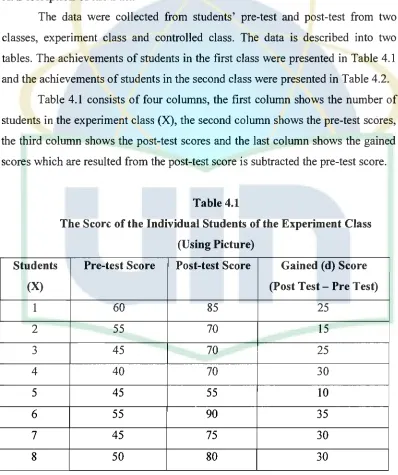
The data were collected from students' pre-test and post-test from two classes, experiment class and controlled class. The data is described into two tables. The achievements of students in the first class were presented in Table 4.1 and the achievements of students in the second class were presented in Table 4.2.
Table 4.1 consists of four columns, the first column shows the number of students in the experiment class (X), the second column shows the pre-test scores, the third column shows the post-test scores and the last column shows the gained scores which are resulted from the post-test score is subtracted the pre-test score.
Table 4.1
The Score of the Individual Students of the Experiment Class
(Using Picture)
Students
(X)
Pre-test Score Post-test Score Gained (d) Score
(Post Test - Pre Test)
1
60
85
25
2
55
70
15
3
45
70
25
4
40
70
30
5
45
55
106
55
90
35
7
45
75
30
8
50
80
30
[image:39.595.107.505.269.744.2]28
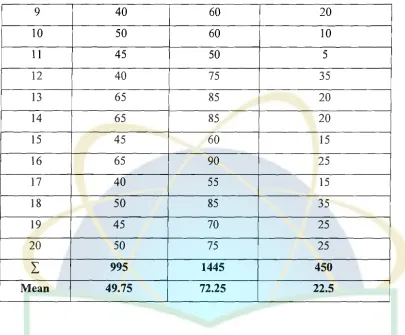
9 40 60 20
10 50 60 10
11 45 50 5
12 40 75 35
13 65 85 20
14 65 85 20
15 45 60 15
16 65 90 25
17 40 55 15
18 50 85 35
19 45 70 25
20 50 75 25
L
995 1445 450Mean 49.75 72.25 22.5
[image:40.596.104.509.114.449.2]The Table 4.1 above describes that the lowest score in the pre-test is 40 and the highest score is 65. Meanwhile, the lowest score in the post-test is 50 and the highest score is 90. Therefore, it can be summarized that the lowest and the highest scores in post-test is higher than in pre-test.
Table 4.2
The Interval class of gained score of the Experiment Class (Using Picture)
Class Interval
f
30-35 6
25-29 5
20-24 3
15-19 3
10-14 2
The Table 4.2 above describes that the most rate interval is 5 on class interval 21-25 gained score. Then the less rate interval is 1 on class interval 1-5 gained score.
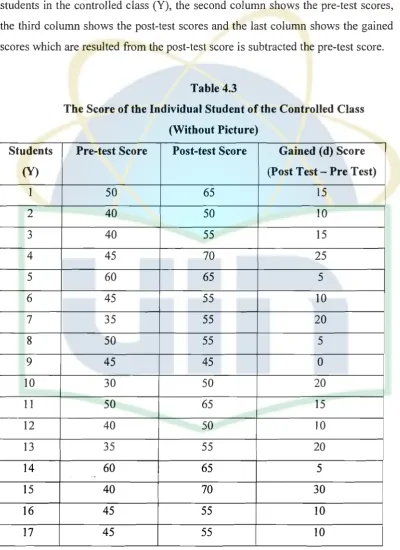
[image:41.596.109.510.198.749.2]Table 4.3 consists of four columns, the first column shows the number of students in the controlled class (Y), the second column shows the pre-test scores, the third column shows the post-test scores and the last column shows the gained scores which are resulted from the post-test score is subtracted the pre-test score.
Table 4.3
The Score of the Individual Student of the Controlled Class
(Without Picture)
Students
(Y)
Pre-test Score Post-test Score Gained (d) Score
(Post Test - Pre Test)
1 50 65 15
2 40 50 10
3 40 55 15
4 45 70 25
5 60 65 5
6 45 55 10
7 35 55 20
8 50 55 5
9 45 45 0
10 30 50 20
11 50 65 15
12 40 50 10
13 35 55 20
14 60
.- 65 5
15 40 70 30
16 45 55 10
30 18 19 20
I
Mean 45 50 50900
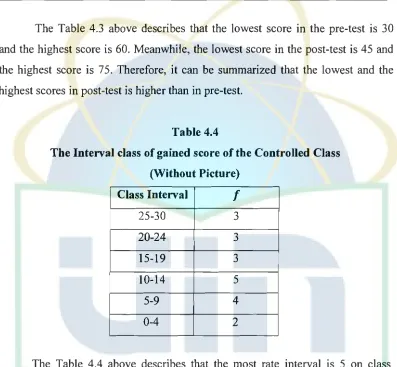
45 50 75 50 1155 57.75 5 25 0 255 12.75 I [image:42.596.113.510.220.587.2]The Table 4.3 above describes that the lowest score in the pre-test is 30 and the highest score is 60. Meanwhile, the lowest score in the post-test is 45 and the highest score is 75. Therefore, it can be summarized that the lowest and the highest scores in post-test is higher than in pre-test.
Table 4.4
The Interval class of gained score of the Controlled Class (Without Picture)
Class Interval
f
25-30 3
20-24 3
15-19 3
10-14 5
5-9 4
0-4 2
The Table 4.4 above describes that the most rate interval is 5 on class interval 21-25 gained score. Then the less rate interval is 1 on class interval 1-5 gained score.
B. Analysis of the Data
Before the writer analyzed the data, she had calculated the data into the statistic calculation. The writer used tlesl formula to find the empirical evidence
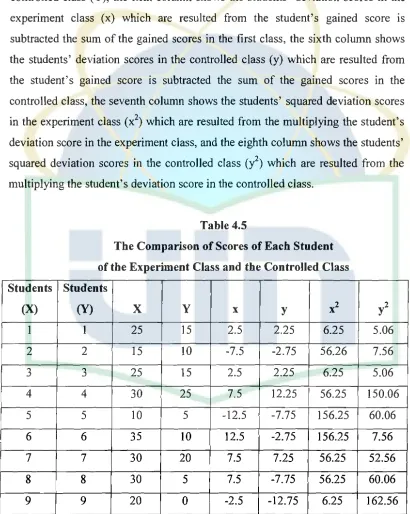
Before it, the writer made the calculation table from two variables. The table consists of eight columns; the first column shows the number of students in the experiment class, the second column shows the number of students in the controlled class, the third column shows the students' gained scores in the experiment class (X), the fourth column shows the students' gained scores in the controlled class (Y), the fifth column shows the students' deviation scores in the experiment class (x) which are resulted from the student's gained score is subtracted the sum of the gained scores in the first class, the sixth column shows the students' deviation scores in the controlled class (y) which are resulted from the student's gained score is subtracted the sum of the gained scores in the controlled class, the seventh column shows the students' squared deviation scores in the experiment class (x2) which are resulted from the multiplying the student's deviation score in the experiment class, and the eighth column shows the students' squared deviation scores in the controlled class (l) which are resulted from the multiplying the student's deviation score in the controlled class.
Table 4.5
The Comparison of Scores of Each Student of the Experiment Class and the Controlled Class Students
(X)
Students
(Y) X Y x
y
x2
y2
1 1 25 15 2.5 2.25 6.25 5.06
2 2 15 10 -7.5 -2.75 56.26 7.56
3 3 25 15 2.5 2.25 6.25 5.06
4 4 30 25 7.5 12.25 56.25 150.06
5 5 10 5 -12.5 -7.75 156.25 60.06
6 6 35 10 12.5 -2.75 156.25 7.56
7 7 30 20 7.5 7.25 56.25 52.56
8 8 30 5 7.5 -7.75 56.25 60.06
32
10 10 10 20 -] 2.5 7.25 156.25 52.56
11 11 5 15 -17.5 2.25 306.25 5.06
12 12 35 10 12.5 -2.75 156.25 7.56
13 13 20 20 -2.5 7.25 6.25 52.56
14 14 20 5 -2.5 -7.75 6.25 60.06
15 15 15 30 -7.5 17.25 56.25 297.56
16 16 25 10 2.5 -2.75 6.25 7.56
17 17 15 10 -7.5 -2.75 56.25 7.56
18 18 35 5 12.5 -7.75 156.25 60.06
19 19 25 25 2.5 12.25 6.25 150.06
20 20 25 0 2.5 -12.75 6.25 162.56
Mean 22.5 12.75 73.75 68.69
Nt =20 N2 =20 450 255 1475 1373.7
The writer calculated the data based on the steps of the test. The steps are: a. Determining Mean of Variable X
LX
M
x
=-Nt
450 20 =22.5
b. Determining Mean of Variable Y M.
=LY
Y Nz
255 20 = 12.75
セ
J1475
20
= -V73.75
=
8.59d. Determining Standard of Deviation Score of Variable Y
J¥;
XZSD=
-Y Nz
セ
J1373.7
20
= -V68.69
= 8.29
e. Determining Standard Error Mean of Variable X
SDx
SEMx= セ
.,jN
1-18.59
V201
8.59 4,36 = 1.97
f. Determining Standard Error Mean of Variable Y
SD y
SEMy= セ
.,jNz
-18.29
V201
8.29 4,36
= 1.90
34
SEMx - My=
JSEM/
+
SEM/=
..J1.972+
1.902=
..J3.88+
3.61= ..J7.49
=2.74 h. Determining to
Mx - My
to
=
SEM -Mx y
22.5-12,75 2,74 9,75 2,74
=3.56
1. Determining Degrees of Freedom
df=N/+N2- 2
= 20+20-2 = 38
Because the Value of 38 is not mentioned in the table, the writer uses the closest value to 38 which is 40 as degrees of freedom. He gained the t-lable as follow:
Degree of significant 5% from 40 is 2.02, and degree of significant 1% from 40 is 2.71.
The Comparison between to and t table
From the calculation above, the score of experimental class is higher than the controlled class. The writer also got the result of comparison between to and ttable:
2.71 <3.56>2.02
=
ttable<to>ttableC. Test of Hypotheses
1.
If to>ttable : the alternative hypotheses (Ha) is accepted and the null hypotheses is rejected. It means there is significance differences between the result of using pictures technique in teaching vocabulary and without using pictures technique in teaching vocabulary.2.
If to<ttable : the alternative hypotheses (Ha) is rejected and the null hypotheses is accepted. It means there is no significance differences between the result of using pictures technique in teaching vocabulary and without using pictures technique in teaching vocabulary.To prove the hypotheses above, the writer used the result of statistic calculation from the experimental class and the controlled class. It was obtained that the value of to was 3.56 while the degree of significance 5% is 2.02 and degree of significance 1% was 2.71.
By comparing of statistic calculation that to>ttable (3.56> 2.02 at 5% and 2.71 at 1%) is significant. There different between the average score from experimental class and controlled class. The score result from the experimental class is higher than controlled class. So, Ha (alternative hypotheses) is accepted and Ho(null hypotheses)is rejected. It means, There is significance different between the result of using pictures technique in teaching vocabulary and without it.
D. Interpretation of the Data
36
degree of significance of 5% is 2.02. Comparing the towith each values of the degree of significance, the writer finds that> 2.02. So, to is higher than t-table'
Since to score in the table is higher than t-table score obtained from the result of calculating, so the alternative hypotheses (Ha) is accepted and the null hypotheses (Ho) is rejected.
This is the last chapter to present the conclusions and some suggestions.
A. Conclusion
The conclusion of this research is drawn in accordance with the result of the data analysis in the previous chapter. There are some significant differences between pre-test and post-test. It can be seen to the result of the calculationn using t-test. It shows the value of tobserved: 3.56 and tlable: 2.02 at significance level 5% and tlable: 2.71 at significance level 1% and df= 38. It means that tobserved was higher than tlable (2.02 ::;; 3.56 セ 2.71). Thus Null Hypothesis (Ho) is rejected while Alternative Hypothesis (Ra) is accepted. From the explanation above, it can be concluded that the use of pictures is effective in teaching vocabulary at the seventh grade ofMTS AI-HanifSerua.
B. Suggestion
Based on the results or the research, the writer would gIve some suggestions that might be useful for students, English teachers and other writers, as follows:
1. Every student should realize that learning English is their need. They cannot only depend on the teacher to learn it. They have a responsibility to learn it by themselves, especially in leaming vocabulary. It is impo