i
PERFORMANCE ANALYSIS OF WIRELESS MULTI-HOP NETWORK
NUR ASYRANI BINTI MOHD ASARI
This Report Is Submitted in Partial Fulfillment Of Requirements For The Bachelor Degree Of Electronic Engineering (Wireless Communication)
Faculty of Electronic Engineering and Computer Engineering Universiti Teknikal Malaysia Melaka
v
vi
ACKNOWLEDGEMENT
Alhamdulillah, in the name of God, most beneficent, most merciful. All the praise and thanks are to Him, I am able to complete this project successfully without any problems.
First of all, I would like to thank to all organizations and individuals who have contributed to my project. With the cooperation from all parties, the objectives of the project were achieved precisely to the expected outcome. My special thanks go to Engr Fakrulradzi Bin Idris, my supervisor for all the guidance, support and advice.
vii
ABSTRACT
viii
ABSTRAK
ix
CONTENTS
CHAPTER CONTENT PAGE
PROJECT TITLE i
CANDIDATE’S DECLARATION ii
SUPERVISOR AUNTHENTICATION iii
DEDICATION iv
ACKNOWLEDGEMENT v
ABSTRACT vi
ABSTRAK vii
CONTENTS viii-ix
LIST OF TABLE x
LIST OF FIGURE xi-xii
LIS OF ABBREVIATION xii
1 INTRODUCTION
1.1 Introduction to project 1-2
1.2 Problem statement 2-3
1.3 Objectives 3
1.4 Scope of work 3-4
1.5 Methodology 4-5
x
2 LITERATURE REVIEW
2.1 Literature review 6-8
2.2 Overview of wireless network 8-10
2.3 IEEE802.11 standards 10
2.3.1 IEEE802.11s 11
2.4 Overview of wireless multi-hop network 12-13
2.5 Advantage of WMN 14
2.6 Overview of network simulator 15 2.6.1 Network simulator 2 (NS2) 15-16 2.6.2 Network simulator 3 (NS3) 16-18 2.6.3 Basic commands in NS3 18-19 2.7 Optimized link state routing (OLSR) protocol 19 2.8 Performance parameter : throughput 20-21 2.9 Performance parameter : average packet delay 21
3 METHODOLOGY 22
3.1 Introduction 22-23
3.2 Phase 1 : Literature study 24
3.3 Phase 2 : Simulation of Network Simulator 3 25-27 3.3.1 Point to point network 28 3.3.2 Point to Point by Hanging A Bus network 29-30 3.3.3 Wireless multi-hop network (WMN) 30-33 3.4 Phase 3 : Analysis and discussion 33
xi
4.1 Introduction 34
4.2 Point to point analysis 35
4.3 Point to point by hanging a bus analysis 36
4.4 WMN Analysis : NS3 Classes 37-38
4.5 WMN Analysis : Throughput 38-43
4.6 WMN Analysis : Packet delay 43-49
5 CONCLUSION AND RECOMMENDATIONS 50
5.1 Conclusion 50-51
5.2 Recommendations 51
REFERENCES 52
xii
LIST OF TABLE
No TITLE PAGE
2.1 IEEE802.11 standards 10-11
3.1 Parameter setting 28
3.2 Parameter setting 30
3.3 Parameters setting 31
4.1 Throughput for different packet size 40
xiii
LIST OF FIGURE
NO TITLE PAGE
2.1 Layout of OPNET scenario 7
2.2 Global average throughput 8
2.3 IEEE802.11 LAN Topology 9
2.4 Wireless Multi-hop network 13
3.1 Flow Chart of Working Principle Phase 23
3.2 Point to Point Network 28
3.3 Point to Point by Hanging A Bus network 29
3.4 Wireless multi-hop network topology 30
3.5 Scenario 1, single hops 32
3.6 Scenario 2, 2 hops 32
3.7 Scenario 3, 3 hops 32
3.8 Scenario 4, 4 hops 33
4.1 Result of Point to Point network 35
4.2 Result of Point to Point by Hanging A Bus network 36
4.3 mypsm.cc script 39
4.4 Results from mypsm.cc script 40
4.5 Throughput for video traffic 41
4.6 Throughput for data traffic 42
xiv
4.8 Packet delay for video 44
4.9 Packet delay for video with 2Mbps 45
4.10 Packet delay for data 46
4.11 Packet delay for data with 2Mbps 47
4.12 Packet delay for voice 47
xv
LIST OF ABBREVIATIONS
WLAN - Wireless local area network
WMN - Wireless multi-hop network
NS3 - Network Simulator 3
NS2 - Network Simulator 2
UDP - User datagram protocol
LAN - Local area network
BSS - Basic service set
DS - Distribution system
AP - Access point
STA - Station
IBSS - Independent BSS
PHY - Physical
MAC - Media Access Control
AODV - Ad-hoc on demand distance vector routing
DSDV - Dynamic distance-sequenced distance-vector routing
1
CHAPTER 1
INTRODUCTION
1.1 Introduction to project
Nowadays, internets have become the most important thing in our life. We can get connected through all over the world by using internet access. Wireless local area network (WLAN) provides us the internet access connection through an access point using wireless distribution method. WLAN allows the users to move around within a local coverage and still be connected to the network. Arising demand of this network leads to the expanding of the network access to poorly serve or highly loaded areas for a wider coverage. So, wireless multi-hop network have been created with the additional WLAN access points are connected to wire internet gateways through wireless links to other access points using decentralized architectures.
2
this project is to develop and analyze the performance of WMN. This is done by optimizing certain parameters. The desired parameters such as throughput and average packet delay of the WMN are the parameters that are being considered in order to achieve the desired objectives. The simulation of the development of WMN is done using Network Simulator 3 (NS3). The application of WMN is generally divided into two scenarios which are sensor networks consisting of dedicated devices that provide monitoring or measurement data on their surroundings and ad-hoc networks formed anywhere and at any time, with communication as the primary purpose. This project focused on WMN as ad-hoc networks that perform communication barrier.
1.2 Problem statement
As a senior futurist Thomas Frey predicted in 2006, “ The world of wires has already begun its long descent into oblivion as wireless technology improves to the point where wires become obsolete” (Frey, 2006). Although fibre optics has overwhelming advantages in bandwidth and transmission loss, the cost in installation and maintenance, especially for rural areas, limit their applications in access network services [1]. The present WLAN, IEEE 802.11 interconnections rely on wired networks to carry out bridging functions. For a number of reasons, this dependency on wired infrastructure must be eliminated because :
This dependency is costly and inflexible, as WLAN coverage cannot be extended beyond the backhaul deployment.
Centralized structures work inefficiently with new applications, such as wireless gaming, requiring peer-to-peer connectivity.
3
Beside, the arising demand of having the ability to communicate wherever and whenever has lead to an inevitable trend in wireless access. So, wireless multi-hop network (WMN) have been created with the additional WLAN access points are connected to wire internet gateways through wireless links to other access points using decentralized architectures. WMN hold the promise to get over the emerging needs.
1.3 Objectives
The purpose of this project are :
To study in details about the performance of WMN and open source software, Network Simulator 3 (NS3).
To develop and simulate the WMN model using NS3.
To analyze the performance of WMN in terms of throughput and packet delay for different type of packet.
1.4 Scope of work
4
application and class using in NS3 script is based on WiFi. This WMN is applying OLSR routing protocol and sending a User datagram protocol (UDP) packet transmission. This project also will focus on network’s throughput and average packet delay by using NS3. From that, the real performance of the actual wireless multi-hop network can be analyzed. The gathered information will allow us to enhance the understanding about wireless multi-hop network. All of these are important in order to make sure that performance analysis of wireless multi-hop network is successfully done.
1.5 Methodology
The method used for achieving the above objectives can be divided into three stages. Firstly, a literature review on the current literature published based on WMN was carried out. Most of the information was collected from the journal, internet web explorer, data based online data, books, manuals and magazines. From the gathered data and information, only the important point are being highlighted and analyzed. This was done in order to identifying the trends and issues, and defining the scope of study. Study on the various type of software such as Network Simulator 2 (NS2) and Network Simulator 3 (NS3) has been done too. It was necessary in order to choose the best and suitable software to develop the basic WMN.
5
gathered from the simulations in the previous stage. The performance of the WMN in terms of throughput and average packet delay was analyzed.
1.6 Project outline
The first chapter introduces brief idea of Wireless Multi-hop Network (WMN). This chapter also covered problem statements, detailing the objectives, scopes and methodology of the project.
Chapter 2 provides in depth discussions on the background and literature review on the current state of WMN issues. The literatures on the characteristics, open issues and research trends are reviewed in this filed. This chapter also consists of definition of terms used throughout the report.
Chapter 3 will discuss on project methodology in completing this project. There are three stages that have done in order to complete this project. This chapter explains the flow of the procedure taken throughout the project.
Chapter 4 presents the analysis result obtained from the NS3 simulations. The throughput and average data packet for different scenarios are compared respectively. Then, the result of each scenario was discussed.
6
CHAPTER 2
LITERATURE REVIEW
2.1 Literature Review
The first paper that was being referred for this project is “Performance evaluation of IEEE 802.15.4 wireless multi-hop networks: simulation and testbed approach” [2]. This paper explains the performance evaluation of IEEE 802.15.4 wireless sensor network for both simulation and testbed. The performance of the network is analyzed in terms of throughput, packet delivery ratio and average packet delay using Network Simulator 2 (NS2). Even though this paper is about the different network from this project, the performance parameter is being referred for this project. The paper is being referred on how they measure the throughput and average packet delay. This paper use NS2, so it’s coding quite complicated since NS2 does not really support wireless network.
7
[image:22.612.180.472.169.407.2]comparison of different simulators has been referred. Different simulators have their advantages and disadvantages. OPNET has a layout of the scenario like Figure shown below :
Figure 2.1 : Layout of OPNET scenario
8
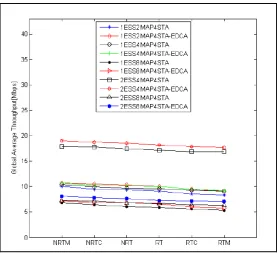
Figure 2.2 : Global average throughput
Third technical paper that has been referred is “Throughput Analysis of IEEE802.11 Multi-hop Ad hoc Networks” [3]. This paper focuses on the throughput analysis of IEEE802.11 Multi-hop Ad hoc networks. To verify the simulation results, it set up a real 6 node multi-hop network using NS2. The experimental measurements confirm the existence of the optimal offered load.
2.2 Overview of Wireless Network
9
[image:24.612.158.494.149.360.2]Physical (PHY) layer used in IEEE802.11 is different from wired network. Figure 2.3 below shows the IEEE802.11 LAN topology [1] :
Figure 2.3 : IEEE802.11 LAN Topology
The concept of service set is the basis of the different types of wireless LAN topologies. Service set is a grouping of devices that access the network by broadcasting a signal across a wireless radio frequency (RF) carrier. Basic service set (BSS) is a stations competing for access to shared wireless medium. BSS usually isolated or connected to backbone distribution system (DS) through access point (AP). Figure 1 above shows two BSS where each of them has two station (STA). The two stations in BSS communicate to each other via AP which acts as relay and AP also act as a bridge to the DS.