Agroforestry Technology to Bridge Divergent between Farmer
Production Goal and Government Environmental Goal
Tarigan, Suria Darma
Jurusan Tanah, Jl. Meranti, FAPERTA, Institut Pertanian Bogor Kampus Darmaga, Bogor – Indonesia
E-mail:[email protected]
Abstract: Soil conservation problems in developing countries involve a large group of farmers. These farmers normally characterized with the following attributes: a) small land holding size (between 0.5 ha—2 ha), b) low income and, c) short term view, which causing lack of environmental appreciation. These attributes should be taken into consideration in introducing technology for sustainable soil conservation. Mechanical structures such as terracing, gully plug, etc proofed to be not sustainable in this environment due to high input and maintenance cost and high labor requirement, which small farmer with low income hardly can afford.
Sustainable soil conservation in this environment has two aspects: (1) appropriate type of technology and (2) active’s farmer participation. Appropriate technology calls for a balance between production goals and environmental goal. Farmers are concern toward production goals while most development projects and government agencies promoting watershed management are concern toward conservation and environmental goals benefiting people living at downstream.
This study focuses on evaluation of sustainability index of various land use systems for soil conservation practices in the area where small land holding farmer are dominant. Indicators used for evaluation are:
Profitability indicators: Return to labor (smallholder’s concern), Year to positive cash flow and return to land (government’s concern)
Agronomic indicators: Soil compaction and soil exposure
Environmental indicators: Erosion on-site (smallholder’s concern), reservoir sedimentation rate (government’s concern)
From those indicators sustainability index of various land use systems for soil conservation practices was determined using analytical hierarchy process. Among selected land use system, agroforestry technology received highest sustainability index. It means, agroforestry practices will better bridge gap of farmer production goal and government environmental goal.
Keywords: agroforestry, analytical hierarchy process, small landholder, sustainability index 1 Introduction
According to the latest statistic, forest coverage in Indonesia amounts to 113 million ha. Rate of forest and land degradation is 1.5 million ha per annum. Meanwhile, reforestation and regreening rate are low, respectively 0.05 and 0.5 million ha per annum. Reforestation means tree replanting in side forest zone and regreening means re-vegetation of degraded land outside forest zone, for instance in agriculture field.
Mechanical structures such as terracing, gully plug, etc proofed to be not sustainable in this environment due to the high input and maintenance cost and high labor requirement, which small farmer with low income hardly can afford. Therefore, the adoption of mechanical structures for soil and water conservation is unsustainable. For soil conservation measures to be sustainable, it should not only function as soil conservation per se but also provide short-term benefit to the farmer. As a substitute for mechanical structures, agroforestry practices for soil conservation might serve this function. Agroforestry practices are considered to be appropriate in the area where small holder farmers are dominant. Beside their function in conserving soil, they will provide a short-term benefit for farmer.
Objective of this study is to evaluate sustainability of agroforestry practices for soil conservation in the area where small holder farmers are dominant. Sustainability is expressed in term of sustainability index derived from analytical hierarchy process.
2 Material and methods
This research focuses on evaluation of appropriate type of technology for sustainable soil conservation following forestland conversion. Five types of land use practices following forestland conversion were included in this research. These land use practices are grouped in to three categories: 1) Natural Forest as a comparison; 2) Monoculture practices; and 3) Agroforestry practices. Monoculture practices were sub-divided into the following category: Coffee plantation monoculture, Oil palm monoculture, and Rubber monoculture. Meanwhile agroforestry practices were sub-divided into the following: Coffee–agroforestry and rubber-agroforestry. Tree components in agroforestry practices consist of fruit and timber trees such as: Nephelium lappaceum, Paraserianthes falcataria, and
Phithecellobium lobatum.
Indicators used for sustainability evaluation are: 1) Environmental indicators (Erosion and sedimentation rate), 2) agronomic indicators (soil compaction and soil exposure), and 3) Profitability indicators (return to labor and to land). These indicators representing respectively government and smallholders’ socioeconomic concerns, which are in many cases divergent. Profitability analysis was carried out by calculating net present value (NPV). Sustainability index was derived from these indicators using analytical hierarchy process. Deriving the sustainability index involves the following steps:
2.1 Ranking relative effectiveness of agroforestry practices in controlling erosion/sedimentation (environmental indicators)
Effectiveness of various land use practices in controlling soil erosion was measured using sediment collector. A part of the soil erosion data was compiled from other research report in the same area (ASB, 1998; Gintings, 1982).
2.2 Ranking agronomic sustainability
Two parameter were used to represent agronomic sustainability. These criteria are: potential soil compaction and soil exposure. Soil compaction was determined by measuring mean bulk density. Soil exposure based on number of month of low (<50%) soil coverage in one cycle of growing period.
2.3 Analyzing profitability of various vegetative soil conservation practices
2.4 Ranking sustainability index by including preference of stakeholders (farmer and government) using analytical hierarchy process
The establishment of agroforestry for soil conservation practices in a watershed scale requires active’s farmer participation. As it is mentioned before, these farmers normally have lack of environmental appreciation due to the small land holding size and short-term view. Therefore, it is important to consider their preference to secure the sustainable establishment and maintenance of those practices. Certain agroforestry practices might generate high income for farmer, but these practices could result in higher erosion/sediment, which harmful for public facilities downstream. Therefore, preference of government should be included as well. Weighing the preference of farmer and government together was accomplished using procedure of analytical hierarchy process (AHP). Application of multi-criteria such as AHP for incorporating small holder farmer’s and government concern involves setting each of that indicators/criteria – profitability, agronomic and environmental- into several descending level of hierarchy. The goal of AHP is to select the highest sustainability index in the area following forestland conversion where small holder farmers are dominant (See Fig. 1).
Fig.1 Structure of analytical hierarchy process used in this research 3 Result and discussion
3.1 Effectiveness of selected land use practices in controlling erosion/sedimentation
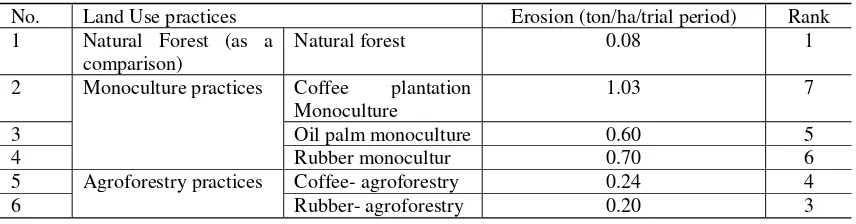
Effectiveness of various land use practices in reducing erosion and sediment yield is shown in the Table 1. Erosion rate from coffee-based agroforestry practices 3 lower than monoculture coffee plantation and 3 higher than natural forest. The best land use practices to control erosion is certainly forest category followed by agroforestry category. Monoculture practices tend to have high erosion rate due to the less canopy cover. In this area, monoculture practice is usually clean-weeded as well, which reduce soil contact cover and erosion become higher.
Table 1 Comparative effectiveness of agroforestry practices in reducing erosion
No. Land Use practices Erosion (ton/ha/trial period) Rank 1 Natural Forest (as a
comparison)
Natural forest 0.08 1
2 Coffee plantation
Monoculture
1.03 7
3 Oil palm monoculture 0.60 5
4
Monoculture practices
Rubber monocultur 0.70 6
5 Coffee- agroforestry 0.24 4
6
Agroforestry practices
Better erosion control of certain land use practice is not necessarily result in higher adoption of small land holding farmer for that technology. Farmer might have another important indicators, such as profitability. Therefore, to ensure the sustainable adoption of technology by farmers for reduction of erosion/sediment, other indicators such as profitability should be analyzed. On the other hand, land use having higher profitability for farmer can be detrimental to the environment.
3.2 Agronomic indicators
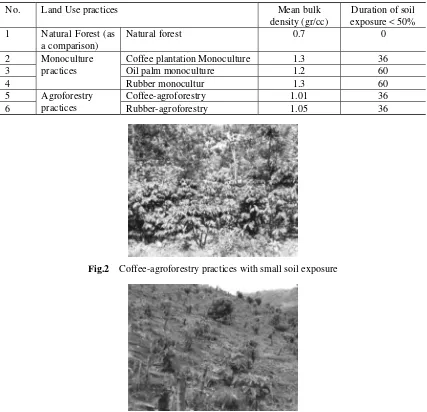
Parameters of agronomic indicators are shown in Table 2. Coffee monoculture has a serious problem in soil exposure, due to the low canopy cover especially during initial growing period. In addition, monoculture practices are usually clean weeded. On the other hand, coffee – agroforestry has small soil exposure (Fig.2). There is a clear difference in soil compaction between undisturbed forest and agriculture land use. Monoculture practices tend to have more compacted soil due to the low canopy and associated clean weeded practices in early growing period (See Fig.3 ). Soils are easily compacted, but it takes a long time to return to initial condition. Soil compaction will affect water infiltration and root growth.
Table 2 Agronomic indicators of various land use
No. Land Use practices Mean bulk
density (gr/cc)
Duration of soil exposure < 50% 1 Natural Forest (as
a comparison)
Natural forest 0.7 0
2 Coffee plantation Monoculture 1.3 36
3 Oil palm monoculture 1.2 60
4
Monoculture practices
Rubber monocultur 1.3 60
5 Coffee-agroforestry 1.01 36
6
Agroforestry
practices Rubber-agroforestry 1.05 36
Fig.2 Coffee-agroforestry practices with small soil exposure
3.3 Analyzing profitability of various land use practices
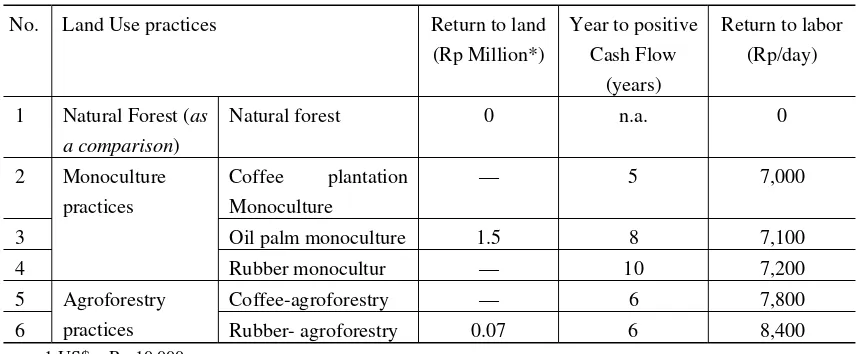
Result of profitability analysis for various land use practices is shown in the Table 3. Profitability analysis was carried out by calculating net present value (NPV) at private and social prices. Return to labour was determined by calculating the wage rate that sets NPV to zero. Macroeconomic parameter used such as wage rate, real interest rates (net of inflation) based on prices in 1997.
The calculation of NPV is based on three types commodites commonly found in the area after forest conversion such as oil palm, rubber and coffee plantation. Highest return to labour provided by agroforestry category. Agroforestry category has relatively higher return to labour compared to the monoculture practices. This partly caused by higher fertiliser input in monoculture practices.
Table 3 Profitability indicators of various land use
No. Land Use practices Return to land
practices Rubber- agroforestry 0.07 6 8,400
1 US$ = Rp 10,000
3.4 Ranking sustainability index by including preference of stakeholder using analytical hierarchy process
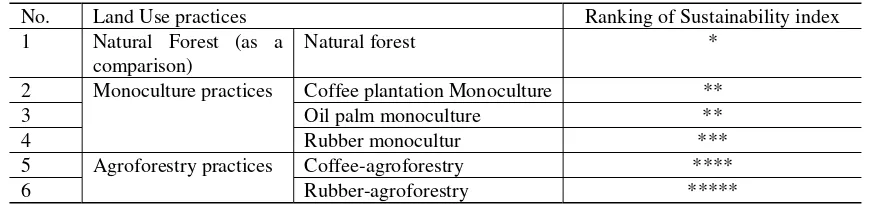
Table 4 Ranking of sustainability index of selected land use system based on ahp
No. Land Use practices Ranking of Sustainability index
1 Natural Forest (as a comparison)
Natural forest *
2 Coffee plantation Monoculture **
3 Oil palm monoculture **
4
Monoculture practices
Rubber monocultur ***
5 Coffee-agroforestry ****
6
Agroforestry practices
Rubber-agroforestry ***** Remarks: * = Lowest sustainability index; ***** = highest sustainability index.
4 Conclusion
In the area where small landholder farmer is dominant, return of certain land use practice may be more important rather than environmental indicator, such as erosion and sedimentation. This fact should be taken into consideration in introducing soil conservation technology. On the other hand, profitable land use system might not sustainable from government environmental point of view, such as soil compaction and soil exposure. Divergent goals of conflicting interest group should be weighed for sustainable land use system. Based on AHP, agroforestry category showed relatively higher sustainability index than monoculture practices. Highest sustainability index of agroforestry category was due to the higher return for small holder farmer on one site and favorable environmental impact on the other side.
Acknowledgement
Presentation of this paper in ISCO 12th Conference, May 25-31, 2002, Beijing.
China is fully sponsored by Quality for Undergraduate Education (QUE) Project of Study Program of Soil Sciences, Faculty of Agriculture, Bogor Agricultural University, Fiscal Year 2001.
References
Hasyim, A.I., et al. 2000. Identifying Tree and Crop Options for the Transition of Imperata Grasslands into Agroforestry Systems in North Lampung.
Saaty, T.L., 1990. Multicriterion Decision Making; Analytical Hierarchy Process. Planning Priority Setting, Resource Allocation. RWS Publication, Pittsburg.
Sinukaban, N., S.D. Tarigan, and E. D. Wahjunie. 2000. Analysis of Watershed Function. Unpublished report, Bogor Agricultural University, Indonesia.