Vol. 7 No. 2 May 2016
240
The indonesia’s Police Reform
Police in the Reform Era New
Institutionalism Perspective
ACHMAD NURMANDI, ISNAINI MUALLIDIN, SURYANTO, EKO PRIYOPURNOMO
Department of Social and Political Sciences, Universitas Muhammadiyah Yogyakarta. Email: [email protected]
ABSTRACT
Since the reformation and democratization movement in 1998, Indonesians have faced a chronic corruption problem. At the beginning of reformation era in 1998 to fight against corruption, the Indonesian government reforms the orga-nization structure of the Indonesia Police to be an independent body separated from the Military organization. The police reforms begun in 1999 and got legal foundation with Act No. 2/2002. However, since fourteen years, the level of police reform has not yet succeed because of low community satisfaction on police service and the intense conflicts always occur whenever ACA investigates the case of corruptions conducted by police leaders. Three conflicts between police institution and ACA have taken placed. By using institutionalism approach, this research focus on the reform in police themselves are major actors on how reforms are organized and managed. This study is interpretative in nature gained only through social constructions such as language, consciousness, shared meanings, documents, tools, and other artefacts’. This finding revealed that this unsuccessful institutionalization process took place in a context of the main task of police for communicty service. Second, the study has demon-strated that three concepts from institutional theory as aforementioned provided vocabularies and insights to explain the phenomenon under study. Keyword: new intitutionalism. Anti Corruption Agency, police, corruption, con-flict
INTRODUCTION
In the early 20th century there were increasing demands for a police reform in order to professionalize the police, reduce corruption and political influence, and increase the accountability of the police to the law (Paun. C, 2007).
Received 17 march 2016 Revised 30 March 2016 Accepted 11 April 2016
JOURNAL OF GOVERNMENT & POLITICS
241
Since the reformation and democratization movement in 1998,Indonesians have faced a chronic corruption problem. At the beginning of reformation era in 1998 to fight against corrup-tion, the Indonesian government reforms the organization struc-ture of the Indonesia Police to be an independent body sepa-rated from the Military organization. In addition, another anti-corruption body was also established in 2002 named Anti-Cor-ruption Commission (ACC) to fight against big corAnti-Cor-ruption.
242
Vol. 7 No. 2
May 2016 which their individual benefits depend on the provision of the
collective benefit’ (1998).
This study is interpretative research in new institutionalism perspectives that nature gained only through social construc-tions such as formal and informal constrains of institution. First, it provides a new understanding and a fresh explanation of how institutionalization of Indonesia’s police have taken place in the context of developing countries.
THEORETICAL FRAMEWORK
According to Ostrom (1999), institutions have wide defini-tions and numerous concepts that are based on behavioural rules, norms and approaches. In other words, “institutions are the pre-scriptions that humans use to organise all forms of repetitive and structured interactions, including those within families, neighbourhoods, markets, firms, sport leagues, churches, private associations, and governments at all scales (Ostrom, 2005). The terms of institutions can be considered to include formal institu-tions, such as Constitution, government laws, charter, decree and statutes, and informal institutions, such as code of conducts, customs, local knowledge and social expectations (North, 1991, Quinn et al., 2007, Smajgl and Larson, 2007).
243
JOURNAL OF GOVERNMENT & POLITICS
1990).
On the other hand, there are some problems with North’s exposition. Hodgson (2006) says that North is insufficiently clear about the distinction, (a) between institutions and organisation, and (b) between “formal rule” and “informal constraint”. The first problem arises if we define the organisation as an actor or player. North simply ignored that the instances when “the group of people that want to achieve the same goals bound by common purposes” may not be the case. North is less interested in the internal mechanism by which the organisations coerce or per-suade members to act together to some degree (Hodgson, 2006). In other words, an organisation involves structures or networks, and these cannot function without rules of communication, membership and sovereignty so in that case, organisation must be regarded as a type of institution (Hodgson, 2006).
The second ambiguity of North’s argument is the distinction between formal “rules” and “informal” constraint. Some iden-tify formal with legal and look at informal rules as non-legal; in turn, if “formal” means “legal”, then it is not clear whether “in-formal” should mean illegal (Hodgson, 2006). Furthermore, it is possible to identify the formal as being that which is designed, and the informal as spontaneous institutions, along the lines of Carls’s distinction between pragmatic and organic organisation (Hodgson, 2006). Therefore, it is suggested that the terms for-mal and inforfor-mal with regard to institution and rules should either be abandoned or employed with intense care.
244
Vol. 7 No. 2
May 2016 In regard to describing the difference between norms and law,
norms is all of those settings that define proper behaviour and then these norms make it feasible for people to live together with-out excess (Ostrom, 1990). In addition, norms can build reputa-tion. On the other hand, law is established by Government and applied throughout society; Law is compulsory; a citizen cannot choose which laws to follow or to ignore (Heywood, 2011). Fur-thermore, law is also recognised as binding on those whom it affects and law has a civic quality in that is consists of codified, published and enforced (Heywood, 2011). In addition, law pro-vides rights to the people and promises that all the people or parties will be treated equally (Fennell, 2010).
Institutions as rules and procedures (both formal and infor-mal) that structure social interaction by constraining and enabling actors behavior. How to distinguish between formal and infor-mal institutions is, however, less clear. Some scholars equate in-formal institutions with cultural traditions Others employ a state-societal distinction, treating state agencies and state-enforced rules as formal, and the rules and organizations within civil society as informal. Still others distinguish between informal norms, which are self-enforcing, and formal rules, which are enforced by a third party, often the state (Helmke and Levitsky, 2004)
In the recent period we find two influential but contrasted ways to conceptualize the relation of informal and formal rules
institutions The first is Hayek’s theory of law. It is influenced by
the common law experience and sees law (like morals) as evolved abstract rules that have been selected through a lengthy histori-cal process of cultural evolution, where the advantageous rules
have been filtered through group selection. The second
for-245
JOURNAL OF GOVERNMENT & POLITICS
mal rules and the persisting informal constraints.. While changes in formal rules are made and enforced by the polity, informal constraints are linked to cultural inheritance. North also strongly criticizes the mainstream approach to transition, emphasizing the limits to our understanding of institutional change (Chavance, 2008).
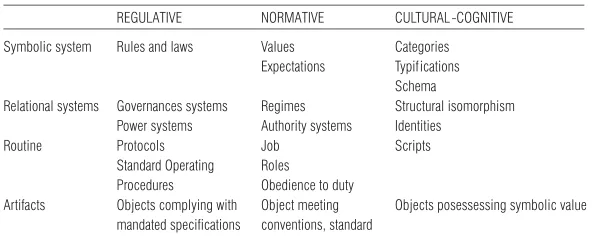
A number of authors have extended the new institutionalist view in terms of the interplay between formal and informal rules. Pejovich (1999) has put forward the “interaction thesis,” where different instances of relations are distinguished: 1) Formal in-stitutions suppress, but fail to change informal inin-stitutions; 2) Formal rules directly conflict with informal rules; 3) Formal rules are either ignored or rendered neutral; and 4) “Formal and in-formal rules cooperate” — as in cases where the state institution-alizes informal rules that had evolved spontaneously. Based on new institutionalism—which focuses on the interaction between an organization and its broader context and defines “institution” not only as the formal and informal processes and rules of an organization but also as systems of meanings and normative or-der that guide, incentivize, constrain, and encourage how indi-vidual and organizations operate and interact with each other (DiMaggio & Powell, 1983; March & Olsen, 1984, 1989; Scott, 1994). Further more Scott (2008) identified supporting institu-tion called “pillars” (Table 1).
TABLE 1. THREE PILLARS OF INSTITUTION
246
Vol. 7 No. 2
May 2016 Institution constraint and regularize behaviour. It has
regula-tory processes that involve the capacity to establish rules, inspect other conformity to them and manipulate sanctions-rewards or punishment in an attempt to influence future behavior (Scott, 2009). Normative pillar is placed on normative rules that intro-duce a prescriptive, evaluative and obligatory dimension in to social life, such as values and norms (Scott, 2009). Selznick (1996) suggests, organizational practices are not institutionalized unless they emerge to have distinctive forms, are infused with value beyond the technical task requirements, and are embedded with rituals and norms. Cultural pillar follows anthropologists theory which stresses the centrality of cultural-cognitive elements of in-stitutions: the nature of social reality and the frames through which meaning is made (again see Table 1). Cultural-cognitive pillar insist not only organization applies rules and enforce-ment mechanism, but also socially contructed (Scott, 2009).
RESEARCH METHODS
247
JOURNAL OF GOVERNMENT & POLITICS
RESULT AND ANALYSIS
We will describe and analyze the current status of Indonesia police reform into three sections: police reform policy, previous longintudinal community satisfaction on police service research done by other reseachers, corruption in police organization and the dynamic relation between police and ACA (anti Corruption Agency) in term of suspected high-rank police officers.
POLICE REFORM POLICY
Police reform in indonesia was preceded the release of Presi-dential Decree No. 2 1999 which ordered Defence Minister to set the police instituion separation from the armed forces. In july 2000 furthermore the government issued a Presidential Decree No. 89 / 2000 on the police institution status and role. This presidential decree stated that police is managed directly under the president. In the next august 2000, the government issued a Decree of House of Representatives No.VI. year 2000 on the separation function and power of armed forces and po-lice and a Decree of House of Representatives No. VII year 2000 on the role of the army and the role of police. Later on, Parlia-ment and GovernParlia-ment continue to issuie Act No. 2 year 2002 on the police (January 2009) (Umar, 2009). Since the act No. 2
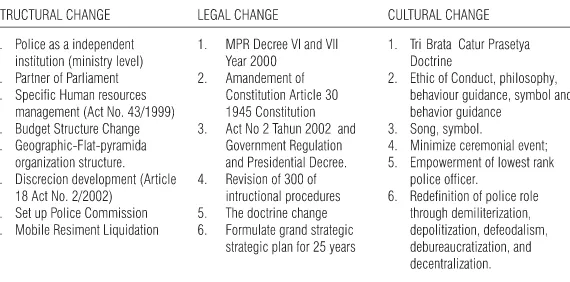
TABLE 2. INDONESIA POLICE REFORM SINCE 1999
248
Vol. 7 No. 2
May 2016 Year 2002 issued, some police reforms were launched below (Table
2). By using regulative pillar (structural change and legal change), those regulations become regulatory based for police institution to provide inducement to secure compliance. Relational system of new police institution based on Act No. 2/2002 created the new governance system: police under president and separated from the Army with specific mandate for public servant.
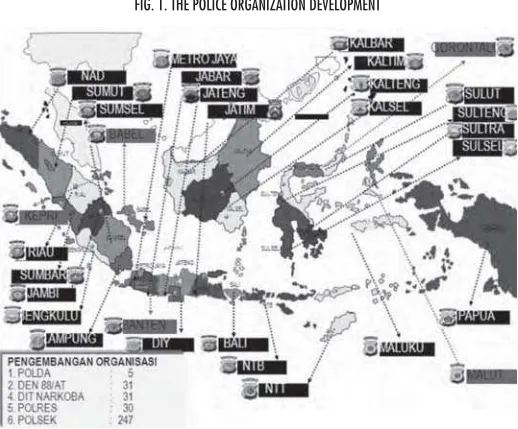
In the Fig 1 below, since 1999 Indonesia police organization has develop police organization into the new five provincial units (POLDA-polisi daerah), 88 anti terror units, 31 narchotics units, 30 regency/city units and 247 district units. This logic of police organizational development is basically based on the growing number of new autonomy city or regency after 1998. Regency/
city police organization (Polres-polisi resort) has similar service area
with regency/city one.
FIG. 1. THE POLICE ORGANIZATION DEVELOPMENT
249
JOURNAL OF GOVERNMENT & POLITICS
However, since fifteen years the police reform has been launched, the cultural reform in police organization has been challenged by the public. How do police doing their job and roles as a public servant ? Is there any change from military cul-ture to service culcul-ture in police institution? Marzuki and Eko (2004) tried to do community survey on police service for local community in Pontianak, West Borneo with 250 respondents. The research found that there was very low public satisfaction on police service. Only 18 percent of respondents from the com-munity state that the police can handle the comcom-munity reports satisfactorily signified by 18 percent reporting having very good experience. Similar to the previous figure, other data depicts vivid data on unsatisfied public toward the police service since the majority of the public (65.61 %) consider the police as either uncapable or bad. Only 7.69 percent of public that feel satisfied with the police service as they regard that the police service is good. Mean, one third of the public (27.69%) see that the police service is just fair.
250
Vol. 7 No. 2
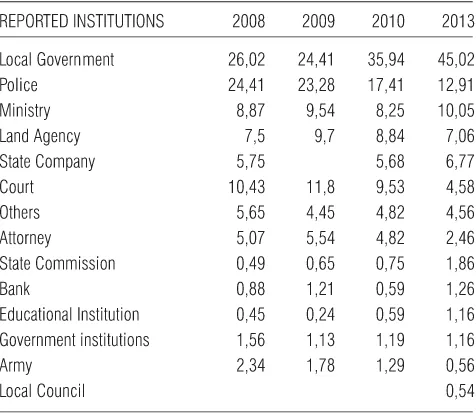
May 2016 TABLE 3. PUBLIC COMPLAINTS TO NATIONAL OMBUSTMAN (%)
Source: Indonesia Ombusman Report, www.ombudsman.go.id.
FIG.2. PUBLIC EXPERIENCE ON POLICE SERVICE
Source: Kompas Survey, 8 November 2013
251
JOURNAL OF GOVERNMENT & POLITICS
The most important findings showed that the criminal detective being the most police reported police institution (949 cases or 70%).
In 2013, Kompas (2013) did survey research on police ser-vice. It was not surprisingly that Kompas survey findings was not different with the Marzuku and Eko’s (2004) findings The re-search findings done by Kompas (2013) from 1000 respondents above confirms that police organization has not follow rules yet that much of behavior in an organization is specified by stan-dard operating procedures. The violations of police rules and regulation done by police officer are common cases found in different level of police office. Figure 4 can figure out the cur-rent data on the public satisfaction toward the police service. The public perceive that the police are too bureaucratic (52%) in providing their services. The rest (48%) of the public character-ize the police to have negative images including making power abuse, conducting procedure deviation, being incompetence, treating public unfairly, accepting bribery, and behaving unpolitely.
POLICE, CORRUPTION AND ITS RELATION WITH ANTI CORRUPTION AGENCY (KPK-KOMISI PEMBERANTASAN KORUPSI)
One of the normative pillar of institution is morally governed
252
Vol. 7 No. 2
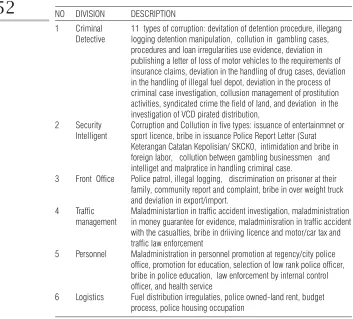
May 2016 units namely criminal detective, intelligent security, front office,
traffic management, personnel, and logistics (Umar, 2009).
TABLE 4. CORRUPTION IN POLICE ORGANIZATION
Source: Bambang Widodo Umar, Indonesia Police Reform, IDSPS Press, Jakarta, 2009
253
JOURNAL OF GOVERNMENT & POLITICS
control of the central government (Smith, J, et. al, 2003). The most serious accusation that has been made in connection with the settlement of criminal cases is that the investigating officers can be persuaded to close their eyes to the crime committed and close the case under investigation citing insufficient evidence (to the detriment of the victim). This condition has incited loud protests from the public in high profile cases involving high level corruption (Reksodiputro in Holloway, 2002). In the most cases if the corruption took placed at the regency/city police office, police leaders are often ambivalent via-a-vis local corruption pros-ecutions (Clark, S. 2012).
Police in Indonesia, like many countries, even when not ac-tively abusive, is lack a tradition of public service to the commu-nity at large, indifference ( like neglect, it is another form of un-responsiveness), a lack of dedication, incompetence, venality (petty corruption), extortion: this is more systematic and serious in nature than venality,relying on overt intimidation or actual vio-lence, inconsistency, intimidation, excessive force, brutality (Gold-smith, 2005).
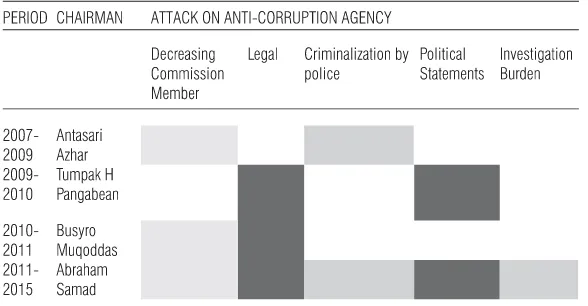
In addition, another anti-corruption body was also established in 2002 named Anti-Corruption Commission (ACA) to fight against big corruption. ACA was successful to bring big corrup-tors before the law. However, intense conflicts always occur when-ever ACA investigates the case of corruptions conducted by po-lice leaders. Three conflicts between popo-lice institution and ACA have taken place since ACA’s establishment. The first conflict took place in 2009 which was known as a “lizard versus crocodile case”. Next, a strong conflict between Police and ACA emerged again when ACA enacted Brigadier General Police Djoko Santoso as the accused in the corruption case. The latest dynamic rela-tion between police and ACA has taken place recently in the case of appointment General Budi Gunawan as the candidate of Indonesian Police leader.
254
Vol. 7 No. 2
May 2016 Law authorises the KPK to investigate and prosecute most
cor-ruption cases itself and to take over corcor-ruption investigations and prosecutions from police and prosecutors in some circum-stances (arts 8 and 9). It gives the ACA (KPK) investigative pow-ers that the police lack. These include powpow-ers to wire-tap sus-pects’ phones without seeking court approval, to freeze bank ac-counts and to issue travel bans (art. 12). The Law also prohibits the ACA (KPK) from dropping a case once it has progressed beyond initial investigations – a restriction aimed at preventing prosecutions from being dropped in return for bribes (Fenwick 2008). Ordinary police, prosecutors and judges appear poised to regain the exclusive control over corruption cases that they lost to the ACA (KPK) and the Corruption (Tipikor) Court under the 2002 ACA (KPK) Law (Butt, 2011).
TABLE 5. WEAKENING ANTI-CORRUPTION AGENCY
Source: Kompas, 24 January 2015
255
JOURNAL OF GOVERNMENT & POLITICS
highcompetence and integrity, leads to an “institutional ‘zero-sum game’... ,wherein the KPK draw[s] staff resources away from th[e other] Twoorganizations (Jacobs, L. G., & Wagner, B. B. (2007).
256
Vol. 7 No. 2
May 2016 of “gecko vs. crocodile” soon proliferated online. When the
In-donesian Corruption Watch organized a street rally online, 5,000 people showed up on the streets of Jakarta showing support for “the gecko.” This was followed by demonstrations in several other cities in support of the two men. On December 3, 2009, this public pressure saw charges against Bibit and Chandra dropped (Lim, 2013).
257
JOURNAL OF GOVERNMENT & POLITICS
were dealt prior the establishment of KPK (Partohap, T. H., & Pradiptyo, R., 2015).
Formal institutions as rules are readily observable through written documents or rules that are determined and executed through formal position, such as authority. In Indonesia, the corruption cases were handled by three legal institutions: Police, ACA and Prosecutor. Every institution seizes its authorities that are regulated by the law. This paper focuses to discuss two insti-tutions only, namely, Police and ACA, since when these two in-stitutions imposed their authorities; they produce various ten-sions, constraints, and disagreement in implementing their au-thorities.
In the article 14 paragraph (1) point Law No. 2, 2002 about Indonesian National Police states that the main function of
Po-lice is to conduct investigation and indictment towards all legal offenses
in ACA accordance to criminal procedure acts and other laws. This main function of ACA in Criminal Procedure Acts (CPA) Article 6 paragraph (1) CPA states that investigator are Indone-sian Police officers and Civil servants with special authorities granted by law. Meanwhile, Article 6 point c Law no. 30, 2002 about Anti-Corruption Acts (ACA) mentions that the functions of ACA are to conduct investigation and prosecution towards corruption crimes. And Article 11 point c gives a limitation that ACA can only investigate and prosecute corruption crimes that cause the state loss at least 1 billion Indonesian Rupiah (IDR).
Po-258
Vol. 7 No. 2
May 2016 lice, based on Article 50 Law No. 30, 2002, include:
1. When a corruption case is found out and the KPK has not commenced its indictment process, while the case is being indicted by the Police or the Prosecutor’s Office, that institu-tion is obliged to inform the KPK at the latest fourteen days since the commencement of the indictment process.
2. An indictment process being conducted by the Police or the Prosecutor’s Office as outlined in (1) must be coordinated continuously with the KPK.
3. When the KPK has already commenced its indictment pro-cess, the Police or the Prosecutor’s Office no longer has the authority to conduct an indictment process.
4. When an indictment process is being conducted concurrently by the Police and/or the Prosecutor’s Office and the KPK, the process conducted by the Police or the Prosecutor’s Of-fice shall cease immediately.
Informal institution constitutes rules based on implicit un-derstandings, being in most socially derived parts and therefore it is not ACA acessible through written documents or it is neces-sarily sanctioned through formal position. Informal institutions include coordination and Supervision. There are some informal institutional problems that become the root of disharmonious relation between ACA and Police in eradicating corruption in Indonesia. The problems include not solid coordination patterns to work in team between the institutions and egocentric issues that exist in the institutions (Ferawati, 2013).ACA hold a wide range of authorities to coordinate with other authorized institu-tions to fight against corruption. Article 6 point a Law No. 30, 2002 mentions that ACA retains coordination function with other authorized institutions to eradicate corruption.
259
JOURNAL OF GOVERNMENT & POLITICS
Comptroller, and Local Auditing Agency) Nugroho (2013). To be more specific, ACA should focus to coordinate and supervise in processing the corruption crime with Police and Prosecutor. Nugroho (2013) found that the coordination and supervision functions of ACA as enacted in Article 6 point a and b Law No. 30, 2002 has been implemented and even getting better from year to year. However, investigators from attorney institution and Police in Central Java mentioned that functions of coordina-tion and supervision of ACA are not properly accomplished yet. ACA only undertakes coordination and supervision functions when ACA obtains reports from the society. Next, the constraints faced by ACA to perform its coordination and supervision func-tions in local level lay on legal factor, legal officer factor, and facilities factors. ACA encounters human resources shortages to accomplishe its corruption indictment coordination and super-vision functions. Consequently, the main task to cover coordi-nation and supervision functions all over Indonesian regions is not optimally undertaken.
Other than coordination and supervision issues, a fundamen-tal problem in terms of informal institutional constraints is insti-tutional egoism, that is, in handling the corruption case, officers from every institution tend to protect their corruption-suspected colleagues to save the name of their institutional corps. One of the instances is the corruption case of driving license simulator. In this case, ACA had made early indictment and named the suspect Inspector General Joko Susilo. Soon, Police name three other suspects in this case. In the indictment process in this cor-ruption case, Police refers to the MoU signed by Police, ACA and Atterney on March 29 2012. Artile 8 poin 1 in the MoU mentions, “When some parties make indictment in the same case, to avoid investigation duplications, the institution that is obliged to proceed the investigation is the institution that issues the letter of order for investigation or a party under approval of other related parties.”
260
Vol. 7 No. 2
May 2016 and Prosecutor contains article that is in contradictory with the
Law about ACA. Therefore, based on Civil Procedure Act the MoU was null and void. It is null and void because any agree-ment should be in contradiction with the existing and binding Law. As a result, Police could not use MoU as the basis for in-dictment in the case of Driving License Simulator. Besides null and void, the case had named Insp. General Djoko Susilo, a police personnel, as the suspect. As regulated in Article 11 point a Anti-Corruption Law, when Corruption case involve a legal apparatus, ACA is the right institution to undergo an indict-ment process. Moreover, if the corruption is more than 1 bil-lion, it is the authority of ACA to administer an indictment pro-cess. In this respect, the corruption case of Driving License Simu-lator reached an amount of IDR 198,7 billion.
261
JOURNAL OF GOVERNMENT & POLITICS
Indonesian Police to add the provision on functions and authori-ties of Police to handle specific criminal cases like corruption cases. This comprises the strategy to minimize the future rela-tional collision between police and ACA. Informal institurela-tional reforms require agreements that emphasizes on strengthening professionalism culture, nurturing mutual respect, and reducing institutional egoism. Such agreements are demanded when en-forcing the law to the legal enforcer apparatus.
Based on the above understanding, we hypothesize that the current institutional status quo (S) and its relative position to the idealized institutional setting (I) should constrain the possi-bility of reform space (R) and incentivize certain reform strate-gies (Fig 6), such as decoupling.
FIG. 3. INSTITUTIONAL CONTEXTS AND HYPOTHESES OF REFORM STRATEGIES OF POLICE
262
Vol. 7 No. 2
May 2016 and valid data collection (process), a social obligation, morally
governed, shame and honor (normative pillar) and constraints of executive power and good check and balance mechanisms to prevent frauds and abuse (power) (regulative pillar).
In order to fill the gap (AIS), police leadership at all levelt unit is very important factor to encourage police reform This leadership has leadership characteristics, such as the charisma of the reform leaders as a figure example (humble and honest)their ability to articulate a clear vision for others to follow, and their ability to connect with other key stakeholders to mobilize their support, are very important and can alter the institutional land-scape and release the constraining forces (see Ho and Im, 2013). The second variable is citizen powers that allow citizens to ex-press their opinions and frustration, and the legal rights to pro-tect their freedom of speech through the media, such as in case of gecko vs. Crocodile and the Budi Gunawan Budi failed as the chief of national police.
The third variable is police reform is affected by the establihment of ACA (KPK) due to the competition among the law enforcement agencies in combating corruption. The results show that both Police and Public Prosecutor have man-aged to reduce the length of period of judiciary process for corruption cases since the establishment of the ACA (KPK) (Partohap, T. H., & Pradiptyo, R. (2015).
CONCLUSION
263
JOURNAL OF GOVERNMENT & POLITICS
problem is more of an institutional and societal problem than an individual and group problem (Kumssa, A. 2015). The sig-nificant and sustainable reform was achieved in East Germany, Eastern Slavonia, El Salvador, Mozambique, Namibia, Northern Ireland and South Africa (Bayley, D. H. 2001). Those success-fully reforms were affected by the reform with considering the personal and institutional interests, a evidence-based policing that involves developing a new management style as well as reliable information systems (Bayley, D. H. 2001). By analyzing conflict between ACA and police, paper summarizes that the dynamic relational problems between ACA and police embody many con-straints. The constraints derive from formal institutional aspects due to the existing overlapping authorities of each institution. In addition, the constraints are also rooted in informal institu-tional aspects signified by the shortages of effective coordination and supervision as well as the strong institutional egoism in en-forcing the law to fight against corruption in Indonesia
This paper had been presented at International Conference on Pub-lic Organization organized by Asia Pacific Society for PubPub-lic Af-fairs, 27-28 August 2015 in Davao, Philipines.
REFERENCES
Bayley, D. H. (2001). Democratizing the police abroad: what to do and how to do it (p. 3). US Department of Justice, Office of Justice Programs, National Institute of Justice Butt, S. (2011). Anti-corruption reform in Indonesia: an obituary?. Bulletin of Indonesian
Economic Studies, 47(3), 381-394.
Buttle, J. W., Davies, S. G., & Meliala, A. E. (2015). A cultural constraints theory of police corruption: Understanding the persistence of police corruption in contemporary In-donesia. Australian & New Zealand Journal of Criminology.
Chavance, Bernard. (2008). “Formal and informal institutional change: the experience of postsocialist transformation”. The European Journal of Comparative Economics Vol. 5, n. 1.
Clark, S. (2012). Courting Corruption in Post-Suharto Indonesia: A Model of Local Cor-ruption Prosecutions in a New Democracy.
Davies, S. G., Meliala, A., & Buttle, J. (2014). Gangnam Style versus Eye of the Tiger: people, police and procedural justice in Indonesia. Policing and Society, (ahead-of-print), 1-22.
264
Vol. 7 No. 2 May 2016
Ferawati, Meily. (2013). “Harmonisasi Pola Hubungan Komisi Pemberantasan Korupsi Dan Kepolisian Republik Indonesia Dalam Memberantas Tindak Pidana Korupsi Di Indone-sia”. Skripsi
Goldsmith, A. (2005). Police reform and the problem of trust. Theoretical criminology, 9(4), 443-470.
Helmke, Gretchen and Levitsky, Steven. 2004. “Informal Institutions and Comparative Politics: A Research Agenda”. Perspectives on Politics, Vol. 2, No. 4 Dec.
Heywood, A. 2011. Global politics, Houndmills, Basingstoke Hampshire ; New York, Palgrave Macmillan
Holloway, Richard. (2002). Stealing from the People 16 Studies of Corruption in Indone-sia Book 2: The Big Feast – Soldier, Judge, Banker, Civil Servant, the Aksara Founda-tion on behalf of the Partnership for Governance Reform in Indonesia, Jakarta. Hodgson, G. M. 2006. What are institutions? Journal of Economic Issues, 40, 1-25. Jacobs, L. G., & Wagner, B. B. (2007). Limits to the Independent Anti-Corruption
Com-mission Model of Corruption Reform: Lessons from Indonesia. Pac. McGeorge Global Bus. & Dev. LJ, 20, 327
Kumssa, A. (2015). Police Corruption: A Perspective on its Nature and Control. Kunarto (1995), Critics to Police (Merenungi Kritik Terhadap POLRI), Jakarta: Cipta
Manunggal, 1995
Levi, M. (1998) ‘A State of Trust’, in V. Braithwaite and M. Levi (eds) Trust and Gover-nance, pp. 77–101. New York: Russell Sage
Lim, Merlyna, (2013),”Many Clicks but Little Sticks: Social Media Activism in Indonesia”, , Journal of Contemporary Asia, 2013Vol. 43, No. 4, 636–657)
McCARTHY, J.F.(2000). The changing regime: forest propertyand reformasi in Indonesia. Development and Change, 31,91–129
Meliala, A. (2001). Police as military: Indonesia’s experience. Policing: An International Journal of Police Strategies & Management, 24(3), 420-432.
North, D. C. 1990. Institutions, institutional change, and economic performance, Cam-bridge ; New York, CamCam-bridge University Press.
North, D. C. 1991. Institutions. Journal of Economic Perspectives, 5, 97-112.
Nugroho, Hibnu. 2013. “Efektivitas Fungsi Koordinasi dan Supervisi Dalam Penyidikan Tindak Pidana Korupsi oleh Komisi Pemberantasan Korupsi”. Jurnal Dinamika Hukum Vol. 13 No. 3 September.
Lim, Merlyna, (2013),”Many Clicks but Little Sticks: Social Media Activism in Indonesia”, , Journal of Contemporary Asia, 2013Vol. 43, No. 4, 636–657)
Pejovich, S. 1999. “The Effects of the Interaction of Formal and Informal Institutions on Social Stability and Economic Development”. Journal of Markets & Morality, 2(2). Rachnaningsih, Rani. 2013. “Benturan Kewenangan Polri Dan Kpk Sebagai Penyidik Dalam
Kasus Simulator Sim (Kajian Yuridis Penyelesaian Melalui Memorandum Of Under-standing)”. Jurnal Ilmiah Untuk Memenuhi Sebagian Syarat-Syarat Untuk Memperoleh Gelar Kesarjanaan Dalam Ilmu Hukum Universitas Brawijaya Malang. Partohap, T. H., & Pradiptyo, R. (2015). Who Cares of Anti Corruption Agency? An
As-sessment of Court Decisions for Corruption Cases in Indonesia Using Proportional Hazard Model1. An Assessment of Court Decisions for Corruption Cases in Indonesia Using Proportional Hazard Model (April 15, 2015)
Paun, C. (2007). Democratization and police reform (Doctoral dissertation, FU Berlin). Pejovich, S.,(1999). “The Effects of the Interactionof Formal and Informal Institutions
onSocial Stability and Economic Development”, Journal of Markets and Morality , Vol. 2, No. 2
Scott, Richard W. (2009). Institution and Organization, Sage, Los Angeles, 2009. Selznick, P. (1996). Institutionalism “old” and “new.” Administrative Science Quarterly,
265
JOURNAL OF GOVERNMENT & POLITICS
Smith, J., Obidzinski, K., Subarudi, S., & Suramenggala, I. (2003). Illegal logging, collu-sive corruption and fragmented governments in Kalimantan, Indonesia. International Forestry Review, 5(3), 293-302.
Sukma, R., & Prasetyono, E. (2003). Security sector reform in Indonesia: The military and the police. La Haye, Netherland Institute of International Relations “Clindengael”, février, disponible sur< http://www. clingendael. nl/cru/pdf/working_paper_9. PDF Tatuil, Gidion. S. H. 2013. “Penyelesaian Sengketa Atas Kewenangan Penyidikan Kpk
Dan Polisi Dalam Menangani Kasus Korupsi”. Lex et Societatis, Vol. I/No.3/Juli. Theodore E. Zorn (et. al (2010).”Institutional and NoninstitutionalInfluences on
Informa-tion andCommunicaInforma-tion Technology AdopInforma-tionand Use Among Nonprofit Organiza-tions”, Human Communication Research 37(2011) 1–33.
Tat-Kei Hoand Tobin Im (2013). “Challenges in Building Effective and Competitive Gov-ernment in Developing Countries: An Institutional Logics Perspective”, American Re-view of Public Administration XX(X) 1 –18.