Galuh Rahmi
PangestiBalai Besar Latihan Ketransmigrasian Yogyakarta
Heru
Kurnianto Tjahjono
Universitas Muhammadiyah Yogyakarta
Tri
Maryati
Universitas Muhammadiyah Yogyakarta
ABSTRACT
This research aims to know and analyze whether transformational leardership, motivator factor, and hygiene factor influence
job
satisfactionto
the employeeof
Balai Besar LatihanKetransmigrasian Yogyakarta. It is also ob.fected to know variable and factors having an effect on most dominant
to
employee'sjob
satisfactionat
Balai Besar Latihan Ketransmi$asianYogyakarta. The research method applied is descriptive analiytical method and multiple regiession analytical method and using the SPSS version15.00 software as processing data. Priinary data
-e
acollected by distributing questionnairesin which variables are measured by Likert scale. Theresult
of
this research indicates that independent variablese.g transformational leardership,motivator factor. and hygiene factor are simultaneously and partially having significant influences to variable dependent that isjob satisfaction. The result offlris research also indicates that hygiene
factor is the most dominant variable that inlluencestheir job satisfaction. Based on determinant
identification,
it
shows that adjustedW
is 72,5o/o, meaning that ernployees' job satisfaction of Balai Besar Latihan Ketransmigrasian Yogyakarta is affected simultaneously and partially by transformational leardership, motivator factor, and hygiene factor and 27,5yo effected by other variables that have not been used in this research.Keywords: transformational leadership, ntotivator factor, hygiene factor, and eruployee's job
orgar;ization should pay attention to the problem
ofjob
satisfaction, especially the factors that influence the employee. Those are leadership styles,in
spitdof
recognizing the other aspectsof
job
satisfactionitself. Robbin (2001)
remindedto
each organization managerto
really observethe
importanceof
understanding andfulfillment
of
job
satisfactionthat
have an impact on productivity, absences, and labor turnover.A
research conductedby Byco et al
(1985) shows thatthe
styleof
tranformasional and transactional leadership effect significantly tojob
satisfaction. Some ressarches even suggestthat tranformasional leadership
style
is
moreinfluential
than transactional leadership styletoward
job
satisfaction.According
to
Herzberg,job
satisfactionis
always
associatedwith
job
content
and dissatisfaction atwork
is relatedto
thework in
relationwith
the aspects calledjob
context. Job satisfactionsaccording to
Herzberg named motivator factors, as for the dissatisfaction iscalled
the
hygienefactors.
Research data conductedby
Herzberg demonstratesthat
theopposite
of
satisfactionis
not
dissatisfactionbut
rather
not
satisfied,while
opposed todissatisfaction is not dissatisfaction.
According to Herzberg, the factors that result
job
satisfaction are separated and distincted from the factors that create dissatisfaction. Therefore an individual often feels uncomfortablebut not
necessarily
motivated
when
associated
with
hygiene
factors
includingsupervisionquality, wage, corporate wisdom, physical conditions of work, relations
with
otherindividuals, and
job
security (Robbins, 2008: 227).When the hygiene factors are adequate, a personwill
not feel dissatisfied; but that does not mean they are satisfied. Herzberg stressed that to motivate individuals inwork,
organization shouldtake precedence of the factors relatedto the work itself
or
the
results derived therefrom as promotional opportunities, personal development opportunitigs, recognition, responsibility, and achievement.In
orderto
make the employeesfeel
satisfiedin
theirwork,
the organization must ensure that the employees are having adequate hygiene factors such as salaries/wages, organizationalpolicies, security and
working
conditions, aswell
asthe
relationshipof
co-workers and superiors. When hygiene factors are availablg thiswill
only ensure that employees do not feel discontentor
zeropoint
atthe
foundationof their
motivation. Thus, there must be driving motivatorsto
the
employees such as achievements, advancements, suipervision,the work
itself, and career growth. When simultaneously
it
is
noticedby the
organization, alongwith
the
developmentof
a
style
of
leadershipthat
is
capableof
defining, communicating and articulating the vision of the organization, by a leader who are able to motivate the employeee to do their responsibility more than they expect to do so.The influence
of
leadership andwork
motivation factorsofjob
satisfaction employees are encouraged the authorto
examinethe
scopeof
organizations ImplementingUnit
Technical Center (IIPTP) of theMinistry
of Manpower and Transmigration of the Republic of Indonesiaparticularly in the
Office of
the Balai Besar Latihan Ketransmigrasian. In this study, the coreol
the discussion focusedon
th'e influenceof
transformasioanal leadership, motivator, andhygiene factors
job
satisfactionof
Balai Besar Latihan
Ketransmigrasian Yogyakarta's employee.PROBLEM FORMULATION
l.
Do
transformational leaderstrip" naotivatorfactoq
and hygienefactor
havepositive
andsignificant influence
to job
satisfaotion
of
Balai
Besar
Latihan
Ketransmigrasian Yogyakarta' s employee?2.
What are factors that dominate theirjob
satisfaction?OBJECTIVE
OFTHE STUDY
i
This research aims to test and analyze.
The influence
of
transformational leadership, motivator factor, and hygiene factorto job
satisfaction of Balai Besar Latihan Ketransrnigrasian Yogyakarta's employee.The influence of transformational leadership toward
job
satisfaction of Balai Besar l-atihanKetransmigrasian Yogyakarta' s ernployee.
The
influence
of
motivator
factor
toward
job
satisfaction
of
Balai
Besar
LatihanKetransmigrasian Yogyakarta's employee.
The
influence
of
hygiene.
factor
toward
job
satisfactionof
Balai
Besar
LatihanKetransmi grasi an Yogyakarta' s employee.
BENEF'ITS
OF STUDYThis research result is expected to provide the benefits as follows:
l.
Practical advantageThe result
of
this
researchare
expectedto
givesome advicesfor
Balai
Besar LatihanKetransmigrasian Yogyakarta
in
orderto
devise policies on human resources, especiallyin
an attempt to improve employeejob
satisfaction.i
2.
Teoretical advantageThe result of this result are expected
to
become oneof
the empirical references, especiallyfor
other researchers who are interested in researching a problem relatedto
employeesjob
satisfaction in government offrcesCONCEPTUA.L FRAMEWORI(
The use
of
variables in this study is the resultof
some previous researchers and directed tofind
a research gapto
be raisedin this
study, thus a model that has a unique and differentcharacteristics than any previous research model is obtained. This research aims
to
fill
those gaps. so as to complement and refine the previous researchers.The reserach
is
objectedto
fill
the previous researches aswell
as complement and refinethem. Those gaps are as follows.
l.
On previous researches, mostof
them show separatelythat
motivator factors aregiving
more dominant factor rather than hygiene factors in affeeting employee'sjob
satisfaction.2.
This
study usesa
scaleof
measurementof
Transformational Leadership Questionnaire(TLQ),
and scale measurement ofworking
motivationwith
two-factor theory Herzberg tosee whether motivator factors and hygiene factors affecting
job
satisfactionin
of
BalaiBesar Latihan Ketransmigrasian Yogyakarta' s employee.
Understanding that
working
motivation has influencedjob
satisfaction, faotors motivatorsand hygiene fbctors
will
be
analized.Motivator factors
(satisfter)relate
to
the
aspectscontained
in
thework itself or
thejob
content, also known as intrinsic,,factorin
the job.While hygiene factors (dissatisfier) relate to the aspects around the execution of the
job
or job context, alsoknown
as extrinsic aspectsof
the workers.In
orderto know the
influenceof
transfbrmational leadership,motivalor,
and
hygiene
factors
of
job
satisfactionthen
a framework of thought is designed as follows.MOTMTOR
FACTOR
(X'
,
Ac.hievement.
Advancement.
Work it self.
Recognition.
GrorvthFAKTOR
HYGTENE (X3).
Company policy. Relation to co-workers . Working security
.
Supervisor. pay
Notes:
Y
abr dan bz Xr
X2 X3
e
Hypothesis Test
Alpha
>
0.60 then measuring instruments are saidto
be reliable (Ghozalr,zaaz;ly.
Reliability
and validity testing of the questionnaire is given
to
56 respondents as the sample.Data Analysis
Method
1.
Descriptive Analitical MethodThis method aims
to
systematically describe factsor
characteristicsof
a situation,in
this case the data already collected and classified, interpreted, and then formulated, so asto
provide a clear picture of the problems examined2.
Quantitative Analysis MethodThe researches uses statistical analysis method
of
regression onthis
research.Multiple
analysis methodis appliedto
predict the valueof
a dependent variableofjob
satisfactionwith
taking into account the valuesof
free vaiabel which are transformational leadership, motivator factor, hygiene factor, andwork
motivation,within
SPSS software application 15.00 for Windows, with the model equations that are used are as follows.a
f
brXr +bzXz +brXl
+ eKepuasan kerja konstanta
koefisien regresi
Kepemimpinan transformasional
Motivator factor
Hygiene factor
error
Statistical calculation
called
statisticallysignificant
if
the
statisticstest
valueis
in
thecritical region (the area where Ho was rejected), meanwhile
it
is called insignificant when the statistics values are in the area where the FIo is accepted. In regression analysis, there are three types of accuracy criteria, namely:The coeffrcient of determination @)
Determination coeffisient
is
usedto
measurethe
extentof
the capability modelin
the variables. The valueof R
that is getting large (closeto
one) indicates the presenceof
the influenceof
independent variables(X)
is bound to dependent variable(y).
However,if
Ris
getting
smaller (closeto.zero)
it
is
assumedthat
the
influenceof
the
independent variable(X)
is small against the dependent variable(y).
F-Test
F Test basically shows whether
all
independent variables entered into the models have an synchronously effectto
dependeqt variable(9.
f
Test is usedto
see whether dependentvariables,
called
motivators factors(X1)
and hygienefactors
(X2), are simultaneously'significant
toward work motivation
(y).
Hs;[l:[2=0,
meaning that simultaneously thereis
no positive significant influence fromtransformational leadership (X1), motivator
factor
(X2), hygienefactor
(X3) towardjob
satisfaction (Y).Ho: bl*b210,
meaning that simultaneously there are positive significant influences from transformational leadership(X1), motivator
faotor (X2), hygienefactor
(X3) towardjob
satisfaction (Y).3.
Signifrcant Test(Uji
QThe t-test is a test using the
following
criteria decision as follows:Ho:
bl=b2:0,
meaningthat
partially there are positive significant
influences from transformational leadership (X1),motivator
factor (X2), hygienefactor
(X3) towardjob
satisfaction (Y).Ho: bl+b2*0,
meaningthat
partially there are positive significant
influences frorntransformational leadership (X1),
motivator
factor (X2), hygienefactor (Xr)
towardjob
satisfaction (Y).Decision taken should
fulfill
criteria as follows: [I4 acceptedif
t testing< t table,a:
5YoHe accepted
if
t testing> t table,a=
5o/oDescriptive Analysis
Quessionaires distributed to the respondents contains statements about the transformational Ieadership, motivator, and hygiene factors as variables
that
affectjob
satisfactionof
BalaiBesar Latihan
KetransmigrasianYogyakarta's employee.
Here
is
shown
the
data characteristics ofrespondents which can be seen from several aspects:l.
The levelof
education. Based on research done,
it
can be known the respondent's levelof
education can be seenin
the table below.
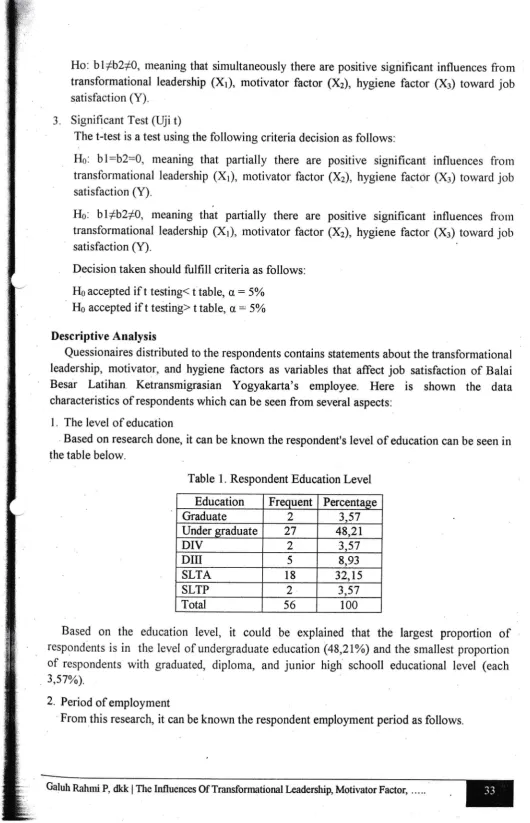
Table
l.
Respondent Education LevelEducation Frequent Percentage
Graduate 3.57
Under graduate 27 48.21
DIV
3.57DIII
8,933,57 100
Based
on the
educationlevel,
it
could be
explainedthat
the
largest proportion
of
respondents isin
the level of undergraduate education (48,21%) and the smallest proportionof
respondentswith
graduated,diploma,
andjunior
high schooll
educationallevel
(each 3,57yo).2.
Period of employmentFrom this research,
it
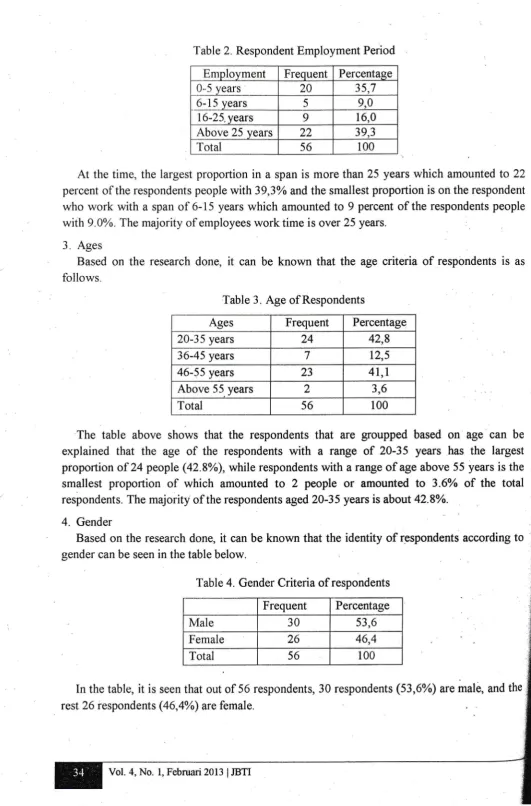
can be known the respondent employment period as follows. [image:8.595.20.551.17.842.2]Table 2. Respondent Employment Period Employment Frequent Percentage
0-5 years 35.7
6-15 years
l6-25,years 16,0
Above 25 vears 39.3
Total 100
At
the time, the largest proportionin
a span is more than 25 years which amountedto
22 percent of the respondents people with39,3Yo and the smallest proportion is on the respondentwho
work with
a spanof
6-15 yearswhich
amountedto
9 percentof
the respondents peoplewith9.)Yo. The majority of employees work time
is
over 25 years.3.
AgesBased
on the
research done,it
can be knownthat the
agecriteria
of
respondentsis
as follows.Table 3. Age of Respondents
Ages Frequent Percentage
20-35 years 42,8
36-45 years 12,5
46-55 years
4l,l
Above 55 years
Total 100
The table
above showsthat the
respondentsthat are
groupped basedon
agecan
beexplained
that the
ageof
the
respondentswith
a
rangeof
20-35
years hasthe
largestproportion of
24
people$2.5%),
while respondentswith
arangeof
age above 55 years is thesmallest
proportion
of
which
amountedto
2
peopleor
amountedto
3.6Yoof
the
total respondents. The majority of the respondents aged 20-35 years is about 42.8%.4.
GenderBased on the research done,
it
can be known that the identityof
respondents according to gender can be seen in the table below.Table 4. Gender Criteria of respondents Frequent Percentage
Male 53,6
Female 46,4
Total 100
In the table,
it
is seen that out of 56 respondents, 30 respondents (53,6%) are male, and therest26 respondents (46,4%) are female.
[image:9.595.39.571.34.842.2]STATISTICAL ANAIIYSIS
Hypothesis testing
Hypothesis
testing
is
intendedto
look at
the
influence
of
independentvariable
i.etransformational leadership
(X1), motivators factor
(Xz),
and hygiene factors
(X:)
with
dependent variable calledjob
satisfaction(Y).
In this
studythe
testing doneby the
enter method.Multiple
regression equations can be known from thefollowing
table.Coefficientf Unstandardized Coefficients Standardized Coefficients (Constant) Kepemimpinan Transformasional Motivator Factors Hygiene Factors
11,779 ,188 ,251 ,654 6,500 ,080 ,124 ,108 ,188 ,2',t3 ,602 -1,812 2,353 2,029 6,074 ,076 ,022 ,048 ,000
a. Dependent Variable: Kepuasan Kerja
From the table above, the
multiply
regresion can be formulated as follows.Y
:
-11,779 + 0,188Xr + 0,251 X2 + 0,654Xt+
eNote:
Y
= Work motivationXr
=Trans
rmational LeadershipXz
:
motivstorfactorsX3
= hygiene fuctorse
:
error standardRegression equations are outlined as follows:
a.
11,779-Constant (negativevalue)
states thatif
thereis no
variable transformational leadership, motivator, and hygiene factors existed thenjob
satisfactionwill
not
be achieved.b.
the
coefficient 0,188implied that
everytime the
numbersis
increased oneunit
intransformational leadership, the
job
satisfactionwill
increase by 0,188.c.
the
coefficient 0,251implied
that
every
time
the
numbersis
increasedone unit
inmotivator factor, the
job
satisfactionwill
increase by 0,251.d.
the coeflicient 0,654 implied
that
everytime
the
numbersis
increasedone unit
inhygiene factoE thejob
satisfactionwill
increase by 0,654.The Result of
Multiply
Regression Testingl.
Determinan G2)It
is
essentially measuringthe
simultaneouslyproportion
or
percentageof
dependent variableof
transformational leadership (X1), motivatorfactor
(X2), and hygiene factors (X3) towardjob
satisfaction(Y)
asthe independent variable.It
can be seen on the table below.ModelSummary
R Square
'
il',i$l#;
l?iTlllhill35ffi .l:fi:fi
ator FactorsOn
the table above,it
can be seenthat
AdjustedR2:
0,725 meaning ,nurrr,r*of
job
satisfaction(Y)
of
Balai Besar'Latihan
KetransmgrasianYogyakarta's
employeescan
beexplained
by
transformational leadership(X1), motivator factor (Xz),
and hygiene factors(X:)
Meanwhile
the
rest
of
27,5Yocan
be
explainedby
other factors whibh are
not investigated in this research.It
shows that the model iswell-built
enough.2.
F Test basically shows whetherall
independent variables entered into the models have an .synchronously effectto
dependent variable(Y)
F Test is usedto
see whether dependentvariables,
called
motivatorsfactors (X1)
and hygienefactors ()G), are
simultaneouslysignificant toward
job
satisfaction (Y).Testing result:
Ho: b1=b2:0,
meaning that simultaneously there is no positive significant influence from transformational leadership(Xl),
motivator factor(X2),
hygienefactor (X3)
towardjob
satisfaction (Y).Ho:
bl*bhl0,
meaning that simultaneously there are positive significant influencesfrom
transformational leadership
(Xl),
motivator factor(X2),
hygienefactor (X3)
towardjob
satisfaction (Y).a.
F table can be seen inu=
5YoNumerator degree
:
k-
I
:
3-
|
:
2Denominator degree
:
n-
k:
56-
3:
53F table on significance 5Ys= 3,1'1
b,
Finding counted F by using Anova table as follows.Sum of
Sottares Mean Square
a. Predictors: (Constant), Hygiene Factors, Kepemimpinan Transformasional,
MotiVator Factors
b. Dependent Variable: Kepuasan Kerja
Decision taken criteria
Ho accepted
if
Fcount(
F table,a:SYo
FIo unaccepted
if
F count> F table,a:
5YoIt
can be seenfrom
the table above that F-count is 49,359with
0,000 significance(below 0,05). When
it
is known that F count (49,359) > F table (3,17),it
means that Ho is unacceptedor in
the other words, transformational leadership (X1), motivatorfactor (X2),
and hygienefactor
(Xr)
are
simultaneously havepositive
significantinfluence toward
job
satisfaction (Y).3.
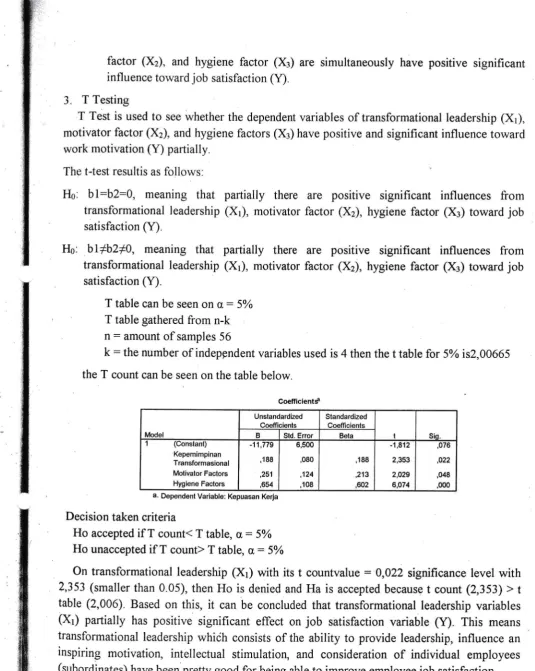
T TestingT
Test is usedto
see whether the dependent variablesof
transformational leadership (X1),motivator factor (X2), and hygiene factors (X3) have positive and significant influence toward work motivation
(Y)
partially,The
ttest
resultis as follows:Ho:
bl:b2:0,
meaning
that
partially
theretransformational leadership (X1), motivator satisfaction (Y).
Ha'.
bl*b2*0,
meaning
that
partially
theretransformational leadership (X1), motivator satisfaction (Y).
T table can be seen on
a=
5%oT table gathered from n-k
n = amount of samples 56
k
:
the number of indepgndent variables theT
count can be seen on the table below.are
positive
significant influences
fromfactor
(X2), hygiene factor(X:)
towardjob
are positive
significant influences
fromfactor
(X2), hygiene factor(&)
towardjob
used is 4 then the t table for 5Yo is2,00665
Unstandardized Cnpfficienl<
Beta
1
(Constanl) Kepemimpinan Transformasional Molivalor FactorsHygiene Faclors
11,779 ,188 ,25'l ,654 2,353 2,025 6,074 ,0/.6 ,022 ,000
a. Dependent Variable: Kepuasan Kerja
Decision taken criteria
Ho accepted
if
Tcount(
T table,a:5Yo
Ho unacceptedif T count)
T table,a:5Yo
On transformational leadership (X1)
with
itst
countvalue:
0,022 significance levelwith
?,353 (smaller than 0.05), thenHo
is denied andHa is
accepted becauset
count (2,353)> t
table (2,006). Based on
this,
it
can be concluded that transformational leadership variables(X1) partially
haspositive significant effect
onjob
satisfaction variable(Y).
This
means transformational leadershipwhich
consistsof
theability to
provide leadership, influence aninspiring motivation, intellectual stimulatioq and
considerationof
individual
employees (subordinates) have been pretty good for being able to improve employeejob
satisfactionOn variable factors motivators (X2)
it
is
known that the valueof
Tcounti s 2,029with
alevel
of
significanceof
0,048 (smaller than 0.05), so thatHo
is denied and Ha was acceptedbecause
t
count (2,029) >t
table (2,006). Thus,it
can be inferred that the motivator factors arepartially,
positively,
andsignificantly
influencejob
satisfaction variable(9.
This
suggests [image:12.595.10.546.23.695.2]itself
recognition, and career growth injobs
isalready pretty good and was able
to
increase employeejob
satisfactionon
hygiene factors(x3),
it
is
noted that the valueof
Tcountinthe
significaricelevel
of
0'000' is 6'074 (smaller than 0.05), then
Ho
isunaccepted and Ha is a"cepled because
t
count(6'074) >
t
table(2,006)
Soit
canbe infemed that the hygiene factor is partially, positively, and significantly influences
job
satisfaction variable(y).
This indicatesth;t
the hygiene of the
policy
of
the
organization, connectionswith
co-workers,
job
security, relationshipwith
supervisor, wages, and working conditions
in the
organization are already quite good because they can increase
job
satisfaction so as to improvethe performance of
employ..r,
From the T-test results,
it
is revealed that the dominant factors influencingjob
satisfaction
is
the
variable
on
factor hygiene
(this
can
be
seenfrsm
the
value
oi
unstandardizedcoeflicients factor hygiene (0,654).
CONCLUSION
Transformational Leadership, motivator factor, and hygiene factor contribute positive and
significantly to
job
satisfaction,which
means ttrehijner
thetransfor;;;;
leadership,
the better
motivatorfactors
in
work,
andthe
betterthe condition
of
hygiene factors provided in the office, the higherjob
satisfactionwill
be.It
is based on the test resultsof
F test (simultaneous/together).The
most
dominant
factor
in
influencing
job
satisfactionof
Balai
Besar
Latihan Ketransmigrasian Yoyakarta employees is hygiene factor (thiscan be seen from the value
of factor hygiene unstandardized coeflicients (0,654).
Based on the analysis results, the coefficient of Adjusted R2determination
values is 0,725, meaning that 72,5Yo variablesincluding transformational leadership,
motivator factor, and hygiene factors are able to explain the employee
job
satisfaction,
while
the restof
27,5o/ocan be explained by other factors which
are not examined in this study.
RET'ERENCES
Azwar, s., 2003, Reliabititas dan vatidiras. yogyakarta:pustaka pelajar.
Bycco
cs'
1995' Further
AssesmentofBass
1985,
conceptualization
ofTransactionaland Transformational Leadership. Journal of Applied psychology.
vol
g0,No
446g-47g.Ghozali,
Imam'
2oo2-Aplikasi Analisis Multivariate
denganprogram,sp,ss.
semarang:
Ong,
BP.
1997. "Organizational Climate and Teachers'job
Satisfactionin
Residential andNon Residential School", Master Thesis. Department of Extension Faculty of Educational
Universiti
Putra
Malaysia. OktoberKorespondensi:
Goluh Rahmi Pangesti, Staf Balai Besar Latihan Ketransmigrasian Yognparta.
Heru Kurnianto fiahiono, StafPengajar Fahtltas Ekonomi Universitas Muhammadiyah Yognlcarta. Emai I : heruuti li tas@nhoo. com
Tri Maryati, Staf Pengajar Fahtltas Ekonomi (Jniversitas Muhammadiyah yogtakarta.
Ema i I : t ry _maryati (@nhoo. com
Galuh Rahrni p, dkk