Luis M. Camarinha-Matos
New University of Lisbon, Portugal
Hamideh Afsarmanesh
University of Amsterdam, The Netherlands
123
COLLABORATIVE
NETWORKS:
REFERENCE MODELING
Luis M. Camarinha-Matos Hamideh Afsarmanesh New University of Lisbon University of Amsterdam
Campus de Caparica Collaborative Networks Group Quinta da Torre Kruislaan 419, MATRIX I 2829-516 Monte Caparica 1098 VA Amsterdam
Portugal The Netherlands
[email protected] [email protected]
Library of Congress Control Number: 2008924914
Collaborative Networks: Reference Modeling
ISBN-13: 978-0-387-79425-9 e-ISBN-13: 978-0-387-79426-6 Printed on acid-free paper.
© 2008 Springer Science+Business Media, LLC
All rights reserved. This work may not be translated or copied in whole or in part without the written permission of the publisher (Springer Science+Business Media, LLC, 233 Spring Street, New York, NY 10013, USA), except for brief excerpts in connection with reviews or scholarly analysis. Use in connection with any form of information storage and retrieval, electronic adaptation, computer soft-ware, or by similar or dissimilar methodology now known or hereafter developed is forbidden. The use in this publication of trade names, trademarks, service marks, and similar terms, even if they are not identified as such, is not to be taken as an expression of opinion as to whether or not they are subject to proprietary rights.
9 8 7 6 5 4 3 2 1 springer.com
TABLE OF CONTENTS
REFEREES ………..……… vi
FOREWORD ……… vii
PART 1. INTRODUCTION………... 1
1.1 Overview 3
1.2 Motivation for a theoretical foundation for collaborative networks 5 1.3 Related work on reference modeling for collaborative networks 15
PART 2. TOWARDS A CN REFERENCE MODEL ………. 29
2.1 Overview 31
2.2 Reference modeling: Needs and basic terminology 33
2.3 Collaboration forms 51
2.4 The ARCON modeling framework 67
2.5 ARCON reference models for collaborative networks 83
2.6 A comprehensive semantic indexing schema for ARCON 113
2.7 Further steps on CN reference modeling 129
PART 3. MODELING TOOLS AND APPROACHES ……….. 135
3.1 Overview 137
3.2 A survey of modeling methods and tools 139
3.3 A survey of soft modeling approaches for collaborative networks 165
PART 4. MODELING EXAMPLES ……… 191
4.1 Overview 193
4.2 A multi-model approach to analyze inter-organizational trust in VBEs 195 215
4.4 Modeling collaboration preparedness assessment 227
4.5 A benefit analysis model for collaborative networks 253
277
4.7 Selection of a virtual organization coordinator 297
4.8 Modeling the value of expectations in collaborative networked
organizations 311
4.9 Prospective performance measurement in virtual organizations 319
ANNEX: Biographies 327
SUBJECTS INDEX ………... 333
4.3 Networked partner selection with robust portfolio modeling
vi
REFEREES
The following people helped with the revision of the various chapters: Servane Crave
Ekaterina Ermilova Nathalie Galeano Iris Karvonen Toni Jarimo Simon Msanjila Wico Mulder
Alexandra Pereira-Klen Michel Pouly
Ricardo Rabelo Iiro Salkari Ingo Westphal
ECOLEAD REVIEW TEAM
The following members of the European Commission Review Team followed the development of the ECOLEAD project where this work was developed and contributed with very useful guidance for its improvement:
Jorge Grazina Alberto Bonetti Bernhard Koelmel Jorge Pinho Sousa Norman Roth
SPONSOR
ECOLEAD
European Collaborative Networked Organizations Leadership Initiative IST IP 506958 project
Foreword
The field of Collaborative Networks has seen a remarkable progress during the last 10 – 15 years in terms of research and practical applications. Nevertheless the ongoing consolidation of the area as a new discipline requires more efforts on establishing its theoretical foundation. This book is a contribution in this direction. Particular emphasis is put on modeling multiple facets of collaborative networks and establishing a comprehensive modeling framework that captures and structures diverse perspectives of these complex entities. Further, a contribution to the definition of reference models for Collaborative Networks is introduced.
This work was mostly developed in the context of the ECOLEAD project, a large 4-year European initiative including 28 academic, research, and industrial organizations from 14 countries in Europe and Latin America, within which the authors had major leading responsibilities. In addition to the contribution from the authors, some other colleagues have also contributed to some chapters, namely with provision of some modeling examples, as indicated in the corresponding sections. We would like to also thank those colleagues who acted as referees reviewing earlier versions of this manuscript and making valuable contribution to its improvement.
Finally we expect this work to effectively contribute to the establishment of comprehensive reference models for Collaborative Networks, and thus to offer a basis for researchers and practitioners interested in the field.
Luis M. Camarinha-Matos
New University of Lisbon, Portugal
Hamideh Afsarmanesh
PART
1
1
.
1
Overview
Related work on CNs modeling CNs as new
discipline
Related work on reference modeling
Motivation for theoretical foundation
Modeling needs in CNs
The area of collaborative networks is already extended over two decades of research and development since the first results on virtual enterprises were published. A large number of research projects and pilot applications contributed to the worldwide establishment of the area since then, generating a vast amount of concepts, mechanisms, models, systems, approaches, etc. In order to facilitate its smooth progress, it is necessary to invest on a theoretical foundation that gives a solid basis for further developments.
The motivation for this foundation and the need for recognition of collaborative networks as a new discipline are introduced in this section.
1
.
2
Motivation for a theoretical foundation
for collaborative networks
A growing number of collaborative networks can be observed in many domain areas. However, the developments and even the understanding of these cases have suffered from ad-hoc approaches, being urgent to establish a proper theoretical foundation for the area. Furthermore, the fast developments in the area and the nature of the paradigm configure the emergence of a new discipline, which needs to be built on a sounder theoretical basis.
1. INTRODUCTION
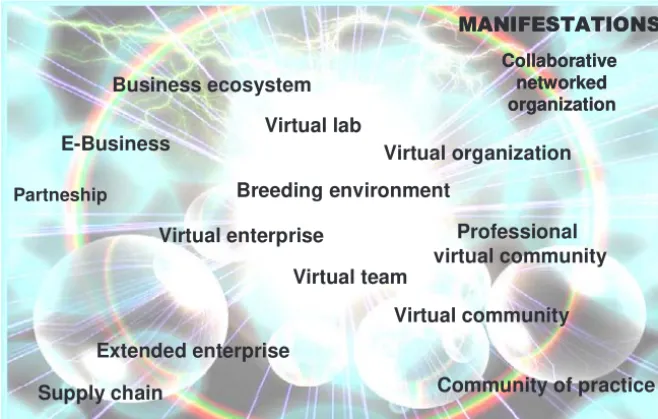
The rapid progress on computer networks and pervasive computing has offered the base conditions for the establishment of a networked society where new forms of collaboration are being explored. In fact a large variety of collaborative networks have emerged during the last years as a result of the challenges faced by the business, social, and scientific worlds and enabled by the fast progress in the information and communication technologies. Advanced and highly integrated supply chains, virtual enterprises / virtual organizations, virtual (professional) communities, virtual laboratories / e-science, are illustrations of a major trend in which entities seek complementarities and join efforts that allow them to better participate in challenging and competitive opportunities (Fig. 1) (Camarinha-Matos, Afsarmanesh, 2007). In particular for industrial societies composed mostly of small and medium enterprises (SMEs), as is the European case, the involvement in a collaborative network represents not only a survival factor but also a competitive advantage in face of turbulent market scenarios. Market turbulence in this context is characterized by complexity as well as the speed of change in interactions and inter-dependencies in the socio-economic environment.
6
Extended enterprise
Supply chain
Virtual enterprise
Virtual organization
Virtual community
Community of practice Professional
virtual community Breeding environment
Business ecosystem
E-Business Virtual lab
Virtual team
Collaborative networked organization Collaborative
networked organization
Partneship
Figure 1 – Some “manifestations” of collaborative networks
A large number of research projects have been carried out worldwide in the last decades and a growing number of practical implementations showing different forms of collaborative networks are being reported. This trend has so far led to an extensive amount of empirical base knowledge that now needs to be organized and leveraged.
The initial investments on Virtual Organizations led, in most cases, to highly fragmented and case-based approaches. For many years, one of the main weaknesses in the area has been the lack of appropriate theories, consistent paradigms definition, and adoption of formal modeling tools. Often the project of a new case of collaborative network is conducted from scratch, without benefiting from previous experiences because knowledge from past cases is not properly organized and made widely accessible. Dramatically enough, there is not yet a common definition of basic concepts such as virtual organization, collaborative networks, or virtual enterprise. This situation constitutes a major obstacle for interaction among experts from multiple disciplines, involved in this area, and creates an obstacle for the recognition of collaborative networks as a new scientific paradigm. Based on the acquired experiences, it is now urgent to consolidate and synthesize the existing knowledge, setting a sounder basis for the future.
As in any other scientific discipline or engineering branch, collaborative networks (CNs) require the development of formal theories and models, not only as a help to better understand the area, but also as the basis for the development of methods and tools for better decision-making. In fact decision-making in all phases of the future CNs life cycle needs to be based on well argued and verified models and methodologies. These models and methodologies constitute the basis for the ICT-based support for business and organizational development and operation, as well as the base for education, training, and effective management and operation of CNs.
Motivation for a theoretical foundation 7
After an initial phase in which, mostly biased by traditional business practices, the very first infrastructures and pilot cases were developed, there is at present a vital need to focus more on fundamental research in order to understand both the architectures and the emerging behavior as well as to support the design of new collaborative organizational forms. The establishment of a theoretical foundation for collaborative networks needs to proceed in two directions:
1 - Consolidation / structuring of the large body of existing empirical knowledge.
2 - Adoption / extension of theories and modeling tools developed elsewhere, in order to understand and explore emerging forms of collaborative networks and their behavioral patterns.
Existing knowledge on diverse manifestations of “traditional” collaborative networks is in fact quite fragmented, being urgent to proceed with an integration and formalization effort. Nevertheless, purely formal methods in addition to being hard to apply are also difficult to follow by those not familiar with such methods. This might suggest, in some cases, the appropriateness of semi-formal methods.
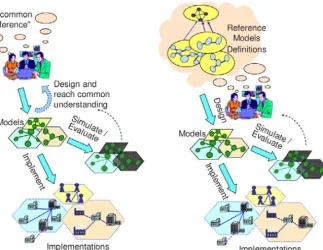
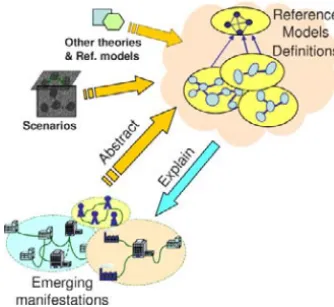
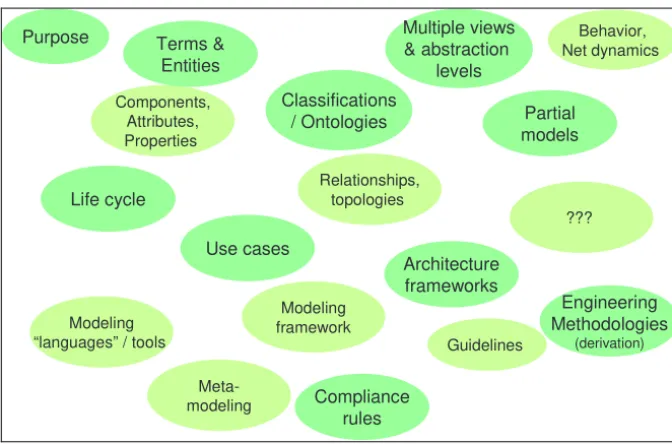
On the other hand, new forms of collaborative networks and new patterns of behavior are being invented and explored. As illustrated in Fig. 2, it is typical that emerging CNs are first perceived and explained through informal descriptions. Only when more cases become available and sufficient experience is accumulated an effort to consolidate the acquired knowledge through formal modeling methods starts.
Figure 2 – Evolution of modeling approaches
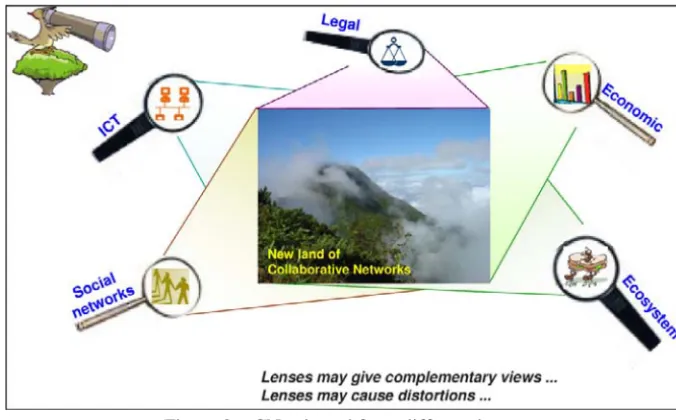
Furthermore, new CN forms correspond to complex phenomena that require new ways of analysis and proper modeling tools. These phenomena show characteristics such as complexity, emergence1, self-organization, dynamics, interaction of social
1
8
networks with organization networks, etc. As new collaboration-support infrastructures and tools become available, new behavioral patterns emerge, even in traditional collaborative networked organizations. In this context, new ways of collaboration, new forms of organizing the collaborative networks, even new institutions, and new roles for participants are being rapidly developed while not being yet well understood. Therefore, a theoretical foundation is necessary, not only to consolidate the existing empirical knowledge, but also as a basis for perceiving and understanding emerging collaborative forms.
In order to establish a theoretical foundation for CNs inspiration and help can be sought in other areas. Some theories and paradigms defined elsewhere (see part 3 of this book) have been suggested by several research groups as promising tools to help understand and characterize emerging collaborative organizational forms. Nevertheless, it is unlikely that any of these theories and modeling methods will cover all modeling needs of CNs; they can be used as a starting point but extensions or adaptations are needed. In fact, there is no single (formal) modeling tool / approach that adequately covers all perspectives – i.e. no “universal language” for all modeling problems in this area. For instance, typical works on networking and social networks consider, for sake of simplicity, just one kind of links among network members, while practical methods for CNs need to consider a diversity of link types (and different strengths for each link). Furthermore, interoperability of different modeling tools and approaches is needed for a comprehensive definition and modeling of this paradigm.
2. TOWARDS A NEW DISCIPLINE
CNs are complex systems and consist of many facets whose proper understanding requires the contribution from multiple disciplines. In fact the various manifestations of this paradigm have been studied by different branches of science, including the computer science, computer engineering, management, economy, sociology, industrial engineering, law, etc., to name a few. The 1990s and early 2000s correspond to the stage that Kuhn would call a pre-paradigmatic phase (Kuhn, 1975), in which the collaborative networks phenomenon has been described and interpreted in many different ways, depending on the background of the researcher.
The acceptance of a new paradigm is not a pacific process (Kuhn, 1975), as the established sciences and paradigms tend to resist the introduction of another “competitor”, and rather prefer to extend the existing sciences or fields and their associated rules to explain the new phenomena. For instance, virtual enterprises have been studied, in a quasi independent way, by the engineering and management communities with almost no mutual recognition. This tension situation is further increased by the multi-disciplinary nature of the phenomena, namely in the case where multiple traditional disciplines / branches of organized knowledge and professionals compete to claim and master the new area. This is the clear case we have observed for collaborative networks.
As a good example of this strained behavior, so far several of the established branches of science have tried to use / extend their definition and behavioral model of the single enterprise paradigm to explain the collaborative networks; e.g. the attempts in the direction of “enterprise engineering” and “enterprise architecture”,
Motivation for a theoretical foundation 9
among others. Considering a virtual enterprise as just another form of an enterprise naturally leads to consider that extending the existing models of a single enterprise would be a promising approach. However, anomalies appear when the existing enterprise-centric models and their extensions fall short of capturing the key facets and specificities intrinsic in networked organizations, as well as when realizing that the base facilities of the applied discipline are not sufficient to properly represent and model all aspects of the behavior of collaborative networks. Instead of focusing on the internal specificities and tight interconnections among the internal components of an enterprise, the focus in collaborative networks must be directed to the external interactions among autonomous (and heterogeneous) entities (e.g. interoperability mechanisms and tools), the roles of those entities (e.g. coordinator, member, cluster-manager, broker), the main components that define the proper interaction among entities (e.g. common ontologies, contracts, distributed business processes, distributed multi-tasking, collaborative language), the value systems that regulate the evolution of the collaborative association (e.g. collaborative performance records), and the emerging collective behavior (e.g. trust, teamwork), among others.
In the history of science, the recognition and acknowledgement of anomalies has resulted in “crises”, that are the necessary preconditions for the emergence of novel theories and for a paradigm change or even the rise of a new discipline. As in other past paradigm changes, considerable research efforts have been focused on identification of “anomaly” aspects for CNs, i.e. the identification of what is new in the collaborative networks in reference to the established body of knowledge, that has itself lead to the induction and progressive characterization of a new scientific paradigm. CNs cannot be seen as proprietary to any one of the single contributing disciplines, rather representing a new emerging discipline of its own (Camarinha-Matos, Afsarmanesh, 2005). A new discipline emerges once: (i) the new paradigm is adjusted to cover the various manifestations of the emerging collaborative forms, (ii) the consolidated set of basic knowledge is organized, and (iii) the various multi-disciplinary researchers involved in this work start to identify themselves as members of this new community, rather than experts doing research on collaborative networks while staying as members of their original communities and disciplines. Fig. 3 illustrates the foundation for the CNs discipline.
10
Adjustment to manifestations.
An ordered set of principles and practices form the foundation of a discipline (Liles et al., 1995). In the case of Collaborative Networks and their manifestations, a large number of R&D projects and practical implementations have been developed during last years. Particularly in Europe, more than 100 projects have been supported by the European Commission, in addition to various national initiatives. However, each one of these efforts has only addressed particular facets of the CNs, leading to some fragmentation of research. Furthermore most of the early initiatives were of an ad-hoc nature, not relying on sound theories and principles. In spite of this ad-ad-hoc and fragmented research situation, a growing set of principles and practices has been collected in many projects and pilot applications. In this way, the paradigm is progressively better characterized.
At present, the main phases of the life cycle of a CN are intuitively understood and the primary required support functionalities have been identified. It is also nowadays a widely accepted principle that the effective establishment of dynamic VOs requires an underlying breeding environment (or cluster network). A variety of such breeding environments or clusters can already be identified for instance in Europe (Plüss, Huber, 2005), Japan (Kaihara, 2004), Brazil (Vargas, Wolf, 2006), and Mexico (Flores, Molina, 2000). CNs is therefore seen as the paradigm that gives the base framework for all such manifestations.
On the other hand, disciplines, like the proposed one, are frequently based upon other disciplines that can be called the reference disciplines or adjacent disciplines (Liles et al., 1995). Developments in CNs have benefited from contributions of multiple disciplines, namely computer science, computer engineering, communications and networking, management, economy, social sciences, law and ethics, etc. Furthermore some, theories and paradigms defined elsewhere have been suggested by several research groups as promising tools to help define and characterize emerging collaborative organizational forms.
Base knowledge organized and consolidated.
A scientific discipline for Collaborative Networks is characterized by the existence of an active research agenda where many fundamental questions are being tackled and studied. In principle, the existence of an active research agenda is revealed if the following three main characteristics exist (Liles et al. 1995): (1) It stands the test of time, (2) It is complex and substantial enough to be subdivided into different research directions, and (3) Multiple fundamental questions / approaches are raised and formulated to guide the research in the area. In the case of collaborative networks the following situation holds:
1. It stands the test of time. CNs represent an active research area for more than 15 years. During this time a growing number of research projects have been launched world-wide and many pilot application cases are being developed in different regions for a variety of application domains. Definition of challenges and the research questions are becoming more precise and detailed, and their dimension more evident as the knowledge about the area accumulates. The application domains are also growing. In addition to industry, forms of collaborative networks can now be found in services, governmental
Motivation for a theoretical foundation 11
organizations, elderly care, energy management, etc. It is therefore becoming clear that this is not a temporary fashion but rather a major area of research that continuously grows.
2. It is complex, and substantial enough to be subdivided into different research directions. CNs represent a vast area of research that requires a subdivision into a number of research areas in order to be studied and handled. This subdivision can be based for instance, on the type of manifestation (VE/VO, Professional Virtual Communities, Collaborative Virtual Laboratories, etc), or on different technical perspectives (e.g. socio-economic focus, management focus, ICT infrastructure focus, ICT support services focus, theoretical foundation focus).
3. Multiple fundamental questions/approaches are raised and formulated to guide the research in the area. A large and growing number of open issues and research challenges are being identified in the various manifestations of the CNs and their focus areas. These questions are illustrated by a number of research roadmaps related to collaborative networks, that are elaborated, namely in Europe (Camarinha-Matos, Afsarmanesh, 2004a).
An example of a comprehensive research agenda for CNs is given by the VOmap roadmap for advanced virtual organizations (Camarinha-Matos, Afsarmanesh, 2003), (Camarinha-Matos et al, 2005). VOmap aimed at identifying and characterizing the key research challenges needed to fulfill the vision, required constituency, and the implementation model for a comprehensive European initiative on dynamic collaborative virtual organizations (VO). The VOmap vision is that of an effective transformation of the landscape of European industry into a society of collaborative relationships. In order to be efficient and competitive in their operation, VOs of the future have to rely on solid bases and strong methodological approaches. This roadmap, which includes contributions from about 100 experts from industry and academy, identifies a large number of the main challenges for research and development in this area, and suggests a time frame for the proposed research actions.
Other roadmaps have also been proposed, addressing some of the related research challenges to collaborative networks. For instance, the COCONET roadmap (Schaffers et al., 2003) is focused on virtual communities and their cooperation environments, the IDEAS roadmap (Chen, Doumeingts, 2003) addresses needs for supporting interoperability of ICT infrastructures, the Semantic Grid roadmap (Roure et al., 2001) focuses on e-Science and GRID infrastructure needs, and the Assembly-net roadmap (Onori et al., 2003) discusses research challenges in advanced collaborative manufacturing systems.
A new research community.
Community development through education and professional associativism is essential to the widespread recognition of a discipline. Several activities that have taken place during last years have contributed to the establishment of a significant community of professionals involved in collaborative networks. Examples are:
12
(Camarinha-Matos, Cardoso, 2004). Similarly the Federal University of Santa Catarina (Brazil) and the Costa Rican Institute of Technology (Garita, 2004) started offering VE/VO courses to their students. Other universities are designing similar courses or including CN-related modules in their existing curricula (Klen et al., 2005). Other similar example courses are being developed in Europe at the Master program level. A proposal for a reference curriculum for CN education at the university level was developed by the ECOLEAD project (Camarinha-Matos et al., 2008).
Scientific associations. Scientific associations play an important role as facilitators and promoters of collaboration among professionals involved in a specific discipline. Some initiatives in this area have been launched in recent years. For instance, at IFIP (International Federation for Information Processing) level, a Working Group on Infrastructures for Virtual Enterprises and e-Business (COVE - CO-operation infrastructure for Virtual Enterprises and electronic business) was established under its Technical Committee 5. The SOCOLNET Society of Collaborative Networks started in 2006 and aims at promoting and stimulating the scientific research, teaching, technological development, technical and scientific interchange between researchers in the Collaborative Networks area, including virtual organizations, virtual enterprises, virtual laboratories and related areas. Another example is the ESoCEnet (European Society of Concurrent Enterprising Network) established in Italy.
Conferences. Professional and scientific conferences provide a forum to discuss current thoughts and experiences, as well as a channel to publish emerging ideas. The IFIP/SOCOLNET Working Conference series PRO-VE [www.pro-ve.org], the first yearly conference focused on Virtual Enterprises started in 1999, and since then has established itself as the reference conference and most focused scientific event on collaborative networks, attracting a good number of professionals from academia and industry. CTS is an American annual conference devoted to Collaborative Technologies and Systems. BASYS is an IFIP conference series focused on Information Technology for Balanced Automation Systems that devotes a track to collaborative networks. Another related event, more focused on the Concurrent / Collaborative Engineering aspects is the ICE conference.
These elements are evidence of the establishment of Collaborative Networks as a new discipline. As such, CN require a sound theoretical basis to support its continued development.
3. CONCLUSIONS
The large diversity of existing and emerging collaborative forms and related experiences and empirical knowledge require a consolidation effort in order to:
- better understand the paradigm and its manifestations, and - facilitate new developments.
A theoretical foundation supported by adequate modeling tools is also important to help understanding the new collaboration forms and thus support a more rational design, analysis and management.
Motivation for a theoretical foundation 13
Furthermore, as the CNs phenomenon is not “property” of any single established discipline, it clearly requires a multi-disciplinary approach. Progressively, the area of CNs has been turning itself into a distinct discipline. Further developments of the discipline require a sounder holistic modeling effort.
The following chapters of this book represent a contribution to this modeling effort. Complementarily, in (Camarinha-Matos et al., 2008) a comprehensive collection of methods and tools for collaborative networks also developed in the ECOLEAD project are presented.
Acknowledgements. This work was funded in part by the European Commission
through the ECOLEAD project.
4. REFERENCES
1. Camarinha-Matos, L.M.; Afsarmanesh, H. (2003). A roadmap for strategic research on virtual organizations. In Processes and Foundations for Virtual Organizations, Kluwer Academic Publishers, Boston.
2. Camarinha-Matos, L.M.; Afsarmanesh, H. (Ed.s) (2004a). Collaborative networked
organizations – A research agenda for emerging business models, Kluwer Academic
Publishers, Boston.
3. Camarinha-Matos, L.M.; Afsarmanesh, H. (2004b). TeleCARE: Collaborative virtual elderly care support communities, The Journal on Information Technology in
Healthcare, Vol. 2, Issue 2, pp 73-86, ISSN 1479-649X, London, Apr 2004.
4. Camarinha-Matos, L.M.; Afsarmanesh, H. (2005). Collaborative networks: A new scientific discipline, J. Intelligent Manufacturing, vol. 16, Nº 4-5, pp439-452. 5. Camarinha-Matos, L.M.; Afsarmanesh, H. (2007). Classes of Collaborative Networks.
In Encyclopedia of Networked and Virtual Organizations (G. Putnik, M. M. Cunha, Ed.s), Idea Group, Dec 2007.
6. Camarinha-Matos, L.M.; Afsarmanesh, H., Cardoso, T., Klen, E. (2008). A reference curriculum for education in CNOs. In Methods and Tools for Collaborative
Networked Organizations, Springer, 2008.
7. Camarinha-Matos, L.M.; Afsarmanesh, H., Ollus, M., (Ed.s)(2008). Methods and tools for collaborative networked organizations. Springer.
8. Camarinha-Matos, L.M.; Cardoso, T. (2004). Education on Virtual Organizations: An experience at UNL. In Virtual Enterprises and Collaborative Networks, Kluwer Academic Publishers, Boston.
9. Chen, D.; Doumeingts, G. (2003). Basic Concepts and Approaches to develop interoperability of enterprise applications. In Processes and Foundations For Virtual
Organisations, Kluwer Academic Publishers, Boston.
10.Flores M., Molina A., “Virtual Industry Clusters: Foundation to create Virtual Enterprises”, in Advanced in Networked Enterprises - Virtual Organizations,
Balanced Automation and Systems Integration, L.M. Camarinha-Matos, H.
Afsarmanesh, Heinz-H. Erbe (Eds.), Kluwer Academic Publishers, 2000, pp. 111- 120.
11.Garita, C. (2004). A case study of VO education in Costa Rica. In Virtual Enterprises
and Collaborative Networks, Kluwer Academic Publishers, Boston.
14
13.Klen, E., Cardoso, T., Camarinha-Matos, L. M. (2005). Teaching Initiatives on Collaborative Networked Organizations, in Proceedings of 38th CIRP - International
Seminar on Manufacturing Systems, May 16-18, Florianópolis-SC, Brazil.
14.Kuhn, T. S. (1975). The structure of scientific revolutions. Univ. of Chicago Press, 2nd edition.
15.Liles, D.; Johnson, M.; Meade, L.; Underdown, D. (1995). Enterprise Engineering: A discipline?, Society for Enterprise Engineering (SEE) Conference, Orlando, FL, http://www.webs.twsu.edu/enteng/ENTENG1.html.
16.Onori, M.; Barata Oliveira, J.; Lastra, J.; Tichem, M. (2003). European Precision Assembly – Roadmap 2010, Assembly-Net, ISBN 91-7283-637-7.
17.Osorio, A.L., Camarinha-Matos, L.M., Gomes, J.S. (2005) – A collaborative network case study: The extended “Via Verde” toll payment system. In Collaborative Networks and their Breeding Environments, Springer.
18.Plüss, A., Huber, C. (2005). “VirutelleFabrik.ch – A Source Network for VE in Mechatronics. In Virtual Organizations Systems and Practices. Edited by L.M. Camarinha-Matos, H. Afsarmanesh and M. Ollus. Springer, pp. 255 – 264.
19.Roure, D.; Jennings, N.; Shadbolt, N. (2001). Research Agenda for the Semantic Grid: A future e-Science infrastructure, EPSRC/DTI Core e-Science Programme.
20. Schaffers, H.; Ribak, A.; Tschammer, V. (2003). COCONET: A roadmap for context-aware cooperation environments. In Processes and Foundations for Virtual
Organizations, Kluwer Academic Publishers, Boston.
21.Vargas, R., Wolf, P. (2006). “Virtual Collaboration in the Brazilian Mould and Die Making Industry” in Real-Life Knowledge Management: Lessons from the Field, KnowledgeBoard. Abdul Samad Kazi & Patricia Wolf (Eds.), ISBN: 9525004724. April 2006, pp. 323 – 333.
1
.
3
Related work on reference modeling
for collaborative networks
*Several international research and development initiatives have led to development of models for organizations and organization interactions. These models and their approaches constitute a background for development of reference models for collaborative networks. A brief survey of work on modeling the enterprises, enterprise architectures, and early contributions to reference models of virtual enterprises is provided. Finally an identification of the main modeling requirements for collaborative networks is made.
1. INTRODUCTION
Some authors see the roots of the Virtual Organization / Virtual Enterprise paradigm, which constitutes one of the first manifestations of the Collaborative Networks, in the early works of economists such as Oliver Williamson in the 1970s. Along his very prolific work, and in particular in the “Markets and Hierarchies” (Williamson, 1975), Williamson established the study of Transaction Cost Economics as one of the first and most influential attempts to develop an economic theory of organizations. He defends that manufacturing firms should make much greater use of externally purchased goods and services, rather than those internally supplied. Williamson also discusses the business transaction costs at the same level as the production costs. While production costs are considered as being analogous to the costs of building and running an “ideal” machine, transaction costs cover those that incur by deviation from perfection. For instance, he argues that the lack of information about the alternative suppliers might lead to paying too high a price for a good or service. Through identifying the important variables that determine the transaction costs, the work of Williamson contributed to the better understanding of business interactions among enterprises.
These ideas had a more evident impact with the booming of the “outsourcing” wave in the 1980s. Outsourcing became very attractive when managers had to reduce the organization overheads and eliminate the internal inefficient services, the so called lean manufacturing, as it transfers the problem to the outside, namely other efficient service providers. For many enterprises, outsourcing some services allows them to concentrate on their core competencies. For others, outside contractors simply provide complementary services for which the company lacks adequate internal resources or skills. In the same line but with a focus on the management
16
and financial activities is the off shoring movement. Among many factors that justify the outsourcing strategy, the reduction of costs, and elimination of poor performance units, can be pointed out, particularly in the case of those units that do not represent core capabilities or when better and cheaper alternatives can be identified in the market. In parallel with the outsourcing tendency, another transformation can be observed in large companies that reorganize themselves in terms of their production lines, leading to some “federation” of relatively autonomous departments.
These transformations, putting the emphasis on networking and partnership / cooperation have raised a large interest for new disciplines such as the coordination theory, organizational theory, and sociology of the industrial organizations.
The idea of virtual enterprise (VE) / virtual organization (VO) was not “invented” by a single researcher, rather it is a concept that has matured through a long evolution process. Some of the early references first introducing the terms like virtual company, virtual enterprise, or virtual corporation go back to the early 1990s, including the work of Davidow and Malone (1992), and Nagel and Dove (1995). Since then, a large but disjoint body of literature has been produced mainly in two communities, the Information and Communications Technology community and the Management community.
Generalized access to Internet that is available through multiple channels and the fast developments around the world-wide-web have led to the proliferation of many terms such as the e-commerce, e-business, e-work, e-government, etc. To put it in a more emphatic way, it seems that in the first years of this decade everything became e-something. Similarly, Business-to-customer (B2C) and Business-to-Business (B2B) are other examples of popularized terms.
So a question arises: since virtual organizations are also supported by the Internet and the web, where do they fit in this “e-movement”? Fig. 1 shows an attempt to put things into perspective, showing that e-Commerce is mostly about B2C relationships and mainly concerned with buy-sell transactions among the involved entities. Virtual organizations on the other hand, go far beyond simple transactions, and are focused on collaboration among a number of enterprises and doing things together (Camarinha-Matos, Afsarmanesh, 2005).
However, concepts and definitions related to the VE/VO paradigm are still evolving, and the terminology is not yet fixed. There is still not even a common definition for the VE/VO that is agreed by the community of researchers in this area. Most developments in the area are of ad-doc nature, i.e. focused on solving specific application cases. Only a few contributions to a sounder basis can be found in the literature. For instance, one of the first references to a (partial) theoretical foundation for virtual organizations comes from Appel and Behr (1998) which however limit their approach to the application of the transaction-costs theory. Ahuja and Carley (1998) focused on the structural aspects of the collaborative networks.
An attempt to organize and categorize reference models for VOs can be found in Tolle, Bernus, and Vesterager (2002), and Zwegers, Tolle and Vesterager (2003) as a result of the GLOBEMEN project.
Related work on reference modeling 17
Figure 1 – Virtual Organization and e-Commerce
The THINKcreative project was one of the first initiatives to introduce the concept of Collaborative Networked Organization (CNOs) as a more general concept to encompass various collaborative forms such as virtual organization, virtual enterprise, professional virtual community, etc (Camarinha-Matos, Afsarmanesh, 2004a). This project also clearly identified the need for a sound theoretical foundation for CNOs (Camarinha-Matos, 2003), (Camarinha-Matos, Abreu, 2003). Furthermore THINKcreative identified and briefly analyzed some potential theories and approaches developed in other disciplines that could form the basis for the desired theoretical foundation (Camarinha-Matos, Afsarmanesh, 2004b,c). THINKcreative also discussed the concept of emergence in complex self-organizing systems and briefly analyzed the potential contribution of areas such as theories of complexity, multi-agent systems, self-organizing systems and evolving networks, and holistic approaches. Sustainable development of collaborative networked organizations needs to be supported by fundamental research leading to the establishment of Collaborative Networks as a new scientific discipline (Camarinha-Matos, Afsarmanesh, 2004e). However, THINKcreative was not a development project and this study was confined to a first identification of needs, potential contributions, and generation of research recommendations.
18
by VOmap. Another recommendation for investing on a theoretical foundation for collaborative networks can be found in the work of Eschenbaecher and Ellmann (2004).
One example of effort to systematize and consolidate the existing empiric knowledge on virtual organizations, mainly based on the achievements of a large number of European projects, was carried out by the VOSTER project (Camarinha-Matos et al., 2005). It is also important to mention the role of the IFIP PRO-VE series of conferences, started in 1999, in the development and consolidation of the area.
Proper understanding of collaborative networks, due to their complexity, requires the contribution from multiple disciplines. A typical tendency when a new paradigm emerges is that each contributing discipline tries to extend its boundaries in order to capture the facets of the new phenomena. As a good example of this behavior, so far several of the established branches of science have tried to use / extend their definition and model of the single enterprise paradigm (Noran, 2003) to explain the collaborative networks; e.g. the attempts in the direction of “enterprise engineering” and “enterprise architect”, among others. Understanding a VE/VO as just another form of an enterprise naturally leads to consider that extending the existing models of a single enterprise would be a promising approach. However, the existing enterprise-centric models and their extensions cannot adequately capture all key facets and specificities intrinsic in networked organizations.
For instance, in relation to the Collaborative Networked Organizations, past studies and developments have primarily focused on the internal aspects of an “organization”, rather than on “collaboration” among enterprises, which is of a totally different nature, and requires innovative approaches to solve its many problems.
To clarify this issue and motivate this problem area, let us look at a metaphoric example that is easier to describe.
Consider the case of “collaboration among a number of people” who aim to achieve certain goals, e.g. to organize a party, to write a research proposal, to produce an innovative product, or even to build a house together. Here the constituents of this “collaboration network” are humans. How to model this situation? Certainly, the study of human body and the function of its internal organs has long been achieved through the research on human anatomy, and has lead to the elaboration of detailed models of various systems related to the human body (e.g. nervous system, and circulatory system) in terms of their composition, inter-relationships, flows, etc. Although the human anatomy studies is necessary and very useful in some contexts (e.g. for disease diagnosis in medicine), they are not appropriate and at best minimally relevant to the understanding of neither the potential nor the behavior of social groups of people, or even for understanding the behavior of a single individual within a social collaborative group (Fig. 2).
Related work on reference modeling 19
Figure 2 - Human anatomy vs. Understanding of social behavior
Similarly, for a CNO, although the detailed study of its constituents, namely the “organizations” is achieved by some research in the past, and proves to be very valuable, it is in fact not addressing the “collaboration” and or “networking” problem areas and focus.
Finally it shall be mentioned that although there are not many contributions to the holistic understanding of collaborative networks, there are many publications that contribute to the advances in certain specific facets, whose full account is out of the scope of this chapter, but some main contributions are addressed in different chapters of this book. Perhaps surprisingly, some important contributions to the study and understanding of complex dynamic networks during the last five years come from the area of Physics (Barabási, 2002), (Dorogovtsev, Mendes, 2003).
There are also many developments in other disciplines that can contribute to the start of a foundation for collaborative networks, e.g. in complexity theories, game theory, multi-agent systems, graph theory, formal engineering methods, federated systems, self-organizing systems, swarm intelligence, and social networks. The theoretical foundation work in the ECOLEAD project took the mentioned early works as a baseline.
2. A BRIEF SURVEY OF RELEVANT WORK
The following sections give a brief overview of relevant elements from some important attempts to establish reference models. As none of the early initiatives covers the necessary scope for CN reference models, the cases included here are mainly to illustrate the conceptual approaches and give the reader a synthetic overview of the state of the art and trends.
2.1 Zachman framework
Purpose and scope. The Zachman Framework for Enterprise Architecture
20
Highlights of the model.The Zachman Framework constitutes a matrix of 36 cells,
covering the Who, What, Where, When, Why, and How questions in regards to an enterprise. The enterprise is then split into six perspectives, starting at the highest level with business abstraction, passing through intermediate level of details (i.e. conceptual, logical, etc.), and going all the way down to implementation. Such objects or descriptions of architectural representations are usually referred to as Artifacts. The framework can contain global plans as well as technical details, lists, and charts. Any appropriate approach, standard, role, method or technique may also be placed in it.
Zachman basically supports two important actions for an enterprise namely: The creation of a new enterprise and the evolution of an existing enterprise. The support and management aspects are based on the interrogation of perspectives subjected to the abstractions. The interrogatives are used for deciding about what must be included in the enterprise when creating a new enterprise. Also, they are used to decide about what must be changed when an enterprise must evolve. Therefore, in general, the interrogative abstractions are applied for the management of the enterprise complexity. On the other hand, this perspective allows dealing with the rate of change; in fact it brings the engineering disciplines to the management and the priority of change. This provides guidelines from the abstract description to the detailed level of implementation.
Useful elements for CNs. Zachman architecture represents one enterprise properly.
Clearly enough, CNs cannot be treated the same as a single organization; in fact, members of a CN are all independent and autonomous entities. However, it would be interesting and challenging to consider the application of Zachman to CNs in relation to the following aspects:
Similarities between running an enterprise and the operation of a CN shall be studied.
Similarities between the evolution of an enterprise as supported by Zachman and the creation, evolution, dissolution and metamorphosis stages of CNs shall be studied.
Also, considering the life cycle of CNs and the application of Zachman in these phases may be useful:
Investigating the necessary elements when creating an enterprise can be used to study what needs to be included in the architectures for CNs.
Investigating what needs to be changed when an enterprise has to evolve, change or dissolve, can be used for issues of CN evolution and metamorphosis.
2.2 SCOR
Purpose and scope. The SCOR (Supply-Chain Operations Reference-model) has
been developed / endorsed by the Supply-Chain Council. It is a process-based model developed as a standard diagnostic tool for supply-chain management in industry. Considering all stakeholders involved in the supply-chain, SCOR provides an environment for their interaction/communication, enabling users to address, improve the management of supply-chains (Barnett, Miller, 2000).
Highlights of the model. Since the development of SCOR, this model has been successfully used, providing a base for projects of any size, from small projects
Related work on reference modeling 21
specific to a site, to large and global projects. The SCOR-model, focused on satisfying customer demands, facilitates the modeling and description of all business activities associated with different phases of the supply chain developments. It uses a set of process building blocks and a common set of definitions to model and describe activities of both simple and complex supply-chains. As a result, independent, heterogeneous, and geographically distributed industries can be simply linked within any supply chain.
Useful elements for CNs.As a supply chain is a particular case of CN, SCOR is an
adequate reference model for the functional / process perspective of this organizational form.
When it comes to other classes of CNs however, it is necessary to consider that: - While providing a comprehensive reference-model for relatively stable
environments; SCOR is not tailored for dynamic environments of many CNs. - SCOR cannot capture / measure performances with soft factors related to the
collaboration, for instance the trustworthiness of organizations.
- SCOR requires major efforts in configuring the Supply-Chain, and therefore prohibits the agility needed in configuration of ad-hoc or dynamic collaborative networks, for instance VOs for emergency management.
2.3 VERAM
Purpose and scope. The Virtual Enterprise Reference Architecture and Methodology (VERAM) primarily aims to increase the preparedness of entities involved in the networks for efficient creation of virtual enterprises (VEs). The VERAM facilitates the modeling process through provision of guidelines on how to build the models and how to identify the common characteristics of the VEs and networks (Zwegers et al. 2003). It offers a blueprint that can be followed by organizations for setting up VEs (Tølle and Bernus 2003). VERAM provides a generalized model for the desired properties of VE. It specifically addressed the involved entities in creation, operation, and dissolution of VEs (Tølle and Bernus 2003).
Highlights of the model. Three main layers can be identified in VERAM (Zwegers
et al. 2003):
1. The Concepts of VE and network; 2. The Reference Architecture for Concepts; 3. The Components of the Reference Architecture.
The concepts address for example the network, the competencies, the customers, etc. The reference architecture presents a three dimensional view, with dimensions of
life-cycle phases, generality, and modeling views. Furthermore, the components of VERAM are divided into five categories of: 1) contingency factors, 2) modeling, 3) applications and infrastructures, 4) methodology, and 5) VE implementation.
22
mainly borrowed from the GERAM (TFAEI, 2003), makes the model more difficult to understand and utilize. For instance it seems that by eliminating the generality
dimension, perhaps the VERAM model can be simplified
2.4 EGA – Enterprise Grid Alliance
Purpose and scope. The Enterprise Grid Reference Model developed by the Enterprise Grid Alliance (EGA, 2005) defines the terminology and glossary of grid computing and identifies various components, interfaces, interactions and data models. It is intended that such reference model enables interoperability among heterogeneous grid applications or products and improve integration of grid applications or services, thereby improving the opportunities for the effective use of grid computing within the enterprise, to the benefit of both vendors and users of such technology.
Highlights of the model. The reference model provides a specific context for describing requirements, standards, comparing technologies and implementing grid solutions. The model delivers a framework and a set of customer-based requirements needed to accelerate enterprise grid adoption. Included in its three main components are: a glossary providing a common lexicon of grid terms; a model that classifies the management and lifecycles of the components required for enterprise grids; and a set of use cases that demonstrate the requirements for enterprise grid computing.
The principal aim of the glossary is not to define new terms rather it is to provide some precision around terms in common use but which are directly applicable to the work of the area. Some terms which have specific meaning within the EGA are also defined. The model itself is concerned with providing a context for the grid components including attributes and properties, life cycle and classification and also a management entity called GME – Grid Management which is responsible for ensuring that the various grid components meet their goals. Finally the set of use cases provide the overall customer or user centric view of the sets of problems that the EGA intends to address such as: the set of commercial enterprise community-centric use cases and consistent and relevant requirements for partner SDOs (Standards Development Organizations) and all other enterprise Grid stakeholders.
Useful elements for CNs. Similarly to EGA, in CNs we need to define the base
concepts, relationships and interfaces. Some elements from EGA regarding resources management can also be useful to CNs.
2.5 FEA – Federal Enterprise Architecture
Purpose and scope. The development of the Federal Enterprise Architecture (FEA, 2005) by the US Office of Management and Budget (OMB) started on February 6, 2002. The purpose of this effort is to identify opportunities to simplify processes and unify work across the agencies and within the lines of business of the US Federal government.
The FEA, a business-based framework for government-wide improvement, has the aim of transforming the US Federal government to one that is citizen-centered, customer-focused, results-oriented, market-based, and that maximizes technology investments to better achieve mission outcomes.
Related work on reference modeling 23
Highlights of the model. The FEA consists of a set of interrelated “reference
models” designed to facilitate cross-agency analysis and the identification of duplicative investments, gaps and opportunities for collaboration within and across agencies. Collectively, the five reference models comprise a framework for describing important elements of the FEA in a common and consistent way. Through the use of this common framework and vocabulary, IT portfolios are expected to be better managed and leveraged across the federal government. The FEA Reference models are:
- Performance Reference Model (PRM); - Business Reference Model (BRM);
- Service Component Reference Model (SRM); - Technical Reference Model (TRM);
- Data Reference Model (DRM).
As FEA adopts an entirely business-driven approach, its foundation is the Business Reference Model, which describes the US government’s Lines of Business and its services. This business-based foundation provides a common framework for improvement in a variety of key areas such as: Budget Allocation, Information Sharing, Performance Measurement, Budget / Performance Integration, Cross-Agency Collaboration, E-Government, and Component-Based Architectures.
Useful elements for CNs.
The use of a set of interrelated reference models seems to be a practical approach. Putting the center of gravity on the Business Reference Model (BRM) may also be a good alternative for the CNs Reference Model. The FEA BRM provides a framework that facilitates a functional (rather than organizational) view of the federal government’s lines of business, including its internal operations and its services for citizens, independent of the agencies, bureaus and offices that perform them. The BRM describes the federal government around common business areas instead of through a stove-piped, agency-by-agency view and thus promotes agency collaboration (collaborative e-government);
- The development of a process for maintaining and evolving the FEA reference models is very relevant. The continued maintenance of the reference models is critical to the implementation and usage of the corresponding architecture.
3. MODELING NEEDS
On modeling. Models and modeling are an integral part of the human understanding and thinking processes. Since reality is usually too complex to understand and influence directly, we develop models of reality either on our minds (mental models) or formally / semi-formally using drawings or other representations including mathematical and computer (simulation) models.
A model is an abstract representation of reality and as such should exclude details of the world which are not of interest to the modeler or the ultimate user of the model. This justifies that even in a given field (e.g. computer science) there are various modeling approaches, which very much depend on the modeling purpose. For instance, when we are interested in the dynamics of a system our focus is on the processes rather than on the structure of the system.
24
the modeler”. Although some modeling tools and methodologies try to constrain / guide the modeling process, the outcome greatly depends on the experience of the modeler and even his/her aesthetic preferences. The same applies, to some extent, to the choice of the modeling tools and formulation to apply.
On systems perspective. Modeling is one of the key activities in understanding, designing, implementing, and operating systems. Modeling is at the very heart of any scientific and engineering activity.
A major output of the process of designing a new system is a model or set of models of the system to be implemented. The abstract representation of the intended system will then be used to guide the implementation. Furthermore, a model is also very useful in order to supervise (manage) the operation of the developed system during its life cycle. Complementarily, a model can also be used to predict the behavior of the system being developed or managed. And yet, from a systems perspective, it is important to set the purposes for each model. As Shannon clearly noted:
“The tendency is nearly always to simulate too much detail rather than too little. Thus, one should always design the model around the questions to be answered rather than imitate the real system exactly”.
On modeling CNs. As in any other scientific discipline or engineering branch,
collaborative networks require the development of models, not only as a help to better understand the area, but also as the basis for the development of methods and tools for better decision-making.
It is however important to note that modeling is not only necessary for building software systems; in the context of a complex system like a CN, modeling is fundamental for understanding, managing, simulating / predicting the behavior of the network and its members, and certainly also for software development. For instance, in the VOSTER project (Loeh, Zhang, Katzy, 2005), the following purposes for modeling in this domain were considered:
• Support the development and understanding of the organizational structure and processes for the management;
• Define and document ways how partners collaborate in virtual organizations for the human actors involved;
• Support enterprise and business process reengineering;
• Document the solution domain (e.g. actors, objects, standard processes); • Document software requirements (e.g. system processes, entity
relationships);
• Document computer systems (e.g. system architecture, system objects); • Allow computer enactment of the models;
• Define standards for data exchange and process behaviors; • Establish system interoperability requirements.
A previous work from Presley at al. (2001), although biased by a process-view of virtual enterprises (a popular view after the “boom” of the business process re-engineering methods), also recognized the need to consider multiple views for modeling collaborative networks. Even for the very particular case of traditional supply chains, a quite simple case of CN, Kim et al. (2004), in an extensive state-of-the-art analysis of the best practices in the area, identified the need to consider
Related work on reference modeling 25
several modeling methods (in addition to the traditional process-based SCOR model), such as for example: Deterministic analytical models, Stochastic analytical models, Economic models, and Simulation models. Furthermore, they also mentioned the need for models involving multi-functional issues such as location/routing, production/distribution, location/inventory control, inventory control/ transportation, and supplier selection/inventory control.
In fact in the late 1990’s several works tried to extend SCOR to cope for the new needs of more dynamic supply chains, but still limited to a process view. Another example is given by the work of Barnett and Miller (2000) that introduced extensions to support discrete event simulation but also resorting to other developments such as the HLA (High Level Architecture) of the Department of Defense.
After 2000 the research community gradually became more aware of the need to also consider other modeling perspectives. As an example, Goranson (2003), although discussing a process view (and defending PSL), recognizes the need to go much further, including:
- Federated approaches;
- Multi-level control to consider both operational processes and business processes;
- Multi-agent based models;
- Introduction of the notion of fractional value;
- Soft modeling - support for uncertain and unknown facts and dynamics; situation theory; and
- Metaphors.
Modeling purposes. Based on a number of workshops organized by the ECOLEAD
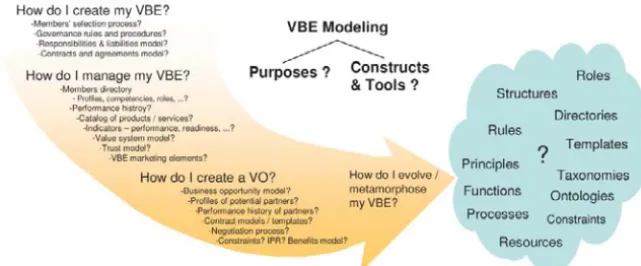
project, Figure 3 illustrates some of the questions a modeler may pose when attempting to model a VO Breeding Environment (VBE).
Figure 3 – Examples of modelling purposes in VBE
Certainly many other relevant questions may be asked in relation to a VBE. Similarly, for VO management a large number of modeling purposes are typically considered (Fig. 4).
26
Given this large diversity of modeling purposes, which also leads to different types of models, it is important to establish a framework for modeling. A proposal for a more comprehensive framework is discussed in chapter 2.4 of this book.
Figure 4– Examples of modelling purposes in VO management
On perspectives and tools. Proper understanding and analysis of a complex system
such as a CN requires the consideration of many facets. However, an analysis of past modeling efforts indicates that practitioners and researchers are not fully aware of a comprehensive spectrum of suitable modeling processes, tools, and methodologies. For instance, very often modeling is restricted to a “processes view” (e.g. SCOR type of models for traditional supply chains). Or they stick – often out of principle – with one approach such as using UML even though it might not be the most appropriate approach for all or a part of the modeling effort.
This situation is however improving and lately some theories and paradigms defined elsewhere have been suggested by several research groups as promising tools to help understand and characterize emerging collaborative organizational forms. Nevertheless, it is unlikely that any of these theories and modeling methods will cover all needs of CN; they can be used as a starting point but extensions or adaptations are needed.
Furthermore, existing knowledge on diverse manifestations of “traditional” collaborative networks is quite fragmented, being urgent to proceed with an integration and formalization effort. Nevertheless, purely formal methods in addition to being hard to apply are also difficult to follow by those not familiar with such methods.
As mentioned above, dissemination, education, and communication is one important purpose for modeling CNs. As such, we must acknowledge that this area is addressed by a large variety of people with different backgrounds; not all of them possess a strong formal background, and even many of the ICT practitioners do not have a formal education on computer engineering or computer science. This might suggest, in some cases, the appropriateness of semi-formal methods.
On the other hand, new forms of collaborative networks and new patterns of behavior are being invented and explored, for which it is not feasible to develop fully consistent formal models at start. In these cases, semi-formal models, or even informal analogies as represented by metaphors, can provide valuable insights towards a preliminary level of understanding of new collaborative forms.