IOP Conference Series: Earth and Environmental Science
PAPER • OPEN ACCESS
Physicochemical and sensory characteristics of soy sauce substituted
with pigeon pea (Cajanus cajan (Linn.))
To cite this article: C Retnaningsih et al 2018 IOP Conf. Ser.: Earth Environ. Sci.102 012047
View the article online for updates and enhancements.
1234567890
International Symposium on Food and Agro-biodiversity (ISFA) 2017 IOP Publishing IOP Conf. Series: Earth and Environmental Science 102 (2017) 012047 doi :10.1088/1755-1315/102/1/012047
‘’“”
Physicochemical and sensory characteristics of soy sauce
substituted with pigeon pea (
Cajanus cajan
(Linn.)
C Retnaningsih1, Sumardi1, Meiliana1 and A Surya1
1Food Technology Department, Soegijapranata Catholic University,
Jl. Pawiyatan Luhur IV/1, Bendan Duwur, Semarang 50234
Abstract. The objective of this study wasto investigate the physicochemical and sensory properties of the soy sauce substituted with pigeon pea. Soybean was substituted by 20%, 50%, 75%, and 100% of pigeon pea. The observation included viscosity, total solids, protein levels, antioxidant activity, and sensory characteristics. The results showed that the more substitution of pigeon pea, the less the protein content of soy sauce and the more the antioxidant activity as well as total solids. The most favored group was 25% pigeon pea substitution. It is suggested that soy sauce could be prepared using 25% to 75% pigeon pea substitution.
Keywords: soy sauce, pigeon pea
1. Introduction
Pigeon pea (Cajanuscajan (Linn.))is a group of nuts with 20.7% of proteinand 1.4% of fat contents and it could be used as black soybean substitution in making soy sauce due to their similar properties in shape, color, and seed size [1]. Pigeon pea also contains antioxidants such as polyphenols, isoflavones, phenols, phenolic acids and derivatives, flavonoids, tocols, phospholipids, amino acids, peptides, phytic acid, ascorbic acid, pigments, and sterols [1]. However, pigeon pea containsa low level of antinutrition compounds such as antitrypsin, hemagglutinin, and phytic acid. Phytic acid is not desirable because it can bind minerals and proteins and decrease the bioavailability of iron in the body. The content of phytic acid in pigeon pea flour is 0.77% and can be eliminated. Washing, soaking, boiling, steaming, and fermentation process can decrease phytic acid by 91-97% [2].
2 1234567890
International Symposium on Food and Agro-biodiversity (ISFA) 2017 IOP Publishing IOP Conf. Series: Earth and Environmental Science 102 (2017) 012047 doi :10.1088/1755-1315/102/1/012047
‘’“”
anti-nutritive substances [5]. This research aims to investigate the physicochemical and sensory properties of the soy sauce substituted with pigeon pea.
2. Materials and Methods
2.1. Materials and Tools
Materials used in this study includedblack soybeans, pigeon peas obtained from Gita Pertiwi Foundation in Surakarta, inoculum tempeRaprima, brown sugar, salt, galangal, bay leaf, lemongrass leaves, orange leaves, deaf, K2SO4, HgO, concentrated H2SO4, Na2S2O3-NaOH , 4% boric acid, methyl
red and methylene blue indicator, 0.1 N HCl, methanol, DPPH (2,2-diphenyl1-1-picrylhydrazyl), and aquades. The tools used were stove, pot, tampah, filter cloth, bottle, plastic bucket, strainer, wood stirrer, analytical scales, cormorant, pounder, cobek, viskotester, destructive, destilator, refractometer, burette, statif, erlenmeyer, bekker glass, pumpkin powder, porcelain cup, spectrophotometer, waterbath, and hotplate.
2.2. Materials Preparation.
Black soybeans and pigeon peas were sorted and cleaned through running water. Black soybeans were soaked in 3 liters of water for 24 hours while pigeon peas were soaked for 48 hours in water which was changed every 6 hours. The black soybeans and pigeon peas were boiled for 60 minutes to soften the texture, drained, and fully peeled. Then, they were steamed for 30 minutes, drained, and chilled at 300C. Last, the materials were prepared into 4 groups which contained 1 kg of materials for each group. The groups respectively contained 25%, 50%, 75%, and 100% of pigeon peas.
2.2.1. Koji Fermentation. The yeast required in koji fermentation was 1% of the soybean net weight of each group, sprinkled over the materials on a tampah (clean tray). The materials were incubated at room temperature for 3-4 days in a rather dark place. After the hyphae were formed and the structure of the materials became compact, the koji then was dried [2].
2.2.2. Moromi Fermentation. The dried koji was soaked into a 20% salt solution for up to 2 months. One kg of materials requires 2 liters of 20% salt solution. During this incubation process, the mixture needed to be sunbathed and stirredevery morning and closed and stored every afternoon [2].
1234567890
International Symposium on Food and Agro-biodiversity (ISFA) 2017 IOP Publishing IOP Conf. Series: Earth and Environmental Science 102 (2017) 012047 doi :10.1088/1755-1315/102/1/012047
‘’“”
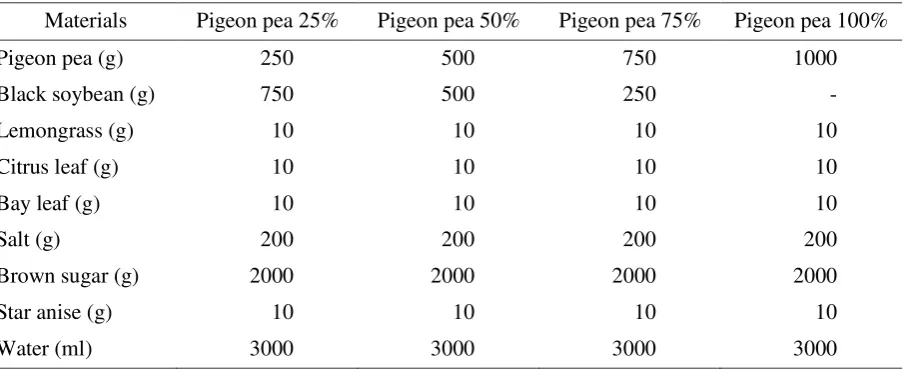
Table 1.The pigeon pea soy sauce formula.
Materials Pigeon pea 25% Pigeon pea 50% Pigeon pea 75% Pigeon pea 100%
Pigeon pea (g) 250 500 750 1000
2.3.1. Viscosity.A 100 ml of the samples from each group was measured using rotor viscotester three [7].
4 1234567890
International Symposium on Food and Agro-biodiversity (ISFA) 2017 IOP Publishing IOP Conf. Series: Earth and Environmental Science 102 (2017) 012047 doi :10.1088/1755-1315/102/1/012047
‘’“”
drops of methyl red and methylene blue mixture and titrated with 0.1 N HCl until the distillate became purple[6]. The formulas to calculate % N and% proteins are:
% Nitrogen = HCl volume (sample-blanco) x N HCl x 14,008 x 100% Sample weighing (gram) x 100
% protein =% N x conversion factor (6.25)
2.3.5. Antioxidant Activity.The process included measuring 0.5 ml of the sample (methanol as blanko) and extracting it using 5 ml methanol for 2 hours, taking 0.1 ml of the extraction and mixing itwith 3.9 ml of DPPH solution (2,2-diphenyl1-1-picrylhydrazyl) for 30 minutes of chemical reaction, and measuring the absorbance at t = 0 for control and t = 30 for sample using a 517 nm wavelength [10]. The antioxidant activity was measured as% discoloration calculated using formula:
% discoloration = [1- (At30 / At0)] x 100
Information
At 30 = sample, At 0 = control
2.3.6. Sensory Characteristics.The 4 groups of pigeon pea soy sauce and commercial soy sauce as control were evaluated for their color, odor, taste, and overall appearance using hedonic rating methodand 30 panelists. The attributes was expressed by a score of 1 to 5 written in a questionnaire sheet, with 1 as least preferredand 5 as the most preferred. The highest average of the resultsdetermined the most preferred group [11].
2.4. Statistical Analysis
Data were subjected to ANOVA (and Duncan test for any significant results with p <0.05) to determine significant differences between groups using SPSS 13 for Windows statistical application program. The Mann-Whitney test was used to determine the real difference between variables. Sensory characteristics data were analyzed using Kruskal-Wallis and Mann Whitney test [12].
3. Results and Discussion
In this study, the characteristics of the pigeon pea soy sauce were compared to the characteristics of the commercial soy sauceas control. Each group of the pigeon pea soy sauce yielded about 2,125 ml. The data of viscosity, sugar level, and salt level are presented in Table 2.
Table 2.Viscosity, sugar, and salt level of the commercial soy sauce and pigeon pea soy sauce.
1234567890
International Symposium on Food and Agro-biodiversity (ISFA) 2017 IOP Publishing IOP Conf. Series: Earth and Environmental Science 102 (2017) 012047 doi :10.1088/1755-1315/102/1/012047
‘’“”
The result showed that there were no differencesof viscosity and sugar level between pigeon pea soy sauce and commercial soy sauce. Commercial soy sauce had a higher salt level compare to pigeon pea soy sauce. The salt level might be influenced by the different formulas and moromi fermentation process. The immersion of koji in salt solution increased the soy sauce saltiness. This process also meant to prevent thegrowth of harmful microbeswhile still allowing the growth of bacteria and taste-shaping yeast. The salt solution serves to extract the dissolved nitrogen compounds resulting from the hydrolysis of the mold enzymes in soybeans. Without salt, an undesirable anaerobic fermentation process occurs [4,13]. During the salting process, every morning the koji needed to be sunbathed and stirred, while every afternoon it needed to be closed and stored again. During this incubation process, the koji must be stirred so that the salt solution can homogeneously touch the surface of the substrate and provide air to stimulate the growth of yeast and flavor-forming bacteria [13,14].
Viscosity is one of the physical attributes that determines the quality of soy sauce. Viscosity equalization is needed so that the quality of the pigeon pea soy sauce and commercial soy sauce is similar with standard viscosity of 8.5 dPaS. Therefore, the cooking process of all groups stopped when they reached the same viscosity as the commercial soy sauce. The total content of solids, protein level, and antioxidant activity of the soy sauce groups are presented in Table 3.
Table 3.Total dissolved solids, protein, and antioxidants activityof the commercial soy sauce and pigeon pea soy sauceAB.
Soy Sauce Total solids (%) Protein level (%) Antioxidant activity (%)
Commercial 15.67±0.26d 3.51±0.02b 90.31±0.84a
Pigeon pea 25% 13.21±0.25a 3.70±0.04e 92.59±0.29b
Pigeon pea 50% 13.72±0.12b 3.63±0.02d 93.15±0.20c
Pigeon pea 75% 14.38±0.32c 3.54±0.02c 93.55±0.21cd
Pigeon pea 100% 15.41±0.36d 3.46±0.02a 93.91±0.14d
A
The result is the mean value ± standard deviation.
B
Different letters show significant difference values (p<0.05).
The total solids of commercial soy sauce had the same value as 100% pigeon pea soy sauce. The protein levels in all groups of soy sauce were significantly different due to the different amount of pigeon pea substitution. The more amount of pigeon pea used for substitution in soy sauce, the fewer the protein level of soy sauce because the protein level of pigeon pea is lower than black soybean. However, the higher concentration of pigeon pea added, the more the antioxidant activity of soy sauce. The carbohydrate level of pigeon pea is higher than black soybean, resulting in increasing the total solids of soy sauce. In food material, some solids are in soluble form and some are in non-solvent form. Soluble solids usually consist of organic substances, inorganic salts and, dissolved gases [2].
Protein level in pigeon pea soy sauce and commercial soy sauce are between 3-4%. According to
6 1234567890
International Symposium on Food and Agro-biodiversity (ISFA) 2017 IOP Publishing IOP Conf. Series: Earth and Environmental Science 102 (2017) 012047 doi :10.1088/1755-1315/102/1/012047
‘’“”
Table 4.Sensory Characteristics of the commercial soy sauce and pigeon pea soy sauce.
Soy Sauce Color Aroma Taste Mouth feel Overall
The result is the mean value ± standard deviation.
B
Different letters show significant difference values (p<0.05).
C
The score interpretation are 1 = very unacceptable, 2 = unacceptable, 3 = quite acceptable, 4 = acceptable, and 5 = very acceptable.
The mouthfeel of pigeon pea 25% had the best score among other concentrations. It is
related to the total solids presented in soy sauce. Pigeon pea 100% had a high total solid
content which gave a specific taste in mouth feel attribute. Besides, pigeon pea 100% had a
stronger flavor of pigeon pea which made it less favored by the panelists.
4. Conclusion
Based on the sensory analysis and protein level results, the best formula of pigeon pea soy sauce waspigeon pea 25%. The more amount of pigeon pea used for substitution in soy sauce, the fewer the protein level of soy sauce and the more the total solids and antioxidant activity of soy sauce. Higher amount of pigeon pea decreased the panelists’ acceptance of soy sauce.
References
[1] Fitri V 2007 Antinutrition compounds in pig nuts (Vicia faba) and pigeon pea (Cajanus cajan) and inactivation methods Bogor Agricultural Institute
[2] Rukmana R 1999 Pigeon pea cultivation and postharvest handling (Yogyakarta: Kanisius) [3] Widowati S, Erliana G and Sri S A 2009 Soybean superior variety for soybean industry raw
materialJournal of Agricultural Research 28
[4] Pangastuti A, Yona S and Purwoko T 2004 Content carbohydrate, fat and protein in soy sauce from tempe Surakarta
[5] Isnawan H 2010 Changes in quality of soy sauce household scale production during the three months storageJurnal Teknologi dan Industri Pangan 14
[6] Purwoko T and Noor S H 2007 Protein content of sweet soy sauce without fermentation moromi as fermentation results of Rhizopus oryzae dan R. oligosporusBiodiversitas 8 223-27.
[7] AOAC 1995Official methods of analysis of the association of official agriulture chemist(Washington DC: Association of Official Analytical Chemist)
[8] Apriyantono A and Yulianawati G D 2004Volatile component changes during fermentation ketchupJurnal Teknol dan Industri Pangan 15 100-12
[9] AOAC 2000 Officialmethod of analysis of the AOAC 17th ed(Washington DC: Association of Official Analytical Chemist)
[10] Williams W B, Cuvelier M E and Berset C 1995 Use of afree radical method to evaluate antioxidant activityTechnol 28 25-30
[11] Meilgaard M, Civille G V and Carr B T 1999 Sensory evaluation techniques 3rd edition(Florida: CRC Press LLC)
1234567890
International Symposium on Food and Agro-biodiversity (ISFA) 2017 IOP Publishing IOP Conf. Series: Earth and Environmental Science 102 (2017) 012047 doi :10.1088/1755-1315/102/1/012047
‘’“”
[13] Rahayu E, Indrati R, Utami T, Harmayani E and Cahyanto M N 1993 Fermented food ingredients Food & NutitionCollection
[14] Rahayu A, Suranto and Tjahjadi P 2005 Analysis of carbohydrates, proteins, and fats in the making of lamtoro gung (Leucaena leucocephala) sauce fermented by Aspergillus oryzaeSurakarta
[15] Standar Nasional Indonesia (SNI) 2013 Sweet soy sauce (Jakarta: Center for Industrial Standardization Ministry of Industry)