Food Loss and Food Waste as Global Issues
Dao Thi Anh Thu & Nguyen Thi Truc Loan
Food Technology Division, Chemical Engineering Department University of Science and Technology, The University of Danang
Danang, Vietnam
e-mail: [email protected]; [email protected]
ABSTRACT
The entire world is facing significant challenges in the coming decades. It has been demonstrated that many countries must prepare themselves to face a considerable rise in food consumption and corresponding food waste. There must be a cooperation of consumers, retailers, producers and government to solve this complex issue. Their efforts to decrease food waste would offer a significant sustainable alternative to scale up food manufacturing that leading to a stabling food security internally and internationally. Governments and businesses should develop food loss and food waste prevention throughout the entire supply chain. There should be a higher effort on decreasing post-harvest losses in early stages in the food value chain in the developing countries. Meanwhile, in the developed countries, the government should have policies to reduce food waste at consumer level which could minimize food being unnecessarily thrown away. Governments should also support the establishment of independent organizations which could facilitate and assess efforts to decrease food waste, such as the WRAP in the UK in grocery and hospitality supply chain.
Keywords: food loss, food waste, food value chain, reuse, cycle
Seluruh dunia sedang menghadapi tantangan yang signifikan pada dekade mendatang. Beberapa negara haru smempersiapkan diri untuk menghadapi tantangan yang terkait dengan konsumsi pangan dan makanan sisa. Kerjasama yang baik antara konsumen, retailer, produsen dan pemerintah amat diperlukan untuk menyelesaikan persoalan tersebut, Upaya yang baik perlu dilakukan untuk mengurangi makanan sisa sehingga menjadi alternative solusi untuk meningkatkan sustainabilitas produksi pangan yang lebih ramah lingkungan.
Kata-Kata Kunci: democracy assistance, efetifitas bantuan luar negeri, demokrasi, stabilitas politik, pertumbuhan ekonomi.
Definition
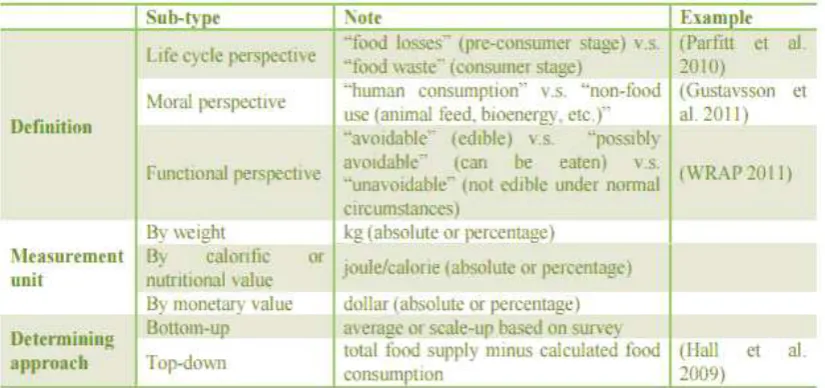
It was reported that “Food waste is an important part of food loss, which refers to the discarding or alternative (non-food) use of food that was fit for human consumption-by choice or after the food has been left to spoil or expire as a result of negligence” (FAO, 2014).
The Waste Reduction Action Programme (WRAP), which is launched in 2000 by the UK government, is a top program in the area of food waste decrease. The WRAP has classified food waste as following categories:
- Avoidable: food and drinks that are thrown away despite still being edible; - Possibly Avoidable: food and drinks that some people consume and some do
not or food that can be edible, if cooked one way instead of another; •
- Unavoidable: waste deriving from the preparation of food or drinks that are not, and could not be edible (Quested & Parry, 2011).
According to the Food Use for Social Innovation by Optimising Waste Prevention Strategies (The FUSIONS), “Food waste is any food, and inedible parts of food, removed from the food supply chain to be recovered or disposed (including composted, crops ploughed in/not harvested, anaerobic digestion, bio‐energy production, co‐generation, incineration, disposal to sewer, landfill or discarded to sea)”.
Table 1. The definition, measurement unit and determining approach of food losses
and food waste (Liu, 2014)
It is studied that between around one quarter and one third of agricultural products never reach the consumer (Gustavsson, 2011). The lack of interconnectivity between harvest, transportation, processing, marketing, preparation, and the consumer activities is the dominated reason of food waste. Food wastage is an international phenomenon. Food waste management is a major task in food processing industries because of environmental regulations worldwide.
The values of reducing food waste are relatively low, but the potential benefits are substantial. Less food waste results to more efficiency, more economic productivity and decrease in emissions of green house gases that contribute to global warming. The question is how can the world could feed more than 9 billion people by 2050 but reducing pressure on the environment? The agriculture has to produce more food and fiber to feed a increasing population and apply more efficient and sustainable production methods while minimize the climate change. If a country could reduce and manage food waste effectively that would lead to increase profitability and environmental sustainability.
The cause of food waste
Figure 1. The cause of food waste (Barilla Center for Food and Nutrition, 2012)
Figure 2. Potential reasons for food waste from post-farm gate to purchase (Parry,
James & LeRoux, 2015)
Global food waste and food loss
Figure 3. Global food waste and loss by food categories (Gustavsson, 2011)
Detail of the figure 3: over 2 million people will die while over 2 million children will die from malnutrition. In industrialized countries, 286 million tones of cereal products are thrown away. In Europe, the dairy products wastage is 29 million tones. Around half of fruit and vegetables produced globally are wasted which highest wastage rate every year. This number in meat products and oilseeds and pulses are over 20% and 22% of the globally production (around 263 million tones). In North America and Oceania, a 5814 thousands tone of roots and tubers is lost at the consumption level only (Gustavsson, 2011)
Figure 5. Global food losses and food waste by supply chain stage (FAO, 2013)
Figure 6. Amounts of food waste arising by region and by supply chain stage
(Gustavsson, 2011)
In low-income countries
In medium and high-income countries
The consumer behaviour, policies and regulations are the main reasons causing of food loss (FAO, 2014). In particular, setting up consumer food waste prevention campaigns could help to reduce food waste in the emerging cities with fast growing middle class population. For example, the Love Food Hate Waste.
Figure 7. Summary of household food waste composition across five countries (Julian,
2010)..
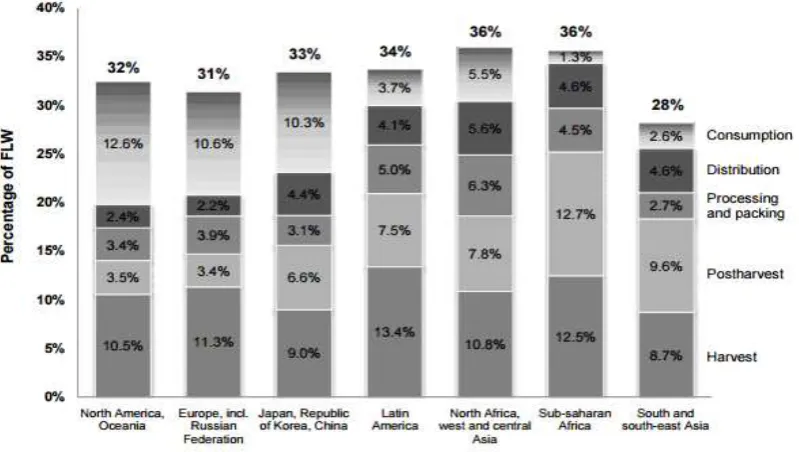
Figure 9. The distribution of FLW along the food chain in the different world regions (HLPE, 2014)
The impacts of global food losses and food waste
Table 3. Examples of potential impacts of food losses and waste on the sustainability
Wastewater: The quantity of water to produce the wasted food is around 250,000 billion liters annual on global scale, which could provide for New york’s domestic water demand for the next 120 years. (FAO, 2013).
Wasting agricultural land: The land needed to product the wasted food globally is about 1.4 billion hectare which is nearly 30% of the world agricultural land. (FAO, 2013)
Increasing the global warming: The carbon footprint of wasted food is 3.3 billion tones of carbon dioxide on a global scale.
Figure 10. Top ten global green house gas-emitting countries versus food loss and
waste in 2005 (WRI, 2012)
Figure 11. GHG emissions linked to food waste arising by region and by supply chain
stage (Gustavsson, 2011).
Wasting money: The UN FAO reported the direct economic for food waste costs $750billion a year (or $470 a tonne) that equivalent to the GDP of Switzerland, except from fish and seafood. However, the true economic cost of food waste will be much higher through the supply chain[8]. In South Africa, the food waste costed increasing from around %450 a tonne to over $1,100 a tonne between agriculture and consumption. Meanwhile In the UK, the value of food waste increased from around $1,500 a tonne for manufacturers to $4,800 a tonne for consumption. This number in the US was around $ 2,700 a tonne for retail and consumer level (Parry et al., 2015) In Japan, the Ministry of Agriculture Forestry and Fisheries reported the value of food waste was around $4,800 a tonne in 2007 with 23 million tones (OECD, 2014).
Figure 12. Cost of food waste arising (producer prices) by region and by supply chain
stage (Gustavsson, 2011)
International collaborative working
Food waste with its negative effects is more and more becoming a global concern with the considering from many international organizations to address this problem. The UNEP, FAO and WRAP have reported the guidance on the implementation and development of effective food waste strategies and tactical implementation plans (UNEP et al, 2014) (WRAP, 2015).
Figure 13. The main international organizations addressing the problem of food waste
(Gustavsson, 2011)
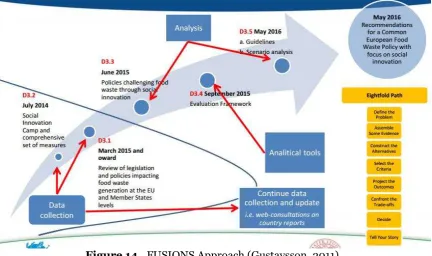
knowledge institutes, consumer organizations and businesses. Project duration is 48 months from 2012 to 2016. Activities of the project includes:
- The harmonisation of food waste monitoring;
- Improved understanding of the extent to which social innovation can reduce food waste;
- The development of guidelines for a common Food Waste policy for EU‐27 (EU‐ 28).
Figure 14. FUSIONS Approach (Gustavsson, 2011)
WRAP: reported the global consumer food waste cost more than $400 billion per year. It also states the significant savings by decreasing food waste in the UK and other nations all over the world. This report emphasis the practical changes in all countries could leads to significant different in preventing food from spoiling (Parry et al., 2015) The African Development Bank (AfDB), International Fund for Agricultural Development (IFAD), International Trade Centre (ITC), United Nations Industrial Development Organization (UNIDO), and World Food Programme (WFP) are some UN organizations at UN level working in term of food waste management.
Solutions and legislations in some nations
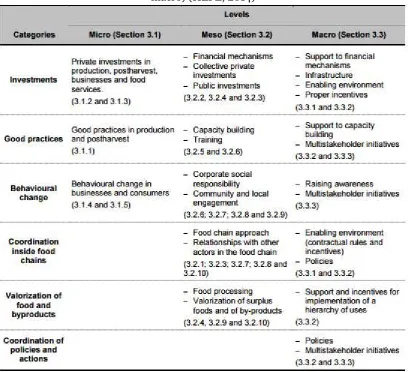
Some legislations have been passed in many countries to decrease the effects of food waste on the environment. The suitable treatment technologies, the establishment of discharge standards or discharge waste are specified in these legislations. The action in partnership need to be undertook between FAO with other regional and international organizations as well as with all food chains actors from headers, farmers, fishers to international companies.
Table 3. Categories of solutions to reduce Food loss and waste by levels (micro, meso,
macro) (HLPE, 2014)
United States
The National Pollution Discharge Elimination System control the discard of waste water from a point source. The quality and quantity of effluents is regulated by NPDES when facilities are discharged directly into the waters. The specific waste from each type of industry is governed by the federal effluent guideline (Chen, 2005)
Canada
The FAO reported that there was around $27 billion of food waste every year in Canada. This is a symptom of processes and attitudes, especially the affluence. In 2009, It is estimated that food waste at the retail and consumer levels was around 122 kg per person for fruits and vegetables, 6kg for dairy products, 10kg of boneless poultry and 16kg of boneless red meats, and 18 kg of oils, fats, sugar and syrup (Statistic Canadian, 2010). In Canada, the food wastage occur mainly on the farm, processing, distribution, retail locations, food service, consumers. According to the Environment Canada 2010, the decomposition of organic waste in landfills produce methane- a greenhouse gas- that lead to global warming that is 20-25 times higher than carbon dioxide (VCMC, 2015).
Figure 15. The percentage of food loss along the Canadian Food Value Chain (VCMC,
2015)
Australia
Australia wastes $8 billion worth of food annual. Food wastage have been demonstrated its negative effects on food security and the environment in Australia. The cost of food wastage has increased from $5.2 billion in 2009 to $8 billion in 2014 in which the consumer and retail level is predominant. It is reported that each household waste around $616 worth of food each year. Therefore, consumer behaviour need to be changed to decrease food wastage. In Australia, local government also take a significant role in making food waste regulations. In Sydney, the bins and biodegradable bin bags have been provided to the residents and then been collected weekly. Next, the food waste is converted into a combustible gas for green electricity generation (Maria, 2014).
Asia
b.
c.
Figure 16. Benefits of a 20% reduction in food waste in Industrialised Asia
a. Cost of food waste avoided, b. weight of food wasted avoided, c. GHG emissions avoided (FAO, 2011&2013) (Parry et al., 2015)
Japan
In 2006, the quality of food waste from food-related industries is around 11.35 million ton including:
- From food processing industries: 4.95million - From food wholesale industries: 0.74 million
- From food retailers (department, super markets, convenience stores, green grocery stores): 2.62 million
- From food service industries (buffets, restaurants, hotels, inns): 3.04 million
making methane gas from food waste and kitchen wastewater to generate electricity and heat (Takenaka Corporation, Kobelco Eco-Solutions Co.,Ltd and Teral Inc).
Figure 17. Waste Food discharged from Food Related Industries (FY 2006)
Singapore
Food waste makes up around 10% of total waste in Singapore. The food waste in 2012 could fill 600 Olympic-size swimming pools. There was only 13% (101,400 tonnes) of 788,600 tonnes fod waste was reused in 2014 (National Environment Agency). The NEA is monitoring food waste recycling systems at various premises to assess their effectiveness in curtailing food waste. There is a food waste manage company will have to provide recycling machines and training for cleaner and stall-holders that leads to more than 30 food company recycle their food waste. For example, the food waste will be dumped in a machine after being segregated, then the microbe will accelerate the decompose rate of the food waste, the sludge then run though a grease separator and filtered. The organic and inorganic waste much be separated first. The effort to cut the food waste depends on the economic viability, effectiveness of the system and whether the end-product can be fully utilized (Ariffin, 2015). Another policy is that there is cooperation between PUB-Singapore’s national water agency and Anaergia Pte Ltd to produce more biogas to generate electricity by co-digesting demonstration facility with water sludge and food waste. There could be up to 40 tons of food waste and used water sludge. There will have a district-level pilot in Clementi for collecting segregated food waste from educational institutions, hospitals and camps for co-digestion by September 2015 (Bernama, 2015).
European Commission
Norway
The food industry and partners have set up a collaborative programme called ForMat which aimed to decrease to a 25% reduction in food waste by 2015 as well as changing attitudes and improving knowledge and routines. The data was selected from producers, retailers, wholesalers and consumers. In term of productions, the data show a decrease in food waste from 4.8% in 2010 to 4.0% in 2013 in stage of selected product categories. There was also a reduction of consumers quantity who having discarded a particular product category from 2010 to 2013 with the highest decreased in eggs (50%), followed by snacks, fresh meat, milk/cream, cheese and yoghurt/sour cream (Parry et al., 2015)
France:
There is a legislation banning supermarkets from throwing away unsold but edible food on fines and jail sentences to crack down on food waste.
Germany
The Internet is used to spread products still in good condition from store rubbish.
UK
It is indicated that the carbon impact of food waste is over the equivalent of 20 Mt of C02 emission. The UK Government has also applied an effective strategy which includes: prevention, reuse, recycling of waste, followed by recovery and disposal strategies. A plan which to share responsibility between all the involved components in society have been established by their corporation, for example businesses and consumers. The Courtauld Commitment have been signed by more than 40 major retailers, brand owners, manufacturers and suppliers which being launched in July 2005. The participants have committed to decrease both post-consumer packaging and post-consumer food waste through innovative packaging and optimal choice of volume of the product, in-store guidance and a consumer campaign (ECDGE, 2008, p.64). In households level, WRAP’s policies have contributed to an estimated 18% decrease in avoidable food waste (VCMC, 2012).
Tesco-biggest supermarket chain have introduced a pilot scheme at its stores to distribute each day’s unsold food to charities.
Figure 18. Amounts of food waste arising in the UK by sector (total equals ca 15
Figure 19. Top down estimate of average greenhouse gas emissions associated with household food and drink waste in the UK (Parry et al., 2015
Table 4. Cost and benefits of waste prevention activities related to the third phase of
the Courtauld Commitment (2012-2015) (Parry et al., 2015)
Future trends
The World Resources Institute (WRI) indicates that food loss and waste reduction is part of building a sustainable food future. It also stated that reducing wastage could contribute to food availability in the future. WRI cooperated with the World Business Council for Sustainable Development (WBCSD) in Action 2020, a global business platform. The businesses will be involved in reducing waste and loss as its content. Together with WRI and UNEP, WBCSD is building a Food Waste Measurement Protocol to support business to measure waste. On the European level, the European Commission plans for 50% less food wastage in 2020 with the policy based on the EU financed research project FUSIONS which also has as its main purpose a more resource efficient Europe through significantly reducing food waste (Tielens & Candel, 2014). In recent years, many scientific researches demonstrated the biologically desirable value of natural compounds or products of natural origin. The large quantities of by-products have great potentials for the extraction of biologically desirable high added value compounds. The future trend in food waste management is the manufacturing of secondary products. The recovery of by-products could also bring higher profits for company. Different high value biological compounds include lipids, proteins, bio-polymers, minerals, amino acids and enzymes could be recovered from wastewaters, head, viscera, skin, tails, flesh as solid residues in by-products and waste from food processing industry. These processing may be canning process (filleting, cooking, salting or smoking stages). These valuable compounds could be applied in medicine, food, agro-chemical industries or pharmaceutical. The natural products are also more accepted than the synthetic ones by the general public because of their “safer perception”. The new recovery and reuse technologies are needed to be developed to restrain the loss of valuable compounds attached to the waste. The remaining food residues needs to be treated with appreciate technologies from pretreatment to advanced treatment. For example, Fish takes up between 20 and 75% as main material for food industry that brings a huge amount of by-products and waste. The quantity of residues and wastewater in this industry increases because of higher consumption of fish products and changing perception of ready-to-use products as well as more stringent quality and higher hygienic standards. Fish gelatin could be considered as Halal and acceptable by all religions (Ferraro et al., 2013).
REFERENCES
Ariffin, N. A. (2015). Cutting down food waste with machines. The Channel Newa Asia. Retrieved from http://www.channelnewsasia.com/news/singapore/cutting-down-food-waste/1863614.html
Barilla Center for Food and Nutrition. (2012). Food waste:causes, impacts and proposals. Retrieved from www.barillacfn.com
Bernama. (2015). Singapore to produce electricity from waster sludge, food waste. The Eco-Business. Retrieved from http://www.eco-business.com/news/singapore-to-produce-electricity-from-water-sludge-food-waste/
Chen, S. (2005). Food waste. In Food engineering: encyclopedia of life support systems. (pp. 775-787). Paris, France.
Ferraro, V., Carvalho, A. P., Piccirillo, C., Santos, M. M., Castro, P. M. L, Pintado, M. E. (2013). Extraction of high added valua biological compounds from sardine, sardine type-fish and mackerel canning residues-A review. Materials Science and Engineering C, 33, 3111-3120.
Food and Agriculture Organization of United Nations. (2014). Save food: Global Initiative on food loss and waste reduction. Retrieved from http://www.fao.org/save-food/en/
Food and Agriculture Organization of the United Nations. (2013). Food wastage footprint: Impacts on natural resources. Summary report. Retrieved from http://www.fao.org
Gustavsson, J. (2011). Global food losses and food waste: extent, causes and prevention. Retrieved from Food and Agriculture Organization of United Nations website: http://www.fao.org/docrep/014/mb060e/mb060e00.pdf
High Level Panel of Experts on Food Security and Nutrition of the Committee on World Food Security (HLPE). (2014). Food losses and waste in the context of sustainable food systems.
Julian, P., Barthel, M. & Macnaughton, S. (2010). Food waste within food supply chains: quantification and potential for change to 2050. Philosophical Transactions of the Royal Society of London B: Biological Sciences 365(1554): 3065-3081.
Liu, G. (2014). Food losses and food waste in China: A first estimate. OECD Food, Agriculture and Fisheries Papers, 66.
Maria, R. T. (2014). Food waste in Australia. Strategic Analysis Paper. Retrieved from
Future Directions International Pty Ltd website:
Pap, N., Pongrácz, E., Myllykoski, L., & Keiski, R. (2004). Waste minimization and utilization in the food industry: Processing of arctic berries, and extraction of valuable compounds from juice- processing by- products. In: Pongrácz E. (ed.). Proceedings of the Waste Minimization and Resources Use Optimization Conference. University of Oulu, Finland (p.159-168). Oulu th University Press.
Parry, A., James, K. & LeRoux, S. (2015). Final Report: Strategies to achieve economic and environmental gains by reducing food waste. ISBN: 978-1-84405-473-2.
Quested, T. & Parry, A. (2011). Final report: New estimates for household food and drink waste in the UK. Retrieved from The Waste Reduction Action Programme (WRAP) website: http://www.wrap.org.uk
Statistic Data of the Ministry of Agriculture, Forestry and Fisheries (FY2007)
Tielens, J., Candel, J. (2014). Reducing food wastage, improving food security, Food & Business Knowledge Flatform, Netherlands
Value Chain Management Centre and George Morris Centre. (2012). Cut waste, grow profit: How to reduce and manage food waste, leading to increased profitability and environmental sustainability. Retrieved from http://www.valuechains.ca.
World Resources Institute. (2012). Climate Analysis Indicators Tool. Retrieved from World Resources Institute at http://cait.wri.org.