The Prospects of ERP Systems on Quality of Education and
Research in Higher Education and Research Institutions of
Pakistan
Najia Saher1, Dost Muhammad Khan2, Faisal Shahzad3, Nawaz Mohamudally4
1
Lecturer, Department of Computer Science & IT, The Islamia University of Bahawalpur, PAKISTAN
2
Assistant Professor, Department of Computer Science & IT, The Islamia University of Bahawalpur, PAKISTAN & PhD Student, School of Innovative Technologies & Engineering, University of Technology Mauritius (UTM), MAURITIUS
3
Lecturer, Department of Computer Science & IT, The Islamia University of Bahawalpur, PAKISTAN
4
Associate Professor, & Consultancy & Technology Transfer Centre, Manager, University of Technology, MAURITIUS
Abstract
It has been challenging for the educational and research institutions like universities and colleges to succeed in their core missions. The universities are facing the reduction in funds from traditional sources which has trimmed their revenues. The competition for private funding including grants, endowments and alumni donations is growing. The escalating student populations are creating physical space and service challenges. The Government regulations create pressure on the institutions to operate with a high degree of transparency, which intensifies the need to report, document and track financial, demographic, and educational information. These myriad of challenges can be addressed by better utilizing the current technology. The higher education and research institutions should be powered with IT that aligns with their requirements, supports for change and improve in the human resource management system. The institutions need to operate more efficiently and integrate processes, from business services to academic affairs and student care, while collaborating externally with government agencies and other service providers. The most of the teaching institutions in Pakistan are still using fragmented, nonintegrated and disjointed business systems, which are resultantly inefficient, outdated, and expensive. These systems are not helpful at all in decision making. The implementation of ERP system is, therefore, the best solution to envelop these bottlenecks. This paper is a case study which shows the effects of using ERP systems as an innovative learning and networked curriculum in a public sector university of Pakistan. This case study aims at emphasizing the importance of data integration and migration explaining in detail the architecture of ERP. The Campus Management Solution (CMS) is the name given to the ERP implementation in The Islamia University of Bahawalpur, Pakistan (IUB). This case study thoroughly examines the core concepts of implementing ERP along with its consequences.
Keywords: ERP, SAP, Client-Server architecture, HEC, IUB
1. Introduction
Prior to the concept of ERP systems, each department has its own computer system. The problem was integration of data from different departments. For example, the Human Resource computer system manages only employee information while the payroll of the employee is calculated and stored in the finance department. The data was migrated and transferred from one department to another department. The migration of data is an important activity so many decisions i.e. identify the data to be migrated, timing of data migartion and creating of data templates, have to be made before migartion or transfer. The following are the advantages of ERP systems:
a) Combines the data of formerly separate applications. b) It keeps the data in synchronization across the enterprise.
c) It simplifies the computer infrastructure within a large organization.
d) It standardizes and reduced the number of software specialties required within larger organizations.
e) Improvement in curriculum.
f) Improves student learning and the research capabilities of faculty as well.
On the other hand ERP systems have disadvantage like: a) Limited customization of software.
c) The cost of switching is high and reduce its effectivess due to resistance in sharing senstive internal information between departments [1][2][3][4][12][13][14].
The rest of paper is organized as: section 2 deals with the architecture of ERP system, section 3 is about the methodology; a case study, the implementation of ERP system with the name of the Campus Management Solution (CMS) in The Islamia University of Bahawalpur, Pakistan (IUB). Section 4 presents the results and discussion and the conclusion is drawn in section 5.
2. Architecture of ERP System
The Information age is revolutionized due to advent of Internet and Integrated Enterprise Resource Planning (ERP) systems during the past decade. The e-biz phenomenon has changed the way of traditional business process. Now business is round the clock. On the other hand this new paradigm has increase the volume of data. The new business process becomes very complex, volatile and spread across the world, as compared to the pre-e-biz era. ERP system is to integrate all departments and functions across the enterprise onto single computer systems. ERP system is like a three-tier client-server architecture, consists of operating system, application and database. This architecture provides scalability and customization ability. Data entered into one module is immediately reflected in all other modules, allowing users to access and make quick decisions [6][7][10][11][17]. The architecture of ERP system is illustrated in figure 1.
Figure 1 The Architecture of ERP System
The data is stored in a unified database for various modules. The users can access data from different places and also accommodate the growth of the data.
3. Methodology: A Case Study
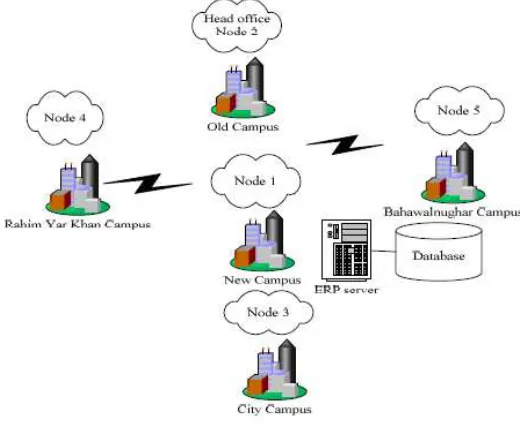
In this paper we are discussing a case study of The Islamai University of Bahawalpur, Pakistan. The university currently has five campuses situated at different locations; three campuses are within the city and the other two campuses are at about 200 kilometers distance. All the five campuses are connected with each other through the modern network technology. Figure 2 shows the interconnection of all the five campuses of the university.
Figure 2 The Interconnection of the Campuses of IUB
Figure 3 The Architecture of Networking at three Campuses of IUB
The university has more than 10,000 students in 47 different disciplines. The figure is increasing each year due to the induction of new and innovative disciplines by the uinversity. The university has more than 2,000 emplyees. The university has more than 200,000 books in its Resource Center and a Digital Library is also functioning in the Resource Center. Table 1 below shows the number of students, the number of disciplines, the number of books and the number of emplyees of the university from year 2000 to 2009.
Table 1. The Data of Students, Employees, Books and Disciplines from Year 2000-2009
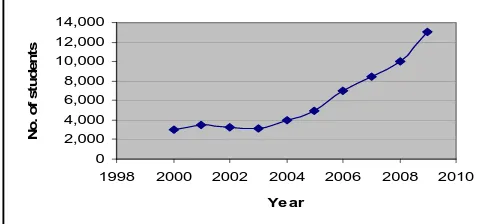
A graph in figure 4 shows the yearly increase in the number of students. At the same time the number of employees, the number of books and the number of disciplines are also increasing yearly.
0
1998 2000 2002 2004 2006 2008 2010
Ye ar
Figure 4 A Graph for Number of Students per Year (1998-2010)
Only to keep the record of students, their examinations, fees and dues, number of courses taken and books issued from the resource center is a very complex task. The university have other important entities like employees, faculty and resource center. The examinations system, the finance system and the library information system are already computerized but they are not integrated with each other. The decision making from these nonintegrated systems is very difficult. The implementation of ERP system is the only choice not only for the universities but
also for the other higher education and research institutions of Pakistan.
The Islamia University of Bahawalpur, Pakistan is implementing the Campus Management Solution(CMS), an ERP system in its all five campuses. It will provide the students, the faculty members and the administartion an immediate access to real time information and connects that information to specific action. In the first phase, students examination system and hostel management system are integrated with each other. Later on, the Library information system, Budget, Payroll, Store, Planning and Development, Advanced Studies and Research and the Audit systems will be developed and integrated with all the rest of university’s systems [5][8][9][15][16].
4. Results and Discussion
The students want a web-based enrollment of courses and examinations and even e-learning opportunities as part of the curriculum. The Internet is becoming an essential part of education and research. The only and trivial solution is the implementation of ERP systems. The major benefits of this solution are:
a) Satisfied students: because students have 24/7 access to the system and can generate time table, examinations reports, attendance records, books record and fees records. The students may be able to download missing lectures. The students have a chance to exchange their ideas with international students
b) Better organization: the smooth running of the administartion.
c) More effective management: d) More efficient IT: and
e) Transparency in use of funds: the funding bodies can generate reports at any time. It also helps in auditing system of the universities.
forward with the developed countries. The ERP provides the best solution to coup with all issues and problems of the institution. It will be fruitful if all the business modules of the university are integrated. The true picture of ERP systems can not be drawn with the implementation of two or three modules. The Internet is essential for the education, learning and research needs of the future.
5. Conclusion
In this paper we discuss the importance of data integration and migration and the effects of using the ERP systems in the education and research institutions as an innovative learning and networked curriculum. After the implementation of ERP systems the information about the students, faculty, resource center, finance and the general administration etc. are available when you need it; any where and any time. We conclude this paper that universities have sufficient in-house IT skills personnel, they can develop new modules and integrate them with the multiple software products. It is better to implement only portions like student examinations and hostel mangement of an ERP system and the rest of the university’s modules may be developed in-house. Another important point is e-learning and distance e-learning modules may be added in ERP systems. It will help the students living in the remote areas of the country. The research capabilities of the faculty will be improved with ERP systems. The innovative curriculum will be introduced in different disciplines. Hence the quality of education and research will improve with the implementation of the ERP systems. One can say a university using ERP is: “Shaping a
university that can compete with the best”.
Future Work
The data of the university increases yearly due to the induction of new disciplines, employees and the number of books in the resource center, it is better to use data mining techniques in the ERP systems. The campuses of the university are situated at different locations and the two campuses are far away from the main service provider of the ERP systems, this is an example of n-tier client-server distributed system, the use of intelligent mobile agents will be further benefited for the ERP systems. The intelligent mobile agents are very commonly used in distributed network systems given that they are not cumbersome for the network traffic. More over, they overcome network latency, operate in heterogeneous environment and possess fault-tolerant behavior.
Acknowledgement
The Campus Management Solution (CMS) is implemented at The Islamia University of Bahawalpur, Pakistan (IUB) due to the courtesy of Higher Education Commission (HEC), Pakistan. The project is fully funded by HEC, Pakistan.
References
[1] Injazz J. Chen, "Planning for ERP systems:
analysis and future trend", Business Process
Management Journal (MCB UP Ltd) 7: 374-386, ISSN 1463-7154, 2001
[2] Anderegg, Travis, “Confusting Terms and
Definitions for a Murkey Alphabet Soup”, at
http://www.wlug.org.nz/EnterpriseSpeak, 2007
[3] Monk, Ellen & Wagner, Bret, “Concepts in
Enterprise Resource Planning”, (Second ed.), Boston:
Thomson Course Technology, ISBN 0-619-21663-8, 2006
[4] Ramaswamy V. K., “Data Migration Strategy in
ERP” , 2007
[5] Turban et al., “Information Technology for
Management, Transforming Organizations in the Digital Economy”, Massachusetts: John Wiley &
Sons, Inc., pp. 300-343. ISBN-13 978-0-471-78712-9, 2008
[6] Brown, C., and I. Vessey, "Managing the Next
Wave of Enterprise Systems: Leveraging Lessons from ERP”, MIS Quarterly Executive, 2(1), 2003.
[7] King. W., "Ensuring ERP implementation
success”, Information Systems Management, 2005
[8] Web site, The Islamia University of Pakistan: http://www.iub.edu.pk, 2010
[9] Voskob. Max., Howey. Rob., Panin. Nick., “Data
mining and Privacy in Public Sector using Intelligent Agents”, Discussion paper, New Zealand, 2003
[10] R. Buck-Emden, J. Galimow, “Client/Server
Technology SAP R/3 System” (Hardcover) Publisher:
Addison Wesley; Subsequent edition ISBN-13: 978-0201403503, 1996
[11] Elbert B, Martyna B, “Client/Server Computing
Architecture, Applications and Distributed Systems Management”, Publishers, Boston * London, ISBN
0-89006-691-4, 1994
[12] Somerville, Ian, “Software Engineering”, 6th Edition. ISBN: 020139815x, 2001
[13] Pressman, R.S., “Software Engineering: A
Practitioner’s Approach, 6/e.”, ISBN: 0072853182, 2005
[14] Lethbridge, T.C. ,and Laganiere, R.,
“Object-oriented Software Engineering: Practical Software Development
using UML and Java 2/e”, ISBN:
[15] Reis, Christian Robottom, Fortes, Renata Pontin de Mattos, “An Overview of the Software Engineering
Process
and Tools in the Mozilla Project”, Brazil 13560-970,
February 8, 2002.
[16] Coulouris, George., Dollimore, Jean., and Hindberg, Tim., “Distributed Systems Concepts and
Design Third Edition”, ISBN:0201619180, 2000.
[17] Khan, Dost Muhammad. & Mohamudally, Nawaz., “From Mainframe to Cloud Computing: A
Study of Programming Paradigms with the Evolution of Client-Server Architecture”, Journal of