EXECUTIVES’ MEETING OF EAST ASIA– PACIFIC CENTRAL BANKS AND MONETARY AUTHORITIES (EMEAP)
FOREIGN EXCHANGE SETTLEMENT RISK IN THE EAST
ASIA-PACIFIC REGION
Report prepared by the EMEAP Working Group on Payment and Settlement Systems
FOREWORD
The Executives’ Meeting of East Asia-Pacific Central Banks and Monetary Authorities (EMEAP) was established in 1991 as a cooperative organisation for central banks and monetary authorities from eleven economies. In July 1998, the EMEAP Working Group on Payment and Settlement Systems was initiated by the EMEAP Governors as a forum to discuss and share information on topics of common interest to members relating to payment and settlement systems. It has met twice a year since its first meeting in March 1999 and six meetings have been held so far.
Since its inception, the Working Group has actively discussed options for reducing foreign exchange settlement risk in the EMEAP region. Foreign exchange settlement risk is the risk where one delivers the currency being sold but does not receive the currency being bought, which, given the huge size of foreign exchange turnover and the resulting potential for systemic risk, has been a concern to central banks and monetary authorities in every region. This risk is a particular concern for EMEAP members. Time zone differences between the two payment legs of a foreign exchange transaction is one of the major factors affecting foreign exchange settlement exposure, and EMEAP economies are geographically located where there is the greatest time zone difference with the United States whose currency is on one side of most foreign exchange transactions in the region.
Against this background, the Working Group surveyed banks operating in EMEAP economies to determine the scale of foreign exchange settlement risk in the region and assess banks’ current settlement practices. This report has been compiled based on the results of these surveys and makes some practical recommendations regarding how foreign exchange settlement risk can be reduced. We hope it will help banks in the EMEAP region to fully recognise the very significant scale of foreign exchange settlement risk and further increase awareness of the importance of introducing risk reduction measures.
The production of this report was possible because of the valuable contributions of Working Group members and their staff who so willingly devoted much time and energy to this project. Special thanks go to Greg Johnston of the Reserve Bank of Australia, who did much of the drafting and provided technical assistance to member economies on the conduct of a foreign exchange settlement risk survey and the compilation of survey results. Other members of the drafting committee, comprising the Reserve Bank of Australia, the Bank of Korea, the Bank of Japan, and the Hong Kong Monetary Authority, also provided useful comments on the report.
Tadashi Nunami
Chairman, EMEAP Working Group on Payment and Settlement Systems and Associate Director, International Department, Bank of Japan
TABLE OF CONTENTS
Members of the EMEAP Working Group on Payment and Settlement Systems...v
Executive Summary...vii
Foreign exchange settlement risk defined...vii
Survey findings...vii
Recommendations... viii
1. INTRODUCTION...1
1.1 Background...1
Executives’ Meeting of East Asia-Pacific Central Banks and Monetary Authorities...2
Working Group on Payment and Settlement Systems...3
Existing studies...3
1.2 Objectives of the EMEAP survey and report...4
2. FOREIGN EXCHANGE SETTLEMENT RISK...5
2.1 Settlement risk in foreign exchange transactions...5
How settlement risk arises...5
Other risks in foreign exchange transactions...5
2.2 Central bank concerns...6
Magnitude and Duration of exposures...6
Potential for systemic risk...6
Steps taken to reduce foreign exchange settlement risk...6
2.3 Defining and measuring foreign exchange settlement risk...7
Foreign exchange settlement risk defined...7
The changing status of a trade...8
Minimum and maximum exposures...8
3. SETTLEMENT PRACTICES AND RISK IN THE EMEAP REGION...9
3.1 Survey methodology...9
Survey limitations...10
3.2 Settlement practices...10
Key times in the settlement process...10
3.3 Settlement risk...14
Duration of exposures...14
4. RISK MANAGEMENT...17
4.1 Institutions’ current practice...17
Senior management responsibility...17
Measurement of exposures...17
Control of exposures...18
Bilateral netting...18
Cancellation and reconciliation times...18
Payment-versus-payment...19
Contracts for difference...20
Plans for change...20
4.2 Options for improved risk management...20
Individual institutions...20
Central banks...21
Cross-currency trades...22
5. CONCLUSIONS...25
5.1 Summary of findings...25
5.2 Recommendations...25
Annex 1 Allsopp Report recommendations on managing foreign exchange settlement risk...27
Annex 2 Survey documents...29
Annex 3 Time zones...41
Annex 4 Additional survey data...43
Annex 5 Payment-versus-payment facilities...45
FIGURES
Figure 1: Foreign exchange settlement process – changing status of a trade... 8
Figure 2: Payments system operating hours... 11
Figure 3: Daily average foreign exchange settlements in the EMEAP region by currency... 14
Figure 4: Foreign exchange settlement risk in the EMEAP region... 16
Figure 5: PVP settlement of HKD/USD trades in Hong Kong... 46
Figure 6: CLS Bank settlement of foreign exchange trades... 48
TABLES Table 1: Survey period, timeframe and coverage... 9
Table 2: Weighted average cancellation times... 12
Table 3: Weighted average reconciliation times... 13
Table 4: Duration of foreign exchange settlement risk for selected currency pairs... 15
Table 5: Time zones for EMEAP economies... 41
Table 6: Time zones for other economies... 41
Table 7: Maximum duration of foreign exchange settlement risk... 43
Table 8: Minimum duration of foreign exchange settlement risk... 43
MEMBERS OF THE EMEAP WORKING GROUP ON PAYMENT AND SETTLEMENT SYSTEMS
Chairman Mr Tadashi Nunami
Bank of Japan
Vice Chairman Mr Enoch Ch’ng
Monetary Authority of Singapore
Reserve Bank of Australia Mr Greg Johnston
People’s Bank of China Mr Song Pan
Hong Kong Monetary Authority Mr James Lau
Mr Esmond Lee
Bank Indonesia Ms Dyah Nastiti
Mr Aribowo
Bank of Japan Mr Shuhei Aoki
The Bank of Korea Mr Kahn Park
Bank Negara Malaysia Mr Johari Mesar
Mr Christopher Fernandez
Reserve Bank of New Zealand Ms Allison Stinson
Bangko Sentral ng Pilipinas Ms Ramona Santiago
Monetary Authority of Singapore Mr Terry Goh
Bank of Thailand Mrs Saowanee Suwannacheep
EXECUTIVE SUMMARY
Central banks around the world have been concerned about foreign exchange settlement risk for some time. These concerns have arisen because of the magnitude of institutions’ foreign exchange settlement exposures and the potential for systemic problems to occur as a result of the failure of a single trading counterparty. As a result, a good deal of work has been undertaken to develop a framework to correctly measure, manage and, where possible, reduce this risk.
In order to address these concerns in the Asia-Pacific region, members of the EMEAP1 Working Group on Payment and Settlement Systems agreed to undertake a study of possible foreign exchange settlement risk reduction measures. As part of this study, members surveyed the foreign exchange settlement practices of commercial banks in their jurisdiction. The objectives of the EMEAP survey were to:
• raise commercial banks’ understanding of concepts relating to foreign exchange settlement risk, both at executive and operational levels;
• promote the implementation of current best practice in the region, with respect to both the management of foreign exchange settlement risk and the back office practices which influence the size and duration of this risk; and
• identify other potential options for reducing foreign exchange settlement risk which may be implemented by individual banks and central banks and monetary authorities.
Foreign exchange settlement risk defined
Foreign exchange settlement risk is the risk that a counterparty to a foreign exchange deal delivers the currency it sold, but does not receive the currency it bought. This risk arises because the delivery of the two currencies involved in a trade usually occurs in two different countries which, in many cases, are located in different time zones. The result is that one party to a trade is usually required to pay away funds in the currency which it sold before receiving the currency that it purchased. This creates a credit risk which can last for several days - from the time the instructions for delivery of the currency sold can no longer be unilaterally cancelled until the time that the currency purchased has been received with finality.
Survey findings
The EMEAP survey found that the average duration of foreign exchange settlement risk in the EMEAP region was more than two operating days (ie not including weekends and public holidays). This is consistent with earlier surveys conducted by the Group of Ten central banks. Because of the duration of risk, a bank’s full foreign exchange settlement risk exposure at a particular point in time is a multiple of one day’s trades and often exceeds the value of its capital.
The survey process identified some sound risk management and back office practices amongst banks in the region. For example, many banks identified the final receipt of foreign exchange settlements in their domestic currencies on the date they were due. Others formally managed foreign exchange settlement risk as a form of credit risk.
Nevertheless, it is apparent that there is scope for improvement in banks’ risk management and back office practices. Many banks have not formally agreed with their correspondent banks a deadline for cancelling instructions to pay away a sold currency. Some banks also unnecessarily delay the time they identify the final receipt of some or all of their settlements. Of particular concern is the relatively low use of bilateral obligation netting in many of the economies whose legal systems recognise this process.
This report recognises the potential for well designed payment-versus-payment (PVP) systems to eliminate foreign exchange settlement risk, and encourages banks to be alert to opportunities to reduce their foreign exchange settlement risk even if their domestic currency is not eligible for settlement by a PVP system. In considering whether the use of PVP systems is appropriate, commercial banks should carefully consider the operations, and risk control mechanisms, of such systems in terms of the Core Principles for Systemically Important Payments Systems, which were developed by the Committee on Payment and Settlement Systems. They should also keep in mind that they retain a credit risk against their correspondent banks even if foreign exchange settlement risk is removed for trades settled on a PVP basis.
Recommendations
This report recommends that commercial banks should be looking to improve their settlement and risk management practices in order to reduce their exposures to foreign exchange settlement risk. In particular, commercial banks should take steps to:
• ensure that senior management are aware of, and are formally involved in, the day-to-day management of foreign exchange settlement risk;
• measure exposures properly so that they do not underestimate the level of their exposure, including by taking into account the inter-day nature of foreign exchange settlement risk;
• apply appropriate credit-based controls to exposures;
• improve back office procedures and enter into well-documented correspondent banking arrangements in order to minimise the duration of exposures;
• enter into bilateral obligation netting arrangements with counterparties to reduce the magnitude of their foreign exchange settlement risk, where this is legally enforceable; and
• where available and appropriate, use PVP systems.
The report also recommends that EMEAP central banks and monetary authorities:
• take all necessary steps to ensure that senior management within commercial banks have a formal role in managing their institution’s exposure to foreign exchange settlement risk;
• provide guidelines for measuring and managing foreign exchange settlement risk;
• consider whether additional steps may be needed to ensure that commercial banks’ increased awareness and understanding of foreign exchange settlement risk is maintained. This may be done by publishing survey results, conducting follow-up surveys, and discussing banks’ survey results with their senior management, particularly where they have fallen short of industry best practice;
• consider involving prudential supervisors to help them achieve the above
objectives; and
1. INTRODUCTION
Foreign exchange settlement risk, or Herstatt risk, is the risk of principal losses on foreign exchange transactions. This typically occurs in circumstances where a bank has irrevocably paid away the currency sold but, due to the failure of its counterparty, does not receive the currency purchased. Foreign exchange settlement risk is of particular concern to central banks given the large values involved in settling foreign exchange transactions, and the resulting potential for systemic risk.2
In order to address these concerns in the Asia-Pacific region, members of the EMEAP Working Group on Payment and Settlement Systems agreed to undertake a study of possible foreign exchange settlement risk reduction measures. As part of this study, members surveyed the foreign exchange settlement practices of commercial banks in their jurisdiction.3 This report sets out the Working Group’s findings, and includes a summary of survey data and associated analysis, as well as a discussion of the various foreign exchange settlement risk reduction measures applicable to the region. The report also complements earlier studies undertaken by the Committee on Payment and Settlement Systems (CPSS) of the Group of Ten central banks, which assessed foreign exchange settlement risk in G10 commercial banks and put forward various options for reducing or eliminating foreign exchange settlement risk. Chapter 1 provides some background to the origins of this report and describes the role of the EMEAP Working Group on Payment and Settlement Systems. It also sets out the particular reasons why EMEAP regards reduction of foreign exchange settlement risk as essential, and summarises the work of other bodies that have pioneered analysis of these issues and promoted a greater understanding of foreign exchange settlement risk as a distinct form of financial risk. Chapter 2 provides an explanation of how foreign exchange settlement risk arises, the basis of central bank concerns, and the accepted international methodology for measuring foreign exchange settlement risk. Chapter 3 provides a description of foreign exchange settlement practices in the EMEAP region, including information on key settlement times in regional and major currencies. From this information a picture of foreign exchange settlement risk in the region is developed. Chapter 4 sets out institutions’ current risk management practices and some options for improved management of foreign exchange settlement risk. Finally, Chapter 5 draws conclusions and sets out recommendations for further action. Copies of the survey form, additional survey data and background material, and a list of key reference documents are reproduced in separate annexes.
1.1 Background
Central banks have become increasingly aware of the scale of foreign exchange settlement risk and the importance of risk reduction measures. Behind this growing awareness are several events in the past in which foreign exchange settlement risk might have caused
2 April 2001 data published by the Bank for International Settlements indicate that the size of global daily foreign exchange market turnover is around US$ 1.2 trillion.
systemic risk in global financial markets, including the failure of Bankhaus Herstatt in 1974, the closure of BCCI SA in 1991 and the Barings crisis in 1995.
Some factors particular to the EMEAP region have aggravated concerns shared by regional central banks and monetary authorities. One factor is the geographic location of EMEAP member economies, which leads to an increase in foreign exchange settlement exposures in the region. As EMEAP economies are located in the Asia-Pacific area, they have the largest time zone differences with the United States whose currency is dominant in foreign exchange trades in the region. One of the major factors affecting the duration of foreign exchange settlement exposures is the time zone difference between the regions where each leg of a currency pair is settled, as detailed in Chapter 3.3. In this sense, EMEAP economies have a “handicap” in the settlement of foreign exchange trades against the US dollar.
Another factor is that the inclusion of EMEAP currencies in the Continuous Linked Settlement (CLS) initiative will be very limited, at least in its early stage. CLS is a global private-sector initiative for the reduction of foreign exchange settlement risk (see Annex 5). Currently, the Australian dollar and the Japanese yen are scheduled to be included in its first wave of seven major currencies, with the Singapore dollar to be included in the second wave. When CLS launches its services, most EMEAP currencies will be excluded from CLS settlement and will therefore lag behind the major currencies included in CLS in terms of reduction of foreign exchange settlement risk.
Reduction of foreign exchange settlement risk is particularly important for EMEAP economies, not only for reducing systemic risk but also for enhancing the international competitiveness of their payments and financial market infrastructure. EMEAP central banks and monetary authorities have been concerned that delayed improvement in foreign exchange settlement risk reduction might affect the credibility of their local currencies and markets. The currency crises experienced in some EMEAP economies from 1997 through 1998 amplify these concerns.
Executives’ Meeting of East Asia-Pacific Central Banks and Monetary Authorities
Monetary Authority of Singapore Bank of Thailand
As well as meetings at the Governor and Deputy Governor level, EMEAP members also participate in three separate working groups on payment and settlement systems, financial markets and banking supervision.
Working Group on Payment and Settlement Systems
The EMEAP Working Group on Payment and Settlement Systems was convened by the EMEAP Governors in July 1998 with the following Terms of Reference:
• to exchange information, share experience and undertake analysis on
developments in domestic and cross-border payment and settlement systems;
• to communicate with multilateral institutions and international forums on matters related to payment and settlement systems; and
• to organise seminars and workshops on payment and settlement issues of common interest among members.
Consistent with these objectives, the Working Group proposed a work plan consisting of a number of key themes, one of which was a study of measures to reduce foreign exchange settlement risk in EMEAP member economies. A formal survey of foreign exchange settlement risk, and analysis and assessment of results, was envisaged as a key step in undertaking this theme of study.
Prior to undertaking the EMEAP survey, the Reserve Bank of Australia and the Bank of Japan, who had each conducted prior surveys, organised roadshow presentations at the request of some EMEAP member economies. The roadshow presentations were designed to provide Working Group members with the necessary technical and analytical skills to undertake a survey and raise local banks’ awareness of foreign exchange settlement risk issues. In part, these presentations drew upon material included in the CPSS’s Tackling Foreign Exchange Settlement Risk: A Toolkit.4
Existing studies
Central banks’ approach to foreign exchange settlement risk has been developed in a number of reports issued by the CPSS. Earlier reports discussed foreign exchange settlement risk in the context of cross-border and multi-currency netting schemes (the Angell and Lamfalussy reports5), and resulted in the widely accepted Lamfalussy Standards. A later report extended the analysis to central banks’ role in providing such services (the Noël report6).
4 The CPSS was established in 1990. It serves as a permanent forum for G10 and other central banks to monitor and analyse developments in domestic payment, settlement and clearing systems as well as in cross-border and multi-currency settlement schemes. The “toolkit” is a collection of resource materials and analytical tools to assist central banks and monetary authorities in tackling foreign exchange settlement risk.
5 Bank for International Settlements, Report on netting schemes, Basel, February 1989. Bank for International Settlements, Report of the Committee on Interbank Netting Schemes of the central banks of the Group of Ten countries, Basel, November 1990.
6 Bank for International Settlements, Central bank payment and settlement services with respect to cross-border
More recently, a formal methodology for measuring the size and duration of foreign exchange settlement risk was developed in the Allsopp Report,7 which was released in 1996. This report also set out the results of a survey conducted by the G10 central banks, including the Bank of Japan, of foreign exchange settlement risk in the major institutions active in the foreign exchange market. The findings of the report were that foreign exchange settlement risk was not only very substantial, but that there was also limited awareness or understanding of the risk, resulting in inadequate risk management. A follow-up report was released in 1998.8 This report set out the results of a second survey and found that while some progress had been made on minimising foreign exchange settlement risk within G10 economies, there remained considerable scope for improvement among reporting banks.
The Reserve Bank of Australia also issued separate studies in 1997 and 1999,9 which reported the results of two surveys of Australian banks active in the foreign exchange market. The results of these studies were consistent with the CPSS findings.
In preparing this report, the Working Group benefited greatly from the existing work undertaken by the CPSS in this area. The analytical approach to foreign exchange settlement risk presented in this report follows that set out in the Allsopp and Progress Reports. The Working Group also drew upon materials provided in the CPSS Toolkit on foreign exchange settlement risk.
1.2 Objectives of the EMEAP survey and report
International experience has shown that conducting a survey of banks’ foreign exchange settlement practices is a valuable way of ensuring that senior management and operational staff develop a better understanding of foreign exchange settlement risk and the options for reducing and better managing this risk. The key objectives of the survey are thus to:
• raise awareness and understanding of foreign exchange settlement risk, both at the senior executive level and at an operational level;
• promote implementation of current best practice in both the management of foreign exchange settlement risk and the back office procedures which influence the magnitude and duration of the risk, with the aim of reducing institutions’ overall exposure; and
• identify other potential options for reducing foreign exchange settlement risk which may be implemented by individual banks and central banks/monetary authorities.
7 Bank for International Settlements, Settlement Risk in Foreign Exchange Transactions, Basel, March 1996. 8 Bank for International Settlements, Reducing Foreign Exchange Settlement Risk: A Progress Report, Basel, July 1998.
2. FOREIGN EXCHANGE SETTLEMENT RISK10
2.1 Settlement risk in foreign exchange transactions
Settlement risk is the risk that settlement does not occur as scheduled, or as expected. In the context of settling foreign exchange transactions, this means that the bought currency was not received by the purchaser according to the terms of the trade. Foreign exchange settlement risk is thus the risk that you deliver the currency being sold, but you do not receive the currency being bought. This is a form of credit risk and involves the full principal amount of the sold currency.
How settlement risk arises
Foreign exchange transactions involve the payment of the sold currency to a counterparty in return for receipt of the bought currency from that counterparty. For example, when buying USD against JPY, the trade is settled with a payment of JPY against receipt of USD. Correspondent banks are often used to transfer or receive value where a counterparty to the trade does not participate directly in the payments system of the country of origin of one or both currencies.
Settlement risk arises because there is no coordination between the two payments which make up the settlement of the transaction. That is, the payment of one currency is not conditional on the payment of the other currency. This creates a risk that one leg of the settlement process may be completed, but the other leg may fail due to operational, insolvency or other reasons. The lack of coordination between each payment arises for a number of reasons. First, the payments are made through different payment systems, making it operationally difficult to link the two payment legs. Second, the two payment legs may occur in different time zones, which in some cases means that one leg of the settlement must be finalised a number of hours before the other leg, increasing the duration for which the outstanding leg is at risk. Finally, a number of different correspondent banks may be involved in the payments, introducing the possibility of delays and communication issues into the process.
Foreign exchange settlement risk may also have a liquidity risk dimension where the failure to deliver a currency puts a counterparty’s ability to meet its obligations to third parties at risk.
Other risks in foreign exchange transactions
Although a range of other risks are present in foreign exchange transactions, these should be distinguished from foreign exchange settlement risk on the grounds that they do not place the principal at risk, and are thus less likely to have systemic implications.
These risks include market risk, replacement cost risk and operational risk. Market risk is the risk of making losses on an unhedged position due to unfavourable exchange rate movements, and may occur before or after settlement of a particular trade. Replacement cost risk occurs where a counterparty fails to deliver the bought currency on the agreed settlement date, but this is known before the sold currency is irrevocably paid away. This means that the original
trade can be cancelled and replaced with another, similar trade, but possibly at a less favourable rate.
Operational risk is a key cause of some other risks being realised and arises when a problem occurs in technical systems or operational procedures, or in the event of human error. In all but exceptional circumstances, operational risk is not likely to cause foreign exchange settlement risk to crystallise.
2.2 Central bank concerns
Magnitude and Duration of exposures
The size and duration of foreign exchange settlement exposures are a major source of concern for central banks. The total size of global foreign exchange turnover is in excess of US$ 1,200bn each day, of which the EMEAP region is estimated to account for 24 per cent.11 In addition, the duration of foreign exchange settlement risk can last for a number of days; this results in total foreign exchange settlement exposures exceeding the levels of daily exposures, with the result that exposures are often a multiple of banks’ capital.
Potential for systemic risk
The size and duration of foreign exchange settlement risk gives rise to the potential for systemic disturbances to payments systems and financial systems more generally. Even relatively minor disruptions to the settlement of foreign exchange trades may be sufficient to substantially undermine the smooth operation of payments systems and the solvency of participating financial institutions. In addition, because banks participate in a range of different payment systems, either directly or through correspondent banking arrangements, there is substantial scope for disruptions in one payment system to have a flow-on effect in another payment system.
Steps taken to reduce foreign exchange settlement risk
The range of options available to reduce foreign exchange settlement risk is explored in detail in Chapter 4. However, some of the recent initiatives of central banks and monetary authorities in the EMEAP region, described below, have contributed directly to reductions in foreign exchange settlement risk.
In recent years, almost all Working Group members have implemented or further developed domestic RTGS systems for the settlement of high-value, time critical payments, such as those initiated to settle the domestic leg of foreign exchange transactions. As well as the broader risk reduction benefits of RTGS, these initiatives enable participants to actively manage the times at which they irrevocably pay away when selling the domestic currency, and reconcile final receipt when purchasing the domestic currency. Participants are thus able to reduce the duration of their foreign exchange settlement risk should they choose to do so.
11 Bank for International Settlements, Central bank survey of foreign exchange and derivatives market activity in
One member of the Working Group, the Hong Kong Monetary Authority, has also put in place a US dollar clearing system, enabling partic ipants to settle HKD/USD foreign exchange transactions on a payment-versus-payment (PVP) basis.12
2.3 Defining and measuring foreign exchange settlement risk
Foreign exchange settlement risk can be defined as the risk that a counterparty to a deal delivers the currency it sold, but does not receive the currency it bought. This risk arises because the delivery of the two currencies involved in a foreign exchange trade usually occurs in two different countries which, in many cases, are located in different time zones. The result is that one party to a trade is usually required to pay away funds in the currency which it sold before receiving the currency that it purchased. This creates a credit risk which can last for several days – from the time the instructions for delivery of the currency sold can no longer be cancelled until the time that the currency purchased has been received with finality.
Foreign exchange settlement risk defined
A formal definition of foreign exchange settlement risk, set out below, was adopted by the CPSS in the Allsopp Report:
A bank’s actual exposure - the amount at risk - when settling a foreign exchange trade equals the full amount of the currency purchased and lasts from the time a payment instruction for the currency sold can no longer be cancelled unilaterally until the time the currency purchased is received with finality.
This definition draws attention to two aspects of foreign exchange settlement risk – its size and duration. Of these, the concept that the full amount of currency purchased is at risk until settlement13 is more intuitively obvious than the duration over which the risk exists.
The duration of a bank’s foreign exchange settlement exposure commonly commences before funds are actually paid to a counterparty, or its correspondent bank. This is because the correspondent bank paying away the sold currency will specify a deadline after which a payment instruction cannot be withdrawn unilaterally even though the actual payment may not be scheduled to occur until much later. Similarly, settlement risk may continue until well after the time the bought currency was scheduled to be received (for example the currency may not be received due to an operational or solvency problem at the paying bank or the counterparty to the trade). There may also be delays in completion of a bank’s internal reconciliation process to identify settled and failed trades.
This is not to imply that risks are borne solely by the party to pay away first. A counterparty which is due to receive the currency which is to be settled first may also be exposed to foreign exchange settlement risk if the cut-off time for unilateral cancellation of a payment instruction for its sold currency occurs before it knows that it has received the purchased currency.
12 The US dollar side of the transaction is settled across the books of a private sector bank that has been appointed as the settlement institution. Details of the system are described in Annex 5.
Surveys of banks conducted by the Group of Ten central banks and Australia between 1994 and late 1998 have shown that the duration of foreign exchange settlement risk can be as long as three operating days (ie not including weekends and public holidays). As a result, a bank’s full foreign exchange settlement risk exposure is a multiple of one day’s trades and at any particular point in time often exceeds the value of its capital.
The changing status of a trade
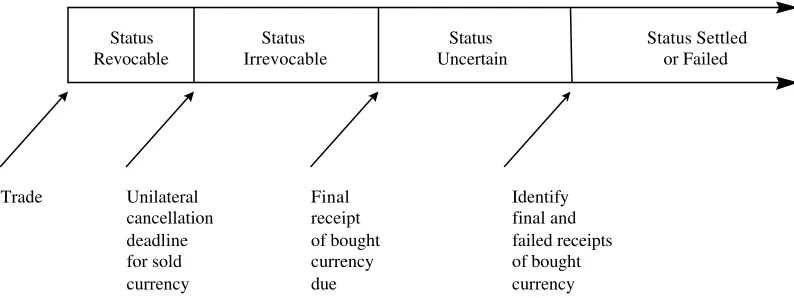
The Allsopp Report recognises that before inroads can be made into foreign exchange settlement risk a necessary first step is to correctly measure exposure. A diagram similar to Figure 1 was used in the Allsopp Report to draw out the potential duration of foreign exchange settlement risk and highlight the importance of timely and accurate reconciliation procedures.
Figure 1: Foreign exchange settlement process – changing status of a trade
Status
Within this framework foreign exchange settlement risk does not commence until such time as a payment instruction becomes irrevocable. Further, risk does not expire until such time as receipt of the due currency is known with certainty. Thus the duration of foreign exchange settlement risk is the sum of trades with status irrevocable and status uncertain.
Minimum and maximum exposures
This framework encompasses both the period when in an ex post, accounting sense, value is at risk (the minimum exposure) and the true economic, or live management, risk (maximum exposure). Both are defined formally below.
Minimum exposure: This is the value of the trades for which a bank can no longer unilaterally stop payment of the sold currency but has not received the bought currency (either because it is not yet due, or because payment has been delayed because of operational or other difficulties). Using the above diagram, this equates to the sum of status irrevocable and status failed trades.
3. SETTLEMENT PRACTICES AND RISK IN THE EMEAP REGION
The surveys undertaken by Working Group members yielded a wide range of information on foreign exchange settlement practices in their respective economies. This section sets out the methodology used to gather this information, and an analysis of settlement practices and the associated foreign exchange settlement risk in the EMEAP region. This report does not reproduce specific data on the size and duration of foreign exchange settlement risk for EMEAP economies or individual banks.
3.1 Survey methodology
Participating member economies, with the exception of Australia and Japan, each conducted a survey of their respective foreign exchange markets between June 2000 and June 2001. The data reported for Australia and Japan were obtained from earlier surveys undertaken in 1998 and 1997 respectively.
A standardised survey form, consistent with that used by the CPSS in earlier surveys, was used to gather data from respondents. The survey form is reproduced in Annex 2.
Table 1: Survey period, timeframe and coverage
Period Timeframe No. of participants
Coverage (% of turnover)
Australia 1 month October 19981 21 90
Hong Kong 2 weeks January 2001 23 85
Indonesia 2 weeks May-June 2001 18 90
Japan 2 weeks October-November 19972 7 60
Korea 1 month July-October 2000 36 95
Malaysia 2 weeks June 2000 25 75
New Zealand 2 weeks September 2000 6 90
Philippines 4 weeks July 2000 22 85
Singapore 2 weeks September 2000 39 90
Thailand 2 weeks November 2000 18 91
1 Survey results also published in Reducing Foreign Exchange Settlement Risk in Australia:
A Progress Report (Reserve Bank of Australia, September 1999).— 2 Survey results also
published in Reducing Foreign Exchange Settlement Risk: A Progress Report (Bank for International Settlements, July 1998).
Table 1 lists the EMEAP members participating in the survey, and provides a summary of when the survey was conducted in each economy, as well as the period of the survey, the number of participants involved, and the estimated coverage of the local foreign exchange market.
The extent of survey coverage, that is the share of total foreign exchange transactions captured by the survey, was also determined by the need to obtain results representative of the overall market. In this respect, the Working Group considered 50 per cent or greater coverage to be sufficient. The variation in the number of institutions surveyed to obtain the desired coverage can be explained by differing degrees of market concentration; in some economies, the majority of foreign exchange transactions were undertaken by only a small number of banks.
The currencies covered by each member’s survey were, in principle, those with over US$ 1 million in settlements during the survey period. Because of this, there were some differences in the currencies covered by the survey in each economy as some currencies are more important in some jurisdictions than others.
Survey data from respondents were collected by the central bank or monetary authority and standardised to allow analysis and comparison across currencies. These data were then used to determine the settlement practices prevailing in the local market, and the resulting foreign exchange settlement risk.
Survey limitations
In conducting the survey, Working Group members endeavoured to obtain accurate and consistent data from survey participants. However, given the range and complexity of the data requested, it is not certain that in all cases the survey results accurately reflect settlement practices in each institution. It is possible that reporting institutions in different EMEAP economies may have had slightly different interpretations of some survey questions. The same might also apply to institutions operating in the same economy.
For these reasons the results presented in this report should be viewed as indicative measures only. This is consistent with the findings of similar surveys.
3.2 Settlement practices
Most members found that the majority of their domestically operating banks directly use the domestic wholesale payments system for the settlement of their own or customer transactions in their local currency. However, there were instances of very small banks in some member economies using larger banks to settle their local currency obligations.
Foreign currency payments and receipts are principally made through accounts that are held with overseas correspondent banks (nostro accounts). It is also apparent that the choice of overseas correspondent bank in some economies is often related to ownership; in such cases a parent or subsidiary is used to settle foreign currency transactions.
The surveys showed that banks in the EMEAP region are often more dependent on correspondent banking arrangements to settle foreign currency trades than those of North American and European banks. This adds to the complexity of reducing the duration of foreign exchange settlement risk as the timing of settlement payments, and the compilation of reports on received payments, are often not directly within the control of banks in the EMEAP region.
Key times in the settlement process
important payment systems in other regions. The times have been adjusted to GMT+9 (Tokyo time) in order to accurately portray the overlap in times between the various payment systems. Annex 3 sets out the time differences between economies in the EMEAP region and between the EMEAP region and some other significant economies.
The introduction of CLS will mean that some economies will extend the opening hours of their respective payment systems. This must be done so that a sufficient overlap with CLS opening hours can be achieved.
Figure 2: Payments system operating hours
0:00 6:00 12:00 18:00 24:00 30:00 36:00
US (Fedwire)
0:00 6:00 12:00 18:00 24:00 30:00 36:00
Tokyo time (GMT+9)
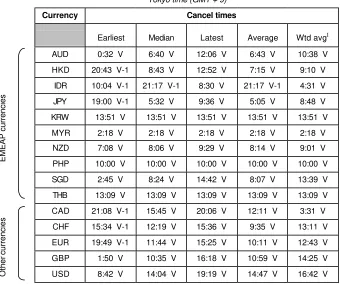
Table 2 provides a summary of weighted average cancellation deadlines within the EMEAP region for a range of currencies. This deadline is the last point in time that a paying bank can cancel the payment of the sold currency with certainty. Foreign exchange settlement risk commences from this point and the paying bank’s exposure is the full value of the bought currency.
The cancellation times shown in Table 2 are for EMEAP economies, rather than individual banks. For example, the earliest cancellation time for AUD is that of the EMEAP economy whose banks reported, on a weighted average basis, the earliest cancellation time. Where a currency is only actively traded in one country, the earliest, median, latest and average times are identical. Notwithstanding that these data are for economies, they can be used by individual banks as a reference point for comparing their practices with those of other banks in the region.
Table 2: Weighted average cancellation times Tokyo time (GMT + 9)
Currency Cancel times
Earliest Median Latest Average Wtd avg1
AUD 0:32 V 6:40 V 12:06 V 6:43 V 10:38 V
1. The weighted average of all EMEAP economies for the currency in column 1.
Several members indicated that some surveyed banks do have well documented cancellation times (only one economy reported a figure in excess of 30 percent for surveyed banks having documented cancellation deadlines with their most important nostro agents). However, in some cases, the benefits of this practice were reduced by bank staff being unfamiliar with these contractually agreed times. In other cases, operational or system constraints meant that payment instructions were sent much earlier than contractually agreed cancellation deadlines. The more common practice across EMEAP banks is to rely on less formal arrangements. This results in increased risk as banks without documented cancellation deadlines can only cancel payment instructions on a “best endeavours” basis. Without legally enforceable arrangements in place, the paying bank’s exposure commences when the payment instruction is sent.
Table 3 has been produced on the same basis as Table 2. It provides a summary of weighted average reconciliation times for the EMEAP region for a range of currencies. The reconciliation time is the time at which the exposure to foreign exchange settlement risk ceases. The bought currency is confirmed as being received with finality and so is no longer at risk. However, if a bank reconciles its receipts and finds that it did not receive the bought currency then this amount is overdue and so remains at risk.
Members’ surveys identified examples of sound reconciliation practices. For example, many banks reconciled the final receipt of settlements in their domestic currencies on the day they were due, taking advantage of the real-time settlement finality provided by their domestic RTGS systems. Some banks also took advantage of the relatively short time differences in the EMEAP region and reconciled receipt of some other EMEAP currencies on the value date. However, there were also examples of inappropriate practices. In some cases banks began
EMEAP currencies
identifying receipt of all bought currencies at the same time, usually on the day after the value date, even though each currency has a different receipt time. In a few cases, reconciliation of bought currencies was not completed for some days after the value date.
Table 3: Weighted average reconciliation times Tokyo time (GMT + 9)
Currency Identify times
Earliest Median Latest Average Wtd avg1
AUD 1:42 V+1 12:03 V+1 13:46 V+1 9:50 V+1 4:12 V+1
HKD 22:45 V 11:57 V+1 13:33 V+1 9:58 V+1 22:53 V
IDR 10:30 V+1 18:36 V+1 2:42 V+2 18:36 V+1 13:22 V+1
JPY 14:54 V 12:01 V+1 15:28 V+1 10:02 V+1 22:55 V
KRW 23:10 V 23:10 V 23:10 V 23:10 V 23:10 V
MYR 10:19 V+1 10:19 V+1 10:19 V+1 10:19 V+1 10:19 V+1
NZD 7:13 V+1 11:36 V+1 12:52 V+1 10:33 V+1 8:37 V+1
PHP 10:00 V+1 10:00 V+1 10:00 V+1 10:00 V+1 10:00 V+1
SGD 23:46 V 12:38 V+1 16:03 V+1 11:40 V+1 1:14 V+1
THB 21:29 V 21:29 V 21:29 V 21:29 V 21:29 V
CAD 11:30 V+1 16:55 V+1 19:41 V+1 16:15 V+1 16:01 V+1
CHF 10:26 V+1 13:54 V+1 3:32 V+2 17:11 V+1 20:08 V+1
EUR 9:36 V+1 12:56 V+1 17:11 V+1 13:30 V+1 14:55 V+1
GBP 10:22 V+1 14:34 V+1 3:54 V+2 16:24 V+1 18:47 V+1
USD 12:47 V+1 14:23 V+1 17:12 V+1 14:30 V+1 15:00 V+1
1. The weighted average of all EMEAP economies for the currency in column 1.
EMEAP currencies
Value of foreign exchange settlements
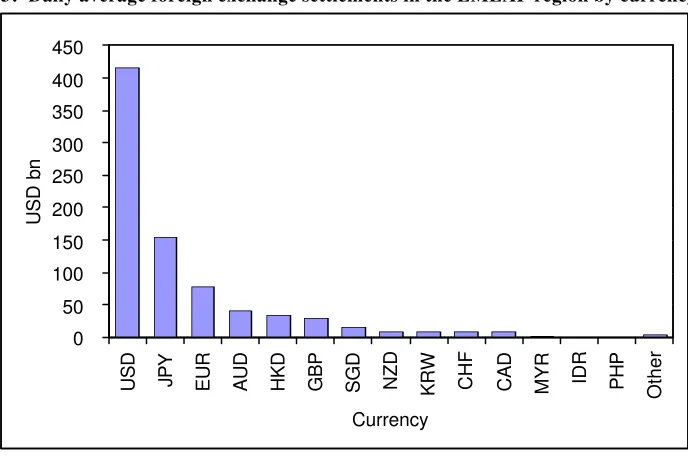
Figure 3: Daily average foreign exchange settlements in the EMEAP region by currency
Figure 3 provides a breakdown, on a daily average basis, of currencies and settlement values within the EMEAP region.14 The survey revealed that the US dollar was on one side of almost all foreign currency trades settled in each EMEAP economy. With one exception, the domestic currency was the second most important currency traded in each member economy. The Japanese yen was also traded to a significant extent in most member economies, though the values were usually substantially smaller than the domestic currency. There was only limited non-domestic trading of other EMEAP currencies in the region.
3.3 Settlement risk
This section considers some important aspects relating to the duration and the size of foreign exchange settlement risk. It highlights the fact that foreign exchange settlement risk is an interday phenomenon with exposures lasting for considerably longer than 24 hours, and also that the size of the risk can be extremely large.
Duration of exposures
An institution’s foreign exchange settlement risk lasts from the time at which a payment instruction for the sold currency can no longer be cancelled unilaterally until the currency being purchased is known to be received with finality.
14 Note that the data illustrated in Figure 3 are not directly comparable with April 2001 data, published by the Bank for International Settlements (BIS), on foreign exchange and derivatives market activity. The EMEAP data represent surveyed banks’ aggregate payments and receipts, after netting, for currencies traded. The BIS data represents aggregate foreign exchange market turnover, adjusted for double counting, and not aggregate settlements relating to this turnover.
0 50 100 150 200 250 300 350 400 450
USD JPY EUR AUD HKD GBP SGD NZD KRW CHF CAD MYR IDR PHP Other
Currency
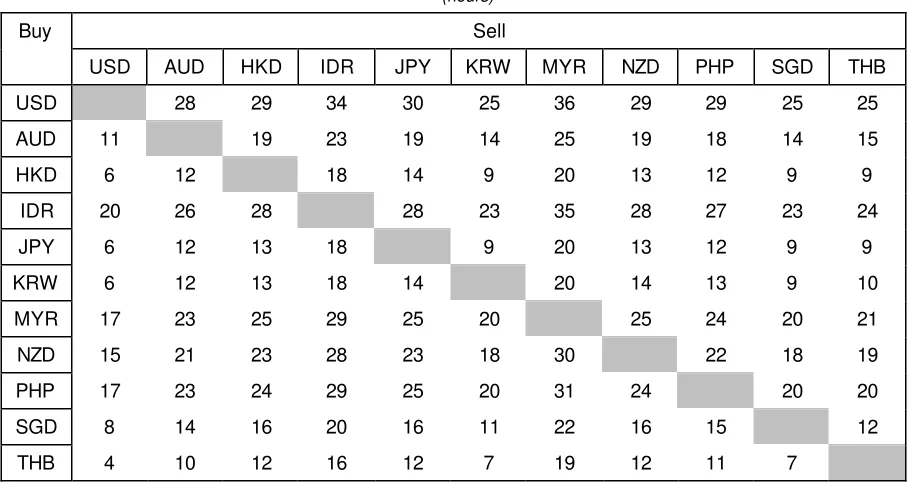
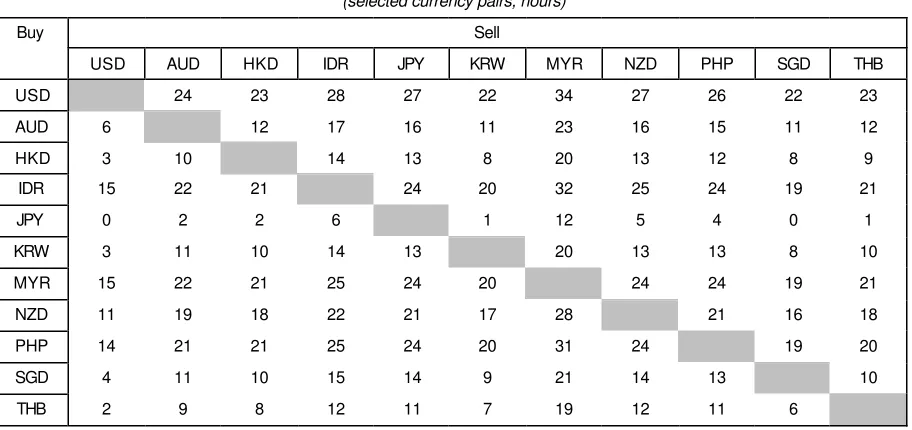
EMEAP region weighted average durations for a range of currencies are set out in Table 4. The durations shown are representative of the durations of foreign exchange settlement risk in each currency pair for member economies and participating banks.
Table 4: Duration of foreign exchange settlement risk for selected currency pairs (hours)
Buy Sell
USD AUD HKD IDR JPY KRW MYR NZD PHP SGD THB
USD 28 29 34 30 25 36 29 29 25 25
Note: Reported durations are a weighted average for the EMEAP region as a whole.
The duration of foreign exchange settlement exposures varies between the intra-regional currency trades and those against the US dollar. Given the relatively small time difference in the EMEAP region, the exposure duration is shorter for settlements between regional currencies. In contrast, the exposure duration is extremely long for settlements where the US dollar is the bought currency due to the large time zone difference between the EMEAP region and the United States. This tendency also applies to currencies in the Euro zone, which has a large time zone difference with the EMEAP region.
It is important to note that for many currency pairs the duration of foreign exchange settlement risk is an interday phenomenon. The survey results have shown that this settlement exposure can, on average, last for as long as 36 hours for an individual currency pair. When all currency pairs are taken into account, the average duration of the exposure in the EMEAP region, for a single day’s settlements, can last for more than two days (see Figure 4). Institutions should be aware of the interday nature of the risk and reflect this in their risk management procedures.
Magnitude of exposures
Figure 4: Foreign exchange settlement risk in the EMEAP region (single day and interday profile)
Figure 4 also provides an interday profile for foreign exchange settlement risk in the region. Because the duration of exposure for many currency pairs lasts longer than 24 hours, the cumulative interday peak of foreign exchange settlement risk is much larger than the single-day peak. It is apparent that the size of foreign exchange settlement exposure within the EMEAP region is very large. Single day exposure peaks at around US$ 350 billion, while interday exposure peaks at around US$ 450 billion. Exposures are generally within a range between US$ 300 billion and US$ 350 billion.15 In many cases, the size of banks’ exposures exceeded their capital.
15 Exposure to foreign exchange settlement risk differs from the aggregate values settled because of the rolling nature of settlement. Foreign exchange settlement risk rises as cancellation deadlines pass, and falls as reconciliation occurs.
0 50 100 150 200 250 300 350 400 450 500
0:00 V-1
0:00 V
0:00 V+1
0:00 V+2
0:00 V+3
USD bn
4. RISK MANAGEMENT
4.1 Institutions’ current practice
The EMEAP survey form includes a number of qualitative questions relating to reporting banks’ current risk management practices and any plans they may have for improvements. The following sections summarise banks’ responses.
Senior management responsibility
The involvement of senior management in matters relating to foreign exchange settlement risk is critical for ensuring that institutions devote a sufficient amount of attention and resources to controlling this important risk. Their involvement should encompass the development of policies for measuring and reducing their foreign exchange settlement risk, implementation of individual counterparty and global limits on the size of this risk and day-to-day monitoring to ensure that limits are not breached.
In the EMEAP region, senior management were usually formally involved in managing foreign exchange settlement risk, though the degree of this involvement did vary. However, even in economies where banks reported a relatively high level of senior management involvement, there were often worrying examples of a minority of banks where this was not the case. In a few economies, a significant number of reporting banks’ senior management had no involvement in foreign exchange settlement risk matters. Banks that had no, or limited, senior management involvement usually had a poorer understanding of key concepts relating to foreign exchange settlement risk and the ways in which their back office and other practices contributed to their exposure.
Measurement of exposures
There are several methods that banks use to measure their foreign exchange exposures. Most of these methods will underestimate or overestimate the actual exposures that they face. The Allsopp Report outlined a method that includes both irrevocable and uncertain payments and provides an accurate measure of an institution’s foreign exchange settlement exposure.
The majority of reporting banks do use some form of methodology for measuring foreign exchange settlement exposure. Many of these use the single day method, whereby exposure is measured as being equal to all foreign exchange receipts that are due on the day. Because of the interday nature of foreign exchange settlement risk this methodology will tend to underestimate the actual exposures that are faced by institutions. A handful of institutions use a multiple day approach when measuring the risk. This method may have a tendency to overestimate the actual risk that is faced if intraday changes in the level of risk (ie as a result of confirmed receipt of various currencies) cannot be measured.
Control of exposures
Most members noted that the majority of their respondents used some form of individual counterparty limit to manage their exposures. Several members noted that these limits are applied to the global operations of the institution. A couple of members also noted that these limits are monitored by reporting banks on a regular basis. One member noted that some respondents have separate limits for foreign exchange settlement exposures, while others have limits for aggregate settlement exposures that are created through a range of instruments. Another member indicated that the majority of its respondents apply controls to foreign exchange settlement exposure that are similar to credit controls used for short-term credit extensions. One member noted that many banks in its jurisdiction do not include foreign exchange settlement risk in their credit risk limits.
Bilateral netting
Bilateral obligation netting, in jurisdictions where it is legally certain, is an important way for trade counterparties to reduce the size, but not the duration, of their foreign exchange settlement risk. This process allows trade counterparties to offset their gross settlement obligations to each other in the currencies they have traded and settle these obligations with the payment of a single net amount in each currency. In the event of a counterparty default it is the net, rather than the underlying gross, settlement obligation that may be at risk. This offers substantial risk management benefits to financial market participants.
Netting can also provide significant liquidity savings for financial market participants in that it reduces the total value of settlement payments needed for a given level of trading. However, where obligation netting is not legally certain, this process only results in a reduction in transaction values.16 The underlying
gross settlement obligations are likely to represent an institution’s true exposure in the event of one of its counterparties defaulting.
The results of members’ surveys indicated that there is considerable scope for increased use of obligation netting in the EMEAP region. Most of the six economies in which this type of netting is legally certain (see Table 9 in Annex 4) noted that at least some of their reporting banks had netting agreements in place with their major counterparties. However, in some instances, this was a clear minority of reporting banks and, in one instance, no reporting banks made use of netting. As a result, the reduction in the value of foreign exchange obligations subject to netting was often significantly below that reported by the G10 countries in 1998.17 The EMEAP survey results also showed that netting of foreign exchange settlement transactions is not commonly used in economies where the legal validity of obligation netting is uncertain. Any increased use of netting in these jurisdictions would need to be treated with some caution as the size of institutions’ foreign exchange settlement risk may not be reduced by this process.
Cancellation and reconciliation times
Most Working Group members found that their economy’s weighted average cancellation deadlines for foreign currency payments were sometime on the day that payments were due.
16 As a result, this process is called “transaction netting” in some economies.
However, many banks reported cancellation deadlines sometime on the day before payment was due, particularly for other EMEAP and foreign currencies. A few banks reported that their cancellation deadlines were the same for all the currencies, resulting in unduly long exposures for some currencies. The relatively small differences in the time zones of the various EMEAP member economies, and the need to give correspondent banks sufficient notice may, in part, account for this practice.
Many members reported that the majority of their banks reconciled most foreign currency receipts on the day after the payment was due. It was also common practice in many economies for reporting banks to reconcile receipt of their domestic currency payments sometime on the value date. In a limited number of instances, reporting banks took advantage of the relatively small time differences between EMEAP economies, and the intraday finality offered by wholesale payments systems, to reconcile receipt of other EMEAP currencies on the value date.
However, there was considerable variation between best and worst practice in each economy, indicating that there is room for improvement in the back office practices of some reporting banks. Most members also noted that the majority of their reporting banks did not have documented and legally enforceable cancellation deadlines with their correspondent banks. Instead, cancellation requests were treated on a “best endeavours” basis by correspondent banks.
In a limited number of cases, there was also evidence that reporting banks were unaware of the significance of cancellation deadlines and reconciliation of receipts for the duration of their exposure.
Payment-versus-payment
Payment-versus-payment (PVP) settlement of trade obligations eliminates foreign exchange settlement risk by ensuring that final transfer of one currency occurs if, and only if, a final transfer in the other currency takes place. The introduction of this type of system requires wholesale payments systems in relevant jurisdictions to have overlapping operating hours and the establishment of technical and legal infrastructure to ensure the coordinated final settlement of both currencies involved in a trade.
The US dollar is on one side of most foreign exchange trades in the EMEAP region. It is therefore important to recognise the key role of the US dollar in any PVP solution for the EMEAP region if significant and immediate reductions in foreign exchange settlement risk are to be achieved. Hong Kong’s US dollar clearing system allows its participants to conduct PVP settlement of HKD/USD trades and also send and receive stand-alone US dollar payments (see Annex 5). Usage of this system has been growing and currently about 14 per cent, by value, of HKD/USD trades between local counterparties in Hong Kong are settled in this manner.
Continuous Linked Settlement (CLS) is a major international initiative that aims to provide a private sector solution to foreign exchange settlement risk. Members of this arrangement will be able to settle their foreign exchange payments on a PVP basis across the books of a special purpose bank, the CLS Bank, which will be regulated by the Federal Reserve Bank of New York. The introduction of CLS Bank’s PVP services is currently planned for 2002.
including the Singapore dollar, will be included by CLS Bank at a later stage. A number of banks in both Japan and Australia intend to use CLS Bank’s services when they are available. It is also possible that other PVP systems may be developed in the future.
Contracts for difference
Contracts for difference (CFD) are based on the notion that many foreign exchange transactions are entered into for the purposes of hedging and speculation, and as such do not require delivery of the underlying currencies. Only the mark-to-market profit or loss on the underlying trades would need to be settled.
The use of a CFD has the potential to provide significant reductions in the size of foreign exchange settlement risk. However, like all contracts between trade counterparties, it is important that the jurisdictions of both counterparties recognise such arrangements in the event of one of the parties to the contract defaulting. The survey results indicated that CFDs are not widely used in the EMEAP region.
Plans for change
As a result of the survey process, some participating banks in a number of economies indicated that they intend to make various changes which would reduce their exposure to foreign exchange settlement risk. These included reconciling incoming foreign exchange payments earlier, negotiating more favourable cancellation times with their correspondent banks and, in a few cases, formally documenting these arrangements. Banks in some economies also indicated that they intend to make greater use of netting and, in a limited number of cases, change their technical and back office systems to ensure that they can track their risk in real time. However, this willingness on the part of participating banks to look at ways of reducing foreign exchange settlement risk was not evenly spread within member economies or between them.
Several members noted that a number of their banks had expressed an interest in using CLS Bank’s services if their domestic currency were included in the CLS initiative at some point in the future.
4.2 Options for improved risk management
Individual institutions
Individual banks can significantly improve the way they measure and limit the size of their foreign exchange settlement risk in a number of ways. These include:
• Ensuring that senior management are fully briefed on the foreign exchange settlement process, and the associated risks, and that a senior executive is responsible for managing the bank’s day-to-day foreign exchange settlement risk.
• Controlling foreign exchange settlement risk in a manner that is consistent with the way they control their other credit exposures, such as the extension of a loan or letter of credit.
• Using bilateral obligation netting to reduce the size of settlement obligations arising from foreign exchange trading.
Well designed PVP systems also provide commercial banks with an opportunity to eliminate foreign exchange settlement risk arising from their foreign currency trades. In considering whether the use of PVP systems is appropriate, commercial banks should carefully consider the operations, and risk control mechanisms, of such systems in terms of the Core Principles for Systemically Important Payments Systems.18 Commercial banks which access PVP services indirectly, through correspondent banks, should note that they retain a credit risk against their correspondent bank even though foreign exchange settlement risk is removed for those trades settled on a PVP basis. Taking these considerations into account, banks should be alert to opportunities to reduce their foreign exchange settlement risk even if their domestic currency is not eligible for settlement by a PVP system (ie because they may trade currency pairs which are eligible for PVP settlement).
Central banks
International thinking on the role of central banks in addressing foreign exchange settlement risk has evolved over a number of years. A report issued by the CPSS in 1993, Central bank payment and settlement services with respect to cross-border and multi-currency transactions (the Noël Report), identified four key ways in which central banks may reduce foreign exchange settlement risk and improve the efficiency of cross-border and multi-currency settlements. These were:
(1) Improve home currency payment and settlement services so that they more fully supported international settlements, such as by providing settlement accounts and intra-day final transfer capabilities to settle home currency obligations relating to foreign exchange trades.
(2) Extend operating hours of home currency payments services so that a greater overlap, or a reduced gap, between the operating hours of the payments systems in various countries can be achieved.
(3) Develop multilateral or bilateral links between domestic systems so that central banks can monitor, control and execute simultaneously payments relating to the same foreign exchange deal or net obligation over their respective home-currency payments system.
(4) Provide a multi-currency payment and settlement service. The service being introduced by CLS Services Limited is an example of such an arrangement.
However, in 1996 the Allsopp committee, after weighing up the options and recognising the costs and benefits of each option, recommended that:
• Central banks should do (1) and (2).
• The private sector, rather than central banks, be encouraged to undertake (4).
• (3) be recognised as a decision for individual countries to consider.
Central banks in the EMEAP region have been very active in taking steps to ensure that their wholesale payments systems meet international best practice. This has been done by introducing real-time gross settlement (RTGS) for high-value payments systems (see Table 9 in Annex 4) and ensuring that payments in these systems are irrevocable at the time they are made. A number of EMEAP central banks have also actively supported the introduction of legislation to underpin the legal validity of bilateral and multilateral netting in their jurisdictions. Extensions in the operating hours of the Japanese and Australian wholesale payments and securities settlement systems are being planned to cater for the introduction of CLS Bank’s settlement services in JPY and AUD.
Hong Kong has introduced a domestic US dollar settlement system based on the services of a commercial bank. The link between this system and the Clearing House Automated Transfer System (CHATS), Hong Kong’s wholesale payments system, facilitates PVP settlement of HKD/USD trades in Hong Kong.19
Not all banks in each economy have plans to implement measures to reduce foreign exchange settlement risk. A challenge therefore exists for domestic authorities to take steps to ensure that best practice is implemented by their domestic banks. To this end, a number of members are considering steps such as follow-up discussions with reporting banks which fell short of best practice, discussions with prudential regulators and, in one case, a further survey to track improvements in banks’ management of foreign exchange settlement risk.
However, there is also scope for improvement on the part of central banks and monetary authorities in the EMEAP region. They could encourage the use of bilateral obligation netting and provide settlement infrastructure that would facilitate the reduction of foreign exchange settlement risk, including by improving payment system infrastructure and extending wholesale payment system operating hours. Such actions would support commercial banks’ efforts to reduce foreign exchange settlement risk.
Cross-currency trades
As noted earlier, the US dollar is on one side of most foreign exchange transactions in the EMEAP region. This fact is equally true in all jurisdictions.20 However, this may be considered to be counterintuitive given that significant trading of goods and services, as well as direct investment, occurs between EMEAP economies.
The dominance of the US dollar may in large part be attributed to the deep liquidity in US markets. Deep liquidity provides easier price discovery, narrower spreads and the capacity to absorb greater transaction values without disrupting market prices. These advantages can tend to outweigh other considerations such as regional trade and investment flows. A further
19 Wide usage of PVP systems in the EMEAP region, or in a member economy, would make such arrangements systemically important. These arrangements would need to be consistent with the Core Principles for Systemically Important Payment Systems (see Annex 6). Core principle VI would be a particular consideration given the size of foreign exchange trades.
20 Only 10 per cent of global foreign exchange turnover does not involve the USD. Source: Central bank survey
factor explaining the dominance of the US dollar is that a significant share of foreign exchange turnover represents market making and speculative position taking.
However, because of their geographical location, EMEAP economies are exposed to significantly greater duration of foreign exchange settlement risk than are the economies of Europe and the Americas. One means of addressing this is to promote, where possible, cross-currency trades in EMEAP currencies. Presently, there is little such activity as counterparties tend to enter into two trades against the US dollar (eg one selling an EMEAP currency and buying US dollars, and a second transaction selling US dollars and buying a second EMEAP currency).21
While it is not clear what might be done to promote greater use of cross-currency trades beyond promoting the growth of regional markets to achieve critical mass, it might be worthwhile for central banks and monetary authorities in the EMEAP region to examine this issue.22
21 Because of the relative illiquidity in EMEAP cross-currency markets, the transaction costs of the two trades may be lower than a single cross-currency trade.