APPLICATIONS OF POTASSIUM FERTILIZER AND
Bacillus
sp. BIOPESTICIDE FOR
INCREASING TOMATO RESISTANCE TO BACTERIAL WILT DISEASE
By:
Nur Prihatiningsih*), Heru Adi Djatmiko and Eny Rochminarsi Faculty of Agriculture University of Jenderal Soedirman
Jl. dr Suparno Karangwangkal Purwokerto 53123.Central Java Indonesia
*)
Corresponding author Phone : +62-281-638791 E-mail: [email protected]
Received : March 3, 2009/Accepted: July 29,2010
ABSTRACT
Bacterial wilt on tomato caused by Ralstonia solanacearum is a crucial disease, because it can reduce yield until 50%. The aims of this research were: 1) to find out biopesticide formula for Bacillus sp.growth, 2) to test Bacillus sp. against R. solanacearum in vitro, 3) to test potassium fertilizer combined with Bacillus sp. for enhancing tomato resistance to the bacterial wilt disease. The research was conducted in 2 steps i.e to test the persistence of Bacillus sp. in biopesticide formula, and to test the best combination of both potassium and the Bacillus sp. biopesticide. The results showed that Bacillus B298 was the best isolate in its persistence on the biopesticide formula of organic growth medium+CaCO3+CMC 1%+mannitol 1%, and in
inhibiting R. solanacearum. The best biopesticide formula for the Bacillus sp. persistence was growth organic media+ CaCO3+CMC 1%+mannitol 1%.
Bacillus sp. was able to increase tomato resistance to the bacterial wilt disease from the category of susceptible to be tolerant and becoming resistant.
Keywords: tomato, Ralstonia solanacearum, potassium and Bacillus sp.
INTRODUCTION
Bacterial wilt disease caused by Ralstonia solanacearum is an important disease on tomato and other members of the family Solanaceae. Yield loss by this disease may reach 50%. Biocontrol can be carried out by using Bacillus sp., that has been explored from potato rhizosphere in the previous research. Five selected isolates have been tested to control the bacterial wilt disease on potato and tomato. Bacillussp. was capable to suppress either the
disease on potato or tomato, and was able to quicken the maximum harvesting time on tomato (Prihatiningsih and Soedarmono, 2004; Prihati-ningsih and Kustantinah, 2005).
Bacillus sp. is also known as stimulant in plant resistance. According to Choudhary and John (2008), it is called as the ISR (Induced systemic resistance). Increase in plant resistance may be stimulated by the pathogen infecting limitedly, the avirulen pathogen, and non pathogenic baterium including that as an antagonist such as Bacillus sp. and certain chemical substances (van Loon, 2000; Agrios, 2005). Applications of Bacillus sp. combined with potassium fertilizer could enhance the plant resistance, because potassium was required in carbohydrate accumulation and translocation. K (potassium) element together with Cl, F, and Boron would move and be available in the xylem, so they strengthened stem tissues and the plant became more resistant to pathogen attack that its multiplication took place within the stem (Jones et al., 1991). Furthermore, Aziz et al. (1992) said that K fertilization could decrease significantly the infection percentage of the bacterial late blight on rice and increased plant resistance from susceptible to be moderate resistant.
Recommendation of K fertilization on horticultural plants that is generally in the form of KCl or K2O with the dose of 6 g/plant or 20 g/m2
increase. Supply of K also strengthen the stem tissues (Jones et al., 1991). Therefore, the plant becomes more resistant to pathogen attack multiplying in the stem xylem tissues like R. solanacearum.
The aims of the research were 1) to find out the best biopesticide formula to evaluate the Bacillus sp. persistence in the formula, 2) to test the biopesticide formula containing Bacillus sp. as the biological agent in suppressing R. solanacearum in vitro, and 3) to test the combination of potassium fertilizer and Bacillus sp. biopesticide for controlling the bacterial wilt disease and to enhance the tomato plant resistance to the disease.
MATERIALS AND METHODS
The research was conducted at Kutasari Village Baturaden Sub District Banyumas Regency, from June to August 2008. Materials used in the research were tomato seeds of Mirah variety, R. solanacearum inoculum, medium of YPGA (yeast pepton glucose agar), CPG (Casamino acid, pepton glucose), TTC (triphenyl tetrazolium chloride), phosphate buffer +0,1%pepton, KOH 3%, hydrogen peroxida 3%, alcohol 70%, formula substances such as ultisol soil, organic growth medium, CMC (Carboxy Methyl Cellulose) as sticker and CaCO3 as
rectifier, and mannitol as carbon source, Bacillus sp. isolate, B46, B209, B211, B298 dan B315, potassium fertilizer (KCl).
The research was done in two steps, the first step was to test Bacillus sp. persistence in carrier materials (ultisol soil, organic growth medium):CaCO3:CMC:mannitol was 10:5:1:1
(weight:volume). The volume of Bacillus sp. was 5 ml per treatment, prepared from the slant YPGA medium in a tube of two days and was
dissolved in 1,000 ml of sterilized water for each tube. The density was 1010 CFU/ml. Sub-sequently, it was conducted an inhibition test of the five Bacillus sp. isolates taken from the formula to R. solanacearum in vitro, by growing them in double layer in a petridish containing the YPGA medium. The second step was a combination test of potassium fertilizer and the biopesticide formula in enhancing the tomato plant resistance to the bacterial wilt disease. The treatment in this step was the best isolate gained from the first step research, namely the isolate B298. This result was seen from the average population during observations at week 2, 4, 8, and 12. Therefore, the treatments were arranged as follows:
K: Control (without Bacillus sp. B298 bio-pesticide, inoculated with R. solanacearum). F20: (without Bacillus sp. B298 biopesticide
and without R. solanacearum inoculation) F21: Biopesticide formula (ultisol soil + CaCO3
+ CMC 1%+mannitol 1%), Bacillus sp. B298 + Kalium (KCl 6 g/plant) + R. S ola-nacearum inoculation.
F22: Biopesticide formula (organic growth medium + CaCO3+ CMC 1% + mannitol
1%), Bacillus sp. B298 + Kalium (KCl 6 g/plant) + R.solanacearum inoculation. F23: Biopesticide formula (ultisol soil +
CaCO3+CMC 1%+mannitol 1%), Bacillus
sp. B298 + Kalium (KCl 6 g/plant) + without R.solanacearum inoculation. F24: Biopesticide formula (organic growth
medium + CaCO3+CMC 1% + mannitol
1%), Bacillus sp. B298 + Kalium (KCl 6 g/plant) without R.solanacearum inoculation.
These six treatments were replicated five times and each used six polybags. The comparison of the formula was similar to the first step, that was a comparison between weight These treatments of the biopesticide formula were on tomato seeds before nursery, by coating them. The concentration of R. solanacearum was 109CFU/ml.
Variables observed were:
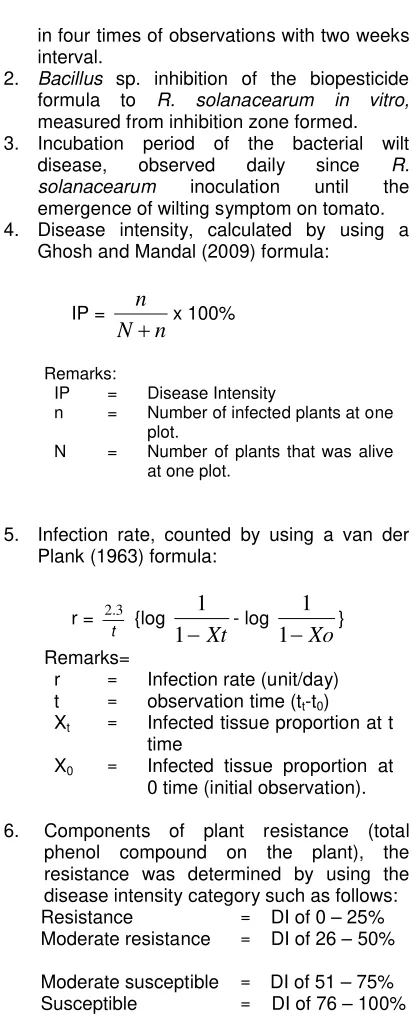
in four times of observations with two weeks solanacearum inoculation until the emergence of wilting symptom on tomato. 4. Disease intensity, calculated by using a
n = Number of infected plants at one plot.
Xt = Infected tissue proportion at t
time
X0 = Infected tissue proportion at
0 time (initial observation). 6. Components of plant resistance (total
phenol compound on the plant), the resistance was determined by using the disease intensity category such as follows:
Resistance = DI of 0 – 25%
Moderate resistance = DI of 26 – 50% Moderate susceptible = DI of 51 – 75% Susceptible = DI of 76 – 100%
Remarks : DI = Disease Intensity
Two steps experiment were conducted in RCBD (Randomly Completely Block Design. Data obtained were analyzed by using analysis of variance and when significant then continued by using DMRT of 5%.
RESULTS AND DISCUSSION
Bacillus sp. Persistence in the Biopesticide Formula
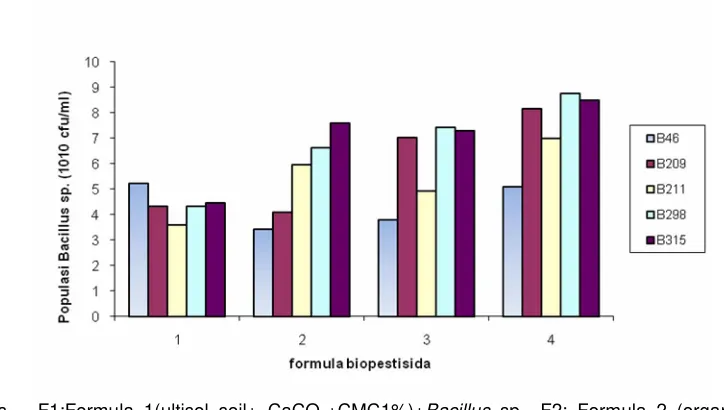
The result of observations at the step 1 was Bacillus sp. persistence obtained from tested biopesticide formula, based on the observation of Bacillus sp. population within 12 weeks.
Figure 1 performs the average population of five isolates of Bacillus sp. in four formula isolates was F4, followed by F2, F3 and F1 that were indicated by mean population of five Bacillus sp. isolates at those formulas reaching 7.51 x 10¹⁰ CFU/ml, 6.20 x 10¹⁰CFU/ml, 6.09 x 10¹⁰ CFU/ml, and 4.39 x 10¹⁰ CFU/ml respectively. The F4 (organic growth medium+ CaCO3+CMC1%+manitol 1%) was the best one
solanacearum causing the bacterial wilt disease on tomato plants.
R. solanacearum Inhibition by Bacillus Sp. Isolated From the Formula In Vitro
These inhibition observations were carried out by growing R. Solanacearum and Bacillus sp. in double layer on the YPGA medium in the Petridish. Suppression of R. solanacearum by five isolates of Bacillus sp. that were persistent in the biopesticide formula was shown by the presence of the inhibition zone as seen in Table 1. Not all isolates of Bacillus sp. grown at the biopesticide formula that have been isolated, were capable to perform the inhibition zone to R. solanacearum, although in the previous observations taken from the pure isolate grown at the YPGA medium, the isolates were able to show the inhibition zone to R. solanacearum (Prihatiningsih and Soedarmono, 2004). This
could be caused by the reduction in the antagonistic effectiveness, due to the pure isolates collected for four years and incubated at the YPGA medium treated with sterilized liquid parafin at the temperature of +18oC. To maintain the antagonistic effectiveness in soil, it could be added nutrition substances and organic matters in soil at the antagonist application, as using rice husk and other organic matters (Phae et al., 1992; Muhibuddin, 2008). This research also used the carrier of the organic growth medium as the arranging substance for the biopesticide formula in order to maintain the Bacillus sp. effectiveness at soil application. This was shown in the glasshouse observations, the antagonistic effectiveness in the F4 formula was capable to control the potato bacterial wilt disease reaching 84.21%, whereas at the high land it only controlled 51.20%, and 46.40% at the medium land (Prihatiningsih et al., 2008).
Remarks = F1:Formula 1(ultisol soil+ CaCO3+CMC1%)+Bacillus sp., F2: Formula 2 (organic growth
medium+ CaCO3+CMC1%)+Bacillus sp., F3: Formula 3 (ultisol soil+
CaCO3+CMC1%+mannitol 1%)+Bacillus sp., F4: Formula 4 (organic growth medium+
CaCO3+CMC1%+mannitol 1%)+Bacillus sp.
Control of the Bacterial Wilt Disease and Increase of Plant Resistance
The treatments of Bacillus sp. B298 combined with potassium fertilizer at the in planta research could control the bacterial wilt disease and increase the tomato plant resis-tance to the disease. This can be seen from the vulnerable-tolerant variety of Mirah to the bacterial wilt disease which performed the presence of increasing resistance. Biopesticide treatments which was combined with the potassium fertilizer, as seen in Table 2, decreased the disease intensity and increased the tomato plant resistance to the bacterial wilt disease from being susceptible-tolerant to be resistant. According to Aziz et al. (1992), the potassium fertilizer increased rice plant
resistance to the blast disease by P. oryzae, reduced the percentage of leaf blight invasion, increased plant height, and quickened flowering period until 75%, and added milled dry weight. Moreover, Mengel and Kirby (1979) stated that the increase in resistance caused by potassium fertilization was due to formation of the outer epidemic wall that was thicker.
Plant resistance can be measured based on the data of disease intensity and total phenolic compound of plants at each treatment. Symptom of the bacterial wilt disease only emerged at the treatment of F20 without Bacillus sp. This performed that the biopesticide treatments could suppress the disease.
Table 1. Inhibition of R. solanacearum by Bacillus sp. Pure isolate of
Bacillus sp. a)
Inhibition zone, mm a)
The best Bacillus sp. isolate from the formula b)
Biopesticide formula b)
Inhibition zone, mm b)
B46 16.0 B46 K 1.0
B209 15.0 B209 F1 1.0
B211 15.0 - F2
-B298 15.0 B209 F3 2.0
B315 15.0 B298 F4 2.0
Remarks= a) Inhibition of R. solanacearum by Bacillus sp. pure isolate . b) Inhibition of R. solanacearum by Bacillus sp. isolates from formula. K: control; F1: ultisol soil + CaCO3+ 1ml CMC 1%; F2: organic growth medium + CaCO3 + 1 ml CMC 1% ; F3 ultisol soil + CaCO3 + 1 ml CMC+ 1 ml mannitol 1%; F4: organic growth medium + CaCO3 + 1 ml CMC 1% + 1 ml mannitol 1%.
Table 2. Incubation period, disease intensity, infection rate and resistance level of tomato to bacterial wilt disease
Treatments Incubation period dai
Disease intensity %
Infection rate,
unit/day Plant response
K 0 0 0 Resistant
F20 21 10 0.015 Resistant
F21 0 0 0 Resistant
F22 0 0 0 Resistant
F23 0 0 0 Resistant
F24 0 0 0 Resistant
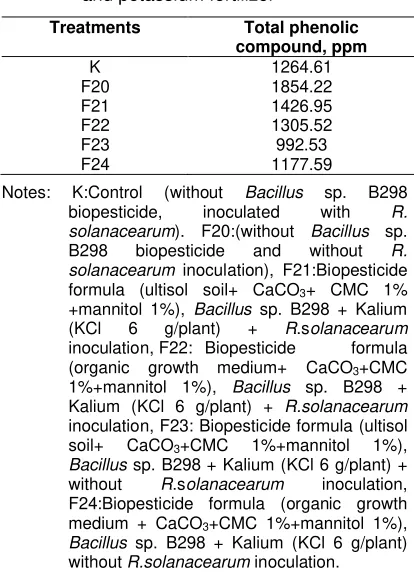
The plant used was Mirah variety that owned susceptible-tolerant trait. However, after planted in this research, they showed to be resistant to the bacterial wilt disease. The plant resistance could also be looked at the total phenolic compound in the stem (Table 3). The total phenolic compound in the plants has been normally formed, but if there are pathogen attack and another stimulation of non-pathogenic microbes, the phenolic compound is enhanched. The result of the research indicated that the treatments of biopesticide and potassium fertilizer could increase the total phenolic compound up to 31.80%.
Table 3. Content of total phenolic compound in tomato plants after having treatments with Bacillus sp. B298 biopesticide and potassium fertilizer
Treatments Total phenolic
compound, ppm
K 1264.61
F20 1854.22
F21 1426.95
F22 1305.52
F23 992.53
F24 1177.59
Notes: K:Control (without Bacillus sp. B298 biopesticide, inoculated with R. solanacearum). F20:(without Bacillus sp. B298 biopesticide and without R. solanacearum inoculation), F21:Biopesticide formula (ultisol soil+ CaCO3+ CMC 1% +mannitol 1%), Bacillus sp. B298 + Kalium (KCl 6 g/plant) + R.solanacearum inoculation, F22: Biopesticide formula (organic growth medium+ CaCO3+CMC 1%+mannitol 1%), Bacillus sp. B298 + Kalium (KCl 6 g/plant) + R.solanacearum inoculation, F23: Biopesticide formula (ultisol soil+ CaCO3+CMC 1%+mannitol 1%),
Bacillus sp. B298 + Kalium (KCl 6 g/plant) + without R.solanacearum inoculation, F24:Biopesticide formula (organic growth medium + CaCO3+CMC 1%+mannitol 1%),
Bacillus sp. B298 + Kalium (KCl 6 g/plant) without R.solanacearum inoculation.
The total phenolic compound on tomato plants which had the best treatment of Bacillus sp. B298 biopesticide and the potassium fertilizer was the F21 treatment by the increase of the phenolic compound up to 11.38%. This result performs that the treatment of the Bacillus
sp. B298 and potassium fertilizer treatments could enhance the tomato resistance to the bacterial wilt disease. The potassium is capable to increase the resistance by strengthening stem tissues and as a catalisator of some chemical reactions in plants. Potassium is useful as catalisator, particularly in protein alteration to be amino acid. If the plant has sufficient K, then its protein will increase (Jones et al., 1991). According to Aziz et al., (1992), provision of potassium may decrease the percentage of the leaf blight invasion and makes the plant become moderate resistant.
Plant resistance can be seen from the phenolic compound in the plant tissues. The content of the total phenolic compound in stem parts of tomato plants tested performed that Bacillus sp. biopesticide application was capable of increasing the total phenolic compound at F21 (ultisol soil+ CaCO3+CMC 1% 1 ml) that was
higher than K (control, without biopesticide). F23 and F24 treatments had lower total phenolic compound than K. This indicates that the total phenolic compound in the experimental plants has not been able to be used as the criterion of increase in the plant resistance because the compound has not been specific yet. According to Agrios (2005), the phenolic compounds functioning to increase the plant resistance were more specific, such as groups of chlorogenic acid, jasmonic acid etc. This research has not analyzed the content of specifically phenolic compounds for resistance. Kapoor (2008) stated that the treatment of Glomus macro-carpum or G. fasculosum mycorhiza 20 days after getting infection with Fusarium oxysporum f.sp. lycopersici could induce the systemic resistance on tomato indicated by the increasing activity of Phenylalanine Ammonia Lyase (PAL), phenolic concentration, leaf trichome density, and jasmonic acid concentration until nine fold.
CONCLUSIONS AND SUGGESTION
CONCLUSIONS
The best biopesticide formula for the persistence of five Bacillus sp. isolates was with the materials of organic growth media + CaCO3+CMC 1%+ mannitol 1%. The best
sp. biopesticide was able to enhance the tomato plant resistance from the category of susceptible to be tolerant to resistant.
SUGGESTION
It is suggested that further field research is required to test the capability of Bacillus sp. B298 in enhancing the tomato plant resistance to the bacterial wilt disease combined with the potassium fertilizer in order to achieve the Bacillus sp. B298 biopesticide having stabil character.
ACKNOWLEDGEMENTS
The researchers thank DP2M Directorate General of Higher Education for the grant given to support this research through Competitive Hibah 2008, the Head of the Research Institution of Unsoed and the Dean of the Faculty of Agriculture Unsoed for the permission and facilities provided to conduct this research. Thank also goes to Reza Dwipamudia Oktarianti for her assistance.
REFERENCES
Agrios, G.N. 2005. Plant pathology. 5thed. Elseiver Inc. Amsterdam. pp. 922. Aziz, S.A., F. Rumawas, S.Adiningsih and A.H.
Sasraatmadja. 1992. Pengaruh pemberi-an silikat dalam bentuk sekam dpemberi-an kalium terhadap penyakit blas (Pyricularia oryzae Cav.) dan produksi padi gogo (Oryza sativa L.). Bul. Agron. 20(2): 7-13
Choudhary, D.K. and B. B.N. John. 2008. Interaction of Bacillus spp. and plants-with special reference to induced systemic resistance (ISR). http://www. sciencedirect. com/science?
Ghosh, P.P., and N.C. Mandal. 2009. Some disease management practices for bacterial wilt of potato. Plant Protection Sciences. 1(1): 51-54
Jones, Jr,. J. Benton, B. Wolf and H.A. Mills. 1991. Plant Analysis Handbook. Micro-Macro Publishing Inc. USA. pp.213. Kilian, M., U. Steiner, B. Krebs, H. Junge, G.
Schmiedeknecht and R. Hain. 2000. Pflanzenschutz-Nachrichten Bayer 1/00,1: 72-93
Kapoor, R. 2008. Induced resistance in mycorrhizal tomato is correlated to concentration of jasmonic acid. Biological Sciences 8(3): 49-56
Mengel, K dan E.A. Kirby. 1979. Principles of plant nutrition.2nded. International Potash Ins-titute. Switzerland.
Muhibuddin, A. 2008. Kajian hubungan populasi Glomus fasciculatum dengan Faktor Lingkungan. AGRIVITA. 30(1): 84-89. Phae, C.G., M. Shoda, N. Kita, M. Nakang and
K. Ushiyama. 1992. Biological control of crown and root rot and bacterial wilt of tomato by Bacillus subtilis NB22. Ann. Phytopath. Soc. Japan 58: 329-339. Prihatiningsih, N. dan Soedarmono. 2004.
Pengendalian hayati penyakit layu bakteri kentang dengan Bacillus sp. Laporan Penelitian Hibah Pekerti II/1. Fakultas Pertanian Unsoed Purwokerto. pp.68.
Prihatiningsih, N. and Kustantinah. 2005. Uji penerapan lima isolat Bacillus sp. asal rizosfer tanaman kentang terhadap Ralstonia solanacearum, pertumbuhan dan hasil tanaman tomat. Agrin 9(1): 121-129
Prihatiningsih, N., Soedarmono, T. Arwiyanto and B. Hadisutrisno 2008. Biopestisida beragen hayati Bacillus sp. untuk mengendalikan penyakit layu bakteri kentang dalam rangka mempertahankan keamanan pangan. Laporan Penelitian Program Insentif Riset Terapan Tahun II. Fakultas Pertanian Unsoed. Purwokerto. pp.36
van der Plank, J.E. 1963. Plant disease: epidemic and control. Academic Press. New York. pp.349.
van Loon, L.C. 2000. Systemic Induced Resis-tance. P. 521-574 In:A.J. Slusarenko, R.S.S, Fraser, L.C. van Loon (eds.), Mechanisms of resistance to plant diseases. Kluwer Academic Publisher. London.