Khoirunisak Nur Islami Viqi Ardaniah
English Department, Universitas Airlangga
Abstract
African American Vernacular English is a variety of English which is spoken by some groups of African American. One of the most popular African American singers is Nicki Minaj. The study aims to analyze the African American Vernacular English in the Nicki Minaj’s lyrics. In the data collection, the writer identified the words which may
have phonological and morphological processes in lyrics of 27 Nicki Minaj’s songs. The writer found that there are
some new words which contain phonological process and morphological processes. In phonological process, the writer found that Nicki Minaj often uses deletion rule (96.2%), regressive assimilation (2.5%), and insertion rule
(1.3%). On the other hand, there are three morphological process in Nicki Minaj’s lyrics including alphabetic abbreviations (33.3%), blends (31.1%), clipping (15.6%), eponyms (13.3%) and variant of other words (12.5 %).
Keywords: African American Vernacular English (AAVE); morphological processes; phonological processes
1. Introduction
One example of Non – Standard English is African American Vernacular English (AAVE). It is used by some group of people in the United State. This dialect has a number of characteristics which are not found in standard mainstream American English. AAVE is commonly used in the northern cities of the United States. The characteristic of AAVE is unique because there are many distinctive aspects. One of its most distinctive features is the complete absence of copula be in some social and linguistic context, while the speakers of Standard English use shortened or reduced forms of the verb be. AAVE speakers will say the sentence she is very nice by She very nice.
Since AAVE has many distinctive features, many scholars are interested in conducting a study on AAVE. First, a study by Adharini (2005) aimed to analyze the grammatical features of AAVE such as nonfinite verb and finite verb in Missy Elliot’s Supa Dupa Fly. Second, in a study by Marliahadi (2007), it was found thatthe AAVE had special features, for example, in morphology (the absence of to be such
am, is, and are), in syntax (the use of ain’treplacing didn’t), and in phonology (the use of sound [n] which replaces sound [ŋ]). These AAVE features are also found in the conversation of the characters in Guess Who movie series. Third, in a study conducted by Kusuma (2007), it was found that there are many AAVE in the lyrics of 50 Cents. He found that in the lyrics of 50 Cents songs, the sound [n] replaces sound [ŋ]. Besides, Pramana (2009) analyzed the characters of AAVE utterances in Richard Wright’s Big Boy Leaves Home novel. He found the linguistics features like phonology (the use of g-dropping), morphology (multiple negation), and syntax (subject – verb agreement) level. Finally, Tejo (2011) who studied AAVE in the characters of White Chicks movie, found that there were many ain’ts and non – standard past tense forms.
According to the studies mentioned above, there are some similarities. Those studies show that AAVE features can be seen in phonology and morphology features. The most common feature is that the sound of [n] at the end of the word which is replaced by [ŋ]. Other common features are multiple negation and non – standard present and past tense forms.
Phonological and Morphological Processes
of African American Vernacular English
From the explanation of the studies above, indeed, AAVE is interesting to be researched. Not only is it found in the novel and movie, but it is also found in the music. The use of AAVE is very popular because people like listening to the lyrics of songs which are categorized as R&B, hip hop, and rap music. The features of AAVE are almost found in the Nicki Minaj’s lyrics. Nicki Minaj is an African American singer. According to an entertainment site Grape Juice news, one of the official music websites in the United States, the Nicki Minaj’sPink Friday: Roman Reloaded album has been sold 726,875 copies in the first week and it got top ten position on Billboard. Because of her album sale and its eligibility to reach a top ten position in Billboard music, she becomes a famous African American singer.
The lyrics of Nicki Minaj’s songs are interesting. Some of her lyrics are Anyway, lil’ niggadon’t test the kid, oohh the girls, they wanna ride with us tonight and lemme hear that boy. From the short lyrics of Nicki Minaj, the writer found that there are some words that are not available in the dictionary generally such words lil’,nigga, wanna, and lemme. On those italic words, the writer found that there are some linguistic features which are not mentioned in the previous studies: Adharini (2005), Marliahadi (2007), Kusuma (2007), Pramana (2009), and Tejo (2011). Those studies do not include phonological process and a new word formation in AAVE. These differences make the writer interested and eager to conduct a study which aims to analyze the process of the phonological alternation and word formation of AAVE. Therefore, she decided to choose 27 lyrics of songs in Nicki Minaj’s 3rd album, Pink Friday: Roman Reloaded The Re-Up as her research data.
African American Vernacular English has many features that make some scholars are interested in analyzing it. The grammatical features of AAVE such as nonfinite verb and finite verb found in Missy Elliot’s Supa Dupa Fly (Adharini, 2005). Marliahadi (2007) found that the AAVE has special features, for the example in morphology (the absence of to be such am, is, and are), in syntax (the use of ain’t replaces didn’t), and in phonology (the use of sound [n] which replaces sound [ɳ]). These AAVE features are found in the conversation of the character in “Guess Who” movie series. Besides, the linguistics features like phonology (the use of g-dropping), morphology (multiple negation), and syntax (subject – verb agreement) level in the characters of AAVE utterances in Richard Wright’s Big Boy Leaves Home novel were analyzed by Pramana (2009). Finally, Tejo (2011) who studied AAVE in the characters of “White Chicks” movie, found the morphology (the use of ain’t) and syntax (non – standard past tense).
The writer analyzed the linguistic features of African American Vernacular English used in the Nicki Minaj’s lyrics. In her research, she only focused on the process of phonological alternation and word formation. The writer used the theory proposed by Fromkin, Rodman, and Hyams(2011), Hannah and Davenport (2005) and Roach (1991). According to Fromkin, Rodman, and Hyams (2011), there are several word formations.
2. Words Coinage
Word coinage is the construction and invention of new words which become part of the lexicon (Fromkin, Rodman, and Hyams 2011:501). Recently the advertising industry often uses many words in English, such as Kodak, Nylon, Orlon, and Dacron. There are also some specific brand names now such as Xerox, Band – Aid, Kleenex, Jell-O, Brillo, and Vaseline used as the generic name for some different brands now. Some of these words also were formed from the existing words, for example Kleenex from the word clean and Jell-O from gel. In words asteroid, neutron, genome, krypton, brontosaurus, and
vaccine were formed to describe the objects or processes arising from the scientific investigation. Those words used by sciences have given a raft of newly coined words over the age.
3. Blends
Blends are formed by combining two words, but parts of the words that are combined are deleted (Fromkin et.al 2011:502) like smog, from smoke + fog; brunch, from breakfast and lunch; motel, from
4. Eponyms
Eponyms are words coined from proper names and another of the many creative ways that vocabulary of language expands. Some of words which include eponyms are:
Sandwich Named for the fourth Earl of Sandwich, who put his food between two slices of bread, so that he could eat while he gambled.
Robot After the mechanical creatures in the Czech writer Karel Capek’s play R.U.R, the initials
standing for “Rossum’s Universal Robots”.
Gargantuan Named for Gargantua, the creature with a huge appetite created by Rabelais.
Jumbo after an elephant brought to the United States by P.T.Barnum. ( “Jumbo Olives” need not be as big as an elephant)
5. Reduced Words
Fromkin, Rodman, and Hyams (2011) classified reduction words into clipping, acronyms, and
alphabetic abbreviations.
5.1. Clipping
Clipping is the abbreviation of longer into shorter ones, such as fax for facsimile; in the British sometimes word telly refers to television, prof for professor, piano for pianoforte, and gym for gymnasium. They are only a few examples of such clipped forms that are used as whole words now for example ad
(advertisement), bike (bicycle), math (mathematics), gas (gasoline), phone (telephone), bus (omnibus), and van (caravan) and other words dis and rad (from disrespect and radical).
5.2. Acronyms
Acronyms are words derived from the initials of several words such as Radar from” radio detecting and ranging”, laser from “light amplification by stimulated emission of radiation, and RAM from “random access memory”.
5.3. Alphabetic abbreviations
Alphabetic abbreviations are acronym that the string of letters is not easily pronounced as a word. The acronym is produced by sounding out each letter, as in NFL [ɛnɛfɛl] for National Football League, UCLA [yusiɛle] for University of California, Los Angeles, and MRI [ɛmaraɪ] for Magnetic Resonance Imaging.
5.4. Borrowing or loan words
Borrowing words from other languages is an important source of new words, which are called loan words. Borrowing occurs when one language adds a word or morpheme from another language to its lexicon. There are numbers of French word entering English: government, nation, attorney, lechery, religion, crown, jury, saint, virgin, chapel, prince, judge, miracle, value, royal, estate, crime, charity, pray, money, parliament, sue, court, mercy, and society.
Besides analyzing new word formation, the writer also analyzed processing phonological alternation. Fromkin, et.al (2011) stated that the process of phonological alternation deals with the rules of phonology that, some of it, consist of feature-changing rules, insertion rules, and deletion rules
6. Assimilation rules
into consonant A in some way for the example words dogs [dɑ:gz] and runs [rʌnz] the sound [s] change to become [z] because the influence of the preceding voiced consonants.
7. Dissimilation rules
Phonological rules that change feature values of segments to make the changes less similar. The rule applied to sequences /fɵ/ and /sɵ/ become [ft] and [st] for the example a fricative dissimilation rule : /ɵ/ is pronounced [t] following another fricative like in words sixth /sɪks + ɵ/ is pronounced [sɪkst].
8. Feature – changing rules.
The rule in English that aspirates voiceless stops initial of a syllable simple adds a non - distinctive feature. Fromkin, et.al (2011) stated that aspiration occurs only if the following vowel is stressed. The /p/ in word pit and repeat is an aspirated [ph ]. Besides, the /p/ in word inspect or compass is an unaspirated [p] (Fromkin, et.al 2011:289). They also note that in intervening consonant, the aspiration is happening in words such crib [khrɪb], clip [khlɪp], and quib [khɪwɪp]. Those all words are initiated with an aspirated [kh].
9. Insertion rules
Insertion, a manipulating entire feature matrix, is the mirror image of a deletion rule. Therefore, it is inserting some segment A; it would be expressed by starting with zero: Ǿ → A (Davenport and Hannah 2005: 159). According to Davenport and Hanna there is any schwa inserted by a final liquid + nasal cluster, for example in words /film/ becomes [fɪləm].
10.Deletion rules
Deletion is expressed in terms of a segment becoming Ǿ (zero) (Davenport and Hanna 2005: 159). They also explained that a variety of English in which a word – final coronal stop is deleted in cluster such in words ‘list’ [lɪs], ‘locust’ [loʊkəs]. Fromkin, Rodman, and Hyams stated that /g/ is deleted when it occurs before a syllable – final nasal consonant” in such words’ sign’ [saɪn], ‘design’ [dəzaɪn], and ‘signature’ [sɪgnəʧər].
11.Methodology
The writer used a qualitative approach because the writer analyzed some new words formations and phonological alternations of AAVE. The qualitative research is one of the research characteristics when the researcher is interested in analyzing about the process, meaning, and understanding through word or pictures (Merriam, 1998). In addition, the main part of the qualitative approach of the material or data is formed by the coding process, interpreting the analyzed text, and attributing the meaning to its individual parts (Charmaz, 2006; Bryman,2004;Flick,1998).
In obtaining the data, there are several steps that would be taken. First, the writer took the written lyrics of each song from CD entitled Nicki Minaj’s on Pink Friday: Roman Reloaded album. Second, she underlined words which contain AAVE phonological and morphological features that are different from Standard English. Third, she made a list of the underlined words in order to make classification the features easily. Finally, she rewrote the underlined words and put them into table.
The features would be identified by the theory of Fromkin, Rodman, and Hyams, (2011), Hannah and Davenport (2005), and Roach (1991). Besides, she also used Slang American dictionary as her guidelines to organize each AAVE linguistic features found in the lyrics. The source of data in this study were 27 songs of Nicky Minaj and the data contained of AAVE linguistic features. After that, she counted the number of phonological alternation processes and words formation that are used in Nicki Minaj and its percentage for each phonological alternation processes and words formations.
12.Discussion
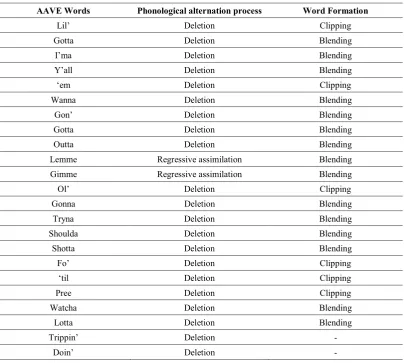
AAVE Words Phonological alternation process Word Formation
Lil’ Deletion Clipping
Gotta Deletion Blending
I’ma Deletion Blending
Y’all Deletion Blending
‘em Deletion Clipping
Wanna Deletion Blending
Gon’ Deletion Blending
Gotta Deletion Blending
Outta Deletion Blending
Lemme Regressive assimilation Blending
Gimme Regressive assimilation Blending
Ol’ Deletion Clipping
Gonna Deletion Blending
Tryna Deletion Blending
Shoulda Deletion Blending
Shotta Deletion Blending
Fo’ Deletion Clipping
‘til Deletion Clipping
Pree Deletion Clipping
Watcha Deletion Blending
Lotta Deletion Blending
Trippin’ Deletion -
Doin’ Deletion -
Table 1. Phonological Process and Word Formation
12.1. Phonological features
In regressive assimilation section, the writer found lemme and gimme. Lemme [leme] is abbreviation of let me. It has consonant changes in place articulation where a final consonant with alveolar place of articulation is followed by an initial consonant with a place of articulation which is not alveolar. The sound [t] changes into [m] if [t] is followed by [m]. In this case [t] is the alveolar while [m] is bilabial, thus the changes is appear when the final consonant [t] of let changes into initial consonant [m] of me and also [m] is stronger influence than [t]. Therefore, let me becomes lemme [leme].
Gimme or give me is another example of regressive assimilation which also assimilates in three ways. In place of articulation, the final consonant of place articulation is labiodentals [v] and it is followed by initial consonant of bilabial [m]. The [v] changes into [m] if [t] is followed by [m]. Therefore, it becomes gimme [gɪme]. Gimme or give me has a consonant change in manner of articulation. In this case, the final consonant [v] of give is a fricative and the initial consonant [m] of me is a nasal stop.
12.2. Deletion Rules
In this rule, the writer found fifteen deletion rules of AAVE words in Nicki Minaj’s lyrics. They are:
a) Anyway,lil’nigga don’t test the kid b) I’ma violate your asses like Chris Stokes c) I’m the motherfucking Queen ‘lizabeth d) But y’alldon’t hear me through
e) When they go against the kid its gon’ cost for real f) Watcha done did I need some referrals
j) Send ‘em up in flames like a firemen deleted; therefore, it becomes [lɪl]. I’ma consists of word I am going to; in this case the deletion process occurs in
going to [goʊɪŋ tu:]; thus it is only I’ma forms in pronouncing [ʌmʌ] as in point b). Elizabeth [ɪlɪzəbi:ɵ] is pronounced ‘lizabeth [lɪzəbi:ɵ] in point c) because it omits the sound [ɪ]. In point d) the omission occurs in words
of [əv] from all of you [ᴐ:l əv ju:]; thus the simplified of all of you is y’all [jᴐl. Gonna [gɑ:nə] is simplified into
gon’[gʊn]; in this case gon’ deleted na [nə] in gonna such in point e. Watcha is composed by what [wɒʧ], do[du]/are
[a:r], and you [ju:] that it is simplified on you [ju:] and do/are changes into watcha [wɒʧɒ] as in point f). Therefore,
the abbreviation of watcha based on lyric above is what are you done did I need some referrals. As in point g) there is omission of of [əv]and a [ə] in word alot of that it becomes lotta. It also occurs in point h) trying and to which omission of +ing and to; therefore it produces as tryna [traɪnʌ]. There are other simplified words which have different omission aspect with explanations above in point i). It is a shotta [ʃʊtə]. Shotta is an abbreviation of shot callers; it only changes word callers [kɑ:lərz] into [tə]. ‘Em, in point j), is simplified to word them [ðem] which is
deleted the [ð]. Ol’[oʊl] is also from old [oʊld] and [d] is deleted as in point k). Other variation examples of deletion rule are pree in point l) and till in point m). In word pretty [prɪti] reduced [ti] sound becomes pree [prɪ] and also in word until [ʌntɪl] which is reduced [ʌn]; therefore the result is til [tɪl]. The other word, as in point n), is fo’ [fᴐ]; it deleted the sound [r] of for. The last is in point t) thinkin’ which is also classified as deletion because it dropped letter –g; therefore it is only [n] segment left.
12.3. Morphological features
12.3.1.Clipping
The writer found seven words of abbreviation from longer into shorter in lyrics of this album for the example:
The explanation of the italic words: in point a) lil’ is reduced by little. In this case little [lɪtl] reduced some parts of sound segment [tl] becoming lil’ [lɪl]. It also found in word ‘em [em] in point b) which reduction of them [ᵭem] and the part of sound segments reduced is [ᵭ]. Gon’ in point d) is another example of clipping words for gonna. Gonna itself consists to going to. Pretty becomes pree as in e).
Til,in point f), is also reduced by until. The last word is for; it is shortened into fo’.
12.3.2.Blends
The writer also found fourteen blending words in Nicki Minaj’s lyrics. They are:
a) Lemme hear that boy.
i) Watcha done did I need some referrals j) Boobs,boobs, lotta, boobs
l) I’m me top shotta
m)When they go against the kid it’s gon’ cost for real
n) Shoulda shoulda said I got 5 in a possible
In point a) words lemme consists of two words; they are: let and me; point b) words gimme from also consists of two words: give and me; words gonna in point c) is other blend words which also consist of two words: going and to. Gonna can be shortened into gon’ m) which also has a similar combination with
gonna. Trying and to be able simplified becomes tryna as in e). Ought and to can blend as f) outta. Wanna
in point g) is also variant blending words such two examples before, want and to; it includes gotta as in point h) abbreviate of got and to. There are two combinations of words in watcha in point i). They are
what are and what do you. According to lyric above as in i) the word watcha refers to what are you
because there is a verb after using watcha. Point j) lotta comes from word a lot of. All of you becomes y’all as in k). Shotta as in l) is an elaboration of shot and caller which means gangster by black people.
Shoulda, according to lyric above, means should have because it is followed by past participle have. Besides, the writer also found blends words which consist of four words such in point d) I’ma consists of three words: I, am, going, and to which means an activity in the future.
The frequency of AAVE phonology features and morphological features found in Nicki Minaj’s of songs will be presented in table 2.
No Phonological alternation Total Percentage
1 Regressive Assimilation 2 2.12%
2 Progressive Assimilation - 0%
3 Feature changing – rule - 0%
4 Insertion rule 1 1.06%
5 Deletion rule 76 80.85 %
6 Movement ( metathesis) rule - 0%
7 Reduplication - 0%
Total 79 100%
Table 2. Occurrence of Phonological Alternation
There are seven phonological alternations found in Nicki Minaj’s lyrics. The total numbers of the AAVE words used by Nicki Minaj’s in her lyrics are 91. From table 2, we can see that AAVE words that are mostly used in Nicki Minaj are deletion rule (80.85%). The second words are mostly used in Pink Friday: Roman Reloaded album are regressive assimilation (2.12 %). Finally the smallest number is insertion rule (1.06 %).
The frequency of AAVE phonology features found in Nicki Minaj’s lyrics will be presented in table 3
No Word formation Total Percentage
1 Variant other word 3 6.7%
2 Blends 14 31.1%
3 Eponyms 6 13.3%
4 Clipping 7 29.16%
5 Acronyms - 0%
6 Alphabetic abbreviations 15 33.3
7 Borrowing or loan words - 0%
Total 45 100%
Table 3. Occurrence of Word Formation
the smallest number is insertion rule (1.3 %). For the progressive assimilation, feature changing – rule, movement (metathesis) rule, and reduplication are not available in Nicki Minaj’s lyrics of songs.
13.Conclusion
African American Vernacular English is an interesting topic to discuss because it is one kind of English varieties differing from Standard English and it is only spoken by certain ethnic, black people. After analyzing the data, the writer could conclude several points. First, the phonological features which are found in Nicky Minaj’s lyrics are progressive assimilation, insertion rules, deletion rules . Second, the morphological features which are found in Nicky Minaj’s lyrics are blend, reduced word in terms of clipping. Third, for the phonological features and morphological features which are frequently found, in phonological feature, Nicki Minaj mostly uses deletion and in morphological feature, she almost uses blending formation.
Finally, the writer hopes that this study will be useful for the readers who like to listen to the songs which are sung by black American singers, to improve new knowledge and vocabulary. The readers may have knowledge that varieties of English can be found in the lyrics of song, The writer expects that this study may give some contributions for other students who are interested in doing linguistic research, not only who want to analyze AAVE, but also who want to analyze other variety languages.
14.References
Adharini,A.(2005). The African American English in Missy Elliot’s supa dupa fly. Surabaya: Universitas Kristen Petra Surabaya.
Bryman,A.(2004). Social Research Methods. New York: Oxford University Press. Bybee,J.(2003).Phonology ang Language Use.Cambridge: Cambridge University Press.
Chapman.R., & Kipfer,A.(1995).Dictionary of American Slang (3rd ed.). New York: Harper Publishers inc. Charmaz, K.(2006). Constructing Grounded Theory. London : Sage Publications.
Dalzell,T.& Victor,T.(2008). The Concise New Partidge Dictionary of Slang and Unconventional English. New York :Routledge.
Davenport,M.,& Hannah,S.J.(2005). Introducing Phonetics and Phonology(2nd ed). Great Britain: Hodder Education. Fromkin,V.,Rodman,R.,& Hyams,N.(2003).An Introduction to Language(7th ed). Boston : Wardsworth.
Fromkin,V.,Rodman,R.,& Hyams,N.(2011).An Introduction to Language(9th ed). Boston : Wardsworth.
Kusuma,E. (2007). The linguistic features of Afro American vernacular English in the lyrics of 50 Cent’s songs. Surabaya : Universitas Kristen Petra. Thesis Database.
Flick,U.(1998). An Introduction to Qualitative Research. Sage Publication.
Green.J.(2002). African American English a linguistic introduction.Cambridge: Cambridge University Press. Glazar,A. & Vogrinc,J.(2010). The Role of Qualitative Research in Science Education,6(1),77-84.
Holmes, J. (2008). An introduction to sociolinguistics (3rd ed.). London: Pearson Longman.
Jack,S.(2013). Language Varieties in African American Vernacular English (Ebonics). Retrieved from http://www.hawaii.edu/satocenter/langnet/definitions/aave.html#top-AAVE. Citation in text: (Sidnell,2013).
Karvonen,K.(2009). The development of African American Vernacular English in two fiction text: a case study. University of
Jyväskylä. A Bachelor’s Thesis.
Labov,W.(1972). Language in the inner city: Studies in the black English vernacular. Philadelphia : University of Pennsylvania Press.
Lieber,R.(2009).Introducing Morphology. New York: Cambridge University Press.
Marliahadi,F.(2007). African American Vernacular English (AAVE) and Standard English (SE) used in the Future Father in-law and son in-law relationship in “guess who”. Surabaya: Universitas Kristen Petra. Thesis Database.
Merriam,S.(1998). Qualitative Research and Case Study Application in Education, 2nd ed. San Francisco: Jossey – Bass Publishers.
Pramana,I. (2009). The African American Vernacular English Used In Richard Wright’s Big Boy Leaves Home. Surabaya: Universitas Airlangga. Thesis Database.
Roach,P.(1991).English Phonetics and Phonolgy(2nd ed.). Cambridge: Cambridge University Press.
Scheibman,Joanne.(200a).I dunno but…..a usage-based account of the phonological reduction of don’t in conversation ,5,90-573.
Tejo,L.(2011). The Features of African American Vernacular English used by Black and White Characters in “White Chicks” Movie. Surabaya : Universitas Kristen Petra.
Trudgill,P.(1983). Sociolinguistics : An introduction (2nd ed). Great Britain: Cox & Wyman Ltd. Trudgill,P.(1994). Dialects. London and New York: Routledge.
Trudgill,P.(2004).Linguistic and social typology: The Austronesian migration and phoneme inventories. Linguistic Typology 8:305-320.
Wardaugh,R.(2002). Sociolinguistics: An introduction (4th ed). Great Britain: Blackwell publishing. Wardaugh,R.(2005). Sociolinguistics: An introduction (5th ed). Great Britain: Blackwell publishing.
Staff,J.(2013). ‘The Re-Up’: Billboard Praises Nicki Minaj Re-Release Sales/Target To Stock Up?. Retrieved November 29,2012, from http://thatgrapejuice.net.