Triyono
CORRELATION BETWEEN PREEXPONENTIAL FACTOR AND ACTIVATION ENERGY
OF ISOAMYLALCOHOL HYDROGENOLYSIS ON PLATINUM CATALYSTS
Triyono
Chemistry Department, Faculty of Mathematics and Natural Sciences Gadjah Mada University, Yogyakarta
ABSTRACT
Arrhenius equation stated that reaction will proceed faster at higher temperature and with lower activation energy (Ea). Many literatures reported that preexponential factor (A) is constant for certain reaction and there is no relation between A and Ea. Experiment on the reaction of isoamylalcohol hydrogenolysis showed that logarithm of A increased linearly with Ea. The result of this investigation suggests that the rate of a process is affected by the number of active centers on the surface of a catalysts, which influences the value of the pre-exponential term in the expression for the rate constant of a reaction. An increase in the number of active centers corresponds to a higher value of A, the active centers would be less effective and is attended by a growth in the value of Ea. Therefore, reaction with lower activation energy will not always has higher reaction rate due to decreasing of Ea.
Keywords: isoamylalcohol hydrogenolysis, preexponential factor, activation energy.
INTRODUCTION
Any study of reaction rate and the rate at which molecules collide quickly shows that not every collision between molecules creates products: in fact, the vast majority does not. There are two basic reasons why not every collision is effective.
First, the molecules have to be oriented in the correct way. A very simple gas phase reaction will not occur unless the molecules are oriented such that the molecules are easily accessible by the others. This is known as the steric factor. The second factor is due to the activation energy. Molecules are held together with strong chemical bonds. In order to break these bonds, the colliding molecules must have a large amount of kinetic energy from the collision. If they do not have enough energy, the reaction will not occur. The minimum energy needed by reactant to be able to react is called activation energy. If the activation energy is high, at normal temperatures only small proportion of molecular encounters result in reaction. A catalyst lowers the activation energy of the reaction in various ways, once by providing one or many alternative path and results in a higher reaction rate at the same temperature.
A catalyst does not initiate a thermodynamically either possible or impossible reaction, but only accelerates a possible reaction. At the expense of what factors can this acceleration be achieved, experiments showed that for the tremendous majority of catalytic processes a relationship similar
to the Arrhenius equation is not always obeyed for the rate constant k of every reaction.
The dependence of rate constants on temperature over a limited range can usually be represented by an empirical equation proposed by Arrhenius in 1889:
ln k = ln A - Ea/(RT) (1)
Thisequation can serve as the basis for finding the activation energy in the usual manner from experimental data [1]. According to this equation, a straight line should be obtained when the logarithm of the rate constant is plotted against the reciprocal of the absolute temperature.
Complication of relation between k and Ea was usually appeared for heterogeneous reactions especially in connection with adsorption and desorption phenomena prior to reaction. It often happens that the reaction first becomes observable when the chemisorbed gas starts to desorb, the rate then rises rapidly with an increase in temperature [2]. As the high temperature region is reached, the number of adsorbed molecules decreased and it caused lower reaction rate.
Triyono
Fundamental theory on heterogeneous catalysis stated that in order to react, reactants molecules must be adsorbed on the catalyst surface. From the thermodynamic point of view, adsorption is exothermic process and the number of adsorbed reactant on the catalyst will decrease when the temperature increase.
The kind of support to disperse a metal can have a significant effect to the catalyst characters including its activity [4]. Metal-support interaction (MSI) may create special sites at the metal-support interface, which interact with reactant molecules to enhance the reactivity [5]. This phenomenon showed the effect of special sites onto the preexponential factors in the Arrhenius equation of rate constant.
EXPERIMENTAL
Reactions were conducted in a flow reactor (50 ml volume) using a mass of 1000 mg catalyst. The adapted gas-flow control system allowed different controlled gas flows under 1 bar total pressure. The temperature of the reactor was controlled by a furnace system designed to create the temperature in the range of room temperature to 500oC (recorded by thermocouple immersed into the furnace of the reactor).
The catalyst was placed in between glass wool. Prior to the reaction the catalyst was reduced at 400oC in the hydrogen stream for 2 hours. After cooling down to the reaction temperature, isoamylalcohol was introduced. The hydrogen was added as a reactant. The reaction mixture then enter to the reactor at reaction temperature either 100, 110, 120, 130 or 140oC. After prefixed times t,
reaction products were withdrawn from the reaction system. The composition of the products was evaluated by GC measurement.
The isoamylacohol used as a reactant was of the highest purity available from Merck and was used after several freeze and thaw cycles. The catalysts used were Pt/silica, Pt/γ-Alumina and Pt/zeolite prepared by an impregnation method using an aqueous solution of platinum chloride. The concentration of the impregnation solutions was adjusted to obtain platinum loading of 0.5 wt%. This loading is a compromise between dispersion, activity and cost of catalysts [6]. The silica and γ -alumina were supplied by Merck (Darmstadt, Germany) and zeolite was an Indonesian natural zeolite taken from Wonosari (Yogyakarta, Indonesia)
RESULT AND DISCUSSION
On Pt/γ-Alumina the only reaction occurred for hydrogenolysis of isoamylalcohol was the scission of the C-O bond. Isopentane as a product of that reaction might be isomerized to produce n-pentane. Conversion data of isoamylalcohol at 100, 110, 120, 130 or 140oC on Pt/SiO2, Pt/γ-Al2O3 and on Pt/zeolite as a function of reaction time were then modified to data of activity and temperature and the results were presented in Table 1.
Table 1 showed that all catalysts prepared had almost the same activity in the range of reaction temperature investigated. No significant support effect was observed on hydrogenolysis of isoamylalcohol on platinum catalysts.
Table 1 Reaction of Isoamylacohol at 100, 110, 120, 130 or 140oC on Pt/SiO2, Pt/γ-Al2O3 and on Pt/zeolite
Catalyst Reaction temperature (oC) Activity (TOF)/(Mol/h)
Triyono
-3.2 -3 -2.8 -2.6 -2.4 -2.2
0.0024 0.00245 0.0025 0.00255 0.0026 0.00265 0.0027 0.00275
Inverse of Temperature (1/K)
Loga
rithm of Ac
tiv
it
y
Pt/SiO2
Pt/Al2O3
Pt/TiO2
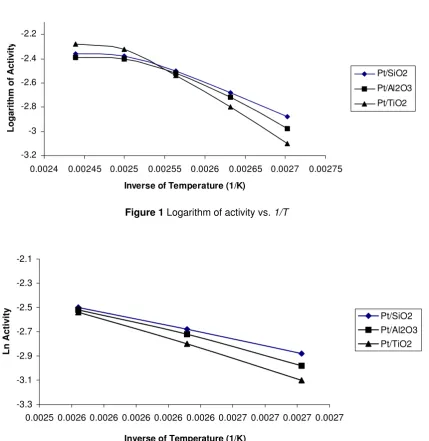
Figure 1 Logarithm of activity vs. 1/T
-3.3 -3.1 -2.9 -2.7 -2.5 -2.3 -2.1
0.0025 0.0026 0.0026 0.0026 0.0026 0.0026 0.0027 0.0027 0.0027 0.0027
Ln Activity
Pt/SiO2
Pt/Al2O3 Pt/TiO2
Figure 2 Linear correlation between logarithm of activity and 1/T in the range of reaction temperature 100 to 120oC.
In order to calculate the activation energy, logarithm of activity was plotted against reciprocal of absolute temperature. The results were shown in Figure 1. Figure 1 showed that there was a linear correlation of Ln activity and 1/T in the range of reaction temperature 100 to 135oC. The Arrhenius equation was only proper for reaction at reaction temperature of 100 to 135oC while that of above 135oC, the effect of reaction temperature on the reaction rate was lower than at temperature below 135oC. The fundamental reason for this is the interplay between the normal tendency for the surface coverage to decrease at higher
temperatures, this means decreasing the number of adsorbed molecules on the catalyst surface [7,8]. Since the reaction rate of the surface reaction is proportional to the surface coverage, therefore, at higher temperature reaction rate becomes lower. By using this point of view, the calculation of Ea was based on the reaction temperature in the range of 100 to 120oC, was producing a linear correlation as can be seen in Fig.2.
Triyono
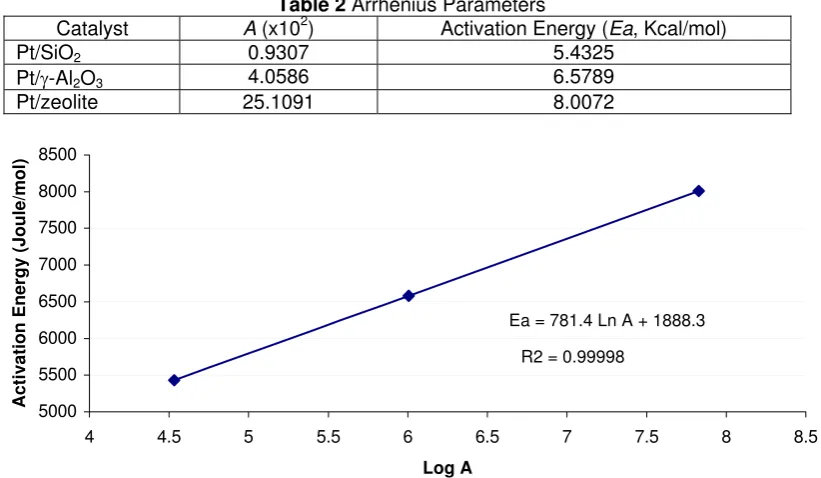
correlation between activation energy and ln preexponential factor. The equation corresponding to the straight line shown in Fig.3 can be written down as Ea = 781.4 Ln A + 1888.3. The existence of such relationships was surprising since it would seem that there should be no relation between Ea and A, the reason being that Ea is directly related to the adsorption potential of the active centers, whereas A with an accuracy to the factor of proportionality is related to the number of active centers per unit of surface area or unit of mass of catalyst.
The existence of such law, however, leads to very great difficulties in the comparative assessment of the activity of catalysts. The relation between activation energy and Ln preexponential factor can also be written down as follows:
Ln A = (1/781.4) Ea – 1888.3
Therefore, using a certain catalysts for the heterogeneous catalytic reaction, in order to compete with any other catalysts, a substantial lowering of the activation energy is required.
Rate (cat1) A1 Ea
= exp Rate (cat2) A2 RT
In the case of hydrogenolysis of isoamylalcohol on platinum catalysts, a decreasing of preexponential factor of about 20.000 (A1/A2) would need
activation energy reduction of about 7500 J/mol at
100oC. It is needed just to make the reaction rates on both catalysts equal. In order to make the reaction proceed faster, the activation energy must decrease more than 7500 J/mol.
Finally, it can be stated that a catalyst having a higher activation energy ought to lead to its lower overall activity, but a simultaneous and, as a rule, proportional growth of the preexponential factor levels out the action of the activation term and may lead to about the same value of the catalyst activity.
The also rational explanation of the relationship between Ea and A was based on the theory of active centers. The probability of the entire surface of a catalyst being active is quite small, and it is called as active centers. The latter have different energies. For statistical and thermodynamic reasons, they should be more numerous with a decreasing energy. An increase in the number of active centres corresponds to a higher value of A. At the same time, the active centers should be the less effective, the lower is their energy, i.e. a decrease in the energy of the active centres is attended by a growth in the value of Ea. It thus becomes clear why high activation energy is connected with a high value of A.
Finally, it can be stated that a catalyst having a higher activation energy ought to lead to its lower overall activity, but a simultaneous and, as a rule, proportional growth of the preexponential factor levels out the action of the activation term and may lead to about the same value of the catalyst activity.
Table 2 Arrhenius Parameters
Catalyst A (x102) Activation Energy (Ea, Kcal/mol)
Pt/SiO2 0.9307 5.4325
Pt/γ-Al2O3 4.0586 6.5789
Pt/zeolite 25.1091 8.0072
5000 5500 6000 6500 7000 7500 8000 8500
4 4.5 5 5.5 6 6.5 7 7.5 8 8.5
Log A
Activation Energy (Joule/m
o
l)
Ea = 781.4 Ln A + 1888.3
R2 = 0.99998
Triyono
The also rational explanation of the relationship between Ea and A was based on the theory of active centers. The probability of the entire surface of a catalyst being active is quite small, and it is called as active centers. The latter have different energies. For statistical and thermodynamic reasons, they should be more numerous with a decreasing energy. An increase in the number of active centres corresponds to a higher value of A. At the same time, the active centers should be the less effective, the lower is their energy, i.e. a decrease in the energy of the active centres is attended by a growth in the value of Ea. It thus becomes clear why high activation energy is connected with a high value of A.
CONCLUSIONS
1. Hydrogenolysis of isoamylalcohol on platinum supported catalysts would not always produce higher reaction rate at higher reaction temperature.
2. There was a linear correlation between activation energy and logarithm of preexponential factor for reaction of hydrogenolysis of isoamylalcohol on platinum catalysts supported on silica, alumina and on zeolite.
3. Lower activation energy for hydrogenolysis of isoamylalcohol on platinum supported catalyst would not always produce higher reaction rate.
REFERENCES
1. Atkins, P. W., 1990, Physical Chemistry, 4th Ed., Oxford University Press, Tokyo.
2. Bell, A.T, and Lombardo, S.J., 1991, A Review of Theoretical Models of Adsorption, Diffusion, Desorption, and Reaction of Gases on Metal Surfaces, Surface Science Reports 13, Elsevier Science Publisher B.V, North-Holland.
3. Silbey, J.R, and Alberty, R.A., 2001, Physical Chemistry, 3rd Ed, John Wiley & Sons, Inc. Singapore.
4. Kreuzer, K and Kramer, R.,1997, J.Catal., 167, 391.
5. Lin, D.S, Sanders, D.K, and Vannice, M.A., 1994, J.Catal., 147, 370
6. Steen, E.V, Connor, C.T, and Sewell, G.S.,1997, J. Catal., 167, 513.
7. Gasser, R.P.H., 1985, An Introduction to Chemisorption and Catalysis by Metals, Clarendon Press, Oxford, 1st Ed.