A JOURNAL ON TAXONOMIC BOTANY,
PLANT SOCIOLOGY AND ECOLOGY
REINWARDTIA
A JOURNAL ON TAXONOMIC BOTANY, PLANT SOCIOLOGY AND ECOLOGY
Vol. 12(1): 1-128.22 July 2002
Editors
ELIZABETH A. WIDJAJA, MIEN A. RIFAI, SOEDARSONO RISWAN, JOHANIS P. MOGEA
Correspondence and subscriptions of the journal should be addressed to
REINWARDTIA Vol 12, Part 1, pp: 121 – 124
NEW SPECIES OF LABISIA (MYRSINACEAE) FROM SUMATRA
BAMBANG SUNARNO
Herbarium Bogoriense-Puslit Biologi, LIPI, Bogor
ABSTRACT
SUNARNO, BAMBANG. 2002. New species of Labisia (Myrsinaceae) From Sumatra. Reinwardtia 12(1): 121– 124. ⎯ Three new species L. posthumusiana, L. steenisiana and L. sumatrensis are described.
Keywords: Labisia, Myrsinaceae, Indonesia
ABSTRAK
SUNARNO, BAMBANG. 2002. Jenis baru Labisia (Myrsinaceae) dari Sumatra. Reinwardtia 12(1): 121–124. ⎯ Dipertelakan tiga jenis baru Labisia posthumusiana, L. steenisiana dan L. sumatrensis.
Kata kunci: Labisia, Myrsinaceae, Indonesia.
Since the monograph of Myrsinaceae was published in 1902 some local treatments of the genera, e.g. Ardisia (Sleumer, 1988; Stone, 1982, 1989) for New Guinea and Borneo, Conandrium, Discocalyx, Embelia, Fittingia, Grenacheria and
Maesa had been revised for New Guinea (Sleumer 1986, 1987, 1988), and Labisia was reviewed for Peninsular Malaysia by Stone (1988). This paper concerns with the latter, the genus Labisia Lindl. with special references to Indonesia.
The plant resembles Ardisia, especially to that of subgen. Bladhia. The type species is Labisia pothoina Lindl. The correct name for this type species, L. pumila was formerly named as Ardisia pumila. However its induplicato-valvate petals and imbrication in the margin provide good features distinguishable from Ardisia. Mez (1902) placed Labisia in the tribe Myrsineae on the basis of its monoseriate ovules, while Ardisia belongs to Ardisieae. Those the two genera were separated at tribal levels. Beside the venation of the leaf which shows numerous lateral main nerves and almost parallel to each other, the reddish brown peltate trichome which is distributed throughout young stem, petiole, midrib, lamina and also peduncle, pedicel, ovary and stamen was also mentioned as a good character for the genus (Stone, 1988).
Morphology of flowers shows a clue to specific distinction, especially on the shape and size of the almost mature corolla bud (flower bud nearly to anthesis). The shape and size of petals, sepals, stamens and styles are here considered as diagnostic characters for specific distinction. In a certain limit, a corelation of flower and leaf characters is considered diagnostic for
infra-pecific distinction within L. pumila complex. Sterile or fruiting specimens may be identifiable to some extend, but satisfactory identification is mostly achieved by flowering specimens.
After a thorough study of the genus Labisia
at Herbarium Bogoriense, K (Royal Botanical Garden Kew Herbarium), L (Rijksherbarium Leiden) to include specimens from Java, Sumatra, Kalimantan (Indonesian Borneo), Moluccas, Sulawesi and Irian Jaya (West New Guinea), I examine some species which are not match to the known species, therefore they are to be proposed here as new:
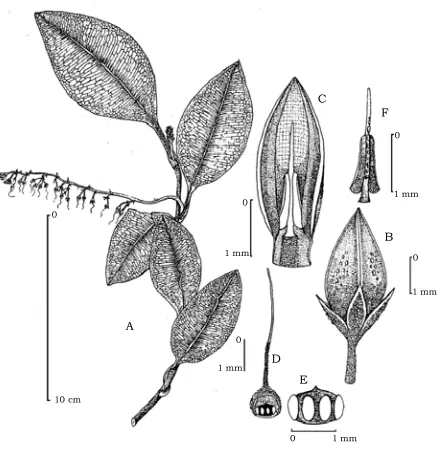
1. Labisia posthumusiana Sunarno, spec. nov. – Fig. 1
A Labisia acuto alabastris obclavatis; stamenibus duplo brevioribus ca. 1.2 mm longis, antheris duplo brevioribus ca. 1 mm longis, folia magna, oblonga vel obovata subcoriacea differt. – Typus: Sumatra, Prov. Jambi, Selemuku, fl. & young fr. Aug., 1925.
Posthumus 777 (L–Holo; BO–Iso).
Erect or decumbent undershrub, up to 60 cm high. Stem rather stout. Leaves many, vaguely alternate, broadly oblong or or broadly obovate, usually large, 16–22 by 6–12 cm, very rarely smaller, subcoriaceous; margin dentate; base acuminate, decurrent; apex acute to obtusely acuminate or rounded, emarginate; midrib sunken above, prominent; lateral main nerves numerous, c. 2 cm, jointed at 5–7 mm margin; petiole 0.5–1 cm, superficially sub-sessile, sligthly winged.
Inflorescences axillar, paniculate or ra-ceme of corymbose fascicles of 2–5 flowers each, 10–15 cm long, not branched; bracts and bracteoles
122 REINWARDTIA [VOL. 12
nearly equal, deltoid, c. 1 mm long; peduncle 4–5 cm long; corymbose peduncles 4–5 mm long.
Flower white or pinkish white; pedicels c. 2 mm long. Sepal 5, connated just only at base; segment valvate; lobes imbricate in mature flower buds, deltoid, slightly cupidate at apex, c. 1 mm long.
Corola 5, obclavate in mature buds, 4–4.5 mm long; lobes somewhat narrowly ovate or lanceolate, 4.5–5 by 1–1.5 mm. Stamens 5, c. 1.2 mm long; filaments c. 0.1 mm long; anthers elliptic, c. 1 mm long, connective appendage c. 0.1 mm long. Ovary ovoid; placenta broadly ellipsoid, ovules 6. Style filiforms, 4–5 mm long, rarely slightly shorter. Fruits drupaceous, young fruit subglobose.
Fig. 1. Labisia posthumusiana Sunarno. A. Habit. B. Flower bud; C. frontside view of a detached petal with enclosed stamen; D. Opened ovary; E. Enlarged placenta and ovules; F. Stamen, backside view; G. Calyx shape, projection of inside view (after
Posthumus 777)
DISTRIBUTION. Sumatra: Jambi in Selemuku and Pasir Mayang. Probably also in Bukit Ceng-keembun, Inderagiri highland.
HABITAT. Primary forest, swampy forest, at 50 - 300 m alt., probably higher up to 700 m alt. Flowering: August and December; fruiting: Octo-ber, December and February.
FIELD NOTES. Leaf dark green, venation red, peduncle red, fruits light green.
NOTES. It is allied to L. acuta which is common in Sumatra e.g. Riau, Jambi, Bangka Isl. and Borneo e.g. Sarawak and Central Kalimantan. However, the new species can be easily distinguished by the shape and size of leaves and stamens. The fruiting specimen Buwalda 7081 from Bukit Cengkeembun at 700 m alt. has smaller leaves and slightly shorter style. It is perhaps a variant of the species due to altitudinal factor. The epithet is after Dr. Oane Posthumus (1898–1945), Director of General Experimental Station for Agriculture and Professor of Agri-cultural college at Bogor in 1939–1941.
SPECIMENS EXAMINED: SUMATRA. Jambi: Kab. Muara Bungo–Tebo, Pesisip river, near dusun Pasir Mayang, Primary swampy forest 50 m alt., fl. & fr. Dec. 1980, Franken & Roos 351 (L); Kab. Muara Bungo–Tebo, PT. IFA Concession, Pasir Mayang, Primary forest 100–300 m alt., young. fr. Feb.2, 1982. (Leaf dark green, venation red, peduncle red, fruits light green.), Vreeken-Buijs 6 (L); Kab. Sarolangun, Selemuku, 180 m alt., fl. Aug.25, 1925, Posthumus
777 (BO–Iso, L–Holo); Kab. Muara Bungo–Tebo, Bukit Cengkeembun, ca. 700 m alt., young. fr.,
Buwalda 7081 (BO).
2. Labisia steenisiana Sunarno, sp. nov. – Fig. 2
Labisia pumilo alabstris angusto ovoidea ad aliquanta conica, petalis, sepalis, stylis et antheris differt.. – Typus: Sumatra, Aceh, Lintang, 1800 m alt., fl. Sept., 1937. van Steenis 6310. (BO–Holo; L–Iso).
Undershrubs, erect to 20–25 cm high or decumbent up to 50 cm long. Stem slender.
Leaves spirally arranged or apparently alternate; lamina ovate, 5–12 by 2–6 cm, subcoriaceous; margin subentire to crenulate; base acute to obtuse, slightly decurrent or not; apex acute to acuminate; midrib sunken above, secondary nerves numerous, c. 4 cm, widely patent almost parallel, conjunction 4–5 mm from margin; petiole 3-5 cm long, terete or slightly winged base thickened. Inflorescences axillar, paniculate, 6–20 cm long, never branched; bracts and bracteoles narrowly triangular, 2–3 mm long; peduncles 3–9 cm long. Flowers white or pinkish white; pedicels 2–3 mm long. Sepal lobes narrowly ovate to nar-rowly triangular, c. 1.5 mm long, acuminate.
2002] SUNARNO: Labisia from Sumatra 123
pusticulate. Ovary ovate; placenta broadly ellipsoid; ovules 6. Style filiforms, 3.5–4 mm long. Fruit globose, c. 7–9 mm diam. Seed globose, 3.5–5 mm diam., ribbed.
0 1 mm
Fig. 2. Labisia steenisiana Sunarno. A. Habit; B. Flower bud; C. Frontside view of a detached petal with enclosed stamen; D. Opened ovary; E. Enlarged placenta with ovules; F. Stamen, back side view (after van Steenis 6310)
DISTRIBUTION. Sumatra.
HABITAT. Usually in moist shady primary forests or damp forests at 1500-2000 m alt. Flowering: February, March, and September.
NOTES. It is close to L. pumila in vegetative part, but easily distinguish by the narrowly ovoid corolla in flower buds, much longer styles and connective appendages. In some cases it resem-bles L. paucifolia but it has distinctive stamen and style. Ridley described L. paucifolia as having style c. 1 mm long, but 3.5–4 mm long in
L. steenisiana. The former species also has so much longer anther with shorter connective appendage which is different from the latter new species.
SPECIMENS EXAMINED. SUMATRA. – Kab. Aceh Tenggara, Lau Alas river, 1000-2000 m alt., fl. Feb.7, 1937, Steenis 8702 (BO, L); Kab. Aceh Tenggara, Lintang, 1800 m alt., damp forest, forested ridge, fl. March, 1937, Steenis 6310 (BO–Holo, L–Iso); Kab. Aceh Tenggara, Gayo land, Mt. Kemiri east slope, Camp 1 to 2, 1800 m alt., fl. March, 1937, Steenis
9564 (BO, K, L).
3. Labisia sumatrensis Sunarno, spec. nov. – Fig. 3.
Labisia paucifoliolis antheris breviora, filamentis longiora, connectivo appendicis breviora, et stylis longiora differt.- Typus: Sumatra, Aceh, upper Mamas river valley, c. 15 km west of Kutacane, c. 1500 m alt., G. Leuser Nature Res., Camp central, fl. June 24, 1979. de Willde & de Wilde-Duyfjes 19059 (BO– Holo; L– Iso)
Fig. 3. Labisia sumatrensis Sunarno. A. Habit; B. Flower bud; C. Frontside view of a detached petal with enclosed stamen; D. Opened ovary with the shape of placenta (enlarged); E. Stamen, backside view ( A–E) after de Wilde & de Wilde-Duyfjes 19059); F & G Stamen and placenta of Labisia paucifolia Ridley (after Md. Haniff & Nur 7950).
Undershrubs, erect up to 25 cm tall. Stem
slender, striates. Leaves spirally arranged; lamina subovate to ovate, 7–8 by 3.5–4 cm, subcoria-ceous; margin crenulate; base obtuse, apex acute, rounded or emarginate; midrib sunken above, glandular punctates, prominent underneath; lateral nerves c. 6 cm, conjunction 1–3 mm from margin; petioles terete, 3–4 cm long or more, base thick-ened. Inflorescences axillar, paniculate, or raceme of corymb fascicles, c. 4 cm long; bracts narrowly triangular, c. 3 mm long; bracteoles triangular 1–2 mm long; peduncles c. 2 cm long, corymb peduncles c. 0.5 cm long to nearly sessile.
Flowers pinkish white, pedicels 1–2 mm long.
Sepal lobes ovate, c. 0.5 mm long, acuminate.
124 REINWARDTIA [VOL. 12
DISTRIBUTION. Sumatra
HABITAT. Montane rainforests on humus rich soils, at 1200-1500 m alt.
SPECIMENS EXAMINED: SUMATRA. Kab. Aceh Tenggara, Gn. Leuser Nature Reserve, upper Mamas river valley, c. 15 km west of Kutacane, c. 1500 m alt., fl. June 24, 1979, W.J.J.O de Wilde & B.E.E. de Wilde Duyfjes 19059 (BO–Holo, L–Iso); Kab. Aceh Tenggara, Gn. Leuser Nature Reserve, upper Mamas river valley, c. 15 km west of Kutacane, c. 1500 m alt., fl.June 24, 1979, W.J.J.O de Wilde & B.E.E. de Wilde Duyfjes
18310 (BO, L). Kab. Asahan, East coast Sumatra, Aek Si Tamburak, Asahan (region southeast of Dolok Si Manuk Manuk, st., Oct.28, 1936, Rahmat Si Boeea &
Bartlett 10660 (L); Kab. Asahan, Aek Si Tamburak, Asahan (region southeast of Dolok Si Manuk Manuk, st., Oct.26, 1936, Rahmat Si Boeea & Bartlett 10633 (L); Kab. Asahan. Vicinity of Talun na Uli, Toba (east of Dolok Si Manuk Manuk, near headwater of Aek Mandosi, fl., Oct., 1936, Rahmat Si Boeea & Bartlett
10202 (L).
ACKNOWLEDGEMENTS
The author would like to express his gratitude to the British Council and Flora Malesiana Foundation for financial support during his studis in Royal Botanical Gardens, Kew, and Rijksherbarium, Leiden. He is grateful to Drs. R.M. Polhill and B. Verdcourt of Kew, Drs. P. Baas, the late C. Kalkman, the late R. Geesink for their support and encouragement for the study. He wish to thank Drs. Mien A. Rifai and E. A. Widjaja of Herbarium Bogoriense for their advice and
help. His special thank to the late Dr. B.C. Stone from the Department of Botany, Academy of Natural Sciences, Philadelphia, USA for his encouragement to him for the study of Myrsinaceae family. This work was accomplished as a part of MSc dissertation sub-mitted Gadjah Mada University with financial supports to him from LIPI (Lembaga Ilmu Pengetahuan Indonesia) 1986–1989.
REFERENCES
MEZ, C. 1902. Myrsinaceae. In A Engler. Das Pflanzenreich Regni Vegetabilis. Conspectus IV No. 236. Konigl. Press. Akademische der Wissensch. Weinheim.
SLEUMER, H. 1986. A revision of the genus Rapanea
Aubl. (Myrsinaceae) in New Guinea. Blumea 31(2): 245–269.
SLEUMER, H. 1987. A revision of the genus Maesa
Forsk. (Myrsinaceae) in New Guinea, the Moluccas, and the Solomon islands. Blumea 32(1): 39–65.
SLEUMER, H. 1988. The genera Discocalyx Mez,
Fittingia Mez, Loheria Merr. and Tapeinosperma
Hook.f. (Myrsinaceae) in New Guinea. Blumea
33(1): 81–102.
SLEUMER, H. 1988. A revision of the genus Ardisia
SW. (Myrsinaceae) in New Guinea. Blumea 33 (1): 115–140.
STONE, B.C. 1988. Notes on the genus Labisia Lindl. (Myrsinaceae). Malayan Nature Journal 42: 43–51. STONE. B.C. 1989. New and noteworthy Malesian
Myrsinaceae, III. On the genus Ardisia Sw. in Borneo. Proceed. Acad. Nat. Sc. Philadelphia
INSTRUCTION TO AUTHORS
Taxonomic keys should be prepared using the aligned-couplet type.Manuscripts intended for publication in
Reinwardtia should be written either in English, French or German, and represent articles which have not been published in any other journal or proceedings. Each manuscript received will be considered and processed further if it is accompanied by signed statements given independently by two reviewers chosen by the author(s) attesting to its merits as well as its scientific suitability for publication in Reinwardtia.
Two printed copies (on A4 paper) of the manuscript of not more than 200 pages should be sent to Editors, together with an electronic copy prepared on Word Processor computer programme using Times New Romance letter type and saved as Rich Text File must be submitted.
For the style of presentation authors should follow the latest issue of Reinwardtia very closely. Title of the article should be followed by author's name and mailing address and a one-paragraphed abstract in English (with French or German abstract for papers in French or German) of not more than 250 words. Keywords should be given below each abstract. On a separate paper author(s) should prepare the preferred running title of the article submitted.
Strict adherence to the International Code of Botanical Nomenclature is observed, so that taxonomic and nomenclatural novelties should be clearly shown, Latin description for new taxon proposed should be provided, and the herbaria where type specimens are deposited should be indicated. Synonyms should be presented in the long form [name of taxon, author's name, year of publication, abbreviated journal or book title, volume (number): page].
Maps, line drawing illustrations or photographs preferably should be prepared in landscape presentation to occupy two columns. Illustrations must be submitted as original art accompanying, but separate from, the manuscripts. On electronic copy, the illustrations should be saved in jpg or .gif format. Legends for illustrations must be submitted separately at the end of the manuscript.
Bibliography, list of literature cited or references follow the Harvard System.
ISSN 0034 - 365 X
REINWARDTIA
Vol. 12. No. 1.2002CONTENTS
Page
Y. PURWANTO. Gestion de la Biodiversite: Relations aux plantes et dynamiques vegetales chez les Dani de la Vallee de la Baliem en Irian Jaya, Indonesie 1
TRI MULYANINGSIH & COLIN ERNEST RIDSDALE. The Bornean genus
Hypo-bathrum (Rubiaceae): an investigation of its characters and taxonomic status 95
BAMBANG SUNARNO & HIROSHI OHASHI. A new species of Dalbergia
(Legumi-nosae) from Malay Peninsula 117
BAMBANG SUNARNO. New species of Labisia (Myrsinaceae) from Sumatra 121
SRI S. TJITROSOEDIRDJO. Four new taxa of Asteraceae in Sumatra 125
HERBARIUM BOGORIENSE BIDANG BOTANI