A GENETIC BASED APPROACH TO THE TYPE I
STRUCTURE IDENTIFICATION PROBLEM
by
S.E. Papadakis, P. Tzionas, V.G. Kaburlasos, J.B. Theocharis
Abstract. A novel approach to structure identification of type I is presented in this work. A simple genetic algorithm, enhanced with a local search operator is used to determine an optimum subset of features that actually affect the output of a system, from a set of candidate features selected intuitively. The problem of input selection, addressed in the bibliography as the type I structure identification problem, is considered to be the most important phase of the structure identification process. The fuzzy curve technique introduced by Lin and Cunningham [19] extended to fuzzy surface concept, is used as a fast modelling technique to built a coarse, model from a subset of the initial set of candidate inputs. In order to identify inputs that are interdependent, a genetic algorithm is used to guide the probing of more than one input simultaneously. The objective of the genetic algorithm is to determine the minimum number of inputs that, ideally, are necessary and sufficient to describe the system. Extensive simulation results on both artificial examples and real world applications were obtained in order to assess thoroughly the proposed approach.
Keywords: structure identification, feature selection, modelling, input selection, fuzzy curve, genetic algorithms.
Introduction
related to the selection of those inputs (features) that affect the output of a system significantly. It is subdivided into type Ia and type Ib subcategories. The type Ia is concerned with the definition of a set of candidate’s inputs, which form the feature space of the system. It is realized entirely intuitively, requires human knowledge about the system to be identified and also, it is the starting gate to modelling. Frequently, the expert who decides on the feature space components is misplaced, overestimating the importance of several inputs and increasing the complexity of the model to be built. In many cases the set of features that actually affects the output of the system is a subset of the initial set. This work focuses on the structure identification problem of type Ib, that is, the selection of a small subset of features that, ideally, is necessary and sufficient to describe the target concept. The ultimate objective of feature selection is to obtain a feature space with a) low dimensionality, b) retention of sufficient information, c) enhancement of separability in feature space, for example in different categories by removing effects due to noisy features, and d) comparability of features among examples in same category [15].
Researchers have attempted input selection through varied means, such as statistical [7] ,[10] geometrical, information-theoretic measures [1], mathematical programming [2], among others.
In statistical analyses, forward and backward stepwise multiple regression (SMR) are widely used to select features, with forward SMR being used more often due to the lesser magnitude of calculations involved. The output here is the smallest subset of features resulting in a correlation coefficient value that explains a significantly large amount of the variance. Similarly in [12], the K–L transform was applied to the training examples to obtain the initial training vectors. Training is started in the direction of the major eigenvectors of the correlation matrix of the training examples. The main drawback of these approaches is that they searche for interdependent features in the input space ignoring the influence of each one on the output of the system.
time complexity of the method is overwhelming due to the training process required for each input combination.
Rough sets theory was also used to determine the degree of dependency of sets of attributes for selecting binary features. Features leading to a minimal preset decision tree, which is the one with minimal length of all paths from root to leaves, were selected. Similarly, best first search was used, stopping after a predetermined number of non-improving node expansions [15]. Similar algorithms such as the IDG take the positions of examples in the instance space to select features for decision trees. They limit their attention to boundaries separating examples belonging to different classes, while rewarding (penalizing) rules that separate examples from different (same) classes [15]. Decision trees generated using the proposed algorithm had better accuracy. The implied drawback of this hierarchical approach is that the structure of a decision tree is depended on the specific sequence of features to be tested apart from the features themselves.
Neural networks were also used to measure the contribution of individual input features to the output of the neural network [15]. These methodologies have to undergo the time-consuming training process of the network used to test every input combination.
The most popular feature selection methods in machine learning literature are variations of sequential forward search (SFS) and sequential backward search (SBS) [15]. SFS (SBS) obtains a chain of nested subsets of features by adding (subtracting) the locally best (worst) feature in the set. The serious weakness of this approach is that it adds or subtracts one feature at a time. It results in trapping the search in local minima, because it fails to encode the probing of all the potential combinations.
interdependent inputs could be characterized significant when tested independently. In this paper we introduce the fuzzy surface concept as an extension of the fuzzy curve in an entirely different way. We take advantage of the fast model building capabilities derived from the concept of fuzzy curve and a genetic based probing of more than one input simultaneously, to cope with the weakness mentioned above.
The proposed method
Let us consider an m-input single output system described by a nonlinear function of the form: y= f(x), where x=[x1,..xj...,xm] and and y denotes the output of the system. Also, let ℘q denotes the observation input output data set comprising q m-input/output patterns: ℘q,m,1=
{
(xk,yk),k=1,...,q}
. Letℑ be the set of candidate input set representing the input vector (feature space). Also let
(
)
!derived from the set of m candidates’ inputsℑ, excluding the empty subset, equals2m−1. Given a specific subset ℑn,l the respective ℘q,n,l of the specific n-inputs /output data observation data points is derived as a subset of ℘q,m,1.
For each n-input - output datum on ℘q,n,l a fuzzy rule with crisp output is
created in the following form:
k
Having determined the product as the fuzzy implication method and using the centroid defuzzyfication technique, the output of the fuzzy model is given by the formula:
Equation (3) provides a continuous and parameter free surface, which approximates the input output data, and behaves as a fuzzy model. The mean absolute percentage error is used to estimate the quality of the approximation:
%
Since the number of rules equals the number of data, the risk of over fitting the data set is major. In order to estimate the validation of the model the data set is subdivided into two subsets. Each subset comprises one half (q/2) of input output patterns. The fuzzy surface is built on the first data subset ℘q/2,n,l and it is evaluated on the whole data ℘q,n,l according to (4).
It has to be pointed out that the complexity of the aforementioned fuzzy model is preventive for using it as a regular model in order to identify the system. Nevertheless, it is a coarse model that can be easily built, avoiding any time-consuming adaptation processes. Parameters σj play a very important role in the proper identification of the system properly. If the values of the parameters are extremely small the fuzzy surface-based model results in over fitting the data increasing Eq,n,l due to poor generalization. On the other hand, very large value of the parameters σj result in inadequate identification performance increasing the Eq,n,l, due to poor identification. Empirical studies have shown that a value calculated by the formula:
(
xkj xkj)
k qj =δ ⋅ max( )−min( ), =1,...,
σ Where δ∈[0.05,0.15] (5)
For each subset ℑn,l a fuzzy surface FSn,l can be built on ℘q/2,n,l according to equation (3). For each FSn,l an evaluation measure Rn,l, related both to the modeling performance and to the complexity of FSn,l, is defined by the
formula:
) 1 , 0 ( )
1 ( *
100
max , ,
, = ⋅ + − ⋅ w∈
m n w E
E w
Rnl qn
l
(6) where Emax =max(Eq,1,l), l=1,...,m. It is used for the normalization of Eq,n,l
values. The smaller the value of Rn,l the greater the importance of the
respective FSn,l. If a specific subset ℑn,l comprises non-important inputs, then both terms in (6) increase, raising the respective Rn,l value. Inserting
significant inputs or deducting negligible ones the respective terms in (6) decrease resulting in lower Rn,l values. In the case that two input combinations are equivalent the preferred combination is the one with the lowest order n. Therefore, the objective of the proposed input selection method is to track down the subset ℑn,l with the minimum Rn,l value, among all the 2n −1 subsets derived from the set of candidate’s inputsℑm.
The genetic algorithm
In the case that the cardinality m of ℑm is small, the probing of all
possible combinations is feasible. On the contrary, for a large set of candidates’ inputs the number of combinations is prohibitively high. In general, the minimization of the measure given in (6) can be formulated as a combinatorial unconstrained optimization problem. A simple genetic algorithm with binary encoding, adaptive mutation and crossover rate [18], is applied. In this paper the chromosome of each individual consists of m genes of one bit. Each bit encodes the presence ‘1’ or absence ‘0’ of a particular input variable
m j
xj =1,..., to the construction of a specific ℑn,l ⊆ℑm. Hence, the
chromosome and derives all the potential chromosomes (15 chromosomes) by permuting the selected bits and keeping the rest ones intact. The chromosome with the best fitness value is adopted as the new elite chromosome replacing the initial one.
Experimental results
In order to highlight some functional aspects of the proposed approach two artificial examples are examined initially. Then, the method is applied on two real world applications: the Fisher Iris recognition Benchmark and the Box & Jenkins [4] gas furnace problem.
Example I
The first example concerns the importance evaluation of the inputs for a three-input one output non-linear function [19]:
] 3 , 0 [ , , , 5x )] 3 sin( 5 . 1
[ 11.5 − 2 2 + 3 1 2 3∈
= x x x x x
y (7)
300 input output data pairs [x1,x2,x3,y]k,k =1,2,...,300 were produced. The first 150 were used to build the fuzzy surfaces and all the 300 data to calculate the Eq,n,l in (6). For each pair the input valuesx1,x2,x3 are randomly
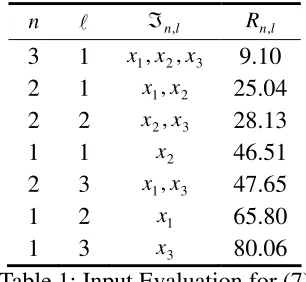
generated within the interval [0,3] and the output is calculated according to (7). In (6), the value of the weight w equals w=0.8. Since the number of candidate inputs is small, all the combinations were evaluated without genetic optimization. The evaluation results are illustrated in Table 1, ranked in ascending order with respect to their importance. It is apparent that the combination comprising all the inputs is the most important one. Moreover, a ranking of the importance of each individual input is possible by examining the results for n=1. The order x2,x1,x3 is also recognized in [19]. The time
n l ℑn,l Rn,l
Table 1: Input Evaluation for (7)
Note that the results in Table 1 are not mutually exclusive. Let f be a comparative operator regarding the relative importance of two objects. i.e.
b
af indicates that ‘a’ is more important than ‘b’. The implication:
t
constraint is confirmed in Table 1. Example II
The next example is a modification of the previous one. A fake input is added to the input space, which has no impact to the output of the system. Equation (7) is modified as follows:
]
The input data points are created extending each input vector k x x
x , , ]
[ 1 2 3 ,
created in the previous example with one more component, which represents the x4 input value. Hence, 300 data points in the form
the range [0,3]. The first 150 data is used to craft the fuzzy surfaces, as in Example I. After applying the proposed method, the best combination was
3
Example III
In this example we are dealing with the examination of our method in the case of interdependent inputs. Suppose we have a system governed by the non linear equation:
) sin( 3 10
) sin( )
sin( 3 2 1
4 2
1 x x wherex x
x
y= + + − = ⋅
(10)
The inputs x1,x2 are interdependent, while the input x3 affects slightly the output. 300 input-output data pairs were generated in a manner similar to Example I. The input vector comprises random numbers in [0,3] range and the output for each input vector is calculated by (10). The evaluation of the inputs shows that the best combination was x1. Both the x2 and the x3 inputs were
rejected. Note that following to the methodology referred to [19] the input x2
is detected as an important input because it provides a non-flat fuzzy curve. The Fisher Iris Benchmark
The second example is a real world application, the well-known Fisher Iris benchmark. This benchmark comprises four candidates inputs that represent measured attributes of a crinum family such as sepal-length, petal length etch. The lilies are classified into three categories represented by an integer number from 1 to 3, according to their attributes. The data set consists of 150 input-output data points. Our method is applied to track down the attributes, which are necessary and sufficient to describe a classification system. The first 75 points were used for building the fuzzy surfaces. The proposed input selection method suggests the combination x1,x2,x3,x4 as the
best one, with R4,1 =3.10. The next best in order was x3,x4 with R3,1 =3.18. All combinations comprising the x2 input obtain relatively large values and the x2
valuated as standalone was the worst option. Following, the methodology presented in [19], the input x2 would be rejected due to a flat fuzzy curve
although its combination with the rest inputs affects considerably the output of the system. This a major advantage of the proposed algorithm. Introducing a pseudo input to the set of candidates inputs as in Example II, and reapplying our input selection algorithm the combination x1,x2,x3,x4 is recognized again as the most important one acquiring a valuation R4,1=2.46. The combination
4 3,x
5 4 3 2
1,x ,x ,x ,x
x that comprises the fake input x5 is worst enough obtaining
valuated R5,1 =13.85. Moreover, the x5 input is the last in order option. The Gas Furnace Problem
The Box & Jenkins [4] gas furnace problem, a well-known real world application, is considered to estimate the validity of the proposed method. This dynamic problem involves a single input u(t) that represents the gas flow at time t, and a single output y(t) which corresponds to the co2 concentration in the exhaust gas of the furnace. The intention of many modeling techniques [4], [13], [19] is the prediction of y(t), utilizing past values of both the input u(t) and the output y(t). The candidates input set consists of 20 inputs u(t), u(t-1),….,u(t-10), y(t-1),y(t-2),….y(t-10) that is 220 −1=1,048,576combinations. The targeted output is y(t). The genetic algorithm mentioned in section 0 is applied to track down the combination with the minimum Rn,l value. The
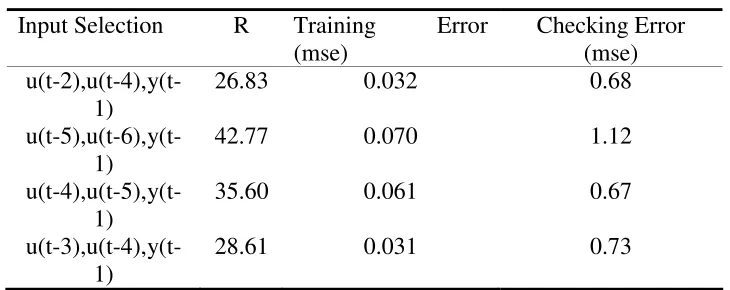
chromosome of the algorithm comprises 20 bits and the fitness function is given by (6). A population of 25 individuals was employed. After 50 generations the best individual achieved a fitness score of R3,1 =26.83 suggesting x=[u(t−2),u(t−4),y(t−1)] as the most effective input combination. It has to be pointed out that different methods in literature consent regarding the number of inputs to be used, but result in a different subset of the same order n=3. In [13], the proposed input subset was:
)] 1 ( ), 4 ( ), 3 (
[ − − −
= u t u t y t
Input Selection R Training Error (mse)
Checking Error (mse)
u(t-2),u(t-4),y(t-1)
26.83 0.032 0.68
u(t-5),u(t-6),y(t-1)
42.77 0.070 1.12
u(t-4),u(t-5),y(t-1)
35.60 0.061 0.67
u(t-3),u(t-4),y(t-1)
28.61 0.031 0.73
Table 2: comparison of the proposed input selection approach
From the experimental results it is clearly shown that the proposed input selection method tracks down the input vector with the greater impact to the output of the system. Additionally, the importance measure Rn,l is highly
correlated with the importance of each combination. The total simulation time was in average 4.33 minutes on a Pentium III computer 1.2Ghz and the total number of tested combinations by the genetic algorithm was: 50 generations * (25 evaluations per generation for the reproduction+16 evaluations per generation for DHCO operator)=2048.
Conclusion
References:
1. Battiti, R., ‘Using mutual information for selecting features in supervised neural net learning’ IEEE Transactions on Neural Networks 5 (4), (1994), 537– 550.
2. Bradley, P.S., Mangasarian, O.L., Street, W.N., ‘Feature selection in mathematical programming’, INFORMS Journal on Computing 10 (2), (1998), 209–217.
3. Barada s. and sing H, ‘ Generating optimal adaptive fuzzy-neural models of dynamical systems with application to control,’ IEEE trans on syst. man and cyb. Part c, vol 28, no 3, pp 371-391, 1998.
4. Box G. E. P. and Jenkins G. M., "Time series analysis, forecasting and control,", San Francisco, CA: Holden Day, 1970.
5. C. C. Lee, “Fuzzy Logic in Control Systems: Fuzzy Logic Controller- Part I,” IEEE Trans. on Syst., Man, and Cybern., vol. 20, No. 2., 1990.
6. C.T. Lin and C.S.G. Lee, “Real-Time Supervised Structure/Parameter Learning for Fuzzy Neural Network,” IEEE Conf. on Fuzzy Systems, pp. 1283-1291, 1992.
7. Fukunaga K., Introduction to Statistical Pattern Recognition, second ed., Academic Press, Boston, 1990.
8. I.J.Leontaritis and S.A. Billings, ‘model selection and validation methods for non-linear systems’, int. j. control, vol 45, no 1, pp. 311-341, 1987.
9. Hopkins, C., Routen, T., Watson, T., ‘Problems with using genetic algorithms for neural network feature selection’, 11th European Conference on Artificial Intelligence. (1994), 221–225.
10. Kittler, J. ‘Mathematical methods of feature selection in pattern recognition’, International Journal of Man–Machine Studies 7 (1975), 609– 637.
11. L.-X. Wang and J. M. Mendel, "Back-propagation fuzzy system as non-linear dynamic system identifiers," IEEE Conf. on Fuzzy Systems, pp. 1409-1416, 1992.
13. L. Wang and R. Langari, ‘Building Sugeno-type models using fuzzy descretization and orthogonal parameter estimation techniques,’ IEEE Trans. Fuzzy systems, vol. 3, no. 4, pp. 454-458, 1995.
14. M. Sugeno and K. Tanaka, "Successive identification of a fuzzy model and its applications to prediction of a complex system," Fuzzy Sets and Systems, vol. 42, pp. 315-334, 1989.
15. Piramuthu, S. ‘Evaluating feature selection methods for learning in data mining applications’, European Journal of Operational Research 156 (2004), 483–494.
16. Siedlecki, W., Sklansky, J., ‘A note on genetic algorithms for large-scale feature selection’, Pattern Recognition Letters 10 (5), (1989), 335–347.
17. S. E. Papadakis and J. B. Theocharis, "A GA based Fuzzy Modeling Approach for Generating TSK models," Fuzzy Sets and Systems, vol 131, no. 2, 121-152, 2002.
18. S. Papadakis and J. Theocharis, “A Novel Genetic Training Algorithm With Application to Fuzzy Neural Networks,” IASTED Int. Conf. On Syst. Modelling Identification and Control pp. 125-128, Feb. 1996.
19. Y. Lin and G. A. Cunningham, “A New Approach to Fuzzy-Neural System Modeling,” IEEE Trans. Fuzzy Systems, vol. 3, pp. 190-198, May 1995.
Authors:
S.E. Papadakis - Technological Educational Institution of Thessaloniki, Greece, E-mail address: [email protected]
P. Tzionas - Technological Educational Institution of Thessaloniki, Greece, E-mail address: [email protected]
V.G. Kaburlasos - Technological Educational Institution of Thessaloniki, Greece, E-mail address: [email protected],