e-Security
Malaysia Cyber Security CentreFrom the Editor’s Desk
Greetings from the editor’s desk. We have a new look for our newsletter and if you have any feedback on our new design, please do let us know. The new design reflects a more advance and technological look and feel.
So, what has happened in the second quarter? Well, the much awaited SecureMalaysia 2006 Conference and Exhibition took place very successfully from the 24th July - 26th July 2006. The event was opened by Y.B Dato’ Sri Dr. Jamaludin Mohd Jarjis, the Minister of Science, Technology & Innovation.
It was a great event with many great speakers from all over the world. We had the honour of having Howard Schmidt, the former advisor to the US President on Cyber Terrorism and also former CISO for Microsoft & Ebay. It was thoroughly refreshing to listen to his talk and also we had Steve Orlowski and Dr. John Meakin.
This issue will see a variety of articles from our contributors touching many areas of information security. I do hope that you will find it useful and able to communicate with the contributors if you need more information.
Our CISSP classes are ongoing and our last class for 2006 is in August 2006 and exams in September and December. Do visit our website at http://www.niser.org.my/cissp
for updates and information
Once again, we invite more security professionals to contribute to our newsletter and remember that you can view our newsletter online from our website at
http://www.niser.org.my.
Philip Victor
Dealing With Dangers From Within By Siti Suharti & Zahri Yunos
[email protected] [email protected]
Accreditation for Information Security Laboratory
By Nahzatulshima Zainuddin [email protected]
How To Develop & Implement Legal Strategies in IT Security Management
By Zaid Hamzah & Juanda Zeng [email protected]
Introduction To project Management
By Ramona Susanty [email protected]
Keeping Your Database Secure
By Abdirazak [email protected]
Noise (Audio)
By Zabri Talib [email protected]
Safeguarding Against Email / Phishing Attempts
By Sharifah Roziah [email protected]
Rootkits and Its Growing Underlying Danger
By Ang Ban Leong
Regional Director for South East Asia, McAfee
Why Companies Must Take A Closer Look At Intrusion Prevention Systems
By Ken Low
Security Lead, Asia Pacific, 3Com Corporation
The New Version of Common Criteria ISO/ IEC 15408
By Norhazimah Abdul Malek [email protected]
Contributors
Volume 7 - (Q2/ 2006)
e - S e c u r it y
MALAYSIA CYBER SECURITY CENTRE
15
17
19
15
20
5
6
7
10
13
Malaysia Cyber Security Centre
e-Security
MOSTI
Reader Enquiry
Training & Outreach Unit Malaysia Cyber Security Centre (formerly known as NISER) MIMOS Berhad
Technology Park Malaysia 57000 Kuala Lumpur, Malaysia
Tel: +60 3 8657 7042 Fax: +60 3 8996 0827
e-Security
Malaysia Cyber Security CentreOriginal Issue Date: 15th July 2006
The MyCERT Quarterly Summary is a report which includes some brief descriptions and analysis of major incidents observed during that quarter. This report also features highlights on the statistics of attacks/incidents reported, as well as other noteworthy incidents and new vulnerability information.
Additionally this summary also directs to resources in dealing with problems related to security incidents, including patches, service packs, upgrades and hardenings.
1.0 Recent Activities
This quarter saw an outbreak of W32.Brontok worm that affected many organizations in the constituency. Besides this outbreak, there was an alarming surge in intrusions of mainly defacements of .MY domains hosted on virtual hosting servers and a tremendous increase in incidents involving forgery or identity theft. However in general, there was a 20.98% decrease in the number of incidents reported in this quarter compared to the previous quarter. The number of incidents reported for this quarter is 3379 compared to 4276 reports in the previous quarter with a majority of incidents contributed to reports on spam.
2.0 Surge in Intrusion
The second quarter of 2006 saw a surge in intrusion incidents with a total of 277 incidents, which is more than two folds from the previous quarter. Intrusions reported to us mainly involved web defacements of various domains belonging to our constituency and mass defacements of websites hosted on virtual hosting servers, inclusive of Windows and Linux platforms. MyCERT had also sent alert to the MyCERT-List members regarding the surge in mass defacements of websites hosted on virtual hosting servers for precautions purposes.
As the number of defaced websites in this quarter is quite alarming, thus, MyCERT would like to urge all system administrators and virtual host administrators to upgrade and patch systems/services/applications they are currently using. In addition, it is also recommended to disable unnecessary/ unneeded default services on the systems. MyCERT encourages system administrators to consult MyCERT for further advice and assistance, if they have difficulties in securing and hardening of their servers.Based on MyCERT’s analysis of logs received from owners of victim machines, we found some of the defacements were due to PHP fopen() CRLF Injection vulnerability that were not properly patched besides manipulation of the unpatched WebDAV vulnerability running on web servers.
Details of the vulnerabilities and patches are available at:
1. WEBDAV Vulnerability
http://www.cert.org/advisories/CA-2003-09.html
2. PHP fopen()CRLF Injection
http://www.securiteam.com/unixfocus/ 5OP0C0A8AC.html
Detail guidelines on securing UNIX and Windows Servers are available at:
UNIX Security Checklist by CERT/CC http://www.cert.org/tech_tips/usc20_full.html
Windows 2000 Server Baseline Security Checklist by Microsoft
http://www.microsoft.com/technet/security/chklist/ iis5cl.mspx
Windows NT Configuration Guidelines by CERT/CC http://www.cert.org/tech_tips/
win_configuration_guidelines.html
3.0 Reports on Forgery/Identity Theft Increases
Forgery or identity theft incidents are still increasingly prevalent compared to previous quarter. A total of 89 incidents were received compared to 54 in previous quarter, which represents a 64.8% increase. Majority of Forgery incidents were phishing activities which mainly involved foreign financial institutions such as Ebay and Paypal, with a few involving local Financial Institutions. As was in previous quarter, in this quarter we continued to receive reports from foreign financial organizations and foreign CERTs regarding phishing sites hosted on Malaysian servers. MyCERT responded to the reports by communicating with the respective ISPs, Data Centers and Organizations to remove the phishing sites and within 6 hours or less the phishing sites were removed successfully. We had also advised the respective ISPs, Data Centers and Organizations to investigate the affected machines and rectify them accordingly.
MyCERT strongly urges users who receive emails purportedly from financial institutions requesting to change their logon and password to ignore/delete such emails immediately. When in doubt, users are to refer and verify any such emails with their ISPs, CERTs or with the particular financial institutions mentioned in the email.
In addition, organizations are advised to secure and harden their online services and applications to prevent their system from being compromised and used for malicious activities, such as running phishing sites, open relay, open proxies and zombie drones.
2
e-Security
Malaysia Cyber Security Centre Besides phishing reports, MyCERT also received a few reportsfrom our constituency regarding Internet scams, that are worth highlighting. Some of the Internet scams reported to MyCERT are:
a) Nigerian Scams
b) Benin Import Scams, which targets manufacturers c) Advance Fee Scams, which targets foreigners looking
for jobs in Malaysia d) Lottery Scam and e) Get Rich Scams
Nevertheless, the number of victims and monetary loss involved due to the above scams reported are low and not alarming. The modus operandi of the above scams are almost similar to one another as they employ using websites to lure Internet users to visit the website and deposit certain amount of funds to the fraudsters’ accounts.Some scams had manipulated names of local law enforcement agencies by convincing Users of their activities via invalid/valid local addresses and contact numbers. Based on our analysis, we found the websites are mostly registered and hosted abroad. However, we believe some of the operators could be foreigners based in Malaysia - based on the nature and mode of the scams. Most of the Internet scam cases are referred to the local law enforcement agencies, i.e. the police and Bank Negara Malaysia for further investigations.
MyCERT advise Users not to deposit or credit funds except to bona fide and licensed financial institutions. Users who receive any or such scam/suspicious emails to ignore such requisitions and further advised to authenticate emails and contents with their respective ISPs, CERTs or Bank Negara Malaysia for clarification.
4.0 Malicious Code Outbreak
Incidents related to malicious code increased to 27 this quarter from 17 in the previous quarter. It represents a 58.82% increase. We observed an outbreak of the W32.Brontok worm in this quarter with about 18 reports on W32.Brontok worm and the rest of reports involved the W32.Nyxem worm. The W32.Brontok worm outbreak had partly affected the constituency with large number of PCs in many organizations. Organizations infected with the worm had their PCs’ registries locked up and simultaneously disrupted security settings. However, successful worm eradication and system recovery processes by the respective organizations have had the situation contained. MyCERT had released the following revised alert related the W32.Brontok worms, as below:
W32.Brontok Worm ( Revised on 1st May 2006) http://www.mycert.org.my/advisory/MA-104.032006.html
Email Gateway Filtering
Sites are encouraged to apply filters at email gateways to block any attachments associated to worms. Sites are also encouraged to close all ports except those necessary to prevent against worms that exploit open ports,
System/Host Protection
i. Users must ensure that their PCs are installed with anti-virus softwares and are frequently updated with the latest virus signatures.Users without anti-virus installed on their PCs may download such software from the following site:
http://www.mycert.org.my/anti-virus.htm
ii. Users need to ascertain their PCs or machines are always updated with the latest service packs and patches. Some worms propagate by exploiting unpatched programs present in PCs or machines.
iii. Enable personal/host-based firewalls on PCs.
MyCERT advise users/organizations to always take precations against worm incidents.through:
Increase in Hack Threat
Incidents involving hack threat showed an increase of 83.33% in this quarter. A total of 11 reports were received on hack at-tempts for this quarter compared to 6 in the previous quarter. Hack threats targeted mainly organizations’ systems and net-works involving network and host scanning activities.
MyCERT’s findings for this quarter showed top ports commonly targeted were SSH (TCP/ 22), FTP (TCP/21), HTTP (TCP/ 80), MS SQL (TCP/1433). Port scannings are often actively carried out, using automated or non-automated tools once a new bug or exploit is released to the public. Besides scanning for open ports, scannings are also actively done to detect machines run-ning vulnerable programs and scripts, such as Unicode vulner-ability on IIS web servers and scanning machines running vul-nerable PHP scripts.
Safe Email Practices
MyCERT strongly advice users not to open any unknown attachments, received via emails. Any suspicious emails shall be deleted or forwarded to the respective ISPs or CERTs for verification. Users may refer to the following guidelines on safe email practices:
http://www.mycert.org.my/faq-safe_email_practices.hlml
e-Security
Malaysia Cyber Security CentreMyCERT recommends the following good practices:
a) Close all ports or unneeded services except http service and other required ports/services should be filtered and patched accordingly. b) All machines/systems are properly patched and upgraded with latest patches, service packs and upgrades
c) Organizations can install network based or host based IDS to alert scannings and other malicious attempts to their hosts.
d) It is recommended that home users install personal/host-based firewalls in order to alert of any scanning activities targeting their machines, and to block any unauthorized outgoing traffic from their system in the event their host has been compromised with spywares, adwares or trojans.
More information on home PC security is available at: http://www.mycert.org.my/homepcsecurity.html
Drop in Harrassment
Incidents involving harassment has dropped compared to previous quarter with a total of 11 reports this quarter compared to 14 reports previous quarter. This represents a 21.43% decrease.
Majority of harassment incidents reported, involved emails, chat forums and web forums communication. Most of the reports were referred to the law enforcement agencies for further investigation. MyCERT had also assisted law enforcement agencies in analysing several harassment incidents reported.
MyCERT advise users who are harassed via Internet or harassments of any kind on web forums with religious, social, political or economic implications to report to MyCERT for further analysis.
In addition, we also advise users to be careful while communicating on the net, either via emails, chat forums or web forums. They should never reveal or upload personal information such as their contact numbers, home address, photos on the net or transmit to untrustworthy source as such information could be open for exploitation.
Other Activities
Spam
Spam incidents dropped with a total of 2964 reports which represents a 27.50% decrease compared to previous quarter. The main reason for the decrease may be due to more ISPs
and organizations applying anti-spam filters at their gateways to prevent spam emails from dropping into end-users mailbox. We see this as a positive measure in minimizing spam activities in the country.
Spam has developed from a mere nuisance into an epidemic that threatens enterprises. There are no perfect techniques or tools to completely eradicate spams, however there are procedures that can minimize them. Organizations are advised to install anti-spam filters at their email gateways to minimize spam emails and End-Users are also advised to appropriately apply filters to minimize spam emails.
Denial of Service
During this quarter, we did not receive any reports on denial of service incidents as was in previous quarter.
Conclusion
Overall, the number of incidents reported to us had somewhat decreased to about 20.98% compared to the previous quarter. Forgery, intrusion, malicious code and hack threat incidents continue to increase. Harassment related incidents had dropped while Denial-of-Service remained nil as was in previous quarter.
Generally, no crisis was observed this quarter. Nevertheless, we advise users and organizations to take measures to protect their systems and networks from security incidents. MyCERT also encourages users and organizations to report and seek assistance in the event of any security incidents.
Complete statistics on incidents reported to MyCERT by monthly are shown below:
Incident Statistics (June 2006)
e-Security
Malaysia Cyber Security CentreSpam Incident Statistics (June 2006)
Developments in Information and Communications Technology (ICT) and growing dependencies on information systems have made it more difficult to protect and defend confidential and critical data. And, if defending against intruders and their increasingly sophisticated and powerful tools isn’t bad enough, ICT security professionals also have to deal with attacks involving people from within the organisation who already have access to the computer systems. These people take advantage of their knowledge and access privileges to infiltrate networks.
Apart from disgruntled employees wishing to express anger or outrage, these insiders may also have other intentions such as stealing information for competitors.
A report by U.S. Secret Service (USSS) & Computer Emergency Response Team Coordination Centre (CERT/CC) on cases between 1996 and 2002 shows that the highest cases involving insiders are sabotage, followed by fraud and information theft mostly in the banking and finance sectors [1].
These threats become greater with the increase in outsourcing programming that involve contractors or suppliers who have been given privileged access to critical information such as company accounts, employees data, system configurations, and others.
Dealing with dangers from within
Carelessness also leads to certain unprivileged users gaining access to sensitive data after having obtained access information such as usernames and passwords. This is often done by “shoulder surfing” or watching for username and password pairs entered by other users.
several recommendations that can and should be implemented by organisations:
Screening the Employees
Most of studies showed that employees become the greatest risks for the access facility they have. As such, organisations should screen or conduct a background check on the employees especially those who are responsible in areas with critical and confidential information by studying their background, work histories and perhaps, their personalities.
Password and Account Management
A strict password and account management policy should be implemented to ensure that only eligible personnel can access the network. Also, upon resignation or termination, a former employee’s access account must be deactivated immediately.
Security Awareness Training
Employees should be aware of and understand the issues of information security in their organisations. Organisations should educate their staff on how their actions can threaten the enterprise. Periodic security awareness training is needed for the staff to increase the knowledge in information security such as desktop security and password management.
Monitoring and Audit
Organisations should employ system monitoring or logging to monitor and audit especially for employees who have privilege to access the system remotely, and ensure that no system irregularity or changes to sensitive information and data.
Backup and Recovery
To avoid the loss of important data due to accidental deletion or file corruption, a proper backup and recovery strategy should be implemented to ensure organisation’s information systems are functioning even in the event of attack.
Conclusion
Threats from intruders within the organisation can cause plenty of damage to a company’s computer systems, financial data, business operations and ultimately, reputation. As such, organisations should take preventative measures.
Without firm restrictions and policy enforcement, insider attacks can have far reaching and deeply devastating effects on any business.
Best Practices
Organisations should take preventative measures to protect against these threats before it harms the entire operation and employ certain best practices in the organisations. There are
REFERENCE
[1] Keeney, Michelle, Eileen Kowalski, Dawn Cappelli & Andrew Moore. Insider Threat Study: Computer System Sabotage in Critical Infrastructure Sectors. May 2005. Carnegie Mellon University Software Engineering Institute’s CERT Coordination Center and United States Secret Service. November 2005.
<www.cert.org/archive/pdf/insidercross051105.pdf>.
e-Security
Malaysia Cyber Security CentreIntroduction
Nowadays, there are many information security laboratory have been established in Malaysia for different purposes. Among them are security assessment, product assessment, common criteria and also digital forensics. These laboratories existence in the industry meet the current demand in ensuring the integrity of a product, a system or a test. Accordingly, the quality of the laboratory management system must also up the premier standards locally as well as internationally.
The most common standard in regard to laboratory in Malaysia is ISO/IEC 17025. This standard is under the responsibility of Department of Standard Malaysia (DSM), MOSTI. Currently, there is yet a specific standard tailors to the district of information security.
What is accreditation?
Accreditation is defined in ISO/IEC Guide 2 as a “procedure by which an authoritative body gives formal recognition that a body or person is competent to carry out specific tasks”. In the case of laboratory accreditation, the tasks are tests or specific types of tests.
What is ISO 17025?
ISO 17025 Laboratory Accreditation is the requirements for laboratories to conform in demonstrating that they are technically competent and effectively operate a quality management system. Besides that, the laboratory should also be capable and competent to provide scientifically sound and valid calibration or testing services as documented on its scope of accreditation and on the calibration certificates and/or test reports it issues.
This standard applies to any organization that wants to assure its customers of its precision, accuracy and repeatability of results. It also includes in-house laboratories where confidence of results is at the highest priority. This standard was developed specifically to give guidance to lab managers on both quality management and the technical requirements for the proper operation of a laboratory.
Why accredited?
Recognition & status to the laboratory
Accreditation gives formal recognition to competent
laboratories, thus providing options for consumers to choose reliable testing and calibration centers. This recognition needs to be maintained through reassessment periodically by the accreditation body to ensure their continued compliance with requirements, and to check that their standard of operation is being maintained.
Eliminates costs
Accredited laboratories receive a form of international recognition, which allows their data to be more readily accepted in the global markets. This is done through a system of international agreements, the Mutual Recognition Arrangement (MRA). Thus, the cost of retesting can be eliminated since manufacturers and exporters have their products or materials tested in accredited laboratories.
Assurance of competency and performance
The accreditation reinforces the laboratory to operate a quality system by technically competent analyst to produce technically valid results. Lab personnel are required to be properly qualified and trained in addition to the ongoing commitment to high quality. Laboratory accreditation is highly regarded both nationally and internationally as a reliable indicator of technical competence.
Increase competitiveness and market share:
Because of changes in the regulatory environment and the increasing internationalization of the marketplace, laboratory accreditation that can be recognized around the world will soon be counted as one of the keys to corporate survival. Accreditation affirms the competency of the lab to perform certain processes and tasks consistently.
Conclusion
Towards the era of globalization, it is crucial for information security industry to remain competitive at the international level. Being accredited is a strategic approach to be renowned and recognized worldwide. Details of the ISO 17025 will be elaborated in details in the next issue.
Accreditation for Information
Security Laboratory
e-Security
Malaysia Cyber Security Centrepartly responsible or perhaps Company A is a company with more money instead of going after the hacker! The concept of downstream liability is not established law in many countries but it is an evolving area of law.
2 HTML means hyper-text mark up language, the language in which text on
website are created.
The operational level involves the drafting of specific agreements right down to the review of specific clauses in legal agreements both online as well as in physical form. The operational level of legal risk management would include for example the day to day management of processes such as handling requests to draft the terms and conditions of email security policies to minimize if not to avoid potential legal risk liabilities on the part of the organization.
Bearing in mind these three levels of legal management, one can now start to plan the substance of what is being managed legally. At the end of the day, it is all about management of legal liability risks. Nothing is more important than protecting oneself against possible suit by others that may result in financial loss. Strategic legal risk management like other areas of management needs to be measurable in order for one to see whether it is working or not. As they say, what you cannot measure, you cannot manage! So in strategic legal risk management, the success of such a strategy must be measurable by, for example, by having a scorecard or some kind of numbers (no matter how imprecise) to measure how much costs have been avoided or saved because your legal risk avoidance or legal risk mitigation strategy has worked to prevent liability on the part of the organization.
1.1.1 Objectives of IT Security: Legal Implications
In developing effective legal strategies in IT security, we begin with the fundamentals. The principal objective of IT security is to protect and assure the confidentiality, integrity, and availability of information systems and the data contained in such system. If a subject circumvents confidentiality measures designed to prevent its access to an object, the object is said to be “compromised.”
Integrity measures in turn are meant to protect data from unauthorized modification. The integrity of an object can be evaluated by comparing its current state to its original or intended state. An object which has been modified by a subject without proper authorization is said to be “corrupted”. Finally, availability means having an information system and its associated objects accessible and functional when needed by its users. Attacks against availability are called denial of service attacks.
1.1 INTRODUCTION
This Chapter builds on the overview in Part I and seeks to introduce the basic steps in developing a strategy in managing legal issues in IT security management
The ability to develop a sound legal strategy in IT security is a must for security professionals. In IT security, having a legal strategy is about understanding the legal risk environment in the provision of IT security services and defining where the enterprise would want to go in the long term and how it is going to get there. Developing a legal strategy is about understanding the legal processes involved and how an organization can avoid potential legal pitfalls by proactively positioning the organization to deal with such legal risk exposures.
There are essentially three levels of legal management:
(1) Strategic; (2) Tactical; and (3) Operational level.
Strategic legal management requires the management team in an organization to look at the bigger picture and understand its business as well as legal impact in both the short and long term particularly the legislative or policy environment in a particular jurisdiction that would impact the organization business performance, competitive edge and legal risk liabilities. For instance, at the strategic level, legal advisors in the field of IT security will look at emerging areas of such as downstream liability1
The tactical level of legal risk management including deal and document structuring. A typical example would be a legal decision that needs to be made in terms of how the business deal is going to be structured. For example, when digital assets such as intellectual property in digital format (music in electronic form or text in html2) needs to be protected, the lawyers need
to decide if this form of protection requires a separate legal agreement with different parties and not simply provisions which are buried in some obscure pages in a thick bundle of legal agreement.
1 The concept of downstream liability simply means the extent a party is
legally responsible to others with whom that party has no legal relationship or privity of contract. Thus if Company A is careless in securing its IT infrastructure and a hacker uses this weak system as a staging area to attack Company B, Company B may have a legal basis to sue Company for its negligence on the basis of what is being called “downstream liability”. Company B may want to sue Company A perhaps because the latter is
How to Develope & Implement Legal
Strategies in IT Security Management
e-Security
Malaysia Cyber Security Centre(1) Analysis;
(2) Planning; and (3) Implementation.
In analyzing the legal risk environment, the key issue that enterprise must address often boils down to the management of legal risk liability, that is, it is a bottom line issue. Legal risk liabilities will direct impact financial liabilities such as when an enterprise is sued for damages. The question is always how an enterprise (or a director in his personal capacity) can ensure that it does not get sued by another party and how it can sue others when the enterprise’s rights are violated.
In developing sound strategic legal risk management policies at the enterprise level, a good starting point is to develop an overall framework and to start thinking of the methods and processes involved as a map that the team involved can follow to achieve success. If such a framework is developed at the enterprise level and involving every key stakeholder in the enterprise, there is a higher likelihood of ensuring strategic success.Like the formulation of any broad strategy, the three distinct phases in developing a new legal strategy typically involves:
The development of legal strategies in IT security is driven by the need to establish a legal risk management framework that would ultimately assure the organization of the confidentiality, integrity and availability of information system through legal risk avoidance or mitigation. In developing such a strategy, an organization typically begins by reviewing its legal risk environment that poses threats to confidentiality, integrity and availability.
For example, an Internet banking enterprise may rank reputational risk above all others and it may seek to ensure that it develops a management framework that addresses the critical area of customer confidence in the bank’s system to ensure confidentiality. In such a scenario, the bank may develop a legal policy environment and a legal framework that seeks to ensure that the organization’s reputation is safeguarded as a top corporate priority. If this Internet banking enterprise seeks to brand itself as a top-notch bank that provides blue chip IT security services to its customers, legal objectives and processes must then be in place to achieve this. In order to get there, this enterprise for example may decide that acceptance of a pro-customer security policy and the necessary support legal documentation must take precedence over a legal framework that is driven by the need to avoid all forms of liability for any form of security breaches.
Another enterprise may place protection and commercial exploitation of its business intellectual property, for example, patentable software as a key driver in its business model. If this is the vision of the enterprise, the legal counsel in the company or its external legal advisers must then set the necessary legal framework and processes to achieve such vision. In this scenario, the enterprise will give top priority to legal documentation and processes that focus on asset protection including providing a sound and effective system to protect, manage and exploit such assets commercially. The enterprise may take, for example, an offensive policy to assert its rights by suing others. In other circumstances, the enterprise may be sued by others and therefore requiring it to take a defensive posture.
1.2
DESIGNING A LEGAL RISK
MANAGEMENT FRAMEWORK
In designing the overall legal risk management framework, enterprises should, as a general rule, have a proactive and structured program of action involving the following elements:
(1) An overall system to identify, classify, measure, prioritize and assess legal risks that are relevant to the enterprise’s operations;
(2) A plan that is documented in the form of operation manual (both hard copy and embedded into the system in the form of web-based documents containing policies, practices and procedures that addresses and controls these risks. Such a plan must specify the responsibilities of all parties involved in the whole risk management process from the operational level right up to the CEO; (3) A regular test plan that when implemented approximates all possible worst-case scenarios for the purpose of testing the system to its fullest potential;
(4) Monitoring program to assess all types of technology and other operational risks and the evaluation of the effectiveness of such program;
(5) Updating such plans in the light of developments in the technology, law and business practices;
(6) Post-incident recovery procedures which must
incorporate digital evidence collection, preservation and presentment techniques which are legally compliant; (7) Fulfillment of legal compliance requirements as specified
by the regulatory bodies; and
(8) Security awareness program that will help nurture a more security conscious environment.
See Figure 1.
1.3 LEGAL AUDIT
In designing this legal risk management framework, it is best to start with an audit. This phase involves the senior management in the enterprise and the legal team doing an audit on the adequacy of legal strategies, legal documentation and work procedures and
1.1.2
Where does one start?
e-Security
Malaysia Cyber Security Centre of legal strategies, legal documentation and work proceduresand guidelines that affect the day to day legal management of Internet commerce services. Examples of issues that are usually addressed during the audit include:
(1) The overall legal strategy to handle legal risks that are technology-driven and the objectives and plans currently guiding the enterprise in the area of technology risk management;
(2) An assessment of the legal compliance environment as well as the developments in the legal standard of care in providing security services to protect the enterprise from intrusions or such other forms of attack;
(3) The form and effectiveness of the enterprise’s legal standard operating procedures and guidelines and the general organization and administration of legal matters;
(4) Legal cost and economics, for example the cost benefit analysis of getting external lawyers to advise on the legal issues that the enterprise is currently addressing; (5) Legal department resources and capabilities, i.e., strengths and weaknesses, as related to resources, reputation, services and legal market position. Issues that need to be addressed include whether existing lawyers who are competent in the traditional type of commercial activities such as loan document preparation are competent to handle IT-related legal liability issues for example in the area of security breaches in Internet commerce; and
(6) A forecast of the technology and security risk environment and the legal consequences that flow from it that will affect the legal position of the enterprise and its clients.
TABLE 1
STEPS TO DEVELOPE A STRATEGIC LEGAL RISK
MANAGMENT FRAMEWORK
STRATEGIZE
(1) Where is the organization now? (in terms of trustworthy computing environment, e-security exposure in both the short and long term)(2) Where does the organization want to go? (3) How does it get there?
SITUATION ANALYSIS
(1) Look at the big picture and analyze the overall risk environment including the impact of government legislation, policies, and regulations & overall policy environment & how that impacts the performance of the organization(2) Review corporate, industry and regulatory standards that impacts both security and legal risk liability (example compliance risks, risk of loss of intellectual property, downstream liability etc)
(3) Analyze the overall internal corporate strategy, understand the needs of the management and the company & its impact on the legal risk environment (4) Understand your organization’s strength & weaknesses (including competitive
advantage, if any, in dealing with the legal risk exposures) addressing all aspects from strategy, tactics and ground execution
(5) Review management practices & workflow that impacts legal risk liability
(6) Review existing contracts and other arrangements (right down to the clause level)
RISK ASSESSMENT
(1) Develop an overall system to identify, classify, measure, prioritize and assess legal risks that are relevant to the enterprise’s operations;(2) Identify the legal risks against the context of other risks & prioritize/rank the legal risks (3) Develop plans to mitigate or avoid legal risks at all level & seek third party counsel
if necessary
(4) Determine legal standard operating procedures and guidelines and the general organization and administration of legal matters
e-Security
Malaysia Cyber Security Centre(1) Focus on areas & set priorities (given limited resources) & integrate strategy with other corporate strategy
(2) Develop the formal structure to manage the legal risks at all levels & communicate the strategy effectively
(3) Determine project “owners” (4) Set timeline
(5) Test the strategy
(6) Determine key performance indicators
DEVELOP
STRUCTUR &
DEFINE SCOPE
DETERMINE
BUDGET
(1) Work out detailed budget (2) Work out cost-benefit analysis
IMPLEMENT (1) Implement workflow for more effective legal risk management (2) Appoint personnel, particularly project owners
(3) Draft & sign documents
MONITOR & REVIEW (1) Audit
(2) Monitor legal performance & review strategy
1.4 CONCLUSION
At the end of the day, e-security law & strategy is ultimately about how liability issues are managed when there are breaches of e-security. Enterprise must take reasonable steps to secure its information system. This demands a holistic and integrated approach that addresses not only at the technology, processes, administrative controls, procedural precautions but also a structured and proactive legal risk management framework not only within the enterprise’s own systems, but also the systems of its networked partners and clients.
a system. Temporary meaning the project has definite beginning and definite end. Unique means a product that is distinguishing way from all other products. All definition where taken from PMI, 2004.
When a group of 2 or more projects being put control under one umbrella, the projects will become a program. There is no specific definition of a program. However, we could say that when many related projects who shares one specific goal could become a program. This program can be called as a mega projects for example building up an aircraft, or sending man to the moon.
There are few examples of a program.
Example 1: A group of related projects with a common objective to obtain benefits and control but could not be managed individually can also be a program (PMI, 2004).
Example 2: An on-going work after a project has been completed and launched can also be a program. An example of an on-going work is developing new model of a car including the manufacturing.
Example 3: Repetitive or cyclical projects such as newspaper and magazines.
Project Management: The Big Picture
A project is implemented to achieve the organization’s business objectives. Whereas business objectives are created to achieve the organization’s strategic goals. Thus we could say that a project is also implemented to achieve organization’s strategic goals.
What is a project to you? The definition given in PMI, 2004, a project is a temporary endeavor undertakes to create a unique product, service or a result. Example of a project is, building an office complex, developing a software program or auditing
Introduction to Project Management
e-Security
Malaysia Cyber Security Centre Example 4: There are also projects which are not related hastheir own individual objective, however for a better control and convenience, there are managed in a coordinated way. For example, projects where delivered to a same client or multiple projects that share same resources.
The next definition would be a project portfolio. What do we know about project portfolio? We know that in each company, it has their own research and development unit or an IT unit that controls and monitor all network activities and maintenance of your company’s network and of course a finance unit. These units have their own strategic business objectives. Every projects under these units will managed together to meet their strategic business objectives. Thus, a project portfolio is a collection of projects or programs that are being managed together to meet the unit strategic business objectives.
So what is a project management? Project management is an application of knowledge, tools, skills and techniques to the above defined project activities to meet the project requirement (PMI,2004). A project manager is a person who manages the project and will always face triple constraint which is project scope, time and cost. The project quality will be affected by these constraints. Project management office will consist of project managers and assistant if there is any, hand in hand managing the project including project planning which include project budget planning, duration, resources gathering and logistics.
Choosing a Project.
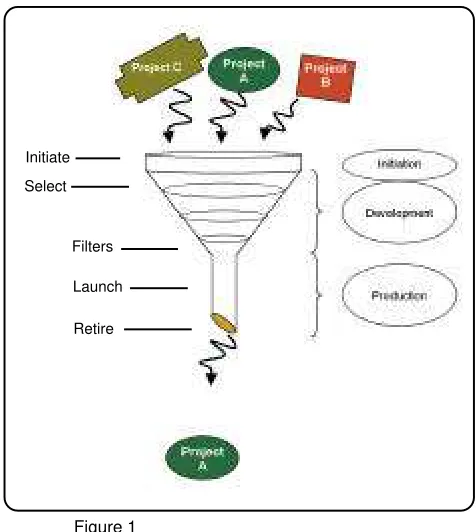
There are many ways, models and methodologies used when it comes to choosing a project. One of the models that I would like to share is called Funnel and Filters® Model. This model can be used in any ‘end-to-end’ life cycle of products or services process. There are three parts that made up the model. The parts are the head, the body and the leg. The illustration of the Funnel and Filters® Model are shown at figure one. The parts represent the phases that require us to follow in order to complete a project (PMBOK® Guide 2000 Edition). The phases are:
1. Initiation 2. Planning 3. Executing 4. Controlling 5. Closing.
The above 5 phases could be represented in three broad phases which are Initiation, Development and Production. In the illustration, any projects that enter the funnel at the top will go through the phases and moves along until it reach one point where it can be launched and officially closed.
Retire Launch Filters Initiate Select
Figure 1
In the funnel, individual project will be managed to achieve its objectives and collectively the projects are managed to achieve the portfolios objectives.
For further understanding of the Funnel and Filters® Model, let us go through the phases one by one.
Initiation Phase
In the initiation phase, managers together hand in hand with the project management office will do the assessment, feasibility studies/analysis and the selection of the project. In this phase, project ideas are initiated and each idea is evaluated on its individual merit as well as how it stacks up against the other competing ideas. The ideas go through a filter(s) that screens out those projects that are not deem worthwhile. The Selected ideas become ‘formal’ projects and enter the next phase
Development Phase
The objective of this phase is to develop the product or service that is targeted to be launched. The development took place in this phase is characterized by four phases. The phases are;
1. Planning 2. Execution 3. Control 4. Closeout.
e-Security
Malaysia Cyber Security CentreThus together with the initiation phase, this will form the overall five-phase project life cycle, this is as illustrated in figure two below (PMBOK® Guide 2000 Edition).
1. Initiation 2. Planning 3. Execution 4. Control 5. Closeout.
Throughout the development phase, the whole process may occur more then once. Each process is linked with each other by the results they produce. The process could also be overlapping with one another throughout the phase process. Finally, a close-out of a one phase could become the initiation of a next phase. For an example, a result of the design phase is an initiation for the implementation phase. Project Process is an article by it self. I will cover this in another time.
Let us go back to the Funnel and Filters® Model. Now, if you look back at the Funnel and Filters® Model figure one, you can find that the filters are aligned through out the development phase. Roles of filters represent the decision points made by the management. The first filter is where you select the right project. The second, third and forth filter is where we evaluate each project during the development. This will gives us decisions whether to remain, halt or terminate a project.
The filters will take place on regular cycle either semi-annual or annually when all the competing projects are evaluated at the same time for funding on their relative merit.
Generally, filters at head is to initial project selection as filters at the body of the funnel is where the project reprioritization and termination may be done after the project has been selected, funded and has made progress in the development phase.
Always remind yourself that filters is not a ‘stage/gates™’. ‘Stage/gates™’ is decision points specific to individual project in the portfolio where by the objective is to control project life cycle from one phase to the next phase. Where by decision made at the filters in the funnel is to compete at relative merit with other projects in the portfolio for further funding.
Lastly, we have reached the final phase which is the production phase. The production phase is the final product lifecycle. Here as a result we have produced a complete product that could be sold and maintain. As for services, it could only be involved supporting. At the end of the product cycles, the product will be obsolete and no longer be sold or supported. This is where we call, a product “retires” from its life cycle.
Any product/services considered for improvement or enhancement will take it as a new idea and had to go through a new life cycle. The Funnel and Filters® will restart again.
Finally, there are few key points that we should consider which is, each project is initiated based on organization strategic goals. This are investment rather that to be treated as an expensive. Therefore a project portfolio is an approach that can be use effectively to get the best returns. Secondly, a project is a temporary endeavor undertakes to create a unique product, service or result. Lastly, services or product undergone through an end-to-end lifecycle can be characterized by three broad phases which are initiation, development and production.
1 2
Initation
Planning
Control Execution
Close Out
e-Security
Malaysia Cyber Security Centre In today’s world a person needs a simple computer with aninternet access to gain illegal access to a company’s database where 90% of the organization’s sensitive information is nor-mally kept. As a result of such possibilities we will describe here some of the best techniques which can help improve the confidentiality and security of data.
This article discusses some of the numerous aspects of the architecture of a reliable database. The following topics are considered: Data Accessibility; Audit procedure, backup and restore strategy, encrypting of data, Insider attacks.
1. DATA ACCESSIBILITY:
Data accessibility is a major goal in database secu-rity. Many organizations can not work properly if databases are down. In other words they are mission-critical systems. To make the data available implies to provide the security mechanisms to ensure authen-tication, authorization and auditing procedures. Au-thentication means that user identity must be truly veri-fied, commonly through a password only known to the user. This is a critical phase in the foundation of the security strategy. After this first step has been com-pleted, the system must determine the resources that the particular user ID can have access to. This is the authorization phase and all the tasks involved are of-ten referred to as user security administration. Finally, to detect possible intruders and ensure data integrity, a u d i t i n g u t i l i t i e s m u s t b e a c t i v a t e d .
While on routing from server to receiver, data passes through different devices where, if security policies have not been applied or are defective, a third-party can get access to the packets. This is potentially dan-gerous with some kind of information such as credit card numbers, payrolls, social security numbers, and medical records, to name but a few. Obviously, this is a security threat that must be taken into strong con-sideration. We must ensure that data can only be seen by the same individual we sent the data to while avoid-ing data corruption by a third party. To achieve the former, encryption must be applied. Data integrity is usually ensured by means of certificates and public key encryption. Another important aspect is non-re-pudiation. This is extremely important in e-business because it makes sure that a sender cannot deny to h a v e s e n t t h e i n f o r m a t i o n .
Keeping Your Database Secure
2. AUDIT PROCEDURE:In many databases, auditing procedures are often inactivated. This helps to avoid decreasing the performance of the system. This however results in an important consideration: there are no records to study any illegitimate activity in the database. This does not mean that recording everything is the optimum solution. Depending on the system nature, an intelligent auditing strategy can be built to highlight security problems whilemaint a i n i n g d a t a b a s e p e r f o r m a n c e .
Auditors can use audit software to achieve their audit objectives. One popular database auditing solution is DB Audit created by Soft Tree Technologies. This solution helps ease the problems associated with enabling the built-in audit utilities of most databases. DB Audit is easy to customize and does not require installation of any additional software or services on the database server and network. It works with Oracle, Microsoft SQL Server, Sybase ASE, Sybase ASA, and IBM DB2.
This solution is implemented on the database back-end and eliminates any possibility of back door access that would otherwise be unrecorded. The benefits of using a solution such as DB Audit are:
i. Totally transparent system-level and data-change auditing of any existing applications
ii. Improved system security and ensured system accountability
iii. Centralized auditing control of multiple database systems from a single location, and
iv. Audit trail details that are normally unavailable from standard audit utilities.
Database Audit has many useful tools to help the auditor, including pre-built analytical reports that help reduce large amounts of audit data and tools to create custom reports and report filters. The solution also alerts management when changes are made to data within the tables.
A perfect data access auditing solution would address the following six questions:
i. Who accessed the data?
ii. When?
iii. Using what computer program or client software?
iv. From what location on the network? v. What was the SQL query that accessed the
data?
vi. Was it successful; and if so, how many rows of data were retrieved?
e-Security
Malaysia Cyber Security CentreA database backup strategy should be customized for the environment. It should take into consideration the system workload, usage schedule, importance of data, and hard-ware environment of the database. But there are some guidelines that apply to all databases. Incorporating these guidelines into the strategy will ensure more reliable and more cost effective backups. Here are the guidelines.
v Always maintain a log of your backup schedule v Occasionally store backups in a separate
location
v Spread your database across several disks
v Always consider your existing hardware
configuration and system workload
v Determine the volatility and value of your data v Verify the integrity of your database regularly v Verify the integrity of your backup media after
each backup
4. ENCRYPTING DATA:
Encryption in database will render data in storage or in transit to be meaningless to the unauthorized user. Illegal leaking of such data will not compromise protection of the database, as such; cryptographic controls can take a lion’s share where access, flow, and inference controls cannot.
It adds an important layer of protection that enforces security. Any user trying to access the data not only needs the right password, but the encryption key as well. One advantage of this schema is that files can be unreadable to people that have access to the database, such as a system administrator, but no databases privileges. Database encryption affects performance and a compromise solution must be found between performance and security, only encrypting tables, or columns with sensitive information.
5. INSIDER ATTACKS:
It is thought that most of the attacks come from outside but, in the real world, a large percentage of the security breaking incidents are made by insiders, people working in the same organization with extra knowledge about the database structure and security policy. It is estimated that 50% of identity theft cases are committed by employees within the organization who have access to the database.
If proper security recommendations are followed, damage caused by insider’s activities can be limited and audited.
Right security policies largely decrease risks by reducing vulnerabilities and strengthening defenses and countermeasures. A database server with important information is tempting for many people and appropriate measures have to be taken. They include the physical security of the server and the number of people accessing it.
The solutions shown above try to guarantee, in the greater degree, as much as possible, both database and data security. The importance to do so has been also highlighted and there is a general recognition that these methods must be applied in the highest level, mostly in databases with very sensitive information. Availability of funds to apply a good security policy is an important feature, but human factor is also essential. Good Database administrators and security managers can handle system resources and improve security by applying some basic low-cost techniques, reducing vulnerabilities and eliminating backdoors. In summary we cannot eliminate risks but we can manage them properly.
CONCLUSION 3. BACKUP AND RESTORE STRATEGY
REFERENCES
i. BrainTree. “Client/Server Database Security”. URL:
http://www.bti.com/Whitepapers/3-Tier_Data..._down2/Cswp.pdf
ii. ISS. “Network and Host-based Vulnerability Assess-ment”. URL: http://www.iss.net/prod/whitepapers/ nva.pdf
iii. ISS. “Secure E-business”. URL: http://www.iss.com/ prod/whitepapers/securityebus.pdf
iv. ISS. “Securing Database Servers”. URL: http:// documents.iss.net/whitepapers/securedbs.pdf
v. Le Tocq, Chris & Young, Steve. “SET Comparative Performance Analysis”. 2 Nov 1998. URL: http:// www.setco.org/download/setco6.pdf
vi. Legato. “Manager’s Guide to Informix Database Protection”. URL: http://www.iqproducts.de/ iqproducts/whitep...de_informix.pdf
vii. Mattsson, Ulf. “Secure Data Technology Overview”. 27 Apr 2001. URL: http://education.protegrity.com/ downloads/...eData_IBMv1.pdf
viii. Pentasafe Security Technologies, Inc. “Common Vulnerabilities in Database Security”. May 2001. URL: http://www.pentasafe.com/whitepapers/ penta...erabilities.pdf
ix. Sybase Inc. “What Backup, Recovery, and Disaster Recovery Mean to Your Adaptive Server Anywhere Databases”. 15 Jun1999. URL: http://
www.sybase.com/detail/1,3693,47877,00.html
x. Turner, Tom. “Securing the Database: What are the Issues?” URL: http://www.itaudit.org/forum/ security/f218se.htm
e-Security
Malaysia Cyber Security Centre Noise is the unwanted sounds that exist inside audio recordingssuch as clicks, hiss and static. Its presence is unavoidable no matter how professionally the audio recording process is done. Audio noise presence is more obvious inside an analog recording as compared to digital.
Audio noise only becomes a problem if it was produced within a human listening range (20Hz-20KHz). Otherwise its existence can be masked by other louder elements.
Distortion is similar to noise except distortion has some key characteristics. Audio noise is something that is produced by an outside signal such as a hum. Meanwhile distortion is the signal modification (special effects) on the signal itself.
Types of Noise
The ability to recognize the types of noise is also crucial for audio forensics analysts whilst performing audio restoration process. This will help audio forensics analysts, as they can plan their audio restoration strategy before performing any audio restoration processes.
Broadband Noise
Broadband noiseis also known as continuous noise, such as hiss and static that is present at all frequencies, at a given range. In every audio recording there will be a certain amount of broadband noise albeit it was done by professional audio engineers using high-end equipments.
Narrowband Noise
This refers to a sound which occupies a narrow range of frequencies such as hums or buzzes as opposed to broadband or wideband noise. Hums are usually caused by incorrect grounding and poorly shielded cables.
Thermal Noise
It’s produced from the electronic circuit itself and impossible to eliminate. However it can be minimized by using added quality components such found inside a high-end sound cards and audio interfaces.
Impulse Noise
It includes a short and sharp sound like clicks and pops. Clicks usually are introduced by minor scratch or small mark caused by dust on a record or CD. Usually it’s gathered during recording sessions when digital device is not synchronized. Pops appear due to bad scratch. When the recording is opened in a waveform editor, these clicks and pops will appear like a sharp spike or a deep gap.
Click is distinguished with a narrow spike and might even span a few samples (A sample or data point on a standard CD
resolution is 1/44100 per second). Pop is formed by multiple clicks in a row.
Irregular Noise
Irregular Noise includes sound such as background conversation, traffic and rain. These sounds are near impossible to eliminate owing to the fact that they were formed by multiple random sounds in dissimilar frequencies and decibels.
Conclusion
The Objective of Audio restoration process is aimed to significantly reducenoise inside an audio recording at a minimal level possible. Audio restoration processes require very much the use Audio Forensics analysts, as long as it involves eliminating various types of audio filters and noise elimination.
1) Identifying phishing/fraudulent attempts:
a) Legitimate online businesses will never ask you for sensitive personal information such as passwords, bank account or credit card numbers, PIN numbers, or Social Security numbers via e-mail. So, if you were asked to reveal this information online, this may be a fraudulent attempt.
b) Phishers normally use convincing messages to ask users to go to their websites and enter personal/sensitive information on the phishing website. It would be advisable to scan the types of messages contained in the email prior to visiting the websites.
Among messages to be cautious of are as follows:
• Security or server updates, maintenance upgrades, online banking problems
• Billing information requests or billing issues
• Official or urgent notices
• Account updates e-mail or account verification requests
• Consumer alerts, customer warnings
• Your account has been, or may be, suspended or needs to be reactivated
• Problems with your account, errors found
1 5
Noise (audio)
e-Security
Malaysia Cyber Security Centre• Suspicious transactions, fraud investigation, unusual activity
• Someone sent you money, payment acknowledgments, order confirmations, lottery wins, jackpot wins, competition wins
• Requests for assistance with fund transfers (the infamous ‘Nigerian’ scam)
• Offers of advice on how to protect yourself from fraudulent transactions, identity theft solutions
c) The phishing email does not address a user by his/her name.
d) No confirmation of the company that does business with you, such as referencing a partial account number.
e) The email warns that your account will be shut down unless you reconfirm your financial information.
f) Spelling or grammatical errors in the phishing emails.
2) Avoiding phishing attempts
a) Do not respond to e-mails requesting for your personal information. Legitimate companies do not ask their customers for confidential information, such as passwords and account numbers, though e-mail.
b) Do not open attachments or download files. Phishers can use these files to infect your computer with a virus or spy ware.
c) Do not click on links provided in e-mails. If you are uncertain about a website address that appears in an e-mail, go to your browser and enter the legitimate address manually. Phishers can use links to point recipients to a “spoofed” site, using an address similar to a real bank’s URL. If in doubt, phone the business in question. Use a phone number that you have obtained from a reliable source, and not from the suspected e-mail.
d) Do secure your computer. Uses updated anti-virus software, personal firewalls and apply latest security patches for your operating system and browser to secure your system from unwanted incidents. Anti-spam software can also help stop phishing e-mails from getting into your inbox. Some phishing e-mail may try to release a virus onto your computer.
Internet Explorer (IE) users can download a special patch to protect against certain phishing schemes.
The download is available at:
www.microsoft.com/security/
e) Do report suspicious e-mails to the legitimate company, to your Internet Service Provider (ISP) or to your Computer Emergency Response Team (CERT).
f) Do review your credit card and bank statements regularly to check for errors or unauthorized transactions. If anything looks suspicious, do contact your bank and all card issuers.
g) Do install a Web browser tool bar to help protect you from known phishing fraud websites.
EarthLink ScamBlocker is part of a free browser toolbar that alerts you before you visit a page that’s on Earthlink’s list of known fraudulent phisher Web sites.
Free download is available at:
http://www.earthlink.net/earthlinktoolbar
h) Do consider protecting yourself from dangerous scripts and spammers and phishers. Software such as the latest version of Outlook Express does make it much easier to do this.
3) Reporting a phishing case
Upon receipt of a report from user, Malaysian Computer Emergency Response Team (MyCERT) will perform below:
a) Verify the existence of the reported phishing site and check if the phishing site is still online or offline.
b) Find out the administrator/location of the Internet Protocol (IP) address where the phishing site is hosted by using ‘whois’ search tools. ‘Whois’ is an Internet database that provides information on a person or an organization.
c) Communicate with the administrator of the IP to shutdown the phishing site immediately, within 3 hours if the phishing site is hosted locally and within 24 hours if the phishing site is hosted overseas. For phishing sites hosted overseas, a copy of the notification will be carbon copied to the respective CERT of the country.
d) Monitor the phising sites from time to time if it is still online after notifying the relevant parties, locally and overseas. If it is still online, we shall send reminders to the respective parties.
e) Phishing sites that are not shutdown within 24 hours of notification, particularly the ones hosted on foreign servers, will be referred to the Law Enforcement Agency, the Malaysian Communications and Multimedia Commissions (MCMC), for further action.
e-Security
Malaysia Cyber Security Centre In just three short years, the use of stealth techniques inmalicious software (malware) has grown by more than 600 percent. The shocking increase has indicated that rootkits are a pervasive and evasive threat to today’s systems. With its increasingly sophisticated stealth techniques, the detection of rootkits and stopping the damage becomes significantly challenging
The History of Stealth Malware (a.k.a Rootkits)
Originally, a rootkit was simply a collection of tools that enabled administrator-level access (also known as root access in the Unix world) to a computer or network. The term referred to a set of recompiled Unix tools, including ps, netstat, ls, and
passwd. The term rootkit became associated with stealth
because the same tools could be used by an attacker to hide any trace of intrusion. When these same strategies were applied to the Windows environment, the rootkit name transferred with them. Today, rootkit is a term commonly used to describe malware – such as Trojan, worms and viruses – that actively conceals its existence and actions from users and other system processes.
The practice of hiding malware from the prying eyes of users and security products dates back to the very first PC virus, Brain1, which was released in 1989. Brain escaped detection
by intercepting PC boot-sector interrogations and redirecting the read operations to elsewhere on the disk. Virus authors soon recognised that the longevity of any virus was critically dependent upon such stealth techniques when, in 1987, the Lehigh virus2 was quickly contained after its release because
it made no such attempt to hide its presence.
Malware authors continued to develop ever more complex DOS viruses throughout the late 1980s and early 1990s, adding innovative stealth techniques to mask detection. The advent of the Internet brought new opportunities and capabilities to both attackers and
1 Brain, http://vil.nai.com/vil/content/v_221.htm 2 Lehigh, http://vil.nai.com/vil/content/v705.htm
defenders. For malware authors, it added new propagation vectors and masses of exploitable victims. For system defenders, it provided new means of real-time network detection with intrusion prevention system (IPS) devices and other traffic-monitoring equipment to watch for the telltale signs of malicious activity.
Rootkits, Malwares
Malware comes in may form. There are, however, differences between viruses, Trojans, worms and potentially unwanted programs (PUPs). Viruses, like their biological analogues, are
self-replicating programs that can also steal confidential information, block system resources, destroy information or perform other malicious acts. Trojans are programs that appear to be benign or even useful software applications on the surface but harbour malicious code within. While Trojans are not self-replicating, they can cause an infected computer to download other malware that is. Worms are malware that replicate by spreading copies of themselves through a shared network, floppy drives or even USB drives, often autonomously without human intervention. Although similar to Trojans and other malware in that they often steal confidential and private information, PUPs are distinct because they are installed and executed with the tacit approval of the user.
Stealth technology, however, is not the exclusive domain of malware. PUPs and commercial software applications are increasingly employing stealth technologies to prevent their removal. In April 2005, Adware-Isearch3 was one the first
adware found to use stealth technology. Since then, several others have been discovered, including Apropos4, Qoolaid5 and
DigitalNames6all of which were reclassified as Trojans because
they posed a significant threat to the user.
Rootkit Technology Trends
3 Adware-Isearch, http://vil.nai.com/vil/content/v_133320.htm 4 Apropos, http://vil.nai.com/vil/contents/v_137345.htm 5 Qoolaid, http://vil.nai.com/vil/content/v_126149.htm 6 DigitalNames, http://vil.nai.com/vil/content/v_135063.htm
In this section, we explore the reasoning behind the increase in rootkit adoption and diversity, the motivation driving rootkit writers and the technology trends that will shape the future of rootkits.
Trend 1: Rootkits spread beyond Trojans to other forms of malware and PUPs
Over the past three yeas, the incidence rate of stealth technology in malware, PUPs and commercial applications has more than sextupled. As Graph 1 shows, the use of stealth technologies was no longer the exclusive domain of Trojans in 2005, turning up in other forms of malware, as well as PUPs and commercial applications.
1 7