arXiv:1709.05953v1 [quant-ph] 14 Sep 2017
Stephen M. Barnett and Matthias Sonnleitner
School of Physics and Astronomy, University of Glasgow, Glasgow G12 8QQ, United Kingdom
We know that in empty space there is no preferred state of rest. This is true both in special relativ-ity but also in Newtonian mechanics with its associated Galilean relativrelativ-ity. It comes as something of a surprise, therefore, to discover the existence a friction force associated with spontaneous emission. The resolution of this paradox relies on a central idea from special relativity even though our deriva-tion of it is non-relativistic. We examine the possibility that the physics underlying this effect might
be explored in an ion trap, via the observation of a superposition of different mass states.
“The term ‘holistic’ refers to my conviction that what we are concerned with here is the fundamental interconnectedness of all things. I do not concern myself with such petty things as fingerprint powder, telltale pieces of pocket fluffand inane footprints. I see the solution to each problem as being detectable in the pattern and web of the whole. The connections between causes and effects are often much more subtle and complex than we with our rough and ready understanding of the physical world might naturally suppose.”
Douglas Adams [1]
I. INTRODUCTION
It has long been appreciated that the optical Doppler shift could be used to cool a gas of atoms [2] or a trapped ion [3, 4]. The essential idea is that a narrow-line laser tuned below a resonant transition frequency for the atom will be absorbed, preferentially if the atom is moving towards the light source because of the Doppler shift and hence be slowed down so as to accommodate the momentum of the photon [5]. If the absorption of a laser photon is followed by spontaneous emission a further photon can be absorbed and, after a number of cycles, the average velocity of the atom is reduced. If the single laser beam is supplemented by five more then Doppler cooling can be achieved in three dimensions [6] and an atom feels an average frictional forceF=−αv, wherevis the velocity of the atom. These ideas were the seed from which the field of laser cooling and trapping, and much else besides, has flowered [7].
Hidden within the combination of the optical Doppler shift and the interaction between light and atoms is a paradox, which we have identified recently [8]. The point is simply made: an excited atom in an otherwise empty region of space can return to its ground state by the spontaneous emission of a photon. In doing so it receives a recoil so as to conserve momentum; if the emitted photon has momentum~kthen the momentum of the atom
changes, correspondingly, by −~k. If the atom is stationary then the essentially isotropic nature of spontaneous
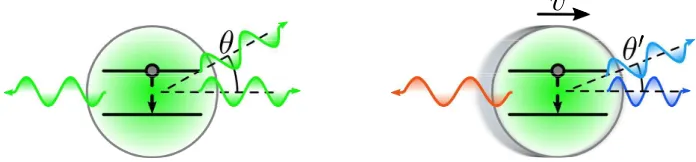
emission means that there the net oraveragechange in the momentum is zero. If the atom is moving, however, then a photon emitted in the direction of motion of the atom will have, by virtue of the Doppler shift, a higher frequency and hence a higher momentum than one emitted in the opposite direction, as depicted in Fig. 1. If we take the average over these events we are led to a net reduction in the momentum of the atom in the emission process. This reduction, moreover, is proportional to the velocity of the atom. In short, we have a friction force associated with the spontaneous emission event. Yet the existence of a force in one frame that does not exist in another seems to be at odds with both the Galilean and Einsteinian principles of relativity. Hence we have a paradox.
Our earlier publication on this problem was necessarily somewhat formal and rigorous [8]. Our aim here is to
Figure 1: Illustration of the (spontaneous) emission process of an atom at rest (left figure) or moving at speedv(right). An atom at rest emits photons of the frequencyω0in all directionsθso that the average recoil is zero. A moving atom emits photons of
frequencyω′0≈ω0
present the key ideas in a more physical fashion. We shall find that the resolution of the paradox lies in a key idea from special relativity, but the remarkable feature of our analysis is that it requires ideas familiar only from non-relativisticphysics. We consider also the possibility that the central idea involved in this resolution might be observable in an ion-trap experiment.
II. VACUUM FRICTION: A PHYSICAL DERIVATION
Let us consider the spontaneous emission by an atom via an electric-dipole transition. A simple calculation based on Fermi’s golden rule gives the spontaneous emission rate [9]
Γ= ω
3 0|d|2
3πǫ0~c3, (1)
wheredis the transition dipole matrix element andω0 is the atomic transition frequency. If the atom is moving then there will be a change to this decay rate but only that required by the time-dilation of special relativity, as may be confirmed by direct calculation [10]. This effect is of second order in the velocity and will not be of concern to us
in this paper; we are interested in those effects that arise at first order inv/c.
We can apply physical reasoning to arrive at least at an approximate form for the paradoxical friction force and it is instructive to follow this approach. To this end we introduce the idea of a spontaneous emission rate into an infinitesimal solid angle,
dΓ=ΓdΩ
4π, (2)
which is simply the spontaneous emission rate multiplied by the probability of emission into the solid angledΩ. If we integrate this over all directions of emission then we recover the full spontaneous emission rate,RdΓ=Γ.
If the atom is stationary then the emitted photon will carry away an amount of momentum given by~k0=~ω0/c.
The net or average recoil force on our atom is simply
F = −
wherePe(t) is the probability that the atom is still in the excited state at timet. The zero value of this net force is a direct consequence of the lack of a preferred direction for the spontaneous emission which is, itself, a consequence of the isotropy of empty space.
If the atom is moving then this motion selects for us a direction in space. Let us take this direction to define the z-axis so that the atomic velocity isv=vzˆ. Because of this motion the Doppler effect means that the frequency of the
emitted photon will depend on the direction in which it is emitted. If the angle between the direction of the emitted photon and thezaxis isθthen the observed frequency of the photon will be
ω0′ =ω0
If we insert this Doppler-shifted frequency into our expression for the net force we find a first tentative expression for the force due to spontaneous emission on a moving atom:
which has the characteristic form of a friction force. Here we have exploited the rotational symmetry about the z-axis to infer directly that the force must be parallel to this axis.1
Is there anything we have left out and, in particular, is there any non-relativistic effect that is missing? The
answer, of course, is yes and the additional feature is the aberration of light due to motion. This is a familiar element of special relativity where the constancy of the speed of light leads to a modification of the angles measured in different frames and this requires us to replace the cosines and sines by [11]
cosθ→cosθ′ = cosθ+v/c 1 + (v/c) cosθ
sinθ→sinθ′ = sinθ
γ(1 + (v/c) cosθ), (6)
whereγis the usual Lorentz factor,γ= (1−v2/c2)−1/2. It is important to note, however, that this idea is much older than relativity. Indeed it was first noted by Bradley in 1729 [12] in the response to the appearance of consistent discrepancies in the measurement of stellar parallaxes. Bradley’s explanation for this was a modification in the perceived angles due to the finite value of the speed of light:
“And in all Cases, the Sine of the Difference between the real and visible Place of the Obje, will be to the Sine of the visible Inclination of the Objeto the Line in which the Eye is moving, as the Velocity of the Eye to the Velocity of Light.” [12].
Putting these words into mathematical form we arrive at
sin(θ−θ′) =v
csinθ′, (7)
which is readily recovered from the relativistic expression (6) in the limit of small velocity. Rather than work with Bradley’s expression it is more transparent (although strictly equivalent) to work with the relativistic formula and restrict ourselves to low velocities by working to first order inv/c. The aberration means that the angle between the z-axis and the direction of emission of the photon, the term cosθin our expression for the force should be replaced by cosθ′. If we make this substitution then we arrive at the correct expression for the net force:
F = −e−Γt
As a check of this idea we can work with the primed angle,θ′, and note that this involves a change in the integration variable
d(cosθ′) = d(cosθ) (1 + (v/c) cosθ)2
⇒dΩ = dΩ′(1 + (v/c) cosθ)2. (9)
Evaluating the net force in this manner and again working to first order inv/cgives
F = −e−Γt
where we have again worked to first order inv/c. We have arrived at the same expression by using two sets of angles, θandθ′. In the first we take account of the aberration by transforming the angle of emission, but in the second it is the solid angle into which the emission occurs that is transformed.
The above analysis considered isotropic emission and one might wonder if our simple result changes for a more general emission pattern. A general emission pattern is defined by a quantity γ(k), the rate at which light with wavevectorkis emitted, if the atom is in the excited state. The total decay rate is thus
Γ=
Z
γ(k)d3k, (11)
where we integrate over all directions and frequencies,d3k=ω2dωdΩ. As before we express the wavevector in spherical coordinates,k=ω/c(sinθcosφ,sinθsinφ,cosθ)T. In the rest frame of the emitter we get a recoil force
F=−e−Γt Z
d3k~kγ(k). (12)
For a spontaneously decaying atomγ(−k) =γ(k) and this net recoil force in the rest frame is, of course, zero. In a frame where the emitter is moving at a velocityv=vzˆ, we expressk′using the Doppler shift and aberration to first order,
where we used the aberration formula, equation (6), to arrive at the last line. We could also have used Bardley’s non-relativistic expression as we are working only to first order inv/c.
It is not necessary to give an explicit transformation for the general emission patternγ(k), as we know that the amount of radiation emitted into each volume element must be invariant, so that
γ(k)d3k=γ′(k′)d3k′. (14)
As the decay rateΓonly changes with second order in velocity, we can express the force in the moving frame in terms of the unprimed quantities,
and we again find a friction force proportional to the velocity of the atom.
The spontaneous decay rate depends on the density of modes at the transition frequencyω0 and so we write γ(k) =δ(ω−ω0)γe(Ω) where we can set
R
dΩγe(Ω) =Γ/ω2
0such that (11) is satisfied. It follows that the average or net force is
in agreement with our earlier expression (8).
III. RESOLUTION OF THE PARADOX
If you ask a class of physics students to state Newton’s second law of motion, it is likely that the answer you will get (apart from those smart enough to spot a trap) will beF=ma. If we apply this to the force we have just derived then we find
˙
v=−e−Γt~ω0
mc2Γv, (17)
wheremis the mass of the atom. This effect is certainly small: it is proportional to the ratio of the photon energy
to the rest-mass energy of the atom and this ratio is typically of the order 10−10. There is an important point of principle, however, in that if the deceleration exists, whatever its value, then we have a conflict with relativity, both of the Einsteinian and Galilean forms. To emphasise this point we can integrate this equation to find the net change in the velocity of the atom:
v(∞) = exp −~ω0
mc2 !
v(0)≈ 1−~ω0
mc2 !
v(0). (18)
So, if true, this says that the observed speed of the atom is reduced by a simple factor and that this is the case, moreover, irrespective of the speed of the atom. So if we see an excited atom in motion then, on average, following the emission the speed will be reduced but if we are co-moving with the atom then there is no corresponding average change in the speed. This cannot be true.
The resolution of the paradox comes from a surprising place in that it embodies an intrinsically relativistic notion, indeed perhaps the most famous idea in relativity - the equivalence of energy and mass or inertia. In the physics class mentioned above you might find a student who pauses to spot the catch and says, in answer to the question, “force equals rate of change of momentum”.2 ,F= ˙p. They might recall, for example, the classic problem of the motion of a space rocket, that burns fuel and, in the process, reduces its mass [15]. If this is the resolution of the paradox then we can only infer that the emission of the photon corresponds to a loss of mass by the atom. Let us see where this leads us. If we allow for the possibility that the emission process changes the mass of the atom then Newton’s second law gives us:
˙
mv+mv˙=−e−Γt~ω0
c2 Γv. (19)
A change in the average velocity is, as we have seen, paradoxical and suggests that we should set ˙v= 0. If we do this we are left with a simple equation for the rate of change of the mass of the atom:
˙
m=−e−Γt~ω0
c2 Γ. (20)
Which leads directly to the suggestion that the atom is lighter after emitting the photon than when it was prepared initially in its excited state:
m(∞)−m(0) =−~ω0
c2 . (21)
From the viewpoint of those schooled in special relativity this makes perfect sense: the transition has lowered the total energy of the atom by~ω0 and using the most famous equation in physics,E=mc2, we are led to conclude
that the ground state atom is indeed lighter than the excited state atom by precisely ~ω0/c2. Indeed very early
in the development of relativity, Einstein established this relationship between a change in internal energy and a change in inertia [16]. From the viewpoint of special relativity this is entirely unsurprising, of course, given the close relationship between momentum and energy, which combine as a four-vector.
Taking this view, however, misses our point. We have employed an entirely non-relativistic analysis to arrive at a paradox the only resolution of which seems to imply the necessity of a central feature of special relativity. Perhaps Adams’s eponymous hero Dirk Gently was indeed correct and that there is a fundamental interconnectedness in the physical world and the need for a holistic approach.
2Newton’s statement was: “Mutationem motus proportionalem esse vi motrici impressae & fierisecundum lineam ream qua vis illa
IV. POSSIBILITY OF AN ION-TRAP EXPERIMENT
Is there an experiment to be done in order to test these ideas? As stated, the lack of a change in the average velocity of a radiating atom would be a difficult, and perhaps not very satisfying, result to establish. It is indicative
of the scale of the challenge that we would be seeking to find no net change as opposed to a change of perhaps one part in 1010. There is an interesting experimental challenge, however, the demonstration of which would verify the resolution presented above. This is to show that an atom prepared in an electronically excited state has a smaller mass than one in the ground state and that this difference is given by the transition energy divided by the square of
the speed of light.
To show that an excited state is more massive than a ground state requires a mass measurement with a precision of ~ω0/mc2 which, for visible light and an atomic mass will be of the order of one part in 1010. It is reasonable
to start with the observation that such a measurement, if it is possible, will require a significant period of time to perform and this means, necessarily that we need to identify an atom with a very long-lived excited state. We note that ion traps have been used to measure atomic masses with a precision of 1−10keV [17]. Although this is roughly three orders of magnitude larger than the typical optical transition energy we are seeking to measure it is at least encouraging. Excited ionic states with very long lifetimes are known, moreover, and some of these have been considered as candidates for frequency standards. For these reasons it is natural to consider an ion trap experiment as the way to test this idea. We shall not propose a specific implementation here but rather present a “back of the envelope” assessment of what might be possible with currently available technology.
Let us consider a single ion, prepared in its ground state and trapped in a harmonic trap with trap angular frequencyΩ=√k/m, wherekis the trap stiffness andmdenotes the mass of the ion. Using suitable optical pulses
we can transfer the ion into a superposition of the initial ground state and a suitably chosen metastable excited state, separated from the ground state by the energy~ω0. If this is performed using a two-photon transition, then this can
be done without affecting the motional state of the ion, which will continue to undergo harmonic oscillations in the
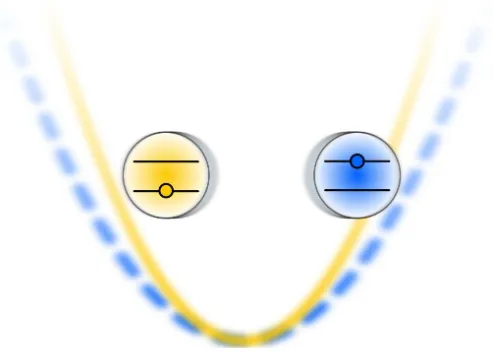
trap. The ground and excited states, having different masses, will oscillate at different frequencies in the trap, as
depicted in Fig. 2. The frequency of oscillations for the excited state,Ω∗, and for the ground state,Ω, are related by
Ω∗=
It follows that even if the motional state is unchanged in the creation of the superposition, the subsequent motion will become entangled with the internal ionic state, as if the two states were associated with different potentials. The
time taken for the motions of the ground and excited states to first become maximally separated is
T= π
To observe this separation of the ground and excited states would certainly be technically demanding but is not a hopeless task. The first requirement is for a long-lived excited state so that the experiment can be performed before the metastable state decays. Ions studied for possible frequency standards have been shown to have very long-lived metastable states. These include the171Yb+ion; its2F7/2-state is remarkably stable with a lifetime of several years [18, 19]. The transition frequency between this state and the ground state isω0/(2π) = 642 THz and this means that
~ω0/(mc2)≈1·36×10−11. Hence the maximum spatial separation between the ground and excited states will occur
after about 7·4×1010motional periods. For a trap frequency of 1·3 MHz [19] this corresponds to a time of 5·7×104s or 15 hours, which is substantially less than the excited-state lifetime. One would, of course, have to keep the trap stable and avoid interruptions to the ion, such as collisions with background gas atoms.
Although challenging, there is a subtle and highly unusual feature of the proposed experiment that makes it worthy of further consideration. This is the fact that we are exploring a superposition ofdifferent massstates rather than energy states as the spatial separation of the wave-packets for the ground and excited states depends on the difference in rest masses for these states. It is interesting to note that there are good reasons arising from Gallilean
invariance why such a superposition is not possible in non-relativistic quantum theory, although this restriction does not extend to the relativistic domain [20].
V. CONCLUSION
Figure 2: As the oscillation frequency of a trapped ion depends on its mass, Ω∼(m)−1/2, an ion in an excited internal state oscillates at a different frequency,Ω∗∼(m+~ω0/c2)−1/2.
corresponding necessity of a preferred frame of absolute rest. The existence of such a state of absolute rest would be in direct conflict with special relativity but also with Newton’s mechanics and, in particular, with his first law of motion.
The quantitive resolution of the paradox is, as we have seen, that the exited atom loses mass in undergoing sponta-neous decay and that the amount of mass lost is precisely~ω0/c2. When we combine this idea with energy
quantisa-tion we are led directly toE=mc2, a key consequence of special relativity. The remarkable feature of this, however, is no explicitly relativistic ideas were used to derive it; we needed to use only non-relativistic quantum theory, the first-order Doppler shift and Bradley’s 1729 notion of aberration due to motion. We may ponder the point at which relativity sneaked into our analysis or simply marvel at the way in which in physics seems to take care of itself and has no regard for our attempts to classify parts of it as classical or quantum, or as relativistic or non-relativistic.
Endnote (SMB)
Danny Segal was a lovely man, a generous and caring teacher, and a talented, enthusiastic and imaginative physi-cist. He enjoyed, perhaps especially, the absurdities that our chosen discipline throws up from time to time and I would very much loved to have had the chance to show to him the one presented above, to benefit from his wisdom and to see him smile.
Acknowledgement
We are grateful to Nils Trautmann, Mohamed Babiker, Jim Cresser and Helmut Ritsch with whom we have enjoyed many interesting discussions on this topic.
Disclosure statement
The authors declare no conflict of interest.
Funding
Publisher’s statement
This is an Accepted Manuscript of an article published by Taylor & Francis inJournal of Modern Optics on 14 September 2017, available online: http://www.tandfonline.com/10.1080/09500340.2017.1374482
[1] Adams D.Dirk Gently’s Holistic Detective Agency; Heinemann: London, 1987.
[2] H¨ansch, T. W.; Schawlow A. L. Cooling of Gases by Laser RadiationOpt. Commun.1975.13, 68–69.
[3] Wineland, D.; Dehmelt, H. Proposed 1014∆ν < νLaser Fluoresence Spectroscopy onT l+Mono-Ion Oscillator IIIBull. Am. Phys. Soc.1975,20, 637–637.
[4] Mavadia, S.; Stutter, G.; Goodwin, J. F.; Crick, D. R.; Thompson, R. C.; Segal, D. M. Optical Sideband Spectroscopy of a Single Ion in a Penning TrapPhys. Rev. A2014,89, 032502.
[5] Adams, C. S.; Riis, E. Laser Cooling and Trapping of Neutral AtomsProg. Quant. Electr.1997,21, 1–79.
[6] Chu, S.; Hollberg, L.; Bjorkholm, J. E.; Cable, A. and Ashkin, A. Three-Dimensional Viscous Confinement and Cooling of Atoms by Resonance Radiation PressurePhys. Rev. Lett.1985,55, 48–51.
[7] Ashkin A.Optical Trapping and Manipulation of Neutral Particles Using Lasers; World Scientific: New Jersey, 2006.
[8] Sonnleitner, M.; Trautmann, N.; Barnett, S. M. Will a Decaying Atom Feel a Friction Force?Phys. Rev. Lett.2017,118, 053601. [9] Loudon, R.The Quantum Theory of Light, 3rd ed.; Clarendon: Oxford, 2000.
[10] Cresser, J. D.; Barnett, S. M. The Rate of Spontaneous Emission of a Moving AtomJ. Phys. B: At. Mol. Opt.2003,36, 1755– 1759.
[11] Rindler, R.Relativity Special, General and Cosmological, 2nd ed.; Oxford University Press: Oxford, 2006.
[12] Bradley, J. A Letter from the Reverend Mr. James Bradley Savilian Professor of Astronomy at Oxford, and F. R. S. to Dr. Edmund Halley Astronom. Reg. &c. Giving an Account of a New Discovered Motion of the Fix’d Stars.Phil. Trans.1729,35, 637–661.
[13] Newton, I.Philosophae Naturalis Principia Mathematica; Royal Society: London, 1686. [14] Ball, W. W. R.An Essay on Newton’s “Principia”; Macmillan: New York, 1893.
[15] Fowles, G. R.; Cassidy, G. L.Analytical Mechanics5th ed.; Harcourt Brace: Fort Worth, 1993.
[16] Einstein, A. Ist die Tr¨agheit eines K¨orpers von seinem Energieinhalt abh¨angig?Ann. Phys. (Berlin)1905,323, 639–641. [17] Blaum, K.; Dilling, J.; N¨ortersh¨auser, W.; Precision Atomic Physics Techniques for Nuclear Physics with Radioactive Beams
Phys. Scripta2013,T152, 014017.
[18] Roberts, M.; Taylor, P.; Barwood, G. P.; Gill, P.; Klein, H. A.; Rowley, W. R. C. Observation of an electric octupole transition in a single ionPhys. Rev. Lett.1997,78, 1876–1879.
[19] Roberts, M.; Taylor, P.; Barwood, G. P.; Rowley, W. R. C., Gill, P. Observation of the2S1/2–2F7/2electric octupole transition
in a single171Yb+ion.Phys. Rev. A2000.62, 020501.