98
Ummah, Nuzula Khoiro dkk:
The Development Of Learning Material Based On Field Trip Strategy
THE DEVELOPMENT OF LEARNING MATERIAL BASED ON FIELD TRIP STRATEGY
FOR THE TOPIC OF ECOSYSTEM TO TRAIN STUDENT’S CRITICAL THINKING SKILLS
Nuzula Khoiro Ummah
Biology Education, The Faculty of Mathematics and Natural Sciences, Universitas Negeri Surabaya, Gedung C3 Lt 2. Jalan Ketintang, Surabaya 60231
Email: [email protected]
Endang Susantini
Biology Education, The Faculty of Mathematics and Natural Sciences, Universitas Negeri Surabaya, Gedung C3 Lt 2. Jalan Ketintang, Surabaya 60231
Email: [email protected]
Abstract
The objective of this research was to produce learning material based on field trip strategy for the topic of ecosystem to train students' critical thinking skills. The development of learning material referred to four D-models, consisted of define, design, and develop phase, however, disseminate phase was not conducted. The developed learning material consisted of lesson plans (Rencana Pelaksanaan Pembelajaran = RPP), student worksheets (Lembar Kegiatan Siswa = LKS), and pretest posttest questions. The observed parameters were validity and practicality of the learning material. The data of validity based on the validation of an education expert, as well as the validation of an expert on subject matter namely ecosystem and a biology teacher were analyzed based on mode. The data of practicality based on lesson plan implementation and student’s activity were analyzed based on the average value fromeach meeting.The results showed that the validity of the lesson plans, student worksheets and pretest posttest questions were; 100%, 100%, 100% respectively. The results of practicality based on lesson plan implementation and students’ activity obtained a value of 94.49% and 93.88%. Based on these results, it can be concluded that this learning material was suitable to be used in training the critical thinking skills.
Key Words : learning material, field trip, critical thinking skills, ecosystem
INTRODUCTION
The 2013 Curriculum is a curriculum that requires students to think critically in solving problems and applying the learning materials (Kemendikbud, 2014). However, in reality, in term of critical thinking skills, Indonesian students are still considered low. It can be seen from the achievement of Indonesia in the latest data of PISA study which was ranked 64 out of 65 countries (OECD, 2014). This low rank was mainly due to the fact that the materials being tested in PISA consisted of several aspects, one of which involved problem-solving abilities. Indonesian students did not use their understanding to support their problem solving. The level of understanding was still relatively low and also
because students only memorized the simple fact-based knowledge acquired in the classroom.
99
Ummah, Nuzula Khoiro dkk:
The Development Of Learning Material Based On Field Trip Strategy
Banyuurip mangrove forest, located in Banyuurip Ujung Pangkah.
One of the strategies that can support the learning in the mangrove forest is the field trip strategy. The field trip is a strategy where the teacher take the students to interesting location, to interact with outdoor environment outside the classroom in order to connect the students’ theoretical knowledge with real experience in the field trip location (Behrendt and Franklin, 2014; Guler and Afacan, 2013). There are some activities in the field trip that can train students to achieve some indicators of critical thinking skills such as formulating problems, giving arguments, inducting, evaluating and making conclusions (Ennis, 2001).
A study conducted by Ernst and Monroe (2013) concluded that the learning associated with the environment and implemented outside classroom to the student grade XII, has been proven giving a positive effect on improvement of critical thinking skills with the acquisition of critical thinking test scores 5.54, this was higher by 76 points compared to the students who learned the same subject but did not connect to the environment. Based on the description of the background, the objective of this research was to produce learning material based on field trip strategy for the topic of ecosystem to train student’s critical thinking skills.
METHOD
This developmental research used the 4-D model (Thiagarajan, et al., 1974) which consisted of four phases namely define, design, develop, and disseminate. However, in this study disseminate phase was not implemented due to inadequacy of time and cost. The research was carried out during the period of September 2016 to March 2017. The implementation was conducted in SMA Negeri 1 Cerme involving 20 students of class XI majoring in Science, 2015/2016 academic year.
The observed parameters were validity and practicality. The validity of learning material based on the validation by an education expert, as well as the validation by an expert on subject matter namely ecosystem and biology teacher. The data was collected by employing validation method and analyzed based on mode. Learning material was categorized to be worth, if the mode score of validation results was ≥ 2.6 in the category of valid or very valid (Ratumanan and Lauren, 2011).
The practicality based on the lesson plan implementation and student’s activity. The data was collected by employing observation method. The lesson
plan implementation data was analyzed based on the average value from each meeting. Learning material was categorized to be practical if mean score based on lesson plan implementation was ≥ 75% in the category of practical or very practical (Ratumanan and Laurens, 2011). The average of implementation score for each meeting was categorized to be practical based on the student’s activity if means score was ≥ 60% in the category of practical or very practical (Riduwan, 2015).
RESULT AND DISCUSSION
RESULT
1. The result of Learning material validation
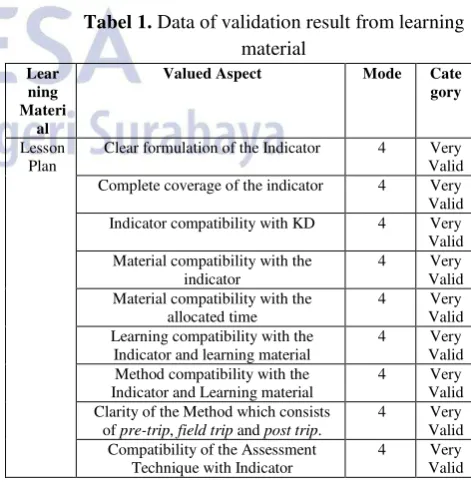
Learning material consisted of lesson plans, student worksheets and pretest posttest questions which were validated by an education expert, an expert on subject matter namely ecosystem and a biology teacher. Validation results of the learning material were presented in Table 1.
The lesson plan validation resulted from ten aspects that are assessed by the three validators indicate that each aspect gains a mode value of four, from scale 1-4. The result of LKS validation by regarding eight aspects obtains a value of four. Meanwhile, the results of the validation from pretest posttest questions assessed by referring to the five aspects obtain a value of 4. The attainment of value mode by four in each of these aspects indicates that this learning material is well worth to be tested in biology learning-based on field trip.
Tabel 1. Data of validation result from learning material
Lear ning Materi al
Valued Aspect Mode Cate
gory
Lesson Plan
Clear formulation of the Indicator 4 Very Valid Complete coverage of the indicator 4 Very Valid Indicator compatibility with KD 4 Very Valid Clarity of the Method which consists
of pre-trip, field trip and post trip.
100
Ummah, Nuzula Khoiro dkk:
The Development Of Learning Material Based On Field Trip Strategy
Completeness of Assessment Availability of short material in
accordance with the concept
4 Very Valid Completeness of cover, Identity and
Introduction material Conformance of the letter consisting of
type, size and color
4 Very Valid The use of communicative language 4 Very Valid Language structure based on EYD
(Indonesian spelling refinement) Questions are made in accordance with
level and class grade
4 Very Valid Questions are equipped with reading
of logical phenomenon
4 Very Valid Sentences used in question are decent
and accurate
2. Practicality Results of Learning Material Based on Lesson plan Implementation and Student Activity
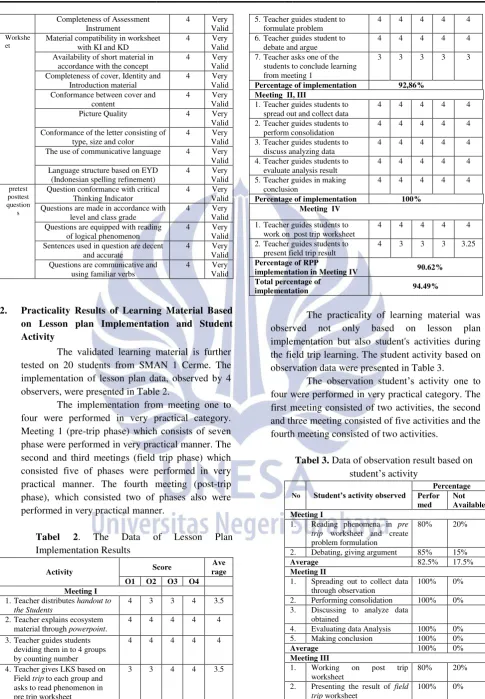
The validated learning material is further tested on 20 students from SMAN 1 Cerme. The implementation of lesson plan data, observed by 4 observers, were presented in Table 2.
The implementation from meeting one to four were performed in very practical category. Meeting 1 (pre-trip phase) which consists of seven phase were performed in very practical manner. The second and third meetings (field trip phase) which consisted five of phases were performed in very practical manner. The fourth meeting (post-trip phase), which consisted two of phases also were performed in very practical manner.
Tabel 2. The Data of Lesson Plan 1.Teacher distributes handout to
the Students deviding them in to 4 groups by counting number
4 4 4 4 4
4.Teacher gives LKS based on Field trip to each group and asks to read phenomenon in pre trip worksheet
3 3 4 4 3.5
5.Teacher guides student to formulate problem
4 4 4 4 4
6.Teacher guides student to debate and argue
1.Teacher guides students to spread out and collect data
4 4 4 4 4
2.Teacher guides students to perform consolidation
4 4 4 4 4
3.Teacher guides students to discuss analyzing data
4 4 4 4 4
4.Teacher guides students to evaluate analysis result
4 4 4 4 4
5.Teacher guides in making conclusion
4 4 4 4 4
Percentage of implementation 100%
Meeting IV
1.Teacher guides students to work on post trip worksheet
4 4 4 4 4
2.Teacher guides students to present field trip result
4 3 3 3 3.25
Percentage of RPP
implementation in Meeting IV 90.62%
Total percentage of
implementation 94.49%
The practicality of learning material was observed not only based on lesson plan implementation but also student's activities during the field trip learning. The student activity based on observation data were presented in Table 3.
The observation student’s activity one to four were performed in very practical category. The first meeting consisted of two activities, the second and three meeting consisted of five activities and the fourth meeting consisted of two activities.
Tabel 3. Data of observation result based on student’s activity
101
Ummah, Nuzula Khoiro dkk:
The Development Of Learning Material Based On Field Trip Strategy
Average 90% 10%
Total Percentage 93.88% 6.12%
DISCUSSION
The developed lesson plan obtained good value because it already contained learning activities integrated with the field trip strategy to train critical thinking skills. This was proven by the first meeting of lesson plan (pre-trip) that consisted activities where teachers guided students to read the zoning phenomenon of the spread of flora and fauna in Banyuurip Mangrove Forest. This phenomenon could evoke questions triggering students to find the answer (Langrehr, 2006).
The second and third meeting (field trip) of the lesson plan consisted of teachers guided students to collect data through observation, data analysis, assessing the validity of the analysis and making conclusions. The fourth meeting of the lesson plan which was the post-trip, consisted some activities in which teachers accompanied students to take on the post trip worksheets. Teachers also gave feedback through the presentation of the field trip observation.
The results of worksheet also showed a good validation, this was categorized as very valid. It means that the worksheet developed was well worthy to be the teacher’s guide in managing field trip-based learning. The concept about ecosystem was built through worksheets. According to Toman (2013), Worksheet is a teaching material containing a summary of the material, instructions and guidance on the steps of conducting the tasks that are suitable to the basic competence to be achieved.
The worksheet consisted of three parts and each part contains pre trip, field trip and post trip. The first worksheet is pre trip which contained readings on zoning phenomenon of the spread of flora and fauna in Banyuurip Mangrove Forest. Based on this phenomenon, students are given instruction to work in groups. The worksheet also provides a column to write and discuss the formulation of the problem and their arguments.
The second worksheet namely field trip facilitates to be active in the mangrove forest. For example, the worksheet gives students instruction to collect the data of flora and fauna through observation in the mangrove forests, the worksheet also provides a column to put the temperature of soil and water measurement. The column contains several questions that require students to analyze the relationship between the temperature difference with the spread of fauna and flora
in each zonation, from here, there is another column to put their evaluation on the data and make a conclusion.
The third worksheet namely post trip provides a column to design a food web, in addition, student are given instruction to analyze the food web. The worksheet also provides a column to identify the supporting units of the ecosystem based on the field trip observation data. The post-trip worksheet is considered more as a formation phase. This is in accordance with Badan Standar Nasional Pendidikan (2006) which mentioned that by having this formation phase, the students will be able to understand the concept, able to find different ways to present the material and able to interpret it.
The results of the validation of pretest posttest questions showed a good validation with the valid category. It obtained a good value because the questions were set to meet 5 indicators of critical thinking as suggested by Ennis (2001), this included about formulating the problem, giving arguments, inducting, evaluating and making conclusions. This was proven by the question number 1 in which the news about the destruction of mangrove forest was presented. Through the news, students were required to make a formulation of the problem and provide a response to such damage problem.
The lesson plan implementation and student activity were performed in very practical manner. This could happen due to the use of learning material that was initially validated and tested to be suitable to use. The implementation which was carried out during four meetings indicated as very practical. The results of the first meeting of the lesson plan implementation showed that it was in accordance with stages of pre-tripby which students were divided into groups, each group was facilitated with the worksheet, and students were guided to formulate the problem and give arguments. In closing activities, there was a stage that was not conducted. The teacher did not ask one of the students to conclude the material, but instead the teacher did it. This was done as an attempt to shorten the time. According to Behrend and Franklin (2014), during pre-trip, it is critical for the teacher to prepare very carefully the timing, so that all stages can be proceeded smoothly.
102
Ummah, Nuzula Khoiro dkk:
The Development Of Learning Material Based On Field Trip Strategy
students to make conclusions (Behrendt and Franklin, 2014).
In the fourth meeting, namely post-trip, all stages were performed in very practical manner. Teacher distributed post trip worksheet, guided students to create food-web and analyzed the provided column and then identified the ecosystem constituent units. The teacher also guided students to do presentations. Presentations served as feedback (evaluation). According to Black and Wiliam (2007) through the presentation, it is expected that there will be an instructional dialogue between teachers and students and students with other students with the purpose of sharing information obtained from the measuring instrument to rectify or improve the result of fulfillment.
Based on observed student’s activity showed that all students perform well in all activity. Students were abletounderstand thereading ofzoningphenomenon of the spread of flora and fauna in Banyuurip Mangrove Forest indicated by asking questions and giving arguments. Nevertheless, in the activity of making the problem formulation and providing arguments, there was some students who did not carry out this activity.Thisis because the activity was conducted in groups, so it is possible that it was dominated by only a few students. The solution for this problem was that the teacher provided the opportunity for students to formulate problems and expressed their opinions (Suwarna, dkk, 2006).
Inthesecondandthirdmeeting(fieldtripstage) it can be clearly seen that all activities were performed well. Students observed biotic and abiotic components and measured temperature of soil and water,thenstudents discussedinanalyzingthedata.Studentswerealsoableto evaluate the data and made a conclusion. According to MoragandTal(2012),theseactivitiescanmakestudents moreactiveduringfieldtriplearning.
At the fourth meeting which was the post-trip stage, students worked on post-trip worksheets within theirgroupandthendidpresentations.Alloftheactivities werecarriedoutwellduetotheirhighmotivationsothat studentswereexcited andfocused onlearning(Suwarna, dkk,2006).
CLOSING Conclusion
Based on the analysis and discussion of the research data, it can be concluded that learning material of ecosystem based field trip strategy suitable to be used to train students' critical thinking skills. The validity of lesson plans, student worksheets and pretest posttest
questions were obtained a good validation in categorized as very valid. The lesson plan implementation and student activity were performed in very practical manner.
Suggestion
Few suggestions related to this research can be summed up as follow.
1. Similar research needs to be developed by both teachers and students with careful attention and decent planning such as initial observation to the field trip location, proper equipment and materials, transport, consumption and medications.
2. During the field trip, each group must be accompanied by guidance teachers so that students can focus on learning, not engage in activities outside the learning objectives.
ACKNOWLEDGEMENT
The researchers would like to thank to Prof. Dr. Muslim Ibrahim, M. Pd and Dr. Fida Rachmadiarti, M. Kes, the Biology teacher in SMA Negeri 1 Cerme Gresik who have become the validator and also to the students of class XI IPA 1 and 4.
REFFERENCES
Badan Standar Nasional Pendidikan (BSNP). 2006. Instrumen Penilaian Tahap II Buku Teks Biologi SMA/ MA. Jakarta : BSNP. hlm. 2-3.
Behrendt, M and Franklin T. 2014. A review of Research on School Field Trips and Their Value in Education. International Journal of Environmental & Science Education. 9 : 235-245.
Black and Wiliam. 2007. Providing Students with Effective Feedback. Academic Leadership Journal. 4 : 4
Ennis, R. H. 2001. Critical Thinking Assessment. Journal Theory and Practice, 32 :3.
Ernst, J and Monroe, M. 2013. The Effects of Environment- Based Education On Student’s Critical Thnking Skills and Disposition Toward Critical Thinking. Environmental Education Research, 10 : 4.
103
Ummah, Nuzula Khoiro dkk:
The Development Of Learning Material Based On Field Trip Strategy
Harpern, D. F. 2011. Thought and Knowledge : An Introduction to Critical Thnking Third Edition. New York : Psycology Press.
Kemendikbud. 2014. Konsep dan Implementasi Kurikulum 2013. Jakarta : Kemendikbud.
Langrehr, John. 2006. Thinking Skills. Edisi Pertama. Jakarta : PT. Gramedia.
Morag, O and Tal, T. 2012. Assesing Learning in the Outdoors with the Field Trip in Natural Environments (FiNE) Framework. International Journal of Science Education, 34 : 5 (745-777).
Nadelson, L.S and Jordan, J.R. 2014. Student Attitudes Toward and Recall of Outside Day : An Environmental Science Field trip. The Journal of Educational Research, 105 : 220-231.
OECD. 2014. PISA 2012 Results In Focus : What 15-Year-Old Know and What They Can Do With
What They Know.
https://www.oecd.org/pisa/keyfindings/pisa-2012-results overview.pdf.Acceced on 15 November
2016.
Ratumanan and Laurens. 2011. Penilaian Hasil Belajar Pada Tingkat Satuan Pendidikan Edisi 2. Surabaya : Unesa University Press.
Riduwan. 2015. Skala Pengukuran Variabel-variabel Penelitian. Bandung : Alfabeta.
Suwarna, dkk. 2006. Pengajaran Mikro. Yogyakarta : Tiara Wacana.
Thiagarajan, S; Semmel, D.S; Semmel, M.I. 1974. Instruction Development For Training Teachers Of Exceptional Children. Indiana : Indiana University.
Toman, U. 2013. Extended Worksheet Develop According To 5 E Model Based On Constructivist Learning Approach. International Journal on New Trends in Education and Their Implications, 4 : 4.