77
The Impact of Social Media Marketing on Brand Equity toward the Purchase
Intention of Starbucks Indonesia
Melissa Anastasia Karman
International Business Management Program, Petra Christian University Jl. Siwalankerto 121-131, Surabaya
E-mail: [email protected]
ABSTRACT
Starbucks Indonesia is a global coffee company has been able to manage its strong presence in the retail coffee industry. However, the burgeoning independent coffee shops in several major cities of Indonesia has become the new competitor for Starbucks Indonesia. This research is aimed to analyze the impact of social media marketing on brand equity toward the purchase intention of Starbucks Indonesia. Moreover, this research attempts to examine the role of brand equity as the mediating variable of social media marketing and customer purchase intention.
There are 122 respondents gathered in this research from the simple random sampling. This research used reliability and validity test and classical assumption tests as data-processing method. Then, path analysis with linear regression, and Sobel test to prove the mediation effect were used for the data-analysis. This research’s findings indicate that social media marketing has significant impact toward the purchase intention of Starbucks Indonesia. In addition, online communities, interaction, and sharing of content were found to have significant impact toward the purchase intention of Starbucks Indonesia. Brand equity is also found to be the mediating variable between social media marketing and purchase intention of Starbucks Indonesia
Keywords: Social Media Marketing, Brand Equity, and Purchase Intention.
ABSTRAK
Starbucks Indonesia merupakan sebuah perusahaan kopi global yang mampu mempertahankan keberadaan yang kuat pada industry kopi di tingkat pengecer. Akan tetapi, berkembangnya beberapa toko kopi independen di beberapa kota besar di Indonesia telah menjadi competitor baru bagi Starbucks Indonesia. Penelitian ini bertujuan untuk menganalisa pengaruh pemasaran melalui media social pada ekuitas merek terhadap niat beli pelanggan Starbucks Indonesia. Lebih jauh, penelitian ini mencoba untuk menganalisa peran ekuitas merek sebagai variabel mediasi Antara pemasaran melalui media sosial dan niat beli pelanggan.
Ada 122 responden yang terkumpul dalam penelitian ini melalui simple random sampling. Penelitian ini menggunakan uji reliabilitas dan validitas dan uji asumsi klasik untuk metode pengolahan data. Kemudian, metode analisa data yang digunakan adalah analisa jalur dengan regresi linear serta uji Sobel untuk membuktikan efek mediasi. Dari hasil penelitian ini dapat diketahui bahwa pemasaran melalui media sosial memiliki pengaruh signifikan terhadap niat beli pelanggan Starbucks Indonesia. Lebih jauh, komunitas online, interaksi, dan berbagi konten memiliki pengaruh signifikan terhadap niat beli pelanggan Starbucks Indonesia. Ekuitas merek juga ditemukan memediasi pemasaran melalui media sosial dan niat beli pelanggan Starbucks Indonesia.
Kata Kunci: Pemasaran melalui Sosial Media, Ekuitas Merek, dan Niat Beli Pelanggan..
INTRODUCTION
It has been more than one decade since the rise of Internet in late 1990. The Internet revolution has transformed the way of communication, information acquisition, and way of conducting the business world. The latest trend is every business compelled to provide a dynamic presence on every E-media platforms
78 than just an effort of nurturing business presence to customers.
Social media marketing offers various opportunities to attain the business objectives (As'ad & Alhadid, 2014). The use of social media in a business is to be believed as one of the most popular marketing tools. The social media serves 87% as middle touch point on the path to purchase, makes it more prospective than the other marketing channel (MDG Advertising, 2014). American global coffee company like Starbucks is one of the examples of company that has been utilizing several social media platform in effort of their marketing (Schoultz, 2013). Starbucks Coffee chain in Indonesia outgrows more and more since this company arrived in Indonesia in early 2002 through PT Sari Coffee Indonesia, a subsidiary company of PT Mitra Adiperkasa as the retail marketer (The Jakarta Post, 2012). Starbucks Indonesia also reaches the customers through social media platform, namely Facebook, Twitter, and Instagram (Jaya, 2013). Through social media Starbucks Indonesia shares the information in a way to build or maintain a strong brand in the customer’s mind. Social media can be the tool to develop more consistent brand image in a way to improve brand equity. Moreover, social media helps company to make any product or brand-related information more accessible for customers and thus can give more positive brand evaluations in the customer’s mind (Farquhar, 1989). There is possibility of brand equity to mediate social media marketing and customer purchase intention. Hence, a good brand evaluation creates better impact to the purchase behavior later on. The customers’ positive feelings of a brand that generated from a particular source of marketing may drive their behavioral intention. Customer-based Brand Equity is shown by the increase in attitude strength, whereby attitude can refer to an association of object and evaluation of that object in customers’ memory (Farquhar, 1989).
However, Starbucks Indonesia also face competition from other local independent coffee shop. The latest trend is many independent coffee shops or cafes burgeoning in major cities of Indonesia (Coffee & Cafe Trends in Asia, 2013, para. 1). The brand position of Starbucks in Indonesia has been experiencing quite serious declining in the past three years; from 11th, 17th, and the 21st in 2015 (Campaign Asia, 2015). The competition from other independent coffee shops is not merely on running business through physical stores. The independent coffee shops also presents it activities in social media. Those independent coffee shops also utilizing social media to reach more customers that can increase the brand recognition as part of building their brand equity. It means that Starbucks Indonesia is not the only player in social media marketing (The Top 10 Benefits Of Social Media Marketing, 2014, para. 4).Through social media marketing Starbucks Indonesia may be able to improve its customer insight, acquire more information
about customers’ interest and how they behave. This condition can help Starbucks Indonesia to set up the right social media profile for improving its brand equity and can minimize potential loss of competition from other independent coffee shops’ social media profile.
Furthermore, Starbucks’ revenue also has been declining in the past four years based on the year-over-year growth (Starbucks, 2015). In the 2011, the revenue’s year-over-year growth is 36%, then decrease to 31% in 2012, 27% in 2013, and 23% in 2014. It might be caused by any drop in the sales. Hence, social media marketing may also alter customers’ purchase intention aside from its impact on the customer-based brand equity.
This research is trying to show to what extent social media marketing affects the brand equity and thus the purchase intention of customers. As explained in the background paragraph that marketing activity can increase customers’ attitude of their object association and evaluation. The hypotheses of this research are:
1. The social media marketing has significant impact toward the purchase intention of Starbucks Indonesia.
2. The social media marketing has significant impact toward brand equity of Starbucks Indonesia.
3. The social media marketing has significant impact toward the purchase intention, mediated by the brand equity of Starbucks Indonesia. 4. The social media marketing dimensions (Online
Communities, Interaction, Sharing of Content, Accessibility, and Credibility) has significant impact toward the purchase intention of Starbucks Indonesia.
LITERATURE REVIEW
Social Media Marketing defined as “a strategic and methodical process to establish the company’s influence, reputation, and brand within communities of potential customers, readers or supporters” (Neti, 2011, p. 4). Other source also utter that social media marketing denoted as the fast-growing phenomenon driven by digital word of mouth contained in marketing (Sybex, 2012). While according to As’ad and Alhadid (2014), social media is “a collection of online tools that facilitate interaction and communications between users”.
79 a Social”, n.d.). The focus of social media marketing is the struggle to deliver content, which can draw the readers’ attention and encourages them to share it among their social network (Chary, 2014).
Internet or mobile based tools like Facebook, Twitter, YouTube, and MySpace are some examples of social media platforms, which combine technology and social interaction (Neti, 2011). The goal of using social media in marketing is making the distribution of corporate message easily accessible to everyone that driven by word-of-mouth from a trusted third-party dimensions of social media marketing that consist of online communities, interaction, sharing of content, accessibility, and credibility (As'ad & Alhadid, 2014; Zai, 2015). Online communities depicted as a community around a common interest of products or businesses built through the use of social media (Taprial & Kanwar, 2012). The common interest helps the members to “share essential resources, i.e. cognitive, emotional, or material in nature” (Laroche, Habibi, Richard, & Sankaranarayanan, 2012). More importantly, the communities shall put upfront the purpose of information sharing than just merely commercial reasons by exercising the influence of members’ opinion. Thus, the active participation of social media’s community members can help to generate the content (Laroche, Habibi, Richard, & Sankaranarayanan, 2012). Interaction refers to the ability to add or invite more friends or colleagues into the network, in which user can connect, share, and communicate each other in real-time (Taprial & Kanwar, 2012). The interaction in social media becomes important as it enables communications, whereby the social media itself is said to be another communication tools to improve user’s experience (Kim & Ko, 2010). In addition, Kim and Ko (2010) also argued that two-way communication is happened in the social media. Sharing of content talks about the scope of an individual exchanges, distributes, and receives content in a social media setting in which the possible content can be in the form of picture, video, or status update (Babac, 2011). Based on Taprial and Kanwar (2012), accessibility refers to the easiness to access and the minimal costs to use the social media that makes user with online access able to initiate or participate in the conversations. The last dimension is credibility, which talks about the message delivery that clearly articulate the brand to establish credibility for what is being said or done yet connecting emotionally with the target audience (Taprial & Kanwar, 2012).
According to Aaker (1991), brand equity is “a set of brand assets and liabilities linked to a brand, its name and symbol that add or subtract from the value
provided by a product or service to a firm and/or to that firm’s customers”. In order to acquire the brand equity, companies can build, borrow, or buy it. It is said that a creation of positive brand evaluations with a quality product, development of accessible brand attitude to create utmost impact on the purchase behavior, and the development of consistent brand image are the root for brand equity to be built (Farquhar, 1989). Moreover, Wood (2000) argues that the term ‘brand equity’ used by most marketers indicates brand description or brand strength, whereby both brand description and brand strength are sometimes refer to the customer-based brand equity.
Customer-based Brand Equity is shown by the increase in attitude strength, whereby attitude can refer to an association of object and evaluation of that object in customers’ memory (Farquhar, 1989). As explained in the background paragraph that marketing activity can increase customers’ attitude of their object association and evaluation, therefore this research will use the indicators of customer-based brand equity presented by David A. Aaker (1991). Other research by Yoo, Donthu, and Lee (2000) stated brand equity as “the difference in consumer choice between the focal branded product and unbranded product given the same level of product features”. Hence, the action to indicate the brand equity can be by comparing two products that respectively identical except the name through assessing the intention to buy or preferences toward the focal brand over the counterpart.
According to Aaker (1991), the customer-based brand equity comprise four dimensions, which are brand awareness, brand associations, perceived quality, and brand loyalty. Brand awareness is “the ability of potential buyer to recognize or recall a brand as a member of certain product category” (Aaker, 1991). Furthermore, brand awareness refers to the brand recognition and brand recall, whereby the customers correctly distinguish certain brand as soon as they received the cue and then able to retrieve the brand information given the product hint. When customers have a relatively high brand awareness and presume some strong, favorable, yet unique brand association, then the customer-based brand equity are likely to happen (Jalilvand, Samiei, & Mahdavinia, 2011).
80 suggested brand associations as the key element in brand equity formation and management.
Next, Jalilvand, Samiei, and Mahdavinia (2011) believe that perceived quality can be happened when company has turned the customer-driven quality not merely for a short-term plan but an influential long-term strategy as it served the company competitive needs. In addition, perceived quality gives influence to the brand inclusion and elimination from the consideration set prior to the selection ,yet it is needed for a strong brand to convey more messages and gain more success (Aaker, 1991).
According to Aaker (1991), brand loyalty is “a situation which reflects how likely a customer will be to switch to another brand, especially when that brand makes a change, either in price or product features”. The increase in brand loyalty may reduce the vulnerability of the customer base to competitive action (Aaker, 1991). In the lowest level of loyalty, there is non-loyal buyer who completely indifferent to the brand. The second level may have buyer who are satisfied with the product, which often refer to the habitual buyer. The third level consist of buyer who satisfied and have the switching costs, either switching costs for time or money. In the fourth level, there is buyer who truly like the brand with emotional or feeling of attachement. At the very top level, there is the committed customer who is proud to use the brand as it is very important both functionally or as self-expression (Tumoninen, 1999). One loyal set of customers can reduce marketing costs and provides trade leverage over others (Aaker, 1991).
Purchase intention can be classified as “one of the components of consumer cognitive behavior on how an individual intends to buy a specific brand or product” (Hosein, 2012). Moreover, Tariq, Nawaz, Muhammad Rafay Nawaz, and Butt (2013) define purchase intention as a multi-step process that leads to personal customer experience in order to complete the product knowledge on certain product. This process starts when customer gathers the brand related information and then evaluates the product attributes to know whether the brand suits his or her intention. Eventually, the customer is able to consider on the purchase decision. The customers’ positive feelings of a brand that generated from a particular source of marketing may drive their behavioral intention. The context of customer purchase intention can be measured by interest, attending, and information. Interest refers to the personal feeling about the products or brand. Attending refers to the actual physical presence. While information talks about the additional data that customers may gather that will influence them to make the purchase decision (Hosein, 2012).
Relationship Between Concepts
Accordingly to the discussion above about social media marketing, brand equity, and customer purchase
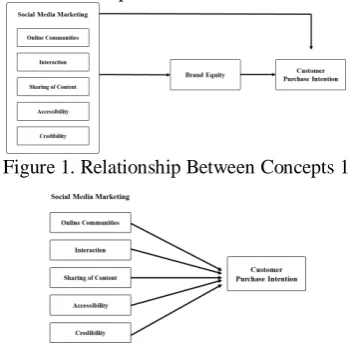
intention as the three main concepts of this research, the relationship between concepts can be summarized infigure 1 The social media marketing dimensions are online communities, interaction, sharing of content, accessibility, and credibility (As'ad & Alhadid, 2014). Previous study suggested the idea of social media marketing has positive influence to brand equity (As'ad & Alhadid, 2014). Furthermore, previous research from Santoso and Cahyadi (2014) has proposed the idea that brand equity has significance influence toward the purchase intention. In addition, Aaker (1991) also stated brand equity has a positive impact on customers purchase intention.
Many companies have utilized social media for marketing and advertising. The use of social media marketing itself has created more possibilities of business opportunities that customers are now being exposed to the brand messages yet built more interaction (Kim & Ko, 2010). The brand messages or information conveyed through social media can affect customer’s perception on the brand equity. Through marketing activities, company tries to create a positive brand evaluation with the development of accessible brand attitude and consistent brand image to create utmost impact on the purchase behavior (Farquhar, 1989). Kim and Ko (2010) also utter that purchase behavior, in this case purchase intention, is related to the attitude and preference upon certain brand. The customer-based brand equity is shown by the increase in attitude strength (Farquhar, 1989). Therefore, the brand equity perceived will contribute to affect the purchase intention later on.
The figure 2 explains about the relationship between concepts of social media marketing dimensions, which consist of online communities, interaction, sharing of content, accessibility, and credibility, will impact the customer purchase intention. In the past research, Kim and Ko (2010) proved that the variables of social media marketing is significant to affect purchase intention.
Figure 1. Relationship Between Concepts 1
81 RESEARCH METHOD
This research aims to analyze the impact of social media marketing on brand equity toward the purchase intention of Starbucks Indonesia. This research will use the causal study since the writer would like to find the effect of variables toward another. In addition, the writer will use the quantitative approach for this research to test the theory and able to measure precisely the outcome.
The dependent variable of this research is about the cusomer’s purchase intention and will be measured through the following statements: because I am interested in Starbucks Indonesia product, I will buy it in the future. Then, if I want to buy a cup of coffee in the future, I will come to Starbucks Indonesia outlet. Last, if I want to buy a cup of coffee, I will gather information about Starbucks Indonesia.
Then, the independent variables of this research are the dimensions of social media marketing, which are online communities, interaction, sharing of content, accessibility, and credibility. There are three items to measure online communities. First, the Starbucks Indonesia’s online communities allows direct user input or posting to site. Second, the Starbucks Indonesia’s online community is useful for gathering various information about the product or the brand.Third, at least some of members of Starbucks Indonesia’s online community know me.
Then, there are four items to measure the interaction. First, it is possible to add or invite more friends to the Starbucks Indonesia’s online community. Second, it is possible to exchange opinions or conversation with other users through Starbucks Indonesia’s social media. Third, it is possible to do two-way interaction between administrator and user through Starbucks Indonesia’s social media. Fourth, it is possible to share information with other users through Starbucks Indonesia’s social media.
There are four items to measure sharing of content. First, I would like to pass out information on brands, products, or services in the form of picture, video, or status update from Starbucks Indonesia’s social media to my friends. Second, I would like to upload contents in the form of picture, video, or status update from Starbucks Indonesia’s social media on my micro blog or other social media profile. Third, I would like to share opinion in the form of picture, video, or status update on brands, product, or services acquired from Starbucks Indonesia’s social media with my acquaintances. Fourth, I would like to receive content in the form of picture, video, or status update about brands, products, or services from Starbucks Indonesia’s social media.
There are three items to measure the accessibility. First, it is easy to access the Starbucks Indonesia’s social media site. Second, it is easy to participate in the Starbucks Indonesia’s social media site. Third, I do not have to spend cost to participate in Starbucks Indonesia’s social media. Then, there are three items to measure credibility. First, I trust the information
obtained from Starbucks Indonesia’s social media site. Second, Starbucks Indonesia’s social media provides clear information about its brands, products, or services. Third, I feel that I have emotional bond with Starbucks Indonesia by acquiring the information from its social media site.
The mediating variable of this research is about brand equity. There are five items to measure brand equity. First, when talking about coffees, I remember Starbucks Indonesia. Second, Starbucks Indonesia has a strong image. Third, Starbucks Indonesia always gives qualified products in the transaction. Fourth, When Starbucks Indonesia’s product that I want is not available, I will buy a product of another brand. Five, I would like to buy Starbucks Indonesia, even if other brands have the same features as Starbucks Indonesia.
Furthermore, this research will utilize two types of data in the questionnaire, which are nominal, and interval. Nominal data will be used for the screening questions, which are gender, respondents’ engagement to Starbucks Indonesia social media profile, and also measure the range of age and monthly expense. The interval data will be used for the indicators of measuring social media marketing, brand equity, and the purchase intention, as the likert scale will be used in measuring those indicators.
The population of this research is anyone who follow or like the Starbucks Indonesia’s social media profile at least one (Facebook or Twitter or Instagram), in which they possess the general knowledge about Starbucks Indonesia’s brand, products, and services yet the big picture of Starbucks Indonesia’s outlets, logo, and other visual presentations. Now, there are approximately 1.7 million people who follow or like Starbucks Indonesia’s social media sites. Thus, writer choose to take sample from the population by applying the probability sampling through simple random sampling method, whereby the selection chance of what is supposed to be measured (Cooper & Schindler, 2014). There are two types of validity form, which are external validity that when the data generalization across persons, setting, and times is happened and internal validity that when the instruments measure things alleged to be measured. This research will discuss about the internal validity and thus writer measures the Corrected Item-Total Correlation to see the correlation between variables. In conducting this test, writer has to compare the r- value as the result of Corrected Item-Total Correlation to the r-table. It is said to be valid when the value is greater than the r-table (Ghozali, 2013).
82 from random error (Cooper & Schindler, 2014). Different time and condition may affect a reliability and thus lead to several aspects of reliability. One of the way to test the reliability is by conducting Cronbach’s Alpha (α) test to know the internal consistency of an attribute. The value of Cronbach’s Alpha must range from zero to one, in which higher value is indicating more reliability. The minimum value said to be reliable is 0.6 (Sufren & Natanael, 2014).
As explained in the beginning of this chapter that this research will have an intervening or mediating variable, thus the writer decided to use the Path analysis. Writer wants to know whether and yet to what extent one variable may affects other variable. According to Ghozali (2013), path analysis is the expansion of multiple regression technique. In addition, this method cannot be used to determine the causalities relationship yet as the substitution of analyzing causalities between variables. Path analysis is beneficial in helping the researcher to identify the relationship pattern between three or more variables. Hence, the path analysis for this research as presented below:
Regression 1
= + Regression 2
� = + Regression 3
= + ′ + �
Thus, mediating or intervening variable said to be mediator when in the first regression, the independent variable significantly affects the dependent variable, then the independent variable in the second regression significantly affects the mediating variable, and yet the mediating variable significantly affects the dependent variable by controlling the independent variable in the third regression (Ghozali, 2013).
The accuracy of a regression model can be measured based on its goodness of fit, in which statistically measured through coefficient of determination, F-test, and t-test (Ghozali, 2013). The higher adjusted R square value indicates the better explanatory power of independent variables toward the dependent variable variance, thus it provides better estimation of the total population (Pallant, 2013). F-test basically test the simulatenous effect of the independent variable toward the dependent variable. This research used 5% of significance level. The decision rule of hypothesis testing can be done by comparing the significance F to the significance level or by comparing F value to F table. Hence, if the significance F is lower than significance level or the F value is greater than F table, H0 is rejected, means that the independent variable simultaneously affect the dependent variable.
T-test is intended to determine the relationship of independent variables and dependent variable individually (Ghozali, 2013). This research used 5% of significance level.
The decision rule of hypothesis testing can be done by comparing the significance T to the significance level or by comparing T value to T table. Hence, if the significance T is lower than significance level or the T value is greater than T table, H0 is rejected, means that the independent variable individually affect the dependent variable.
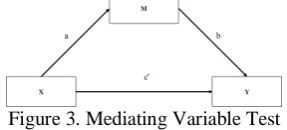
Sobel (1982) has developed hypothesis testing method for regression model with mediator, in which examined the indirect effect of independent variables toward the dependent variable through a mediating variable. This research used 5% of significance level.
Figure 3. Mediating Variable Test
To begin the Sobel test, writer have calculated the standard error of indirect effect by using the equation below:
� = √ 2� 2+ 2 � 2+� 2� 2
Whereby:
ab = The regression coefficient that represent the effect of X on M and M on Y, correspondingly Sa = Standard error of a
Sb = Standard error of b
Sab = Standard error of indirect effect
Then, the hypothesis testing is conducted base on the z value of ab coefficient, whereby z value is calculated by dividing coefficient of ab with standard error of indirect effect. If the z value is greater than 1.96, H0 can be rejected and indicating a significant mediation effect in the model.
RESULTS AND DISCUSSION
Table 1. Reliability Test Statistic
Variable Cronbach’s Alpha
Online Communities 0.716
Interaction 0.757
Sharing of Content 0.763
Accessibility 0.859
Credibility 0.704
Brand Equity 0.824
Purchase Intention 0.715
According to Sufren and Natanael (2014), the indicators are said to be realiable when the Cronbaach’s Alpha value is greater than 0.6. Hence, the result in Table 1 is indicating that all indicators are reliable.
Table 2. Validity Test Statistic
Variable Indicator Corrected Item-Total Correlation
83
According to Ghozali (2013), the indicators are said to be valid when the r-value (Corrected Item Total-Total Correlation) is greater than r-table. Since that there were 122 respondent, with df= 120, the r-table is 0.1779. All indicators above have the r-value greater than 0.1779, which indicating that the data is valid.
Table 3. Adjusted R-square Statistic
Regression Model R2 Adjusted
R2 power of independent variable toward the variance of dependent variable. According to table 4.7 below, adjusted R2 for the first regression is 0.565. It means that 56.5% variance of purchase intention can be explained by the social media marketing, meanwhile the other 43.5% is explained by other factor which not included in this model.
For the second regression, the adjusted R2 value is 0.414. This implied that social media marketing can explain 41.4% variance of brand equity, while the other 58.6% is explained by other factor which not included
in the regression model. The third regression has adjusted R2 of 0.576 or equal to 57.6% of purchase intention variance can be explained by social media marketing and brand equity, where the rest of 42.4% is explained by other factor.
The adjusted R2 for the fourth regression resulted as 0.611, which means that 61.1% of variance in the purchase intention can be explained by five social media marketing dimensions that consist of online communities, interaction, sharing of content, accessibility, and credibility. This also implied that the other 38.9% is explained by other factor which not effect of independent variable toward the dependent variable. The summary in Table 4 has shown that in the first regression, the F-value of 158.150 is greater than F-table (3.92). Moreover, the result of significance F for the first regression is 0.000 means that social media marketing is statistically significant toward customer purchase intention. Hence, writer is able to reject the null hypothesis. It can be concluded that social media marketing has significant impact toward the customer purchase intention of Starbucks Indonesia. The F-value of second regression is 86.479 is greater than F-table (3.92). In addition, the result is supported by the value of significance F which is below 0.05. It implies that social media marketing is statistically significant toward the brand equity and thus the null hypothesis is rejected. Hence, social media marketing has significant impact toward brand equity of Starbucks Indonesia.
84 statistically significant. The null hypothesis is rejected and thus social media marketing (Online Communities, Interaction, Sharing of Content, Accessibility, Credibility) simultaneously has significant impact toward customer purchase intention of Starbucks Indonesia.
Table 5. T-test Statistic Regre
ssion
Independent Variable
Unstandar dized Coefficient s (B)
t Sig.
3
Social Media Marketing
0.922 8.396 0.000
Brand Equity 0.142 2.032 0.044
4
Online Communities
0.209 2.731 0.007 Interaction 0.224 3.652 0.000 Sharing of
Content
0.495 6.805 0.000 Accessibility 0.079 1.631 0.106 Credibility 0.107 1.817 0.072
According to Gozhali (2013), T-test is intended to test the relationship of independent variable and dependent variable individually. Based on Table 5, social media marketing has T-value of 8.396 and brand equity has T-value of 2.031, both of them is higher than T-table (1.98) yet the significance is below 0.05. Thus, it means that social media marketing and brand equity individually has significant impact toward customer purchase intention.
As for the additional regression 4, it shows that only online communities, interaction, and sharing of content have T-value greater than 1.98. Hence, only those three dimensions that individually affects the purchase intention.
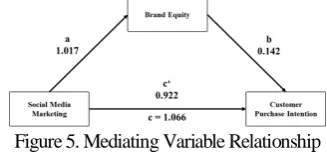
Recall back the F-test result that the first three regressions have significant result, thus the mediation happened. The Sobel test was conducted to indicate the indirect effect.
Figure 5. Mediating Variable Relationship The calculation of Sobel test resulted the standard error of indirect effect is 0.073, then then coefficient of indirect effect is 0.144. Hence, the result of z value is 1.975. Since the z value is higher than 1.96, thus the social media marketing has significant impact toward customer
purchase intention, mediated by brand equity of Starbucks Indonesia.
Therefore, the result of hypothesis testing for the regression 1 is found to confirm the previous research result from Kim and Ko (2010), which the second hypothesis of their research had proposed the same idea with hypothesis 1 of this research. This research result is aligned with Kim and Ko’s, in which they had proven that social media marketing is a positive significant marketing tool to affect the purchase intention. The explanatory power of social media marketing together on the purchase intention is about 56.5 %.
While if the social media marketing put into further discussion, writer found in the regression 4 that 61.1 % variance of purchase intention can be explained by five dimensions of social media marketing. There might be a chance that the other 38.9% variance of purchase intention is explained by other factor, such as entertainment. Entertainment, interaction, and word of mouth has positive impact on the purchase intention (Kim & Ko, 2010). Thus, writer also has discussed about the additional hypothesis proposed to check to which extent of social media marketing dimensions affect the purchase intention of Starbucks Indonesia.
The result of hypothesis 4 is also aligned with journal reference from Kim and Ko (2010). They had proven that purchase intention is influenced by interaction and word of mouth. The term word of mouth here has the similar meaning with sharing of content term used in this research. This research proved that sharing of content give more effect to the purchase intention of Starbucks Indonesia with coefficient of 0.495. Interaction is the second highest variable that affects purchase intention with coefficient of 0.224 and followed by online communities with coefficient of 0.209.
85 communication between customers are the basic aspects to affect purchase intention, while accessibility and credibility are not necessary to influence purchase intention.
Moreover, the hypothesis 2 resulted to be aligned with the journal reference from As'ad & Alhadid (2014). They had proven that there is a strong relationship between social media marketing and brand equity in the mobile service providers in Jordan. This research also has proven that social media marketing has significant impact toward the brand equity of Starbucks Indonesia. These days, people is getting more concern about the use of social media as part of marketing activities. Through social media Starbucks Indonesia is able to improve the brand awareness, increase the brand association in customer’s mind, provide a solid quality perceived by customers, and yet build the brand loyalty.
Lastly, the research result is able to prove the hypothesis 3 which stated that social media marketing has significant impact toward customer purchase intention, mediated by brand equity of Starbucks Indonesia. Past research journal of Jalilvand, Samiei, and Mahdavinia (2011) mentioned that brand equity has the positive significant impact toward the purchase intention. Furthermore, brand awareness in brand equity has important role in affecting consumer decision making (Keller, 1993). Brand association is the base of customers purchase decision. Meanwhile, the perceived quality can provide more value to customer and the brand loyalty as the reflection of actual loyalty from the customer that can be seen through the purchase intention (Jalilvand, Samiei, & Mahdavinia, 2011).
It is hardly to be happened that people will directly have the purchase intention toward a brand, without having a big picture of the brand equity. This research shows that 57.6% variance of purchase intention can be explained by social media marketing and brand equity as the mediator. It means that the other 42.4% is explained by other possible factor, such as intimacy and trust in the customer relationship (Kim & Ko, 2010). Intimacy happened due to the accumulation of knowledge overtime (Carroll & Ahuvia, 2006). The social media activity of Starbucks Indonesia can help to build this intimacy. Trust is needed to enhance relationship between a brand and its customers, in which this corresponds to brand loyalty. As the customers trust Starbucks Indonesia, it will result in positive behaviors, namely individual intention to purchase and recommend to others (Lau & Lee, 1999).
Past research of Kim and Ko (2010) support the fact that social media marketing will affect the purchase intention through building the customer relationship. Their study suggested that a brand needs to build resilient relationship with the existing customer to keep them around as long as possible, whereby the resilient relationship refers to the brand
loyalty as one of the important part of the total brand equity. Hence, for Starbucks Indonesia, it is true that social media marketing has helped them in generating their customer’s purchase intention. This is because Starbucks Indonesia’s social media site has proven to affect the brand equity perceived by customers, which later on help the customers to make the purchase decision.
CONCLUSION
The writer has gathered 122 valid questionnaires, whereby all of those questionnaires have passed the reliability and validity test. Writer believes that the use of social media in marketing activity is one of the key for Starbucks Indonesia to convey the brand equity. Then, a good brand equity will cause a greater purchase intention from the customers. It is important to be aware that purchase intention is the end goal of marketing activity that resulted in the purchase decision. It means that when customer perceived a better Starbucks Indonesia’s brand equity from its activity in the social media, there is a greater chance to improve the customer purchase intention.
Through this research, writer is trying to answer the research problem whether there is an impact of social media marketing on the Starbucks Indonesia’s brand equity and social media marketing toward the purchase intention, mediated by brand equity of Starbucks Indonesia. For the purpose of further insight, writer is also trying to answer whether each of the social media dimensions has an impact on the customer purchase intention.
In conclusion, this research shows that social media marketing has a direct significant impact to the brand equity of Starbucks Indonesia. Not only to the brand equity, but Starbucks Indonesia’s social media marketing also has a direct significant impact to the purchase intention. As for the dimensions of social media marketing, online communities, interaction, and sharing of content are proved to have direct significant impact to purchase intention. Moreover, the research also shows that social media marketing has a significant impact toward the purchase intention, mediated by Starbucks Indonesia’s brand equity. Thus, this research is able to answer all the research problems yet fulfill the proposed research objectives.
86 analysis. Second, this research study is conducted for a limited field on the industry, namely coffee industry. In addition, this study also limited into scope of marketing with social media based. Since the theory used in this research were not coming from the same industry, thus writer believes that replication of this research for different target population and industry with different object should be examined further before any generalization of result is made. Third is about representativeness of data. In conducting this research, writer realized that the data might not be able to fully represent the actual condition. This must be taken into account that the market of Starbucks Indonesia is very large in terms of geographical location and demographic. Thus, it is difficult to acquire data from very diverse yet large samples in which can fully represent the population. In addition, the time and resource constraints also limited the writer in acquiring more samples to be included in this research study that can provide more accuracy and representativeness of the targeted population. Lastly, some researchers apply different statistical method in conducting research study with mediation. The other method used is called Structural Equation Modeling (SEM). SEM allows researchers to conduct test on the more complex data simultaneously and provide more comprehensive result to be further examined. However, this method required a very large sample size in the research. Writer had the limitation to apply this model due to the relatively small sample size.
Considering several limitations involved in conducting this research, writer believes that this research can be further improved in order to provide better and more accurate result. First, in order to alter the reluctant respondents, it might be more helpful in providing incentives for them in the future research. The incentives could be in a form of vouchers or prizes. It will make the respondent feels more excited to help fill in the questionnaire wholeheartedly. As they are willing to fill the questionnaire wholeheartedly, they are expected to answer all the questions carefully. Thus, it will lead to more accurate data for the research. Second, this research study only comprises five factors or dimensions of social media marketing, which are online communities, interaction, sharing of content, accessibility, and credibility. Writer suggest that for conducting future research, researcher might want to expand other related factors, such as entertainment. The expansion of other possible factors might give different research result and able to provide other insight on the impact of social media marketing on brand equity and purchase intention. Lastly, future research might want to apply the Structural Equation Modeling in order to get different and more comprehensive result, which might be better for the company. In addition to the application of Structural Equation Modeling in the future research, researcher might also use more sample size that eventually provide better and more accurate data for the analysis.
REFERENCES
Aaker, D. A. (1991). Managing Brand Equity. New York, USA: The Free Press.
Ahmed, M. A., & Zahid, Z. (2014). Role of Social Media Marketing to Enhance CRM and Brand Equity in Terms of Purchase Intention. Asian Journal of Management Research, Vol. 4, Issue 3, 533-549.
As'ad, H. A.-R., & Alhadid, A. Y. (2014). The Impact of Social Media Marketing on Brand Equity: An Empirical Study on Mobile Service Providers in Jordan. Review of Integrative Business & Economics Research, 3(1), 315-Brand Analytics. Retrieved from Campaign
Asia Web site:
Market Lett, Vol.17, 79-89.
Chary, S. R. (2014). Social Media Marketing - The Paradigm Shift in International Marketing.
IOSR Journal of Business and Management,
Marketing Research, 1, 24-33.
Forbes. (2013, January 23). Entrepreneurs: 5 Ghozali, I. (2013). Aplikasi Analisis Multivariate
dengan Program SPSS 21, 7th Edition.
Semarang: Badan Penerbit Universitas Diponegoro.
Haylbak, L. (2013, October 17). Importance of Social Media Marketing Among Small Businesses. Retrieved February 25, 2015, from www.bizible.com:
87
portance-of-Social-Media-Marketing-Among-Small-Businesses
Hosein, N. Z. (2012). Measuring the Purchase Intention of Visitors to the Auto Show.
Journal of Management and Marketing Research, 1-17.
Jalilvand, M. R., Samiei, N., & Mahdavinia, S. H. (2011). The Effect of Brand Equity Components on Purchase Intention: An Application of Aaker's Model in the Automobile Industry. International Business and Management Vol. 2, No. 2,, 149-158. Jaya, N. (2013, January 28). Starbucks® Celebrates the
Opening of its First Train Station Store in Indonesia . Bringing the Starbucks® Experience to Gambir Station . Jakarta, DKI Jakarta, Indonesia: Starbucks Indonesia. Keller, K. L. (1993). Conceptualizing, Measuring, and
Managing Customer-Based Brand Equity.
Journal of Marketing, 1-22.
Kim, A. J., & Ko, E. (2010). Impacts of Luxury Fashion Brand’s Social Media Marketing on Customer. Journal of Global Fashion Marketing, vol. 3, issue 1, 164-171.
Kozinets, R. (2002). The Field Behind the Screen: Using Netnography for Marketing Research in Online Communities. Journal of Marketing Research, Vol. 39, No. 1, 61-72.
Laroche, M., Habibi, M. R., Richard, M.-O., & Sankaranarayanan, R. (2012). The Effect of Social Media Based Brand Communities on Brand Community Markers, Value Creation Practices, Brand Trust, and Brand Loyalty.
Computers in Human Behavior, Vol. 28, 1755-1767.
Lau, G. T., & Lee, S. H. (1999). Consumers' Trust in a Brand and the Link to Brand Loyalty. Journal of Market-Focused Management, Vol.4, 341-370.
Malmivaara, T. (2011). Motivations behind liking: Implications of Facebook Brand Community Behavior on Purchase Intentions. Espoo: Aalto University, School of Economics. MDG Advertising. (2014, October 30). What’s Social
Media’s Actual Advertising Contribution? (MDG Advertising) Retrieved February 25,
2015, from MDG Blog:
http://www.mdgadvertising.com/blog/whats-
social-medias-actual-advertising-contribution/
Neti, S. (2011). Social Media and Its Role in Marketing. International Journal of Enterprise Computing and Business Systems, 1-15.
Pallant, J. (2013). SPSS Survival Manual, 5th Edition.
New York: McGraw Hill.
Rio, A. B., Vazquez, R., & Iglesias, V. (2001). The Role of Brand Name in Obtaining Differential
Advantage. Journal of Product & Brand Management, Vol. 10, Issue 7, 452-465. Schoultz, M. (2013, June 15). Starbuks Marketing
Sobel, M. E. (1982). Asymptotic Confidence Intervals for Indirect Effects in Structural Equation Models. Sociological Methodology, Vol. 13, 290-312.
Starbucks. (2015). Starbucks Historical Revenue Summary. Starbucks Investor Relations. Sufren, & Natanael, Y. (2014). Belajar Otodidak SPSS
Pasti Bisa. Jakarta: PT Elex Media Komputindo.
Sybex. (2012). Intoduction. In D. Evans, W. Knibbe, A. Murphy , J. McKee, D. Zeidel, & L. Recktenwald (Eds.), Social Media Marketing: An Hour A Day (2nd Edition ed., p. 11). Indianapolis, Indiana, USA: John Wiley & Sons, Inc.
Taprial, V., & Kanwar, P. (2012). Understanding
Social Media. United States: Ventus
Publishing.
Tariq, M. I., Nawaz, M. R., Nawaz, M. M., & Butt, H. A. (2013). Customer Perceptions about Branding and Purchase Intention: A Study of FMCG in an Emerging Market. Journal of Basic and Applied Scientific Research, Vol. 3, Issue 2, 340-347. Effects of Word-of-Mouth Versus Traditional Marketing: Findings from an internet Social Networking Site. Journal of Marketing Vol. 73, 90-102.
Tumoninen, P. (1999). Managing Brand Equity. LTA, 65-100.
Web 2.0 in a Relationship Marketing Context: Conceptualising a Social. (n.d.). 1-8.
88 Yoo, B., Donthu, N., & Lee, S. (2000). An
Examination of Selected Marketing Mix Elements and Brand Equity. Journal of the Academy of Marketing Science.