Analysis of CuO-Water Nanofluid Application on Heat Pipe
Nandy Putra
1, a*,
Wayan Nata Septiadi
1, band Ranggi Sahmura
1, c 1Heat Pipe Technology Research Cluster, Department of Mechanical Engineering University of Indonesia
Abstract. Since their first introduction to the world, both heat pipe and nanofluid have caught the interest of many researchers. Heat pipe with its unique and exceptional capability in transferring heat passively and effectively, was studied intensively and developed extensively for many applications. While nanofluid with its higher thermal conductivity and some other upgraded properties compared to conventional fluid rose as appealing research subject especially on fluid and thermal research area. This study analyzes the utilization of CuO-water nanofluid on biomaterial wick heat pipe. Laboratory-developed CuO-water nanofluid was used as working fluid for vertically straight-shaped biomaterial wick heat pipe. From the experiment, it was shown that the application of CuO-water nanofluid reduced the heat pipe thermal resistance up to 83%. It was figured out that this enhancement is due to the combination of higher thermal conductivity and better wettability of the fluid. It was also found that the heat pipe with nanofluid did not show significant degradation though being inactivated for several weeks. However, it was figured out that unlike the application of low concentration nanofluid, application of high concentration nanofluid was insignificant in improving thermal performance of the heat pipe.
Introduction
Heat pipe and nanofluid are among breakthrough in applied thermal and fluid area of research. Since their debut in the nineteenth century, both have caught the attention of many researchers. basically a suspension of nano-sized particle inside the base fluid. Having good thermal ability, this fluid could be used for heat exchanger or other cooling system [7]. For heat pipe, nanofluid of many types like Silver (Ag), Gold (Au), Cooper (Cu) and other oxides like Aluminum oxide (Al2O3),
Titanium dioxide (TiO2), and Zinc oxide (ZnO) was tested by Putra et al., by Saleh et al. and also
by other researchers as overviewed by Buschmann [2, 8-10]. Most of the studies stated that nanofluid utilization delivered noticeable enhancement on thermal performance of heat pipe. However, long term stability of nanofluids and long term operating condition of heat pipe operated with nanofluids has not been yet investigated intensively [10].
This study closely analyzed the application of Copper-oxide-water (CuO-water) nanofluid in straight, vertical heat pipe with biomaterial wick. The CuO-water nanofluid at both low and high concentration to obtain the optimum value of concentration were tested. The long term stability of nanofluid as well as the effect of nano-particle to the wettability of the fluid were also investigated in this research.
Applied Mechanics and Materials Vol. 590 (2014) pp 234-238 Online available since 2014/Jun/30 at www.scientific.net
© (2014) Trans Tech Publications, Switzerland doi:10.4028/www.scientific.net/AMM.590.234
Methods
Nanofluid Preparation
The nanofluid used in this study was CuO-water. Both the CuO nano-particle and the CuO-water nanofluid was synthesized and made at the laboratory. The CuO nano-particle was synthesized using the same method used previously [11] that is through sol-gel method, which is extracting CuO particle from dissolution reaction of some amount of CuSO4.5H2O with NaOH. The chemical
reaction of nanoparticle synthesizing shown by Eq. (1).
CuSO4.5H2O + 2NaOH Cu(OH)2 + Na2SO4 + 5H2O (1.a)
Cu(OH)2 CuO + H2O (1.b)
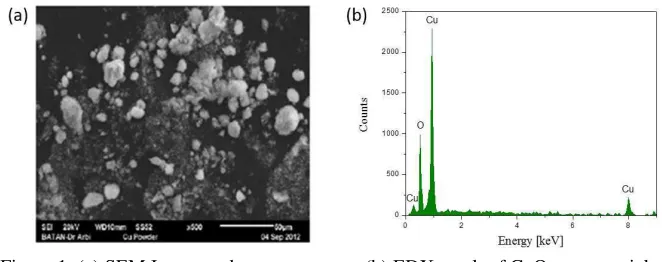
To ensure the size and the content of the particles, Scanning Electron Microscope (SEM) image and Energy Dispersive X-ray (EDX) was obtained, and the result showed that the particles are nano in size and the particle consisted of 67.73% Cu and 32.27% O. The SEM image and the EDX result are shown in Fig. 1. The nano-particle then dispersed to water as its base fluid using ultrasonic
processor at 60 Hz for 30 minutes. The nanofluid volume fraction used the same formulation as the author did previously [2].
Figure 1. (a) SEM Image and (b) EDX result of CuO nano-particle
Experimental Setup
The heat pipe being used in this study is a copper-based with biomaterial wick. It has the length of 5 cm and diameter of an inch, with the wick structure wrapped the inner diameter of the pipe, from evaporator to condenser. The heat pipe is shown in Fig 2(a). The experiment conducted mainly consisted of three parts. The first part is to assess the quality of the nanofluids before utilization. The second one is to investigate the thermal performance of heat pipe, charged by CuO-water nanofluids with various concentrations. Electric heater was used to simulate the heat given by computer microprocessor at minimum and maximum load. The experimental setup for the second part of experiment is shown in Fig. 2(b). The third part is to figure out the long term stability of the nanofluid. The heat pipe containing nanofluid was tested twice, with each test separated by a period of 4 weeks.
Figure 2 (a) The heat pipe used in this study (b) Experimental setup of this study
Result and Discussion
The Assessment of CuO-Water Nanofluid
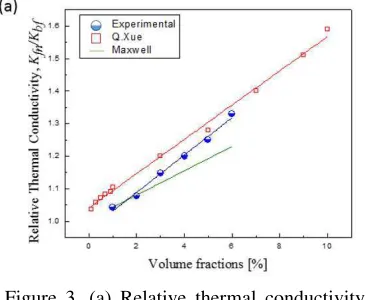
The measurement of nanofluid thermal conductivity was done using KD2 Pro Thermal Properties Analyzer Decagon and compared with other studies [11]. From Fig. 3(a), it can be seen that the relative thermal conductivity of nanofluid increased as the volume concentration increased. The higher thermal conductivity compared to its base fluid could be addressed to the existence of high thermal conductivity particle dissolved inside the fluid. The Brownian effect as well as the layer of liquid-solid interface of nano-particle and a more even molecular structure at the interface of solid nano-particle also have role in enhancing the thermal properties of the fluid [12]. The more particles dissolved at higher concentration of nanofluid leads to the magnification of those effects, thus, higher thermal conductivity. Though the result obtain from this study are slightly different with the model by Xue and the model by Maxwell [13], the trend of the results are quite similar. The presence of some amount of nano-particle dispersed inside the base fluid also has other effect, which is an improvement in wettability [14] Wettability is the ability of fluid to wet the surface, and usually measured by contact angle. From Fig. 3(b), it can be seen that the addition of CuO nano-particle decreased the contact angle of water from 43o to 32o, hence better wettability.
Thermal Performance of Heat Pipe with CuO-Water Working Fluid
The experiment conducted in this study utilized both low and high concentration nanofluids to heat pipe. The low volume concentration nanofluids are ones with volume fraction below 1%, while the high concentration nanofluids are those with volume fraction higher than 1%. As can be seen in Fig. 4, the increment of volume fraction up to 7% (from 0.1% to 7%) yielded lower heater surface temperature. But then the surface temperature rose again as the volume fraction increased from 7% to 9% and 10%. The occurrence of this phenomenon explained as follows.
As previously explained, nanofluid with higher concentration has higher thermal conductivity. The increment of nanofluid’s thermal conductivity being used affects the overall effective thermal conductivity of the heat pipe. Hence up to some extent, increment of nanofluid’s volume fraction – also means increment of nanofluid’s thermal conductivity – would also leads to the increment of the overall effective thermal conductivity of the heat pipe. Thus, more heat dissipated and lower heater surface temperature [15, 16]. But then there is viscous limit [17]. It explained that there is a condition when the fluid becomes too viscous, and unable to flow inside the heat pipe well. This hampered the heat transfer capability of the heat pipe. The theory explained why the surface temperature of the heater rose at the application of nanofluids with very high volume fraction. At this very high volume fraction, the fluid becomes too viscous that it exceeds the viscous limit of the heat pipe design. To be specific, the addition of 0.711 gram of CuO nano-particles on the 0.9% CuO-water nanofluid reduced the heater surface temperature as much as 6.5%, and as shown in Fig. 5(a) reduced the thermal resistance as much as 70%. Meanwhile the addition of 5.530 gram of CuO nano-particles on the 7% CuO-water nanofluid reduced the heater surface temperature as much as
(b) Comparison of wettability
14.3 % and reduced the thermal resistance as much as 83%. These facts showed that the more significant improvement found at the addition of small amount of nano-particles, not at the large one. To be precise, the 7% CuO-water nanofluid added 4,819 gram of CuO nano-particles to the 0.9% CuO-water nanofluids, but only reduce the surface temperature as much as 8.3 % and reduce the thermal resistance by 43.3 %. This again could be attributed to the viscous limit, that is already been closed down by the 7% CuO-water nanofluid.
Long Term Stability of Nanofluid
To test the long term stability of the nanofluid, heat pipe charged with low concentration, 0.9% CuO-water nanofluid and one with high concentration, 5% CuO nanofluid tested twice. Each test separated over period of 4 weeks, and in that period the heat pipe was not being operated. It can be concluded that by the use of low concentration nanofluid, the heat pipe did not show any significant reduction in performance (not shown in figure). Unlikely, the use of high concentration nanofluid clearly show degradation in performance, indicated by the surface temperature that is higher at the second operation as shown in Fig. 5(b).
Figure 4. Thermal performance of heat pipe with various CuO-water nanofluid concentration
In both case, the nanofluids left deposition at the evaporator. However, at lower nanofluid concentration, the deposition form thin layer of nano-particle and enhancing wettability and intensifying bubble generation, thus decreasing thermal resistance [9]. While at higher nanofluid concentration, the deposition was so thick that it obstructed the heat transfer. The capillary pores of the wick were also covered by the thick deposition, increasing the thermal resistance.
Summary
The analysis of CuO-water nanofluid as working fluid for heat pipe has been conducted. It was figured out that due to the existence of both positive and negative effect of nanofluid application, there is an optimum value of nanofluid concentration that yielded the best heat pipe performance. It
(b) Thermal performance of heat pipe with nanofluid after not being operated for 4 weeks
Figure 5. (a) Thermal resistance of heat pipe at application of 0.9% and 7% CuO-water nanofluid
was also found that the addition of high amount of nano-particles proven to be insignificant to the heat pipe thermal performance. The best improvement both in thermal performance and long term stability found on the application of low concentration nanofluid, that is in this case CuO-water nanofluid with 0.9% volume fraction.
Reference
[1] Chen, Y.-S., Chien, K.-H., Hung, T.-C., Wang, C.-C., Ferng, Y.-M., Pei, B.-S., T Numerical simulation of a heat sink embedded with a vapor chamber and calculation of effective thermal conductivity of a vapor chamber. Applied Thermal Engineering. 29(13) (2009) 2655-2664
[2] Septiadi, W.N., Putra, N., Juarsa, M., Putra, I.P.A., Sahmura, R., Characteristics of screen mesh wick heat pipe with nano-fluid as passive cooling system, Atom Indonesia. 39 (2013)
[3] Ji, X, J. Xu, and A.M Abanda, Copper foam based vapor chamber for high heat flux dissipation, Experimental Thermal and Fluid Science. 40 (2012) 93-102
[4] Naphon, P. and S.Wiriyasart, Study on the vapor chamber with refrigerant R-141b as working fluid for HDD cooling, Int. Communications in Heat and Mass Transfer. 39(9) (2012) 1449-1452
[5] Wong, S.-C and C.-W Chen, Visualization and evaporator resistance measurement for a groove-wicked flat-plate heat pipe, Int. J. of Heat and Mass Transfer. 55(9-10) (2012) 2229-2234
[6] S.U. Choi and J. Eastman, Enhancing thermal conductivity of fluids with nanoparticles, Argonne national Lab., IL, United States. (1995)
[7] Saleh, R., Putra, N., Wibowo, R.E., Septiadi, W.N., Prakoso, S.P., Titanium dioxide nanofluids for heat transfer applications, Experimental Thermal and Fluid Science. 52 (2014) 12-29
[8] Putra, N., Septiadi, W.N., Rahman, H., Irwansyah, R., Thermal performance of screen mesh wick heat pipes with nanofluids, Experimental Thermal and Fluid Science. 40 (2012) 10-17
[9] Saleh, R., Putra, N., Prakoso, S.P., Septiadi, W.N., Experimental investigation of thermal conductivity and heat pipe thermal performance of ZnO nanofluids, International Journal of Thermal Sciences. 62 (2013) 125-132
[10]M.H. Buschmann, Nanofluids in thermosyphons and heat pipes: Overview of recent experiments and modelling approaches, International Journal of Thermal Sciences. 72 (2013) 1- 17
[11]N. Putra, W.N. Septiadi, R. Saleh, R.A. Koestoer, S.P. Prakoso, The effect of Cu-water nanofluid and biomaterial wick on loop heat pipe performance, Advanced Material Research. 875-877 (2014) 356-361
[12]P. Keblinski, R. Prasher, and J. Eapen, Thermal conductance of nanofluids: is the controversy over?, Journal of Nanoparticle research. 10 (2008) 1089-1097
[13]Q.-Z. Xue, Model for effective thermal conductivity of nanofluids, Physics Letters A. 307 (2003) 313-317
[14]S. Khandekar, Y.M. Joshi and B. Mehta, Thermal performance of closed two-phase thermosyphon using nanofluids, International Journal of Thermal Sciences. 47 (2008) 659-667
[15]C. Li and G. Peterson, The effective thermal conductivity of wire screen, International Journal of Heat and Mass Transfer. 49 (2006) 4095-4105
[16]D.A.R.P.A. Kew, Heat Pipe: Theory, Design and Applications. USA: Butterworth-Heinemann is an imprint of Elsevier (2006)
[17]P. Nemec, A. Caja, and M. Malcho, Mathematical model for heat transfer limitations of heat pipe, Mathematical and Computer Modelling. 57 (2013) 126-136
Innovative Solutions in the Field of Engineering Sciences
10.4028/www.scientific.net/AMM.590
Analysis of CuO-Water Nanofluid Application on Heat Pipe
10.4028/www.scientific.net/AMM.590.234
DOI References
[3] Ji, X, J. Xu, and A. M Abanda, Copper foam based vapor chamber for high heat flux dissipation, Experimental Thermal and Fluid Science. 40 (2012) 93-102.
http://dx.doi.org/10.1016/j.expthermflusci.2012.02.004
[7] Saleh, R., Putra, N., Wibowo, R.E., Septiadi, W.N., Prakoso, S.P., Titanium dioxide nanofluids for heat transfer applications, Experimental Thermal and Fluid Science. 52 (2014) 12-29.
http://dx.doi.org/10.1016/j.expthermflusci.2013.08.018
[8] Putra, N., Septiadi, W.N., Rahman, H., Irwansyah, R., Thermal performance of screen mesh wick heat pipes with nanofluids, Experimental Thermal and Fluid Science. 40 (2012) 10-17.
http://dx.doi.org/10.1016/j.expthermflusci.2012.01.007
[9] Saleh, R., Putra, N., Prakoso, S.P., Septiadi, W.N., Experimental investigation of thermal conductivity and heat pipe thermal performance of ZnO nanofluids, International Journal of Thermal Sciences. 62 (2013) 125-132.
http://dx.doi.org/10.1016/j.ijthermalsci.2012.07.011
[11] N. Putra, W.N. Septiadi, R. Saleh, R.A. Koestoer, S.P. Prakoso, The effect of Cu-water nanofluid and biomaterial wick on loop heat pipe performance, Advanced Material Research. 875-877 (2014) 356-361. http://dx.doi.org/10.4028/www.scientific.net/AMR.875-877.356
[12] P. Keblinski, R. Prasher, and J. Eapen, Thermal conductance of nanofluids: is the controversy over?, Journal of Nanoparticle research. 10 (2008) 1089-1097.
http://dx.doi.org/10.1007/s11051-007-9352-1
[14] S. Khandekar, Y.M. Joshi and B. Mehta, Thermal performance of closed two-phase thermosyphon using nanofluids, International Journal of Thermal Sciences. 47 (2008) 659-667.
http://dx.doi.org/10.1016/j.ijthermalsci.2007.06.005
[17] P. Nemec, A. Caja, and M. Malcho, Mathematical model for heat transfer limitations of heat pipe, Mathematical and Computer Modelling. 57 (2013) 126-136.