THE PERSONALITY DEVELOPMENT OF HICCUP
IN CRESSIDA COWELL’S
HOW TO TRAIN YOUR DRAGON
A SARJANA PENDIDIKAN THESIS
Presented as Partial Fulfillment of the Requirements to Obtain the Sarjana Pedidikan Degree
in English Language Education
By
Roosefine Shierly Septiana Student Number: 121214037
ENGLISH LANGUAGE EDUCATION STUDY PROGRAM DEPARTEMENT OF LANGUAGE AND ARTS EDUCATION
FACULTY OF TEACHERS TRAINING AND EDUCATION SANATA DHARMA UNIVERSITY
i
THE PERSONALITY DEVELOPMENT OF HICCUP
IN
CRESSIDA COWELL’S
HOW TO TRAIN YOUR DRAGON
A SARJANA PENDIDIKAN THESIS
Presented as Partial Fulfillment of the Requirements to Obtain the Sarjana Pedidikan Degree
in English Language Education
By
Roosefine Shierly Septiana Student Number: 121214037
ENGLISH LANGUAGE EDUCATION STUDY PROGRAM DEPARTMENT OF LANGUAGE AND ARTS EDUCATION FACULTY OF TEACHERS TRAINING AND EDUCATION
SANATA DHARMA UNIVERSITY YOGYAKARTA
iv
DEDICATION PAGE
I dedicate this undergraduate thesis to
My beloved father in heaven
vii ABSTRACT
Septiana, Roosefine Shierly. (2017). The Personality Development of Hiccup in
Cressida Cowell’s How to Train Your Dragon. Yogyakarta: English Education
Study Program. Department of Language and Arts Education. Faculty of Teachers Training and Education. Sanata Dharma University.
This study analyzed a novel entitled How to Train Your Dragon by Cressida Cowell. This study focused on analyzing the personality development of Hiccup in his pre-adolescent stage. The research problem in this study is focused on how Hiccup’s personality development was depicted in the stage of preadolescent.
This study applied the psychological criticism approach to analyze the development of Hiccup in his preadolescence period. This approach was chosen because the main discussion in this study was about the personality development. The method was library study with the novel as the main source, while the other sources were taken from books, articles, and internet.
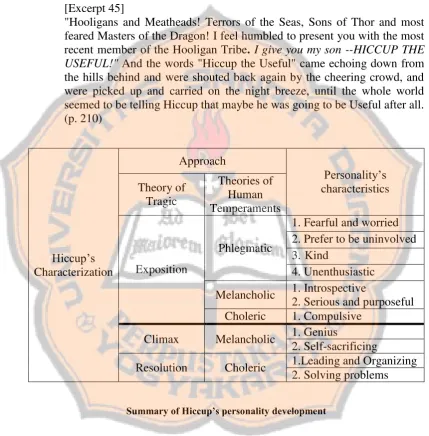
The finding of this study revealed that Hiccup developed from having phlegmatic, melancholic, and choleric personalities. Those personalities had predominant negative characteristics such as fearful and worried, too introspective, and unenthusiastic. Later, Hiccup’s personalities developed and became melancholic and choleric personalities. Characteristics’ of each personality were more positive than previous personalities.
viii ABSTRAK
Septiana, Roosefine Shierly. (2017). The Personality Development of Hiccup in
Cressida Cowell’s How to Train Your Dragon. Yogyakarta: Program Studi
Pendidikan Bahasa Inggris. Departemen Pendidikan Bahasa dan Seni. Fakultas Keguruan dan Ilmu Pendidikan. Universitas Sanata Dharma.
Studi ini menganalisa sebuah novel berjudul How to Train Your Dragon yang ditulis oleh Cressida Cowell. Fokus pada studi ini adalah menganalisa perkembangan karakter Hiccup yang sedang di masa awal masa remaja dan factor yang mempengaruhi perkembangan kararternya.
Terdapat satu rumusan masalah di studi ini, yaitu; bagaimana perkembangan karakter Hiccup yang digambarkan menggunakan pendekatan psikologis terutama pada masa awal masa remaja.
Pendekatan psikologis dipilih karena pembahasan utama pada studi ini adalah perkembangan karakter. Pendekatan psikologis diterapkan dengan tujuan untuk menganalisis perkembangan karakter Hiccup di masa awal keremajaannya.
Metode yang digunakan adalah studi pustaka dimana sumber utama studi ini didapat dari novel yang berjudul How to Train Your Dragon yang ditulis oleh Cressida Cowell, dan sumber lain diambil dari buku –buku, jurnal, artikel dan internet yang berisi tentang karakter, karakterisasi, perkembangan remaja dan kepribadian.
Temuan dari studi ini adalah Hiccup berkembang dari kepribadian yang sangat plegmatis, melankolis dan juga koleris yang berciri-ciri dari setiap kepribadian sangat negatif. Sekarang Hiccup telah berubah menjadi kepribadian berwatak melankolis dan koleris yang ciri-ciri setiap kepribadiannya cenderung lebih positif.
ix
ACKNOWLEDGEMENTS
First, Iwould like to thank God for his guidance. He has given His blessing to me so that I could finally finish my thesis. I believe that this achievement is nothing without Him. I also thank Mother Mary who also gives Her blessing, love, andstrength.
My deepest gratitude goes to my mother Lf. Kus Ari Astuti and my sisters Roosephine Candy Kuntari and Rooseline Linda Octina who always love, encourage, give advices, guidance, and also support me to finish my study every time I wanted to give up. I also give my thank to my father in heaven, Conradus Koenraad Roosen, who gave his never ending love tome. Moreover, for my grandparents, my uncle, and aunty who also support and give me love, courage, andcare to write this thesis. I am grateful to have them as my family.
I would like to give my sincere gratitude to my advisor Dr. Emanuel Sunarto, M.Hum. He has guided me patiently in the writing process and has given me his time to consult this thesis. I thank to all lectures in ELESP for all the guidance to finish my study and my thesis.
x
schoolbest friend, Verena Yosica Ronandha S.Pd. who always reminds me to keep fighting and finish my study. I amvery grateful to have them in my life.
I would like to thank my friends Dogma Uli Sihombing, S.Pd., Anchieta Avi Avilanova, S.Pd., Ria Resty Winarni, S.Pd., Hari Krismawan S.Pd., Giovani Agnes Utami, Chezia Eufresia Isworo, S.Pd., and Christianus Joe Nau Tonga, S.Pd., for their time and willingness to proofread this thesis.
I also express my gratitude to my beloved boyfriend, Yoseph Yulian Setyadi who always stays by my side in joy and tears. Hegives me his love, care, and support. He always encourages and helpsme in any situation. I amlucky to have him by my side.
The last but not least, I would like to thank all of my friends and everyone who give me his or her support, help, and assistance in the process of writing this thesis and for their friendship that we shared.
xi
PERNYATAAN PERSETUJUAN PUBLIKASI ... vi
ABSTRACT ... vii
CHAPTER II. REVIEW OF RELATED LITERATURE ... 8
A. Review of Related Studies ... 8
B. Theoretical Description ... 10
1. Theory of Plot ... 10
2. Theory of Character and Characterization ... 11
2.1Definition of Character ... 11
2.2Definition of Characterization ... 12
xii
A. Hiccup’s Dominant Personalities Before Conflict ... 28
1. Phlegmatic ... 29
B. Hiccup’s Dominant Personalities After Conflict ... 49
1. Melancholic ... 51
CHAPTER V. CONCLUSIONS, IMPLICATIONS, AND SUGGESTIONS 73 A. Conclusions ... 73
B. Implication ... 75
C. Suggestions ... 76
1. Suggestion for Future Researchers ... 76
2. Suggestion for Teachers ... 77
xiii
xiv
LIST OF APPENDICES
Appendix 1:The Summary and cover of How to Train Your Dragon ... 81
Appendix 2: The Biography of Cressida Cowell ... 82
Appendix 3: The Picture of Cressida Cowell ... 84
1 CHAPTER I INTRODUCTION
This chapter consists of five parts, namely, background of the study, problem formulation, objective of the study, significances of the study, and definition of terms. The background of the study provides the explanation why the writer chooses the novel as the subject of the study. The problem formulation describes the question that is going to beanalyzed later. The object of the study deals with the aims of the study. The significances of the study discuss the advantages of this study to the readers. The definition of terms, it is provided to avoid misconception in this study.
A. Background of the Study
Children development is important for parents to understand. Parents should
be really concerned about their children’s development. Accordingly, they can
guide them in a right path to live. Finding a guide to help the parents in raising their children is easy. Many studies have been done to find the detailed information
about children’s development. Those studies are intended to give information as
many as possible about what children development is and how to handle it. The information which is provided is easy to be applied as a guidance for the parents to educate, help, and guide their children.
However, the most important stage is adolescent stage. It is because if children want to become adults, they have to pass the adolescence stage. According to Sullivan’s Stages of Development, there are three stages which are included in adolescence stage (as cited in Feist & Feist, 2006, p. 231). The adolescence’s stages are preadolescence, early adolescence, and late adolescence. Adolescence stage is a stage between childhood and adulthood. According to Conger (1977), “adolescent is a period of rapid change, physical, physiological, psychological, and social” (p. 36). Many children psychologists concern about this stage and call this stage as
“Storm and Stress.” In adolescence stage, children experience a lot of difficulties
which come from themselves (body and mind) and from their environments. A proper guide from parents is a great help for children to pass adolescent stage.
One of the ways to help children pass the adolescence stage is by understanding their personalities. Each child has his or her own personality that makes he or she is different from others. By knowing their children’s personalities, parents can provide better treatments, activities, and environments to help children pass the adolescence stage. According to Hjelle and Ziegler (1981), someone’s personality can be affected by internal and external influences, such as genetic, biological propensities, their social experiences, and changing in environments (p.
7). Moreover, understanding children’s personalities in their preadolescence stage
can be used to prevent and treat negative personalities which are in the children since the juvenile stage. Feist and Feist (2006) state that “earlier negative influences or mistakes in juvenile stage can be diminished in preadolescence stage, but
Negative personality is caused by children’s unhappy emotions. According to Ali and Asrori (2004), in adolescent’s psychological development, children who are entering the adolescence stage experience a sudden growth in their bodies which caused by the brain’s development. The sudden growth in the brain development can trigger unbalanced emotions towards their life such as a sensitiveness which can lead to an unhappy emotion. At this point, the parents’ role is needed, children should be guided and informed about what will happen to them in preadolescence stage. According to Spano (2014), parents should provide their children with warm, strong, and positive communication to build individual values and healthy life to prevent unhappy emotions to turn into negative personalities in their children.
Talking about children is not only interesting for the research but also for literature works. Cressida Cowell is one of the American novelists who is inclined to write stories for children. She began to write stories since she was nine years old. Her first book was published in 1999. However, she began to write stories about adolescent since 2002. Her ideas mostly come from her childhood. Her stories contain her experiences about family, school, and friendship.
be accepted in the tribe so that he can be called as a Viking. In this initiation, he and the other boys should catch and train their own dragons as the final test. Hiccup tries his best to train his coward and self-centered dragon named Toothless. In his journey, he faces a lot of problems such as training Toothless basic commands and fighting the biggest dragon in the world in order to save his tribe.
This novel emphasizes on Hiccup’s personality development in his
preadolescence stage. This study analyzes Hiccup’s personality development since he is rejected until he finally earns his acceptance in his society. This kind of situation happened in many adolescences. Many children have ever felt a rejection from their society especially in their adolescence stage. For example, a case written by Burns (2017), a bullying case of eleven –year-old boy named Thomas Thompson. He took an overdose painkiller after he was bullied because being a clever boy. Thomas being bullied by his friends at Riverside Primary School in Wallasey. Based on the fact above, the writer finds out an interesting topic about understanding personalities in order to help children to survive, especially in their preadolescence stage which needs more attention. Therefore, the writer analyzes the personality development further in this novel.
B. Problem Formulation
There is one problem discussed in this study. It can be formulated as follows:
1. How is Hiccup’s personality development depicted in his preadolescence
C. Objective of the Study
There is one objective to be achieved in this study. The objective is to depict
Hiccup’s personality development from the beginning until the end of the story.
The analysis focusses on his preadolescence stage.
D. Significance of the Study
There are three benefits from this study especially for those who have an interest in literary work and psychology. The first benefit of this study is for the lecturers who teach a literary course. Hopefully, the novel in this study can be used by the lecturers to be teach about character, characterization, and plot in prose or drama courses. The second benefit is for the future researcher. The writer hopes that this study can be the source of future researches in literary studies which analyzes character development or personality development, for example Hiccup’s personality development in adolescence or Snotloud’s character development. The third is for the teachers and parents. This study is expected to be the source for teachers and parents who need adeeper understanding about types of personality and reasons for personality change in order to help their students or children pass the preadolescence stage.
E. Definition of Terms
1. Character
According to Eneste (1991), characters in novel can be in form of humans or animals (p. 24). As stated by Stanton (1965) that “character is the emotion,
wishes, morality, and personality of the individual in the story” (p. 33). Here,
character means the subject of the story in the form of human with their emotions, wishes, moralities, and personalities in the story. The character that is analyzed in this study is a young Viking boy named Hiccup.
2. Personality
Personality has many definitions. As stated by Hjelle and Ziegler (1981),
the word “personality” comes from a Latin word “persona” which means the mask
worn in theatrical players in ancient Greek dramas. Therefore, nowadays,
personality has been seen as the individual’s strongest or most dominant
characteristic (p. 6). In this study, personality is seen as the dominant characteristics in a character.
3. Personality Development
Personality development is a development which enhances individual outer and inner self to bring about a positive change to your life. Outer self means body or physical appearance. Inner self means the mind and conscience. Each individual has a different personality that can be developed, polished and refined. Personality development usually happened because of several changes in their life (“Personality
4. Preadolescence
According to Hurlock (1973), adolescence is a period of transition when the individual changes physically and psychologically from a child to an adult” (p. 2). Children will transform their body and mind from childhood to adulthood. According to Sullivan (1953), there are six stages in development (as cited from Feist and Feist, 2006, p. 223). The stages are infancy, childhood, juvenile era, preadolescence, early adolescence, and late adolescence. Preadolescence is ranged between eight and a half until thirteen years old. Preadolescence is time when intimacy with a particular person in the same gender occurs. In preadolescence the intimacy and love become the characteristics of friendship. The intimate relationship in preadolescence usually involves another person with the same
gender, age and social status. Moreover, love in friendship will occur when other’s
8
CHAPTER II
REVIEW OF RELATED LITERATURE
This chapter consists of three parts. The first part is the review of related studies. The second part is the theoretical description. The third part is the theoretical framework. In the review of related studies, the writer presents the references of the previous studies about character development. In the theoretical description, the writer presents the theories related to the problem formulation. In the third part, the writer explains the steps of conducting this study and shows some theories which are used in analyzing the subject of the study.
A. Review of Related Studies
This study is not the only study that analyzes the character development in a novel. There are two related studies which help the writer to understand more the aspects and factors of character development that the writer aims to reveal. This study uses the same approach as the previous studies but uses different novel as the subject.
The first undergraduate thesis that is related to my study is entitled “The
Psychological Influences of Mother’s Behavior on Paul’s Character Development
as Seen in D.H. Lawrence’s Son’s and Lovers” by Almira Wanodya Padmasari
Padmasari focused on mother’s psychological behavior which affected
children’s character development. In her thesis, Padmasari analyzed the reality on
how the parents’ responsibility takes part on shaping their children’spersonalities.
She said “the mother as the family and major nurturance figure to the children must set an example of behavior for her children. The behavior engaged in herself, her
husband, her children and the society will interfere with the children’s achievement
and integrated personality” (2016: 4).
Padmasari used psychological approach in her undergraduate thesis, since the idea of the character development and personality are the significant theories in psychology. Her approach is the same as this study, but the object of the study is different. The novel that Padmasari analyzed entitle Son’s and Lovers and the novel that is used in this study is How to train Your dragon.
The second related study is “Scout’s Personality Development as Revealed
in Lee’s to Kill a Mocking Bird” by Astari Paramita Tjandra. Tjandra (2015)
focused on Scout’s personality development since she grows up around adulthood. Tjandra analyzed Scout’s personality development since Scout grew up
around adulthood and the moral values that the reader can get from someone’s
racism experience. Tjandra used psychological approach in her undergraduate thesis since the concept of personality development is significant theories in psychology.
written by Padmasari, she focused on the psychological influence of mother’s
behavior toward Paul’s character development. Meanwhile, the second related
study focused on the finding of personality development and moral values that could be found from someone’s racism experience. The difference between two previous studies from this study is on the objects of the study which use different novels. Therefore, the writer finds a new topic which discusses personality development of Hiccup in his preadolescent stage in How to train your Dragon novel using psychological approach.
B. Theoretical Description
There are some theories used by the writer in conducting this study. These theories give the writer some valuable information which are very helpful in analyzing the novel. They are the theory of plot, the theory of character, the theory of characterization, the theory of adolescence, and the last one is the theory of personality.
1. Theory of Plot
McManus (1999) said that there are three major sections. The first is the incentive moment or exposition, contain the introduction of characters, the setting, and the conflict. The second is the climax, the turning point when the problem or conflict turns worst. The third is the resolution, the end of the story when the problem or conflict is solved.
2. Theory of Character and Characterization
Characters is one of the important parts of a story. To have deeper understanding about a story, the reader should know all of the characters in the story. As stated by Stanton (1965), “through our knowledge of the characters, we understand their actions, we understand the characters” (p. 18). The theories of character in this study are proposed by Eneste (1991), Stanton (1965), Kennedy and Gioia (2010).
2.1 Definition of Character
As stated by Eneste (1991), characters in the novel is usually humans, but sometimes there is a novel which has animal characters in it (p. 24). Moreover, as stated by Stanton (1965), “character is used in two contexts. First, character is the individual shown in the story or second, character is the emotion, wishes, morality,
and personality of the individual in the story” (p. 33). Based on the statements
above, a character can be synthesized as humans or animals which have emotion, wishes or certain personality in them and connected to the action in the story.
2.2 Definition of Characterization
Characterization is important when people write stories because every story has characters in it and every character should have their own characterization. According to Eneste (1991) “characterization’s function is to support the story and
the plot” (p. 25). Moreover, as stated by Saad (1967) “characterization’s task is to
supply the reasons for certain action in the story” (as cited in Eneste, 1991, p. 25). Based on statements above, the writer concludes that characterization is an instrument to support the story and explain the reason why certain action happens in the story.
2.3 Ways of Characterization
Characterization can be done in many ways to give a detailed explanation about the character itself. As stated by Rene and Austin (1956), “the simplest way to understand a character is from the name” (as cited in Eneste, 1991, p. 24).
Moreover, according to Eneste (1991), “characterization can be done not only by
Furthermore, Murphy (1972) describes nine ways of characterizationin the novel, which are:
2.3.1 Personal Description
The authors of stories usually describe their character directly. Through their narration, they will give the readers some clues through appearances or clothes to let their imagination form their own perception towards the characters in the story.
2.3.2 Character as Seen by Another
On the other hand, instead of giving a direct narration about character, the author usually gives clues about a character through other characters’ eyes, opinions or thoughts.
2.3.3 Speech
The author can also describe characters through their speech. Clues can be found from how characters talk, their speech, their conversation, and also from their opinions.
2.3.4 Past Life
Characters’ past life can also give the readers description about the
2.3.5 Conversation of Others
The author can give the readers clues about a character through other
characters’ conversation. Usually, other characters will talk about other characters
too. From their conversation we can find some clues that related to certain character that they talked about.
2.3.6 Reactions
Clues can also be found in reactions. The reactions mean that the author sometimes gives the readers clues about a character through their reaction. A
character’s reaction toward some situations and events can help the reader to have
a better understanding.
2.3.7 Direct Comment
The author uses their direct comment or narration to describe the characters directly in the story.
2.3.8 Thoughts
The author gives the readers clues from the characters’ thoughts or what they are thinking about in various events.
2.3.9 Mannerism
The author gives the readers clues about characters’ personalities through
3 Theory of Personality
To see the factors of the development in personality, the theory of personality is needed to give a clearer reason and explanation. The theories of personality are from Ekstrand (2012) and Hurlock (1974).
3.1 Definition of Personality
Personality has many meanings. According to Allport, “personality is the dynamic organization within the individual of those psychological system that determine his or her characteristic behavior and thought” (as cited in Hurlock, 1974, p. 7). Moreover, according to Hjelle and Ziegler (1981) in their book entitled Personalities Theories; Basic Assumption, Research, and Applications, personality is seen as the most dominant individual’s characteristic (p. 6). It can be concluded that personality is an organization from the most dominant individual’s characteristic.
3.2 Theory of Four Human Temperaments
phlegmatic. Ekstrand (2012) says that “all human beings have a degree of each of these four personality types within them, though each person will definitely test out
higher in one, with another being a close second” (p. 2). According to Ekstrand
(2012), each personality is described as follows:
3.2.1 Sanguine
Sanguine personality has positive and negative characteristics in it. Therefore, sanguine characteristics are mentioned in order to support this study in
analyzing Hiccup’s characterization. The sanguine is described as impulsive and
pleasure-seeking personality. According to Ekstrand (2012) the sanguine is called as the talker. They are very expressive and enthusiast with people (p. 2). Sanguine loves to be the center of attention that is why they are very sociable and attractive. Moreover, sanguine loves people so they are famous of being friendly and warm-hearted and it help them to make friends in a crowd. In the other hand, even though sanguine seems to be very cheerful and friendly, sanguine also has some negative characteristics in them. The negative characteristics in sanguine are first, impulsive, they have tendency to make what they want come true as soon as possible. If what they wish did not came too they easily bored and sanguine cannot handle boredom well. The changes of sanguine moods are very fast and they famous of having mood disorder. Mood disorder means the sanguine has fluctuated moods.
3.2.2 Choleric
a leader so they have a great desire to control others. The choleric also famous of
being insensitive because they do not care about other’s feelings. That is why they
good at working independently because choleric is also strong-willed and self-sufficient. The negative characteristics of the choleric are bossy and also domineering others. They also quick tempered and easily angered about something that is wrong. Moreover, when choleric knows that something is wrong, they have tendency to correct it because they have compulsive side that always like to change things (p. 3). Choleric’s characteristics are mentioned in order to give clearer
explanation about choleric type and to support this study in analyzing Hiccup’s
personality development. 3.2.3 Melancholic
The Melancholic is an introverted and thoughtful personality.
Melancholic’s characteristics are explained in order to give detailed information
about melancholic and to help this study in finding Hiccup’s personality. Ekstrand
3.2.4 Phlegmatic
The phlegmatic is described as a relaxed and quiet personality. The phlegmatic is known as a quite personality, they like to make peace and stay out of a trouble and conflict. Therefore, phlegmatic is famous for being kind, sympathetic, easy going and calm. Ekstrand (2012) says that phlegmatic is referred to the watcher. Phlegmatic called as the watcher because they are very curious and observant but they do not like to be involved in some situation especially a conflict. Even though they are very peaceful, their negatives characteristics of the phlegmatic are tend to be a worrier and they tend to be indecisive when they have to decide something. moreover, because phlegmatic is known as the watcher and a relaxed personality, they seem to be an unenthusiastic and reluctant personality (p.
4). Phlegmatic’s characteristics is used in order to find Hiccup’s personality
whether he included in phlegmatic type or not.
3.3 Factors of Personality Change
Every personality development always has a factor. The factor can either come from inside or outside of a person. According to Hurlock (1974) there are eight factors of personality changes that happen in people (p. 124). First is physical changes, physical change may come from maturation, decline, illness, or some other
condition resulting from person’s life pattern but unrelated to the normal change in
the body structure (p. 124). Second is changes in environment, changes in either the
physical or social environment may produce changes in the person’s self-concept
when significant people in an individual’s life change and when he tries to adapt his pattern of behavior and his attitudes, belief, values, and aspiration to theirs, changes in his personality pattern cannot be avoided (p. 126). Fourth is changes in social pressure, as a childhood progresses, the child becomes increasingly aware that some personality traits are admires while some are dislike. Since everyone normally has a strong desire to be accepted by those who are significant to him, he tries to change any personality trait that will militate against his being accepted (p.126). Fifth is changes in role, a child changes being dependent to being economically independent person when he is old enough to become wage earner (p. 126). The changes in role may become favorable or unfavorable effect depends on
how well it fits to person’s need. Sixth is strong motivation, when the motivations
adjustment (p. 128). This theory is used in order to find the factor of Hiccup’s personality development.
Those are the theories that are used in this study. The theories that are explained above are used to support this study. Those theories are used to help the
writer to analyze Hiccup’s personalities development in order to answer the
question. Further explanation about the use of those theories is discussed in the theoretical framework.
C. Theoretical Framework
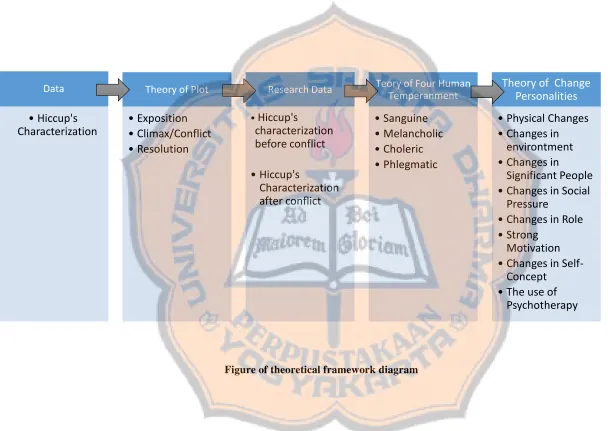
In this study, theories from books and references are taken to help the analysis in this study. The theories are also used to strengthen and support the analysis in this study. Each theory is used to answer the research question. Those theories are the theory of plot, theory of character, theory of characterization, theory of personality, and theory of personality change. The writer uses theory of plot by
Aristotle’s theory of tragic (as cited in McManus, 1999, p. 1). It is to divide the
23 CHAPTER III
METHODOLOGY
This chapter discusses the methodology that is employed in conducting this study. This chapter consists of three parts, namely object of the study, approach of the study, and methods of the study. The first part is the object of the study. It discusses the brief description of the novel. The second part is the approach of the study which presents the critical approach used in this study. The third part is the method of the study. It presents the research procedure which discusses the steps done by the writer in conducting the study to answer the formulated problem.
A. Object of the study
The literary work which is discussed in this study is a novel entitled How to Train Your Dragon. This novel is written by Cressida Cowell, an author of
children’s story. She was born on April 15, 1966 in London. She started writing a
story since she was nine years old. Her first novel published on 1998. Later, How to Train Your Dragonnovel was published in 2003. This novel contains 254 pages and 19 chapters.
tradition. He and the other boys in the village have to catch a dragon for initiation. The training is led by Gobber the Belch, a best friend of Hiccup’s father. After they succeed in catching the dragons for themselves the training begins. Hiccup uses so many ways to train his dragon. However, the result is not good. His dragon does not listen to him. Therefore,he uses his skill to talk in dragon’s language, he is finally able train a basic commandto his dragon. In the final exam, Hiccup’s dragon namely Toothless, starts a fight with other dragons. As the result, the initiation is ruined by the dragonsand the boys will be exiled out of Berk. A huge storm comes to Berk, the elder postponed the exile for a day. In the next day, the storm brought two giant dragons to Berk’s shore. Hiccup, as the only one who is able to speak dragoness, commanded by his father to ask the dragons to leave Berk. The dragons do not want to leave and they intend to eat all the villagers. However, Hiccup has a great idea to solve this problem. In the end, Hiccup succeeds in saving the village and the villagers.
B. Approach of the Study
sociological criticism, gender criticism, reader-response criticism, deconstructionist criticism and, cultural studies. Since this study focuses on psychological aspects, psychological criticism is applied in this study. According to Kennedy and Gioia (2002), psychological criticism has three major areas. They are the investigation of the creative process of artists, a psychology study of certain artists, and the analysis of fictional characters. Since this study analyzes fictional character, this study is included in the third major area of psychology criticism.
This study analyzes Hiccup’s personality development in his preadolescence stage as the main character in How to Train your Dragon novel. The reason which makes Hiccup’s personalities developedis discussed as well. It means that this study deals a lot with Hiccup’s personalities in order to find his personality development. Therefore, it is decent to apply psychology criticism approach to find the personality development because it can achieve a better understanding about human’s personalities. In this study, psychology criticism approach is synthesized by two theories which are the theory of tragic and the theory of four human temperaments. The theory of tragic is applying three parts namely exposition, climax, and resolution. Theory of human temperament is applying four parts namely phlegmatic, sanguine, choleric, and melancholic. The analysis is used to find clues which is going to be used to find Hiccup’s personality development.
C. Methods of Study
available at the library. The primary data of this study was How to Train Your Dragon novel.
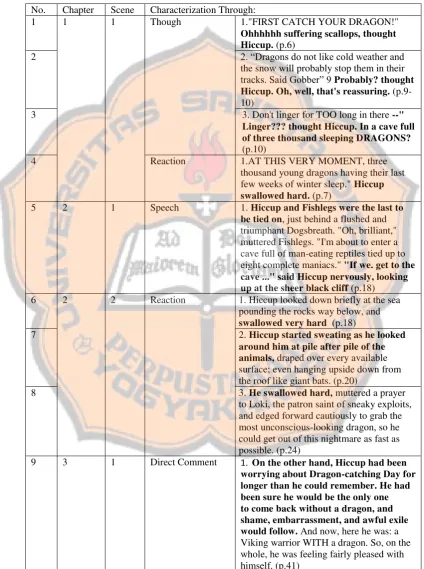
There were several steps applied in conducting this study. The first step was reading the novel several times thoroughly and understanding the story, looking for an information to support the study, taking notes of some information about the data that would be analyzed. After that, the writer was interested in analyzing personality development on Hiccup as the main character. The next step was segmenting the novel in several stages. The novel was segmented by using some theories. The first theory was the theory of plot, the theory was used to divide the story into exposition, conflict, and resolution in order to give clearer development on Hiccup’s personality. The second was the theory of characterization. The theory was used to gather the research data to find clues on Hiccup’s characteristics. After finding the clues from the characterization, those clues were tabulated and divided into personality’scharacteristics. The third was theory of four human temperaments. The theory was used to divide the clues into each personality type to find the most dominant personality before and after the conflict based on the amount of
personality’s characteristics from the tabulated clues. After knowing the before and
28 CHAPTER IV
ANALYSIS
This chapter provides the answer for the question stated in the problem formulation. This analysis is divided into three parts. The first part is what Hiccup’s dominant personalities before conflict which is from chapter one until ten. The second part is how Hiccup’s dominant personalities during and after conflict which are from chapter eleven until nineteen. The third part is Hiccup’s personality development.
A. Hiccup’s Dominant Personalities Before Conflict
Personality cannot be separated from people because every person has his or her own unique personalities. Personality is often shaped by environment, social activities, and experiences that someone has. Indifferent with human, fictional characters in a novel also have personalities. According to Forster, there are two types of character namely flat and round (as cited in Kennedy and Gioia, 2010, p. 78). A flat characteronly has one outstanding traitand tend to stay the same from the beginning until the end of the story. A round character has a greater and generous detail. Hiccup in this novel is a round character. As the main character in the novel, the author gave so many details about him.
ways are personal description, character as seen by another, speech, past life, conversation by others, reaction, direct comment, thought, and mannerism.
After analyzing Hiccup using the ways of characterization, the writer found several characteristics which show Hiccup’s dominant and less dominant personalities according to the findings which were found in the novel. The personalities are considered as dominants when the characteristics of each personality type had at least three clues in each characteristic. The less dominant personality found in Hiccup is sanguine. Sanguine’s characteristic found in Hiccup is forgiving towards other. Sanguine’s characteristic, forgiving, only found less than three times in the story. Therefore, it made the sanguine personality is less dominant personality found in Hiccup. In the other hand, the dominant personalities found in Hiccup are explained as follows:
1. Phlegmatic
1.1 Fearful and Worried
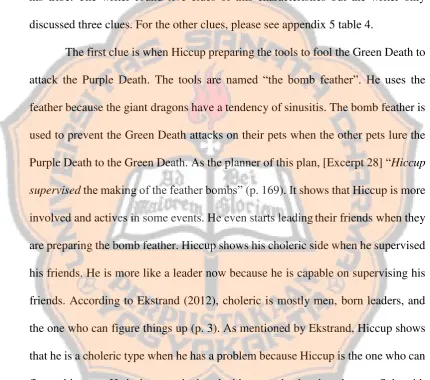
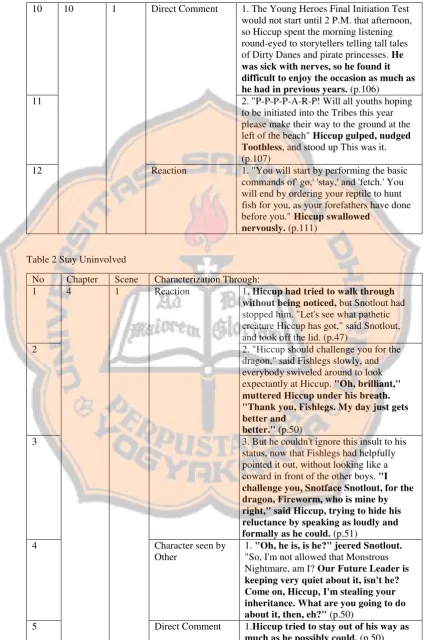
From phlegmatic characteristics that have been found, fearful and worried are on the first place. It isbecause there are 10 of 48 clues that are found from chapter one up to ten. The characterizations which showHiccup’s fearful and worried characteristics are from Hiccup’s thoughts, speeches, direct comments and reactions. The writer only took three clues to be analyzed in this part. For other clues, see Appendix 5 Table 1.
Hiccup and his friendsjointhe initiation as the basic rule to be accepted in their tribe. They have to catch their own dragons and train them for the final exam. The first clue takes place when Hiccup and other boys are in the Wild Dragon Cliff with their teacher namely Gobber. They are going to climb the cliff and enterthe dragon’s cave where the dragons are sleeping due to hibernation. Every boy has to catch a dragon and put it in the basket without waking them up.
[Excerpt 1]
"In the unlikely event that you DO wake the dragons -- and you would have to be IDIOTICALLY STUPID to do so -- run like thunder for the entrance to the cave. Dragons do not like cold weather and the snow will probably stop them in their tracks." Said Gobber. Probably? thought Hiccup. Oh, well, that's reassuring. (p.9 10)
In that scene, Hiccup feels uneasy to enter the dragon’s cave which is occupied with dragons. He has to join the initiation because if he does not pass the initiation he will be exiled from Berk forever. The punishment feels harder for
Hiccup because he has to pass the initiation for the sake of his father’s name as the
According to Murphy (1972), characterization can be done by character’s thought or by giving direct clues to readersabout what the character is thinking about. From Hiccup’s thought we can see that he is not sure that he can come back alive from the dragon’s cave. He starts thinking and criticizing about the test even before the test really starts. Viking is described as a tough and brave tribeso even though with lack of proper instructions, trainings, and tools to protect them, they will do just fine in the test, except Hiccup.
Hiccup is described as a weak boy who cannot do anything and the opposite of a Viking boy should be. Therefore, when he faces this test, his thought
exaggerates the word “probably” by repeating what Gobber said which is “cold
probably can stop the dragons from chasing and hunting them if the boys wake them up”. From the exaggeration and repetition of word “probably”, it shows that Hiccup is worried about the safety of this initiation and himself. Moreover, the
meaning of Hiccup’s sarcasm, “Oh, well, that's reassuring”, is that it is just fine
and nothing can go wrong. On the other hand, what Hiccup means is showing the opposite of the real meaning of that phrase which becomes “this is not reassuring at all and it is not safe”.From Hiccup’s sarcasm phrase, it shows that he is afraidif the cold does not stop the dragons from chasing them.
[Excerpt 2]
Hiccup and Fishlegs were the last to be tied on, just behind a flushed and triumphant Dogsbreath. "Oh, brilliant," muttered Fishlegs. "I'm about to enter a cave full of man-eating reptiles tied up to eight complete maniacs." "If we. get to the cave ..." said Hiccup nervously, looking up at the sheer black cliff.
It was a perilous climb. The rocks were slippery with snow and the other boys were thoroughly overexcited, making the ascent far too quickly. (p.18)
Based on Murphy (1972), understanding a character can be seen from his or her speech. From the clue it shows that Hiccup feels nervous when they climb the cliff. Hiccup responds to Fishlegs with a pessimist answer. He thinks that it is a small chance that they can get to the cave by adding the word “If” in the beginning of the sentence. The word “If” which is followed by “if we, get to the cave” shows that he worries about this climbing. He thinks that there is another possibility that they cannot get to the cliff. The cliff is very steep and dark and makes the climbing is very dangerous. Again, the cliff already makes him scared only by looking at the end of it. Hiccup’s reaction is different from the other boys who excited about this climbing.
The third clue is when the initiation day. This is the very end of the initiation test. The boys only have to pass the final test which is catching fishes as many as the dragons can do. Hiccup does not seemvery excited compared to the previous year when he only becomes the supporter not the contestant.
[Excerpt 3]
According to Murphy (1972), the author can give a direct commentabout how the character is about. From the direct comment,it shows that Hiccup has to perform in front of the Hooligan and The Meathead tribes. He feels sick which indicates that he is worried. He cannot enjoy the occasion like he enjoys it before when he becomesone of the contestants. This day, as a contestant, he has to perform basic commands and order his dragon, Toothless, to hunt fishes as the final test in the initiation day. If he succeeds, he officially becomes one of the Hairy Hooligan tribe’s members. In this clue, the author gives a direct comment on how Hiccup feels about today’s initiation test. The author writes that Hiccup is “sick with nerve” which indicates that he is worried about today’s final test. The author also adds another direct comment says that Hiccup “found out difficult to enjoy the occasion as much as he had in previous year.” In the previous years, when he was younger, Hiccup can enjoy the occasion because he is not the contestant. Therefore, when he is old enough, he becomes one of the contestants. The direct comment gives us a clue that Hiccup is not relaxed because he is worried about the test which makes him feels sick and he cannot enjoy the occasion.
Hiccup seems to have a great amount of fear and worriedness in several activities. This initiation day becomes the source of his fear and worriedness especially when he has to do some tasks to pass the tests. For more evidences about
Hiccup’s fear and worriedness see appendix 5 table 1.
1.2 Uninvolved
Hiccup’s second phlegmatic characteristic is he prefers to be uninvolved.
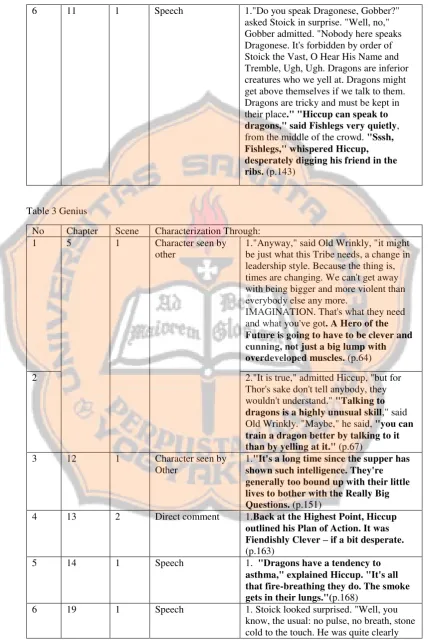
showthat Hiccup prefers to be uninvolved. The clues showthat Hiccup prefersto be uninvolved in several conversation or actions in the story. These are three clues that are analyzed:
The first clue is when the boys return to the village after they caught their dragons. Hiccup and Fishlegs also walktoward the village. The other boys are
hanging out at the village’s gate.
[Excerpt 4]
The second clue is when Snotloud shows off his dragon. Snotloud’s dragon
is Monstrous Nightmares type. That type is special because only the chief can have Monstrous Nightmares. Fishlegs challengesSnotloud in the name of Hiccup to hand over his dragon.
[Excerpt 5]
"Hiccup should challenge you for the dragon," said Fishlegs slowly, and everybody swiveled around to look expectantly at Hiccup.
Hiccup tried to stay out of his way as much as he possibly could. But he couldn't ignore this insult to his status, now that Fishlegs had helpfully pointed it out, without looking like a coward in front of the other boys. (p. 50)
"I challenge you, Snotface Snotlout, for the dragon, Fireworm, who is mine by right," said Hiccup, trying to hide his reluctance by speaking as loudly and formally as he could. (p. 51)
The third clue is when Snotloud mocks and intimidates Hiccup. Snotloud is trying to start a fight with Hiccup. He mocks Hiccup and challenges Hiccup when he steals his inheritance.
[Excerpt 6]
"Oh, he is, is he?" jeered Snotlout. "So, I'm not allowed that Monstrous Nightmare, am I? Our Future Leader is keeping very quiet about it, isn't he? Come on, Hiccup, I'm stealing your inheritance. What are you going to do about it, then, eh?" (p.50)
According to Murphy (1972), the characteristic of a character can be seen
through other character’s perception. In this clue, Snotloud’s opinion gives a clue
about Hiccup’s characteristic. Snoutloud who mocks and jeers Hiccup thinks that
Hiccup does not want to respond to it. Snoutloud says that “Our future leader is keeping very quiet about it isn’t he?” Itindicates that Hiccup does not do anything when Snoutloud mocks and jeers him. Snoutloud is bigger than Hiccup. He is also very mean. Snoutloud is very mean to Hiccup because he wants to be the next chief. Hiccup, who has experienced a lot of unpleasant behavior from Snoutloud, tends to stay quiet. He also does not want to starts a fight with him. Hiccup knows he has a small chance to defeat Snoutloud. He prefers to be uninvolved, patient, and accept everything what Snoutloud has done to him.
1.3 Kind
have a dragon yet. Then, he pulls a dragon from under a dragon’s pile. The dragon’s pile collapses but the dragons do notwake up. Unfortunately, Fishlegs sneezes very loud. One dragon awakes because of the sneeze and starts waking other dragons up. The dragons start to chasethe boys so they run toward the cave’s entrance.
[Excerpt 7]
"I haven't. . . got. . . a . . . dragon," panted Fishlegs, a couple of paces behind Hiccup. "Oh, for THOR'S SAKE," snapped Hiccup. He thrust his basket into Fishlegs's arms and grabbed the empty one from Fishlegs’ back. "Have MINE, then. Wait here." (p.28)
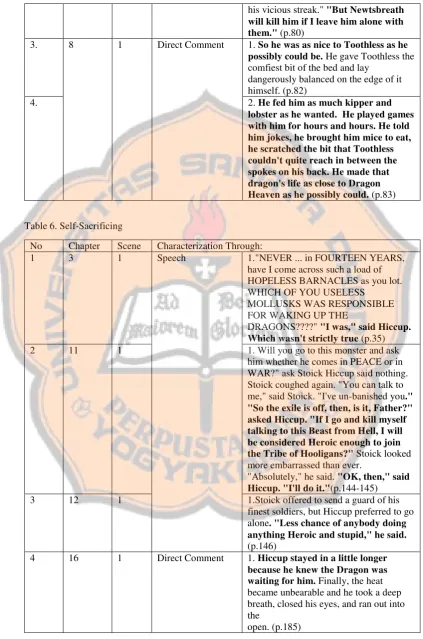
According to Murphy (1972), characteristic can be portrait from his reaction toward a certain event. When Hiccup and Fishlegs are in the entrance of the cave, Fishlegs says that he does not have any dragon in his basket. Each boyshould have his own dragon. If they do not get dragons, they will be failed. Hiccup feels sympathy to Fishlegs. He sacrifices his dragon for Fishlegs, “He thrust his basket into Fishlegs' arms and grabbed the empty one from Fishlegs' back. "Have MINE, then. Wait here.” Hiccup gives his dragon and comes back into the cave. He searches for a new dragon for himself. From Hiccup’s reaction to that situation, it shows that Hiccup is a kind boy. He sacrifices his own dragon for his best friend. By going back to the cave, Hiccup also sacrifices his own safety because hundreds of dragons are chasing them down.
and lay dangerously balanced on the edge of it himself” (p. 82). In Hiccup’s tribe, teaching a dragon has to be done by yelling because it is the easiest way to train it. On the other hand, Hiccup is not good at yelling. Therefore, Hiccup shows his kindness to his dragon by giving him an affection. He hopes that he can be a friend withhis dragon by giving him love. From the direct comment that Cowell gave, Hiccup tries to give Toothless a comfiest bed and a space that he needs by laying dangerouslyin the edge of the bed. Hiccup shows his kindness again. He prefers to lay in the edge of the bed than interrupt his dragon from his sleep.
[Excerpt 9]
He fed him as much kipper and lobster as he wanted. He played games with him for hours and hours. He told him jokes, he brought him mice to eat, he scratched the bit that Toothless couldn't quite reach in between the spokes on his back. He made that dragon's life as close to Dragon Heaven as he possibly could. (p.83)
Further, Hiccup tries to train his dragon by making his dragon’s life like a dragon heaven. Hiccup does not want to train his dragon by yelling. Hiccup tried it once when Toothless bit his father’s beard and it did not work. Hiccup hopes that Toothless will listen to all his commands. Thus, he has to gain his dragon’s trust by
making his dragon’s live like a heaven. He gives everything that his dragon needs,
1.4 Unenthusiastic
Other dominant phlegmatic’s characteristic in Hiccup is unenthusiastic. Ekstrand (2012) said that phlegmatic’s negative characteristic is dampen enthusiasm (p. 4). In several parts of the novel, the writer found three out of 22 clues of his unenthusiastic side. Back to the initiation tests, Hiccup and the other boys are preparing to climb the dragon cliff. Gobber as a teacher tries to pump up his students’ spirit.
[Excerpt 10]
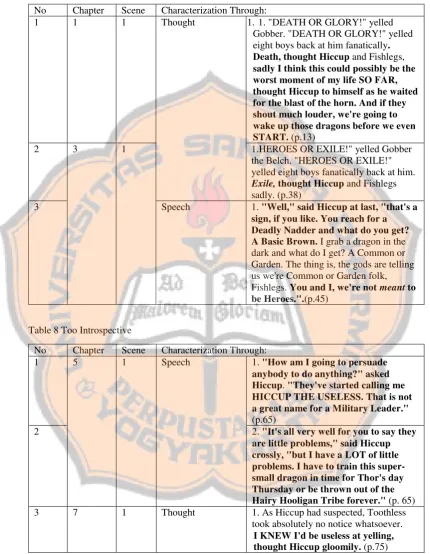
"DEATH OR GLORY!" yelled Gobber. "DEATH OR GLORY!" yelled eight boys back at him fanatically. Death, thought Hiccup and Fishlegs, sadly I think this could possibly be the worst moment of my life SO FAR, thought Hiccup to himself as he waited for the blast of the horn. (p.13)
When Gobber screams death or glory, eight from ten boys answer the same words fanatically. The other two are Hiccup and Fishlegs. They think that the death is the answer. The test has not begun yet and Hiccup has lost his spirit. Hiccup seems unenthusiastic about this initiation. It can be seen through Hiccup’s thought,
“Death, thought Hiccup and Fishlegs, sadly I think this could possibly be the worst moment of my life SO FAR,….” Unfortunately, Hiccup feels that joining this initiation and catching a dragon are the worst day of his life. Contrary, the other eight boys seem brave and like the challenge.
Another clue of Hiccup’s unenthusiastic is when they are at the Dragon Cave. The task is the boys should catch their own dragons. The boys should climb a cliff to reach the dragon’s cave. Gobber tells the instruction how to catch a dragon and punishment if the boys fail to catch dragons. Gobber yells to encourage the
OR EXILE!" yelled eight boys fanatically back at him. Exile, thought Hiccup and Fishlegs sadly (p.38). The other eight boys answer fanatically again. Different from Hiccup and Fishlegs, they think that they will fail and exiled will be the result for them. They have not tried the test yet and they already decide what will be the result for this test. It shows that Hiccup does not want to do his best to finish the test and he does not have the spirit to try.
The last clue of Hiccup as an unenthusiastic boy is in his reaction. After
leaving the dragons’ cave, Hiccup and Fishlegs walk toward the village. They stop
for a while to see their dragons. Hiccup opens his basket to see what type of dragon that he got.
[Excerpt 12]
"Well," said Hiccup at last, "that's a sign, if you like. You reach for a Deadly Nadder and what do you get? A Basic Brown. I grab a dragon in the dark and what do I get? A Common or Garden. The thing is, the gods are telling us we're Common or Garden folk, Fishlegs. You and I, we're not meant to be Heroes.”. (p.45)
Hiccup’s reaction after seeing his dragon that it is just a common dragon
meant to be a farmer and not a fighter. Hiccup’s unenthusiastic side is shown when he says that they (Hiccup and Fishlegs) are not meant to be heroes. Hesays “You and I, we're not meant to be Heroes."(p. 45). He seems unenthusiastic to try to be heroes of Berk. He judges Fishlegs and himself as common folks and are not meant
to be heroes only by their dragons’ types. He should try and keep pushing himself
to the limit first to see whether he can be a hero or not. Hiccup should not see the type of his dragon to decide how his life will be.
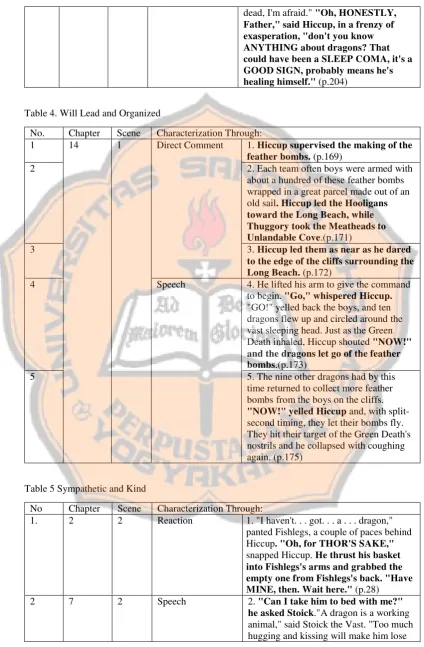
In conclusion, Hiccup’s most dominant personality is phlegmatic type. There are four characteristics of phlegmatic type in Hiccup. They are fearful and worried, stay uninvolved, kind, and unenthusiastic. From those four Phlegmatic characteristics, the writer found 18 clues from Hiccup characterization.
2. Melancholic
Hiccup’s second dominant personality is melancholic. According to
Ekstrand (2012), one individual can have a degree of each types (p. 1). There are two melancholic’scharacteristics in Hiccup. They are introspective, serious, and purposeful. The writer found three clues of each characteristic.
2.1 Introspective
though his friends mock him, Hiccup, as the next chief wants to be responsible for his tribe from now.
[Excerpt 13]
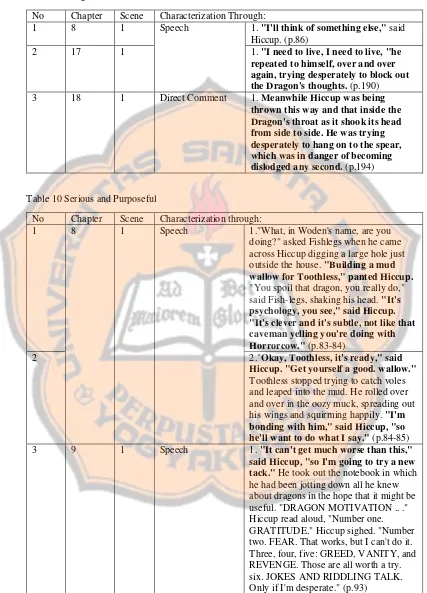
"How am I going to persuade anybody to do anything?" asked Hiccup. "They've started calling me HICCUP THE USELESS. That is not a great name for a Military Leader" (p.65).
Those sentences were found from Hiccup’s conversation with the Old Wrinkly, his grandfather. From the conversation we can see that Hiccup is worried about his future. He starts thinkingabout his name as the chief in the future. He starts questioninghis skill in persuading other people when he becomes a chief. He blames himself that he will not be a great military leader because his friends call him the useless. According to Ekstrand (2012), the melancholicoften takes very serious regarding to his life. He or she often feel hopeless and helpless (p. 5). From
Hiccup’s conversation it shows that Hiccup is helpless in the situation. He shows
his serious action toward his life by introspecting. He asks himself on how he will persuade others, when his friends call him “the useless”. It shows that he really cares about his future as the next chief.
The next clue is when Hiccup has his own dragon. Now, his task is to teach him basic commands. The best way to train a dragon is by yelling at him. They will know who is in charge then they will be obedient. Hiccup knows that he is not good at yelling. He is confused on how to train his dragon.
[Excerpt 14]
Hiccup seems to be stressed. His task to train his dragon is considered as a
problem for him. In Hiccup’s characterization through his speech, the author
capitalized the word “A LOT” which indicates that the word “A LOT” exaggerates
Hiccup’s problems. One of Hiccup’s problems is the initiation. The initiation has
so many tests: catching a dragon, training the dragon, and completing the final test. The punishment is even burdensome for a boy like Hiccup. Hiccup is confused on how to train his dragon. Yelling is one of the easiest method but Hiccup cannot yell loud enough to scare his dragon. The exaggeration of the word “a lot” shows how many problems that Hiccup has and also how deep Hiccup concerns about it is. Hiccup is stressed because he is too introspective. He does not think that he can complete those task and solve the problems. Based on Ekstrand (2012),
“melancholies are also victims of deep bouts of depression that come from great
dissatisfaction, disappointment, hurtful words or events” (p. 5). Here, Hiccup has a
depression or stress because of a certain event and a great dissatisfaction about himself because he has a difficulty to train a dragon.
The last clue of Hiccup’s too introspective characteristic is when Toothless awake from his hibernation. Hiccup and Fishlegs are in Hiccup’s house. They have been waiting to see Toothless opens his eyes for the first time. After a while, Toothless awakes and feels starving. He wants to eat something. Suddenly, he sees
Hiccup’s father beard and he jumps right on to it and starts eating it. His father
15] I KNEW I'd be useless at yelling, thought Hiccup gloomily” (p. 75). From
Hiccup’s thought the writer realizes that Hiccup blames himself and consider
himself useless at yelling. He focuses on how useless he is rather than he tries to practice his yelling. The melancholic often sees the negative side. They tend to become too introspective to themselves.
2.2 Serious and Purposeful
Second characteristics of the melancholic type in Hiccup is serious and purposeful. According to Ekstrand (2012), melancholic is very perfectionist over his life. Therefore, they tend to be serious and purposeful to make their life as perfect as they can (p. 5). From the novel, there are 3 clues that show Hiccup’s serious and purposeful side.
Hiccup wants to be his dragon’s friend. He wants to gain Toothless’ trust by showing his kindness Therefore, Hiccup shows how serious he is to make
Toothless’ life like in heaven by building a mud wallow for him to play. Hiccup
digs a hole in his yard. Fishlegs comes and wonders why Hiccup is digging a hole. After knowing that Hiccup builds a mud wallow for his dragon, Fishlegs tries to convince Hiccup that he spoils his dragon.
[Excerpt 16]
"What, in Woden's name, are you doing?" asked Fishlegs when he came across Hiccup digging a large hole just outside the house. "Building a mud wallow for Toothless," panted Hiccup. "You spoil that dragon, you really do," said Fish-legs, shaking his head. "It's psychology, you see," said Hiccup. "It's clever and it's subtle, not like that caveman yelling you're doing with Horrorcow." (p.83-84)
in order to have bond with him even though he has to serve the best food until building a mud wallow for his dragon. Despite his friend’s criticism for his actions, he keeps digging and he does not stop until his mud wallow is ready. This shows how serious he is to achieve his goal.
After a couple of minutes, Toothless’ mud wallow is ready. Toothless jumps on to it and rolls over until he is covered with mud. Hiccup sees his effort has been paid off. He likes that he can make Toothless happy. He feels happy too by seeing his dragon plays in his mud wallow.
[Excerpt 17]
"Okay, Toothless, it's ready," said Hiccup. "Get yourself a good. wallow." Toothless stopped trying to catch voles and leaped into the mud. He rolled over and over in the oozy muck, spreading out his wings and squirming happily. "I'm bonding with him," said Hiccup, "so he'll want to do what I say." (p.84-85)
According to Ekstrand (2012), melancholic is very serious and purposeful with his life so they will always finish what they start (p. 5). After he sets his goal, he will do anything to accomplish his goal. Hiccup wants to make Toothless’ life like in a dragon’s heaven. That is why Hiccup gives the best food for Toothless and builds a mud wallow for him too. Hiccup will give and do anything that he can to help him accomplish his goal. He does not stop until his goal is accomplished even though his friend thinks this kind of action is useless. Nevertheless, Hiccup does not listen to what Fishlegs says about it. He still focuses on his mission.
several basic commands, Horrorcow does not want to hunt for a fish. In fact, dragons have to hunt for fish in the final test. On the other hand, Hiccup feels more desperate with Toothless because he does not listen to his command at all and even the basic command.
[Excerpt 18]
"It can't get much worse than this," said Hiccup, "so I'm going to try a new tack." He took out the notebook in which he had been jotting down all he knew about dragons in the hope that it might be useful. "DRAGON MOTIVATION .. ." Hiccup read aloud, "Number one. GRATITUDE." Hiccup sighed. "Number two. FEAR. That works, but I can't do it. Three, four, five: GREED, VANITY, and REVENGE. Those are all worth a try. six. JOKES AND RIDDLING TALK. Only if I'm desperate." (p.93) Hiccup does not want to surrender. He still wants to teach Toothless so they can officially be the member of Hairy Hooligan. When he uses verbal commands to Toothless, he does not listen. Thus, Hiccup makes several list of dragon’s motivation to see which motivation will work the best. Instead of giving up, he thinks about anotherway that can be used to make Toothless listen to his command. He uses all his knowledge about dragons and sums it up to make dragon’s motivation in order to help him teach commands to Toothless.
3. Choleric
The third personality is choleric. According to Ekstrand (2012), the choleric is described as an ambitious and leader-like personality or the doer. Even though
this personality is not really dominant in Hiccup but this personality’s characteristic
3.1 Compulsive
Even though Hiccup is very dominant in phlegmatic and melancholic personalities, Hiccup also shows his choleric side. According to Ekstrand (2012), choleric is very compulsive to change things. In several scenes, Hiccup seems want to change some things that happen in his life.
[Excerpt 19]
"HEROES OR EXILES!" yelled Gobber the Belch. "HEROES OR EXILES!" yelled eighteen boys fanatically back at him. "HEROES OR EXILES!" yelled the watching Hooligan and Meathead Tribes. Please let me be a bit of a Hero, just this once, Hiccup and Fishlegs each thought to themselves. Nothing too spectacular or anything, just to get through this Test. (p.112)
When Hiccup doing his final test, he thinks that he wants to be a bit of hero.
The word “a bit” gives an expression that he desperately wants to be a hero even
though only a bit. Therefore, he is eager to change his status to be a hero or to be the official members of the tribe. His eagerness makes him so compulsive to change things. One of them is his social status, i.e. to be accepted in his tribe is his goal. Furthermore, the next sentence is “Nothing too spectacular or anything, just to get through this Test” (p. 112), which indicates that he does not need a big change. It seems that passing the test is enough to make his status change. To be accepted in the tribe is very important for Hiccup. In extend for Hiccup to have a better life, to be one of the heroes, and not the one that be exiled from the tribe.
[Excerpt 20]
The next clue that shows Hiccup’s compulsive side is when he is doing his final test. The final test is that their dragons have to hunt for fish in the sea and collect as many as they can. Hiccup does not believe that Toothess will hunt several fish for him. So, when Toothless brings some fish for him, he reacts with “This is
too good to be true”. It seems that Hiccup does not believe in what happens to him.
He is very excited knowing that his goal will be achieved soon. Moreover, his excitements can be seen through his following sentence which is “In about half an hour, I, Hiccup, will become a fully paid-up member of the Hairy Hooligan tribe” (p. 117 - 118). From the sentence, it shows how excited Hiccup is whilewaiting for half an hour to be the official member of his tribe. Therefore, knowing Hiccup’s excitements shows how important this momentis for Hiccup. After half an hour he can be the member of Hairy Hooligan and his change in social status makes him very compulsive to achieve his goal.
[Excerpt 21]
JUST ONCE," yelled Hiccup. "Why couldn't you let me be a Hero JUST ONCE? I didn't want anything amazing, just to pass this STUPID TEST so I could become a proper Viking like everybody else." Thor's thunder boomed and crackled above him blackly. "OKAY, THEN," screamed Hiccup, "HIT ME with your stupid lightning. Just do something to show you're thinking about me AT ALL." (p.126)
The last clue is when he fails the final test because their dragons fight one another and the boys cannot stop them. The boys will be exiled the day after tomorrow because the weather that day is bad and full with storm. Hiccup cannot take the result well. He is very disappointed and sad. He has been thrown out by his own father. Moreover. knowing his father put the laws first than his son makes