commit to user
A TRANSLATION ANALYSIS OF PROPER
NAMES IN THE CHILDREN FANTASY NOVEL
“HOW TO TRAIN YOUR DRAGON”
THESIS
Submitted as a Partial Fulfillment of the Requirements for Sarjana Sastra Degree of English Department
Faculty of Letters and Fine Arts Sebelas Maret University
by:
CHINDYTIA
C0306002
ENGLISH DEPARTMENT
FACULTY OF LETTERS AND FINE ARTS
SEBELAS MARET UNIVERSITY
SURAKARTA
commit to user
commit to user
commit to user
iv
PRONOUNCEMENT
Name : Chindytia
NIM : C0306002
Hereby, it is stated that this thesis entitled “A Translation Analysis of Proper
Names in the Children Fantasy Novel How to Train Your Dragon” is made and completed by the researcher. It is not plagiarism nor made by others. Everything related to other’s people works are written in quotation and mentioned within the
bibliography. If it is then proved that this pronouncement is incorrect, the researcher will be ready to take the responsibility.
Surakarta, 8 April 2012 The Researcher
commit to user
v MOTTO
“Anything can happen in the blink of an eye. Anything at all.
One Two Three
commit to user
vi
DEDICATION
This thesis is dedicated to:
commit to user
vii
ACKNOWLEDGMENT
All praises to Allah, the Almighty, for giving me strength, guidance, and patience in completing this thesis. So many supports and helps are given to me hence this thesis can be finished well. Therefore I would like to say my deepest gratitude to:
1. Drs.Riyadi Santosa, M.Ed., Ph.D, the Dean of Faculty of Letters and Fine Arts, for approving this thesis.
2. Drs. Agus Hari Wibowo, M.A., Ph.D, the Head of S1 Regular Program of English Department, for supporting this thesis.
3. Ida Kusuma Dewi, S.S., M.A., my thesis supervisor for her guidance, constructive comments and patience.
4. All of my lecturers in English Department, for the dedication, knowledge, and experiences.
5. The informants who give important contributions and their knowledge and times in helping me on this research.
6. My beloved mommy, your love means the world to me.
7. My beloved parents for loving me, praying me, and supporting me.
8. My brothers and sisters who are always beside me on the all happy and sad moments.
commit to user
viii
10.My amazing friends: Dilul, Rengganis, Lala, Bimo, Dila, Vendra, Wulan, Wisnu, Iyum, Kiki, thank you guys. Such a wonderful thing to get to know you all.
11.My Oyong, someone who is always there through the good and bad times, thank you.
12.My friends in English Department ’06 who I cannot mention one by one. Thank you for the friendship and wonderful moments with you all.
Finally, the writer hopes this thesis may give contribution for whomever in need and hopefully, the thesis is beneficial for everyone.
Surakarta, 8 April 2012
commit to user
ix
TABLE OF CONTENTS
TITLE ... i
APPROVAL OF THE ADVISOR... ii
APPROVAL OF THE BOARD OF EXAMINERS ... iii
PRONOUNCEMENT ... iv
MOTTO... v
DEDICATION... vi
ACKNOWLEDGMENT... vii
TABLE OF CONTENTS... ix
ABSTRACT... xiv
CHAPTER I: INTRODUCTION 1 A. Research Background ... 1
B. Research Limitation... 7
C. Problem Statements ... 8
D. Research Objectives ... 8
E. Research Benefits... 8
F. Thesis Organization... 9
CHAPTER II: LITERATURE REVIEW 11 A. Definition of Translation ... 11
B. Problems in Translation... 12
C. Definition of Proper Names ... 14
D. Translation Techniques of Proper Names ... 18
E. Translation Quality Assessment ... 29
F. About the Novel ... 31
CHAPTER III: RESEARCH METHODOLOGY 32 A. Research Type and Design... 32
B. Data and Source of Data... 33
commit to user
x
D. Method of Data Collection... 34
E. Technique of Data Analysis ... 36
F. Research Procedure ... 37
CHAPTER IV: DATA ANALYSIS AND DISCUSSION 39 A. Classification of Proper Name ... 39
1. Personal Name ... 39
2. Geographical Name ... 48
3. Name of Object ... 49
B. Analysis of Translation Techniques ... 52
1. Rendition ... 52
2. Copy ... 58
3. Transcription ... 63
4. Substitution ... 66
5. Recreation ... 70
6. Deletion ... 72
7. Addition ... 74
8. Transposition ... 80
9. Conventionality ... 81
10. Copy and Rendition ... 83
11. Copy and Addition ... 88
C. The Analysis of Translation Accuracy and Acceptability... 91
Accuracy ... 91
1. Accurate Translation ... 92
2. Less Accurate Translation ... 94
3. Inaccurate Translation ... 96
Acceptability... 98
commit to user
xi
2. Less Acceptable Translation... 100
3. Unacceptable Translation ... 101
D. Discussion ... 103
CHAPTER V: CONCLUSION AND RECOMMENDATION... 115
A. Conclusion ... 115
1. Translation Techniques ... 115
2. Accuracy and Acceptability of Translation ... 115
B. Recommendation ... 117
commit to user
xii LIST OF PICTURE
Figure 1 The picture of a glowworm ... 98
LIST OF TABLES
Table 3.1 Scale for Scoring Accuracy ... Table 3.2 Scale for Scoring Acceptability ... Table 4.1 Names of Person in the Novel How to Train Your Dragon ... Table 4.2 Names of Creature in the Novel How to Train Your Dragon ... Table 4.3 Nicknames and Title in the Novel How to Train Your Dragon ... Table 4.4 Geographical Names in the novel How to Train Your Dragon ………. Table 4.5 Names of Objects in the novel How to Train Your Dragon ………….. Table 4.6 Rendition technique application on the data ……….. Table 4.7 Copy technique application on the data ... Table 4.8 Transcription technique application on the data ... Table 4.9 Substitution technique application on the data ... Table 4.10 Recreation technique application on the data ... Table 4.11 Deletion technique application on the data ... Table 4.12 Addition technique application on the data ... Table 4.13 Transposition technique application on the data ... Table 4.14 Conventionality technique application on the data ... Table 4.15 Copy and rendition technique application on the data ... Table 4.16 Copy and addition technique application on the data ... Table 4.17 Accuracy Classification of Proper Names Translation In The Novel
commit to user
xiii
Table 4.18 Acceptability Classification of Proper Names Translation In The Novel “How To Train Tour Dragon” ...
Table 4.19 The Effect of the Translation Techniques and the Level of Accuracy and Acceptability of the Proper Names in the Novel How to Train Your Dragon ...
103
commit to user
xiv ABSTRACT
Chindytia. 2012. A Translation Analysis of Proper Names in the Children Fantasy Novel How to Train Your Dragon. Undergraduate Thesis. Surakarta: English Department. Faculty of Letters and Fine Art, Sebelas Maret University.
The purposes of this research are to describe the techniques used by the translator in translating proper names in the children fantasy novel How to Train Your Dragon and to know the quality of the translations in terms of accuracy and acceptability.
It is a descriptive-qualitative research which uses two kinds of data. The first data are from the English version of the novel How to Train Your Dragon and its translation Bagaimana Cara Melatih Nagamu. The second data are from a questionnaire fulfilled by three raters. This research used purposive-sampling technique to select the data. Two methods were used to collect the data; content analysis was obtained to collect the first data from source and target text and interview and the close and open-ended questionnaire was obtained to gather data of accuracy and acceptability.
commit to user
1
CHAPTER I
INTRODUCTION
A. Research Background
Some translators consider that proper names do not need to be translated into target text. That statement is arising because there are many proper names that do not have meaning and equivalence words in the target language. As stated by Vendler (1975), “since proper names lack of meaning, they are not translated but simply carry over to foreign language during translation” (as cited in Vermes, 2001: 1). Proper names are only treated as labels or titles which are attached to things, person, or place. Therefore, translators simply transfer or carry over the proper names from source text into target text during translation process.
On the contrary, Nord (2003) states:
In the real world, proper names may be non-descriptive, but they are obviously not non-informative: If we are familiar with the culture in question, a proper name can tell us whether the referent is a female or male person (Alice – Bill), maybe even about their age (some people name their new-born child after a pop star or a character of a film that happens to be en vogue) or their geographical origin within the same language community.
She argues that although proper names do not have literal meaning, when translators can recognize the culture of proper names, they would convey the information within the names.
commit to user
translating proper names can not be underestimated especially in children’s fiction story. Proper names in such fiction text have important role leading the readers in understanding the plot/storyline. Fiction text, such as a children fantasy book, has many imagination characters that have unique names. For instance, personal names usually have a relation with the physical appearances or personal traits. Thus the names become the identity for each character. The proper names also indicate the geographical names, institutions names, dates, title and etc. The easiest way to point out the proper names in book is the use of capital letter in the first letter of word as stated by Richards (1985: 68) defines “proper names as names of a particular person, place or thing and are spelled with a capital letter” (as cited in Ordudary, 2007).
Some problems appear in translating proper names in a book How to Train
Your Dragon. For example, the personal name Baggy-bum the Beerbelly that is translated into Baggy-bum the Beerbelly—Baggybum si Perut Gentong. That name indicates physical appearances and it is accompanied by an image of character in the book. If there is an image that represents the character, translator may not face difficulty to translate the personal names. However, most of writers do not include images to their book except it is kind of a fairytale story for children. The name Baggy-bum the Beerbelly might give a problem related to the culture of target readers. The non-existence of image of proper name might be problematic to the translator to fully understand the meaning of the proper name.
commit to user
though there is not any image to describe the physical appearances of Baggy-bum the Beerbelly, the literal meaning of the name can be used to identify the characteristic of Baggy-bum the Beerbelly. Baggy-bum the Beerbelly however, cannot be translated literally into target text because some of the words have critical value in target readers’ culture, such as Beerbelly which consists of two words Beer and belly. Beer in target readers’ culture is a prohibited drink because of its content. Thus the word Beercannot be translated into target text literally.
ST: Snotlout was the son of Baggy-bum the Beerbelly, Stoick the Vast's younger brother (pg.21)
TT: Snotlout adalah anak Baggy-bum the Beerbelly—Baggybum si Perut Gentong, adik laki-laki Stoick Agung.
The translation si Perut Gentong comes from the meaning of Baggy which has a meaning Longgar or Besar in Indonesian, then Belly means Perut. It is also possible that translator decides to use the word Gentong because of the representative of the word Barrel which means “a large round container, usually made of wood or metal, with flat ends and, usually, curved sides, and used for storing beer, wine etc” (Oxford Advanced Learner’s Dictionary, 2000: 93). Barrel and Gentong have similar physical appearance that is a big and round shape.
The word Baggy-bum the Beerbelly is half translated and half transferred into target language text. Seeing from the accuracy, that proper name is translated accurately because the meaning of the proper name is transferred correctly. However in term of acceptability that is related to target reader’s culture, the word
commit to user
the target readers of this book are children and teenagers with differences culture background, so that the word Gentong might not be familiar for those who do not know Javanese culture.
The other example is a proper name that indicates personal traits and has different culture values. Dogsbreath the Duhbrain is a personal name which indicates the personal trait of the character. Dogsbreath the Duhbrain is Snotlout’s friend fellow bully. Together with Snotlout, he bullies Hiccup and Fishlegs badly. As the meaning of the name, Dogsbreath the Duhbrain is not smart and he usually acts as what Snotlout asked him. Personal traits of the character cannot be described using an image like physical appearances. However, proper names that indicate personal traits are usually followed by the description of the character’s acts within the story. The character’s behavior in the story will be synchronized with the name. The proper name above has a strong effect to Indonesian’s culture when it is translated literally. The word Dog has critical values when it is related to religion and language use in target readers’ culture. Most of translator will not translate the name or they would try to find another word to replace it in target readers’ language, in this case is Indonesian. Then in this book, Dogsbreath is not translated and just transferred originally. The word Duh in Duhbrain is “an informal expression that is commonly used to comment
on a foolish or stupid action in English”
commit to user
ST: "I'M in charge, not the Useless. And anybody who objects gets a knuckle sandwich from Dogsbreath the Duhbrain." (pg.3)
TT: “Aku yang memimpin, dan bukan si Tak Berguna ini. Dan siapa pun yang nggak setuju akan mendapat roti isi bogem dari Dogsbreath si Otak Udang”.
Translation of proper name above is accurate, because the personal trait of the character is delivered correctly in target text. Due to the sensitive meaning of the word Dogsbreath in the target reader’s culture, translator does not translate the name. Translator prefers to transfer it originally into target language text. In the term of acceptability, translator does appropriate decision to translate it into Otak Udang, because the phrase of Otak Udang is commonly used as a nickname for someone who does not have a smart brain in target reader’s language. Dogsbreath si Otak Udang can be accepted well by target readers.
commit to user
specialization in meaning, no longer refers to just any serpent or snake, as it once did, but now denotes only specific kinds of snakes.
ST: The big Nadder stared sightlessly ahead, frozen like a dragon statue. (pg.26)
TT: Naga Cerewet besar itu segera menatap lurus ke depan, kaku seperti patung naga.
It can be concluded that Nadder is a name for a specific snake and it does not have literal meaning both in source and target text. However, translator decided to translate it into Naga Cerewet which might come from the word
Natter which means Cerewet. The translation of Naga Cerewet does not synchronize with the explanation of personal traits and attitudes of Nadder that was elaborated in the story.
The above phenomena show that translating proper names should not be underestimated. Through the meaning of the name, sometimes we can seize the important information about the characters and storyline that the writer wants to inform. The translator of text containing proper names has to consider not only the equivalent factor but also the culture values of target readers. All those factors will affect the quality of translation.
commit to user
Horrendous Haddock III, the 11 year old son of Stoick the Vast, a Viking chief. On the Island of Berk, a group of young boys from the Hairy Hooligans are instructed by Gobber the Belch to perform their first military operation—to catch their own dragon. Those who are not able to catch and train a dragon are exiled from the tribe, and those who accomplish the mission are initiated into the tribe as full members.
The fiction names created by the writer are original and some of them do not have any equivalent words in target language text. Translator has to find appropriate words accurately and acceptable to avoid misleading message. Because of that issue, researcher is interested to analyze the techniques that appear in translating proper names and the quality of its translation.
B. Research Limitation
commit to user
C. Problem Statements
Based on the research background, the researcher proposes the following problem statements:
a. What techniques are used by translator to translate proper names in Cressida Cowell’s book entitled How to Train Your Dragon?
b. How do the techniques affect the quality of the translation of proper names in Cressida Cowell’s book entitled How to Train Your Dragon, in terms of its accuracy and acceptability?
D. Research Objectives
The objectives of this research are as follows:
a. To describe the techniques used by translator to translate proper names in Cressida Cowell’s book entitled How to Train Your Dragon.
b. To describe the effect of the techniques used on the quality of the translation of proper names in Cressida Cowell’s book entitled How to Train Your Dragon, in terms of its accuracy and acceptability.
E. Research Benefits
The researcher expects this research will be beneficial for: 1. Students
commit to user
want to study about translating proper names and the techniques to translate it.
2. Lecturers
The result of this research can be used as additional information in lecturers’ translation, especially in the field of translating proper names in fiction. It also can be such examples in writing a thesis.
3. Translators
The result of this research is expected to be additional information as well as references and it can help translator to make right decision in using a proper technique in translating proper names or other case of translating.
4. Other Researcher
This research is expected to give motivation to other researchers to develop further research about translating proper names.
F. Thesis Organization
Chapter I is INTRODUCTION. It consists of research background, research limitation, research problem, research objectives, research benefits and thesis organization.
commit to user
Chapter III is RESEARCH METHODOLOGY. It consists of research type and design, data and source of data, sampling technique, method of data collection, technique of data analysis, and research procedure.
Chapter IV is DATA ANALYSIS AND DISCUSSION. It consists of introduction, research findings, and discussion.
commit to user
11
CHAPTER II
LITERATURE REVIEW
This chapter will discuss about theories related to the research. The theories will function as the base knowledge in analyzing the data of the research. A. Definition of Translation
There are various statements about definition of translation coming from translation scholars. The first is the definition of translation by Roger T. Bell (1991: 5) who states that: “Translation is the expression in another language (or target language) of what has been expressed in another, source language, preserving semantic and stylistic equivalence”. Translation is used to express a message of language, oral and spoken, between two or three different languages both semantically and stylistically equivalence.
“Translation is the replacement of a representation of a text in one language by a representation of an equivalent text in a second language” (Bell, 1991: 6). According to Bell’s statement, translation has a strong relation with equivalence of target language. In this case the equivalence text has a relation with semantic and stylistic of language. The equivalence can also become a problem for a translator to find the closest meaning of the words or sentences.
commit to user
translated into a whole equivalence text in TL. Moreover, when the equivalence replacement does not exist in TL, a translator usually does a simple transference such as using loan word from SL into TL.
Nida and Taber also emphasize in an equivalence of text. They state that “Translating consists in reproducing in the receptor language the closest natural equivalent of the source language message, first in term of meaning and secondly in term of style” (as cited in Widyamartaya, 1989: 11). From that definition, it can be concluded that translation is not only emphasized in meaning but also in the style of language.
B. Problems in Translation
In translation process, there are many problems that appear and have to be solved by translator. Translation process involves two different languages that have its characteristic in term of culture, structure, pronunciation, spelling, and else. Due to those conditions, problems of translation should not be underestimated by translator.
Equivalence is one of the problems appears in translation process. Finding equivalence in translation process is significant issues for translator. In finding the equivalence they can convey the message correctly.
commit to user
The other translation scholars also give assumptions or explanation about the role of equivalence in translation. For example Chestermen (1989: 99) notes that “equivalence is obviously a central concept in translation theory’ while Bassnett (1991) devotes a section to ‘problems of equivalence’ on the chapter entitled of ‘central issues’ of translation studies” (as cited in Munday, 2001: 49).
According to Mona Baker (1992), she distinguishes equivalence into four conditions as follow:
a. Equivalence that can appear at word level and above word level, when translating from one language into another.
b. Grammatical equivalence, when referring to the diversity of grammatical categories across languages.
c. Textual equivalence, when referring to the equivalence between a SL text and a TL text in terms of information and cohesion.
d. Pragmatic equivalence, when referring to implicatures and strategies of avoidance during the translation process (as cited in Vanessa Leonardi, 2000).
commit to user
translating of culture-values items when there are not any equivalent words between source text and target text.
C. Definition of Proper Names
According to Harper Collins Dictionary, name or proper name is “a word or term by which a person or thing is commonly and distinctively known” (http://dictionary.reference.com/browse/proper+name?s). In other words, proper name is used as a title for thing or person that represents what it looks like. For example the personal names can show about the gender of person, John is a name usually uses for a male and Bella is a female name.
In some cultures, there is the convention that fictional proper names can serve as “Culture markers,” i.e., they implicitly indicate to which culture the character belongs (Nord, 2003: 184). That statement indicates that through names, it can be known where the names come from. Names have cultural values which will become an identity. In Indonesian literature, for example, if a man called Edward or Harry appears in Indonesian plot story, he will be directly assumed as English people. On the contrary, if a man called Andy in Indonesian plot story, he cannot be automatically assumed as native Indonesian, because a name Andy is also commonly used by Indonesian and foreign people. This problem in translation can be solved by adding a description to the character that will adjust with target language culture.
commit to user
from another. Name will build a character that belongs to the name itself and it makes differences with another.
According to Tymoczko (1999: 225) who states that, “the referential function of names presupposes a certain “recognizability” and “memorability”, that is to say, names must in “some way be memorable so as to serve their function as indicators of unique objects” (as cited in Fernandes 2004: 146). In other words, target reader will memorize the names by recognizing its uniqueness which different with other names.
Other scholar who makes similar point of the uniqueness of proper name is Närhi (1996) who denotes the two most important criteria for proper names which are their uniqueness and that they function as the identification marks of individuals (as cited in Mizani, 2008).
Marmaridou (1991) states that names in literary works are often used to convey a message to the reader (as cited in Fernandes, 2006: 46). The information that is conveyed by names in children’s fantasy literature is described by Fernandes in his article. Fernandes (2006: 46-48) states that “names can function to convey semantic, social semiotic and sound symbolic meaning(s) directly from the writer to the reader in relation to, for instance, a character, place, or object being referred to in the narrative”. Three types of meaning are explained further below:
1. Semantic Meaning
commit to user
where, a character’s personality is summed up by their name (Fernandes, 2006: 46). For instance, personal name is often used as indication that it may contain clues about the destiny of character or the way the storyline might develop. In Artemis Fowl, Eoin Colfer’s series, Fowl has same pronunciation with the word foul/faul/, which leads expectation from the character of Fowl, an anti-hero and a master-mind of crime.
2. Semiotic Meaning
Name acts as signs and generates ancient or more recent historical associations (Archimedes, Wolfgang Amadeus Mozart), indicates gender (Hermione is female and Harry is male), social class (Sir Nicolas De-Mimsy-Porpington), nationality (Padma and Parvati Patil are Indian), religious identity (Felix and Gabriel are biblical names), intertextuality (Sherlock Holmes), mythology (Centaur, Banshee, Unicorn), and else (Fernandes, 2006: 46).
3. Sound Symbolic Meaning
Sound symbolic meaning can be divided into two types:
a. Imitative sound symbolic meaning is related to the use of onomatopoeia and represents a sound that can be heard (Fernandes, 2006: 47-48). For example Breehy-hinny-brinny-hoohy-hah, a horse in the Chronicles of Narnia series, which imitates the whining of a horse. Mrs. Norris, a cat in Harry Potter series, which imitates the angry hiss and growl of a cat.
commit to user
/gl/, occurring in glisten, glow, glare, glim, glitter, glimpse, are words that usually associated with “light” and “shinning”. Then the initial cluster /sl/, in the words such as slime, slug, slobbery, slog, are connected with “unpleasantness”.
Types of proper name are defined by Newmark (1988: 214-216). He divides proper names into three classifications. They are people’s name, name of objects, and geographical terms. People’s name is a name that is attached to a person and it contains with first and surname. Name of objects is as a proper name contains trademarks, brands, and proprieties. Then geographical term is a name that is attached to a thing and it has geographical features and usually appears in atlas.
commit to user
title in this classification are a name that is used to call the characters other than their real names. Some of the nicknames are a mocking name for the characters. The second classification is geographical name belongs to a thing that has geographical features, such as country, river, mountain, etc. In this classification consists of names of places, both real and fiction places that are mentioned in the novel. The third classification is name of objects. The objects in this classification are many kinds of things, other than personal and geographical name, that have a name. Name of objects in this classification contains names of time, festivals, trademarks, brands, properties, etc.
D. Translation Techniques of Proper Names
There is confusion about terminology of translation technique around translators. Some of translators would call translation technique as translation procedure. The terminology of translation procedure is started by Vinay and Darbelnet as stated by Molina and Albir (2002): “Vinay and Darbelnet’s pioneer work Stylistique comparée du français et de l’anglais (SCFA) (1958) was the first classification of translation techniques that had a clear methodological purpose”. The term they used was ‘procédés techniques de la traduction’.
commit to user
between translation techniques by Molina Albir and translation procedures by Newmark. Micro or smaller units of language become the main point in dealing with translation technique and translation procedure. Moreover Molina and Albir also give definition and characteristic of translation technique. Molina and Albir (2002): “Translation techniques as procedures to analyse and classify how translation equivalence works. They have five basic characteristics:
1) They affect the result of the translation
2) They are classified by comparison with the original 3) They affect micro-units of text
4) They are by nature discursive and contextual 5) They are functional”
According to above statements, it can be sum up that translation procedure also can be called translation technique. The difference about the terminology should not affect the result of translation, because the scope of study between those two are similar.
commit to user
Some translation scholars propose some techniques in translating proper name. As stated by Newmark (1988: 215) “the best method is first to translate the word that underlies the SL proper name into the TL. And then to naturalize the translated word back into a new SL proper name- but normally only when the character's name is not yet current amongst an educated TL readership”.
In children fantasy literature, there are many unique proper names. Writers always have a power to create imaginable names and some of those names do not have any literal meaning. Newmark describes those kinds of names as unfindable name; he defines that “unfindable name is a word that cannot be found in a reference book or be identified by an informant” (1988: 182). For this case, he proposes a transference technique as his statement: “If the 'unfindable' word is found as a little-known proper name- a person or a geographical feature- it is normally transferred (or transliterated) with the addition of some generic information” (Newmark, 1988: 182).
Hervey and Higgins (1992: 29) propose some techniques to translate proper names:
“a. Exotism: the name is taken over unchanged from ST to the TT. It is similar to literal translation but there is no cultural transposition.
b. Transliteration: the name is adapted to conform to the phonic/graphic conventions of the TL.
commit to user
As it is known that some scholars have given some techniques for translator dealing with the proper names, but they do not specify the techniques for proper names especially in children’s literature, as stated by Nord (2003: 184): “[…] there are no rules for the translation of proper names”. Therefore the researcher decides to use translation techniques proposed by Lincoln Fernandes. He proposes some guidelines in translating proper names, especially on children’s fantasy literature, who says that “names have a fundamental role in creating comic effects and portraying characters’ personality traits, which will often guide the reader throughout the plot of the story” (Fernandes, 2006: 44). In his research Fernandes used terms procedures as a way to treat proper names in the process of translation. As explained above, procedure and technique of translation are same things with different term, but not in the subject study. Thus ten techniques in translation of proper names by Fernandes are:
1. Rendition
This technique is used when the name is transparent or an ST name whose meaning transparent in the TT, remaining to its form. Rendition can be also called direct translation (Standowicz, 2009).
Example 1: Source Text:
A real Sea Dragon is fifty times as big as that little creature. Target Text:
commit to user
Example 2: Source Text:
Take a look at Wild Dragon Cliff itself. Target Text:
Lihatlah sendiri Tebing Naga Liar.
Two above examples show that when the proper names in the ST are
enmeshed in the TL, thenthe meaning is rendered in the TL. Creature names Sea Dragonis directly translated into Indonesian Naga Laut. The second example is a place name Wild Dragon Cliff which is translated into Tebing Naga Liar. Rendition usually occurs when there is an equivalent word of the source text names.
2. Copy
Fernandes confirms that his technique is similar to Vinay and Darbelnet's concept of "borrowing" as the simplest type of translation. As stated by Fernandes (2006: 51) “In this procedure, the names are reproduced in the translated text exactly as they appear in the source text […].”
Example 1: Source Text:
There'd be nothing left of even a fatso like you, Wartihog- Target Text:
commit to user
Example 2: Source Text:
At one point Clueless missed his footing and fell -- luckily onto Dogs-breath, who caught him by the back of the trousers and heaved him back on to the rock again, before he brought the whole lot of them down.
Target Text:
Di satu tempat, Clueless kehilangan pijakan dan jatuh-untungnya menimpa Dogsbreath, yang menangkap bagian belakang celananya dan mengayunkannya kembali ke bebatuan, sebelum Clueless menjatuhkan mereka semua ke bawah.
The above examples show that the proper names in the ST (Wartihog and
Clueless) are kept in the TT without any changes. Therefore the technique used by translator to translate the two names above is copy.
3. Transcription
commit to user
Example: Source Text:
"It's a Sea-dragonus Giganticus Maximus, and a particularly big one, I'd say.
Target Text
“Dia adalah Naga Lautus Gigantismus Maksimus, dan menurutku agak lebih besar dari biasanya.
4. Substitution
Fernandes (2006: 52) states that “in this type of procedure, a formally and/or semantically unrelated name is a substitute in the target text for any existent name in the source text.” It can be said that the TL name and the SL name have their own referential worlds, but are not related to each other in terms of form and/or semantic significance.
Source Text:
He'd never even seen the boy: It might have been Harvey: Or Harold.
Target Text:
commit to user
used in Spain. Therefore the technique used by translator to translate the names is called substitution.
5. Recreation
Fernandes (2006: 52) states that “this type of procedure consists of recreating an invented name in the SL text into the TL text, thus trying to reproduce similar effects of this newly-created referent in another target cultural setting.” He also notes that in recreation technique, the lexical item does not exist in the SL or in the TL. For an example is taken from Fernandes (2006: 52):
Example: Source Text:
Well, the Quaffle – that's the biggish red one – is the one that scores goals.
Target Text:
Bem, a goles, a bola vermelha meio grande, é a que faz os gols. Quaffle is a one of ball’s name in Harry Potter novel. It is used to play Quiddich. Quaffle does not have literal meaning both in ST and TT, so that translator used word goles to represent the name in TT that means goal in ST. Therefore technique used by translator is called recreation.
6. Deletion
commit to user
Example: Source Text:
"SILENCE!" roared Gobber the Belch. Target Text:
"DIAM!" teriak Gobber. 7. Addition
Fernandes (2006: 53) considers this technique as the one in which extra information is added to the original name, making it more understandable or appealing to its target readers. Sometimes it is used to solve or avoid ambiguities in translating a particular name.
Example 1: Source Text:
Ten boys, including Hiccup, were hoping to become full members of the Tribe by passing the Dragon Initiation Program.
Target Text:
Sepuluh orang anak-anak, termasuk Hiccup (baca: Hik-kap, dia
mendapat nama cegukan karena dia memang sering cegukan),
sedang berharap untuk bisa menjadi anggota penuh suku itu. Example 2:
Source Text:
commit to user
Target Text:
"Oh, jangan Hiiicc-cuuuup," kata Dogsbreath the Duhbrain
(Dogsbreath punya napas yang memabukkan dan otaknya
mungkin sebesar otak udang, karena itu dia dinamai begitu)
dan kebanyakan anak-anak lain. 8. Transposition
Vinay and Darbelnet (1995: 36) state that “this procedure is defined as the replacement of one word class with another without changing the meaning of the original message” (as cited in Fernandes, 2006: 54). Chesterman (1997: 95) also gives contribution about the description of transposition technique, as stated in his statement, “this procedure also involves structural changes, but it is often useful to isolate the word-class change as being of interest in itself” (as cited in Fernandes, 2006: 54).
Example: Source Text:
There was a huge clapping for Snotface Snotlout and his dragon, Fireworm, rivalled only by the mighty cheering for Thuggory the Meathead and his dragon, Killer.
Target Text:
commit to user 9. Phonological Replacement
Fernandes (2006: 54) defines this as a technique in which a TT name attempts to mimic phonological features of a ST name by replacing a ST name with a TT name which is phonemically/graphologically similar to it.
Example: Source Text:
‘Heard you talking about poor Myrtle,’ said peeves, his eyes dancing. ‘Rude you was about poor Myrtle.’
Target Text:
Ouvi você falando da coitada da Murta – disse Pirraça, os olhos dançando. – Que grosseria com a coitada.
10. Conventionality
“This final procedure occurs when a TL name is conventionally accepted as the translation of a particular SL name” (Fernandes, 2006: 55). It is commonly used with names of historical/literary figures and geographical locations.
Example: Source Text:
“You just do all the thinking you need, boyo," said Thuggory. Target Text:
“Pokoknya, berpikir saja semaumu, Sobat,” kata Thuggory.
commit to user
in ST and TT. Thus it is conventionally translated into sobat in TT which has same references with the definition of boyo.
E. Translation Quality Assessment
Goodspeed (1945: 8) echoes the same sentiment with respect to Bible translating by declaring that:
The best translation is not one that keeps forever before the reader’s mind the fact that this is a translation, not an original English composition, but one that makes the reader forget that it is a translation at all and makes him feel that he is looking into the ancient writer’s mind, as he would into that of a contemporary(as cited in Venuti, 2000: 132-133).
According to above statement, the best translation is a translation that is felt natural and nothing likes a translation at all. The definition above is supported by the statement proposed J.B.Phillips (1953: 53) as quoted in Venuti (2000) who confirms the same viewpoint when he declares that: “The test of a real translation is that it should not read like translation at all.”
commit to user
Translation quality assessment, also called translation criticism is an evaluation of TT by comparing to ST. There are some measurements that will indicate analysis the quality of translation as a translation product. Some experts have defined some criteria dealing with the quality of translation.
Nida (1964) identifies two different kinds of equivalents; formal equivalence and dynamic equivalence that direct to criteria of translation quality measurements.
Formal equivalence focuses attention on the message itself, in both form and content. This translation is concerned in correspondences as sentence to sentence and concept to concept. As the result the message in the target language should match as closely as possible with the different elements in the source language. This translation will lead to determine standards of accuracy and correctness.
A translation of dynamic equivalence aims at complete naturalness of expression, and tries to relate the target readers’ behaviour relevant within the context of target readers’ culture.
According to Nababan (2003: 86), translation quality assessment is focused on the three main things: the accuracy of transferring message, the accuracy of expressing the message into the target language and the language naturalness of the translation.
commit to user
the transferring message from source text to target text. Whether the translation is natural for target readers and appropriate in target readers’ culture or not is affected the acceptability of translation. The last aspect is readability that is related to the comprehensible of message; its form and content that is easy to be understood by target readers.
F. About The Novel
How to Train Your Dragon is children fantasy novel written by British author Cressida Cowell. How to Train Your Dragon is a series book and there are currently nine books in the main series. How to Train Your Dragon was first published in 2003 by Hodder Children's Books.This book includes some pictures as representative of some characters of the story. The story of novelis about the adventures of Hiccup Horrendous Haddock III, the ten-year-old son of a Viking chief, who must capture a dragon for a rite of passage. Set on the Isle of Berk, a group of ten youths of the Hooligan tribe are being led by "Gobber the Belch" to perform their first military operation; to catch their own dragon. Those who are not able to catch and train a dragon are exiled from the tribe. This military
operation has to be done by every Hooligan.
commit to user
32
CHAPTER III
RESEARCH METHODOLOGY
A. Research Type and Design
Descriptive research can be defined as observation or research that is used to obtain information concerning the current status of the phenomena. Creswell (2002: 58) states that:
Qualitative research is an inquiry approach useful for exploring and understanding a central phenomenon. To learn about this phenomenon, the inquirer asks participants broad, general questions, collects the detailed views of participants in the form of words or images, and analyzes the information for description and themes. From this data, the researcher interprets the meaning of the information drawing on personal reflections and past research. The structure of the final report is flexible, and it displays the researcher’s biases and thoughts.
Referring to that statement, Creswell has explained clearly about the scope of qualitative research, the object data, the method, and the result of research. In the qualitative research, the types of data are in the form of words or images instead of numbers.
Patton (2002:14) states: “qualitative methods typically produce a wealth of detail information about a much smaller number of people and cases”. It means the quality of this type of research cannot be examined by the quantity of data but by the quality of data.
commit to user
This research is conducted to identify the techniques used by translator in translating proper names in the novel How to Train Your Dragon and its effect on the translation’s accuracy and acceptability.
B. Data and Source of Data
Data are collection of information that consists of fact and it is used as material subject of research. There are two kinds of data in the research. The first data are taken from the novel How to Train Your Dragon in English version and its Indonesian translation with same title How to Train Your Dragon, Bagaimana
Cara Melatih Nagamu. The second data are taken from the questionnaires given to informants that consist of the score of quality of translation.
The sources of data are the origin information or place that data are taken. The researcher employs an English novel written by Cressida Cowell entitled How to Train Your Dragon and its Indonesian translation translated by Mutia Dharma with same title How to Train Your Dragon, Bagaimana Cara Melatih Nagamu as source of data. The researcher only took data in the form of proper names that appear in the novel. The second data are taken from informants which is in this research are three raters.
C. Sampling Technique
commit to user
This research uses purposive sampling technique which sample of data are taken based on some criteria which relevant with research question or problem. It is based on statement stated by Natasha Mack et al (2005: 5), “Purposive sampling, one of the most common sampling strategies, groups, participants according to preselected criteria relevant to a particular research question”. In this case, the data needed are only the proper names appeared in the novel How to Train Your Dragon. The informants, in this case is raters, are also chosen based on some criteria in order to get the best result. Some criteria are as follows:
1. Raters should master both English and Indonesian language 2. Raters should have knowledge in translation theory and procedure 3. Raters should be majoring in English
4. Raters are willing to participate in the research
D. Method of Data Collection
Content analysis is a method that is used to collect the primary data of the research. As mentioned above, the data are the proper names in English and its Indonesian translation taken from the novel How to Train Your Dragon. First the researcher read both English and Indonesian version of the novel How to Train
Your Dragon. Then collecting the proper names appears in the novel, classifying proper names into several categories and analyzing the proper names.
commit to user
opinions or comments the raters gave for each data in the questionnaires. Interview in this research is used as follow-up with the questionnaires as stated by Mc.Namara (1996), “Interviews are particularly useful for getting the story behind a participant’s experiences. The interviewer can pursue in-depth information around the topic. Interviews may be useful as follow-up to certain respondents to questionnaires, e.g., to further investigate their responses (as cited in Valenzuela, n.d.). This research uses informal, conversational interview which the questions are based on the data in the questionnaires. In gaining the score of the accuracy and acceptability of the translation, the researcher uses the close and open-ended questionnaire in the research. The first step is the application of open format question in which is informant is given an opportunity to express their opinion. In this case, informants should rate or give a score to each question that are given to them. The second step is application of open-ended format questions as explained by Foddy (1993: 127): “… while open-ended questions allow the respondent to express an opinion without being influenced by the researcher” (as cited in Ursa Reja et al, 2003). Informants allow giving comment or farther explanation related to the questions which can be important information for the study. The score and comments that are given by informants will generate the analysis into the next step, which is the quality of translation.
Table 3.1 The Scale for Scoring Accuracy
Scale Definition
3 Accurate, if the translation of proper name in target text (the bold one) in the
target text language has same meaning with its translation in source text
commit to user
2 Less accurate, if the translation of proper name (the bold one) has slightly
different meaning because there is some meaning of proper name in source
text language that is missing or there is an additional meaning.
1 Inaccurate, if the translation of proper name (the bold one) in target text
language has different meaning with its translation in source text language or
proper name is not translated at all.
Table 3.2 The Scale for Scoring Acceptability
Scale Definition
3 Acceptable, if the translation of proper name (the bold one) is natural and it is
commonly used in Indonesian. The translation does not feel like a translation
at all.
2 Less acceptable, if the translation of proper name (the bold one) is unfamiliar
and it is rarely used in Indonesian.
1 Unacceptable, if the translation of proper name (the bold one) sounds strange
and feels like a translation. The translation is never used in Indonesian.
E. Technique of Data Analysis
The researcher analyses the data by means of comparison. It is started by collecting the data from the source of data. The sources of data are from the original version novel and its translation and the informants.
commit to user
The last step is drawing conclusion. From the result of analyzing the data collected, the researcher then draws conclusion and proposes some suggestions and implications.
F. Research Procedure
The researcher conducted the research through a procedure below:
1. Reading briefly of the novel How to Train Your Dragon as the object of this research
2. Collecting data from the sources of data
- The collected data are in form of sentence that consists of the English proper names and its Indonesian translation in the novel How to Train Your Dragon.
- The sentence that had been collected will be made into questionnaires for the informants.
3. Listing and classifying proper names based on the proper names criteria.
4. Encoding the data For example: 001/HTYD/BCMN
commit to user
TL: Dahulu kala, di Pulau Berk yang liar dan berangin, ada seorang anak laki-laki bangsa Viking yang agak kecil dengan nama yang agak panjang.
001 = the number of data
HTYD = the source language novel, How to Train Your Dragon
BCMN = the target language novel, Bagaimana Cara Melatih Nagamu
The proper names were printed in bold way. Every data only consist one proper name, so if there were more than one proper name found, they were separated and put in the next data.
5. Analyzing the data
- Analyzing the data to discover the techniques applied by translator. - Collecting and calculating the scores from the informants to get the
mean from the data.
- Describing the effects of the techniques in terms of accuracy and acceptability.
commit to user
39
CHAPTER IV
DATA ANALYSIS AND DISCUSSION
This chapter presents the analysis of the data. It contains four subchapters;
they are the classification of proper names, the analysis of the translation
techniques, the analysis of the accuracy and acceptability of translation, and the
discussion of the effect of translation techniques.
A. Classification of Proper Names
This subchapter consists of the classification of proper names found in the
novel How to Train Your Dragon.
Newmark (1988: 214-216) divides proper names into three classifications.
They are people’s name, name of objects, and geographical terms. Seeing from
the proper names found in the novel How to Train Your Dragon that in line with
Newmark’s classifications of proper name, thus the researcher classified proper
names into three classifications; they are personal names, geographical names,
and names of object. Each classification is discussed more detail in the following
part.
1. Personal Name
As stated in chapter II, personal name is a name that belongs to somebody
or something (Strawson, 1971). Personal name in this book is fictitious characters
commit to user
There are 115 (58.97%) personal names in the novel How to Train Your
Dragon. The names are divided into three subgroups; they are names of person,
names of creatures, and nicknames and title.
a. Names of Person
Names of person in this novel are names of human characters. Some of the
names indicate their characters or roles in the story. There are names that indicate
the physical appearances, personal traits, and just mere of labels.
i) Names of person that indicate physical appearances
Name that indicates the physical appearances of the character is name that
represents what the character looks like in the story. There are 5 personal names
that indicate physical appearances. Two of them are discussed below:
037/HTYD/BCMN
ST: Snotlout was the son of Baggy-bum the Beerbelly, Stoick the Vast's
younger brother.
TT: Snotlout adalah anak Baggybum the Beerbelly-Baggybum si Perut
Gentong, adik laki-laki Stoick Agung.
Baggy-bum the Beerbelly is Stoick's brother, and therefore Hiccup's
uncle. He is an only minor character in the story. From the name Baggy-bum the
Beerbelly, it can be indicated that he is a fat man who has big stomach that is seen
from the baggy pants he wore. Even though there is not any image to describe the
physical appearances of Baggy-bum the Beerbelly, the literal meaning of the
name indicates the physical appearances of Baggy-bum the Beerbelly.
022/HTYD/BCMN
commit to user
TT: Tidak akan ada yang tersisa, bahkan dari anak gendut sepertimu,
Wartihog-
Wartihog is an eleven year old boy - the youngest in the Hairy Hooligan
Tribe. However, the boy already has bubbling adolescent pimples and a personal
odor problem.Wartihog appears in some parts of the story. Those two words
wart and hog represent the physical appearances of Wartihog in the book. The
writer also has illustrated Wartihog in her book which can be seen in the
illustration on the opening page of the novel. The image of Wartihog is a boy
with pimples on his face and he is a fat boy, even his friends often call him
“fatso”. Wart means “a small hard raised part on someone's skin”
(http://www.ldoceonline.com/dictionary/) and hog is a pig, especially one that is
kept and made fat for eating” (Oxford Advanced Learner’s Dictionary, 2000:
646). The other meaning of Warthog is “a wild African pig with heavy tusks,
wartlike lumps on the face, and a mane of coarse hair” (Collins English
Dictionary, 2003: 892). In other words, the literal meaning of the name matches
with the illustration given by the writer.
ii) Name of person that indicates personal traits of characters.
The name in fiction also can be used to indentify the personal traits of the
characters. There are 4 names that indicate personal traits. One of them is
discussed below:
033/HTYD/BCMN
commit to user
TT: Dan siapa pun yang nggak setuju akan mendapat roti isi bogem dari
Dogsbreath si Otak Udang.”
Dogsbreath the Duhbrain is Snotlout’s friend fellow bully. Together
with Snotlout, he bullies Hiccup and Fishlegs badly. As the meaning of the name,
Dogsbreath the Duhbrain is not smart and he usually acts as what Snotlout
asked him. Duhbrain is the part of name that indicates that Dogsbreath is not a
smart. The word Duh in Duhbrain is an informal expression that is commonly
used to comment on a foolish or stupid action in English
(http://www.ldoceonline.com/dictionary/duh). Dogsbreath is not smart and only
using his physical strength rather than his brain, therefore he always becomes
Snotlout’s fellow bully. Personal traits of the character cannot be described using
an image like physical appearances. However, proper names that indicate personal
traits usually are followed by the description of the character’s acts within the
story. The foolish thing about Dogsbreath’ ability is described on page 15,
chapter 2 of the novel: Dogsbreath was as tall as his father and could do amusing
things like farting to the tune of the Berk national anthem. The character’s
behaviors in the story will be synchronized with the name.
iii) Name that is only as a label
Name as a label is a name that does not have any descriptive meaning.
There are 7 names that are only as a label. One of them is discussed below:
158/HTYD/BCMN
commit to user
TT: ... dan pakaian sepupu perempuannya, Agatha-satu-satunya hal yang
bisa Gobber temukan di dalam rumah untuk dipakai.
Agatha is Gobber’s cousin. She does not actually appear in the story. The
name is only mentioned when Gobber’s clothes are ripped by the Dragon, and
Gobber can only find Agatha’s clothes to wear. The name Agatha is a kind of
non-descriptive name. It does not have any special meaning.
All data of names of person in the book can be seen in the following table:
Table 4.1 Names of Person
No Data Number ST Page
1. 003/HTYD/BCMN Hiccup Horrendous Haddock the Third the Hope and Heir to the Tribe of the Hairy Hooligans
2
2. 006/HTYD/BCMN Gobber the Belch 2
3. 008/HTYD/BCMN Dogsbreath the Duhbrain 2
4. 010/HTYD/BCMN Snotface Snotlout 4
5. 011/HTYD/BCMN Fishlegs 4
6. 012/HTYD/BCMN Gobber the Belch 4
7. 022/HTYD/BCMN Wartihog 7
8. 025/HTYD/BCMN Speedi-fist 10
9. 026/HTYD/BCMN Stoick the Vast 10
10. 033/HTYD/BCMN Dogsbreath the Duhbrain 16
11. 034/HTYD/BCMN Cluesless 17
12. 037/HTYD/BCMN Baggy-bum the Beerbelly 20
13. 040/HTYD/BCMN Loki 23
14. 051/HTYD/BCMN Professor Yobbish 36
15. 054/HTYD/BCMN the Hairy Scary Librarian 36
16. 060/HTYD/BCMN Old Wrinkly 41
17. 070/HTYD/BCMN Ermintrude 50
18. 075/HTYD/BCMN Squidface the Terrible 58
19. 078/HTYD/BCMN Valhallarama 61
20. 079/HTYD/BCMN Old Wrinkly 61
21. 095/HTYD/BCMN Woden's name 82
22. 109/HTYD/BCMN Whimpering Wodens 99
23. 125/HTYD/BCMN Goggletoad 106
24. 127/HTYD/BCMN Thuggory 108
25. 128/HTYD/BCMN Chief Mogadon the Meathead's 108
26. 134/HTYD/BCMN Snotface Snotlout 113
commit to user
No. Data Number ST Page
28. 142/HTYD/BCMN Hairy Scary Librarian 121
29. 146/HTYD/BCMN Badbreath the Gruff 129
30. 147/HTYD/BCMN Squidface the Terrible 130
31. 148/HTYD/BCMN Loudmouth the Gouty 130
32. 156/HTYD/BCMN the mighty Thor 138
33. 158/HTYD/BCMN Agatha 142
34. 176/HTYD/BCMN Dogsbreath the Duhbrain 166
b. Names of Creature
Names of creature in the book are names of animal which mostly are kind of dragons. In the story, dragons are a pet for Viking people. Several names of creature in the story also indicate the relation between name and physical appearances. There are 6 names of creature that indicate the physical appearances. Two of them are discussed below:
096/HTYD/BCMN
ST: Fishlegs had named his dragon Horrorcow.
TT: Fishlegs menamakan naganya Horrorcow-Sapi Betina Penuh
Horor.
Horrorcow is Fishlegs’ dragon. Horrorcow is a type of Basic Brown Dragon. The name Horrorcow indicates the physical appearances of the Horrorcow. It is a dragon which looks like a cow. In the book, the physical appearance of Horrorcow is described clearly, as it can be read on page 83, chapter 8:
commit to user
suspected she might even be vegetarian (How to Train Your Dragon, page
83).
089/HTYD/BCMN
ST: "A unique and . . . er . . . violent species called the Toothless
Daydream, distant relations of the Monstrous Nightmare, but far
more ruthless and so rare they are practically extinct."
TT: “Seekor spesies unik dan ... eeeh ... buas yang disebut Naga
Lamunan Ompong, saudara jauh Naga Monster Mimpi Buruk, tapi
jauh lebih buas dan begitu jarang sehingga mereka hampir punah.
Toothless Daydream is Hiccup’s dragon. Toothless is type of Common
or Garden Dragon. The name Toothless indicates the physical appearance of the
dragon. Toothless is a dragon that does not have teeth at all. It is also confirmed
with the sentence in the book on page 47, chapter 4. Hiccup gets Toothless at the
Dragon-Catching Day event. Snotlout is mocking Hiccup when he sees the dragon
that Hiccup has cought. The situation is:
What are you going to call yours, Hiccup? Sweetums? Sugarlips?
Babyface?" Hiccup's dragon took this particular moment to give a huge
yawn, opening his tiny mouth wide to reveal a flickering, forked tongue,
very pink gums, and ABSOLUTELY NO TEETH AT ALL.
All names of creatures in the book can be seen in the following table:
Table 4.2 Names of Creatures
No Data Number ST Page
1. 024/HTYD/BCMN Monstrous Nightmare 10
2. 028/HTYD/BCMN the Basic Browns 10
3. 030/HTYD/BCMN The Common or Garden 11
4. 035/HTYD/BCMN Glowworms 20
5. 036/HTYD/BCMN Flamehuffers 20
6. 039/HTYD/BCMN Gronckle 21
7. 041/HTYD/BCMN Nadders 25
commit to user
No. Data Number ST Page
9. 063/HTYD/BCMN West Highland Terrier 44
10. 065/HTYD/BCMN Deadly Nadder 44
11. 066/HTYD/BCMN FIREWORM 47
12. 080/HTYD/BCMN Sea Dragon 68
13. 084/HTYD/BCMN Killer Whale 62
14. 086/HTYD/BCMN Fiddlesticks 73
15. 087/HTYD/BCMN Newtsbreath 74
16. 088/HTYD/BCMN Hookfang 74
17. 089/HTYD/BCMN the Toothless Daydream 76
18. 090/HTYD/BCMN Daydream 77
19. 091/HTYD/BCMN King Daggerfangs 77
20. 092/HTYD/BCMN The Royal Daydreams 77
21. 096/HTYD/BCMN Horrorcow 83
22. 098/HTYD/BCMN Seaslug 87
23. 100/HTYD/BCMN the Toothless Wonder 88
24. 106/HTYD/BCMN Black-backed Gull 89
25. 114/HTYD/BCMN Toothfull 101
26. 129/HTYD/BCMN mongrel Nightmares 108
27. 130/HTYD/BCMN the great Ripperclaw 108
28. 135/HTYD/BCMN Killer 113
29. 137/HTYD/BCMN Alligatiger 118
30. 138/HTYD/BCMN Brightclaw 119
31. 145/HTYD/BCMN Tyrannosaurus Rex 128
32. 151/HTYD/BCMN Sea-dragonus Giganticus Maximus 133
33. 153/HTYD/BCMN Big Blue Whale 135
34. 154/HTYD/BCMN Serpent 137
35. 165/HTYD/BCMN the Green Death 153
36. 175/HTYD/BCMN The Purple Death 162
37. 180/HTYD/BCMN Seadragonus Pusillanimus Min-imus
172
38. 185/HTYD/BCMN Purple Horror 177
39. 194/HTYD/BCMN Phoenix 206
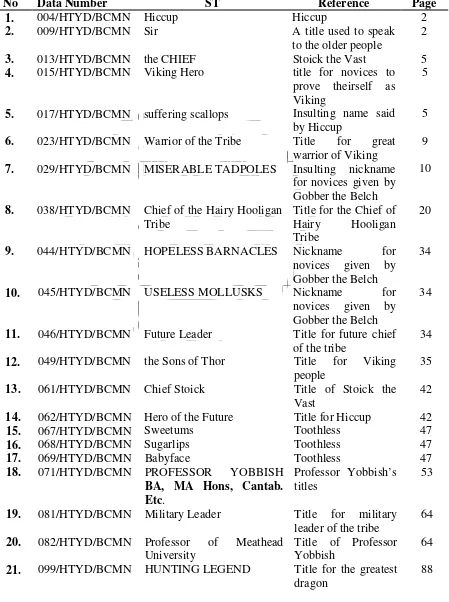
c. Nicknames and titles