Effects of copper on the activity and kinetics of free and immobilized
acid phosphatase
Q. Huang
a,b, H. Shindo
b,*
a
Department of Resources, Environment and Agrochemistry, Huazhong Agricultural University, Wuhan 430070, People’s Republic of China
b
Department of Biological Sciences, Faculty of Agriculture, Yamaguchi University, Yoshida 1677-1, Yamaguchi 753-8515, Japan
Accepted 3 May 2000
Abstract
Heavy metal pollution presents a major hazard to the soil environment. Studies have shown that the activities of a variety of soil enzymes are inhibited by heavy metals. However, little information is available concerning the effect of heavy metals on the activity of enzymes immobilized by different soil constituents. The main objective of this work was to investigate the effects of copper on the activity and kinetic properties of acid phosphatase both free and immobilized on two variable-charge soil clays and the minerals kaolin, goethite and manganese oxide. The effect of different forms of copper on enzyme activity was also examined. In the presence of copper chloride, the activity of free and immobilized enzymes was inhibited at copper concentrations of 0.005–0.8 mM at pH 5.0 and inhibition increased at pH 6.0. The inhibitory effect of copper chloride was greater on the enzymes bound by the two soil clays and kaolin than those by goethite and MnO2. Addition of copper chloride decreased both the Kmvalues and the Vmax/Kmratios of free and all forms of immobilized enzymes, and showed mixed type inhibition kinetics. Comparing the effect of different forms of Cu, the residual activities of free enzyme and soil clay–enzyme and kaolin–enzyme complexes were higher when copper citrate was used than with copper chloride. The reverse was true for the enzymes immobilized on goethite and MnO2. These results indicate that the inhibition by Cu of enzymes immobilized on soil components are influenced by the properties of the adsorbent and the form of Cu, as well as pH.q2000 Elsevier Science Ltd. All rights reserved.
Keywords: Acid phosphatase; Copper; Enzyme activities; Enzyme kinetics; Soil clay; Kaolin; Oxides
1. Introduction
Heavy metals are one of the major pollution sources in soil environment and a number of soil characteristics, including biological properties, are profoundly influenced by heavy metals. The strong inhibition of the activities of a variety of enzymes have been reported in metal polluted soils over the past years (Tyler, 1974; Tabatabai, 1977; Juma and Tabatabai, 1977; Mathur et al., 1980; Frankenber-ger and Tabatabai, 1981; Stott et al., 1985; Doelman and Haanstra, 1986, 1989; Fu and Tabatabai, 1989; Marzadori et al., 1996) and these effects vary considerably. Tyler (1974) found a significant negative correlation between the acid phosphatase activity and the sum of Cu and Zn concentra-tions in polluted soil in Sweden. Among 20 trace elements, Hg (II), As (V), W (VI) and Mo (VI) were reported to be the most effective inhibitors of acid phosphatase (Juma and Tabatabai, 1977). Some investigators have employed the
ED50 value (i.e. the heavy metal concentration at which
enzyme activity is half of the uninhibited level) to describe metal toxicity to enzymes. Using this measure, Doelman and Haanstra (1989) demonstrated that the influence of heavy metals on acid phosphatase activity in soils could be ascribed to the differences in soil composition such as clay, silt or organic matter. The negative impact of heavy metal toxicity on acid phosphatase was most pronounced in sandy soil. Deng and Tabatabai (1995) recorded greater inhibition of 25 trace elements on cellulase activity in field-moist than in air-dried soils. In view of the sensitivity of soil enzymes to heavy metals, the use of enzyme activity as a bioindicator to evaluate the degree of soil contamina-tion by heavy metals was proposed (Dick and Tabatabai, 1992; Nannipieri, 1995). Studies concerning the influences of heavy metals on soil enzyme activity have been reviewed by Gianfreda and Bollag (1996).
A proportion of the extracellular enzymes in soil is solu-ble in the aqueous phase and a proportion is physically or chemically bound to mineral, humus or organo-mineral surfaces (Burns, 1982; Boyd and Mortland, 1990). Most studies regarding the effects of heavy metals on the activity
0038-0717/00/$ - see front matterq2000 Elsevier Science Ltd. All rights reserved.
PII: S 0 0 3 8 - 0 7 1 7 ( 0 0 ) 0 0 1 6 2 - 0
www.elsevier.com/locate/soilbio
* Corresponding author. Tel./Fax:181-83-933-5836.
of soil enzymes have been carried out in natural whole soil systems and have not attempted to distinguish between enzymes in different locations and immobilized on different soil colloids and minerals. Recently, Geiger et al. (1998a) found that the activity of cellulase and glucosidase was inhibited at copper concentrations above 200mM in suspen-sions of montmorillonite and Al-montmorillonite. Copper also caused a shift of pH optimum for the two enzymes associated with clay minerals and goethite (Geiger et al., 1998a, b). More information is needed regarding the kinetics of immobilized enzymes in the presence of heavy metals and the effect of different forms of heavy metals on enzyme activity.
Acid phosphatase is one of the many phosphatases func-tioning in soil and is largely responsible for the mineraliza-tion of organic phosphate compounds in acid soils (Dick et al., 1983; Pant and Warman, 2000). Some of the recent studies on acid phosphatase focussed mainly on their inter-actions with clay minerals or organo-mineral complexes, and included the determination of adsorption, activity, kinetics and stability (Dick and Tabatabai, 1987; Gianfreda and Bollag, 1994; Huang et al., 1995; Rao et al., 1996, 1998). Copper is one of the nutritional elements for plants but excess copper is often introduced into soil through the use of organic fertilizers like pig manure (Doelman and Haanstra, 1989). The objectives of the current work were to investigate the influences of copper (as copper chloride and copper citrate) on the activity and kinetics of acid phos-phatase immobilized on two variable-charge soil clays and minerals such as kaolin, iron and manganese oxides.
2. Materials and methods
2.1. Soil clays and minerals
Yellow brown soil (Alfisol) (YBS) and latosol (Oxisol) (LS) were sampled from Hubei and Hainan provinces in central-south China. The soil was rinsed in deionized water and dispersed by adding 0.01 M NaOH solution drop-wise together with sonication. The,2mm clay fraction of the soil was separated by sedimentation. After flocculation by the addition of CaCl2solution, the colloidal suspension
was washed to be free of Cl2ions by deionized water and ethanol, and then air-dried at 208C^2. Some properties of the clay fractions are listed in Table 1.
Kaolin was prepared by separating and collecting the
,2mm fraction of kaolin (Wako Chemical Industries Ltd., Japan). Goethite andd-MnO2were synthesized
follow-ing the methods described by Atkinson et al. (1967) and Paridu (1981), respectively.
2.2. Enzyme immobilization
Acid phosphatase (EC 3.1.3.2, type I, 0.4 units/mg from wheat germ) was purchased from Sigma Chemical Co., St. Louis, MO, and r-nitrophenylphosphate disodium salt (PNPP) (Wako Chemical Industries Ltd., Japan) was used as the substrate.
Soil clays (YBS, LS) or minerals (40 mg) were mixed with 3 ml NaAc–HAc buffer containing 6 mg acid phospha-tase. Three pH levels (5.0, 5.5, 6.0) of the buffer were utilized for enzyme immobilization. The suspension was shaken at 208C for 1 h and centrifuged at 30,000 g for 15 min. The pellet was resuspended and washed three times with 1 ml of the appropriate buffer (to remove any weakly associated enzyme) and then suspended in 50 ml of buffer solution. The supernatant fractions and washings were collected and the concentration of enzyme in solution was determined directly at 280 nm (Jasco Ubest-50 Uv/ Vis spectrophotometer) using acid phosphatase (0.2– 0.8 mg ml21) as the standard. The amount of enzyme immo-bilized was calculated from the difference between the amount of enzyme added and that recovered.
2.3. Enzyme activities and kinetic studies
Soil clay- or mineral–enzyme suspension (1 ml) were mixed with 1 ml 0.1 M acetate buffer (pH 5.0, 5.5 or 6.0) in the absence or presence of copper chloride or copper citrate at a maximum concentration of 0.8 mM Cu. Imme-diately, 1 ml of 10 mM PNPP substrate (final substrate concentration 2.5 mM) was added and the reaction mixture incubated at 208C for 1 h with shaking every 10 min. The enzyme reaction was terminated by the addition of 2 ml 1 M NaOH. Ther-nitrophenol (PNP) produced was determined at 400 nm spectrophotometrically, as described above. The ‘specific’ activity of free and immobilized enzyme was calculated as the micromoles of r-nitrophenol produced by one milligram of enzyme per hour (mmol PNP mg21h21). The kinetics of free and immobi-lized enzyme was examined using substrate concentrations in the range of 0.05–2.5 mM.
Table 1
Selected properties of soil clays (YBS, yellow brown soil; LS, latosol; DCB, dithionate–citrate–bicarbonate; OX, oxalate; PZC, point of zero charge)
O.M (g kg21) DCB–Fe2O3(g kg21) OX–Fe2O3(g kg21) PZC Surface area (m2g21) Clay mineral composition
YBS 20.9 36.2 4.8 2.96 205 Kaolinite (30%), illite
(30%), 1.4 nm mineral (30%)
3. Results
3.1. Residual activities of enzymes in the presence of copper chloride
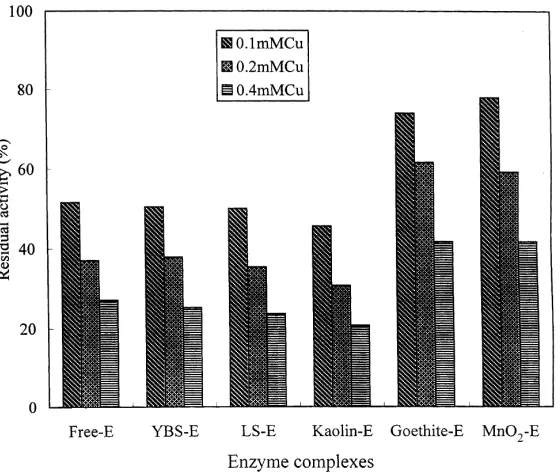
The residual activity of free and immobilized acid phos-phatase was expressed as the percentage of the specific activity in the presence of Cu compared with that in the absence of Cu. As shown in Fig. 1, in the system containing 0.1 mg enzyme at pH 5.5, the residual activity of free (solu-ble phase) phosphatase decreased significantly from 51.6 to 27.2% with the increase of Cu concentration from 0.1 to 0.4 mM. According to the data of enzyme immobilization, 1 ml of soil clay- or mineral–enzyme suspension (0.8 mg dry weight of clay or mineral) contained 0.07,0.1 mg
enzyme (Table 2). The enzyme immobilized on the two soil clays and kaolin mineral showed similar degrees of reduction for their residual activities in the presence of Cu. For example, the enzymes immobilized on these surfaces retained 45–50% and 20–25% of their original
activity in the presence of 0.1 and 0.4 mM Cu (as CuCl2),
respectively. In the goethite and MnO2systems, the addition
of 0.1 and 0.4 mM Cu decreased the activity of immobilized enzymes to 22–26% and 58–59%, respectively. However, much higher residual activities were measured for the two oxide systems as compared to the free enzyme, soil clay and kaolin systems. These results indicate that the inhibition effect of Cu ion varied for the phosphatase immobilized on different soil and mineral supports.
3.2. Enzyme kinetics in the presence of copper chloride
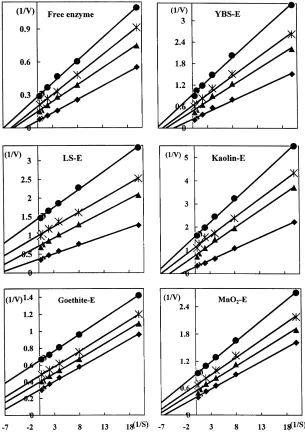
The kinetics of free and immobilized enzymes, which were determined in the absence and presence of Cu (as CuCl2) at pH 5.5, obeyed the Michaelis–Menten equation.
The Lineweaver–Burk plots for the enzyme complexes are shown in Fig. 2 and their kinetic parameters are given in Table 3. In the presence of Cu, the 1/v and 1/s intercept, as well as the slope, were different from those of the control (without Cu) (Fig. 2). According to the theory of enzyme kinetics (Palmer, 1995), the inhibition of Cu on free and immobilized phosphatase was a mixed type model. The
Km and Vmax values of free enzyme are 0.38 mM and
15.62mmol mg21h21, respectively (Table 3). Immobiliza-tion of the enzyme on soil clays and minerals decreased both of the (now apparent) Kmand Vmaxvalues. With an increase
in Cu concentration (0.1–0.4 mM), both the Kmand Vmax/Km
values decreased. The inhibition constants for copper– enzyme (Ki) and copper–enzyme–substrate (KI) were
calcu-lated (Table 4). The Kivalues for free enzyme and YBS-,
LS-, and kaolin–enzyme complexes were 0.3–0.4, while those for goethite- and MnO2–enzyme complexes were Fig. 1. The residual activity of free and immobilized acid phosphatase at different concentrations of CuCl2at pH 5.5 (E, enzyme; YBS, yellow brown soil; LS,
latosol).
Table 2
Amount of acid phosphatase immobilized by soil clays and minerals studied (YBS, yellow brown soil; LS, latosol)
Soil clay or mineral Enzyme immobilized (mg g21)
pH 5.0 pH 5.5 pH 6.0
YBS 127.0 114.9 102.7
LS 111.9 100.4 89.2
Kaolin 106.8 95.3 85.4
Goethite 105.4 100.4 94.6
Fig. 2. Lineweaver–Burk plots for free and immobilized enzymes in the absence and presence of CuCl2at pH 5.5 (E, enzyme; YBS, yellow brown soil; LS,
latosol;V, 0 mM Cu;O, 0.1 mM Cu; p, 0.2 mM Cu;X, 0.4 mM Cu).
Table 3
The kinetic parameters (determined by the Lineweaver–Burk equation; correlations are significant at the 0.001 probability level.) of free and immobilized acid phosphatase at different concentrations of CuCl2at pH 5.5 (YBS, yellow brown soil; E, enzyme; LS, latosol)
Enzyme complexes 0 mM 0.1 mM 0.2 mM 0.4 mM
Km Vmax/Km Km Vmax/Km Km Vmax/Km Km Vmax/Km
Free enzyme 0.380 41.1 0.204 33.0 0.184 27.8 0.144 24.4
YBS–E 0.259 15.5 0.184 11.3 0.163 9.8 0.137 7.8
LS–E 0.125 21.7 0.097 14.4 0.077 13.0 0.065 10.5
Kaolin–E 0.341 10.3 0.191 6.7 0.143 6.2 0.123 5.1
Goethite–E 0.109 30.1 0.087 28.7 0.077 27.5 0.059 26.0
2.3 and 0.8, respectively. In each system, the KIvalue was
usually lower than the corresponding Ki value. Therefore,
the mixed inhibition by Cu of the free and immobilized enzymes is considered as noncompetitive –uncompetitive inhibition (Palmer, 1995).
3.3. Effect of pH on residual activity in the presence of copper chloride
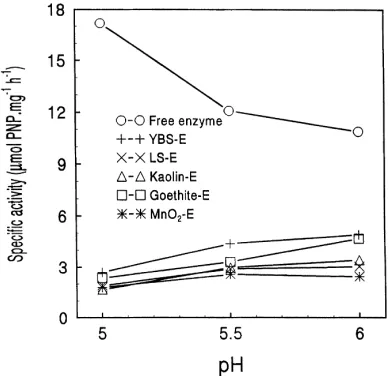
As shown in Fig. 3, in the absence of Cu, the specific activity of free phosphatase decreased from 17.2 at pH 5.0 to 11.1mmol mg21h21 at pH 6.0. Immobilized enzymes showed higher specific activity at both pH 5.5 and pH 6.0 than at pH 5.0. However, in the presence of Cu (as CuCl2),
the residual activities of both free and immobilized enzymes varied significantly with changes in pH. For example, at pH 5.0, as Cu concentration increased from 0.2 to 0.8 mM, the residual activities for free enzyme and YBS-, LS- and kaolin–enzyme complexes decreased from 74 to 44%, while those for goethite- and MnO2–enzyme complexes
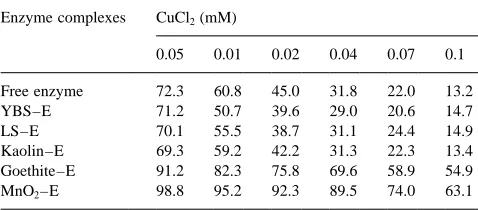
decreased from 92 to 54% (Fig. 4). On the other hand, at pH 6.0 and Cu concentrations from 0.005 to 0.1 mM, the residual activities for free enzyme and YBS-, LS- and kaolin–enzyme complexes decreased from 70–72% to 13–15%, while those for goethite- and MnO2–enzyme
complexes were reduced from 91–99% to 55–63% (Table 5). The results revealed that the inhibition by CuCl2of free
and immobilized phosphatase was greater at pH 6.0 than at pH 5.0 and 5.5. These findings agree with the work conducted by Geiger et al. (1998a) who investigated the effects of CuCl2addition on cellulase and glucosidase
activ-ities in the range of pH 4.0–5.5. Moreover, within the pH range studied, the addition of Cu exhibited less inhibition on goethite- and MnO2–enzyme complexes than the other
enzyme complexes.
3.4. Residual activity of enzymes in the presence of copper citrate and copper chloride
The toxicity of different forms of copper on the activity of free and immobilized acid phosphatase was examined and shown in Fig. 5. In the presence of 0.1 and 0.4 mM Cu (as copper citrate), the residual activities of free enzyme were 82.4 and 48.5%, respectively. The residual activity of enzymes immobilized on the two soil clays and the three minerals was 57–59% and 36–42%, respectively. The significantly higher degree of deactivation of immobilized enzyme in the presence of the Cu may be ascribed to the greater affinity of copper citrate to clay–enzyme mixture. Fig. 5 also shows that free enzyme and the enzymes immo-bilized on the two soil clays and kaolin displayed higher residual activities in the copper citrate than in the copper chloride systems, while the reverse was true for the enzymes held on goethite and MnO2. These results indicate that
copper citrate and copper chloride exhibit different inhibi-tory effects for various immobilized enzyme complexes.
4. Discussion
Very little information is available on enzyme kinetics in the presence of heavy metals. Data from experiments with soil catalase (Perez-Mateos and Gonzales-Carcedo, 1987) showed inconsistent results about the effect of heavy metals on enzyme kinetics. Thus, increased, decreased or no change in Kmand Vmaxvalues were obtained for soil catalase
in the presence of Cd, Ag, and Pb, respectively. In our study, the addition of Cu as copper chloride decreased significantly the maximum reaction velocity, but increased the affinity of the enzyme complex and the substrate (i.e. lower Km
values). It is assumed that the introduction to soil of copper (as either a micronutrient or a pollutant) cause changes to the kinetics of enzymes immobilized on various soil compo-nents. With the increase of CuCl2concentration in all the
systems studied here, a mixed type of kinetic mechanism was observed for the reactions of free and immobilized enzymes, suggesting that Cu can combine with enzyme molecules as well as the enzyme–substrate complex (Palmer, 1995). The Cu may have a greater affinity for the enzyme–substrate complex, as shown by the inhibitor constants (KI,Ki). The inhibition behavior of the Cu on
phosphatase in this study was different from that of tannic
Table 4
The inhibition constants of CuCl2on free and immobilized acid
phospha-tase at pH 5.5 (YBS, yellow brown soil; E, enzyme; LS, latosol)
Enzyme complexes KI KI
Free enzyme 0.42^0.07 0.10^0.03
YS–E 0.36^0.06 0.13^0.04
LS–E 0.40^0.07 0.12^0.03
Kaolin–E 0.35^0.06 0.07^0.01 Goethte–E 2.30^0.2 0.33^0.05 MnO2–E 0.80^0.09 0.30^0.05
acid, which showed pure uncompetitive inhibition for urease (Gianfreda et al., 1995) and acid phosphatase (Rao et al., 1998). The kinetic models of the immobilized phos-phatase also showed that the inhibition constants (both Ki
and KI) of Cu for goethite- and MnO2–enzyme complexes
are greater than those for the other enzyme complexes (Table 4). This means that higher residual enzyme activity was retained in the two oxide systems because higher concentrations of Cu are required to form Enzyme–Inhibi-tor (E–I) and Enzyme–Substrate–Inhibitor (E–S–I) complexes.
In the presence of CuCl2, the phosphatase immobilized on
the two soil clays and kaolin showed a similar degree of deactivation as free enzyme. The major components of the two soil clays were kaolinite and kaolinite and 2:1 type clay minerals, respectively (Table 1). This implies that the enzyme molecules bound to the kaolinite mineral and the two soil clays are as sensitive as free enzyme to Cu. In studying the effects of Cu on b-glucosidase and cellulase activities, Geiger et al. (1998a) reported that neither montmorillonite nor Al-montmorillonite alleviated the toxi-city of the metal. This may bring us to the conclusion that soil clays, including mainly layer silicate clay minerals, are not able to protect enzymes from deactivation by Cu. In the present study, higher residual activities were found for the
enzymes immobilized on goethite and MnO2in the presence
of Cu. The three possible explanations for the difference in the residual activities of the immobilized enzymes in the presence of Cu are as follows. Firstly, the difference is related to the affinity of Cu with enzyme or enzyme– substrate complex. Deng and Tabatabai (1995) stated that metal ions might depress enzyme activity by reacting with the substrate, or the protein-active groups of enzymes, or enzyme–substrate complex. For a mixed type of enzyme inhibitor, the E–S–I complex cannot form products. This suggests that greater amounts of Cu ion may combine with immobilized enzyme molecules rather than enzyme– substrate complex in the two oxide systems. On the other hand, more Cu ion may react with enzyme–substrate complex in the soil clay and kaolin systems. This explana-tion was supported by the adsorpexplana-tion experiment, which showed that in the presence of 0.1 mM CuCl2 at pH 5.5,
the goethite- and MnO2-enzyme complexes adsorbed 22 and
72% of the total Cu ion, respectively, whereas only 6% of the Cu ion was adsorbed by the soil clay- and kaolin– enzyme complexes. Geiger et al. (1998b) described that the mitigating effect of goethite on the toxicity of Cu on b-glucosidase was due to the stronger affinity of Cu for goethite than for the enzyme. Secondly, goethite and MnO2 have hydroxyl surfaces where ligand exchange
plays an important role for the adsorption or immobilization of enzyme molecules (Sepelyak et al., 1984; Huang et al., 1999). The conformation of specifically adsorbed enzymes may be less modified by free Cu ion, and results in lower degree of deactivation for immobilized enzymes. Finally, the acidic condition may cause the release of iron and manganese ions, which would compete with Cu for the active sites in enzyme molecules. Therefore, enzyme activ-ity was inhibited to a lesser degree in the two oxide systems. Gianfreda et al. (1995) found the activities of tannate– urease suspensions were greater in the presence of some soluble species, such as Fe31 and Mn21, than in their absence. They demonstrated that these soluble ions may facilitate the flocculation of enzyme complexes and the formation of more active solid-metal–enzyme complexes.
In this study, the greater susceptibility of enzyme to Cu at higher pH is ascribed to the deprotonation tendency of amino acids of enzyme protein towards higher pH that makes it easier for the interactions between enzyme mole-cules and Cu.
Different effects of copper citrate and copper chloride on the activities of free and immobilized enzymes were recorded. The higher residual activity of free enzyme in the copper citrate than in the copper chloride systems was attributed to the lower affinity of acid phosphatase to Cu in the copper citrate molecule. On the other hand, greater inhi-bition for the enzymes immobilized on the two oxides were observed in the copper citrate than in the copper chloride systems. This may be due to the interaction of the carboxyl groups in the copper citrate molecule with the hydroxyl surfaces of the oxides, which may modify the conformation
Fig. 4. Residual activity of free and immobilized acid phosphatase at differ-ent concdiffer-entrations of CuCl2at pH 5.0 (E, enzyme; YBS, yellow brown soil;
LS, latosol).
Table 5
Residual activity (%) of free and immobilized acid phosphatase in the presence of different concentrations of CuCl2 at pH 6.0 (YBS, yellow
brown soil; E, enzyme; LS, latosol)
Enzyme complexes CuCl2(mM)
0.05 0.01 0.02 0.04 0.07 0.1
of enzyme molecules and thus may result in greater deacti-vation for the immobilized enzyme complexes. Gianfreda et al. (1995) pointed out that, in the presence of inhibitors, the final activity level of enzymatic complexes depends on the extent of a series of catalytic features of the enzyme such as protein conformation, active site geometry, accessibility to substrate and so on. The results in our study clearly showed that the activity of acid phosphatase immobilized on soil components was influenced considerably by the form of Cu. In conclusion, the addition of copper chloride to the system of acid phosphatase immobilized on various soil colloidal constituents significantly decreased the residual activity and the maximum reaction velocity but increased the affinity of substrate. The inhibition effect of Cu ion was intensified with the increase of pH from 5.0 to 6.0. Copper chloride exhibited a mixed type of inhibition mode for the enzyme molecules held on the soil clays and minerals. The toxic level and mechanism of Cu on free and immobilized enzymes was also dependent on its form.
Acknowledgements
The authors are grateful to the Japanese government, the International Foundation for Science (C/2527-1) and the
National Natural Science Foundation of China (49601011) for part of the support of this work.
References
Atkinson, R.T., Posner, A.M., Quirk, J.P., 1967. Adsorption of potential-determining ions at the ferric oxide aqueous electrolyte interface. Jour-nal of Physical Chemistry 71, 550–558.
Boyd, S.A., Mortland, M.M., 1990. Enzyme interactions with clays and clay-organic matter complexes. In: Bollag, J.-M., Stotzky, G. (Eds.). Soil Biochemistry, vol. 6. Marcel Dekker, New York, pp. 1–28. Burns, R.G., 1982. Enzyme activity in soil: location and a possible role in
microbial ecology. Soil Biology & Biochemistry 14, 423–427. Deng, S., Tabatabai, M.A., 1995. Cellulase activity of soils: effect of trace
elements. Soil Biology & Biochemistry 27, 977–979.
Dick, W.A., Juma, N.G., Tabatabai, M.A., 1983. Effects of soils on acid phosphatase and inorganic pyrophosphatase of corn roots. Soil Science 136, 19–25.
Dick, W.A., Tabatabai, M.A., 1987. Kinetics and activities of phosphatase– clay complexes. Soil Science 143, 5–15.
Dick, W.A., Tabatabai, M.A., 1992. Potential uses of soil enzymes. In: Metting Jr., F.B. (Ed.). Soil Microbial Ecology: Applications in Agricultural and Environmental Management, Marcel Dekker, New York, pp. 95–127.
Doelman, P., Haanstra, L., 1986. Short- and long-term effects of heavy metals on urease activity in soils. Biology and Fertility of Soils 2, 213–218.
Doelman, P., Haanstra, L., 1989. Short- and long-term effects of heavy metals on phosphatase activity: an ecological dose-response model approach. Biology and Fertility of Soils 8, 235–241.
Frankenberger Jr, W.T., Tabatabai, M.A., 1981. Amidase activity of soils: IV. Effects of trace elements and pesticides. Soil Science Society of America Journal 45, 1120–1124.
Fu, M.H., Tabatabai, M.A., 1989. Nitrate reductase activity in soils: effects of trace elements. Soil Biology & Biochemistry 21, 943–946. Geiger, G., Brandl, H., Furrer, G., Schulin, R., 1998a. The effect of copper
on the activity of cellulase and (-glucosidase in the presence of montmorillonite or Al-montmorillonite. Soil Biology & Biochemistry 30, 1537–1544.
Geiger, G., Livingston, M.P., Funk, F., Schulin, R., 1998b.b-Glucosidase activity in the presence of copper and goethite. European Journal of Soil Science 49, 17–23.
Gianfreda, L., Bollag, J.-M., 1994. Effect of soils on the behavior of immo-bilized enzymes. Soil Science Society of America Journal 58, 1672– 1681.
Gianfreda, L., Rao, M.A., Violante, A., 1995. Formation and activity of urease-tannate complexes affected by aluminum, iron and manganese. Soil Science Society of America Journal 59, 805–810.
Gianfreda, L., Bollag, J.-M., 1996. Influence of natural and anthropogenic factors on enzyme activity. In: Stotzky, G., Bollag, J.-M. (Eds.). Soil Biochemistry, vol. 9. Marcel Dekker, New York, pp. 123–193. Huang, Q., Jiang, M., Li, X., 1999. Adsorption and properties of urease
immobilized on several iron, aluminum oxides and kaolinite. In: Berthelin, J., Huang, P.M., Bollag, J.-M., Andreux, F. (Eds.). Effect of Mineral–Organic–Microorganism Interactions on Soil and Fresh Water Environments, Kluwer Academic/Plenum Publishers, London, pp. 167–174.
Huang, Q., Shindo, H., Goh, T.B., 1995. Adsorption, activities and kinetics of acid phosphatase as influenced by montmorillonite with different interlayer materials. Soil Science 59, 271–278.
Juma, N.G., Tabatabai, M.A., 1977. Effects of trace elements on phospha-tase activity in soils. Soil Science Society of America Journal 41, 343– 346.
Mathur, S.P., MacDougall, J.I., McGrath, M., 1980. Levels of activities of some carbohydrases, protease, lipase and phosphatase in organic soils of differing copper content. Soil Science 129, 376–385.
Marzadori, C., Ciavatta, C., Montecchio, D., Gessa, C., 1996. Effects of lead pollution on different soil enzyme activities. Biology and Fertility of Soils 22, 53–58.
Nannipieri, P., 1995. The potential use of soil enzymes as indicators of productivity, sustainability and pollution. In: Pankhurst, C.E., Doube, B.M., Gupta, V.V.S.R., Grace, P.R. (Eds.). Soil Biota: Management in Sustainable Farming Systems, CSIRO, East Melboure, Victoria, Australia, pp. 238–244.
Palmer, T., 1995. Understanding Enzymes. 4th ed. Prentice Hall/Ellis Horwood, London (398pp.).
Pant, H.K., Warman, P.R., 2000. Enzymatic hydrolysis of soil organic phosphorus by immobilized phosphatases. Biology and Fertility of Soils 30, 306–311.
Paridu, K.M., 1981. Studies on MnO2I. Chemical composition,
microstruc-ture and other characteristics of some synthetic MnO2of various
crys-talline modifications. Electrochimica Acta 26, 435–443.
Perez-Mateos, M., Gonzales-Carcedo, S., 1987. Effect of silver, cadmium and lead on soil enzyme activity. Review Ecology and Biology of Soil 24, 11–18.
Rao, M.A., Violante, A., Gianfreda, L., 1998. Interactions between tannic acid and acid phosphatase. Soil Biology & Biochemistry 30, 111–112. Rao, M.A., Gianfreda, L., Palmiero, F., Violante, A., 1996. Interactions of acid phosphatase with clay, organic molecules and organo-mineral complexes. Soil Science 161, 751–760.
Sepelyak, R.J., Feldkamp, J.R., Moody, T.E., White, J.L., Hem, S.L., 1984. Adsorption of pepsin by aluminum hydroxide I: adsorption mechanism. Journal of Pharmaceutical Science 73, 1514–1517.
Stott, D.E., Dick, W.A., Tabatabai, M.A., 1985. Inhibition of pyrophospha-tase activity in soils by trace elements. Soil Science 139, 112–117. Tabatabai, M.A., 1977. Effects of trace elements on urease activity. Soil
Biology & Biochemistry 9, 9–13.